
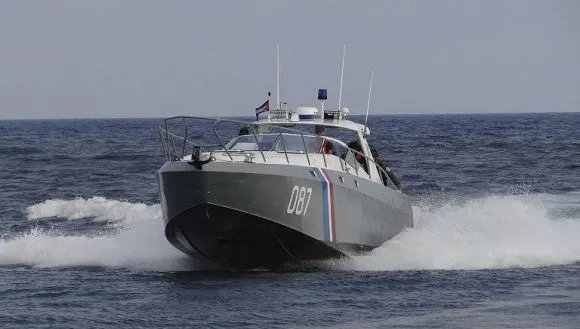
Cuban border guards repelled an armed attack off the northern coast of Villa Clara province on Feb. 25, killing four men, wounding six and detaining others after a Florida-registered speedboat opened fire on a Cuban patrol craft. The vessel, registration FL7726SH, was operating roughly one nautical mile from shore — far too close for any plausible “navigation error.”
According to Cuba’s Interior Ministry, the patrol craft moved to identify and intercept the boat when those aboard opened fire first, wounding the Cuban commander. Guards returned fire. Authorities seized assault rifles, sniper rifles, pistols, Molotov cocktails, handmade explosives, ballistic vests, night vision equipment, telescopic sights, camouflage uniforms and combat food supplies — the full kit of a paramilitary infiltration unit. Monograms of known counterrevolutionary terrorist organizations were also found aboard.
Cuba’s Deputy Foreign Minister, Carlos Fernández de Cossío, named all 10 individuals involved at a press conference on Feb. 26. Most are Cuban nationals residing in the United States. CBS News, citing a White House source, reported that one of the dead was a U.S. citizen, as was one of the wounded. A seventh suspect — Duniel Hernández Santos — was arrested on Cuban soil and has reportedly confessed to being sent from the United States in advance to prepare the way for the group, a ground operative placed inside the country ahead of the attack.
Cuba’s Interior Ministry described the operation as an “infiltration with terrorist objectives.”
Washington already had their names
Two of the assailants, Amijail Sánchez González and Leordan Enrique Cruz Gómez, were already on Cuba’s national list of individuals wanted for prior involvement in promoting and financing violent acts against Cuba. That list was formally transmitted to the United States government in 2023 and again in 2025, pursuant to UN Security Council Resolution 1373 — the same resolution the U.S. routinely invokes to demand counterterrorism cooperation from other countries.
As of the Feb. 25 attack, Cuba was still awaiting a response.
These two men were not unknown quantities who slipped through the cracks of an overwhelmed bureaucracy. They were named, documented, flagged and handed to U.S. authorities — twice. They then participated in an armed attack launched from U.S. territory, on a U.S.-registered vessel, against a Cuban naval patrol. Fernández de Cossío confirmed on Feb. 26 that Cuban authorities had maintained communication with the State Department and Coast Guard from the moment the vessel was detected, and that the U.S. government had indicated willingness to cooperate in the investigation. What the U.S. government had not shown, in the two years prior, was any willingness to act on the information it had already been given.
The broader siege
The Feb. 25 attack came at a moment of carefully engineered Cuban vulnerability. Since Dec. 3, 2025, virtually no fuel has reached the island. The Trump administration’s Jan. 29 executive order has threatened punitive tariffs against any country supplying oil to Cuba. U.S. vessels have intercepted tankers bound for Havana — including the Ocean Mariner, escorted to the Bahamas 70 miles from port. Blackouts have become routine across the island, with hospitals rationing fuel for generators.
Into this condition — maximum economic pressure — comes an armed paramilitary cell, trained on a farm in South Florida, organized via TikTok, crewed in part by individuals the U.S. government had been asked to investigate and declined to touch.
The economic siege and the armed attack are not parallel tracks. They are the same operation.
The U.S. Treasury has meanwhile announced it will allow limited fuel exports to private Cuban entities — explicitly excluding the state. This is a regime-change mechanism dressed as a humanitarian concession: cultivate a private sector dependent on Washington while the broader population remains under siege.
The pattern
The 1960 Mallory Memorandum, a State Department planning document, stated the goal plainly: deny Cuba money and supplies, produce hunger and desperation, bring down the government. The document was not a historical aberration. It codified U.S.-Cuba policy, with varying intensity, ever since. Luis Posada Carriles and Orlando Bosch, responsible for the 1976 bombing of Cubana Flight 455 that killed 73 people, lived freely in Miami for decades while the U.S. blocked extradition. The organizational line runs through Miami: yesterday’s bombers, today’s paramilitary crews — and decades of U.S. support and protection for anti-Cuba terrorists.
The Mallory Memorandum’s prescription was simple: make the majority suffer until the government falls. What its authors did not anticipate — and what six decades of failure has not resolved — is that Cubans don’t submit under siege. They organize, resist and fight back to defend the revolution’s gains.
Join the Struggle-La Lucha Telegram channel