
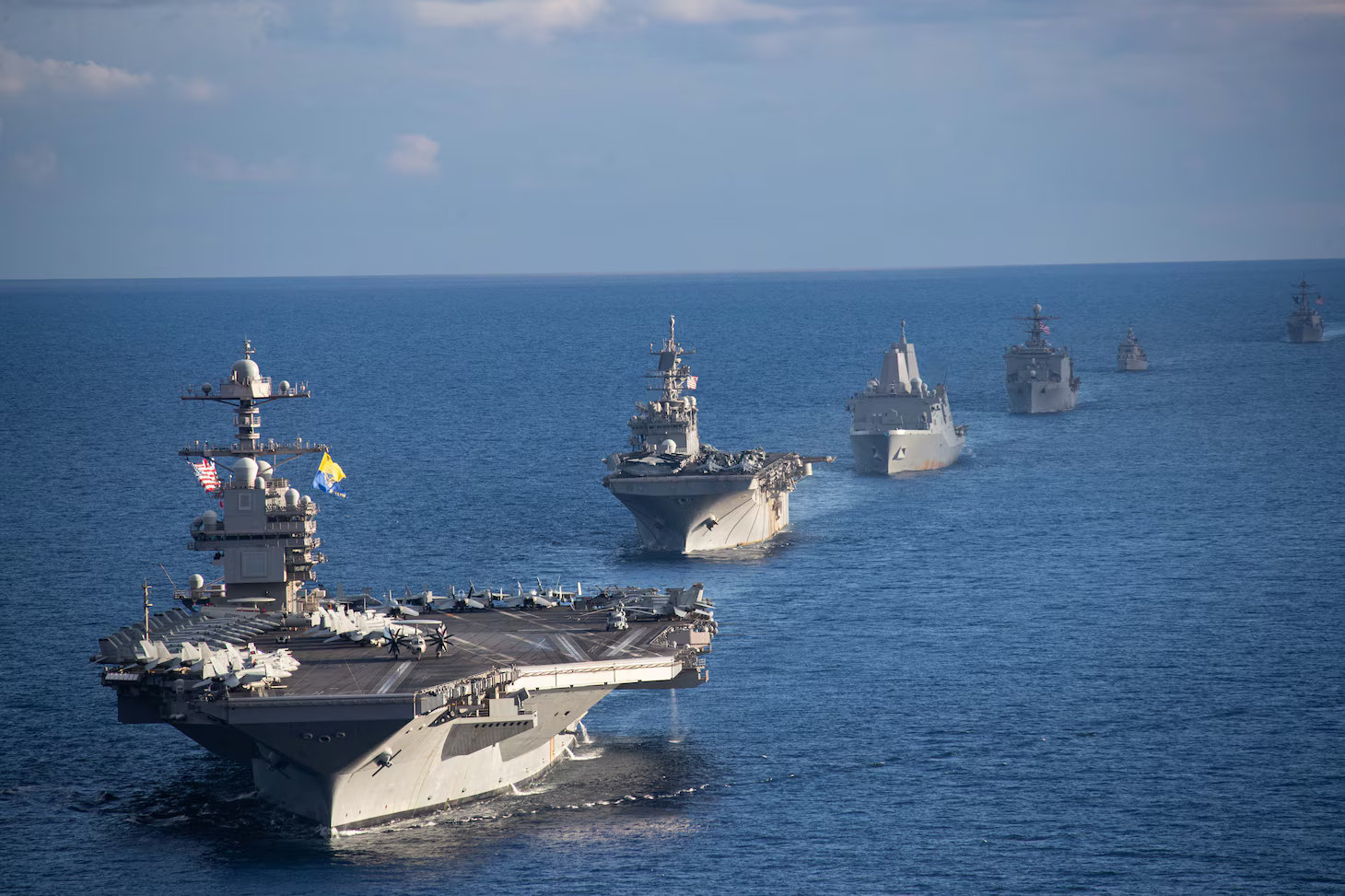
Two aircraft carrier strike groups are converging on the Persian Gulf: the USS Abraham Lincoln, already on station with three Arleigh Burke–class destroyers, and the USS Gerald R. Ford — the largest warship ever built — now ordered forward from the Caribbean.
Pentagon planners are drawing up “sustained, weeks-long operations.”
The richest country on earth is marshaling its war machine against a nation of 90 million people whose primary “offense,” in Washington’s eyes, is refusing to surrender its sovereignty. Seventy percent of the U.S. public opposes military action against Iran. The war preparations continue regardless, because the decisions are not made by the people who will pay the price.
Demands designed to be rejected
Washington has laid out demands that go beyond disarmament to the dismantling of Iran’s economic sovereignty. Iran must permanently terminate its nuclear program — a civilian energy and research infrastructure essential to the country’s development — destroy its entire ballistic missile arsenal, and cut all ties with Palestinian, Lebanese, and allied resistance forces. Iran must surrender both its path to economic independence and every means of defending itself, leaving it at the mercy of the same power that destroyed Iraq, Libya, and Syria.
Iran has offered to negotiate on uranium enrichment and international inspections — the stated reason for the entire confrontation. It has not mattered. The enrichment question was never the point.
The point is that Iran maintains an independent foreign policy, supports Palestinian resistance, and refuses to submit to U.S. regional domination. The missile program is “non-negotiable” because it is the reason Iran has not already been bombed into the same rubble as Baghdad and Tripoli.
Israeli Prime Minister Netanyahu continues to demand “forceful intervention.” This is the role Israel plays. As former Secretary of State Alexander Haig put it, Israel is “the largest American aircraft carrier in the world that cannot be sunk”—a U.S.-funded, U.S.-armed settler-colonial state that functions as Washington’s forward military base. The pressure to attack Iran originates in Washington. Israel is the instrument.
A war machine with serious problems
The Pentagon’s carrier groups in the Persian Gulf look formidable, but they function as “glass cannons” — immense striking power paired with finite defenses. The USS Abraham Lincoln and the USS Gerald R. Ford can launch punishing air operations, yet their escorts reveal a structural weakness. An Arleigh Burke-class destroyer carries roughly 36 to 46 air defense interceptors. Against Iran’s saturation drone and missile tactics, that defensive “magazine depth” can be exhausted quickly. The imbalance is mathematical.
Range compounds the risk. The F-35C Lightning II has a combat radius of about 600 nautical miles, meaning carriers must move closer to launch sustained strikes — and into range of systems like the Khalij Fars.
There is also fleet fatigue. The Ford has already deployed for eight months; extending that mission strains maintenance cycles and crew endurance.
Washington speaks of a “weeks-long” campaign. But against a digitized, asymmetrical defense, this is less a short, decisive operation than a potential war of attrition — one where inventory limits, geography and time set the terms.
Iran rebuilds, adapts, and arms
The June 2025 conflict — the “12-Day War” — was supposed to cripple Iran’s defenses for years. It failed.
China supplied HQ-9B long-range surface-to-air missiles and YLC-8B anti-stealth radar designed to detect the B-2 bombers and F-35s at the center of U.S. strike planning. Beijing also helped Iran transition from the U.S.-controlled GPS to China’s BeiDou, reducing the effectiveness of U.S. signal jamming against Iranian precision-guided weapons.
Russia delivered Mi-28NE attack helicopters and reportedly MiG-29 SMT fighters and Iskander ballistic missiles. The air-defense and strike architecture Washington would confront today is significantly more capable than it was last summer.
Satellite imagery shows reinforced tunnels at Natanz and Isfahan, along with a new hardened facility at Mount Kulang Gazla. Critical nuclear infrastructure has been buried deeper and shielded more thoroughly. The country Washington would be attacking today is not the one it struck in June.
On Jan. 29, Iran, Russia, and China signed a Trilateral Strategic Pact — a concrete step toward breaking Washington’s ability to dictate terms to the rest of the world. The agreement creates trade mechanisms in yuan and rubles that bypass the dollar, provides for intelligence sharing and military cooperation, and advances the North-South Transport Corridor linking Russia to India through Iran. For decades, any country that defied Washington could be sanctioned and starved into submission because there was no alternative. That era is ending.
The covert war
Military buildup is one front. Covert destabilization is another. After protests in January 2026, the State Department diverted funds from other programs to purchase nearly 7,000 Starlink satellite terminals. About 6,000 were smuggled into Iran to give anti-government groups internet access during state-imposed blackouts — regime-change infrastructure dressed up as “internet freedom.” The same playbook used from Cuba to Venezuela to Hong Kong.
Iran countered many of the terminals by spoofing GPS signals, feeding fake location data that prevented the hardware from connecting to satellites. Inside the U.S. government, officials argue over whether the expensive Starlink operation has actually undermined cheaper VPN tools that had been keeping dissidents connected for years. The sabotage campaign is tripping over its own feet.
Then there is financial warfare. Treasury Secretary Scott Bessent took credit for engineering the crash of Iran’s currency in December 2025. During a Congressional hearing in early February 2026, Bessent explicitly stated: “What we have accomplished at Treasury is the creation of a dollar shortage in [Iran].” The dollar shortage forced Iran’s central bank to print money to rescue a failing commercial bank, accelerating inflation and destroying the purchasing power of ordinary Iranians.
This is collective punishment of an entire population — economic warfare aimed at making life unbearable for tens of millions of people. When the U.S. Treasury Secretary boasts about crashing another country’s currency, it confirms exactly what Tehran has always told its people: Their economic pain comes from Washington, not from their own government. The empire handed Iran a propaganda victory along with the economic damage.
A war the empire cannot afford
Iran could close the Strait of Hormuz, through which one-fifth of the world’s oil passes daily, triggering a global energy shock. Swarms of low-cost armed drones could target U.S. bases in Kuwait, Qatar, Bahrain, and the UAE — facilities full of service members, overwhelmingly from working-class communities, who signed up because the military was the only path to a paycheck or a college degree.
The war would not stay contained to Iran. U.S. bases across the region would become targets, and the consequences would spread to countries whose populations have no interest in fighting on behalf of U.S. oil companies and Israeli settler expansion.
Seventy-nine percent of the country does not support this war. A prolonged conflict producing even modest U.S. casualties would become a political catastrophe for an administration with no public mandate. A war on Iran would make Lockheed Martin, Raytheon, and Northrop Grumman richer. It would tighten Washington’s grip on the world’s oil supply and enrich the energy giants that are already lining up for the spoils.
At the American Petroleum Institute’s “State of American Energy” summit in Washington on Jan. 16, veteran industry consultant Bob McNally of the Rapidan Energy Group told the crowd that Iran holds “the biggest opportunity” for the oil industry. McNally, a former energy adviser to George W. Bush, urged the audience to imagine U.S. companies going back into Iran after regime change: “We would get a lot more oil, a lot sooner than we will out of Venezuela.”
A regime change war, he said, would be a “wonderful day” for the oil industry. It would advance Washington’s project of unchallenged military dominance in West Asia, enforced through its settler-colonial outpost in occupied Palestine. It would not build a single school, fund a single hospital, fix a single bridge, or create a single job in the communities across this country being asked to supply the soldiers.
Join the Struggle-La Lucha Telegram channel