Solidaridad frente arremetida contra inmigrantes

S209dola
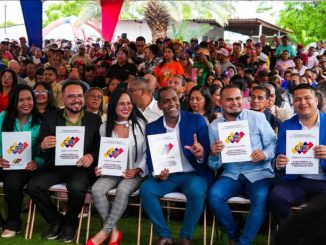
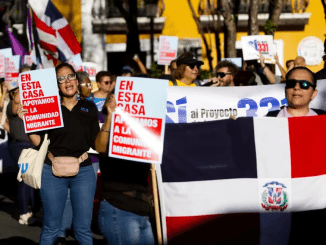
“Se ve, se siente, dominicana está presente”, “Ser humano ilegal, un invento federal” o “Yo defiendo a mis hermanos de los pueblos antillanos”, fueron algunos de los cánticos que repitieron los manifestantes que partieron de el Tribunal Federal del Viejo San Juan y finalizaron en la Fortaleza (residencia oficial del Gobernador de Puerto Rico).

En esta colonia hay dos mundos, el del pueblo solidario, y el del gobierno insensible. En varias ocasiones he comentado sobre las muchas crueldades cometidas por esta administración en contra del pueblo al que se supone que debe servir.

Pero esta vez quiero centrarme sobre esa parte del pueblo, que aunque el gobierno no les considera como tal, son hermanos y hermanas caribeñas, sobre todo de la República Dominicana que es el origen de la máyoría de inmigrantes aquí, que han vivido y trabajado junto al pueblo boricua. Incluso se ha acuñado el término “domirriqueños” para hacerles más nuestros. 

Cuando la nueva gobernadora Jeniffer González se dirigió a esa comunidad luego de que el presidente Trump emitiera sus órdenes ejecutivas racistas y xenofóbicas, ella les aseguró que en nada les afectaría y que ella les defendería. Que la orden era solo para inmigrantes dentro de las fronteras estadounidenes y que no afectaría la colonia. 

Sin embargo, la gobernadora no ha tardado en mostrar su falsedad y su oprobiosa mezquindad, cuando en días recientes, tan pronto el gobierno trompista amenazó con quitar fondos federales a la colonia, ella dio órdenes al Departamento de Transportación para que entregara a los agentes federales estadounidenses la lista de personas inmigrantes con licencia de conducir para facilitar las redadas contra inmigrantes. 

Sólo el pueblo por medio de organizaciones y manifestaciones de todo tipo ha insistido en exigir justicia. Incluso individualmente, defendiéndoles de redadas, como hace unos días, cuando una vecina notó a unos agentes amenazando a una familia de inmigrantes. Ella sacó un pequeño megáfono para gritarle a la familia que no salieran de su casa si no había una orden judical, y a los agentes que cesaran del intento. Obviamente, no tenían ninguna orden judicial y se retiraron del lugar. 

Como decía la poeta nicaragüense Gioconda Belli, “la solidaridad es la ternura de los pueblos”.

Desde Puerto Rico, para Radio Clarín de Colombia, les habló Berta Joubert-Ceci

Strugglelalucha256


Hegseth demands Indo-Pacific allies escalate military spending, prepare for war on China

At the annual Shangri-La Dialogue in Singapore on May 31, U.S. Defense Secretary Pete Hegseth delivered an ultimatum to Washington’s Indo-Pacific allies: Escalate your military spending and prepare for imminent war with China.

Framing China as the aggressor, Hegseth accused Beijing of seeking “hegemony in Asia” and warned that a Chinese move on Taiwan would bring “devastating consequences for the Indo-Pacific and the world.” “There’s no reason to sugarcoat it,” he declared. “The threat China poses is real. And it could be imminent.”

Please note that Taiwan is internationally recognized as part of the People’s Republic of China. Under the One China policy, the United States officially acknowledges this. Since the 1970s, the U.S. has agreed not to recognize Taiwan as a separate state. 

So when U.S. Defense Secretary Pete Hegseth speaks of preparing for war over Taiwan, what he’s really advocating is: a U.S. military intervention to take away a province of China.

This is akin to China threatening war if the U.S. deployed troops to Long Island, N.Y. or Isle Royale in Lake Superior on Canada’s border. 

Hegseth and the Trump administration are attempting to recast China’s efforts to maintain national sovereignty as “aggression,” while portraying U.S. military escalation in China’s immediate periphery as defensive. It’s a textbook example of how imperialism inverts reality.

Furthermore, the U.S. has systematically undermined the One China framework by increasing arms sales to Taiwan, sending high-level officials to visit the island’s capital, Taipei, stationing U.S. troops and conducting joint military training there, and encouraging Taiwanese political figures who flirt with formal declarations of independence.

In addition to arms sales and military visits, the U.S. has steadily undermined the One China policy through a range of provocative actions. These include expanding intelligence sharing and joint military planning with Taiwan, increasing naval and air patrols near the island, and passing legislation to deepen official ties. The U.S. has also promoted Taiwan’s participation in international organizations, supported the development of its domestic arms industry, and formalized trade agreements that treat Taiwan as a separate entity. Collectively, these moves aim to transform Taiwan into a U.S. military and economic outpost, escalating tensions with China and pushing the region closer to open conflict.

All of this raises the stakes deliberately. The U.S. is trying to provoke a response from China, just as it did with Russia over NATO’s expansion to Ukraine. In essence, what Hegseth is demanding is a U.S. military takeover of China’s Taiwan — disguised as “defending democracy.”

A global war strategy

Hegseth made clear that Trump’s “MAGA” doctrine now means aggressive militarization across the globe. The war in Europe and the U.S.-backed and armed genocide in Gaza are not isolated crises. 

“As our allies share the burden [in Europe], we can increase our focus on the Indo-Pacific,” Hegseth told leaders in Singapore. He demanded that regional governments “do their part on defense,” warning that any reluctance would provoke “tough conversations.”

Washington’s pressure campaign mirrors its bullying of NATO allies to dramatically raise military spending. Now the same expectations are being placed on Indo-Pacific partners: massive arms buildups, greater interoperability with the U.S. military, and unconditional alignment against China.

Engineering confrontation with China

The Trump administration’s confrontation with China did not appear overnight. It was Obama’s “pivot to Asia” that began the military and economic encirclement of China, with plans to shift 60% of U.S. air and naval power into the region — now a reality.

Trump and Biden alike escalated this trajectory, launching trade wars, restricting Chinese tech, and ramping up military provocations near China’s coast. 

U.S. militarization of the Indo-Pacific

Hegseth outlined an extensive list of deployments and war plans already underway. These include the deployment of NMESIS anti-ship missile systems and joint military exercises in the strategically sensitive Batanes Islands near Taiwan. 

The U.S. is also planning live-fire tests in Australia of its Mid-Range Capability missiles, which have a range of up to 2,500 kilometers. 

Additionally, this year’s Talisman Sabre war games in Australia will involve 30,000 troops from 19 countries, marking the largest of these exercises to date. 

The U.S. is further expanding the Quad’s military logistics network to integrate the forces of Japan, Australia, and India into a more unified warfighting structure. 

Meanwhile, Washington is establishing a new “integrated defense industrial base” through the Partnership for Indo-Pacific Industrial Resilience (PIPIR), which aims to reorient regional industry toward large-scale war production in support of U.S. plans for conflict with China.

But Hegseth insists this is only the beginning. He is demanding that Asian governments stop hedging between the U.S. and China economically, and instead commit fully to Washington’s war effort — even though China is the region’s largest trading partner. Echoing Trump’s tariff threats, the U.S. is now using economic pressure to enforce military compliance.

Capitalism’s drive to world war

To view the descent toward war as simply a product of Trump’s fascist ideology misses the deeper cause: the global crisis of capitalism. The U.S. ruling class once welcomed China into the world market as a low-wage manufacturing base. But China’s transformation into a major economic and technological rival — threatening U.S. dominance in electronics, green energy, and AI — is no longer tolerable.

The Trump administration is determined to strangle China’s rise — by war if necessary. This is not a defensive strategy. It is a conscious plan to preserve U.S. global supremacy, even if it risks nuclear war.

Strugglelalucha256


Reimagining family and love in a post-capitalist world

Following is part five of an interview with gay communist activist Bob McCubbin, who has organized and written political analyses since the 1960s. He is the author of the 2019 book, “The Social Evolution of Humanity: Marx and Engels Were Right!For Pride Month, Struggle-La Lucha writer Gregory E. Williams sat down with McCubbin to explore the revolutionary history of the LGBTQ+ struggle and what it means for today’s fightback. 

Two follow-up questions for Bob 

Gregory Williams: At the beginning of this interview, we talked about the extreme repression in the 1950s and how the ’60s youth movement was a reaction to that. The 1960s represented a big explosion of struggle. But there was also a lot going on in the ’50s, as you wrote about. For example, you wrote about the gay men’s organization, the Mattachine Society, and the Daughters of Bilitis, a lesbian rights organization, both founded in the ’50s. How did they relate to the Civil Rights movement of their period and the later LGBTQ+ struggle?

Bob McCubbin: I’ve characterized “the ‘50s” as a time of terrible reaction (I could have cited the ruling-class-ordered executions of Julius and Ethel Rosenberg and the so-called “Korean War” (the U.S. invasion of Korea) as particularly horrific examples of that reactionary decade), but, as you note, it was also a period not at all devoid of progressive and even revolutionary struggle.

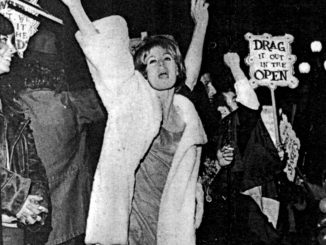
As well as the pre-Stonewall gay and lesbian organizations you mentioned, there was the pre-Stonewall Compton’s Cafeteria riot / rebellion in 1966. It was highly significant that trans people were in the leadership of both pre-Stonewall, Stonewall and post-Stonewall mass resistance. It was the inspiring struggles of the 1950s that led to significant political advances for Black and other communities of color in the 1960s.

How did the early “gay and lesbian” movement relate to the Civil Rights movement unfolding in the same period? In general, as the Black Civil Rights movement became increasingly militant, so did the LGBTQ+ movement. And the LGBTQ+ movement certainly drew great inspiration from the Black and Latinx revolutionaries.

Chairman Huey P. Newton of the Black Panther Party demonstrated the vanguard role of himself and his party with an extraordinary public statement of support for the LGBTQ+ (at that time “Gay”) movement. It was the first such act of solidarity by any internationally known political leader anywhere in the world.

GW: In our first phone conversation, you said, “the struggle for LGBTQ+ rights is the beginning of something far more powerful in terms of changes in society and the family.” Could you say more about this? 

BM: At the end of my book, “The Social Evolution of Humanity: Marx and Engels were right!,” I borrowed from Fred Goldstein’s 2012 book, “Capitalism at a Dead End,” where he asks his readers to begin thinking seriously about what a post-capitalist society would look like. 

Goldstein writes: “There needs to be a serious conversation within the movement about what to replace the present system with. It is the thesis of this work that capitalism has reached a dead end. It is bringing humanity and the environment down. It must be abolished. The starting point for that conversation should be that the new society must be free of class exploitation; must be free of national, sexual and gender oppression; must put an end to war; must be free of all forms of domination and have respect for the planet. Above all, it must use the wealth of society to benefit all of society.”

So what would it mean for post-capitalist society if, like in Indigenous, hunting and gathering societies, and in socialist Cuba, children were the serious responsibility of the whole community? What if, as already exists in Cuba, lovers came together purely based on their mutual feelings of love and / or physical attraction? And were able to separate without complications if and when those feelings faded?  

With the abolition of private property, wouldn’t the tendency to view the ones “loved” (including one’s children) as one’s private or personal property disappear? Wouldn’t all the horrors of patriarchal culture be consigned to the garbage dump of history along with all manifestations of economic, social and political injustice that that culture bolstered through the various stages of class society?

Okay. But just so our immediate challenges of racism, imperialist war and economic injustice aren’t forgotten, let’s remember Che’s admonition: “The present is for struggle. The future is ours.”

Strugglelalucha256


Los Angeles: A Night of Witness and Art

Img 7828

On May 24, the Harriet Tubman Center for Social Justice in Los Angeles hosted a fundraising exhibit to support the people of Gaza. The event was titled “A Night of Witness and Art.” 

The art displayed included incredible paintings by children who have survived the genocide and are now residing in Egypt at the Meera Kindergarten (Center). Also shown and for sale were photos by photojournalist Mahmoud Abusalama, who spoke to the crowd via Zoom.

All of the young artists had lost some or all of their family, and Abusalama had lost 30 members of his family to the barbaric Biden / Trump / Netanyahu genocide.

Fatin, of Unmute Humanity, conducted and translated an hour-long Q&A with Abusalama. In addition to the devastating loss of his family, Abusalama’s computer — containing much of his work — was destroyed when his home was bombed. This made the contribution of the few photos that were saved and used to raise funds for Gaza, especially moving.

It was clear that the exchange with supporters at the exhibit lifted his spirits.

The event, organized by Unmute Humanity, Riverside4Palestine, and the Harriet Tubman Center for Social Justice, raised nearly $5,000.

Strugglelalucha256


Leslie Feinberg, Minnie Bruce Pratt, and the radical legacy of LGBTQ+ communists

Following is part four of an interview with gay communist activist Bob McCubbin, who has organized and written political analyses since the 1960s. He is the author of the 2019 book, “The Social Evolution of Humanity: Marx and Engels Were Right!For Pride Month, Struggle-La Lucha writer Gregory E. Williams sat down with McCubbin to explore the revolutionary history of the LGBTQ+ struggle and what it means for today’s fight back.

Gregory Williams: You’ve been describing the early LGBTQ+ movement and what it was like being in a revolutionary party. You were doing a lot of practical work, but always studying at the same time, always analyzing. You published a pamphlet in 1976, “The Roots of Lesbian and Gay Oppression, A Marxist View.” Just as an aside, I was in a study group in New Orleans, and we were still using it around 2017, when we were doing interventions in the Pride march here, forming a radical contingent. You know, Stonewall means fight back, take back pride! And we felt that we needed to study what the roots of this are. What led you to write that?

Bob McCubbin: The need for a deeper understanding of that struggle, the struggle of – at that point – of lesbians and gays. Now, we were proud to say that we didn’t need a theoretical background to understand that there was oppression going on, that it was oppression of members of our class, and we should fight that. And those are words, of course, but they really instituted the truth of the plan of the leading comrades to overthrow capitalism. 

So, we were out on the streets even without theory, but it’s good to have guidelines, and it’s good to deepen your understanding of your own situation and the situation of your comrades. 

I actually wrote something fairly early in the party’s development, and I showed it to Comrade Dorothy Ballan. She didn’t want to hurt my feelings, but it was terrible. It was unbelievably bad. So she didn’t mince words. She said, “No, this is not Marx. This is not a dialectical analysis.”

So I went back to the drawing board because I wasn’t about to give up. She had actually given me some ideas on how to improve my thinking on this issue. But in terms of when I started writing – this sounds terrible. I did it secretly. I didn’t want influences. 

I wanted to break with the prevailing ideas that were floating around the progressive community. All idealistic, all having to do with ideas rather than struggle and social change and all that. There were some very good books about the oppression of homosexuality, but they all ended on that liberal, happy note: “Now we know more about these people and we want them to be part of the human family, and blah, blah, blah. Yeah, yeah, yeah, yeah.”

GE: But how are you going to do that?

BM: Right. Well-intentioned, there was a lot of well-intentioned stuff. I didn’t want that to creep in because it was dominant, it was prevalent. I didn’t want to do that. We had leading comrades – incredibly developed comrades – who hadn’t given any thought to it and openly admitted that. They said, “We need your help, Bob.” And then a lot of new comrades were bringing in these ideas. 

You know, all of the great revolutionaries have talked about the cultural struggle, which usually follows the physical seizure of power. And it’s absolutely necessary because just the physical seizure of political power in a particular country or a particular region or area – it doesn’t do the job. For one thing, people think, “Oh, the revolution has succeeded, now where’s the reward for it?” 

Well, usually, following a revolutionary war, there is social exhaustion. It takes a while to recover from any kind of military struggle. And so, the issue of culture arises. 

And in the late ‘60s and early ‘70s, there were a lot of – with all due respect – hippie-type ideas about who we were and all that. I didn’t want that to creep in. 

I wanted to develop it in a materialist fashion, to develop the idea, to develop the situation. And to really show the power of the Marxist method to deepen understanding of our situation and the struggle we face, what our goals should be. 

So, yeah, I wrote it all, and I had some confidence, but not a lot of confidence. I’m not an anthropologist. I’m not a historian. I don’t have training in any of those areas. So that was another reason I kept it secret. I wasn’t sure it would be successful. I had another meeting with Dorothy, and she tried to be polite, telling me, “No, you’re not on the right track yet.”

And when I finally had something I felt I could show, I made three copies. I gave one to Dorothy and one to Sam Marcy. And then the third copy I gave to Fred Goldstein, who was a cis man, a heterosexual man, a wonderful communist. 

I hope this doesn’t sound prejudicial, but as a gay man, I really appreciate heterosexual men who aren’t afraid of me, who are warm to me. And Fred was like that. And in terms of what he said at meetings, he struck me as the most politically developed among the youth. I thought, let’s find out if he has anything to say about this text I’ve written. So anyway, those three. And I got good feedback. 

That booklet was released in late winter or early spring of 1976. However, in January 1976, a very important national meeting took place. It was called the Hard Times Conference. And it was called by the Prairie Fire Organizing Committee, which was the above-ground, open organization for the Weather Underground.

And this meeting in January 1976 was kind of like the last hurrah for the so-called New Left movement of the 1960s and early 1970s, but dominated by the Prairie Fire Organizing Committee. 

Their political line was perhaps typical of the left dealing with a new political phenomenon, such as the gay liberation movement. They reacted defensively – forgive me – even stupidly. The Prairie Fire Organizing Committee probably had many LGBTQ+ people involved in it, but their theoretical position, basically, was that homosexuality is a secondary contradiction. What the hell is that? 

My point is, they didn’t have a good position. They had a homophobic position, right? The U.S. Communist Party had a homophobic position. And the Socialist Workers Party went back and forth on it. But basically, they would have preferred not to have to deal with it. 

However, at the time of the conference, the book was ready for publication but had not yet been published. The comrades got on the Xerox machine and printed 300 pre-publication copies of “The Roots of Lesbian and Gay Oppression” – at that point called “The Gay Question.” And Leslie Feinberg, who was pretty new – she/zie had joined the Buffalo branch a few years earlier, and zie’d just moved to New York City around that time, maybe ‘74, ‘75 – zie grabbed them up when we got to Chicago, and zie spent the whole time, the two or three-day conference, zie spent the whole conference selling them. And zie sold all 300. 

That was the kind of incredibly dynamic revolutionary zie was. Full of energy, full of enthusiasm, full of great ideas. And you know, I saw a photo of her/hir recently and it reminded me: Hir eyes projected love. Zie loved hir class. Zie loved children. Zie loved the comrades. And lucky for hir, zie was also brilliant. And people paid attention to hir writings. And zie was invited all over the place. 

I was thinking about it last night, and I’d actually forgotten. Zie spoke in Balboa Park in San Diego. Pride March was on Saturdays, and on the night before, there was always a rally outside the center, with leaders in the struggle speaking. And one year, out of all the national figures who could have been picked, zie was picked to be the spokesperson. 

I remember another time we drove up to Las Vegas. An ex-comrade, who still liked us, had organized a meeting for us in Las Vegas, where Leslie spoke. And zie spoke in San Francisco to an incredible crowd of young people who were just crazy about hir. And in L.A., too. My point is that zie spoke all over the U.S., as well as in Europe and Asia. 

And zie loved our class, zie loved our class very much. And zie made a tremendous contribution. I didn’t have great insight into the trans struggle, but hir friendship and comradeship meant everything. And any mention of Leslie should also include Minnie Bruce Pratt, who was hir life companion, who was also a great revolutionary. Minnie Bruce’s children had been taken away from her by the state because she was a lesbian. That didn’t stop her from a lifelong struggle for justice.

GW: They definitely contributed so much to our understanding of gender and the trans struggle, the way that it’s come down to us today. Our orientation in the Struggle for Socialism Party, of which you and I are members, owes much to the foundation laid by pioneering comrades like Leslie Feinberg and Minnie Bruce Pratt, who were willing to go against the grain, even within the revolutionary movement.

Not everybody understood the importance of these struggles, as you described. It may be hard for young comrades to understand now, but all of these positions had to be fought for in the progressive and even revolutionary movements, just as opposing the war in Vietnam and supporting the Black Panthers had to be fought for.

There’s a good quotation from Leslie Feinberg: “Remember me as a revolutionary communist.” Zie was of Jewish background and deeply committed to the Palestinian liberation struggle — just an incredible example.

And zie left behind many writings that are still so valuable. Aside from your book, I was given copies of Leslie’s writings. That’s how I learned about the history of the gay and lesbian struggle and the trans struggle within the communist movement and the advances that the Bolsheviks made in ending the discrimination against homosexuality and guaranteeing abortion rights very early on, way before the capitalist countries. 

And then you can trace the line through the developments that happened in socialist East Germany, the German Democratic Republic. They recovered a lot of the work that was being done in Germany before the Nazi takeover. Germany had a revolutionary situation before the Nazis came to power, they were going to be possibly the next socialist country. And they were making huge strides in the world of sexology. And the gay and lesbian and trans subcultures were very prominent – all this cultural experimentation that was happening, and the Nazis tried to destroy that totally. 

And then, when socialist East Germany came into being after WWII, they revived what they could, but had to build a lot from scratch. They had to rebuild housing and everything, but also recover what was lost or what had been taken away in terms of gender and sexual struggle. And then, onward through the advances that have been made in Cuba, all the stuff I learned about through Leslie Feinberg’s writing. Just an incredible touchstone for anybody who wants to be a revolutionary today, anybody who’s in the LGBTQ+ struggle. There’s a lot to learn there.

To be continued 


Strugglelalucha256


Mumia embraces the LGBTQ+ movement

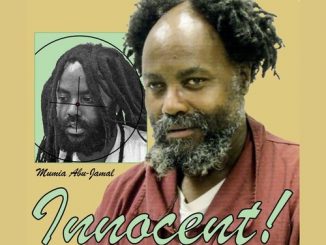
Mumia Abu-Jamal is a brilliant and empathetic revolutionary journalist known as “the Voice of the Voiceless,” hailed as a leader of people working for peace and justice. He is a father, a grandfather, and a longtime ally of the lesbian, gay, bi, trans, queer plus (LGBTQ+) movement. He has been incarcerated for 43 years, since Dec. 9, 1981. Few political prisoners have been held behind bars for this staggering length of time.  

At the time of his arrest, Mumia, a reporter for the Black Panther Party, was president of the Philadelphia chapter of the National Association of Black Journalists. By the age of 15, because of his news reports, the FBI had begun tracking the young writer through its draconian and illegal program known as COINTELPRO – not for violent behavior, but because of his “inclination to appear and speak at public gatherings.” 

Reporting on police brutality and the MOVE siege

It is widely viewed that the racist Philadelphia Police Department targeted Mumia because of his courageous reporting on police brutality. Specifically, he was writing about the police attacks on the MOVE organization, which culminated in a year-long siege of the MOVE house. In 1978, nine members of MOVE were falsely charged with the murder of a police officer. In his coverage of the trial, Abu-Jamal pointed out that the officer was most likely killed in the barrage of police crossfire.

Decades of solitary confinement

Mumia, a U.S. political prisoner, served 29 years in solitary confinement on death row. Following a powerful international campaign demanding “Freedom for MUMIA,” his death sentence was ruled unconstitutional. Now he has a life-without-parole sentence. Mumia Abu-Jamal has said: “My only crime that night is that I survived.” 

Countless due process violations began just moments after Abu-Jamal was found critically wounded, shot through the chest near the prone body of Officer Daniel Faulkner. From that moment on, members of the Philadelphia Police Department began to manufacture Abu-Jamal’s guilt, conceal his innocence, and charge him with murder. 

From early on, it was established that Abu-Jamal’s trial was patently unjust. Philadelphia prosecutors excluded Black people from juries. In Abu-Jamal’s case, 11 out of the 15 peremptory strikes were made to bar Black people from his jury. 

His conviction came in a trial that Amnesty International and numerous human rights groups said showed extensive evidence of prosecutorial, judicial, and police misconduct, and “effectively strip[ped] Mumia Abu-Jamal of any meaningful legal representation,” all seriously violating international legal standards.

A few years ago, it was officially disclosed that cartons full of evidence had been discovered, hidden in a Philadelphia City Hall closet 36 years earlier. Mumia’s legal defense team said this evidence would establish his innocence. Despite that, in 2023, Philadelphia Common Pleas Judge Lucretia Clemons ruled that it was too late for the evidence to be heard.

Support of the LGBTQ+ movement

In recent years, Mumia has become increasingly outspoken about queer and trans issues. In 2000, he wrote a commentary denouncing the brutal murders of three white gay men: Matthew Shepard in Wyoming in 1998, Billy Jack Gaither in Alabama, and Eddie Northington in Virginia, both in 1999. He was responding to an LGBTQ+ campaign in support of his freedom, called Rainbow Flags for Mumia, that Leslie Feinberg initiated.

“The sickening attacks on gay people in cities across the nation recently are a reflection of the sickness that simmers at the core of the American soul. It is here that a truly perverse hatred is bred, and from here that all attacks are launched against all who are seen as Other.

“This violence, which seems psychosexual in nature, is an attack on the self that seeks to destroy a part of the self that threatens the self. From Matthew Shepard, to Alabama, to that bloody American ground that was once the seat of the Confederacy, Richmond, violence, spawned by the dark pit of hatred and fear, is unleashed by men who claim a false and twisted ‘purity.’

“More often than not, those who find themselves attacking gay folks violently are replaying a violence that they grew up with, or that they continue to act out of, against their family or children.

“Is it a coincidence that Richmond, the city where a Black man was burned to death and decapitated, is followed several months later with the decapitation and torture of a gay man? I think not.

“This cruel and savage violence must be stopped — but it won’t be the cops that stop it, for they are the agents of legalized state violence. The brutality that occurs in their own homes daily, the recent spate of cops who kill their wives and kids, more than proves it.

“The people are the solution! So, my thanks to the Rainbow! Ona Move! To Freedom! 

In the 2012 book “The Classroom and the Cell: Conversations on Black Life in America,” Mumia said in a transcript that “Huey P. Newton spoke out, back in 1970, about gay liberation. He didn’t just mention it. He said, ‘We, the Black Panther Party, support gay liberation just as we support women’s liberation.’ He saw it as part of the struggle for human liberation. … It was the most forward position of any radical and revolutionary movement of the period, and reflected Huey’s keen thinking on issues before his time.

Newton’s 1970 statement, made by a Black Panther Party (BPP) leader, came just a year after the Stonewall rebellion, giving ground-breaking support to the then-strong and growing movements for women’s and gay liberation. Newton called for building an alliance with both movements.”

Radio documentary: A revolutionary evolution

Mumia Abu-Jamal explained his decades-long evolution to open solidarity with queer and trans liberation in a radio documentary, “Mumia Abu-Jamal Embraces LGBTQ Liberation” produced by Bob Lederer, host of the program Out-FM on WBAI in New York. Out-FM is a weekly anti-racist program by and for the lesbian, gay, bisexual, transgender, two-spirit, gender non-conforming, intersex, queer, and questioning communities.

In his interview with Mumia, Lederer included an account of the prisoner’s evolution on queer issues by Noelle Hanrahan, a lesbian journalist who has recorded more than 3,000 of Abu-Jamal’s radio essays on prisonradio.org, which airs the voices of incarcerated people. 

In the interview  Mumia said: “When you think about what Huey said at the Revolutionary People’s Constitutional Convention about gay folks and lesbian and queer folks, I must be honest with you, it was not well received by members of the Party. We were shocked in some ways, confused in other ways. But as usual, this was Huey at his finest. And he was a true revolutionary intellectual, who was usually ahead of his peers. …

“And I thought about it in the same context as Dhoruba bin Wahad, who was one of the Panther 21, and he talked about gay liberation. So some of the most advanced sectors of the Black liberation movement began to think about it far more broadly and deeply than even when Huey made his call.”

In Mumia’s 2004 book, We Want Freedom: A Life in the Black Panther Party, he wrote about the Panthers’ 1970 Revolutionary People’s Constitutional Convention in Philadelphia, which around 6,000 activists attended. He called it “a way of developing a revolutionary superstructure that would be the groundwork for a new society” and noted the wide array of groups – of students, socialists, Native peoples, women, and gay and lesbian groups – were invited to contribute. Workshops were held separately by gay men and lesbians, the former more multi-racial than the latter, and the gay men – but not the lesbians – were allowed to present to the larger convention.” 

Mumia wrote: “The many diverse workshops provided the basis for one of the most progressive Constitutions in the history of humankind,” citing calls for Black and Third World representation in governing institutions, national self-determination, sexual self-determination for women and homosexuals,” and the universal rights to housing, health care and day care. … Much of the movement was. … deeply macho in orientation and treated women in many of these groups in a distinctly secondary and disrespectful fashion.” 

But he also noted that “women were far more than mere appendages of male ego and power, they were valued and respected comrades. The women really were the glory of the Party. And I mean, they were the Party’s hardest workers, the most disciplined members and leaders.” 

Mumia cited the emergence in the 2010s of the queer-led Black Lives Matter movement as a major spur for straight Black liberation leaders to embrace LGBTQ+ liberation: 

Mumia also spoke movingly of the lessons he has learned from gay and trans prisoners in the institutions where he has been incarcerated: He gave an eyewitness account of the horrendous oppression of incarcerated gay men and trans women. 

“Well, you know, being in many ways, a blockhead and a nerd, I used to think that for a gay or even a trans man in prison would be a touch of heaven. It’s quite the reverse. They catch hell from prisoners and staff alike. So think about the alienation in isolation that breathes in such a person. I’ve seen people – literally seen them – try to commit suicide by jumping off of a rail onto the floor. If you hit your head or your neck, you can kill yourself, and I’ve seen that several times, in several places, in several prisons. Prison, by its nature, breeds isolation in human beings and atomizes them to the extent that it further isolates and separates them. And for trans and gay men in prison, it’s a hell in a hell, you know? They get the worst of it.” 

Confronting anti-trans violence 

In 2019, Mumia released a commentary denouncing a wave of murders of Black trans women:

“In recent weeks, we have seen naked violence unleashed against trans women, directed against them by the state in the form of police beating and by rightist forces in this emerging fascist movement in America.

“What does this mean? Why now? I believe it comes now for a specific strategic purpose, for trans women stand on the periphery of the gay rights movement, not its nucleus. This means they are isolated and, as such, targeted by rightist forces to isolate them further.

“We must not forget that they are, after all, Black folks in the land and at an era where and when Black life remains cheap. Now add Black, gay, and transgender. See where the analysis goes? And if it’s Black trans women today, it’ll be Black straight women tomorrow and Black children soon thereafter.

“That’s the nature of the fascist beast: attack those who seem weak, isolate them, destroy them. Since Charlottesville, we’ve seen the emergence of rightist racist forces that are committed to destroying Black life and to proving that Black lives don’t matter.

“The lines of Black people are the literal foundation not just of America but all of us. We need to build a radical movement that protects all of us, for all of us can consign such racist violence to the trash heaps of history.

“From Imprisoned Nation, this is Mumia Abu-Jamal.”

Noelle Hanrahan of Prison Radio wrote: “I ‘came out’ to Mumia on my second recording trip in 1992. Sitting across from him, I said you know the committee in San Francisco that is your defense committee has 10 women on it. Seven are lesbians. He was shocked, yet open. I told him Alice Walker was bi, Angela Davis was a lesbian, Bayard Rustin, James Baldwin were gay.

“He was profoundly curious. Warm. He asked, ‘Why?’ I said, ‘We’re deeply oppressed by this society and those of us who are revolutionaries see our liberation bound intrinsically with yours.’

“Mumia, while complicated, is one of the warmest persons I have ever met. Mumia Abu-Jamal’s instinctual curiosity and warm wonder, his lack of judgment or distance and harshness, kept me coming back. I see him 3-4 times a month, strategizing about his freedom, because when we love we win, when we survive we win, when we fight we win.”

Bob Lederer ended his interview by thanking “the amazing Mumia Abu-Jamal for the interviews. Special thanks to two dedicated Free Mumia activists, Dr. Suzanne Ross of International Concerned Family and Friends of Mumia, Noelle Hanrahan of PrisonRadio.org, Johanna Fernandez of the Campaign to Bring Mumia Home, Pam Africa, Dawn Reel, and Betsy Mickel. Thanks to Nathaniel Moore and Claude Marks of the Freedom Archives for providing the audio of Dhoruba Bin Wahad. And thanks to my Out-FM colleague and husband John Riley for providing production support, as well as to my two collectives, Out-FM and Resistance in Brooklyn, for advice. And thanks to WBAI studio engineer Max Schmid. Our closing music will be ‘Never a Prisoner! Free Mumia,’ by Rebel Diaz.”

Strugglelalucha256


Bob McCubbin on LGBTQ+ liberation and Marxist organizing

Following is part three of an interview with gay communist activist Bob McCubbin, who has organized and written political analyses since the 1960s. He is the author of the 2019 book, The Social Evolution of Humanity: Marx and Engels were right! For Pride month, Struggle-La Lucha writer Gregory E. Williams sat down with McCubbin to explore the revolutionary history of the LGBTQ+ struggle and what it means for today’s fight back.

Gregory Williams:  So, after Stonewall, you came to a point where you felt you needed to come out. What was it like when you came out as a member of a revolutionary party? Was it difficult?

Bob McCubbin: I would say it didn’t change anything. What do I mean by that? I was already in the party, and Sam Marcy characterized the party as a combat organization. And within the world that we were living in at that time, a world with incredibly inspiring anti-colonial struggles and everything else progressive that was going on – and again, being in what Sam Marcy characterized as a combat organization – there was a lot of discipline, but it was self-discipline. There were party requirements. 

Those of us in the New York branch, which was very large, were under obligation to call in to the office at least once a day to see what was going on and if anything was going to be happening in the evening that we could plug into. Most of us had jobs, regular-paying jobs. And the social life was largely during breaks at our meetings. 

Our meetings were wonderful. They were so educational, but also organizing. We were always organizing. And other groups on the left, on occasion, referred to us as the mindless activists, because we were always out on the street with our banners. But we weren’t mindless at all. Under the leadership of Sam and Vincent and Dorothy, we knew a lot. We knew a lot about the past at some point. 

Maybe I’ll mention a little bit about Friedrich Engels’ book On the Origin of the Family, Private Property, and the State, because that book was full of evidence that our species need not self-destruct. On the contrary, it was the most social of the animals, the most social of the mammals. I’m talking about our species, Homo sapiens.

Many scientists felt the development of language was based on this incredible sociality. When you were faced with, let’s say, in a particular indigenous group, there might be 30 to 50 families or maybe 100 families. But the point is, under the conditions of sociality. Other animals were social to one extent or another. But we’re talking about profound sociality. 

Your mind had to be able to deal with 30, 50, maybe 100 different personalities. And in any case, whatever the reason was, our brains got larger and larger until we actually entered the Homo sapiens species. And it bodes well for us as a species that we have such intense cooperation with each other. 

But what did the introduction of private property do? It introduced poison into that system. And together with the patriarchal culture that it created, fomented, increased, promoted, it left us with this problem. It’s a problem of private property. And we’re not talking about your toothbrush or even your home. We’re talking about the capitalist system. Money makes money. Well, not really. People, workers, make value. And the ruling class, as long as there is a ruling class, confiscates most of that value, demands ownership of it. 

GE: I’m reminded, a few months ago, there was an article about a new scientific study, I believe it was an anthropological study. They looked at child care in societies that have preserved some of these more communalistic aspects that predate class. And I think they were looking at existing peoples, maybe in the Amazon. 

And they quantified how many people it takes to care for a child. And the short answer is it’s a lot of people. [The study looked at the circle of non-maternal caregivers among contemporary hunter-gatherers, the Mbendjele BaYaka people in the Republic of Congo.]

It takes a village to raise a child. And contrast that with the extreme pressure that’s put [on parents], especially on women, in this modern capitalist society to take care of a child. That’s not how our species evolved. We didn’t evolve to live in these very isolated conditions. And it takes a toll on people. I think that we don’t, maybe even in the revolutionary movement now, we don’t talk enough about that psychological aspect of the extreme alienation that people are feeling. 

But when we look back at society before class and some of the structures that have survived from that time period, we see a different way, a totally different way of living. [As you recommended], I was looking at Dorothy Ballan’s pamphlet earlier [Feminism and Marxism, 1976]. She said that in the earliest societies, cooperation was necessary to survive.

BM: You had to have cooperation.

GW: And now, you know, it strikes me that in order to survive what we’re facing with the capitalist-driven climate crisis – or even the advent of the nuclear bomb – that class society has developed to a point where we’re a factor in nature, almost like an external factor that’s threatening us with extinction. [Like the commodity in Marx’s analysis, which is the product of human labor but appears as something external, wielding power over us.]

Because of that, we need cooperation. We can’t continue in this way. We need cooperation to survive the conditions that class society has created. And so we have to look back, you know, not that we can just recreate early hunting-gathering society, for example, but we can draw from that by dismantling capitalism and living more communally. It’s a question of survival.

Strugglelalucha256


Ballots and bias: How the press framed Venezuela’s regional and legislative elections

The pro-government alliance achieved a sweeping victory in Venezuela’s May 25 elections, while a fractured opposition suffered losses. Western media distorted the results – spinning low turnout claims, ignoring the role of illegal US sanctions, and offering selective sympathy to elite opposition figures.

 Opposition fractures, pro-government consolidates

At stake for the 54 contesting Venezuelan political parties were seats for 285 National Assembly deputies, 24 state governors, and 260 regional legislators.

The pro-government coalition won all but one of the governorships, taking three of the four states previously held by the opposition. The win in the state of Barinas was particularly symbolic for this was the birthplace of former President Hugo Chávez; and especially so, because the winner was Adán Chávez, the late president’s older brother.

Likewise, the Chavista alliance swept the National Assembly, securing 253 out of 285 seats. Notable exceptions were the election of opposition leaders Henrique Capriles and Henri Falcón, both of whom are former presidential candidates.

The New York Times reported the same outcomes but spun it as the “results [rather than the vote]…stripped the opposition of some of the last few positions it held,” inferring fraud.

However, this election outcome was not unexpected because the opposition was not only divided but a significant portion opted to boycott the vote. The pro-government forces enjoyed a unified effort, an efficient electoral machine, and grassroots support, especially from the communal movement.

“After 32 elections, amidst blockades, criminal sanctions, fascism and violence,” Venezuelan President Nicolás Maduro affirmed, “today we showed that the Bolivarian Revolution is stronger than ever.”

Opposition self-implodes

The headline from Le Monde spun the voting thus: “Venezuela holds divisive new elections.” Contrary to what the headline suggests, the divisiveness was not the government’s doing, but due to the opposition’s perennial internecine warfare.

While the pro-government Great Patriotic Pole alliance around the ruling Socialist Party (PSUV) “works in unison,” according to opposition leader Henrique Capriles, the electoral opposition divided into three warring camps. They in turn were surrounded by a circular firing squad of the far-right abstentionists, calling for a vote boycott.

The abstentionists were assembled around Maria Corina Machado. She had been pardoned for her involvement in the short-lived 2002 US-backed coup but was subsequently disqualified from running for office for constitutional offenses. Following Washington’s lead – which has not recognized a Venezuelan presidential election as legitimate since 2012 – the far-right opposition rejected electoral means for achieving regime change and has even pleaded in effect for US military intervention.

Machado’s faction, which claimed that Edmund González Urrutia won the 2024 presidential election, does not recognize their country’s constitutional authority. Consequently, when summoned by the Venezuela supreme court, they refused to present evidence that they won, removing any legal way for their claimed victory to be accepted. Machado maintained that voting only “legitimizes” the government, bitterly calling those participating in the democratic process “scorpions.”

Machado spent the election in self-imposed hiding. She further dug herself into a hole, after urging even harsher punishing US sanctions on her own people, by appearing to support Trump’s sending of Venezuelan migrants to the CECOT torture prison in El Salvador.

El Pais sympathized with her as “driven by the strength of the pain of being a mother who has been separated from her three children.” The WaPo described the middled-aged divorcé from one of the wealthiest families in Venezuela as a “courageous leader” whose “three children are exiled abroad.” In fact, her adult children live comfortably in the US and Colombia.

To this manufactured sympathy for the privileged, Venezuelan-Canadian sociologist Maria Paez Victor asks “where are the defenders of the human rights of Venezuelans?” She excoriates the collective West for their selective concern for human rights, emphasizing the neglect of Venezuelans’ rights amid external pressures and US sanctions.

 The disputed Essequibo

The headline for The New York Times’s report spun the elections with: “Venezuela is holding an election for another country’s land.” This refers to elections for governor and legislators in the Essequibo (Guayana Esequiba in Spanish), which is in fact a disputed land.

For nearly two centuries, Venezuelans have considered that region part of their country, when they wrested it from the Spanish colonialists in 1835. In the questionable Paris Arbitral Award, with the US representing Venezuela, the Essequibo was handed over to the UK in 1899 (then colonial British Guiana and now independent Guyana). Ever since, it has been contested territory.

In 1962, Venezuela formally revived its claim at the UN, asserting that the 1899 award was null and void. Not surprisingly, the Times sides with Guyana or more precisely with what they report as “Exxon Mobil’s multibillion-dollar investments” plus “military ties with the US.”

This first-time vote for political representation in the Essequibo is seen by Venezuelans across their political spectrum as an important step to assert their claim. It follows a referendum in 2023, which affirmed popular support for the Essequibo as part of their national territory. The actual voting was held in the neighboring Bolivar state.

On cue, the western-aligned press criticized the vote on the Essequibo as a “cynical ploy” by the Maduro administration to divert attention from other pressing problems. Meanwhile, they obscure the increasing US military penetration in neighboring Guyana and in the wider region.

Yet even the NYT had to admit: “Claims to the Essequibo region are deeply ingrained among many Venezuelans… [and even] María Corina Machado, the most prominent opposition leader, visited the area by canoe in 2013 to advance Venezuela’s claim.” Venezuelan journalist Jésus Rodríguez Espinoza (pers. comm.) described the vote as “an exercise in national sovereignty.”

Illegal sanctions – the elephant in the room

 WaPo opinion piece claims, “that the actual root cause of poverty has been a lack of democracy and freedom,” as if the US and its allies have not imposed sanctions deliberately designed to cripple the Venezuelan economy. These “unilateral coercive measures,” condemned by the UN, are illegal under international law because they constitute collective punishment.

But the fact that Venezuelans had to vote while being subjected to illegal coercion is completely ignored by the corporate press. That is, the existence of sanctions are recognized but instead of exposing their illegal and coercive essence, the press normalizes them. The story untold by the press is the courage of the Venezuelan people who continue to support their government under such adverse conditions.

Disparaging the election

 Washington and its aligned press cannot question the popular sweep for the Socialist Party’s alliance in Venezuela, because it is so obvious. Nonetheless, they disparage the mandate. The chorus of criticism alleges the fraudulent nature of previous elections, although it is a geopolitical reality that Washington considers any popular vote against its designated candidates illegitimate.

For this particular election, these State Department stenographers focused on the supposedly low turnout. In fact, the turnout was typical for a non-presidential election contest and in the same turnout percentage ballpark as US midterm elections.

Moreover, the pro-government slate actually garnered more votes than it had in the previous regional elections. The Chavista core of older, working class women remains solid.

When Elvis Amoroso, president of Venezuela’s authority (CNE) qualified the turnout percentages to apply to “active voters,” he meant those in-country. Due to the large amount of recent out migration, a significant number are registered but cannot vote because they are abroad.

What was notably low was voting for the highly divided opposition, major factions of which called for a boycott. Further, the opposition had been discredited by revelations that some had received and misused hundreds of millions of dollars from USAID. More than ever, the inept opposition has negatively exposed itself to the broad electorate.

 The overwhelming sentiment on the street in Venezuela is for an end to partisan conflict and for continuing the slow economic recovery. Challenges ahead include inflationary winds, a rising unofficial dollar exchange rate, and above all the animus of the Trump administration that is currently in internal debate over whether to try to deal the Bolivarian Revolution a quick or a slow death. Either way, destabilization efforts continue.

To which Socialist Party leader and Interior Minister Diosdado Cabello said: “No one can stop our people. Not sanctions, nor blockades, nor persecution – because when a people decide to be free, no one can stop them.”

Roger D. Harris is with the human rights organization Task Force on the Americas, the US Peace Council, and the Venezuela Solidarity Network.

Source: Resumen Latinoamericano – English

Strugglelalucha256


From Sally-Tom to Charlotte Fosgate: populism and the fight for trans lives, then and now

In May, the Struggle for Socialism Party Los Angeles branch discussed the new book, “Against Fascism: Reclaiming Populism’s Legacy for Today’s Class Struggle,” compiled by Louisiana socialist Gregory Williams. 

Following is the closing presentation for the series of classes, given by trans activist Melinda Butterfield on May 31.

BUY BOOK NOW  |  FREE PDF

Since this is the eve of Pride Month, I thought it would be good to start with a little about the convergence of queer lives with the 19th-century Populist movement in the South. We know there were queer people involved in the Farmers’ Alliance and the People’s Party, because we have always existed, and today’s queer communities have strong roots throughout the South. 

No doubt some of those who joined the movement were closeted, some were stealth, and some were accepted for who they were, as part of their community. But because there was no queer movement as we understand it today, it can be difficult to find direct information on these intersections. We have to suss them out.

This week I’ve been reading a new book by activist and scholar Eli Erlick, “Before Gender: Lost Stories from Trans History, 1850-1950.” In this book, I learned about Sally-Tom and Mollie Wilson, trans women of color who lived in the South during the height of the Populist movement and the People’s Party. I’m going to share a little bit of their stories:

Sally-Tom was a Black woman who lived the first 26 years of her life in slavery. She took the new opportunities opened up by Emancipation to start living more fully and openly as her true feminine self. In 1869, when she came before the Freedmen’s Bureau on an unrelated matter, she was presented with the opportunity to choose her gender for the official records, and she chose to be legally recognized as a woman. According to Erlick, Sally-Tom was probably the first trans person in U.S. history to have her gender officially recognized.

Sally lived in several Georgia towns over the next four decades, working as a cook and household help, as many Black women did. “Sally refused to discuss her life with reporters, so we do not have a single word of her self-narrative,” Erlick writes. “Those who knew her described her to papers at length, however. With a high and crackly voice, Sally reportedly hid behind her straw hat and left events before conflict arose. 

“Her decision to avoid media made sense from the perspective of self-preservation; she likely did not want to draw attention to herself during such a violent era of increasing lynchings and attacks on the Black population.” She died on March 4, 1908, in Waycross, Georgia, at around the age of 69. According to a death notice in the local paper, none of her friends and neighbors knew she was trans.

Mollie Wilson was a Two-Spirit trans woman who was Choctaw and Black, born around 1865 in what was then the Choctaw Territory, which included parts of Mississippi, Alabama and Louisiana. Originally, she spoke only her Indigenous language. At the age of 19, she barely escaped a lynching, killing several of her would-be murderers in the process. She fled from home and took the opportunity of her escape from these traumatic events to embrace her womanhood.

Erlick writes: “Eventually, she moved to Kansas City, Missouri. She reportedly had a large group of friends, mostly Black residents of the city. Mollie always wore a dark dress and fascinator, and with a tall and thin frame, passed with ease. Her transition allowed her to blossom into a social butterfly without fear of lynch mobs.” She married a man and later lived with a woman.

As Jim Crow’s noose tightened, Mollie was arrested twice on police claims that she was a sex worker. Shortly after one of these arrests, she died of tuberculosis in 1901.

These long-hidden lives show how trans and queer people found ways to live as their true selves during the same era that the Populist struggles were pushing back against reaction.

Trump attacks trans health care

But let’s move to the here and now. Trump’s “big beautiful” budget bill recently passed in the House and is currently before the Senate. It attacks housing, Social Security and public health care to transfer funds to the war machine, ICE, and the 1%. Some 20% of Medicaid recipients are to be cut – nearly 14 million people. 

A rider attached to the House bill would eliminate all Medicaid and Affordable Care Act coverage for trans health care, both for youth and adults. At least 275,000 trans people currently depend on Medicaid. The likely knock-on effect would be to allow private insurance companies to dump gender-affirming care, affecting many more. 

In addition to Sally-Tom and Mollie Wilson, this week I have been thinking about Charlotte Fosgate. Charlotte was a 17-year-old trans girl who lived in Oregon. She disappeared May 1 and jumped from a bridge in Portland the next night. Her death was confirmed last week. 

Charlotte’s final social media posts, made from the bridge where she leapt to her death, became a lightning rod for bigots posting hateful memes and messages.

Charlotte represents all the trans youth and adults who are being forced out of public life and losing their hopes for the future because of health care bans, bathroom bans, sports bans, doxxing and violence.

Populism is supposed to represent the interests of those who have been left out, who are marginalized. What kind of “populism” is it that doesn’t include someone like Charlotte Fosgate and other queer youth who are completely stripped of their right to exist, to be themselves, to even dream of a better future?

What the media and politicians term “populism” now is something utterly different. Where populism in the 19th Century represented the desire of people at the margins – small farmers, formerly enslaved people, agricultural workers and all those left behind by the growth of capitalism – to work together to better their futures, now it usually means appealing to the most backward, atomized, anti-social elements that have completely swallowed the small-capitalist, white supremacist mentality. 

What they now call “populism” appeals mostly to the social base of fascism – the shock troops of the billionaire class.

Nazis co-opted socialist terms

It’s not the first time this has happened. The classical fascist movements and regimes in Europe in the first half of the 20th Century adopted some of the anti-establishment and even anti-capitalist rhetoric of their enemies, the communists and socialists, to attract people to their cause. Hitler even called his organization “National Socialists.” 

But they redirected the righteous anger at capitalism toward Jews, queers, people of color, and the left – much as we see ultra-corrupt capitalists like Donald Trump and Elon Musk railing against the “elites” and “Washington insider corruption” as stand-ins for marginalized communities, migrants, and the working class as a whole.

Like the followers of the Strasser brothers, who formed the “left” wing of the Germany Nazi movement, today we have formations like the so-called American Communist Party (ACP) and the Center for Political Innovation (CPI) that use leftist terminology and symbolism to draw disaffected people and those lacking class consciousness into the orbit of the fascist movement. 

While claiming to be socialists or communists, they adopt the exact same racist, misogynist, anti-trans and anti-queer arguments and bigotry as their MAGA inspirations do.

Where is the united movement from the grassroots that will give a voice to people like Charlotte Fosgate or to Sam Nordquist, a Black trans man who was tortured to death in upstate New York earlier this year? 

Where is the movement that will give a voice to the children whose parents are ripped away by masked ICE Gestapo at immigration hearings across the country? Or the migrants from Southeast Asia who were kidnapped and sent by the Trump regime to South Sudan? 

What about Mahmoud Khalil, who is being held thousands of miles from his wife and newborn child in a Louisiana prison? Or the queer youth who are being thrown away by their families or pushed into state-mandated conversion therapy torture?

Building united movement is our task

This united movement of the dispossessed, of the workers and oppressed, is not going to come from the Democratic Party or the established nonprofits that cling to the broken system. Fighting back in the courts and with other “official” methods, while important, is not going to save us or build the movement we need.

It’s up to us. We have to build this movement, this unity. We have to refuse to be siloed. We have to reach out and find ways to collaborate, even when there is not 100% mutual understanding yet. Working together against our common enemies, in our common interests, is the way to build that understanding.

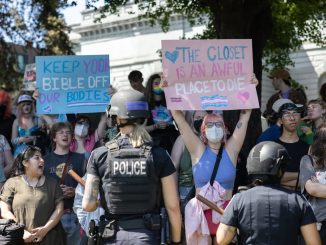
Queer rights are under attack everywhere, including California. Gruesome Gavin Newsom just this week began the process of excluding trans students from athletic competitions, after months of pandering to the worst anti-trans bigots on his podcast. Trans youth have been under attack in schools throughout Southern California for the past few years. And last month, queer activists had to confront a fascist march in the streets of West Hollywood.

That brings us back to LGBTQIA+ Pride Month. This year especially, it’s important for people from all sectors of the working class, all communities, and all organizations of the real left to come out in support of trans rights, trans lives, and all queer people. This is the time to take good sentiments about being an ally and turn them into contacts, joint work, and real efforts to build a united movement. 

In Los Angeles, the Harriet Tubman Center, Struggle for Socialism Party, Trans Rescue Action, and others will be mobilizing for Pride events and queer resistance actions. If you’re not in LA, talk to us, and we can put you in touch with others doing the work in your area.

Let me close with this thought from the conclusion of Vince Copeland’s “Southern Populism and Black Labor,” a classic Marxist work included in the book we’re studying today: “[The Populists’] failure was not due nearly so much to the failure of their ideas, as to the failure to maintain their social position – to hold on to the material base of independent small and especially farming business, from which these ideas originated.

“The new class, the working class, does not yet have the ideas that correspond to its class position. But its class position is innately superior to that of the old Populists from the point of view of having the base to mount a serious and successful struggle. When the new ‘people-ism’ of the workers is born, it will soon grow powerful enough to really lead the people and rule in the name of practically the whole people – something the Populists could not have done, even if they had won.”

Strugglelalucha256


Inside the Bay Area’s Gay Liberation Front with Bob McCubbin

Following is part two of an interview with gay communist activist Bob McCubbin, who has organized and written political analysis since the 1960s. He is the author of the 2019 book, The Social Evolution of Humanity: Marx and Engels were right! For Pride month, Struggle-La Lucha writer Gregory E. Williams sat down with McCubbin to explore the revolutionary history of the LGBTQ+ struggle and what it means for today’s fight back. 

Gregory Williams: We’re getting into what the beginning of the gay movement was like. Nowadays we say LGBTQ+, because we’re constantly trying to be more expansive, with a bigger and bigger vision of liberation, including more and more people. But what was it like? You’re describing how the youth in the late 1960s and early ‘70s were taking inspiration from the Vietnamese and other anti-colonial struggles. Was there a strong sense in the emerging movement that it needed to be anti-capitalist? Was that a common sentiment?

Bob McCubbin: Good question. In Sam Marcy’s party, the guideline that he presented to the youth was Marxism is as Marxism does, meaning the focus needs to be on the struggle. The struggle is what educates our class and our understanding of oppressed nations’ struggles. 

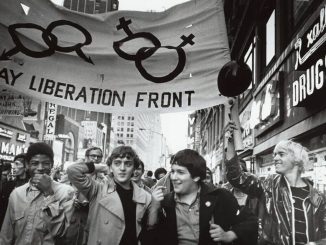
Let me try to describe the San Francisco Gay Liberation Front. We met once a week to discuss activities. One of the Gay Liberation Front organization’s tasks was to join the struggle – struggle for their own rights and the struggle for the rights of their siblings, while also struggling for other members of their class. And we did. 

I remember making a banner to free Angela Davis and Ruchell McGee, and we took it, as the Gay Liberation Front, to the following rally. And we’re talking the Bay Area, San Francisco Bay Area. So we were activists, no question about it.

Another very important example I remember was a young man who was shot trying to escape a bar raid by the San Francisco police. He managed to get out of the bar, but while running toward his car, the police shot him. And we met with him in the hospital, and his request to us as an organization was, please see if you can do a fundraiser for me. I have legal expenses and medical expenses. 

So, who came to our aid to organize a fundraiser? It was the San Francisco local of the West Coast Longshore Union. They had a union hall in San Francisco and turned it over to us to have a fundraiser. It was very successful, hundreds of young people of all genders and sexualities, definitely. We just loved it. 

As chaperones for our event, four of the union officers attended the fundraiser, and they found seats along the wall and smiled a lot, but they didn’t join our circle dances. But my point is how wonderful it was to have the support of a workers’ organization. And they were into it. I mean, they weren’t there to make sure we weren’t smoking marijuana. They were there to show their support for us, and they were very friendly.

I’ve given us a flavor of our activism, but there was another very important role for the LGBTQ+ movement back then. And it was to find personal strength, to help us find personal strength to accept ourselves. Certainly, I was an example of it. 

There wasn’t much consciousness of gender oppression and what it signified and how important it was. But on the other hand, I don’t know how prevalent this was around the country, but in our group, we had what was called “gender fuck.” And it would involve, well, whatever you wanted to do, but people would show up with full beards, wearing a skirt, or any kinds of interesting variations on gender expressions and sexuality expressions. 

And getting support for that, not being ridiculed, not being laughed at, but being loved. And that was a very important part of it, too. You know, if, say, a heterosexual revolutionary came to one of our meetings and said, “you’re wasting all this time.” No, it wasn’t a waste at all. It was finding personal strength. 

But maybe here is a good point to throw in a lesson about the struggle under capitalism. We never win until the final battle. That is to say, we’re talking about Stonewall, we’re talking about 1969. It was a long, long time ago. We won our rights back then. Oh, did we?

GW: Look at everything happening now. 

BM: Now, it’s like the past never happened. And the focus, of course, is on our trans folk. And it’s horrible what’s going on. That’s part of fascism.

GW: It’s important to understand that. There were big victories in the past, and a lot of advances were made, but until the foundations of the society are changed, until capitalism is overthrown and we start to create a new society – socialism – those gains can be taken away in one fell swoop. That’s the job of fascism: to come in like a wrecking ball and destroy all these gains.

Look at the way the Supreme Court overthrew Roe v. Wade, and now women are dying of sepsis. And trans people who get pregnant are dying of sepsis because the doctor’s afraid to treat them. This is just going totally backwards. The struggle is not over. We’re in an intensified period of fighting.

I think it’s important for the young people, especially right now, to get an infusion of hope and revolutionary optimism. Because every struggle that’s happened – you can probably testify to this throughout your life – the people needed to have revolutionary optimism in order to keep on fighting. And that’s so needed right now. We need to have a vision of an alternative kind of society.

BM: It doesn’t have to be this way.

Strugglelalucha256
https://www.struggle-la-lucha.org/2025/06/page/5/