Saturday, March 29th
EMERGENCY RALLY: Stop the Cuts March 29th
Saturday, March 29th
2:00 PM
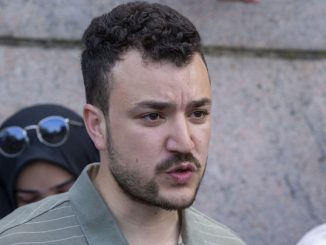
Palestinian student organizer arrested and detained by U.S. Department of Homeland Security
The arrest of Palestinian student activist Mahmoud Khalil took place in the wake of increased threats by the Trump administration to student activists
Agents with the US Department of Homeland Security arrested Palestinian activist and former Columbia University student Mahmoud Khalil on Saturday, March 8, at his residence in New York City. Khalil was active in the Palestine solidarity movement at Columbia University and was one of the lead negotiators with the university administration during the Gaza Solidarity Encampment in Spring 2024.
Khalil is currently being detained in an Immigration and Customs Enforcement (ICE) detention center where he could be processed for deportation. At the time of writing, neither his legal team nor his family knows of his whereabouts. The day after his detention, his wife, who is eight months pregnant, went to visit him at an ICE detention center in Elizabeth, New Jersey, where he was reportedly being held, and she was informed that he was not there. His attorney Amy Greer said in a statement to media that they have not been given any concrete information about his whereabouts but had heard a rumor that he could be transferred to Louisiana.
His detention has been widely condemned due to the multiple violations committed by the DHS agents during his detention as well as the unprecedented nature of his arrest.
Notably, Khalil has a green card and is thus a lawful permanent resident of the United States. During his arrest, the agents told Khalil that his student visa had been revoked and he responded to them saying that he was in fact a green card holder and a permanent resident. When his wife showed them his green card, the agents responded by informing that the State Department had also revoked his green card.
This was confirmed in a post from US Secretary of State Marco Rubio who posted a link to an AP article about Khalil’s arrest with the comment: “We will be revoking the visas and/or green cards of Hamas supporters in America so they can be deported.”
A press release informing on Khalil’s detention also detailed that the DHS agents forced their way into the apartment building where Khalil lives with his wife and did not identify themselves. They also threatened his wife, who is a US citizen, with arrest.
In the short phone exchange that the officers had with Khalil’s attorney, they rejected her request for a copy of the warrant for his arrest and hung up on her.
His attorney Amy Greer said in a statement to media: “ICE’s arrest and detention of Mahmoud follows the US government’s open repression of student activism and political speech, specifically targeting students at Columbia University for criticism of Israel’s assault on Gaza…The US government has made clear that they will use immigration enforcement as a tool to suppress that speech.”
Trump’s crackdown on student protesters
Khalil’s unprecedented arrest comes amid threats made by members of the Trump administration to crack down on the historic Palestine solidarity movement at college campuses across the US. The president himself had written on March 4, “Agitators will be imprisoned/or permanently sent back to the country from which they came. American students will be permanently expelled…”
On January 29, Trump signed an executive order on “Additional Measures to Combat Anti-Semitism” which directed officials, including from the Secretary of State, the Secretary of Education, and the Secretary of Homeland Security, to guide higher education institutions to “report activities by alien students and staff” that Trump’s administration could consider as anti-semitic or supportive of terrorism. Such reports could “lead, as appropriate and consistent with applicable law, to investigations and, if warranted, actions to remove such aliens.”
From this executive order, the “Task Force to Combat Anti-Semitism” was launched on February 3, which is composed of representatives from the Department of Justice, Department of Education, Department of Health and Human Services, along with others, and is coordinated through the Department of Justice’s Civil Rights Division.
On February 28, this Task Force announced it would visit 10 universities that had “experienced antisemitic incidents since October 2023” including: Columbia University, George Washington University, Harvard University, Johns Hopkins University, New York University, Northwestern University, the University of California, Los Angeles; the University of California, Berkeley; the University of Minnesota and the University of Southern California. Notably, the US government announced on Friday, March 7, that it was pulling USD 400 million in grants to Columbia University for inaction on antisemitism.
“To all the resident aliens who joined in the pro-jihadist protests, we put you on notice: come 2025, we will find you, and we will deport you,” Trump said in the White House statement about the Executive Order released on January 30, “I will also quickly cancel the student visas of all Hamas sympathizers on college campuses, which have been infested with radicalism like never before.”
Axios published a report on March 6 stating that Secretary of State Marco Rubio was launching an “AI-fueled ‘Catch and Revoke’ effort to cancel the visas of foreign nationals who appear to support Hamas or other designated terror groups.” According to State Department officials, this effort would apparently involve reviews of the social media accounts of student visa-holders to look for “evidence of alleged terrorist sympathies expressed after Hamas’ Oct. 7, 2023, attack on Israel”.
Rubio’s current actions seem to be the fulfillment of a year-long promise. On October 30, 2023, weeks after protests had begun to oppose Israel’s genocide in Gaza, Marco Rubio penned an editorial in Fox News with fellow Republican senator Dave McCormick titled, “We have one word for terror supporters who abuse our broken visa system”. They wrote: “Foreign nationals supporting Hamas and their brutality against both Israelis and Americans have no place in our great nation. And they certainly don’t have a constitutional right to entry into the United States. In fact, their very presence here violates the law.”
Widespread opposition to arrest
Organizations and individuals across the United States have heavily criticized the arrest of Mahmoud and called for his immediate release. Through an online petition, over 500,000 people have sent letters to different government agencies, including DHS and ICE, as well as administrators and officials at Columbia University and Barnard, calling for the immediate release of Khalil from detention. The petition accuses Columbia University of being complicit in the campaign to criminalize student activists, stating: “Columbia’s continued acquiescence to federal agencies and outside partisan institutions has made this situation possible. Like many other Arab and Muslim students, Khalil has been the target of various zionist harassment campaigns, fueled by doxxing websites like Canary Mission. This racist targeting serves to instill fear in pro-Palestine activists as well as a warning to others.”
Organizations part of the Shut It Down for Palestine coalition including the Palestinian Youth MOvement, Jewish Voice for Peace, the People’s Forum, the Party for Socialism and Liberation, ANSWER Coalition, and Writers Against the War on Gaza, have called for a protest on Monday, March 10, outside the ICE Detention Center where he was first held in the Jacob K. Javits Federal Building.
Source: Peoples Dispatch
Cuba’s message: ‘Learn the truth about our struggle and end imperialist punishment’
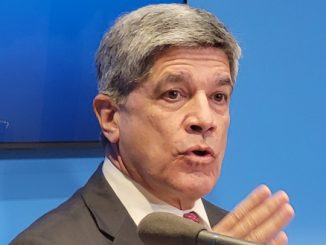
On February 28, Cuban Deputy Foreign Minister Carlos Fernandez de Cossio delivered a speech at the Institute for Policy Studies in Washington, D.C., to provide an update on the current state of U.S.-Cuba relations from Cuba’s perspective. C-Span’s video of the broadcast event is available at: Cuban Official Discusses U.S.-Cuba Relations | C-SPAN.org The event was co-sponsored by the Latin American Working Group and Black Alliance for Peace.
In a concise but clear presentation, de Cossio explained the root issue in U.S.-Cuba relations is “the consistent failure by the government of the United States of understanding and accepting that Cuba is and has the right to be a sovereign nation with the right to self-determination. That the U.S. has no right to govern Cuba and we do have the right to govern ourselves and defend ourselves and to provide for our people in the way that as Cubans we feel is appropriate.”
After eight years of “maximum pressure” initiated during the first Trump administration and continued under Biden, “the current government has come in – at least from the State Department point of view and for the people that are in State Department – with a declared commitment to make life for Cubans, all Cubans, even more difficult than it is today. The commitment to mobilize the full power of the United States which is very overwhelming and has an impact all over the world to make sure that this punishment is presented upon the people of Cuba with the aim of cutting all the remaining sources of income, to be able to cut our access to technology, to markets, to financial institutions,” de Cossio said, likening it to a medieval siege.
The U.S. will fail at its aim to defeat Cuba’s revolutionary independence as it has over the 65 years since Lester Mallory wrote the infamous State Department April 6, 1960, secret memo. The memo outlines the continued U.S. strategy to alienate support “through disenchantment and disaffection based on economic dissatisfaction and hardship.” It specifies that “as adroit and inconspicuous as possible, make the greatest inroads in denying money and supplies to Cuba, to decrease monetary and real wages, to bring about hunger desperation and overthrow of government.” (https://history.state.gov/historicaldocuments/frus1958-60v06/ch10)
At this meeting, the Deputy Foreign Minister discussed Cuba’s role on the international stage. The government of Cuba views the current world order, that of U.S. hegemony, as unsustainable and damaging to world peace. They also believe in a world order based on multilateralism, which is differentiated from a multipolar world order that can seem reminiscent of old colonialism.
The Cuban people have not shied away from their mission to help those of oppressed communities all around the world. Even with U.S. agreements frozen, and the country put back on the “State Sponsor of Terrorism” list, there will still be Cuban doctors working to give life-saving medical care all around the world.
This good faith by the Cuban people is returned on the international stage where since 1992 the majority of countries vote with Cuba in the United Nations General Assembly calling for the U.S. to end its illegal siege and occupation of the island. In 2023 and 2024, 187 out of 193 UN member countries urged that Cuba be removed from the U.S. State Department unilateral list of “State Sponsors of Terrorism” and called on the U.S. to end the blockade.
The audience left the gathering with a clear objective. The objective is to counteract media disinformation by sharing the truth about Cuba with the larger population within the United States. It is the Cuban government’s stance that if the people of the United States knew the true horrors of U.S. imperialism on Cuba, they would work by any means necessary to end the U.S. campaign to intentionally impose hunger and hardships on the Cuban people.
Whether it is fighting the information war or the economic siege, the victories can only be won through continued international solidarity and channeling the Cuban people’s revolutionary fighting spirit and resistance into everything we do.
Koreans rally across U.S. Against imperialist war exercises
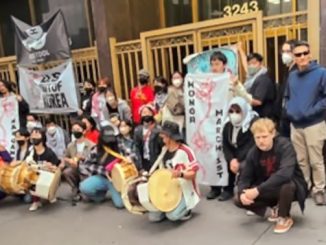
A commemoration of the Korean People’s March 1 Movement was organized by Nodutdol in Los Angeles, New York City and San Francisco. March 1, 1919, was a day when millions of Koreans rose up against Japanese colonialism. The Japanese imperialists massacred participants by the thousands, but the spirit of March 1 continues to inspire tremendous resistance against U.S. imperialism, the division of their country and occupation by U.S. troops today. Speakers talked about the joint war exercises being carried out by the U.S. and the Republic of Korea taking place in March. The exercises are in reality a practice run for a new Korean war.
Committee accuses U.S., South Korea of ‘war provocation’ after bombing incident
Statement from the Committee for the Preparation of a Sovereign Alliance
Immediately halt the U.S.-South Korea joint military drills, including bombing civilian areas and preemptive strikes against North Korea!
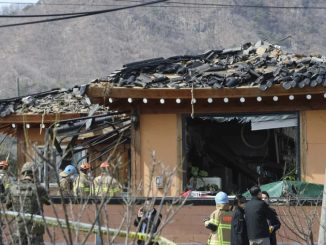
On March 6th, at approximately 10:05 AM, during a U.S.-South Korea joint military exercise near Nogok-ri, Idong-myeon, Pocheon City, two KF-16 fighter jets dropped bombs on civilian areas. The bombs fell about 8 km away from the originally intended target range, in a civilian area. As a result, 29 people, including 15 local residents and 14 soldiers, were injured, and 59 households were affected. The bombs also damaged five houses, a warehouse, a church, a 1-ton truck, and a greenhouse. Residents of border areas, as well as the entire population of South Korea, are suffering from extreme fear and anxiety.
How could such a horrific accident occur again? The military authorities announced that the cause of the incident was a “mistake” in the targeting coordinates entered by the pilots of the KF-16 fighter jets. The pilot of the first jet mistakenly entered the wrong coordinates and dropped the bombs without confirming alignment through system upload or visual observation. The second pilot followed suit. It is hard to believe that the pilots could not distinguish between a training area and a civilian area when they directly pressed the button to release the bombs. Furthermore, the announcement of the accident occurred 1 hour and 37 minutes after the incident, which raises further concerns. The military authorities must clearly explain the cause of the incident and the response process.
The MK-82 bombs used in the incident are 227 kg (500 pounds) general-purpose bombs, filled with tritonal explosive material (87-88 kg), which has significantly more explosive power and lethality than TNT. When one bomb detonates, the blast radius reaches 10 meters in diameter and 3 meters in depth, with a kill radius extending to the size of a football field. Two KF-16 fighter jets dropped a total of 8 bombs on civilian areas, all of which exploded. The consequences would have been unimaginable had the bombs hit nearby schools or other densely populated areas.
This incident occurred during the preliminary drills for the U.S.-South Korea joint military exercise, “Freedom Shield (FS),” scheduled from March 10th to 20th. The joint military exercise involved the U.S. Forces Korea and the South Korean Air Force and Army, with 13 fighter jets, including F-35A, F-15K, KF-16, and FA-50, participating in over 30 live-fire bombing drills. U.S.-South Korea joint commanders, including General JB Brunson of the U.S.-South Korea Combined Forces Command, General Kim Myung-soo of the Joint Chiefs of Staff of the Republic of Korea, and Deputy Commander Kang Shin-cheol, were directly involved in observing the training and managing the aftermath of the incident. The U.S. and South Korean military command cannot evade responsibility for this bombing incident.
The “2025 Freedom Shield” drills, marking the first exercise since the Trump administration’s second term began, will simulate preemptive strikes on North Korea’s nuclear facilities and ballistic missile launch sites, based on the new operational plan “OPLAN 2022.” The drills will involve extensive live-fire exercises, with all types of military assets used, including ground, air, sea, cyber, and space forces. In addition, electronic warfare drills, such as drone attacks, GPS jamming, and cyberattacks, will also take place. As long as the U.S. and South Korea continue their hostile policies toward North Korea and conduct provocative military exercises, North Korea’s strong backlash will only escalate, further threatening peace and security on the Korean Peninsula.
We strongly condemn the U.S. and South Korean authorities for provoking war and escalating tensions on the Korean Peninsula with large-scale military exercises, resulting in another bombing of civilian areas during live-fire drills.
Peace on the Korean Peninsula and war exercises can never coexist. If true peace is desired, the U.S. must halt these military drills and withdraw its forces from this land.
- Thoroughly investigate the cause of the fighter jet bombing of civilian areas and hold those responsible accountable!
- This land is not the U.S. military’s war training ground. Immediately cease all U.S.-South Korea joint military exercises!
- Immediately halt preemptive strike drills against North Korea that escalate the risk of war on the Korean Peninsula!
- Stop war confrontation with North Korea and initiate North Korea-U.S. peace talks!
- Investigate the war-provocation and foreign exchange criminals involved in the insurrection attempts by the Yoon Seok-yeol regime!
March 7, 2025
Committee for the Preparation of a Sovereign Alliance (Provisional)
Struggle ★ La Lucha PDF – March 10, 2025
- On International Women’s Day: Struggle against fascism
- A vibrant Pride Day in DeLand, Florida
- Military vehicles and food tents signal Altadena’s oppressed status
- Massive wildfires threaten communities across Carolinas
- Harriet Tubman Center hosts tribute to Malcolm X
- From Black Reconstruction to Elon Musk: A Black Labor History Perspective
- AFGE is under a MASSIVE attack
- Trump’s NATO demands signal tech billionaire priorities, not peace
- U.S. financial warfare: Sanctions target Russia and China
- Remembering Aaron Bushnell’s self-immolation protest against genocide
- Valentine’s Day: Baltimore loves Palestine
- One year later: Remembering Aaron Bushnell’s self-immolation protest against genocide
- Cuba’s message: ‘Learn the truth about our struggle and end imperialist punishment’
- The real French Connection was CIA approved
- Clara Zetkin, fundadora del Día Internacional de la Mujer
- El Pueblo le dice NO al Megaproyecto Esencia
- En Puerto Rico defienden su cultura Instituto de Cultura
On International Women’s Day: Struggle against fascism
On many holidays recognizing people’s struggles and their leaders — for example, the civil rights movement and Dr. Martin Luther King Jr. — the present-day celebrations are both sweet and sour.
The only reason for formal recognition is that protests and struggle made it so — and this is a victory. But the other, “give it the side-eye” part is that the actual history of how they originated is covered up in pink ribbons.
The blood, sweat and tears that were shed have been washed away.
International Women’s Day is like that. So much has been done to sterilize it, package it, market it, capitalism-it (my made up word) — foremost in the capitalist West, of which the U.S. is the capital.
But the beating heart behind all of the fancy images and representations is still strong, red and has the potential to change the world. Its red tail pokes out from under all of the corporate debris.
The courage of the Black women workers at Amazon’s Bessemer, Ala., warehouse standing up to Jeff Bezos, one of the richest men in the world — Indigenous women resisting gender violence, murder and plunderous oil pipelines — immigrant/migrant women fighting for their survival — teachers and nurses resisting COVID-19 — are the continuing heartbeat of International Women’s Day.
So too are the women in Haiti taking to the streets despite rightwing violence; the women in India resisting Modi and fighting for the rights of poor farmers; and the women of Brazil, Argentina, Ireland and Poland fighting for control of their bodies — they are its heartbeat.
And no amount of praise can be spared for the women of Cuba, China, Zimbabwe, Iran, North Korea, Yemen and so many countries’ women who are resisting sanctions and U.S. imperialism.
After all, International Women’s Day was founded on the idea of international solidarity of working and poor women around the globe, and recognized first by the world socialist movement on March 19, 1911.
International Women’s Day is 114 years old
Clara Zetkin was its original heartbeat, and she definitely had a red heart.
While advances in human history are never the product of one person or leader, but rather the result of social and material conditions that compel the intervention of masses of people, leaders and their organizations are an indispensable product of that process.
They can’t be separated from these earthquakes, placed above or below it, but rather play an indispensable role in guaranteeing its success. Intense struggle, in the form of huge strikes, protests in the streets, sit-downs at the workplace, occupations and ultimately insurrections and uprisings, are the engine of change.
In the case of International Women’s Day, you could call Clara Zetkin the tireless driver of that engine.
During this period, women in Europe and other parts of the world were emerging from feudalism and slave-like conditions, where they were subjugated to sexual abuse, isolated in their homes and villages as serfs and peasants; only to be forced into a new kind of slavery, toiling alongside their children in the brutal sweatshops of capitalism.
In these new conditions, revolutionary socialist and communist women agitated and organized women workers to resist even when this meant doing so under illegal conditions, subjecting them to jail and exile.
The First World War compounded suffering in unimaginable ways. It brought death and starvation, but it also brought resistance, especially by women.
While the declaration of International Women’s Day was made in Europe, Zetkin’s aim as a revolutionary socialist and communist was that it would be international in scope, uniting women across all boundaries.
Inspiration from New York City
One of the earliest of women’s protests that helped fuel the movement took place in the United States on March 8, 1908. Thousands of women garment workers, mainly immigrants, took to the streets demanding their rights.
This was followed a year later with the 1909 “Uprising of the 20,000,” also called the New York shirtwaist strike, a three-month garment workers’ strike.
Women kick off a revolution
But the unforgettable turning point that sealed the deal was when the women of Russia touched off a revolution.
On March 8, 1917, striking women textile workers joined other women attacking bakeries over high bread prices in Petrograd, Russia. They implored soldiers to put down their rifles.
Some 90,000 protesters took to the streets demanding “peace, land and bread.”
This was the opening salvo that toppled Russia’s hated czar and in less than a year, the workers, peasants and the poor led by the Bolshevik Party took power in November 1917.
While encircled and under attack by the imperialist powers, they formed the first socialist workers’ state. One of the very first things the new Soviet revolution did was codify women’s equality.
Zetkin the theoretician, organizer and doer
While Clara Zetkin dedicated much of her time and effort to the cause of working class women, she was simultaneously a thinker and writer, what we call a theoretician, and as a revolutionary, a doer, organizer and participant.
Sometimes there were painful splits and conflict. Zetkin left the Socialist Party of Germany in 1916 because of its imperialist pro-war position and, along with Rosa Luxemburg, helped pave the way for the founding of the Communist Party of Germany.
She was jailed repeatedly for opposing World War I. Remarkably, Lenin met with her to strategize on the question of women.
Another part of Clara Zetkin’s story — fighting racism
Zetkin was fiercely opposed to Jim Crow and lynching in the U.S. South.
She played a major role in building international support for the Scottsboro Case (1932) of nine Black teenagers falsely accused of raping two white women. They were found guilty and Alabama sought the death penalty for 8 members (the ninth member was only 12 years old). While they were eventually freed, it took years before the teenagers were released.
You can find Zetkin’s call, “Save the Scottsboro Black Youth,” in “Clara Zetkin: Selected Writings” edited by Philip Foner with a foreword by Angela Davis.
Zetkin and right-wing putsch at U.S. Capitol
As we continue to discuss the January 6, 2021, events at the U.S. Capitol, we can evaluate and learn from Clara Zetkin.
Zetkin understood the causes of fascism, connecting it to the decay of capitalism, urging socialist and working class unity. Rather than poorly summarize it for you, you should read and study Zetkin’s report given on June 20, 1923, to the Communist International: “The Struggle Against Fascism.”
Zetkin’s writings, presentations and polemics were not abstract. She did not have the luxury of looking back but rather had to write in the middle of the maelstrom. This makes her contributions sharp and even more remarkable.
At the age of 75, gravely ill and nearly blind, she spoke for an hour in the German Parliament (Reichstag) on August 30, 1932, as Nazis yelled death threats at her.
When Hitler came to power, Zetkin was forced into exile and lived her last days in the Soviet Union. She was 76 when she died on June 20, 1933.
Clara Zetkin lived an amazing life, filled with hardship and struggle. She endured the murder of her close friends and comrades Rosa Luxemburg and Karl Liebknecht, but she also witnessed the birth of the Soviet Union and saw genuine advancements for women.
This real history cannot be shoveled underground.
Zetkin’s red heart will remain with us.
En el Día Internacional de la Mujer: Lucha contra el fascismo
Las celebraciones actuales de muchos de los días festivos que reconocen las luchas del pueblo y sus líderes, como por ejemplo el movimiento de derechos civiles y el Dr. Martin Luther King Jr., son un tanto agridulces.
La única razón para el reconocimiento formal es que las protestas y la lucha lo hicieron posible, y esto en sí es una victoria. Pero la otra parte, la escéptica, es que la historia real de cómo se originaron, está escondida.
La sangre, el sudor y las lágrimas que se derramaron se han ocultado.
El Día Internacional de la Mujer es así. Se ha hecho mucho para esterilizarlo, empaquetarlo, comercializarlo, hacerlo cómodo al capitalismo, principalmente en el Occidente capitalista, del cual Estados Unidos es la capital.
Pero el corazón que late detrás de todas las imágenes y representaciones de fantasía sigue siendo fuerte, rojo y tiene el potencial de cambiar el mundo. Su cola roja se asoma por debajo de todos los escombros corporativos.
El valor de las trabajadoras negras en el almacén de Amazon en Bessemer, Alabama enfrentándose a Jeff Bezos, uno de los hombres más ricos del mundo; de mujeres indígenas que resisten la violencia de género, asesinatos y oleoductos saqueadores; de mujeres inmigrantes / migrantes que luchan por su supervivencia; de maestras y enfermeras que resisten al COVID-19, son el latido continuo del Día Internacional de la Mujer.
También las mujeres en Haití que están tomando las calles a pesar de la violencia de la derecha; las mujeres de la India que se resisten a Modi y luchan por los derechos de los agricultores pobres; y las mujeres de Brasil, Argentina, Irlanda y Polonia que luchan por el control de sus cuerpos, son el latido de su corazón.
Y no hay elogio suficiente para las mujeres de Cuba, China, Zimbabue, Irán, Corea del norte, Yemen y tantas mujeres de países que se resisten a las sanciones y al imperialismo estadounidense.
Después de todo, el Día Internacional de la Mujer se fundó sobre la idea de la solidaridad internacional de las mujeres trabajadoras y pobres de todo el mundo, y fue reconocido por primera vez por el movimiento socialista mundial el 19 de marzo de 1911.
El Día Internacional de la Mujer cumple 114 años
Clara Zetkin era su latido original, y definitivamente tenía un corazón rojo.
Si bien los avances en la historia humana nunca son producto de una sola persona o líder, sino más bien el resultado de condiciones sociales y materiales que obligan a la intervención de masas de personas, los líderes y sus organizaciones son un producto indispensable de ese proceso.
No pueden separarse de éstos terremotos, ni colocarse por encima o por debajo de él, sino que juegan un papel indispensable para garantizar su éxito. La lucha intensa, en forma de grandes huelgas, protestas en las calles, sentadas en el lugar de trabajo, ocupaciones y, en última instancia, insurrecciones y levantamientos, son el motor del cambio.
En el caso del Día Internacional de la Mujer, se podría llamar a Clara Zetkin la incansable conductora de ese motor.
Durante ese período, las mujeres en Europa y otras partes del mundo estaban saliendo del feudalismo y condiciones de casi esclavitud, donde eran sometidas al abuso sexual, aisladas en sus hogares y aldeas como siervas y campesinas; sólo para ser forzadas a un nuevo tipo de esclavitud, trabajando junto a sus hijos en los brutales talleres del capitalismo.
En estas nuevas condiciones, las mujeres revolucionarias socialistas y comunistas agitaron y organizaron a las trabajadoras para resistir, incluso cuando esto significaba hacerlo en condiciones ilegales sometiéndose a la posibilidad de cárcel y al exilio.
La Primera Guerra Mundial agravó el sufrimiento de formas inimaginables. Trajo muerte y hambre, pero también resistencia, especialmente por parte de las mujeres.
Si bien la declaración del Día Internacional de la Mujer se hizo en Europa, el objetivo de Zetkin como socialista y comunista revolucionaria era que fuera de alcance internacional, uniendo a las mujeres a través de todas las fronteras.
Inspiración desde la ciudad de Nueva York
Una de las primeras protestas de mujeres que ayudó a impulsar el movimiento tuvo lugar en los Estados Unidos el 8 de marzo de 1908. Miles de trabajadoras textiles, principalmente inmigrantes, salieron a las calles exigiendo sus derechos.
Esto fue seguido un año más tarde con el “Levantamiento de las 20.000” de 1909, también llamada ‘huelga de las camiseras de Nueva York’, una huelga de trabajadoras de la aguja que duró tres meses.
Las mujeres inician una revolución
Pero el inolvidable punto de inflexión que selló el trato fue cuando las mujeres de Rusia iniciaron una revolución.
El 8 de marzo de 1917, las trabajadoras textiles en huelga se unieron a otras mujeres que atacaban las panaderías por los altos precios del pan en Petrogrado, Rusia. Le imploraron a los soldados que no dispararan sus rifles.
Unos 90.000 manifestantes salieron a las calles exigiendo “paz, tierra y pan”.
Esta fue la salva inicial que derrocó al odiado zar de Rusia y en menos de un año, los trabajadores, campesinos y pobres liderados por el Partido Bolchevique tomaron el poder en noviembre de 1917.
Mientras estaban rodeados y bajo el ataque de las potencias imperialistas, formaron el primer estado obrero socialista. Una de las primeras cosas que hizo la nueva revolución soviética fue reglamentar la igualdad de la mujer.
Zetkin la teórica, organizadora y activista
Si bien Clara Zetkin dedicó gran parte de su tiempo y esfuerzo a la causa de las mujeres de la clase trabajadora, fue a la vez intelectual y escritora, lo que llamamos teórica, y revolucionaria, hacedora, organizadora y participante.
A veces hubo divisiones y conflictos dolorosos. Zetkin abandonó el Partido Socialista de Alemania en 1916 debido a su posición imperialista a favor de la guerra, y junto a Rosa Luxemburgo ayudó a allanar el camino para la fundación del Partido Comunista de Alemania.
Fue encarcelada repetidamente por oponerse a la Primera Guerra Mundial.
Extraordinariamente, Lenin se reunió con ella para elaborar estrategias sobre la cuestión de la mujer.
Otra parte de la historia de Clara Zetkin: la lucha contra el racismo
Zetkin se opuso ferozmente al Jim Crow y el linchamiento en el sur de los Estados Unidos.
Desempeñó un papel importante en la creación de apoyo internacional para el caso Scottsboro (1932) de nueve adolescentes negros acusados falsamente de violar a dos mujeres blancas. Fueron declarados culpables y Alabama solicitó la pena de muerte para 8 miembros (el noveno tenía solo 12 años). Si bien finalmente fueron liberados, pasaron años antes de que los adolescentes fueran liberados.
Puede encontrar el llamado de Zetkin, “Save the Scottsboro Black Youth” en “Clara Zetkin: Selected Writings” (Salvemos a los jóvenes negros de Scottsboro, en Escritos selectos de Clara Zetkin) editado por Philip Foner con un prólogo de Angela Davis.
Zetkin y el golpe de Estado derechista en el Capitolio de EE. UU.
A medida que continuamos discutiendo los eventos del 6 de enero de 2021 en el Capitolio de los Estados Unidos, podemos evaluar y aprender de Clara Zetkin.
Zetkin entendió las causas del fascismo, conectándolo con la decadencia del capitalismo, instando a la unidad socialista y de la clase trabajadora. En lugar de resumirlo mal, les instamos a leer y estudiar el informe de Zetkin presentado el 20 de junio de 1923 a la Internacional Comunista: “La lucha contra el fascismo”.
Los escritos, presentaciones y polémicas de Zetkin no eran abstractas. No tuvo el lujo de mirar atrás, sino que tuvo que escribir en medio de la vorágine. Esto hace que sus contribuciones sean más agudas e incluso extraordinarias.
A la edad de 75 años, gravemente enferma y casi ciega, habló durante una hora en el Parlamento alemán (Reichstag) el 30 de agosto de 1932, mientras los nazis le gritaban amenazándola de muerte.
Cuando Hitler llegó al poder, Zetkin se vio obligada a exiliarse y vivió sus últimos días en la Unión Soviética. Tenía 76 años cuando murió el 20 de junio de 1933.
Clara Zetkin vivió una vida increíble, llena de dificultades y luchas. Sufrió por el asesinato de sus buenos amigos y camaradas Rosa Luxemburg y Karl Liebknecht, pero también fue testigo del nacimiento de la Unión Soviética y vio avances genuinos para las mujeres.
Esta historia real no se puede sepultar bajo tierra.
El corazón rojo de Zetkin permanecerá con nosotros.
The real French Connection was CIA approved
Uncle Sam is the world’s biggest drug pusher
The deaths of actor Gene Hackman and his partner, classical pianist Betsy Arakawa, have led to movie clips of “The French Connection” movie being shared across social media. Hackman, who starred in the 1971 box office hit, was awarded an Oscar for Best Actor.
The movie’s plot involved two New York City police detectives busting a huge heroin smuggling operation known as the French Connection.
Gene Hackman played Detective Jimmy “Popeye” Doyle (based on NYPD Detective Eddie Egan). Roy Scheider played Doyle’s sidekick, Detective Buddy “Cloudy” Russo (modeled on NYPD Detective Salvatore “Sonny” Grosso).
The French Connection was real and 112 pounds of heroin were seized in the January 1962 bust. What was left out of the movie was how all of the heroin — valued at $70 million — and hundreds of pounds of other drugs were eventually stolen from the NYPD’s evidence locker. That shows how corrupt police departments are.
Neither did the film reveal how French authorities and the CIA blessed the French Connection. Based in Marseille, gangsters operated laboratories producing heroin and shipped the deadly drug to the United States. It was a gold mine for both French and U.S. organized crime.
As described in “The Politics of Heroin in Southeast Asia,” by Alfred McCoy, these gangsters helped break a 1947 French general strike led by the Communist Party. In exchange for their union-busting and anti-communist terrorism, crime lords in Marseille were allowed to make and ship the heroin.
All of this poison was pumped into the Black and Latinx communities. It served as an excuse to jail hundreds of thousands of poor people.
The CIA and crack
While the French Connection imported opium from Turkey, later in the 1960s the center of heroin production shifted to Southeast Asia against the backdrop of the Vietnam War. The CIA’s Air America transported the junk.
In the 1980s, the CIA helped finance the Contra terrorists trying to overthrow the Sandinista Revolution in Nicaragua by starting the crack epidemic. Tens of thousands of Nicaraguans were killed by the CIA-backed terrorists.
Journalists Robert Parry and Gary Webb helped expose this Contra drug connection. (See Gary Webb’s book, Dark Alliance, the CIA, the Contras, and the Crack Cocaine Explosion.)
Webb deserved a Pulitzer Prize for his articles but was driven to suicide – or was perhaps “suicided” – instead.
When Barry Seal – the top drug smuggler for the Contras – was murdered in 1986, he carried the personal phone number of Reagan’s vice president (and future president), George Herbert Walker Bush. Bush had also been a former CIA director.
Drug smuggling is nothing new for the U.S. ruling class. John Jacob Astor, who became the biggest slumlord in the Western Hemisphere in the 1800s, illegally shipped 10 tons of opium to China in 1816.
Another big-time player in the opium trade was Warren Delano. His family fortune, derived from this poisonous drug, helped put his grandson Franklin Delano Roosevelt in the White House.
It was the Chinese Revolution that ended this drug plague.
Hollywood racism
The real Eddie Egan was a vicious racist New York City cop. Gene Hackman, who had to work with the detective, told the movie’s director William Friedkin, “I think he’s a racist, I think he uses his power over people to intimidate them.”
This was even shown in the film where Hackman’s “Popeye” Doyle character (Eddie Egan) tells his partner “Cloudy” Russo (“Sonny” Grosso), “never trust a (n-word.)”
This open racism didn’t stop this film from winning the best picture award.
The French Connection was the start of a whole series of movies that glorified cops who “cut corners” and didn’t hesitate to beat-up people. Almost all of them featured dramatic car chases that in real life can kill bystanders.
Two months after the French Connection was released, the first Dirty Harry movie appeared.
The French Connection movie was based on the novel of the same name by Robin Moore. He was as racist as his hero Eddie Egan.
Moore wrote the novel The Green Berets that glorified the dirty war in Vietnam. It was the basis of the Green Berets film starring the white supremacist John Wayne. (Moore was even a co-writer of the Green Berets ballad sung by Barry Sadler.)
Moore was also a big supporter of the white settlers occupying Zimbabwe, who called their colony “Rhodesia.” Through armed struggle — the Chimurenga — the people of Zimbabwe took back their land.
So will the people of Palestine.
El Pueblo le dice NO al Megaproyecto Esencia
En PR existen propuestas por personas capacitadas y expertas en las diversas ciencias que han desarrollado proyectos para la mitigación de los estragos que podrían producirse en nuestro archipiélago por los efectos del cambio climático, pero todas las administraciones que han gobernado hasta ahora han hecho caso omiso a estos estudios. Más aún, han viabilizado la destrucción de los terrenos – sobre todo el costero – mediante permisos ilegales productos de actos de corrupción, que se presentan falsamente como proyectos productivos para la economía.
Uno de estos es el Megaproyecto Esencia en la costa suroeste de la isla, donde se encuentra uno de los atractivos naturales más bellos y diversos ecológicamente, del archipiélago. En el área, hay humedales, salinas, mangles y varios ecosistemas frágiles con una biodiversidad enorme, además de tener acceso directo a las playas. Son más de seis mil metros cuadrados de terreno protegido que intentan convertir en un complejo turístico-residencial para la clase más acaudalada. Constaría entre muchos otros elementos, de hoteles lujosos, campos de golf, más de mil residencias turísticas, escuelas y hasta un aeropuerto privado. Sería como una ciudad cerrada para gente rica, mayormente extranjera.
Pero las comunidades impactadas, los colectivos de ambientalistas y el pueblo en general, han forzado celebrar vistas públicas esta semana donde se han dado a conocer estos datos de riesgo no solo en la región, sino en el resto de la isla. Y ha sido el Pueblo, junto a expertos y expertas, organizaciones y residentes quienes a través de sus ponencias y activismo, han asumido su papel de verdadera gobernanza, intentando detener este crimen social y ambiental.
Desde Puerto Rico, para Radio Clarín de Colombia, les habló Berta Joubert-Ceci
1