Madison: Stop the Hate: Build People’s Unity! Feb. 10

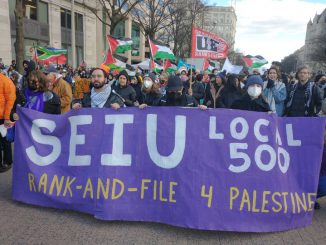
Details: Gather at Library Mall at UW Madison at 1 P.M. Speak out and march.
This emergency event is in direct response to the neo- Nazi “Blood Tribe” march and attempted recruitment rally that was held in Madison on November 18, 2023. This same terrorist organization menaced an LGBTQ community event in Watertown last year. Just some of the latest outrages in Madison/Wisconsin include:
– Recent Islamophobic and anti-semitic attacks in Madison;
– Unrelenting racist, bigoted, anti-worker attacks by the right-wing politicians in the state legislature against the UW system, BIPOC communities, LGBTQ communities, women, prisoners, Palestine and more. These attacks by the right-wing politicians (and their rich bosses) continue to create the climate for hate.
Our public institutions and public spaces are increasingly under severe attack from a well-funded and nationally organized network organized by fascists like the “Blood Tribe,” and the “Proud Boys.” And right-wing organizations such as the Milwaukee-based Bradley Foundation that oppose free thought, truth and diversity, worker’s rights, unions, safety laws, healthcare for all, environmental safety and any regulations that infringe on rich people’s profits.
Join us (and bring your friends, neighbors, fellow students and co-workers) on Feb. 10 to resist the hate and participate in this proactive action to continue building a stronger, more engaged people’s movement in Madison and beyond.
We Demand:
– The restoration of workers’ union rights in Wisconsin;
– Guaranteed access to quality healthcare and medical freedom for everyone;
– Full LGBTQ rights and legal protections against discrimination in healthcare, housing, employment, education, and all other arenas of life;
– Nazi-free streets;
– Investment in our communities not the systems of police and prisons;
– A free Palestine and the ceasing of all U.S. military spending and campaigns globally.
– The restoration of Indigenous land rights. We demand Land Back here and around the globe. System change not climate change!;
– Water is Life!
– An end to the economic, environmental, and military attacks that are driving global migration crises. No Human Being Is Illegal!;
– The human right to vote;
– Full Abortion Rights Now;
– Money for human needs (housing, public schools, healthcare, parks, infrastructure) not endless U.S. wars;
– An end to all fascist attacks against our communities;
– Hands off all public education from elementary to the UW System.
Only by getting organized and joining in unity with fellow workers and community members will we be able to stop the hate and build a people’s world of love and solidarity where we have bread AND roses.
Strugglelalucha256


Sekou Odinga, Black liberation fighter and former political prisoner, passes at 79

Odinga leaves behind a legacy of resistance, having helped Assata Shakur escape prison and having been a member of the most notable Black liberation organizations

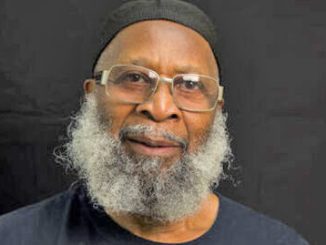
Sekou Odinga, a former United States political prisoner for 33 years stemming from his involvement in the Black liberation movement, passed away on January 12. Odinga was a part of several of the most impactful organizations in US Black liberation history, including Malcolm X’s Organization of Afro-American Unity, the Black Panther Party, and the Black Liberation Army. Odinga is also known for his role in the escape of fellow political prisoner Assata Shakur, who lives free in Cuba to this day.

Odinga was released from prison in 2014. Regarding his role in Shakur’s escape, he never pleaded guilty to charges but told Democracy Now! in 2016 that he was “proud to be associated with the liberation of Assata Shakur.”

Speaking about what drew him to the program of the Black Panther Party, Odinga told Democracy Now!, “What attracted me more than anything else was the stand against police brutality, because like all the other ghettos in this country or Black areas of this country, police brutality was running rampant. From my first memory of it was—in New York was little Clifford Glover, who was murdered out in my neighborhood in Jamaica, Queens…what we were really concerned about was trying to put some kind of control on the police, or at least be in a position that we could counter some of what they were doing.” Odinga’s words reflect the legacy of Black liberation movements throughout US history, which from the mass movement sparked by the murder of Emmett Till to the 2020 uprisings after the murder of George Floyd, share a common outrage at the brutal violence waged against Black people.

Nino Brown, an organizer with the Jericho Movement, an organization fighting for amnesty and freedom for the political prisoners of the US, told Peoples Dispatch, “We in the Jericho Movement were honored to host Sekou, break bread and learn from him so we can continue the fight against oppression and exploitation. He is known to many as ‘Baba Sekou’ and rightfully so.”

“While his life has ended his legacy lives on with all of his comrades and this next generation of revolutionaries,” Brown continued.

In 1965, Odinga joined Malcolm X’s Organization of Afro-American Unity, later leaving the organization to found the Bronx chapter of the Black Panther Party. In 1969, Odinga became a part of the group of BPP defendants dubbed the “Panther 21,” who were accused of planning coordinated attacks on two police stations and one education office in New York City. The trial eventually collapsed, following a grassroots campaign in support of the defendants.

Following the increasing police and FBI repression against the BPP, Odinga joined many activists in moving towards underground organizations, such as the Black Liberation Army.

Source: Peoples Dispatch

Strugglelalucha256


Massive march and rally in Washington: Stop the genocide in Gaza!

At least 400,000 people came to Freedom Plaza in Washington, D.C., on Jan. 13 to demand an end to the slaughter of Palestinian people. They gathered three blocks east of the White House where Genocide Joe Biden oversees the killing of thousands of children in Gaza. (He who pays the piper calls the tune.)

As people were coming to the capital of the blood-soaked empire, the U.S. Navy was again attacking heroic Yemen, one of the poorest countries on earth. Yemen’s crime is to turn ships around that were going to the Zionist state occupying Palestine as a way to stop the bombing of Gaza.  

The rally and the following march were a mass outpouring from the Arab and Muslim communities in the United States. They had many allies. Parents brought their children with them.

People carried signs in English, Arabic, Spanish, and other languages. A truck carried a banner reading “Sikhs for Palestine.”

Union contingents, including those from the American Postal Workers Union (APWU), lined up with their banners. APWU president Mark Dimondstein, who is Jewish, has demanded a ceasefire in Gaza.

Among the many groups that came was the People Power Assembly from Baltimore. Among the speakers was Indiana Rep. Andre Carson, one of three Muslims in Congress.

The massive event was organized by the American Muslim Task Force for Palestine. It includes American Muslims for Palestine (AMP), Council on American-Islamic Relations (CAIR), Islamic Circle of North America (ICNA), Muslim American Society (MAS), Muslim Student Association-National (MSA), Muslim Legal Fund of America (MLFA), Muslim Ummah of North America (MUNA), and Young Muslims (YM). 

Participants carried thousands of flags. Most flags were Palestinian, but many were those of heroic Yemen. South African flags were also welcomed.

Nelson Mandela’s South Africa has righteously charged the Zionist apartheid regime with genocide. Mandela declared, “We know too well that our freedom is incomplete without the freedom of the Palestinians.”

The proceedings being held before the International Court of Justice have put a spotlight on Israel’s mass murder, paid for by the United States.

Two days after the rally would have been the 95th birthday of Dr. Martin Luther King Jr. 

Dr. King was assassinated exactly one year after he declared that the United States was “the greatest purveyor of violence in the world.”

Joe Biden and the Pentagon are still the greatest purveyors of violence. They are Israeli Prime Minister Netanyahu’s paymasters and bosses. 

People from Yemen and South Africa to the United States will stop the genocide in Palestine!


Strugglelalucha256


Luxemburg-Liebknecht memorial: Police in Berlin attack Palestine solidarity activists

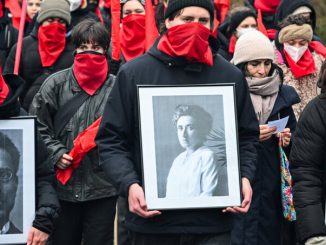
“Viva Palestine” could be heard from afar during the kilometer-long demonstration that marched under red flags to the Socialist Cemetery. Israel’s war against Gaza was the dominant theme at the traditional memorial demonstration for Karl Liebknecht and Rosa Luxemburg, the co-founders of the Communist Party of Germany who were murdered by right-wing Freikorps soldiers 105 years ago, on Jan. 14 in Berlin.

Solidarity with Palestine was also the trigger for brutal police attacks that left numerous people injured. First, a speaker from a block of mostly Palestinian demonstrators was arrested — the reason for this was the banned slogan “From the river to the sea, Palestine will be free,” a police spokesman told jW. After the arrest, contingents at the front of the demonstration turned around and the police were briefly pushed away.

Video: @redstreamnet

The frightening results of the subsequent use of batons and pepper spray by the helmeted state power: A 65-year-old man, run over by the police, lay unconscious on the ground and bleeding from his mouth and nose. According to demonstration paramedics, 15 other demonstrators also had to be treated in hospital with injuries, some of them serious, such as broken bones. The police, however, spoke of attacks on officers during the demonstration, with 21 police officers injured.

“I’m glad that the other demonstrators immediately showed their solidarity with us. This is where our strength lies,” a Palestinian activist named Walid told jW.

According to the police, among the 16 demonstrators arrested are several musicians from Turkey’s Grup Yorum, who are currently on a hunger strike for comrades imprisoned in the Federal Republic of Germany.

According to the organizers, more than 10,000 people took part in the demonstration. In addition to contingents from German Communist Party (DKP) and Socialist German Workers Youth (SDAJ), Marxist-Leninist Party of Germany (MLPD), Trotskyist groups and socialist parties from Turkey and Kurdistan, left-wing trade unionists and neighborhood initiatives, what was noticeable was the strong participation of mostly young supporters of Marxist-Leninist organizations, dressed in black and in orderly formations among a sea of ​​red flags. “Road free for the red youth,” “Youth, future, socialism” and “With Rosa and Karl against war and capital” were heard from these blocks.

With the banner “Defend revolutionary history! Attack German warmongers!” and images of Luxemburg, Liebknecht and Lenin, who died 100 years ago, the “Perspective Communism” movement made it clear that commemoration is not a nostalgic end in itself. This is also how Sevda Karaca, a member of the Labor Party (EMEP) in the Turkish parliament, sees it. “Rosa Luxemburg and Karl Liebknecht are revered worldwide as champions of socialism,” Karaca told this newspaper at the Socialist Cemetery. “In times when fascist ideas are increasing worldwide, it is particularly important that we reflect on the roots of our resistance.”

Even before the demonstration arrived, thousands of people, including the leadership of Die Linke party, had taken part in a “silent commemoration.” The murdered labor leaders were honored at their graves with red carnations and wreaths.

Solidarity with the Palestinian struggle for freedom, the call for peace and the need for socialism also played a central role at the 29th International Rosa Luxemburg Conference. The conference organized by this newspaper took place on Jan. 13 in the Berlin Tempodrom with a new record attendance of 3,700 visitors.

Translated by Melinda Butterfield

Source: junge Welt


Strugglelalucha256


Thousands shut down Port of Oakland, demand ceasefire, end U.S. support of genocide in Gaza

Saturday, January 13, 2024
*** FOR IMMEDIATE RELEASE ***
For press inquiries, please contact
Wassim Hage, wassim@araborganizing.org

Thousands shut down Port of Oakland, demand ceasefire and an end to U.S. support of genocide in Gaza

Organizers declare initial victory in halting all port operations

For visuals of the action, click here.

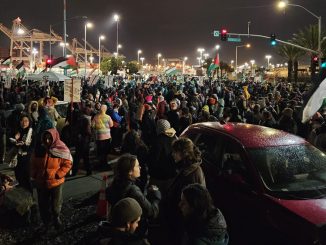
Oakland, CA – Starting at 5 a.m. this morning, over 2500 community members disrupted the majority of Port of Oakland operations today to demand an end to U.S. economic and military support of Israel’s genocidal bombing campaign in Gaza. This port shutdown comes as the death toll of Palestinians in Gaza has reached over 30,000, including over 9,000 children, and genocide proceedings against Israel are taking place at the International Court of Justice in The Hague, the UN’s highest court.

Along with the massive turnout of community members showing up to protest the ongoing war on Gaza, the Oakland Port Authority also called off business that was scheduled at the docks for the morning shift in anticipation of community turnout, effectively shutting down the port. Organizers have declared an initial victory and are vowing to return to the port at 2 p.m. to shut down any business as usual for the afternoon shift.

“The Oakland port has facilitated the transport of weapons, military equipment, and technology that fuel the Israeli slaughter of Palestinians. As long as the U.S. enables this war with our tax dollars and through our port, there can be no business as usual,” says Lara Kiswani, Executive Director of the Arab Resource and Organizing Center. ”Every day, around $12 million in revenue is generated at the Port of Oakland. This is nearly the same amount of money that the U.S. sends to Israel per day in economic and military aid. Today we are shutting it down to make it clear that we will not sit by as the U.S. government is complicit in genocide.”

In early November, hundreds of protestors disrupted the loading and departure of a military vessel used to supply Israel with military equipment and technology. The vessel has returned and is currently docked, though its future deployment plans are unclear.

“The U.S. can end the war on Gaza tomorrow by demanding a permanent ceasefire. Instead, Biden is making the massacre of Palestinians possible by sending billions of dollars of U.S. military aid to Israel, as the only thing this country cares about is profit with no regard to human life,” said Cat Brooks, Co-founder and Executive Director of the Anti Police-Terror Project. “By shutting down one of the busiest ports in North America, we are hitting them where it hurts, and will do so until a ceasefire is implemented, until the U.S. stops funding the apartheid state of Israel, and until Palestine is free.”

The Israeli war on Gaza is funded and supplied in large part by the U.S. government. In November of last year, Bay Area community members turned out to block a U.S. military vessel, the Cape Orlando, which departed to supply Israel with weapons and military equipment for use in Gaza. The vessel was then met with protests in Tacoma, Washington, where weapons were loaded on the ship. The ship is scheduled to return back to the Port of Oakland, and community members are demanding that Oakland stop aiding in the transport of war machinery and the U.S. stop its military support for Israel’s war on Gaza

The Port of Oakland is a frequent site of protests that target war profiteers, and actions at the port, taken by workers and Bay Area communities alike, have a long connection to social justice struggles.

Questions and comments may be sent to info@freedomarchives.org

Strugglelalucha256


‘We’ve learned power’ from labor – MLK on Longshore Union solidarity

If Martin Luther King Jr. still lived, he’d probably tell people to join unions.

King understood racial equality was inextricably linked to economics. He asked, “What good does it do to be able to eat at a lunch counter if you can’t buy a hamburger?”

Those disadvantages have persisted. Today, for instance, the wealth of the average white family is more than 20 times that of a Black one.

King’s solution was unionism.

Convergence of needs

In 1961, King spoke before the AFL-CIO, the nation’s largest and most powerful labor organization, to explain why he felt unions were essential to civil rights progress.

“Negroes are almost entirely a working people,” he said. “Our needs are identical with labor’s needs – decent wages, fair working conditions, livable housing, old age security, health and welfare measures, conditions in which families can grow, have education for their children and respect in the community.”

My book, “Dockworker Power: Race and Activism in Durban and the San Francisco Bay Area,” chronicles King’s relationship with a labor union that was, perhaps, the most racially progressive in the country. That was Local 10 of the International Longshoremen’s and Warehousemen’s Union, or ILWU.

ILWU Local 10 represented workers who loaded and unloaded cargo from ships throughout San Francisco Bay’s waterfront. Its members’ commitment to racial equality may be as surprising as it is unknown.

In 1967, the year before his murder, King visited ILWU Local 10 to see what interracial unionism looked like. King met with these unionists at their hall in a then-thriving portside neighborhood – now a gentrified tourist area best known for Fisherman’s Wharf, Pier 39.

While King knew about this union, ILWU history isn’t widely known off the waterfront.

Civil rights on the waterfront

Dockworkers had suffered for decades from a hiring system compared to a “slave auction.” Once hired, they routinely worked 24 to 36 hour shifts, experienced among the highest rates of injury and death of any job, and endured abusive bosses. And they did so for incredibly low wages.

In 1934, San Francisco longshoremen – who were non-union since employers had crushed their union in 1919 – reorganized and led a coast-wide “Big Strike.”

In the throes of the Great Depression, these increasingly militant and radicalized dockworkers walked off the job. After 83 days on strike, they won a huge victory: wage increases, a coast-wide contract and union-controlled hiring halls.

Soon, these “wharf rats,” among the region’s poorest and most exploited workers, became “lords of the docks,” commanding the highest wages and best conditions of any blue-collar worker in the region.

At its inception, Local 10’s membership was 99 percent white. But Harry Bridges, the union’s charismatic leader, joined with fellow union radicals to commit to racial equality in its ranks.

Originally from Australia, Bridges started working on the San Francisco waterfront in the early 1920s. It was during the Big Strike that he emerged as a leader.

Bridges coordinated during the strike with C.L. Dellums, the leading black unionist in the Bay Area, and made sure the handful of black dockworkers would not cross picket lines as replacement workers. Bridges promised they would get a fair deal in the new union. One of the union’s first moves after the strike was integrating work gangs that previously had been segregated.

Local 10 overcame pervasive discrimination

Cleophas Williams, a black man originally from Arkansas, was among those who got into Local 10 in 1944. He belonged to a wave of African-Americans who, due to the massive labor shortage caused by World War II, fled the racism and discriminatory laws of the Jim Crow South for better lives – and better jobs – outside of it. Hundreds of thousands of blacks moved to the Bay Area, and tens of thousands found jobs in the booming shipbuilding industry.

Black workers in shipbuilding experienced pervasive discrimination. Employers shunted them off into less attractive jobs and paid them less. Similarly, the main shipbuilders’ union proved hostile to black workers who, when allowed in, were placed in segregated locals.

A few thousand black men, including Williams, were hired as longshoremen during the war. He later recalled to historian Harvey Schwartz: “When I first came on the waterfront, many black workers felt that Local 10 was a utopia.”

During the war, when white foremen and military officers hurled racist epithets at black longshoremen, this union defended them. Black members received equal pay and were dispatched the same as all others.

For Williams, this union was a revelation. Literally the first white people he ever met who opposed white supremacy belonged to Local 10. These longshoremen were not simply anti-racists, they were communists and socialists.

Leftist unions like the ILWU embraced black workers because, reflecting their ideology, they contended workers were stronger when united. They also knew that, countless times, employers had broken strikes and destroyed unions by playing workers of different ethnicities, genders, nationalities and races against each other. For instance, when 350,000 workers went out during the mammoth Steel Strike of 1919, employers brought in tens of thousands of African-Americans to work as replacements.

Some black dockworkers also were socialists. Paul Robeson, the globally famous singer, actor and left-wing activist had several friends, fellow socialists, in Local 10. Robeson was made an honorary ILWU member during WWII.

Martin Luther King, union member

In 1967, King walked in Robeson’s footsteps when he was inducted into Local 10 as an honorary member, the same year Williams became the first black person elected president of Local 10. By that year, roughly half of its members were African-American.

King addressed these dockworkers, declaring, “I don’t feel like a stranger here in the midst of the ILWU. We have been strengthened and energized by the support you have given to our struggles. … We’ve learned from labor the meaning of power.”

Many years later, Williams discussed King’s speech with me: “He talked about the economics of discrimination. … What he said is what Bridges had been saying all along,” about workers benefiting by attacking racism and forming interracial unions.

Eight months later, in Memphis to organize a union, King was assassinated.

The day after his death, longshoremen shut down the ports of San Francisco and Oakland, as they still do when one of their own dies on the job. Nine ILWU members attended King’s funeral in Atlanta, including Bridges and Williams, honoring the man who called unions “the first anti-poverty program.”

Source: The Conversation

Strugglelalucha256


Yemen: An indomitable people (part 2)

The transnational mainstream media have planted the narrative that Ansarallah act under the influence of the Iranian government. While neither Iran nor Ansarallah has denied being part of an axis of resistance against imperialism, colonialism, and Zionism, an axis that also incorporates political forces from Lebanon, Syria, Bahrain, and Palestine itself, simplifying the equation to a relationship of “subordination” is both superficial and banal, given the Yemeni people’s own history of struggle.

In West Asia, the growing aggressiveness of “Israel” and the interventionist presence of the United States have been polarizing the political situation. Iran’s recent agreement to settle differences with Saudi Arabia, as well as other agreements that have brought Egypt and Turkey, Qatar and Saudi Arabia, among others, closer together after years of estrangement, in addition to the stagnation of the war in Yemen—all point to the weakening of the imperialist-Zionist pole and the strengthening of the resistance.

In this context, by history and geographical location, the role of Yemen and the Ansarallah movement is decisive. It is worth noting that Ansarallah has never hidden its relationship with Iran. They are united by their common belonging to the Shiite branch of Islam. Both the founder of the Ansarallah movement and his brother, who leads it now, spent part of their lives in Qom (Iran), training politically and ideologically while studying the Shiite current, based on the idea that the legitimate succession of Mohammed belongs to the descendants of his son-in-law Ali, as opposed to the Sunnis who believe that the successors of Mohammed should be the companions of the prophet. Sunni comes from “Ahl al-Sunna,” which translates as “the people of tradition,” and Shia comes from “Shiat Ali,” which means “the party of Ali.”

But this does not mean that Yemenis are mere “accessories” of Iran. Beyond the financial, military, communications, and political support it has received from Tehran, the Ansarallah movement has demonstrated autonomy and self-determination in the design and execution of its actions both in the war against Saudi Arabia and its allies since 2015 and now in supporting the Palestinian cause.

In addition to its aid to Palestine, Yemen has a direct conflict with Israel for the support that the Zionist entity gave to the United Arab Emirates (UAE) during the war of 2015 that allowed it to occupy the strategic Yemeni islands of Socotra, located in the Arabian Sea, about 350 kilometers south of Yemen’s coasts. In Socotra, the entity has established a series of spy bases for gathering information throughout the region, and in particular in the Bab el-Mandeb Strait.

The UAE-Israel base in Socotra also benefits the United States because through this base the U.S. controls the Gwadar port in Pakistan which is also part of the China-Pakistan Economic Corridor (CPEC). The Gwadar port was developed by China so that goods unloaded there could be shipped overland to China, especially to its western region.

As for the current events, Yemen’s actions in support of Palestine began almost immediately after October 7. On October 19, a U.S. Navy ship shot down missiles and drones fired by Ansarallah against Israel, according to Pentagon information released at the time.

A few days later, on October 27, six people were injured when two drones fell in Taba, an Egyptian town bordering Israel, after being intercepted by the Israeli air force. On October 31, Ansarallah claimed a drone strike against the Zionist entity. The “Israeli” army reported intercepting a missile launched from the south.

Ansarallah military spokesperson General Yahiya Sa’ari announced in a televised statement that the organization had launched a large number of ballistic missiles and drones toward “Israel” and that there would be more attacks in the future “to help the Palestinians achieve victory.” In response, Israeli National Security Adviser Tzachi Hanegbi said that the Ansarallah attacks were intolerable but declined to elaborate when asked how “Israel” would respond.

In mid-November, Ansarallah announced that its armed forces would attack all ships sailing under the Israeli flag or operated or owned by Israeli companies or sailing to Israeli ports. A few days later, General Sa’ari announced that the Yemeni armed forces would prevent ships of all nationalities bound for Israeli ports from sailing in the Arabian Sea and the Red Sea until the food and medicine needed by the Palestinians in the Gaza Strip were allowed to enter the war-devastated enclave.

In view of this announcement and following the first attacks on ships bound for Israel, four major shipping companies: the world’s largest container line, Swiss-based Mediterranean Shipping Co. (MSC), Denmark’s Maersk, France’s CMA CGM, and Germany’s Hapag-Lloyd suspended the passage of their vessels through the Red Sea. These companies transport approximately 53% of the world’s maritime containers and about 12% of world trade in terms of volume. It should be noted that 30% of the world’s container traffic passes through Bab al-Mandeb.

In response, on December 19, the United States proposed to create a naval alliance in order to launch an operation called “Prosperity Guardian,” presumably dedicated to “ensuring freedom of navigation in the Red Sea.” In practice, this meant declaring war on Yemen and militarizing the Red Sea. But Yemen has remained unbowed in its position. Its armed forces have asserted that “any attack on Yemeni assets or Yemen’s missile launching bases would stain the entire Red Sea with blood,” claiming that they possess “weapons to sink your aircraft carriers and destroyers.”

The escalation of actions since then has been evident. On December 20, the leader of Ansarallah, Sayyed Abdul Malik Al-Houthi, emphasized in a speech that the responsibility of the Islamic world, and especially the Arab world, for the conflict in Palestine, was great, for being “the heart of that world.” In this regard, he deplored the Islamic-Arab position in the summits held to discuss the issue, especially the one held in Saudi Arabia. Al-Houthi characterized that view as weak. He noted that there should be a commitment by the Arab and Muslim peoples to support Palestine and criticized the focus of some countries on the “conspiracy against Palestine.” The Yemeni leader said that his nation did not expect from the United States and European countries a positive position or role towards Palestine. For these reasons, he considered that the perspective of the axis of resistance should be aimed at raising the level of military support for Palestine.

In this framework, Al-Houthi warned that Ansarallah would attack U.S. warships if Yemeni forces were attacked by Washington after the launching of Operation Prosperity Guardian. According to Al-Houthi, the U.S. is not trying to protect world shipping but is seeking to militarize the sea.

However, the United States could not reach a consensus with its “allies” about the naval alliance. Disagreements were generated with the Arab countries that were called to join the coalition, which has hindered a coherent response to the Yemeni attacks on ships transiting the Red Sea. Two key regional countries involved in the long-running U.S. war against Yemen—the United Arab Emirates and Saudi Arabia—expressed opposition, which has been a major obstacle to the U.S. plan to end the maritime attacks. The final course of action considered by Washington is a military response to Ansarallah, but some Arab allies have refused to join. Instead, they prefer the diplomatic route and the reinforcement of maritime protection for ships.

Analysts consulted on the matter agree that the objectives of the proposed U.S. operation are vague as the naval chiefs have not been given precise missions. Moreover, the coalition ships, although equipped with advanced weaponry, can only limit themselves to repel missile attacks, escorting merchant ships with warships, which is questionable since Yemen’s missile arsenal is inexhaustible in light of the actions undertaken in the last eight years. “Neither the management of the world shipping companies, nor the captains of merchant ships, nor the insurers will be willing to play this lottery,” stressed Ilya Kramnik, a Russian expert on naval forces.

Similarly, Michael Horton, co-founder of Red Sea Analytics International, an independent consulting firm dedicated to providing unbiased analysis of security dynamics in the Red Sea, noted that Ansarallah “has only deployed a fraction of its weapons and has not used longer-range missiles more advanced drones, and hard-to-detect sea mines.”

In this situation, U.S. Vice Admiral Kevin Donegan noted that “the United States has also been accepting as normal the persistent attacks… by the Houthis.” According to the New York Times, this has forced President Biden to face a difficult choice related to future deterrence plans for Ansarallah. He must consider that Saudi Arabia is not seeking an escalation of the conflict that could scuttle a hard-negotiated truce. Tim Lenderking, U.S. special envoy for Yemen, stated in mid-December that “everyone is looking for a formula to reduce tensions.”

On the other side of the conflict, on December 24, the commander of the Iranian Revolutionary Guard Corps, Major General Hossein Salami, announced that Israel would face a total naval blockade if the Mediterranean Sea, the Strait of Gibraltar, and other waterways were closed. To date, Yemen has already been able to blockade almost in its entirety the Israeli port of Eilat, located on the Red Sea, which is operating at only 15% of its capacity. Ansarallah armed forces were also able to hit an Israeli ship deep in the Arabian Sea, near India, at a great distance from Yemeni territory. Meanwhile, Iran has drones and long-range hypersonic missiles, which, in the event of an all-out war against Zionism, could easily target commercial ships moving through the Mediterranean towards Israeli ports.

Moreover, in preparation for a combat of other dimensions against Israel, the Yemeni armed forces announced that it has 20,000 reservist soldiers trained and ready to fight alongside the country’s armed forces against the Zionist entity and the coalition led by the United States.

On December 28, Yemen warned the United States and its partners about the militarization of the Red Sea and stated that it would intensify its attacks against its enemies if the blockade of Gaza continued. In this context, a day earlier, the top commanders of the Yemeni Armed Forces met to discuss the latest regional developments and review the combat readiness of the troops. At the end of the meeting, they expressed their readiness to carry out the orders of the Ansarallah leader. On January 4, after a Yemeni naval contingent came face-to-face with U.S. military forces in the Red Sea, in which the Yemeni side lost three boats and 10 fighters, the commander of the Yemeni Coastal Defense Forces, Major General Muhammad Al-Qadiri warned that Yemen would respond by determining the target in each case on the islands, in the Red Sea, and at “the bases where the Zionists and the Americans are stationed.”

If the U.S. and its alliance eventually decide to directly challenge Ansarallah in the Red Sea, they will face a vast naval war from the Gulf of Aden, the Arabian Sea, and the Indian Ocean. It would unleash an unstoppable spiral of confrontations of incalculable dimensions.

In any case, Yemen has already been able to use its strategic position as a force in the global scenario and to impose itself as an important player in the ongoing confrontation and to express one of the most courageous forms of support for the Palestinian people facing the Israeli war machine supported by the United States and Great Britain, constituting an important pressure card against Zionism and its U.S. mentor.

Controlling the Suez Canal means controlling 90% of global trade, directly affecting Israel by hitting its economy. In this sense, Ansarallah has been able to do what Israel and the United States have tried to avoid at all costs until now: “to turn the genocide in Gaza into a global crisis.”

Lebanese journalist Khalil Harb, citing the World Bank, stated in an article for The Cradle that Israel imports and exports almost 99% of its goods by river and sea, and more than half of its GDP depends on trade in goods.

Brazilian journalist specialized in international politics, Eduardo Vasco, pointed out that in addition to the direct impact that the Ansarallah movement is causing in West Asia, its actions are “paralyzing the world economy, that is to say, the very functioning of the capitalist regime, which is at the root of the war of aggression in the Middle East.” Vasco is of the opinion that the United States and Israel are limited in carrying out a direct attack on Yemen because there could be retaliation against U.S. allies in the region, “mainly against their oil fields, which would brutally aggravate the economic crisis with an oil crisis, which has already begun. For this reason, while the UAE wants strong action against Ansarallah, the Saudis are cautious.”

At the close of this article came the information that Yemen had attacked a U.S. ship carrying supplies to Israel, thus responding to the recent U.S. attacks against Yemeni naval forces.

Moreover, responding to the statements of U.S. Secretary of State Anthony Blinken, Yemen’s Deputy Foreign Minister Hussein Al-Ezzi confirmed “the safety of navigation to all destinations except the ports of occupied Palestine,” categorically discarding the fake news disseminated by Washington, London, and Berlin regarding the safety of navigation.

All these actions show the capacity and determination of the Yemeni people to take a leading role against Israel’s war on Palestine. In fact, they make it clear that, despite being a small country, globally and regionally marginalized from economic development, they have a will to fight that expresses the millenary sentiment of existing as an independent nation, challenging the U.S. by putting obstacles and impediments to the imperial execution of its policies in the region.

Source: Resumen Latinoamericano Translation: Orinoco Tribune

Strugglelalucha256


Yemen: An indomitable people (part 1)

In 2015, Yemen, a country unknown to many in the West, started a war in defense of its sovereignty that was being threatened by an interventionist alliance led by Saudi Arabia.

The Yemeni people had to pay for the lives of almost 400,000 of their children to maintain their independence. Many people have wondered how a country considered the poorest in Western Asia has been able to resist and defeat a coalition made up of some of the richest countries on the planet.

Although the conflict has continued for almost a decade, it appears to have reached a situation that could lead to its possible cessation. Although a tense situation and war conditions of different kinds remain, there has been a reduction in military actions in recent months. It is no longer a total war, but it is not a real peace either. Under the mediation of China, Saudi Arabia and Iran reconciled, paving the way for overcoming several conflicts in Western Asia and North Africa. Hopefully, Yemen is one of them.

Now, after the “Israeli” invasion of Gaza, Yemen, together with the Lebanese Hezbollah movement and other Arab and Muslim revolutionary forces, has taken an active role in the solidarity campaign with Palestine. Once again, Yemen has surprised everyone by making decisions that have not only a local impact but also a regional and global one. Once again, the world is wondering how this could have happened. In two installments, I am going to present some elements so that readers can get to know Yemen and learn about the historical struggle and the heroism of its people to understand the scope and dimension of the Yemeni decision to support, with all the resources at its disposal, the just struggle of the Palestinian people.

The Republic of Yemen is located in a strategic place, in a region where trade routes connect Asia, eastern Africa, and the Mediterranean. Its territory, located on the coasts of the Arabian Sea and at the gates of the Red Sea, overlooks the Bab el Mandeb Strait, placing it in a privileged place on the globe, especially since the 20th century when, on the one hand, large deposits of oil and gas were discovered in the region, and on the other it became a mandatory passage for most of world trade between the West and the enormous economic growth and development of East Asia.

The ancient cities of the territory were part of the biblical kingdom of Sheba in ancient times. From that time began the struggle of the inhabitants of the current Yemeni territory for their liberation and independence, as they had to face the Roman Empire in the 1st century AD. The powerful Roman Empire was defeated in its attempt to dominate Yemen.

Unlike the rest of the Arabian Peninsula, Yemen had prodigious vegetation that provided great wealth to its population due to the great possibilities for consumption and trade it offered. Thus, the Greek mathematician Ptolemy named Yemen “Happy Arabia.”

Over the course of history, the Yemenis had to fight with Jewish Himyarites, who persecuted the majority Christian population until the intervention of the Ethiopians in the 6th century. When Islam arrived in the region during the 7th century, it began to shape a culture that was based on the interweaving of varied cultural and scientific knowledge and would make great contributions to humanity.

However, for many centuries, Yemen remained outside the cultural and economic development established by Islam. It was in the 15th century when the territory of today’s Yemen began to gain strategic value. In their desire for commercial expansion, the Europeans began the domination of territories throughout the world. The first Europeans to arrive in Yemen were the Portuguese, who dominated the country to control the sea route that allowed them to trade spices from Asia to Europe through the Red Sea.

In the 16th century, the Ottoman Empire began occupying regions on the coast of the Red Sea, while the interior of the country and the southern coast remained independent, governed by the Zaydis. In 1634, the Ottomans were finally driven out of Yemen by the Zaydis. Soon after, the English made their appearance in the area, installing a post of the East India Company in the port of Moka on the Red Sea.

In the 19th century, the British expanded their presence by occupying the entire southwestern tip, settling in Aden, the best port in the region, in 1839. In 1872, the Turks were able to consolidate their dominance in the interior of Yemen, for which they settled de facto a hereditary monarchy in the name of a local imam. This division effectively split Yemen into two countries.

Around 1870, with the inauguration of the Suez Canal and the consolidation of Turkish rule over northern Yemen, Aden acquired new importance for British global strategy: it was the key to the Red Sea and, therefore, to the new canal.

At the beginning of the 20th century, Turkey and the United Kingdom marked a border between their territories, which became known as North Yemen and South Yemen, respectively.

During the First World War, Imam Yahya Mahmud al-Mutawwakil, who had already been the imam of the Zaydis since 1904, allied North Yemen with the Ottoman Empire. The defeat of the Turks allowed Yemen to regain its independence in November 1918. However, Great Britain, after recognizing the independence of Yemen in 1928, began a campaign to secure control of the entire south of the country, up to the border with Oman. By 1934, it controlled the territory and converted Aden into a protectorate, then, in 1937, into a colony. Once again, the Yemenis had to resort to armed struggle for independence. In 1940, the nationalist Free Yemen Movement emerged to fight against the control of the country by the imams who had allied themselves with Great Britain.

The fighting took separate paths in the north and south. In 1962, the Yemen Arab Republic was created in the north, while in the south, the National Liberation Front, created in 1963, took Aden in 1967 and proclaimed independence, starting a socialist revolution.

South Yemen was renamed the People’s Democratic Republic of Yemen. It closed all British bases in 1969 and took control of banking, foreign trade, and the naval industry, and undertook land reform. In foreign policy, it maintained a close alliance with the Soviet Union. It also promoted an open anti-Zionist struggle and support for the Palestinian people.

In October 1978, at a congress that enjoyed considerable support from the population, the National Liberation Front founded the Yemen Socialist Party. In December, the first popular election since independence was held to appoint the 111 members of the People’s Revolutionary Council.

From the first years of its existence, the People’s Democratic Republic of Yemen was subjected to constant hostility from Saudi Arabia, which aspired to control parts of the territory in which oil deposits had been discovered. Tensions were aggravated by the growing U.S. military presence in Saudi Arabia.

Meanwhile, in the north, the National Democratic Front (NDF), which brought together all the progressive forces in the country, was leading the armed struggle against Ali Abdullah Saleh, who became president in 1978. When the NDF was about to take power, Saudi Arabia plotted to divert the conflict into a war against the Democratic People’s Republic of Yemen. The mediation of some Arab countries led to a ceasefire and an agreement by which negotiations for reunification, suspended since 1972, were resumed.

Finally, on May 22, 1990, the two republics united to form the Republic of Yemen, which established Sana’a, the former capital of the Yemen Arab Republic, as the political capital, while Aden (the former capital of the People’s Democratic Republic of Yemen) was designated as the economic capital. In a joint session of the Legislative Assemblies of the two held in Aden, a Presidential Council led by General Ali Abdullah Saleh was elected. The unification of Yemen was not received well by Saudi Arabia. Consequently, the Saudis began a policy of supporting infighting and secession. In May 1994, secessionists proclaimed a Yemeni republic in the south of the country but were defeated by forces loyal to the government.

Between June and August 2004, a movement emerged that expressed the beliefs of a specific branch of Shiite-oriented Islam: the Zaydis, under the leadership of the cleric Hussein al-Houthi. Following his martyrdom in September of that year, the movement took the name Houthi, Huthi, or Ansarallah (supporters of God). The history of Zaydism is over a millennia old and it dates back to the mid-8th century. Zaydism is a branch of Islam that emphasizes the struggle for justice and human responsibility in achieving that justice. It believes that Muslims have an ethical and legal obligation by their religion to rise up and depose unjust leaders including unrighteous sultans and caliphs. This ideology, which was marginalized after losing power in 1962, formed the basis of Ansarallah’s political and religious thought.

Ansarallah’s fight against the pro-Western and pro-Saudi government of Ali Abdullah Saleh was long and bloody. They had to resort to arms on five occasions between 2006 and 2008 in defense of their territory in the north of the country until they began to expand their support base and the geographical space under their control. In 2009, Saleh formed an alliance with the Saudis to combat the growing Ansarallah Movement.

For Ansarallah, the fact that a country like Saudi Arabia with an extremely conservative Wahhabi current was present and interfered in the country’s affairs was seen as a threat to the sovereignty of the nation in general and particularly to their existence as a minority. From that moment on, their struggle, which had originally been strictly internal, became a confrontation against foreign intervention.

Although at first, the Ansarallah fighters suffered heavy defeats, including (as mentioned before) the fall of their top leader, they grew stronger over time. From 2011 onwards, under the leadership of al-Houthi’s younger brother, Abdul Malik, the Ansarallah Movement began to claim significant victories and inflict significant setbacks on the enemy. The anti-imperialist and anti-Zionist rhetoric was strengthened by identifying Saudi Arabia as the dominant partner of the United States and “Israel” in the area.

The so-called “Arab Spring” had a special influence on the growth of support for Ansarallah in their fight against Saleh’s repressive government. In Yemen, the political earthquake that shook a significant part of the Arab world had a much more organized response than in neighboring countries. Faced with the strength of the protests, Saleh fled the country and took refuge in Saudi Arabia, being replaced by his vice president, Abdo Rabu Mansur Hadi, who tried to bring order to the country by reaching an agreement with factions opposed to Saleh “to change everything without changing anything,” leaving out the Ansarallah movement.

At the end of 2014, Ansarallah decided to begin the offensive to reclaim the capital, Sana’a. In this context, Saleh — surprisingly, in an attempt to regain power — established an alliance with Ansarallah to confront Hadi. Ansarallah, which had not supported the peace agreements signed by Hadi, allied themselves with their greatest enemy to take the capital. The Republican Guard, a force loyal to Saleh, favored the entry of Ansarallah into Sana’a. Hadi fled to Riyadh, the Saudi capital, from where he “runs” the territories not yet controlled by Ansarallah. In reality, Hadi is a puppet of the Saudi Wahhabi monarchy and its masters in Washington.

Once in power, the Ansarallah Movement formed a Revolutionary Committee to run the country. They were forced to fight simultaneously with the terrorist forces of Al Qaeda, with Saudi Arabia that protects them, and a coalition of other Gulf countries. All these enemies were armed and supported by the West, primarily the U.S., Britain, and Germany.

Saleh considered that Ansarallah had not fulfilled the agreements that, according to him, meant that he had to assume power again, and with Saudi support, he turned against them. Following this betrayal, Ansarallah attacked Saleh’s house, executing him on the spot.

From Riyadh, Hadi called for Saudi intervention in Yemen. To fulfill this request, the Saudi monarchy organized a coalition of Sunni countries to launch the Decisive Storm operation in 2015. This operation relied on air attacks against all populated areas of North Yemen and killed many thousands of people.

This action was planned as a definitive offensive to take control of the country and was followed by a second operation called Restore Hope which was focused more on diplomatic rapprochement. In reality, the war did not cease at any time; on the contrary, the alliance’s land, air, and maritime actions were reinforced by a naval blockade that prevented the entry of international aid, plunging the country into the worst humanitarian crisis in world history until the current Zionist actions in Gaza were unleashed, both with explicit support from the United States.

Ansarallah, which had popular support and better knowledge of the terrain, began using guerrilla warfare tactics inspired—according to the movement—by the liberation struggle in Vietnam and the resistance movements in Latin America. The fighters of Ansarallah were incredibly effective against this invading army that lacked morale, discipline, and motivation for battle. The U.S.-led Saudi-UAE coalition soldiers, which included a very large contingent of mercenaries hired by private companies, have been unable to claim military victories.

Riyadh received heavy blows even in its own territory when Ansarallah’s combative operations struck deep into Saudi territory through an advanced attack system using drones and long-range missiles that hit armed forces barracks, oil refineries, and critical infrastructure works at great distances across the border.

Source: Al Mayadeen Translation: Orinoco Tribune


Strugglelalucha256


Struggle ★ La Lucha PDF – January 15, 2024

Get PDF here

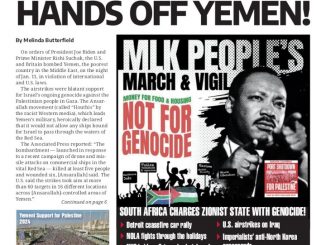
  • Hands off Yemen!
  • Charge the Zionist state with genocide!
  • Detroit ceasefire car rally shuts it down
  • Ralph Poynter used his strong voice and stout heart to fight for justice
  • NOLA fights for Palestine through the holidays
  • Shutting down New York City bridges and tunnels for Gaza!
  • Massive march for Gaza in Los Angeles
  • Biden’s illegal arms shipments kill Palestinian children
  • U.S. broadens imperialist terror campaign with flurry of airstrikes on Iraq
  • Israeli war crimes expose imperialists’ anti-North Korea propaganda
  • Activists link Gaza freedom to climate justice at COP28
  • 55th Anniversary of the Communist Party of the Philippines
  • Baja población Boricua
  • Vinie Burrows, una vida completa
Strugglelalucha256


NOLA: Come to City Hall Thursday, January 18, 10:30 AM

No Tax Break for Genocidal Shell!

Come to City Hall This Thursday, January 18, 10:30 AM

Demand a Public Hearing on the $21.6 Million Shell Oil Tax Giveaway

Let the People Decide!

Fund Housing, Healthcare, Education, Not Corporations Profiting From Genocide in Palestine

Join us this Thursday, January 18, at 10:30 a.m. at City Hall to demand that city council hold a public hearing on the $21.6 million in tax exemptions given to Shell and on the proposed River District neighborhood. Shell, the ninth richest corporation in the world, has reaped massive profits off the Israeli siege and bombardment of Gaza and continues to be one of the world’s largest polluters.
Keep the pressure on! Demand that city council cancel the tax exemptions and fund the people’s needs, not war-profiteering, planet-destroying companies like Shell!

Contact Us: workersvoicesocialistmovement@gmail.com


Strugglelalucha256
https://www.struggle-la-lucha.org/2024/01/page/4/