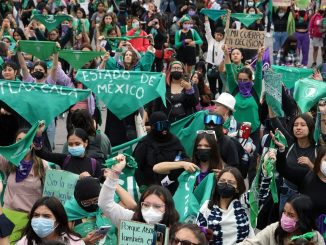
Louisiana protest: ‘AG Landry, you’re a crook! Kids deserve to read gay books!’

Protesters against Jeff Landry gather in the rain outside gubernatorial debate in Lafayette. Photo: Real Name Campaign

Sept. 15, Lafayette, Louisiana – This writer joined over 30 protesters against corrupt far-right gubernatorial candidate Jeff Landry. We gathered outside KLFY studios where the second gubernatorial debate was happening; Landry skipped the first one, claiming that debate hosts would not treat him fairly, and has generally skirted other interactions with his rival candidates.

The action was led by both cis and trans women. Participating organizations included Real Name Campaign NOLA, Reproductive Freedom Acadiana, Louisianahbrah, DSA Southwest Louisiana, and Socialist Unity Party.

Amanda Anderson, an organizer with Reproductive Freedom Acadiana, told the crowd, “Although we have these fascist, bigoted, corrupt politicians imposing restrictions on us, our state is in fact composed of diverse people, like the people that showed up here today. … We have the people, power, and persistence to protect and restore fundamental rights back to the people.”

Quest Riggs of Real Name Campaign said, “Do the majority of Louisianians want to oppress their neighbors? Hell no! Does Jeff Landry want to oppress the people of this state? Absolutely.”

We chanted, “AG Landry, you’re a crook! Kids deserve to read gay books!” When Landry came out, we got as close as we could, pummeling him with noise as he rushed to his vehicle and sped off. So long, janky Jeff! (Another popular slogan from the night.)

Anderson’s words about our diverse community ring true. I thoroughly enjoyed getting to know activists of many ages and backgrounds from across the state. We even had dinner together after the action, strengthening the feeling of solidarity. We are prepared to fight against the far-right, capitalist onslaught.

Who is Jeff Landry?

Landry is cut from the same cloth as Ron DeSantis of Florida and Greg Abbot of Texas, basing his campaign on targeting trans youth and other vulnerable groups. This is his only appeal since he has nothing to offer the state’s working class. He opposes raising Louisiana’s $7.25 minimum wage and even says there shouldn’t be a minimum wage.

This is the same man who sued to kick 700,000 Louisianaians off Medicaid. Apparently, he doesn’t care whether we live or die. Considering the following from The Gambit, we can sum up Landry’s attitude as “I got mine, screw you!”

“As Attorney General, Landry makes $104,942.72 a year — nearly four times the average income for Louisianans. He also has significant sources of outside income. According to Landry’s financial disclosure forms — which only require ranges of income, rather than specific amounts — in 2022 he made between $160,000 and $414,000 from outside sources. Landry also reported investment holdings — all of which are held in his wife’s name — worth as much as $2.4 million.”

As the state’s attorney general, he pushed for strict abortion bans. His office has come under fire – including in this debate – for attempting to track women seeking abortions out of state.

In close collaboration with the St. Tammany Parish Library Accountability Project, a de facto anti-LGBTQ+ group similar to the misnamed Moms for Liberty, Landry has gone after library books. The group’s founder and Landry associate, Connie Nichols Phillips, cost taxpayers in her parish $72,000 processing the 150 book challenges she submitted. 

The St. Tammany Parish Sheriff’s Department has issued a misdemeanor summons to Phillips, who appeared in a viral video assaulting a library supporter outside a parish council meeting.

Last year, it came to light that Landry spent more than $420,000 from campaign donors on his own staffing company. The above are only a few of his ongoing scandals.

Strugglelalucha256


Starbucks Worker Solidarity Day of Action

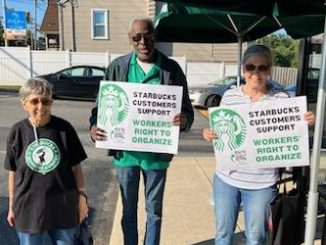
Although over 350 Starbucks Coffee stores around the country have voted to unionize, the company’s CEO and management have failed to come to the negotiating table to discuss workers’ concerns. Starbucks Workers United called for support actions on Sept. 14 for the morning rush hour.

Pictured here is the customer support action team at the Perry Hall, Maryland, store. Support team members collected 80% of the requested signatures during the hour-long petitioning effort. Team members were able to talk to customers as they waited in the drive-thru line, which continuously wrapped around the building the entire hour. There were only 7 workers staffing not only the drive-thru line but also the walk-in customers. 


Strugglelalucha256


Libya, devastated by U.S./NATO bombing, unprepared for extreme storm floods

Blame for the horrible flooding that has killed nearly 20,000 people in the city of Derna, with many thousands still unaccounted for in northeastern Libya, belongs squarely on the doorstep of Western capitalism and the U.S. imperialist military menace. The 2011 U.S.-led NATO war on Libya left the country in a weakened, vulnerable state. This catastrophe, the latest deadly extreme weather event, points more clearly to the link between unbridled U.S. capitalism and militarism and the struggle to mitigate the global warming crisis.

The pursuit of energy profits has been the Pentagon’s primary focus ever since the U.S. came out on top of the heap of imperialist powers at the end of World War II. The U.S. military and the various military alliances organized by the U.S. are huge emitters of greenhouse gases (GHGs.) 

A 2017 study by researchers at Brown University reported that “U.S. military emissions were greater than the GHGs of entire industrialized countries, such as Sweden, Denmark, and Portugal, and also greater than all CO2 emissions from U.S. production of iron and steel.” The U.S. military fought and won the exclusion of military emissions from the 1997 Kyoto Protocol counting process. Now, when lists show the GHGs of various countries, the count is skewed in favor of the U.S.

The GHGs of the Pentagon – shocking and criminal as the statistics may indicate – are not the most significant part of the military’s role in worsening global warming. The Pentagon’s role as the enforcer of imperialist domination, the plunder of nations, and the poverty that is imposed have left the Global South in such a vulnerable state compared to the big capitalist powers of the U.S., Europe, Japan, and Australia. 

The poverty of the Global South is not some natural event. It results from imperialist plunder and is maintained by the threat posed by the imperialist military.

Gaddafi led overthrow of U.S.-backed monarch

The catastrophe unfolding in Libya can’t be fully understood without considering the 2011 U.S.-led NATO assault. Muammar Gaddafi’s overthrow of U.S. ally King Idris in 1969 brought about a profound and positive transformation. Gaddafi took back much of the profit and control of the oil industry from Western companies, including British Petroleum, and took a share of foreign banks operating there. 

Soon, housing, hospitals, and universities were being constructed, and life expectancy and literacy rates shot up. Education was free and mandatory for all — including, for the first time in modern Libyan history, women. Roads and other infrastructure were built.

Libya became a magnet for people throughout the region — Palestinian refugees and thousands of others seeking a better life migrated to Libya and were welcomed. Gaddafi also threw out the British and U.S. militaries and shut down their bases.

None of this was taken lightly by the imperialist powers. In 2011, they found their moment to strike, taking advantage of uprisings against Gaddafi during the “Arab Spring” that had spread throughout the region. The White House was initially silent but then openly backed arms shipments from Qatar and UAE to counter-revolutionaries. 

Demonstrations soon became armed attacks against Gaddafi’s forces. The U.S.-armed counterrevolutionaries attacked Black Libyans in Tawergha and Black guest workers from Chad, Senegal, and other countries, lynching hundreds. The Obama/Clinton State Department didn’t object. When the Gaddafi forces successfully defended against the attacks, the U.S. organized a NATO assault that carried out nearly 10,000 airstrikes over seven months, about 46 every day for 222 days. Gaddafi was captured and murdered by the U.S.-supported reactionaries, and the vast improvements made in Libya have now been erased.

Critical response to capitalist climate change

The dams that collapsed last week were part of that wave of infrastructure improvements that had taken place in the 1970s. They didn’t exist during the long years of U.S.-backed King Idris’ reign. But Gaddafi had put engineers to work to protect people in northeastern Libya from frequent floods.

Storms originating in the Mediterranean were always a threat. But one of the effects of climate change — higher ocean temperatures — has intensified storms and, at the same time, slowed down their movement, sometimes sitting in place for days while dumping vast amounts of rain. Because crucial inspections and maintenance of the dams weren’t kept up after NATO’s murderous assault destroyed Gaddafi’s revolution, the dams were no match for the 22-foot high rush of water that smashed through them and plowed a quarter of the city of Derna into the Mediterranean.

The UN and various groups of scientists have repeatedly warned that the world is not on track to meet even the modest goals set at the Paris Climate talks. The U.S. proxy war against Russia has led to a dramatic increase in GHGs being emitted and opened more projects to extract oil.

Critical international conferences called the Conference of the Parties occur each year. COP28 begins on November 30 in the United Arab Emirates. At the last conference in Copenhagen, an agreement for a “loss and damage fund” was forced on the Western capitalist powers as anger boiled over. The intention was to address the culpability of the U.S. and other capitalist giants in global warming and force them to provide funds for adaptation to those countries that have been so exploited by imperialism that they haven’t the funds to evacuate populations, build stronger infrastructure, or recover when agriculture or industry is damaged. 

Of course, the fund hasn’t been put together yet, and it will be a point of contention at COP28. While they may not become part of the discussion in the United Arab Emirates, the slogans “Abolish the Pentagon” and “Down with U.S. imperialism” need to be popularized in the people’s movement to fight against global warming and fossil fuels.

Strugglelalucha256


When the auto workers went on strike in 1970: Revolutionary implications of the GM strike

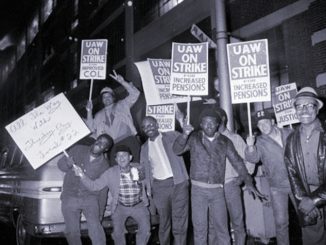
The last major auto strike in the U.S. started on September 15, 1970, when 400,000 workers at 145 factories walked off the job at GM — then the largest corporation in the world — for 67 days.

First published September 30, 1970. 

When a few dozen workers in a sweatshop first take fate in their hands and embark upon a strike, they have to go through a revolution in their own spirits; they have to take a chance on losing their livelihood altogether, especially if there has been no union in their shop before, and if they do not succeed in getting recognition from their boss.

That is why it is so hard to organize the workers even on the elemental level of joining together to prevent the heel of capital from grinding them down altogether, much less organizing to overthrow imperialism and establish socialism.

When workers lose even one hour’s wages, it is often too much of a sacrifice. Those who are eternally in debt, eternally paying for the washing machine, the furniture, or the family automobile, hesitate to take off a day when they are really quite ill; how do they feel when they must face a strike of weeks and possibly several months’ duration? Even when the worker is fully convinced of the necessity of a strike, his or her family is not necessarily convinced equally. And not many workers are equipped to answer the natural conservatism of the family that requires to be fed.

Then there are the workers who do not want to go on strike and must be prevailed upon to do it. They must be convinced and life being what it is under capitalism, sometimes they must be convinced in a rather summary way.

This process is repeated every day somewhere in American industry among the garment shops, novelty and toy producers, plastics factories, in the hospitals where more than a million “non-professionals” are hideously exploited both as to wages and conditions of work, in laundries, dry cleaning centers, many small parts producers; the list is endless.

But in the great scientifically organized aggregations of capital ― basic steel, auto, rubber, basic chemicals, big electronic and electrical companies, trucking, and other transportation―the workers have been unionized for over a generation. They have some of the same problems of the sweatshop worker, but they now have more power and, therefore, more confidence.

Rupture of the status quo

Their strikes resemble the others in this respect: Every strike, large or small, is potentially a revolutionary action. It is a rupture of the status quo in a way more profound than the actions of the most courageous and daring students against the police and the other instruments of imperialist oppression.

Whether the strike be in a sweatshop paying less than the general minimum of $1.60 per hour or in a huge industrial plant like General Motors, where the workers make $3.50 or more an hour and often make $200 a week by working long days and/or coming in Saturday and Sunday, it means a sacrifice for the workers and their families.

[Note: Using the Bureau of Labor Statistics “inflation calculator,” these September 1970 figures are roughly equivalent to the following August 2023 wages: You would need at least $12.53 per hour to match the buying power of the 1970 minimum wage of $1.60. And at least $27.41 an hour would be needed to match the $3.50 hourly wage for unionized auto workers. Yet the federal minimum wage today is only $7.25 per hour, and thousands of UAW workers in lower pay tiers at the Big Three automakers are making less than $27 per hour. This shows how much our class has been thrown back in the last 53 years. ― S.M.]   

This sacrifice does not arise from idealism but from desperation. It is the result of a long choked-up anger at the conditions of their exploitation, often subconscious but nevertheless intractable and ultimately explosive.

Against one ― against all!

It is revolutionary not because of its explosive character alone but because of its objective relationship to production and to the power of the ruling class.

The stopping of any part of American industry has some connection with all American industry. Just as any little street in any town in the United States is connected by other streets, roads, and highways to every other street in every city in the whole country, so every big and little factory is connected by mortgages, stocks, bonds, interlocking directorates, bank control and a hundred other financial devices to every other factory.

A strike against any large corporation (and particularly in the case of GM, the biggest industrial corporation in the world) calls into question the power of the kings of finance who own it and also raises the question of the power of the workers who produce all the profits. It also raises the question of government intervention because of the importance of that industry to the whole economy.

GM is the government

After all, the government itself is run by those who run General Motors and the other great corporations. This means a strike in GM could provoke a crisis in government, especially because of the present weakness in the economy as a whole. The economic crisis can be further affected by the international crisis in the Far East and the Mideast which is also the crisis of the corporations as well as their government not to mention the immediate threat of expropriation of U.S. companies in parts of Latin America. 

On the workers’ side, a strike raises the question of the power of the exploited against their exploiters; the question of their will to withhold their work versus the strength of the bosses to maintain a commodity system while not producing commodities. It raises the question of solidarity within the ranks of the strikers and solidarity in the broader ranks of the whole working class. It is true, of course, that the workers ask “only” for an increased wage. It is true that the workers are by no means ready to overturn capitalist production relations when they go on strike for a raise in pay, even though the company is sometimes willing to murder them rather than yield this increase.

The workers expect to accomplish their aims entirely within the system as it is presently constituted. This expectation is never wholly justified, however, since the workers’ struggle is itself a challenge to the system.

When 345,000 workers demand even a nickel an hour more than the corporation is willing to pay, this is $34.5 million a year. And the union is not asking for just a nickel more, but 24 cents more than GM has offered.

The revolutionary hunger

The better-paid American workers, Black as well as white, eat three meals a day, which is a good deal more than half the world gets. However, the motive force of revolution is not absolute hunger but almost always arises from the hunger to get what can be gotten and what the masses of people think their exploiters owe them.

This varies from country to country and from one historical period to another. The workers at General Motors are potentially just as revolutionary as any other group of workers or peasants in the world. They only need to get a fuller understanding of their own class position and to place the revolutionists within their ranks in the position of leadership. The future crisis of U.S. imperialism will do the rest.

Black people and the wheel of history

The question of the super-exploited, however, is related to the GM strike in a very intimate way, but a way that is only perceptible with an understanding of the history of U.S. Black liberation struggles. First, there are a very large number of Black people working for this company sometimes whole plants are all Black, such as the GM foundry in Tonawanda, New York. [Note: This plant was shut down in 1984 ― S.M.]

How did these Black workers get there and what is their strength against their present oppressor as compared to their strength under chattel slavery?

The 345,000 workers at GM are nearly twice the number of adult slaves in the whole state of North Carolina at the time of the Civil War. And the value of the entire cotton crop of the South was about $200 million in 1860, while the 1969 sales of this one capitalist corporation, General Motors, were about $24 billion120 times as much as the whole South’s product (if no allowance is made for the very great change in the dollar).

And that whole production has been entirely stopped by the workers something the whole Union Army couldn’t do to the Southern cotton crop in four years of the bloodiest war this country ever fought (in terms of U.S. lives lost).

Vehicle for Black vengeance

The chattel slaves of the South, in spite of constant attempts to rebel and occasional glorious insurrections like those of Nat Turner and the attempt of Denmark Vesey, could never get together to make a united push of their own and were compelled to settle for an unreliable alliance with Northern capital an alliance whose fate is now only too well known.

The very nature of separated plantation life determined this, rather than the ability of slaves to fight. Thousands of plantations had less than a dozen slaves, and the means of communication and transportation were slow and completely controlled by the masters. It was impossible to unite for the nationwide insurrection that was necessary.

But General Motors has brought thousands of Black workers together under one roof, so to speak, and has thus helped them to organize against the same capitalist class that betrayed them after the Civil War. It has literally summoned the Black people from the Southern countryside by a hundred mechanical eliminators of farm labor and has done almost the same thing in the North. It has thus helped them to understand their own strength and to use it. This is no credit to General Motors, which is merely a more efficient slave master than the plantation owners at least a hundred times more efficient.

The bureaucratic barrier

There are, of course, great barriers to the revolution at General Motors, among them most prominently the bureaucratic leadership of the workers’ union. The most glaring commentary on this leadership is the fact that in the 1930s, the really revolutionary organizing strikes of GM were conducted by seizing the plants and occupying them until the company gave in.

The workers were not as strong then as they are now. And hardly any Black people worked there at that time. Today, the workers are highly organized, and the Black workers are there in great numbers. Black workers in the auto industry have formed their own caucuses and, in Detroit, organized the League of Revolutionary Black Workers. They not only fight the racist bosses and union bureaucrats but are also militant in their demands for better working conditions and pay.

In the light of all this, the present strike seems rather tame. Yet, it has the potential of far surpassing the perspective of its bureaucratic leaders. The very fact that it happened at all is a testimony to that.

Generally speaking, the beginning of a strike is no time to begin criticizing the union bureaucracy, which has called it and is compelled to support it and even to extend it. But it is well worth noting that Ford and Chrysler practically dared the union to shut them down, too. (Partly because there was such an overproduction of autos last year.)

And, of course, union president Leonard Woodcock regarded that as a “provocation” and pretended not to listen. The UAW leadership has always taken the “one-at-a-time” line that they are playing off one company against the other because the companies are “competitors” ― concealing the fact that two or three big banks virtually own all of them.

Even if this were not so, however, it is often demoralizing to the workers to see others work while they are on the bricks, and for that reason alone, it is better to shut all the companies down together. But of course, the bureaucrats’ real fear is the fear of the workers’ own power and the possible confrontation with the forces that the labor-fakers themselves support the combined corporations and their government U.S. imperialism.

These are only some of the aspects of the GM strike aspects which are true of most other big strikes but they should be sufficient to show how deep is the need for the emergence of a revolutionary leadership among the rank-and-file GM workers and the U.S. working class.

Notes by Stephen Millies.

Strugglelalucha256


Battle with the Big 3 auto companies is on as UAW strikes all three in historic first

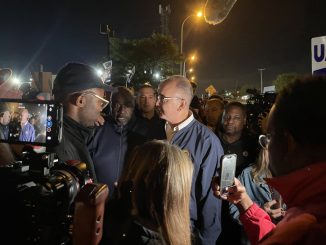
September 15 — At midnight, United Auto Workers struck the Big Three companies — Ford, GM, and Stellanis — in what is being called a “Stand Up Strike.”  Striking at all three companies simultaneously is a historic first for the auto workers union.  

In a letter to union members and supporters, UAW President Shawn Fain announced, 

“A few minutes ago, thousands of UAW members at Ford, GM, and Stellantis walked out, marking the beginning of the Stand Up Strike.

  • UAW members at GM Wentzville Assembly, Local 2250 in Region 4 are ON STRIKE.  
  • UAW members at Stellantis Toledo Assembly Complex, Local 12 in Region 2B are ON STRIKE.
  • UAW members at Ford Michigan Assembly Plant – Final Assembly and Paint, Local 900 in Region 1A are ON STRIKE. 

“This fight is our generation’s defining moment. Not just at the Big Three, but across the entire working class.” 

UAW President Fain immediately left the bargaining table to join the 3,000-plus workers at the Michigan Ford Assembly Plant.  Altogether, 13,000 workers are on strike: 3,300 at Ford ln Michigan; 3,600 at GM at Wentzville, Missouri; and 5,800 at Stellantis at the Toledo Jeep complex in Ohio.

The “stand up strikes” are targeted strikes which auto industry expert Jeff Schuster from GlobalData described, “One engine or transmission location per company might be enough to shut down nearly three-quarters of the U.S. assembly plants. Two plants per company, you can pretty much idle North America.”

The advantage for the union is it saves on the strike funds, giving the workers an edge in holding on longer and keeping the companies questioning where the next strike will occur.

The CEOs are ratcheting up their anti-union rhetoric, which seems to be failing — a recent CNN poll proclaims that 75% of the public side with the workers.

In a recent interview with CNN’s Jake Tapper, UAW President Shawn Fain responded to the company’s claims that a workers’ strike would drive up car prices: “In the last four years, the price of cars went up 30%. [Automakers] CEO pay went up 40%. No one said a word. No one had any complaints about that, but God forbid the workers ask for their fair share,” 

Fain proclaimed, “It’s not [that] we’ll wreck the economy. We’ll wreck their economy, the economy that only works for the billionaire class and not the working class.”

The question on everyone’s minds is, will this strike and the “summer of strikes” be a historic turning point for workers, ending the long period of givebacks and retreats?

Tonight, auto workers and their supporters will converge in downtown Detroit. 

For details on demands, see: Class struggle is back! 150,000 auto workers poised to strike

Strugglelalucha256


‘For All of Mankind’ and other lies

The Indian spacecraft Chandrayaan-3 landed on the moon on August 23. It is now the fourth country to reach the moon’s surface.

The data it will communicate to the scientific community is part of the crucial information relevant to our survival on Earth. 

China, the first country to reach the moon’s dark side, has used the data from its satellites to make a discovery about the plasma ocean surrounding the Earth, the magnetosphere. The plasmasphere researchers have found that material in the magnetosphere protects our planet from solar storms and other high-energy particles. 

That information could give us a tool to fight climate change.

China’s discovery is built on data collected by the Soviet’s Luna 2, the first spacecraft on the moon in 1959, which verified the existence of the plasmasphere.

This is part of the knowledge used by over 160 countries working with China to shed more light on the matter. The world’s largest “artificial sun” project holds promise as a potential future energy source.  

China is also set to launch in 2028 (two years ahead of time) the Solar Power project in space that will send energy back to Earth.

Many other scientific leaps relevant to the survival of our species, including vaccines, are coming from the socialist countries.


“The media’s the most powerful entity on earth. They have the power to make the innocent guilty and to make the guilty innocent, and that’s power. Because they control the minds of the masses.” — Malcolm X


The funny thing is that the TV series “For All Mankind” barely mentions socialist China and leaves out India.

This award-winning Apple TV+ series depicts an “alternate history” set in the 1970s that is intent on showing that U.S. imperialism is the only way forward. The TV series also uses diversity, which should be a good thing, but it is unfortunately used to hide U.S. imperialism’s war crimes, like Vietnam. 

The “alternate history” portrays the U.S. as an underdog victim of the Soviet Union – a communist country that will do anything to shape an authoritarian world devoid of freedom.

The series threads in true events and people to make it look more like a documentary showing the truth about space and the role of the Soviet Union vs. the U.S.

While the U.S. is presented as a place where people have the freedom to seize opportunities (even if they go against the leadership), the Soviet Union is presented as a place where the slightest differences with leadership would land one in a labor camp of hard work and torture.

Actually, neither China — with a population four times larger than the U.S. — nor Russia has a prison population nearing the two million prisoners in the U.S., the actual (not alternate history) largest population of prisoners in the world.

Regarding torture, the type of torture used by the U.S. in Abu Ghraib, in Iraq, is alive and well in U.S. prisons today, such as at Pendleton Correction Facility in Indiana. And the war crimes tortures of prisoners in the U.S.-occupied Guantanamo, Cuba, continue.

The real history of the Vietnam War

Like Captain America, the honorable character committed to freedom and justice, Ed Baldwin, portrays the real Air Force pilot, General Thomas Stafford. The fictional Baldwin has adopted a Vietnamese child who is saved and brought to freedom despite the implied Vietnamese military assault attacking civilians at the end of the Vietnam War. Although Ed Baldwin served during the U.S. war on Vietnam, he was not stationed there. And neither was the real Stafford. However, the fictional Baldwin believes his friends serving in Vietnam are protecting the U.S. and the children of Vietnam.

No mention is made in the series about the more than 3 million killed by the U.S. war on Vietnam. Around 20 million gallons of the chemical weapon Agent Orange were sprayed throughout by the U.S. military from 1961 to 1971. According to the Vietnam Red Cross, an estimated 400,000 people were killed or maimed, and 500,000 children were born with birth defects due to Agent Orange. 

Here’s where diversity is used to make us forget about the racist war crimes. The series shows that in the U.S., despite not having the first women in space, NASA is where women, including Black women, take leading roles; not only in NASA, they are commanding ships in space before the 1990s.

Danielle, the Black woman commanding the U.S. ship to Mars, must rescue the incompetent Soviet Cosmonauts in their ship that “copied U.S. technology,” which explodes due to the stupidity of the Soviet commander.

Soviet Cosmonaut Valentina Tereshkora 

That fiction again hits a wall of truth since Soviet Cosmonaut Valentina Tereshkova reached space long before the women in the TV series got into space. Tereshkova was the first woman in space in 1963 and is part of the initial 5-women team of cosmonauts.

Sally Ride, the first woman from the U.S. in space, got there in 1983. And the series put a woman in the Chief of the Astronaut Office. That didn’t happen until 2009. 

Regarding incompetence and the theft of technology, it was the Soviet Union that landed the first spacecraft on the moon in 1959, with numerous ships following to continue scientific research. 

The Soviet Union also launched the first human into space in 1961. Yuri Gagarin’s flight beat the aptly-named U.S. competing space program MISS (Man in Space Sooner).

These misses pushed the U.S. to begin a space race that made a priority of maintaining their show of capitalist superiority over socialism. The Apollo 11 mission to the moon was based on a rocket designed by Wernher Von Braun, a senior advisor to the Apollo project. During World War II,  rocket scientist Wernher Von Braun (a Nazi Party member) had designed and built the V-2 rocket for Hitler that launched more than 3,000 missiles, while as many as 20,000 concentration camp prisoners died assembling the weapons.

The fictional Ed Baldwin defended Von Braun, and Von Braun said that working for Hitler was the “cost of progress.” 

The person Baldwin portrays, Thomas Stafford, didn’t mention the contradiction of fighting for freedom with a Nazi. He did admit that the cooperation with the Soviet Union was productive, and, instead of accusing the Soviets of stealing technology, he said the Apollo space program studied and learned from the Soviet space program, though the Soyuz rocket was very different and used another propellant.

The interviews in Aerojet Rocketdyne and Spaceflight Insider also spoke about the Apollo-Soyuz Test Project in 1975, which was the cooperative endeavor meant to ease the tension of the Cold War.

This was Stafford’s fourth and final flight, a mission to meet up with the Soviets in space.

Danielle, the African American character in the series who played the role of commander on the International Space Station, was another example of the alternate history. No woman from the U.S. went to space until 1983 – Sally Ride. And it took until 1992 before an African American woman entered space – Mae Carol Jemison, 17 years after the initial International Space Station mission.

In 1982, Soviet cosmonaut Svetlana Y. Savitskaya and her two crewmates marked the first time a space station hosted a mixed-gender crew. 

Unlike the portrait of women in space presented by the series, the Soviet Union broke records with the representation of women and also put the first woman from Britain and the first woman from France aboard the Soviet space station Mir.

From rockets to stealth attack aircraft

In 1975, Stafford commanded the Apollo-Soyuz Test Project and shook hands with cosmonauts in space; in 1977, he took assignment as the Air Force Deputy Chief of Staff for Research, Development, and Acquisition. Although Stafford praised the cooperation with the Soviets and said the ISS helped to maintain peace — his new job was a reversal of those words. He led the design of stealth technology, producing the F-117A stealth attack aircraft, the advanced stealth strategic B-2 bomber, directly threatening the Soviet Union and China.

This stealth technology was used in the invasion of Panama in 1989, then with B2 bombers slaughtering Libyans in the U.S.-led NATO bombing in 2011 and during Operation Desert Storm in Iraq.

Frontline quotes from “Gulf War Air Power Survey Summary Report” by Thomas A. Keaney and Eliot A. Cohen: “F-117 and cruise missiles, these two platforms carried out all attacks against downtown Baghdad; the F-117 operated at night in a heavily populated city. … Both were aircraft of a kind that only a super-power could have, and both could deliver destruction with no advanced warning …

“Even without the flexibility of other aircraft, however, these platforms were able to set the terms for air operations over Iraq and to bring the reality of the war home to the residents of Baghdad.”

Did the Captain America-like character of Ed Baldwin, portraying the supposedly honorable and principled Thomas P. Stafford, ever send a laser-guided missile into a shelter where only civilian women and children resided?

The real-life Stafford did not fly the F-117A, but he led the design of the stealth attack aircraft that did. An F-117A stealth fighter launched two laser-guided missiles on February 13, 1991, in an attack on the al Amiriyah shelter, which resulted in the deaths of more than 400 Iraqi civilians. 

This writer was part of a delegation in 1992 led by former U.S. Attorney General Ramsey Clark, getting a closer look at the real-life nightmares of U.S. imperialism. The walls of the thick concrete shelter were entered like butter by the missiles. The first laser-guided missile prevented the escape from the shelter; the second missile left nothing but shadows in the shape of the victims on the walls. This writer remembers the dark shadow in the shape of a woman carrying her baby. The many pictures of children matching the location of the victims were placed on the walls so people would not forget the evil of U.S. imperialism. 

In Stafford’s interviews, like the Apple TV series, he forgets how his technology was used and never offers any apology. You can imagine him repeating the words of Von Braun: “Progress has a cost.” Former Secretary of State Madeleine Albright admitted to an interviewer on “60 Minutes” that she thought the cost of 500,000 children killed by the U.S. sanctions on Iraq was “worth it” (fascists define progress as the continuation of U.S. imperialist wars and its theft of self-determination and resources).

Ironically, one of the three creators of the “For All Mankind” series is Ben Nedivi. First, he should have less tolerance for injustice given that he was born in Tel Aviv and has a first-hand view of Israeli’s apartheid terror against Palestinians. And his grandfather was a Holocaust survivor. Why would the country that defeated the Nazi government of Germany — the Soviet Union — be portrayed in a false, stereotypical picture of the Cold War, especially since the Soviet Red Army liberated the Nazis’ biggest concentration camp at Auschwitz and freed the greatest number of Holocaust survivors in the extermination camps?

The United Nations General Assembly designated January 27 — the anniversary of the liberation of Auschwitz-Birkenau by the Red Army — as International Holocaust Remembrance Day. The UN writes that it is worrying about the rise of neo-Nazi organizations and wants to use this commemoration to develop educational programs to prevent future genocide.

Justifying the collaboration with Nazis and the ongoing U.S. war crimes does the opposite. It looks like this TV series, in the interest of U.S. imperialism, was designed to sabotage progress at the cost of humanity.

Strugglelalucha256


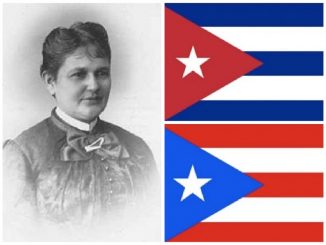
Lola Rodríguez de Tió

Septiembre en Puerto Rico tiene una relevancia muy especial para el pueblo independentista. Es el mes del Grito de Lares, el gesto de independencia en el 1868, cuando revolucionarios boricuas intentaron librarse del yugo español. También es el mes del natalicio de Lola Rodríguez de Tió. 

¿Y quién fue Lola? Seguramente muchos y muchas de ustedes han oído “Cuba y Puerto Rico son de un pájaro las dos alas”, pero no siempre se sabe su origen y su significado tan profundo. Pues es del poema de Lola, “A Cuba” y la estrofa que le sigue dice “reciben flores o balas sobre el mismo corazón”. Un poema de amor y de agradecimiento a esa isla que le dio amparo tras su exilio forzado desde Puerto Rico. Pero también de lucha gemela, pues ambos países libraban batallas de emancipación contra España.

Lola Rodríguez de Tió fue quien escribió el verdadero himno de Puerto Rico, La Borinqueña, luego del Grito de Lares que comienza “¡Despierta, borinqueña, que han dado la señal! ¡Despierta de ese sueño que es hora de luchar! 

Otra de sus estrofas dice “El Grito de Lares se ha de repetir,  y entonces sabremos vencer o morir. Bellísima Borinquen a Cuba hay que seguir”.

Y termina “Ya no queremos déspotas, caiga el tirano ya; las mujeres indómitas también sabrán luchar. Nosotros queremos la libertad, y nuestros machetes nos la dará…”

Obviamente no era del agrado de los tiranos, así que le cambiaron la letra a una escrita por un español, que solo exalta la belleza del archipiélago y agradecía la intervención de España. Esa es la que usa el gobierno y sus instituciones. Sin embargo, para el pueblo independentista sólo hay un himno, el original que ahora para distinguirlo lo llamamos el Himno Revolucionario. 

Desde Puerto Rico para Radio Clarín de Colombia, les habló Berta Joubert-Ceci

Strugglelalucha256


Baltimore Banner Making Party to Support National March to Protect Trans Youth

Baltimore Banner-Making Party in Support of
Oct 7th National March to Protect Trans Youth
Wed. September 20, 6 pm to 9 pm
At Nomu Nomu Arts Collective
709 N. Howard St., Baltimore, MD 21201

Join us for refreshments, banner making in solidarity with the national March. Hear messages from Florida, California & NYC

Sponsored by: Peoples Power Assembly & Women In Struggle/Mujeres en Lucha

www.Protecttranskidsmarch.org

linktr.ee/marchtoprotecttransyouth

Donate Venmo@SolidarityCenter

PAYPAL CLICK HERE
or mail checks made out to Solidarity Center,

Send to 703 E. 37th Street, Baltimore, MD 21218.

Strugglelalucha256


Free Leonard Peltier!

On Sept. 12, Leonard Peltier turned 79 years old in a maximum security federal prison in Coleman, Florida. He has spent over 47 years being locked up for being a leader of AIM — the American Indian Movement.

That’s 20 years longer than the time the old apartheid regime in South Africa imprisoned Nelson Mandela. The late President Mandela sought Leonard Peltier’s freedom.

So have people around the world. Thirty-five people were arrested at the White House on Sept. 12, demanding the Indigenous political prisoner’s release.  

The same day, people rallied in New York City’s Union Square for the AIM leader. Among those attending were Estela Vazquez, Executive Vice President at 1199 SEIU healthcare workers, and James Tarik Haskins, the former political prisoner and Black Panther Party member.

All Joe Biden has to do is pick up a pen to free an older man suffering from diabetes, hypertension, and partial blindness from a stroke. Jonathan Nez, President of the Navajo Nation, urged Biden to do that in a Nov. 30, 2022 letter.

So has the United Nations Working Group on Arbitrary Detention, Pope Francis, and seven U.S. senators. 

Even former U.S. Attorney James Reynolds — whose office prosecuted Leonard Peltier — wrote to President Biden asking that the AIM leader be pardoned. Reynolds admits that Peltier was convicted “on the basis of minimal evidence.” 

Revenge for resistance

Leonard Peltier is being kept locked up in revenge for the historic 71-day occupation of Wounded Knee, South Dakota, by AIM members and supporters in 1973. That’s where 300 children, women, and men from the Lakota Nation were slaughtered by the U.S. army in 1890.

In the years following the 1973 Wounded Knee occupation, over 60 people were murdered in the surrounding Pine Ridge reservation. Just as Mississippi represents for Black people the height of racism, so does South Dakota mean the same for Indigenous people. 

For example, in 1967, William Janklow (who later became South Dakota Attorney General and then Governor) raped 15-year-old Jancita Eagle Deer, who lived on the Rosebud reservation. Several years later, she was killed in a hit-and-run incident.

The FBI refused to do anything about the murders on Pine Ridge. Residents asked Leonard Peltier and other AIM members to provide support and protection.

Tensions resulted in a shootout in which two FBI agents and a young Indigenous man, Joe Stuntz, were killed. No one was prosecuted for Stuntz’s death.

But the death of the FBI agents allowed the U.S. Government to indict AIM members Leonard Peltier, Robert Robideau, and Dean Butler. Robideau and Butler were found not guilty. Peltier, who was extradited from Canada, was tried later and convicted in a tainted trial. 

Leonard Peltier is now imprisoned in Sumter County, Florida, where three Black people were lynched. Sumter County is also where the U.S. army suffered one of its most significant defeats in the Dade battle during the Second Seminole War in 1835.

In the spirit of Crazy Horse, free Leonard Peltier!

Strugglelalucha256


Abortion rights advance in Mexico, while Texas wants to trap ‘runaways’

On Sept. 6, Mexico’s Supreme Court struck down all federal criminal penalties for abortion. The court ruled that national laws prohibiting the medical procedure are unconstitutional and violate women’s rights.  

This was a major victory for the thousands of Mexican women and supporters who have been out in the streets fighting for abortion rights, and reflects the growing movement for abortion access throughout Latin America.

The Mexican court’s action stands in sharp contrast to the U.S. Supreme Court, which threw out Roe v. Wade last year. In the U.S., women’s rights are being turned back by a century. Transgender and other LGBTQ2S people are literally fighting for their lives.

While abortion rights activists in Mexico celebrate, simultaneously in Texas and other states, the reactionary drive to end reproductive rights grinds on. This same ruthless process continues to abolish medical care for trans people.

Under the banner of “stopping abortion trafficking” and “ending the baby murdering cartel,” Texas counties are poised to pass ordinances to block anyone traveling on roads within their county seeking abortion.

So far, two Texas counties have passed such ordinances, which include sections of Interstates 20 and 84. Those major highways connect to New Mexico, where new clinics have been opened to accommodate Texas women and others who can become pregnant since that state effectively outlawed abortion.

The strategy of the far right is to add other counties and cities in Texas – a chilling action that has been compared with 19th century laws to “stop runaway slaves.”

Maggie Vascassenno of Women In Struggle – Mujeres En Lucha stated, “Our strategy needs to be a furious fight back. We should learn from the activists in Mexico and Latin America.”  

The group is part of a grassroots coalition organizing a National March to Protect Trans Youth and Speakout for Trans Lives in Orlando, Florida, on Oct. 7. “Free, legal, accessible abortions” is one of the march’s demands. Learn more at ProtectTransKidsMarch.org

Strugglelalucha256
https://www.struggle-la-lucha.org/2023/page/23/