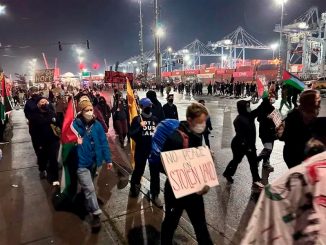
Rally in Support of Drag Story Hour in Brooklyn, Sept. 30

Rally in Support of Drag Story Hour in Brooklyn

Sat 9/30 – 11AM
McKinley Park Library
6802 Ft. Hamilton Parkway
Show support for kids and libraries.
Tell the bigots they’re not welcome.
Bring rainbow swag, signs, and noisemakers!
Wear a mask!
United Against Racism and Fascism NYC
Strugglelalucha256


New York City: End U.S./NATO Proxy War in Ukraine, Fight Corporate Media War Propaganda, Oct. 1

SAVE THE DATE: SUNDAY OCT. 1st (Part of the International week of actions to end the US/NATO proxy war in Ukraine)
End the U.S./NATO Proxy War in Ukraine!
Corporate Media is GUILTY of war propaganda! STOP manufacturing consent for war!
No Weapons & No Money for War!
No to NATO!
NATO out of Ukraine, Africa & OUT of everywhere!
Protest mainstream media’s lies and whitewashing of the truth: the U.S. & NATO are using Ukraine to wage a proxy war on Russia, and will sacrifice every Ukrainian to do it. The U.S. has vetoed negotiations & rejected any ceasefire. The war could end TODAY if the U.S. stopped sending weapons & money to Ukraine.
Endorsed by: Bronx Antiwar Coalition, United National Antiwar Coalition, ANSWER Coalition, Peace in Ukraine Coalition, CODEPINK, International Action Center, NYC/NJ Veterans for Peace, Black Alliance for Peace, Palestinian Youth Movement, NY Boricua Resistance, ILPS – International League for People’s Struggle, National Lawyers Guild International Committee, Party for Socialism and Liberation, Bronx Green Party, World Beyond War, Struggle for Socialism/La Lucha por el Socialismo, PEX Semillas de Libertad, DSA International Committee, Party of Communists USA, U.S. Peace Council, Workers World Party and more.
Sunday, October 1st, 2pm
March from CNN (58th St. & 8th Ave) to NY Times (41 st St. & 8th Ave.)
Contact bxantiwar@gmail.com to endorse and join us!
Strugglelalucha256


Struggle-La Lucha and the Socialist Unity Party condemn terrorist attack on Cuba’s Embassy

Sept. 25 — Struggle-La Lucha and the Socialist Unity Party denounce the terrorist attack on the Cuban Embassy in Washington, D.C. On Sunday evening, Sept. 24, two molotov cocktails were hurled at the Embassy following the successful visit by Cuba’s President Miguel Díaz-Canel to the United Nations.

This cowardly act of violence underscores the hypocritical lies against Cuba, which has been indefensibly placed on the U.S. list of state sponsors of terror. Ironically, it is Cuba that has been the target of terrorism in the U.S. and initiated against the island nation from the U.S.

This is the second violent act against the Cuban Embassy in the past three years. Veteran diplomat Cuban Ambassador Jose Cabañas and his team were threatened when a terrorist carrying an AK47 shot up the Cuban Embassy, just over a mile from the White House. 

We demand that the U.S. immediately remove Cuba from the list of state sponsors of terror.  End the U.S. blockade.  Sign the “Let Cuba Live” campaign.

Strugglelalucha256


Cuban President exchanges with U.S. revolutionaries on UNGA visit

On September 23, hundreds of people packed the auditorium of the New York Society for Ethical Culture to hear Cuban President Miguel Díaz-Canel speak, along with Venezuelan Foreign Affairs Minister Yván Gil Pinto, historian, and director of the Tricontinental: Institute for Social Research Vijay Prashad, and Cuban-trained physician and activist Dr. Samira Addrey. It was the last activity in Díaz-Canel’s week-long visit to New York City for the United Nations 78th General Assembly.

At this event, titled “Voices of Dignity,” the movement to lift all unilateral coercive measures against Cuba and Venezuela was elevated through cultural performances such as that of rapper and union organizer Linqua Franqa, Latin jazz musician Arturo O’Farrill, and Brooklyn-based DJ Cardamami.

In his address, Díaz-Canel outlined the specific ways in which the U.S. blockade against Cuba is putting a stranglehold on the Cuban people. “The U.S. government prevented suppliers of pulmonary ventilators from selling them to us at a time when we needed these ventilators to expand our hospitals to combat COVID,” Díaz-Canel said, to resounding boos from the crowd.

“Pessimism is not the nature of revolutionaries. That is not an option for those of us who believe a better world is possible. It is not an option for those of us who have the belief that it is worth it to fight for that better world,” Díaz-Canel told the gathered North Americans.

“The combined effect of the COVID-19 pandemic and the intensification of the U.S. economic blockade are posing serious challenges to our economic growth and the satisfaction of many of our public. But even in these conditions we have continued and will continue to prioritize social justice. We shall continue to satisfy the basic needs of our populace. We shall continue to defend equity. And we shall continue to make our strongest efforts to defend our socialist system for which so many generations of Cubans have sacrificed themselves.”

Venezuela is no stranger to U.S. hybrid war, and Gil Pinto spoke to the novel threats that his country faces. “The American empire is trying to impose a new military threat in our country, and the excuse that they are using is a border dispute that Venezuela has had for many many years…today, the U.S. is trying to mobilize military troops in Guyana, a conflict they are not involved in at all. If we want a settlement of this border dispute, of course this must be handled through diplomatic means.”

Dr. Addrey, who was trained at the Latin American School of Medicine (ELAM) in Havana, highlighted Cuba’s humanitarian work in training doctors from across the world and sending medical brigades of Cuban doctors to dozens of countries. “Cuba has sent medical internationalists to 165 countries in 60 years of this incredible humanitarian policy,” said Dr. Addrey, “ELAM is an extension of Cuba’s long history of medical internationalism,” she said. “Fidel taught us that we must be resolute that our bodies will no longer pay the price for imperialist crimes.”

Vijay Prashad described the motivations of those who drive sanctions and attacks against Cuba and Venezuela: “We love life. We love humanity. We love human beings… They love death. They love suffering. They want people to be hungry. They need people to go and die in their wars,” Prashad declared. “Those who love life love socialism.”

One day after the Voices of Dignity event, the Cuban embassy in D.C. suffered a terrorist attack, whilst on Friday, September 22, the Senator who has been the chief bulwark of sanctions against Cuba and Venezuela, Bob Menendez of New Jersey, was indicted on charges of corruption. He thus far refuses to resign from his post. Menendez had several Cuba solidarity activists arrested in June when they came to his office for a peaceful discussion.

Prashad also mentioned the wave of African nations that are standing up against French neocolonialism, including ChadNigerBurkina FasoMali, and Guinea.

“There are big changes taking place in the world these days,” Prashad said. “In the entire Sahel region, one country after the other has said, ‘France, go home!’” This last statement was met with enormous applause from the crowd, and chants of “France, go home!”.

The Voices of Dignity event concluded with a resolute slogan: “¡Cuba sí, bloqueo no!” (Cuba yes, blockade no!)

Díaz-Canel pays surprise visit to solidarity activists

Upon arrival on September 18, Díaz-Canel visited the Malcolm X & Dr. Betty Sabazz Memorial and Educational Center in Harlem to pay tribute to the historic meeting between Fidel Castro and Malcolm X in 1960. The African-American revolutionary leader welcomed the Cuban delegation at a time when the United States establishment was shunning, ridiculing, and isolating the newly liberated country.

On September 19, Díaz-Canel addressed the General Assembly. “Cuba will continue to strengthen its democracy and socialist model which, despite being under siege, has proved how much a developing country, with scarce natural resources, can do,” he declared.

On September 22, dozens of activists of all ages marched from Grand Central Station in midtown Manhattan to the Permanent Mission of Cuba to the United Nations, where they held a short rally. This action was organized by the International Peoples’ Assembly, the People’s Forum, the ANSWER Coalition, and others as part of an international call to take Cuba off of the United States’ State Sponsors of Terrorism list.

During their rally outside the mission, Díaz-Canel paid the demonstrators a surprise visit. Peoples Dispatch spoke to several people in the crowd, who were alarmed at first at seeing an entourage of suited men walk up to their action, but quickly turned elated when they realized that the President of Cuba himself had decided to attend their event.

“[When] I realized it was the President…I was overcome with emotion,” said Lillian House, an organizer with the Party for Socialism and Liberation who was a lead organizer in Denver during the 2020 uprising against police brutality. “To me, Diaz-Canel is a towering figure, the person entrusted by the Cuban people to take up the mantle of Fidel and Raul, someone who has lived his entire life in dedication to his people, and he came out to see us and thank us for our solidarity. Never do politicians in the United States come out to protests without teams of press and pre-prepared statements. Never is it in genuine relationship with the people and their struggles. It was a great honor to be there for that expression of mutual solidarity.”

Díaz-Canel joined protesters in chants of “Cuba si, bloqueo no!” before addressing the gathered crowd. “Sisters and brothers, many thanks for your solidarity,” he said. “Many thanks for your support. And many thanks for being here with us.”

Source: Peoples Dispatch

Strugglelalucha256


The answer to job-killing automation: shorten the workweek!

The United Auto Workers (UAW) are taking on three of the biggest corporations on the planet: Ford, General Motors and Stellantis (Chrysler). These outfits had total sales last year of a half-trillion dollars.

That’s as large as the combined Gross Domestic Product of the Democratic Republic of the Congo, Ethiopia, Ghana, Kenya, and Venezuela. Three hundred forty-seven million people live in these five countries.

The UAW members are fighting for all of us. Auto workers are rebelling against 45 years of plant closings, givebacks, and wage cuts.

Instead of equal pay for equal work, newly hired temp workers are paid $16.67 per hour. Adjusted for inflation, that’s worth $1.90 in 1968 money — just 30 cents above the minimum wage that year.

Back in 1970, 321,000 UAW members in the United States struck General Motors for 67 days. Another 21,000 workers, now represented by Unifor, struck GM plants in Canada for 94 days.

They won big wage increases, retirement after 30 years on the job (“30 and out”), and larger pensions. The UAW contract became a goal for millions of other workers who also made gains.

The wealthy and powerful spent decades counterattacking. Capitalism’s biggest weapon was plant closings.

Just on the East Coast, GM plants in Baltimore; Linden, New Jersey (near Newark); Terrytown, New York (a New York City suburb); and Framingham, Massachusetts (near Boston) were shut down. Two plants were closed in Cleveland, and so were Detroit’s Cadillac factory and the Van Nuys plant in Los Angeles.

Today, the UAW represents 150,000 GM workers. That’s 170,000 jobs that were wiped out.

At least as many jobs were destroyed at Ford and Chrysler. The Black-majority cities of Detroit and Flint, Michigan, were the heaviest hit — GM shut down nine of its 10 plants in Flint, where the historic 1937 sit-down strike occurred.

In 1980, before these layoffs, young workers in Flint, Michigan,had higher average incomes than those in San Francisco. Thirty-seven years later, in 2017, half of Flint’s population lived in poverty.

To save a few million dollars, children were poisoned by filthy water pumped from the polluted Flint River instead of using water from the Great Lakes.

Overworked while millions are unemployed

Automation is one of the biggest job killers. Robots replaced spot welders and other workers on the assembly line. Computers swept away office jobs.

One of the UAW’s demands is a 32-hour work week to keep and create jobs. Technology should be used to make people’s lives better, not to increase joblessness and misery.

It’s outrageous that some people are forced to work overtime while 6.4 million people were unemployed in August. Another 5.4 million currently want a job but are not even counted as belonging to the labor force. 

“The condemnation of one part of the working class to enforced idleness by the overwork of the other part, and the converse, becomes a means of enriching the individual capitalists.” That’s what Karl Marx — the founder of scientific socialism, also called communism — wrote in “Capital” in 1867.

For 200 years, the world labor movement has fought for shorter hours of work. British workers struggled first for a 12-hour workday and then for 10 hours on the job.

On May 1, 1886, workers across the United States went on strike for an 8-hour workday. In retaliation, capitalist courts hanged the “Haymarket Martyrs” — George Engel, Adolph Fischer, Albert Parsons, and August Spies — in Chicago on Nov. 11, 1887.

Fifty-six years before, on Nov. 11, 1831, slave masters hanged the freedom fighter Nat Turner. He led a glorious insurrection of enslaved Africans who worked from “no see” in the morning to “no see” at night.

One of the demands of the 1919 steel strike of 365,000 workers, led by future communist leader William Z. Foster, was for an eight-hour workday. The steel tycoons claimed they couldn’t operate their mills without 12-hour shifts.

Although police and private gunmen broke the strike, U.S. Steel president Elbert Gary was compelled to institute an 8-hour workday in the early 1920s. Smaller steel outfits soon followed.

It was the working-class upsurge of the 1930s that established a 40-hour workweek. The labor movement was responsible for the weekend.

Shorter hours mean more jobs

Even after the 40-hour workweek was won, many workers still spend at least 50 hours on their job. That’s because it takes millions of workers at least an hour to travel to and from their job.

Workers should be compensated from the time they leave their homes to go to work. Compulsory overtime should be prohibited.

Unions helped end most child labor in the 1930s. As the legendary IWW (Industrial Workers of the World) leader “Big Bill” Haywood wrote, “the worst thief Is he who steals the playtime of children.”

Capitalists and their politicians are bringing back this atrocity. It was legal for 16-year-old Michael Schuls to be working in a Wisconsin sawmill when he was killed on June 29. Teenagers have been found working in Alabama auto part factories.

Steven Rattner, who helped push through the cutbacks for auto workers during the 2008 economic crisis, thinks the UAW is “asking for too much: In addition to pay raises of 36 percent over four years, the list includes a 32-hour workweek with 40 hours of pay.” 

Well, sir, do you know that 90 years ago, the U.S. Senate passed a law for a 30-hour workweek by a vote of 53 to 30 on April 5, 1933? Alabama Senator and future Supreme Court Justice Hugo Black introduced the bill. (“A Terrible Anger, The Waterfront and General Strikes in San Francisco,” by David F. Selvin.)

This legislation was later ditched in Congress, but it shows what can be demanded. Millions of jobs could be created by instituting a 32-hour workweek, as the UAW is asking for.

The billionaire class can afford it. As UAW vice president Mike Booth pointed out, GM alone raked in $100 billion in profits over the past decade from its North American operations. Twenty-one billion was spent on stock buybacks that only benefit Wall Street speculators.

With today’s technology, demanding a 32-hour workweek is no more impossible than marching for the 8-hour day on May Day in 1886.


Strugglelalucha256


Canada hails Nazi SS veteran from Ukraine as ‘hero’

Earlier this month, there was a storm of outrage from Israel, its lobby and sponsors in the West over comments by Palestinian Authority leader Mahmoud Abbas appearing to blame Jews for their own murders by the German government headed by Adolf Hitler in the 1940s.

One of the most forceful denunciations came from Canada, whose representatives in Ramallah asserted that Abbas’ “remarks distort the historical truth of the Holocaust and promote classic and contemporary tropes of Jew-hatred.”

One might think that the members of this chorus truly care about preserving the memory of the victims of the Nazis, and even take seriously their regular invocation of such slogans as “Never Again.”

But that would be a mistake.

Hero’s welcome

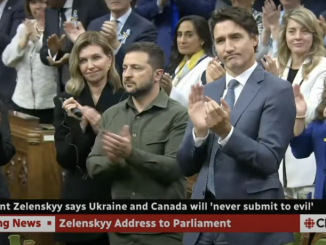
On Friday, Ukraine’s President Volodymyr Zelensky was received as a hero in Ottawa, where he addressed the Canadian parliament.

Following Zelensky’s speech, Anthony Rota, the speaker of the Canadian House of Commons, paid tribute to another man from Ukraine.

“We have here in the chamber today … a Ukrainian Canadian war veteran from the Second World War who fought for Ukrainian independence against the Russians, and continues to support the troops today, even at his age of 98,” Rota said to raucous hoots and a standing ovation.

Rota added that he was “very proud” that the man, Yaroslav Hunka, lived in his own Ontario electoral district.

“He’s a Ukrainian hero, a Canadian hero, and we thank him for all his service,” the speaker added to more boisterous applause.

In fact, Hunka is a veteran of the 14th Waffen Grenadier Division of the SS – part of Hitler’s notorious Schutzstaffel, the elite troops who perpetrated some of the worst genocidal crimes of World War II.

As an article in The Forward points out, “this is the same unit that is honored by controversial monuments in Canada, Australia, and, as the Forward recently exposed, the suburbs of Philadelphia and Detroit. Jewish groups have called for their removal.”

Formed in 1943 from recruits in Western Ukraine, the The Forward explains that the Galician Waffen SS unit was “armed and trained by the Nazis and commanded by German officers. In 1944, the division was visited by SS head Heinrich Himmler, who spoke of the soldiers’ willingness to slaughter Poles.”

The United States Holocaust Memorial Museum holds a number of artifacts about the division, including this newsreel film showing a lavish Nazi ceremony bidding a fond farewell to the Waffen SS Galicia division as its soldiers are sent off from the city of Lviv to receive training, before joining Hitler’s war effort.

After the war, thousands of Waffen SS Galicia veterans were allowed to resettle in the West, with several thousand going to Canada, The Forward notes.

Whitewashing Nazis

In a sense, Friday’s horrifying spectacle in the Canadian parliament is the culimination of decades of whitewashing of the Ukrainian Waffen SS unit by members of the Ukrainian Canadian diaspora and other Nazi apologists.

Ivan Katchanovski – a Ukrainian Canadian political scientist at the University of Ottawa who adamantly refuses to whitewash Ukrainian ultranationalism and its role in bringing his homeland to its present disaster – wondered, “Did anyone in parliament or Zelensky realize that [Hunka] served in Waffen SS division?”

It’s likely many of those clapping had no idea or didn’t care, but there’s little reason to believe that Canadian leaders, including Prime Minister Justin Trudeau, did not know. And there’s no reason to think they would care either.

It is well known that one of Trudeau’s top allies, Deputy Prime Minister Chrystia Freeland, is the proud granddaughter, of one of Hitler’s top Ukrainian propagandists, Michael Chomiak.

Instead of embracing historical truth about her grandfather’s role in recruiting for the SS and spreading anti-Semitic propaganda on behalf of the Hitler regime, Freeland has tried to whitewash his role.

And in 2018, when there was a public outcry about monuments in Canada honoring the Ukrainian Nazis, Trudeau’s office went to work to deflect attention from the matter.

Using freedom of information requests, a Canadian journalist discovered that “government officials were under a lot of pressure” from the prime minister’s office “to counter the news about the monuments to Nazi collaborators,” as The Ottawa Citizen reported.

While many Ukrainian nationalists always kept a flame burning for the Waffen SS Galicia unit, its rehabilitation really took off following the 2014 U.S.-backed coup in Ukraine that brought the current clique of ultranationalists to power.

As recently as 2021, Ukrainians held the first parade honoring the Waffen SS Galicia division in the capital Kiev, prompting protests from Israel and even from President Zelensky.

But things change quickly.

Now much of the Western media and establishment, including Israel and its lobby groups such as the Anti-Defamation League, have been willing to whitewash Ukrainian nationalists who helped Hitler exterminate Jews and Poles, because that suits the politics of the West’s current proxy war – using Ukrainians as cannon fodder – against Russia.

It is common to hear apologists for Hitler’s Ukrainian volunteers claiming that the men of the Waffen SS Galicia division are remembered positively today despite their association with the Nazis, because their true motivation was fighting for Ukrainian independence, against the Soviet Union.

Last year, however, Ellen Germain, the U.S. special envoy on Holocaust issues, called this kind of “rehabilitation” of Nazi collaborators a form of “Holocaust distortion.” She was right.

https://twitter.com/TamaraLorincz/status/1705767342355980692

Cynicism and hypocrisy

All of this goes to show how cynical all the pious condemnations of Mahmoud Abbas have been.

As of this writing, the German ambassador in Tel Aviv, the U.S. anti-Semitism envoy Deborah Lipstadt and her EU counterpart Katharina von Schnurbein, as well as Jonathan Greenblatt, the head of Anti-Defamation League – among the countless others who condemned Abbas – have said nothing about the celebration of Nazis by Canada’s entire political establishment.

Frankly, it would be surprising if any of them ever do.

Among Western governments and elites, the Holocaust is no longer – if it ever really was – treated as a historical crime with real victims whose memories deserve to be truly honored.

It is simply a political club to be hypocritically wielded on behalf of Israel and against official enemies when useful and convenient.

In this context of such utter bad faith, the Palestinian academics and activists who dutifully signed an open letter condemning Abbas’s comments should reflect on the futility – at best – of their gesture.

Meanwhile, students and educatorswriters and artists – anyone standing up for Palestine – are regularly falsely accused of anti-Semitism while living, breathing Nazis receive standing ovations from Israel’s closest friends.

It’s just disgusting.

Update: 25 September

On Sunday evening, Anthony Rota, the speaker of the Canadian House of Commons, issued a statement apologizing for his warm praise for Nazi SS veteran Yaroslav Hunka whom he had invited to attend Friday’s session at which Ukrainian President Volodymyr Zelensky spoke.

“I have subsequently become aware of more information which causes me to regret my decision,” Rota wrote.

The speaker took sole responsibility, asserting that “no one, including fellow parliamentarians and the Ukraine delegation, was aware of my intention or of my remarks before I delivered them.”

That’s definitely convenient for Canada’s political class who can now all pretend they had no idea how deeply entrenched veneration of the Waffen SS Galicia division is among many in Canada’s politically influential Ukrainian diaspora.

The speaker’s statement came after Friends of Simon Wiesenthal Center for Holocaust Studies, a staunchly pro-Israeldemanded an explanation and apology for the standing ovation given to the Nazi veteran.

Michael Mostyn, the head of B’nai Brith Canada, another influential pro-Israel group, also condemned the hero’s welcome for the 98-year-old former Nazi soldier.

From there the matter has spiraled into a political furor, and has made headlines across Canada and around the world.

Prime Minister Justin Trudeau, who as noted above must be well aware of the deep Nazi connections in parts of the Ukrainian Canadian diaspora, is also cannily trying to distance himself from the embarrassing debacle.

“The independent speaker of the House has apologized and accepted full responsibility for issuing the invitation and for the recognition in Parliament. This was the right thing to do,” the prime minister’s office stated.

A government representative, Karin Gould, also denied that Trudeau met personally with Hunka, although images posted to social media apparently by one of Hunka’s relatives, offer a hint that whether or not a meeting with Trudeau took place, one may have been planned or expected.

https://twitter.com/DanPizzaGuy/status/1706196560785064361

Another photo, apparently posted and then deleted by Gould on Instagram, shows her posing with Hunka and Speaker Rota.

These images have circulated widely on social media, although The Electronic Intifada was not able to locate their original sources – their likely having been removed.

No photos of Trudeau with Hunka have emerged as of yet.

Jagmeet Singh, leader of Canada’s nominally center-left New Democratic Party, also made excuses for his participation in the shameful spectacle of applauding a Nazi.

All of these apologies will do little to alleviate concerns about Canada’s longstanding support for Nazis in Ukraine, not just with praise and applause, but with training and weapons going back years.

Historian Tarik Cyril Amar, an expert on Ukrainian ultranationalists, said the Canadian House of Commons’ speaker was engaging in “damage control kamikaze,” trying to shield Canada’s political class by taking sole responsibility.

“But the thing is that this too is deeply dishonest. What Canada has is a deep, pervasive problem with its [politicians] sucking up to the organized far-right of the Ukrainian ‘diaspora’ and masking this despicable normalization as ‘multiculturalism’ and ‘tolerance,’” Amar added.

“The country needs a painful national debate and a serious course correction. Not one scapegoat, not even a volunteer scapegoat.”

Source: electronicIntifada.net

Strugglelalucha256


How could Russia respond when Kiev gets ATACMS missiles and armed drones?

It’s virtually guaranteed that the Kiev regime will get the MGM-140 ATACMS (Army Tactical Missile System), a U.S.-made tactical/theater ballistic missile system with a maximum engagement range of approximately 300 km and a supersonic speed of up to Mach 3. While its capabilities are far from Russian counterparts, such as the now legendary “Iskander” with a hypersonic speed (up to Mach 8, with maneuvering capabilities for its missiles) and a range of approximately 500 km, this is still enough to jeopardize Russian supply lines, as well as civilian settlements deeper within Moscow’s territory. The ATACMS can also be fired from two platforms, namely the tracked M270 MLRS (Multiple Launch Rocket System) and the wheeled M142 HIMARS (High Mobility Artillery Rocket System), both of which have been delivered to the Neo-Nazi junta forces well over a year ago.

When paired with adequate ISR (intelligence, surveillance, reconnaissance) assets, which NATO fields extensively, particularly in the vicinity of Russian borders, the ATACMS can be quite a challenge. Its battlefield performance can be significantly amplified through the effective usage of real-time ISR data that essentially acts as a major force multiplier. This is where the legal “grey areas” of warfare get even more complicated. Namely, Moscow is doing its best to keep the scope of the SMO localized, but NATO continues to escalate, as evidenced by the resurgent presence of its ISR platforms around Russia’s borders, particularly in the Black Sea. The Russian military already shot down some of NATO’s ISR platforms, resulting in several months of pause in flights close to the SMO zone. However, the belligerent alliance recently restarted this highly destabilizing practice.

Moscow is perfectly aware that the political West controls the Kiev regime’s targeting, even issuing orders on which Russian assets are to be attacked. The sole reason why Russia hasn’t responded by shooting down all NATO ISR platforms in the relative vicinity of its forces is that it wants to avoid escalating the conflict. However, the U.S.-led political West sees this as a weakness and an opportunity to hurt Russia because the way the Ukrainian conflict is being conducted is highly beneficial to NATO. Namely, the way that the political West is engaged in hostilities in Ukraine would simply be impossible in a shooting war with Moscow. The reason is quite simple. One of the very first targets for Russian Aerospace Forces (VKS) would be NATO’s ISR platforms. Precisely these are responsible for the vast majority of data being relayed to the Kiev regime.

As Ukraine borders four NATO members, this gives the belligerent alliance a unique opportunity to use their airspace for ISR flights. And while the political West argues that these are “perfectly legal” and that the aircraft “just passively collect information,” the impact of their activities is anything but “passive.” NATO ISR platforms are directly responsible not only for the deaths and injuries of Russian servicemen but also civilians. The United States Air Force (USAF) and the British Royal Air Force (RAF) are the most active NATO members in this regard, particularly with their Boeing RC-135V/W SIGINT (signals intelligence) aircraft that regularly fly over the Black Sea. These are among the belligerent alliance’s most commonly used strategic ISR assets and play a crucial role in spying on Russian forces, covering the collection of ELINT (electronic intelligence) and COMINT (communications intelligence).

These are used to find gaps in Russian defenses (particularly radar coverage) which are then reported to the Neo-Nazi junta forces that can exploit them to launch attacks on valuable assets, as evidenced by recent air strikes with NATO-sourced cruise missiles. This makes ISR aircraft far deadlier than satellites that simply cannot loiter in an area to provide a constant supply of real-time data. NATO SIGINT aircraft also complicate Russian communications significantly, as military units are forced to maintain radio silence or use encryption, which slows down battlefield coordination, thus degrading their effectiveness. More precisely, Moscow’s military planners simply have to pay close attention to what sort of information will end up in the hands of NATO, as this could help in the creation of better countermeasures against Russian forces.

The sheer magnitude of ISR data collected by SIGINT aircraft has helped the Kiev regime forces to a certain extent, but not nearly enough to create conditions for defeating Russian troops. Still, it’s often enough to bring the much-needed PR “victories” that are a crucial part of the overall propaganda war. However, with the delivery of the ATACMS, things can become a lot more complicated, forcing the Russian military to expand the scope of the SMO. Namely, since it’s a land-based missile system, the ATACMS is logistically far less strenuous than the Franco-British “Storm Shadow/SCALP EG” or the German-Swedish “Taurus,” both of which are air-launched and are limited by the number of carrier aircraft (in the case of Neo-Nazi junta, that would be the Soviet-era Su-24), as well as the logistics for the said aircraft. To say nothing of the possibility these could get shot down.

On the other hand, the launch of a single ATACMS is not only more difficult to detect on time, but the weapon is also several times faster than air-launched cruise missiles, meaning that Russian air and missile defenses have significantly less time to respond. This changes the calculus for Moscow, as its major assets could be targeted, causing significant losses that will not be easy to replace, while it may prove difficult to detect and destroy the ATACMS launchers. Once again, it would be impossible for NATO to wage a direct war against Russia in this way, as the VKS would simply send its fighter jets, such as the superfast, high-flying MiG-31BM interceptor or the state-of-the-art Su-35S, both of which carry unrivaled long-range air-to-air missiles (AAM), such as the 400-km-range R-37M, known for its ability to maneuver at hypersonic speed (Mach 6).

Such AAMs would be used to easily destroy any ISR aircraft and other supporting assets hundreds of kilometers around Russian borders. Having the Neo-Nazi junta do all the heavy lifting and dying for “a NATO mission” while the belligerent alliance collects battlefield data is perfect for the political West, but only as long as they can maintain plausible deniability of involvement. However, as Moscow is losing patience for this sort of insolence, the conflict that is still largely limited to Ukraine could inevitably escalate, as Russia can decide to legally redefine what constitutes direct involvement. For the time being, the Russian military might decide to shoot down unmanned SIGINT assets, such as the RQ-4B “Global Hawk.” This was already done once when a Russian Su-27SM3 masterfully downed a USAF MQ-9 “Reaper” back in March.

What’s more, the political West is close to approving deliveries of such drones as well, specifically the MQ-9 and the medium-range MQ-1C “Grey Eagle.” However, these were designed to fight low-tech enemies, meaning they’re completely useless against opponents like Russia, which shot down over 100 “Bayraktars” by April. And while some ISR drones, such as the RQ-4B are extremely expensive and strategically important, the “Global Hawk” is still just a machine, unlike the RC-135, which is manned by up to 30 crewmen. Still, if the political West decides to continue escalating even in that case, then Moscow will be forced to shoot down all of NATO’s ISR assets, which could potentially lead to a world-ending thermonuclear confrontation. If the belligerent power pole thinks it’s worth risking the fate of the world over this, then so be it, as Moscow has had enough.

Drago Bosnic is an independent geopolitical and military analyst.

Source: InfoBrics
Strugglelalucha256


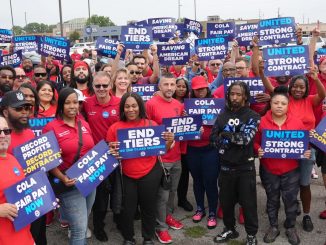
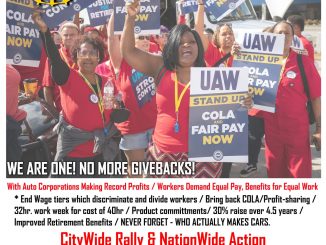
Unite and fight for United Auto Workers on strike – NYC, Sept. 30

Strugglelalucha256


Struggle ★ La Lucha PDF – September 25, 2023

Get PDF here

  • Striking auto workers battle billionaire CEOs
  • When the auto workers went on strike in 1970:
    Revolutionary implications of the GM strike
  • Free Leonard Peltier!
  • ‘I am still here’: Leonard Peltier’s letter to supporters
  • ‘AG Landry, you’re a crook! Kids deserve to read gay books!’
  • The Christmas night murders of Harriette Moore & Harry T. Moore in Florida
  • Starbucks Worker Solidarity Day of Action
  • Abortion rights advance in Mexico, while Texas wants to trap ‘runaways’
  • ‘For All of Mankind’ and other lies
  • Libya, devastated by U.S./NATO bombing, unprepared for extreme storm floods
  • LET CUBA LIVE: Take a stand and get Cuba off the SSOT list
  • Cuba’s President Díaz-Canel at United Nations: ‘A new and fairer global contract is urgently needed’
  • Infierno escolar en Puerto Rico
  • Lola Rodríguez de Tió
Strugglelalucha256


Low-wage workers of the world, unite!

War and Lenin in the 21st century, part 5

Lenin’s “Imperialism, the Highest Stage of Capitalism” was written and published during World War I to show that the war was imperialist on all sides. Lenin also exposed the Second International’s betrayal. The leading socialist parties abandoned international working-class solidarity to give support to their own governments in the war.

Lenin denounced the opportunism and social chauvinism of Karl Kautsky and the leaders of the Social Democratic parties. The betrayal, however, was not simply blamed on flawed leaders. Behind these leaders stood material interests that are based on larger economic forces. 

Colonialism and imperialism had oppressed, colonized, and enslaved peoples around the globe. They had been robbed of their land, resources, and culture. 

In “Imperialism,” Lenin finds the root of the betrayal in imperialist superprofits.

Lenin writes that “capitalism has now singled out a handful of exceptionally rich and powerful states which plunder the whole world … Obviously, out of such enormous superprofits (since they are obtained over and above the profits which capitalists squeeze out of the workers of their ‘own’ country), it is possible to bribe the labor leaders and the upper stratum of the labor aristocracy. And that is just what the capitalists of the ‘advanced’ countries are doing: they are bribing them in a thousand different ways, direct and indirect, overt and covert.”

The class struggle

The exploitative relationship between imperialist monopoly capitalism and the working class and oppressed peoples constantly shifts as conditions evolve. In its drive for profits, monopoly capitalism is always seeking new ways to exploit workers as the economic and political landscape transforms. 

Even as workers organize and fight to improve working conditions and increase wages, the system undermines those gains for the benefit of the capitalist class. 

In the current era, advances in science and technology have dramatically increased the productive capacity of workers in industry and agriculture — especially in robotics, computer-aided design/manufacturing, energy production, health care, transportation and logistics, automated warehouses, self-driving trucks, and AI. These developments have allowed monopoly corporations to reshape global production networks and supply chains. 

They have incorporated hundreds of millions of low-wage workers worldwide into industry and services. This globalization has broken down many borders, internationalizing jobs and wages. By accessing labor in the Global South, monopolies are driving down wages and benefits of workers in the imperialist industrialized countries. The scientific-technological revolution has thus enabled a new phase of exploitation and oppression. This relentless pursuit of profit through global labor arbitrage impacts the working class everywhere.

Globalization drives migration

Global labor arbitrage means moving jobs to countries with low wages and where business costs (such as environmental regulations) are inexpensive. At the same time, impoverished workers migrate to countries with higher-paying jobs.

In the past, the imperialist powers were limited in their ability to exploit workers by geographical constraints. However, advances in science and technology have removed these barriers. Multinational corporations can now easily tap into labor forces across the entire planet. Workers anywhere can potentially be subjected to super-exploitation in the drive for ever greater profits. 

The scientific-technological revolution has enabled a new form of boundary-less capitalist exploitation. The tools of high-tech globalization have allowed exploitation by monopoly capitalists to become truly global in reach. Geography and borders no longer restrict their ability to maximize profits through labor exploitation worldwide.

When Lenin was writing in 1916, imperialist export of capital, colonialization, and its superprofits were used to cultivate an opportunist section of labor leaders and politicians in the imperialist countries. While that has continued, it is being scaled back.

With the global exploitation of labor, the export of capital and the drive for imperialist superprofits are going in another direction. Today, it is used to lower living standards for all workers in imperialist countries, not just the most oppressed. The top tiers of workers and parts of the middle class are being down-graded. Job security and social benefits are being dismantled. Rather than pacifying a privileged layer of workers, imperialist monopoly capital now uniformly undercuts wages, benefits, and rights across the working class in the imperialist countries. It aims to maximize profits globally. 

The continued global integration of production and the rapid expansion of the international working class has made cross-border solidarity an urgent necessity. As more aspects of work become globally interconnected, workers around the world are facing common challenges of exploitation and oppression under imperialist capitalism. 

The only way to fight back is through unified resistance across all borders. The growing ranks of international labor from all corners of the world have shared class interests. Workers need to build solidarity networks across borders to confront the forces of monopoly capital. 

In the U.S.

Over the last four decades, most of the working class in the United States has experienced a continuous erosion of wages and benefits. Throughout these 40 years, workers struggled unsuccessfully against an unrelenting and oppressive union-busting campaign. Union membership has been severely eroded. The United States now has the lowest union membership rate (about 10% of workers) of any of the imperialist industrialized countries. 

Wages have stagnated or declined in the U.S. since 1973. Real (inflation-adjusted) wages have fallen by 4-10% since then. According to the U.S. Census Bureau, women still make 20% lower wages. The U.S. poverty rate rose to 12.4% in 2022 from 7.8% in 2021, the largest one-year jump on record, the Census Bureau reported Sept. 12. At the same time, poverty among children has more than doubled.

The summer of 2023 has been marked by a wave of strikes across the United States. Workers in a variety of industries, including health care, education, manufacturing, and transportation, have walked off the job to demand better pay, working conditions, and benefits. Rising inflation has seriously cut wages.

In order to win, these strikes require unity across the working class through solidarity with other labor and community organizations. That means fighting for equality for Black, Latinx, Asian, and Native peoples; fighting for equal pay for equal work for women workers; defending equality for lesbian, gay, bi, trans, and queer workers; equality for immigrant and undocumented workers.

Labor must build these alliances and show support beyond just their membership. Isolated strikes will struggle. But strikes backed by a united working-class front can win. Solidarity is key.

To borrow a phrase:

Low-wage workers of the world, unite!

War and Lenin in the 21st century

Strugglelalucha256
https://www.struggle-la-lucha.org/2023/page/21/