- Jail Trump for racism & war crimes
- The revolutionary spirit of Minnie Bruce Pratt
- The Supreme Court has no compassion for working-class families!
- TAMPA 5 SOLIDARITY: ‘Protesting is not a crime’
- A racist scab
- Transit and rent hikes are wholesale robberies
- Solidarity in New York with the people of Peru
- Mutulu Shakur’s life & legacy
- The U.S. ‘act of war’ against China
- Biden sends $345 million in weapons to Taiwan
- French authorities escalate repression
- Solidarity statement for Philippines
- NYC meeting salutes 70th anniversary of Cuban Revolution’s beginning
- Coast-to-coast book tour introduces Cleophas Williams
- Pentagon prepares to expand troops in Ukraine
- JoAnn Watson, beloved Detroit leader, dies
- Women in Struggle rejects U.S./EU hostility to Cuba
- NIGER: Old Europe on trial
- Black Alliance for Peace: Condemn call for ECOWAS-led military invasion of Niger
- En peligro juventud boricua
- Eventos del Cerro de los Mártires
- Mujeres en Lucha rechaza hostilidad de EE.UU. y la UE hacia Cuba
Struggle ★ La Lucha PDF – August 14, 2023
Don’t let ‘anti-nuke’ be just another holiday
We need to be shouting ‘No Nukes’ from the rooftops of every building every single day throughout the year.
The A-bomb memorial week is behind us. An inclination is to put our “No Nukes” placards away till next year, just like we put Jack-o-lanterns away on the first of November. The reality is that we need to be shouting “No Nukes” from the rooftops of every building every single day throughout the year.
I am a graduate of a high school in Hiroshima, where 350 young lives were decimated on August 6, 1945. I was born in Sasebo, Nagasaki, approximately 40 miles from Nagasaki-City where the second A-bomb was dropped. My mother was on the island of Goto at the time and witnessed heavily burned victims being evacuated from the city by boatload.
Thanks to the publicity and excitement surrounding Christopher Nolan’s “Oppenheimer,” we are having “a moment” in the Anti-Nuclear movement. Memorial events on August 6 and 9 this year seemed a little more visible than any other year. The critical question is: How do we capitalize on this sudden surge in public attention and not let it become just a fleeting moment?
Threats we face on both fronts – nuclear weapons and nuclear power generation – require us to tackle the issue of nuclear proliferation head on, instead of treating it as “the past” and sweeping it under the rug as an inconvenient truth, or worse, accepting it as a necessary evil.
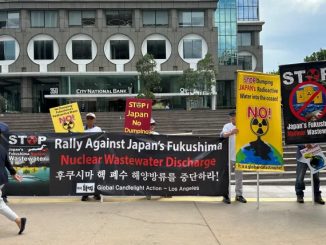
On August 9, 2023, Pacific Asian Nuclear-Free Peace Alliance and Global Candlelight Action Los Angeles co-hosted a peace memorial rally in front of the Consulate General of Japan in downtown Los Angeles.
The rally was dual purpose, with one being equally important as the other; we were there to remember the victims of Hiroshima and Nagasaki, along with the “Global Hibakusha,” victims of ALL nuclear atrocities in the world, as well as to protest TEPCO (Tokyo Electric Power Company) and the government of Japan’s planned dumping of radioactive wastewater from the now-defunct Fukushima Daiichi Nuclear Power Plant into the Pacific Ocean.
In any ordinary year, protesting in front of the Japanese consulate on the anniversary of the bombing of Nagasaki could be seen as inappropriate. However, this year we felt that such a demonstration was necessary.
There are more than 1.3 million metric tons of radioactive wastewater stored in approximately 1,000 tanks on site since the 2011 accident. If they are allowed to proceed with the dumping, it will continue for the next 30-40 years.
Many world-renowned experts in the field have pointed out inadequacy of TEPCO’s data sampling and analysis. To list just a few, out of 64 radionuclides in the water, TEPCO routinely samples only 7. Sampling is always done from the surface of the tank and never from the bottom where the sludges are; meaning that we don’t know how effective TEPCO’s filtering system operates with the sludges.
Tritium is a radioactive isotope of hydrogen that the system cannot filter out. As long as it is outside of a human body, it is relatively safe, for it emits beta radiation which cannot penetrate skin. Once it enters a body, though, as what’s called Organically Bound Tritium (OBT), it can damage cells and DNA.
TEPCO’s analysis does not take into consideration such factors as transboundary effects and bioaccumulation/bioconcentration. A 2012 study detected bluefin tuna migrating from Japan to California all the way across the Pacific Ocean. Fukushima radiation has been present on the West Coast of the United States since 2015. Bioaccumulation/bioconcentration refers to the fact that the higher up you go in the food chain, the higher the concentration of radionuclides becomes.
Moreover, TEPCO has admitted that only 30% of “treated/filtered” water meets the international regulatory standards for discharge into the ocean; the rest, 70%, exceeds the regulatory standards.
The people of Hiroshima and Nagasaki were victims of not only the war crime committed by the U.S. but also of state violence committed by Imperial Japan against its own people.
The bottom line is: the release of such a huge amount of contaminated water for such a prolonged period is unprecedented, and there are so many unknowns with TEPCO/Japan’s plan. Proceeding with the dumping based on the assumed safety is inadvisable.
Despite the voices of concerns from local fishermen and neighboring nations, the dumping is scheduled to take place sometime later this month, after the trilateral summit between the U.S., South Korea, and Japan to be held in or near Washington, D.C., either on August 17 or 18. At the summit, President Biden, South Korean President Yoon, and Japanese Prime Minister Kishida are to “agree” on the dumping, and the date of the first dumping is to be decided.
Spending my formative years in Hiroshima with classmates whose families were directly affected by the A-bomb and teachers who were survivors themselves, I have become convinced that the people of Hiroshima and Nagasaki were victims of not only the war crime committed by the U.S. but also of state violence committed by Imperial Japan against its own people.
Imperial Japan was a crazed, hungry beast who cared about nothing but feeding its own greed and thirst for power. It colonized, enslaved, and inflicted unspeakable harm on the people of many Asian nations. It forced well over 100,000 Okinawans to sacrifice their lives for the emperor. Let it be known that out of more than 200,000 people who perished in four months following the bombings of Hiroshima and Nagasaki, an estimated ten percent were people of Korean descent; many of them had been brought from the Korean Peninsula to be forced laborers in Japan.
The dumping of radioactive wastewater from the Fukushima Daiichi Nuclear Power Plant is akin to Japan committing a nuclear atrocity against the world. The government of Japan has never properly acknowledged senseless killings, slavery, rape, and human experiment that Imperial Japanese Army committed during WWII. By releasing the contaminated water, it is perpetuating the legacy of nuclear colonialism. As a person of Japanese descent whose life has been touched by both the bombings of Hiroshima and Nagasaki, I shall not rest until a nuclear-free world is achieved. 350 girls from my school in Hiroshima and the late Michiko Kato, a fellow anti-nuclear activist and Fukushima evacuee who fell victim to ovarian cancer in 2020 won’t let me.
Source: LA Progressive
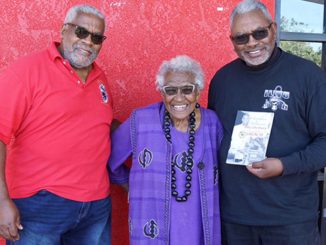
Coast-to-coast book tour introducing Cleophas Williams, first Black president of San Francisco dockworkers
Clarence Thomas, a Black labor union leader and third-generation retired member of the International Longshore & Warehouse Union (ILWU) Local 10, published — and wrote an introduction to — a new book called “Cleophas Williams: My Life Story in the International Longshore & Warehouse Union Local 10” (DeClare Publishing, 2023).
Thomas is on a coast-to-coast book-signing tour promoting this historic work.
The book is a compilation of Cleophas Williams’ writings — selected by Clarence Thomas and edited by Delores Lemon-Thomas, in consultation with Cleophas’ widow Sadie Williams — giving a first-hand account of the life and work of the first African American president of ILWU Local 10. Williams was a union leader, civil-rights activist, and community organizer who played a major role in the fight for social justice and economic equality in the San Francisco Bay Area.
The book comes at a time when there is renewed interest in the history of the labor movement, the Black liberation movement, and the fight for social justice.
It provides a rare inside look at working on the waterfront in the San Francisco Bay Area in the mid-20th century. Williams’s story is one of struggle and triumph, as he became a powerful voice for working people and for civil-rights unionism.
Williams’ writings also illuminate the history of the ILWU, one of the most militant and successful unions in U.S. history.
The book is a valuable contribution to the history of African Americans in the labor movement. Williams’ story is a reminder that African Americans have played a major role in the fight for workers’ rights, making significant contributions to the labor movement. The book is also a powerful reminder of the importance of fighting against racism and for economic equality.
To get your copy, visit MillionWorkerMarch.com.
Food, trade and slumpflation
The latest measure of U.S. consumer price inflation for July actually showed an uptick in the year-on-year rate to 3.2% from 3% in June. That is mainly a result of comparison (‘base effects’, they are called) with a drop in the rate last July from the peak in June. Core inflation, which excludes food and energy prices, remained much higher at 4.7% yoy.

And remember, even if inflation were to fall further towards zero, prices since the end of the COVID pandemic slump are up 10-15% in most G7 economies, with those prices sheer to stay and probably rise more. Yes, the inflation rate is slowing, but U.S. consumer prices are 17% higher than they were at the beginning of 2021.

Inflation remains sticky in the U.S., and most G7 economies, which is why central banks continue to talk of further rises in their ‘policy’ interest rates. But the expectation is that national rates of inflation will come down (if slowly) over the rest of this year. Stock and bond market investors and mainstream economists are generally pleased and confident.
But how about having no inflation at all? That is the situation in China, where consumer prices fell in July compared to July 2022. This could be transitory, however. Stripping out volatile food and energy prices, so-called core inflation rose to 0.8% in July, the highest level since January, from 0.4% in June.
Deflation in China has been greeted by the China ‘experts’ as yet another sign that China is heading for a debt deflation disaster. They reckon that if the expectation of falling prices becomes entrenched, it could further sap ‘demand’, exacerbate debt burdens and even lock the economy into a debt trap that will be hard to escape using the stimulus measures Chinese policymakers have traditionally turned to. I have dealt with these arguments in a previous post, so I won’t go over the rebuttal.
And I am not sure working people would agree that having no inflation or even falling prices is such a bad thing, particularly as it means, in the case of China, that wages are still rising – so real incomes are going up, not down, as in the G7 economies. But then, capitalists companies like a bit of inflation to support profits and give them room to raise prices if they can – as we have seen.

China’s negative consumer inflation result was mainly driven by a drop in food prices from a year earlier when food prices were pushed up by extreme weather conditions. Prices of pork, a staple of Chinese dinner tables, plunged 26% in July from a year earlier. Vegetable prices also fell last month.
That’s not the case in the G7 economies. UK food prices rose 17.4% in the year through June, while Japanese prices were up 8.9%, and French prices were up 14.3%. In each country, food prices are rising much more quickly than prices of other goods and services. The U.S. has fared better, with food prices up only 4.6% from a year earlier in June.

Food prices globally have fallen from the 50-year high in March 2022. But now it seems that the global food price index is turning up again, rising 1.3% in July from June, a second increase in four months. It remains 36% higher than it was three years ago.

The new rise in food inflation is partly driven by the collapse of the Black Sea grain deal between Russia and Ukraine to export their harvests. Last month, Russia withdrew from the deal and subsequently targeted the country’s food-export infrastructure with drone attacks on Odesa’s port facilities. Originally food price inflation was the product of supply chain blockages even before the Russia-Ukraine war began; now, it seems that those blockages could well return.
And then there is a further development: unusual weather patterns hitting harvests of a variety of grains, fruits, and vegetables around the world. July 2023 was the hottest month of all Julys on record. Climate scientists are saying that global warming to dangerous levels is coming upon the planet much faster than previously expected. “Adverse weather conditions, in light of the unfolding climate crisis, may push up food prices,” said European Central Bank President Christine Lagarde.
The impact of unfavorable weather has been most notable in India, where heavy rain has reduced the rice harvest and pushed food prices sharply higher. The Indian government last month imposed a ban on exports of certain types of rice, an echo of similar restrictions on the overseas sale of food staples that were announced by a number of governments as prices surged last year.
One additional risk to food supply is the strong natural warming condition in the Pacific Ocean known as El Niño, which can lead to changes in weather patterns and reduced harvests of some crops. The Australian government’s Bureau of Meteorology has issued an El Niño alert, saying there is a 70% chance that the climate pattern will emerge later this year. Previous El Niño periods have usually (but not always) led to rising grain prices. The ECB reckons that a one-degree celsius rise in temperature during El Nino historically raises food prices by more than 6% one year later.

And then there are the food monopolies. Four companies – the Archer-Daniels-Midland Company, Bunge, Cargill, and Louis Dreyfus, known collectively as ABCD – control an estimated 70-90% of the global grain trade. They have been taking advantage of the food supply crisis by hiking their profit margins. Further up the food chain, just four corporations — Bayer, Corteva, ChemChina, and Limagrain — control more than 50% of the world’s seeds. From seeds and fertilizer to beer and soda, just a small number of firms maintain a powerful hold on the food industry, determining what is grown, how and where it’s cultivated, and what it sells for. Only ten companies control almost every large food and beverage brand in the world. These companies — Nestlé, PepsiCo, Coca-Cola, Unilever, Danone, General Mills, Kellogg’s, Mars, Associated British Foods, and Mondelez — each employ thousands and make billions of dollars in revenue every year.

Energy demand is relatively ‘elastic’ because there are rising alternatives fossil fuel production, and energy demand varies with global growth, industrial production, and trade. So when the world economy slows, and manufacturing goes into recession, as it has now, then demand for energy can fall back. That’s not the case for food. Billions in the poorest parts of the world need ‘food security’ as the cost of food takes up most of their incomes. And a fall in food supply will drive up prices much more than energy.
Indeed, it is food prices that will remain ‘sticky,’ and food inflation could well accelerate from here. Supply and international trade are in the doldrums. The IMF expects growth in global trade to slow to 2% this year from 5.2% last year. The World Bank and the World Trade Organization both forecast trade will grow by just 1.7% this year. Even a partial recovery in 2024 is predicted to fall well short of trade’s average yearly growth of 4.9% during the two decades before the pandemic. “Overall, the outlook for global trade in the second half of 2023 is pessimistic,” the UNCTAD wrote in a June report. The organization now forecasts the global goods trade to shrink by 0.4% in the second quarter when compared with the previous quarter.
This is a confirmation of the end of globalization since the end of the Great Recession of 2008-9 and the long depression of the 2010s. Trade growth no longer provides an escape when domestic growth is weak. Indeed, the world is entering a period of deglobalization led by the U.S. as imposes yet more measures on Chinese trade and investment with its ‘chip war’. The Biden administration has also kept in place most of the tariffs on goods from China and other countries implemented by the Trump administration.
This provides part of the explanation for the significant drop in Chinese exports to the rest of the world, according to the latest data. Overseas shipments from China slumped 14.5% in July from a year earlier, the steepest year-over-year decline since February 2020. Again, the Western experts see this as a sign of imminent collapse or stagnation of the Chinese economy. But it is more a sign of the weakening of economic growth, investment, and real wages in the G7 economies.
Indeed China continues to dominate global trade as it pushes deeper into markets other than the U.S. China’s overall share of global goods exports was 14.4% in 2022, up from 13% the year before the pandemic and 11% in 2012, according to World Trade Organization data.
A growing share of China’s exports are heading to regions including the Middle East and Latin America, reflecting strengthening economic links thanks to Chinese investment and its hunger for natural resources. China is also finding success exporting cheap electric cars and smartphones to emerging markets, edging out much more expensive Western alternatives. The country surpassed Japan as the world’s biggest exporter of vehicles in the first quarter of 2023.
The shift in export destinations also reflects worsening relations between China and the U.S.-led West that are crimping trade. Tariffs on a range of goods mean China accounted for around 15% of U.S. imports in the 12 months through May, down from more than 20% before Donald Trump hit a range of Chinese goods with tariffs in 2018.
Rising food inflation, falling trade growth, and a global manufacturing recession hardly make a recipe for an optimistic ‘soft landing’ for the G7 economies over the next year.
Source: Michael Roberts Blog
All Africans should condemn the call for an ECOWAS-led military invasion of Niger
Black Alliance for Peace statement:
The Africa Team of the Black Alliance for Peace (BAP) and the U.S. Out of Africa Network (USOAN) condemn the threats of the Economic Community of West African States (ECOWAS) to lead a military intervention into Niger. We believe this would be an act of subservience to U.S./EU/NATO interests. As Western imperialism seems to be losing its neo-colonialist grip on Africa, it is trying to expand its use of puppets and proxies to undermine resistance.
The military coup in Niger on July 26 deposed President Mohamed Bazoum and installed General Abdourahamane Tchiani as the country’s new leader. In power since 2021, Bazoum and his party were reliable servants of French and U.S. imperialism. This may help explain why the United States and its NATO allies seemed overly concerned about this particular coup.
The West’s hypocritical claims of standing for “democracy” in Niger fall flat when compared to its response to the military coup in Sudan as well as the political repression faced by the popular movement in that country. The United States (and its Western partners) has had a hand in orchestrating countless coups in Africa, such as those against democratically elected leaders Kwame Nkrumah of Ghana, Patrice Lumumba of the Democratic Republic of the Congo (DRC), and Thomas Sankara of Burkina Faso, to name a few.
The objective of the U.S./EU/NATO Axis of Domination is colonial control of Niger and the Sahel region. France and other EU countries rely on Niger for 15-30 percent of their uranium imports, critical to Europe’s nuclear energy sector. Meanwhile, the majority of Niger’s population doesn’t even have access to electricity. Furthermore, Niger is the last state in West Africa where a large number of Western soldiers are stationed under the U.S. “War on Terror” regime. The $100 million U.S. base in Agadez, Niger, is where the U.S. Africa Command (AFRICOM) operates its drones, and is just one such AFRICOM facility in that country.
As Ezra Otieno, member of the Revolutionary Socialist League in Kenya and BAP’s U.S. Out of Africa Network Steering Committee, says:
“For all of these factors, France, the EU, and the U.S. are keen to maintain control over Niger. They aim to push the new authorities to restore their puppet Bazoum or to reach an arrangement with General Tchiani to maintain his predecessor’s pro-Western stance. If these preparations fail within the next few days, Western imperialists want to intervene militarily with the support of their foot soldiers in the Nigeria-dominated ECOWAS bloc.”
It is clear that the United States and France have decided to draw a line here before France is expelled and U.S. interests are threatened. Without NATO, the United States or France, ECOWAS would not be able to intervene. It is telling that, of all the coups in Africa, ECOWAS is ready to intervene militarily in Niger. This is because their masters in the West demand it. Apparently, ECOWAS member states have chosen servitude to imperialism over the people’s will.
In Haiti, the imperialists use Kenya and the Caribbean Community (CARICOM) as cover for their intervention. To do the same for the coup in Niger, they have the President of Nigeria, Bola Ahmed Tinubu, and ECOWAS. Now they are facing a united front composed of Burkina Faso, and Mali, whose leadership have all expressed support for Niger’s sovereignty. While the CNRD of Guinea, Comité national du rassemblement et du développement (National Committee of Reconciliation and Development) is not part of the front, their Spokesperson, Aminata Diallo said that if “…requested by ECOWAS to send troops that we would refuse…”
ECOWAS is working as a comprador structure, along with the West African Economic and Monetary Union (UEMOA), which has levied financial sanctions against Niger and the coup leaders. The situation in Niger demands an African response, not the imperialist-led and anti-people militarized one suggested by members of ECOWAS.
The Black Alliance for Peace October 2023 International Month of Action against western militarization of the African continent, demanding that the U.S. Africa Command (AFRICOM) is shut down, will be more important than ever before. The annual Month of Action is an opportunity for political education and action that links the domestic war being waged against African peoples in the United States with the war that the United States wages on the continent of Africa and globally.
From Haiti to Niger and beyond, we must build an understanding of Pan-Africanism and illuminate the interdependent geo-political and economic interests among African/Black people in Haiti, the Americas, the African continent, and among those domestically colonized in the enclaves of the imperialist countries.
No to imperialism in Black face. Yes to Pan-African self-determination. U.S. Out of Africa!
Source: Black Alliance for Peace
Mass rally in Niamey backs Niger’s military leaders as ECOWAS-led intervention looms
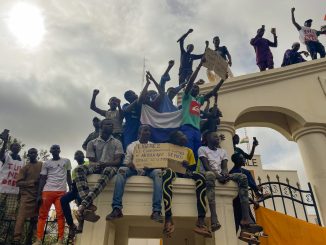
Approximately 30,000 people gathered in Niger’s capital of Niamey on August 6, as the country faced a looming threat of military intervention led by the Economic Community of West African States (ECOWAS) regional bloc. However, as the deadline set by ECOWAS expired on Sunday, the regional bloc held an emergency virtual meeting with the African Union to discuss the situation in Niger.
The bloc did not publicly comment on the expiration of its ultimatum but did on August 7 issue a brief statement, announcing that the chair of ECOWAS, Nigerian President Bola Tinubu, had convened a second Extraordinary Summit of the Authority, which would take place in Abuja on August 10, to discuss “the political situation and recent developments in Niger.”
The bloc had first convened an Extraordinary Summit in Abuja on July 30, following which it had warned Niger’s military leaders, or the National Council for the Safeguard of the Homeland (CNSP) that it would take “all measures necessary,” including the use of force, if ousted president Mohamed Bazoum was not reinstated by August 6.
Coup d’État au #Niger : meeting de soutien aux putschistes, ce dimanche dans le stade de Niamey. #Bazoum #NigerCoup pic.twitter.com/RsB4wP55Vs
— LSI AFRICA (@lsiafrica) August 6, 2023
Plans for a possible military intervention were finalized in a three-day meeting of the ECOWAS defense chiefs of staff which concluded in the Nigerian capital of Abuja on August 4.
However, lawmakers in Nigeria, the country believed to lead the invasion, rejected a proposal by President Bola Tinubu to deploy troops on August 5. ECOWAS members Senegal and Côte d’Ivoire have declared their intentions to deploy troops.
Meanwhile, Niger’s other regional neighbors, Chad and Algeria (which is not a member of ECOWAS), have rejected military action, with Algerian president Abdelmadjid Tebboune reiterating over the weekend that “threats of military intervention in Niger are a direct threat to Algeria,” and warning against any action that would “inflame the entire Sahel region.”
Meanwhile, on Sunday, people poured into the General Seyni Kountche stadium in Niamey, the latest in a series of mass actions against imperialism and foreign intervention held in the country over the past week.
Importantly, hundreds of people also took to the streets in the city of Arlit, where the French company Orano (the successor of the colonial, state-owned mining company Areva) has been mining uranium for decades, and a clear representation of the neocolonial extraction that France has continued to impose on countries such as Niger.
The CNSP has warned that any “aggression or attempted aggression” against Niger will be met with an immediate response by the country’s defense forces. On August 6, the CNSP announced that it was closing down Niger’s airspace citing a threat of intervention. In a separate statement, the military leaders added that there had been a “pre-deployment” of forces in two unnamed Central African countries in preparation for an intervention, warning that any state involved would be deemed “co-belligerent”.
Following a visit by a CNSP delegation to Mali and Burkina Faso over the weekend, both countries are dispatching a joint delegation to Niamey on August 7, to express their solidarity. The military leadership in both neighboring countries came to power in popular coups in 2022 amid anti-imperialist and anti-French unrest and has since also expelled French troops from their borders.
Mali and Burkina Faso have declared that they will treat any attack on Niger as a declaration of war on their respective countries and will mobilize their forces accordingly. On August 6, a demonstration was also held in Burkina Faso’s capital of Ouagadougou in support of the people of Niger.
Source: Peoples Dispatch
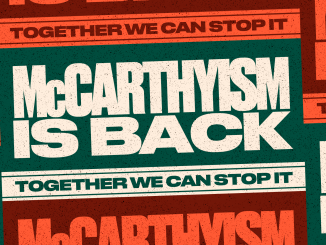
McCarthyism is back: Together we can stop it

Progressive organizations and prominent individuals have just released an important sign-on letter to reject the new McCarthyism that is accompanying the U.S. government’s Cold War agenda against China. Struggle-La Lucha and the Socialist Unity Party are endorsers of this statement.
We stand together against the rise of a new McCarthyism that is targeting peace activists, critics of US foreign policy, and Chinese Americans. Despite increased intimidation, we remain steadfast in our mission to foster peace and international solidarity, countering the narrative of militarism, hostility, and fear.
As the US government grapples with a major crisis of legitimacy, it has grown fearful of young people becoming conscious and organized to change the world. Influential media outlets like The New York Times have joined right-wing extremists in using intimidation tactics to silence these advocates for change, affecting not only the left but everyone who supports free speech and democratic rights.
The political and media establishments, both liberal and conservative, have initiated McCarthy-like attacks against individuals and organizations criticizing US foreign policy, labeling peace advocates as “Chinese or foreign agents.” This campaign uses innuendo and witch hunts, posing a threat to free speech and the right to dissent. We must oppose this trend.
Scientists, researchers, and service members of Chinese descent have been falsely accused of espionage and unregistered foreign agency, often with cases later collapsing due to insufficient evidence. Similar to the old “Red Scare” and McCarthy periods, when scores of organizations and leaders like W.E.B Du Bois, Eugene Debs, Emma Goldman, Paul Robeson and Martin Luther King Jr and others were attacked with fact-less accusations, today, prominent organizations and individuals, including CODEPINK, The People’s Forum, and Tricontinental Institute have been targeted, with smears and accusations propagated by outlets like The New York Times.
Their strategy paints a sinister image of a secret network funding the peace movement. However, there’s nothing illegal or fringe about opposing a New Cold War or a “major power conflict” with China, views shared by hundreds of millions globally. Receiving donations from US citizens who share these views is not illicit.
Media outlets have tried to scandalize funding sources of several organizations that are on the frontlines working with anti-racist, feminist, anti-war, abolitionist, climate justice, and other movements throughout the United States and globally. Meanwhile, when white neoliberal philanthropists flood the non-profit complex with significant funds to support their political agendas this is rarely scrutinized or made accountable to the communities they impact.
From The New York Times to Fox News, there’s a resurgence of the Red Scare that once shattered many lives and threatened movements for change and social justice. This attack isn’t only on the left but against everyone who exercises their free speech and democratic rights. We must firmly resist this racist, anti-communist witch hunt and remain committed to building an international peace movement. In the face of adversity, we say NO to xenophobic witch hunts and YES to peace.
Signed,
CODEPINK
The People’s Forum
Tricontinental Institute for Social Research
ANSWER Coalition
Anticapitalism for Artists
Defend Democracy in Brazil
Families for Freedom
Mulheres de Resistencia do Exterior
Nodutdol
NYC Jericho Movement
NYC Young Communist League
Pivot to Peace
Radical Elders
Abby Martin • Andy Hsaio • Ben Becker • Ben Norton • Bhaskar Sunkara • Brian Becker • Carl Messineo • Chris Hedges • Claudia de la Cruz • Corinna Mullen • David Harvey • Derek R. Ford • Doug Henwood • Eugene Puryear • Farida Alam • Fergie Chambers • Gail Walker • Geo Maher • Gerald Horne • Gloria La Riva • Hakim Adi • Heidi Boghosian • Immanuel Ness • James Early • Jeremy Kuzmarov • Jill Stein • Jim Garrison • Jodi Dean • Jodie Evans • Johanna Fernandez • Karen Ranucci • Kenneth Hammond • Koohan Paik-Mander • Lee Camp • Lisa Armstrong • Manolo de los Santos • Manu Karuka • Mara Verheyden-Hilliard • Matt Hoh • Matt Meyer • Matteo Capasso • Max Lesnik • Medea Benjamin • Michael Steven Smith • Nazia H. Kazi • Radhika Desai • Rania Khalek • Richard M Walden • Robin D.G. Kelley • Roger Waters • Roxanne Dunbar Ortiz • Ruth Wilson Gilmore • Salvatore Engel di-Mauro • Sheila Xiao • Stella Schnabel • Vijay Prashad • Vivian Weisman
REMINDER: Aug. 9th National Day of Protest to Defend the Tampa 5! Protesting DeSantis is Not a Crime!
|
||||||||||||||||||||||||||||||||||||
|
||||||||||||||||||||||||||||||||||||
|
||||||||||||||||||||||||||||||||||||
|
Atomic bombs: Oppenheimer, Hiroshima, Nagasaki, and the USSR

“Oppenheimer” has become a Hollywood blockbuster. The movie’s main character is the liberal, cultured, physicist and war criminal, J. Robert Oppenheimer.
For obvious reasons, it hasn’t been shown yet in Japan, where there are thousands of survivors of the two atomic bombings. This writer hasn’t seen the film because to do so would mean, in effect, crossing the picket lines of actors, writers, and other workers currently on strike.
It’s been noted that the movie doesn’t show the thousands of Indigenous and Mexicana/o people who were driven off their land to build the Los Alamos laboratory. Nor does it mention that hundreds of these local inhabitants suffered from radiation-induced cancers, with many dying.
“Oppenheimer” also doesn’t raise why it wasn’t until 1954 that his security clearance was revoked. The anti-communist witch hunt had been at a fever pitch for years.
Over a hundred Communist Party members had been convicted under the Smith Act of attempting to “overthrow the government.” The Black communist leader Henry Winston was blinded in prison because he was denied medical care.
Richard Nixon’s political career was based on framing Alger Hiss, the former State Department official, and Carnegie Endowment for International Peace ex-president. Hiss appeared before the notorious House Un-American Activities Committee in August 1948.
Senator Joe McCarthy, whose name became synonymous with the entire era, talked of “20 years of treason.” The fascist demagogue claimed that the administrations of Democratic presidents Roosevelt and Truman were infiltrated by communists.
It was the courage of Ethel and Julius Rosenberg that prevented the witch hunt from becoming even worse. The Rosenbergs were framed by the U.S. Government and burned to death on Juneteenth, 1953. (See “The Rosenbergs were heroes.”)
FBI director J. Edgar Hoover was convinced the Rosenbergs, confronted by the electric chair, would make a phony confession. Such forced lying statements would implicate not just Oppenheimer but also a whole series of other liberal figures in the capitalist establishment.
This would have allowed Joe McCarthy’s bogus charges — now amended to “21 years of treason” — to be accepted as gospel truth by capitalist society and its media. The Rosenbergs saved us from this intensified inquisition.
Taking away Oppenheimer’s security clearance was a poor consolation prize for the McCarthyites. While Oppenheimer’s hearing started in April 1954, McCarthy would be censured by the U.S. on December 2 that same year.
In the meantime, a unanimous U.S. Supreme Court outlawed school segregation in its Brown v. Board of Education decision on May 17, 1954. The witch hunt was losing steam. —S.M.
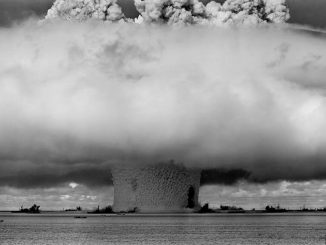
Why Hiroshima and Nagasaki were incinerated
By Stephen Millies
First published August 6, 2019, revised August 7, 2023
Barack Obama visited Hiroshima on May 27, 2016, the first sitting U.S. president to do so. Obama’s visit to the Japanese city revived the question of whether killing hundreds of thousands of people in Hiroshima and Nagasaki with atom bombs was a military necessity.
Dwight Eisenhower didn’t think so. The former president and five-star general wrote in his autobiography “Mandate for Change” that dropping atom bombs on Japan “was completely unnecessary.” Ike claimed that he said this to War Secretary Henry Stimson.
General Curtis LeMay told a Sept. 20, 1945, news conference, “The atomic bomb had nothing to do with the end of the war at all.” Even President Truman declared that dropping the bombs “did not win the war.” (“Hiroshima in America, Fifty Years of Denial” by Robert Lifton and Greg Mitchell)
A big reason why Japan surrendered was that the Soviet Army and Mongolian, Korean and Chinese allies rolled through northeastern China and all of Korea. This not only destroyed the biggest Japanese army but threatened a socialist revolution in Japan itself.
Yet talking heads at Fox News still claim that burning babies alive in Hiroshima and Nagasaki “saved the lives of U.S. soldiers” by averting an amphibious invasion of Japan.
Complete barbarism
After breaching the walls of a besieged city, Roman soldiers killed or enslaved every human being they could find. Even cats were sliced in two. Among their victims was the famous mathematician Archimedes, killed by a legionnaire after Syracuse in Sicily was overrun in 212 BCE (Before the Common Era).
Two thousand years later, international law was supposed to prevent such war crimes. Nazi leaders were hanged in Nuremberg for deliberately killing civilians.
But U.S. war leaders committed war crimes, too. General LeMay burned alive over 100,000 people during the March 9-10, 1945, firebombing of Tokyo.
At least 200,000 people, including thousands of children, were killed by the atom bombs dropped on Hiroshima on Aug. 6, 1945, and Nagasaki three days later. Even decades later, people died from radiation-caused illnesses.
A diplomat from the Democratic People’s Republic of Korea told this writer that 30,000 of the people killed in Hiroshima were Korean forced laborers. Truman murdered these Korean workers held hostage by the Japanese emperor and big business.
President Teddy Roosevelt turned Korea over to the Japanese Empire in the 1905 peace treaty, signed in Portsmouth, New Hampshire, that ended the Russian-Japanese war. Teddy got a Nobel Peace Prize for his crime.
People’s Korea has found it absolutely necessary to develop nuclear weapons to defend itself against the Pentagon. This is not only because of U.S. nuclear missiles aimed at Korea.
At least 4 million Koreans were killed during the Korean War. Using napalm and white phosphorous bombs on human flesh didn’t satisfy U.S. generals and politicians. Then Texas Congressperson Lloyd Bentsen can be seen in “The Atomic Cafe” demanding that atom bombs be dropped on Koreans.
This didn’t stop Bentsen from being the Democratic candidate for vice president in 1988 or from serving as President Bill Clinton’s first Treasury Secretary. Korea also remembers the Hiroshima holocaust.
The Manhattan Project’s real target
More than 120,000 workers were mobilized by the U.S. Army’s Manhattan Project to build the death bombs. At least $2 billion was spent, which, as a percentage of the U.S. economy, equals around $260 billion in 2023.
The excuse for the Manhattan Project was that the U.S. had to “beat Hitler” at developing the atomic bomb. This was the reason given to scientists like the young physicist and future Nobel Prize winner Richard Feynman.
But the real target of the Manhattan Project was the Soviet Union.
According to William Shirer in “The Rise and Fall of the Third Reich,” U.S. brass hats expected the Soviet Union to collapse within six weeks of Hitler’s invasion in June 1941.
A representative of Kansas City’s corrupt Pendergast Machine — Sen. Harry Truman — declared, “If we see that Germany is winning we ought to help Russia and if Russia is winning we ought to help Germany, and that way let them kill as many as possible.” (New York Times, June 24, 1941)
The Soviet Union didn’t collapse. At a cost of 27 million Soviet lives, Nazi forces were forced back from Stalingrad to Berlin. It was the Red Army of workers and peasants that liberated Auschwitz on Jan. 27, 1945.
Despite pleas from Treasury Secretary Henry Morgenthau, War Secretary Stimson refused to bomb the railroad lines to Auschwitz which took millions of people to their death.
USSR deterred nuclear war
The Manhattan Project was Wall Street’s response to the phoenix-like resurrection of the Red Army. The U.S. and British ruling classes dreaded Soviet forces marching all the way to Paris and being welcomed by workers.
Capitalists also feared a revival of the German working class who had been crushed by Hitler.
The tremendous Soviet victory against the Nazis at Kursk in July and August of 1943 — the biggest tank battle in history — caused the U.S. military-industrial complex to speed up its atom bomb project. Because copper was needed elsewhere, the Manhattan Project was allowed to borrow 14,700 tons of silver from the Treasury Department to wrap around its magnets.
The physicist Joseph Rotblat was present when Leslie Groves — the Manhattan Project’s director — admitted that the Soviets were the real target:
“General Leslie Groves, when visiting Los Alamos, frequently came to the Chadwicks for dinner and relaxed palaver. During one such conversation, Groves said that, of course, the real purpose in making the bomb was to subdue the Soviets. (Whatever his exact words, his real meaning was clear.)”
During World War II, Time magazine publisher Henry Luce proclaimed an upcoming “American Century.” The Pentagon was planning to confront the USSR not just with the bomb but also with military forces numbering 16 million GIs and the biggest air force in history.
This immense power was also to be used against the Chinese Revolution and as a threat to all oppressed people.
Super-racist U.S. General George Patton talked about rearming Nazi SS troops and marching to the Volga. Winston Churchill considered an invasion of the Soviet Union in “Operation Unthinkable.”
The U.S. had half the world’s industrial capacity in 1945. President Kennedy correctly noted in 1963 that the Nazi destruction of the Soviet Union would have equaled everything in the United States east of the Mississippi River being destroyed.
But the millions of GIs whom Wall Street wanted to use against the Soviet Union wanted to go home. Even though it was still a Jim Crow army, tens of thousands of soldiers demonstrated in Paris, Manila, and other cities demanding to go home. This GI revolt was the greatest gift of the U.S. working class to the world revolution — and probably the least known.
Despite billions of aid lavished on Chiang Kai-shek, the Pentagon couldn’t stop the Chinese Revolution.
The only reason a nuclear holocaust hasn’t destroyed humankind is that the Soviet Union, at tremendous cost, was able to develop a deterrent nuclear force against a Pentagon attack.
Strategic Air Command head Curtis LeMay and Chair of the Joint Chiefs of Staff Lyman Lemnitzer both wanted to launch a nuclear first strike on the Soviet Union. According to Daniel Ellsberg, the Pentagon planned to kill 600 million people. In 1968 LeMay was George Wallace’s running mate during the segregationist’s fascist presidential campaign.
LeMay actually had hydrogen-bomb-equipped planes continually in the air, ready to attack. Inevitable crashes happened, including one off Spain’s Mediterranean coast in 1966. It took 12 weeks and over 20 naval ships to recover the bomb.
A 1958 accident dropped a Mark 15 thermonuclear bomb off the Atlantic Coast of Georgia. It has never been recovered.
That unexploded bomb is a real threat to people in the U.S., not the small number of nuclear weapons that People’s Korea needs to defend itself.
Jail Trump for racism and war crimes
The whole world witnessed the insurrection in the U.S. Capitol on Jan. 6, 2021, that sought to overturn the 2020 presidential election. So why did it take two and a half years to finally indict Trump on Aug. 1 for trying to steal the votes?
Federal prosecutor Jack Smith never lacked evidence. Trump’s fingers were all over the attempt to reverse the election.
Secret Service agents close to Trump tried to take Vice President Mike Pence to Andrews Air Force Base to stop the counting of electoral votes. Gen. Charles Flynn, the brother of Trump’s first national security advisor Michael Flynn, delayed sending troops to the capitol for 187 minutes.
Trump made calls to state officials demanding changes in the vote totals.
Key to Trump’s conspiracy was attempting to steal Black votes in Atlanta, Detroit, Milwaukee, and Philadelphia. Election workers were threatened and harassed by pro-Trump mobs.
Accompanying all of the Trump indictments is the burning hatred of tens of millions in the working class who know the danger that Trump represents. This is particularly so in Asian, Black, Indigenous, and Latinx Communities.
For many, it was as if the segregationist former Alabama governor and presidential candidate George Wallace had made it to the White House.
Trump isn’t being indicted for his bigotry and encouragement of racist violence. He’s not being prosecuted for keeping immigrant children in cages and denying them health care.
No mention is made of Trump’s continuing occupation and bombing of Syria. Or his other war crimes, like the assassination of Iranian Gen. Qassem Soleimani, who was on a diplomatic peace-making mission when he was murdered in Baghdad by a U.S. drone.
Both Iran and Iraq have asked for Trump’s extradition for the murders of General Soleimani, Commander Muhandis, and five others.
The wealthy scorn democracy
Nobody should think that Trump’s behavior is out of the ordinary for the super-rich. Many big capitalists support Trump, including hedge fund operators as well as oil and gas frackers.
That’s how he got to the White House in the first place. Many of the 756 U.S. billionaires are just as greedy, crude, and bigoted as Trump.
The “old money” in Philadelphia made the fascist Frank Rizzo Philly’s mayor. Their police bombed the MOVE house on May 13, 1985, killing 13 Black people, including six children.
None of the U.S. billionaires refused Trump’s tax cuts. That includes former New York Mayor and current Trump critic Michael Bloomberg, whose $94 billion stash is almost 40 times larger than Trump’s.
Bloomberg spent $250 million to buy three elections as the Big Apple’s mayor. That’s as corrupt as anything Trump did.
The New York Times attacks Trump. Yet the newspaper endorsed Rudolph Giuliani (the “No. 1 unindicted co-conspirator” in the latest Trump indictment) for reelection as New York City mayor in 1997.
Giuliani should have been jailed decades ago for presiding over a trigger-happy police force whose cops fired 41 bullets at Amadou Diallo, killing the African immigrant. As Trump’s top accomplice, Giuliani bragged that he kicked 640,000 New Yorkers off public assistance.
The wealthy and powerful scorn democracy. They find it repulsive that the vote of a homeless person ― or any poor and working people ― should count as much as theirs.
Oil billionaire H.L. Hunt wanted a social order in which the wealthiest individuals could cast the most votes. Hunt even wrote a novel entitled “Alpaca” describing this monstrosity.
Utah Senator Mike Lee says the United States isn’t and shouldn’t be a democracy. Reactionary columnist David Harsanyi wants to “weed out ignorant Americans from the electorate.”
Wall Street Journal editorial page editor Robert Bartley justified George W. Bush going to the White House despite winning 543,895 fewer votes than Al Gore. Bartley did so because many of the Democratic votes were cast by “union households” and “Blacks.”
Did Bartley think Black voters were worth three-fifths as much as white voters? That’s how the U.S. Constitution specified how Black people should be counted in the census.
The day after this racist rant was published in the Wall Street Journal, five U.S. Supreme Court justices selected Bush as president on Dec. 12, 2000.
Trump’s attempted coup d’état
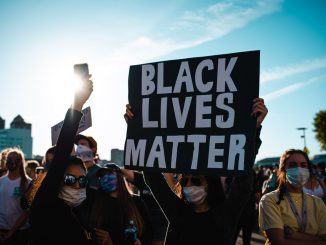
The real reason for the latest indictment of Trump is the same one that prevented him from declaring martial law on June 1, 2020. That was a week after George Floyd was murdered, and demonstrations demanding Black Lives Matter! were sweeping the United States.
Trump wanted to invoke the 1807 Insurrection Act ― which was enacted to suppress rebellions of enslaved Africans ― and send troops to shoot protesters across the country. The rub is that the U.S. Army is 20% Black and almost 18% Latinx.
The Pentagon brass feared that GIs would refuse to follow orders to attack the people demanding justice. Trump’s consolation prize was having demonstrators attacked with pepper spray and tear gas in Lafayette Park across from the White House.
Seven months later, Trump was planning to remain in the White House no matter what. He fired Defense Secretary Mark Esper, appointed Christopher Miller as Esper’s replacement, and promoted three other officials after losing the election. Wasn’t this clear evidence of an attempted coup?
White House Deputy Counsel Patrick Philbin remarked to Jeffrey Clark that there would be “riots in every major city in the United States” if Trump insisted on staying in office.
Clark — whom Trump wanted to make Attorney General — responded, “Well, that’s why there’s an Insurrection Act.”
It’s one thing for Kenosha, Wisconsin, police to welcome fascist vigilantes like Kyle Rittenhouse. It’s another matter when the Joint Chiefs of Staff is asked to stage a coup d’état to keep Trump in office.
Sections of the ruling class, particularly among their legal and political apparatus, consider Trump to be dangerous. This isn’t because he’s making phony anti-war remarks about the conflict between Ukraine and the Russian Federation. (Trump wants to concentrate instead on attacking China.)
It’s because Trump might incite tens of millions of poor and working people to revolt.
Nobody should put their trust in the capitalist “rule of law.” The “rule of law” sent the anti-slavery martyrs of Harpers Ferry to the gallows.
Only the power of the people can stop all the Trumps and overturn the capitalist system, liberating working and oppressed peoples.
1