National Day of Action Against Police Terror – Justice for all Stolen Lives!

WEDNESDAY, FEBRUARY 1, 2023 AT 9 PM EST
National Day of Action Against Police Terror – Justice for all Stolen Lives!

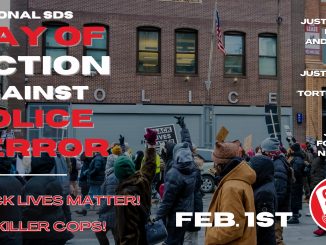
Join National Students for a Democratic Society in a National Day of Action against Police Terror in the wake of the recent murders of Keenan Anderson, Tyre Nichols and Manny “Tortuguita” Teran by police. Join or organize a protest on your campus calling for justice for all stolen lives!
Justice for Manny Teran! Justice for Tyre Nichols! Justice for Keenan Anderson!

Strugglelalucha256


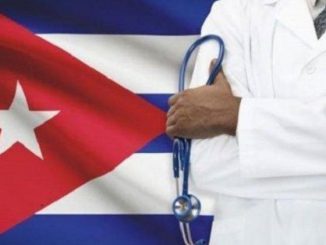
El bloqueo estadounidense a Cuba perjudica a pacientes médicos de ambos países

Las y los científicos cubanos creen que los avances logrados en los sectores de salud y tecnología deben utilizarse para salvar y mejorar vidas más allá de las fronteras del país. Por ello, la isla ha establecido importantes alianzas científicas y médicas con organizaciones y Gobiernos de todo el mundo, incluidos los de México, Palestina, Angola, Colombia, Irán y Brasil. Sin embargo, el bloqueo impuesto a Cuba por los Estados Unidos – que dura ya seis décadas – dificulta estos intercambios.

En el encuentro “Construyendo nuestro futuro”, que reunió a jóvenes cubanos y estadounidenses en La Habana durante noviembre del 2022, los científicos del Centro Cubano de Inmunología Molecular (CIM) afirmaron en su ponencia que el bloqueo también perjudica al pueblo estadounidense. Con el levantamiento de las sanciones contra Cuba, argumentaron los científicos, el pueblo de los Estados Unidos podría tener acceso a tratamientos que salvan vidas y que se están desarrollando en la isla, especialmente contra enfermedades como la diabetes, que hace estragos cada año en las comunidades de clase trabajadora.

Una cura para la diabetes

Las y los científicos cubanos han desarrollado una vacuna contra el cáncer de pulmón y un tratamiento innovador contra la diabetes (el Heberprot-P, desarrollado por el Centro de Ingeniería Genética y Biotecnología (CIGB) de Cuba ) que puede reducir en más de cuatro veces las amputaciones de piernas de personas con úlceras de pie diabético. El medicamento contiene un factor de crecimiento epidérmico humano recombinante que, cuando se inyecta en una úlcera del pie, acelera su proceso de cicatrización, reduciendo así las amputaciones relacionadas con esta condición. Sin embargo – y a pesar de que el medicamento está registrado en Cuba y en otros países desde el 2006 – las personas estadounidenses no pueden acceder al Heberprot-P.

Según el Centro para el Control y la Prevención de Enfermedades, la diabetes fue la octava causa de muerte en los Estados Unidos durante el 2020, cobrándose la vida de más de 100.000 pacientes en ese año. “Las úlceras en los pies se encuentran entre las complicaciones más comunes de los pacientes con diabetes”, pudiendo conllevar amputaciones de miembros inferiores, según un informe del Centro Nacional de Información Biotecnológica. Cada año se practican unas 73.000 “amputaciones no traumáticas de extremidades inferiores” a personas diabéticas en los EE. UU. Estas amputaciones se producen a un ritmo desproporcionado en función del color de piel de los y las pacientes, siendo mucho más frecuentes entre las personas negras y marrones que sufren diabetes. Muchos señalan que la causa de esto se encuentra en las disparidades económicas raciales y al racismo médico sistémico.

“Si vas a los barrios afroamericanos de bajos ingresos, es una zona de guerra… Ves a gente que se desplaza en silla de ruedas”, declaró el Dr. Dean Schillinger, profesor de medicina de la Universidad de California-San Francisco, a KHN. Según el artículo, “las amputaciones se consideran una ‘mega-disparidad’ y eclipsan casi cualquier otra disparidad sanitaria por raza y etnia”.

Según diversos informes, la esperanza de vida de un paciente con amputación de miembro inferior tras una diabetes se reduce considerablemente. “[L]os pacientes con amputaciones relacionadas con la diabetes tienen un alto riesgo de mortalidad, con una tasa de supervivencia a cinco años del 40-48%, independientemente de la etiología de la amputación”. Heberprot-P podría ayudar a decenas de miles de pacientes a evitar esas amputaciones; sin embargo, debido al bloqueo, los y las pacientes estadounidenses no pueden acceder a este tratamiento. La población estadounidense tiene un gran interés en desmantelar el bloqueo de los Estados Unidos a Cuba.

“Así que después de cinco años [post-amputación], eso es lo máximo que se puede vivir, y estamos impidiendo que eso suceda”, dijo Rydell Alvarez Arzola, investigador del CIM, en una presentación dada a los jóvenes estadounidenses y cubanos durante la conferencia en La Habana. “Y eso también es algo que podría unir a nuestros dos pueblos [en Cuba y Estados Unidos] para luchar… para eliminar [el bloqueo]”.

La salud cubana bajo bloqueo

Quizás uno de los logros de los que Cuba se siente más orgullosa es un sistema sanitario de renombre mundial que ha prosperado a pesar de la devastación económica y de un bloqueo de 60 años.

Tras la caída de la Unión Soviética en 1991 – el principal socio comercial de Cuba – la isla sufrió un descenso del PIB del 35% en tres años, apagones y una caída en picada de la ingesta calórica. Sin embargo, a pesar de estos desafíos abrumadores, Cuba nunca vaciló en su compromiso de proporcionar asistencia sanitaria universal. La salud universal, o el acceso a una asistencia sanitaria gratuita y de calidad para todos y todas, es una antigua reivindicación de los movimientos populares estadounidenses, que nunca se ha concretado debido, en gran medida, al modelo con ánimo de lucro de la industria sanitaria y a los enormes intereses corporativos en el sector.

Mientras otras naciones promulgaban medidas neoliberales de austeridad – que recortaron drásticamente los servicios sociales en las décadas de 1980 y 1990 – el gasto público en salud de Cuba aumentó un 13% entre 1990 y 1994. A mediados de la década de 1990, Cuba logró elevar la proporción de médicos por paciente a un médico por cada 202 cubanos, una estadística mucho mejor que la de los Estados Unidos, con un médico por cada 300 personas, según un censo de 2004.

Comenzando la séptima década de bloqueo, Cuba no sólo mantiene la salud universal, sino que sigue estando a la vanguardia de los avances científicos a escala mundial.

Esto quedó patente durante la crisis del COVID-19. Ante la imposibilidad de adquirir vacunas desarrolladas por empresas farmacéuticas estadounidenses debido al bloqueo, Cuba desarrolló cinco vacunas. La nación no sólo logró su objetivo de crear una de las vacunas más eficaces contra la COVID-19, sino que también lanzó, en septiembre de 2021, la primera campaña de vacunación masiva contra COVID-19 para niños y niñas de dos a 18 años.

Compartir conocimientos sin restricciones

A pesar de sus logros, la salud cubana sigue enfrentándose a graves limitaciones que ponen en peligro la vida debido al bloqueo económico. El CIM, por ejemplo, ha tenido dificultades para encontrar empresas internacionales dispuestas a llevar a cabo servicios vitales para ellos. Claudia Plasencia, investigadora del Centro, explicó durante la conferencia que el CIM había firmado un contrato con una empresa alemana de síntesis genética que luego se echó atrás porque había firmado un nuevo contrato con una empresa estadounidense. “No podían seguir procesando nuestras muestras, no podían seguir haciendo negocios con Cuba”, dijo Plasencia.

Arzola explicó cómo es prácticamente imposible adquirir equipos de alta gama debido a las restricciones comerciales. “Un citómetro de flujo es una máquina que cuesta un cuarto de millón de dólares… aunque mi laboratorio tenga el dinero, no puedo comprar la mejor máquina del mundo, que es de los Estados Unidos, todo el mundo lo sabe”, dijo. Incluso si el CIM comprara esa máquina a un tercero, no podría utilizar los servicios de reparación de los Estados Unidos. “No puedo comprar estas máquinas aunque tenga el dinero, porque no sería capaz de repararlas. No puedes gastarte un cuarto de millón de dólares cada seis meses [comprando una máquina nueva]… aunque sepas que esta [máquina] es la mejor para tus pacientes”.

Hablé con Marianniz Díaz, una joven científica del CIM. Cuando le pregunté qué podíamos hacer en los Estados Unidos para ayudar a los científicos del CIM, su respuesta fue directa: “Lo principal que se puede hacer es eliminar el bloqueo”.

“Me gustaría que tuviéramos una interacción sin restricciones, para que [Cuba y EE. UU.] podamos compartir nuestra ciencia, nuestros productos, [y] nuestros conocimientos”, me dijo.

Este artículo se produjo como colaboración entre Peoples Dispatch y Globetrotter.

Natalia Marques es redactora en Peoples Dispatch, organizadora y diseñadora gráfica residente en Nueva York.

Strugglelalucha256


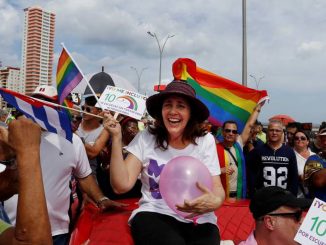
Cuban leader Mariela Castro Espín on ‘progressive conquest of new rights’

Video message from Mariela Castro Espín, director of Cuba’s National Center for Sex Education (CENESEX) and deputy of the National Assembly of Popular Power, to the webinar “What We Can Learn from Cuba’s ‘Code of Freedom’ for Families,” hosted by Women In Struggle/Mujeres En Lucha on Jan. 22.

Greetings to all, I am Mariela Castro.

There are two main milestones in the Cuban Revolution regarding family law. One was the Family Code approved in 1975, which also went through a process of popular consultation and was taken to a referendum.

This code allowed for instituting important values that are being promoted in Cuban society for equal rights between men and women, especially in family life, in the equitable distribution of educational tasks and household chores, to begin to erode that patriarchal heritage of the sexual division of labor.

That code played a very important role and was considered one of the most advanced in the world at that time. Still a heteropatriarchal code, in some aspects, and hetero-normative specifically, yet not much more could be asked of Cuban society at that stage.

Education and scientific development, especially in the field of legal and social sciences and humanities, led to strengthening of Cuban culture regarding the family and family law. Progress was made regarding the rights of women.

All of this is reflected at a statistical level, as Cuba ranks second in the world for women parliamentarians: 53% of the Cuban parliament consists of women. There is an increasing presence of women in the National Assembly of Popular Power at leadership levels. Cuban women predominate in the sciences and there are several sectors of Cuban society at a professional level where the presence of women is increasingly greater.

In Cuba, there is respect for women, but the society is still patriarchal. Although the patriarchy has been eroded and weakened by the advances of our Revolution, there is significant resistance, and that creates challenges for us.

After 47 years of the Family Code being in force with all the new elements that were incorporated, the laws in which Cuba subscribed and committed itself as a state, laws in the field of international law, in the field of Human Rights, everything that our Revolution was advancing, it was already necessary to update that code.

But it began first, with the reform of the country’s economic and social development strategy with the participation of the people with their criteria, with their criticisms and their proposals. From there, it went on to the constitutional reform, which was a substantial reform of 2019 approved in April 2019, also subject to specialized consultation, popular consultation and referendum with a very high turnout. 87% of the population approved that constitution in which the rights of LGBT people were already protected, important paths were opened, for example, for what they call equal marriage, but also to strengthen greater protection for sexual health and reproductive, sexual and reproductive rights.

‘Heart, intelligence and wisdom of our people’

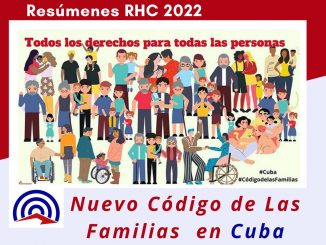
There are many other elements of the 2022 Families Code that you will be able to read on this valuable document that some consider to be the most advanced in the world, that is, international experts consider it to be so.

But this code, like the constitution, was written with the heart, intelligence and wisdom of our people. And so this is also called the heartfelt code because the bonds of affection are given precedence over the straitjacket of biological bonds.

This is truly very significant, despite the opposition of some religious groups and particularly the Catholic Church, to prevent the advances of the Revolution in the progressive conquest of new rights. This has truly been achieved with the participation of our people in reaching a widely accepted code, although it was the first in which there were 33% negative votes.

But that’s fine. It shows the resistance that still exists regarding these issues and all the challenges that they generate for us to continue transforming awareness that will allow us to create an active citizenry regarding the need for social and subjective transformations for achieving an increasingly just and equitable society.

The transition to socialism is complex and individual awareness is always in the rearguard. And this is what has been happening. That is the significance. Our people have approved a constitution and a very advanced family code within the context of a socialist society of rights and social justice.

I am very satisfied with the result, but I also feel the responsibility that we still have to continue advancing to permanently educate and communicate all the elements based on science that help provide elements of analysis to monitor and evaluate the application of this new legislation in family law.

I thank you very much for your interest in this issue, and I invite you to read this valuable document that has been the result of building consensus for the 47 years that the previous code lasted. This is the importance it has, how our society is advancing by becoming more aware and moving towards a much more conscientious culture regarding the issues that this code deals with.

Thank you very much for your interest and warm greetings. Until we meet again.

Full text of the 2022 Families Code (in Spanish)

Comprehensive summary (in English)


Strugglelalucha256


End the U.S. economic war against the Cuban people!

Talk given by Cheryl LaBash, co-chair of the National Network On Cuba (NNOC), at the webinar “What We Can Learn from Cuba’s ‘Code of Freedom’ for Families,” hosted by Women In Struggle/Mujeres En Lucha on Jan. 22.

Sixty years is a long time. But that is how long the United States government, led by both Democrats and Republicans, has waged an economic, financial and commercial war against the Cuban people.  

Even before that, the Eisenhower administration recognized that Fidel and the July 26th Movement – Raul, Che, Almeda, Camilo, Vilma, Haydee, Celia, Melba and so many more – would stay true to their promise: liberation, equality and sovereignty for all the Cuban people.

An April 6, 1960, State Department memo admitted the fact that the Cuban people supported the revolution. So it prescribed the path taken by the U.S. from then until today: 

“Every possible means should be undertaken to weaken the economic life of Cuba,” the memo states. “If such a policy is adopted, it should be the result of a positive decision which would call forth a line of action which, while as adroit and inconspicuous as possible, makes the greatest inroads in denying money and supplies to Cuba, to decrease monetary and real wages, to bring about hunger, desperation and overthrow of the government.”

Although the goal didn’t change, the tactic did. On Dec. 17, 2014, President Obama and President Raul Castro agreed to begin a different road. President Obama even visited Cuba – and as a result many people wrongly believe the blockade ended then. Some things were eased, but behind it all, the coercive economic measures continued. 

Then, in June 2017, President Trump declared he would return to the failed direction outlined by the State Department in 1960.

And then came the pandemic. Cuba had to close its main source of hard currency – tourism – and used its reserves to save lives, develop five COVID vaccines (three now in emergency use) and send its famous Henry Reeve Brigades to countries needing help against the pandemic. 

U.S. uses pandemic as weapon

The United States saw its opportunity to use the pandemic as a weapon. Some 243 new measures were implemented to block any financial possibilities for Cuba. Surely the Cuban people would be desperate enough to embrace capitalist landlords, bankers and bosses. 

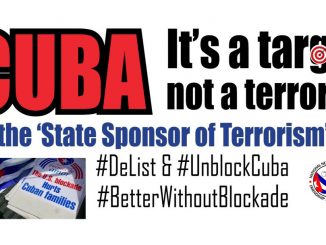
Then as a parting shot, after the 2020 Biden election, Cuba was again declared a “State Sponsor of Terrorism.” Certainly an insult as well as an injury to Cuba.

Although President Biden has been in office two years, he has done virtually nothing to lift the pressure on the Cuban people. The SSOT can be lifted with a letter from Biden!

Instead, we have been inundated with propaganda about “human rights” to justify turning back the changes made by the Obama administration in 2014-2015. 

There is no alternative truth. Cuba is not a state sponsor of terrorism, but has been targeted by terrorist acts organized and financed in the U.S. The intensified blockade has hurt Cuban families on both sides of the Florida straits. For three years, Cubans in Miami have said “end the blockade” in the streets every month. 

And it hurts farmers, workers and ordinary people in the U.S., too. Cuba has developed medical treatments that make 70% of diabetic amputations unnecessary, and a lung cancer vaccine that prolongs the quality of life of patients. 

Guess what? The U.S. categories of “legal” travel to Cuba do not include medical treatment. It’s the only country in the world where U.S. travelers need to declare a U.S. government designated category.

Elected bodies representing more than 44 million residents from California to Connecticut, from Montana to Michigan to Alabama, have called for the blockade to end, including city councils and labor organizations, school boards and county commissions. Find out how to get local resolutions where you live.

The last weekend of every month, caravans are held to end the blockade in Miami and cities across the U.S. and around the world. Make a sign with hashtag #UnblockCuba and #OFFtheList.

Participate in the U.S.-Cuba Normalization Conference March 11-12 or the May Day Brigade.  

Stay in touch with the National Network On Cuba on social media. Web: NNOC.org; Facebook.com/CubaNetwork; Instagram: NationalNetwork4Cuba; Twitter: @NNOCuba.

Sixty years is too long. This campaign needs you to act now. 

Strugglelalucha256


Cuba’s Families Code shows: Queer people need a socialist revolution!

Talk given by Melinda Butterfield, Struggle-La Lucha co-editor, at the webinar “What We Can Learn from Cuba’s ‘Code of Freedom’ for Families,” hosted by Women In Struggle/Mujeres En Lucha on Jan. 22.

Good afternoon siblings, friends, and comrades.

It’s an honor to follow the beautiful message of solidarity from Comrade Mariela Castro Espín. The organization she leads, Cuba’s National Center for Sex Education (Cenesex), just celebrated its 35th anniversary, a tremendous milestone for the Cuban people and all progressive peoples of the world.

Marking the anniversary, the Transcuba Nacional organization said that Cenesex has “developed important research and contributions in the sciences that have aided the development of Cuban society in terms of sexual rights. It has educated and trained professionals and activists who bring about social transformations around the realities of human sexuality. The particular attention paid to trans people has made Cenesex a home of respect, love and inclusion.”

What a contrast to the situation that queer people, especially trans people, face here in the United States in 2023!

Have you heard of Christynne Lili Wrene Wood? She is a retired African American city worker in Santee, a suburb of San Diego. This trans woman has become one of the latest targets of the anti-trans panic that has swept the country since last year. 

On Dec. 29, Christynne was finishing up her weekly water aerobics class at the local YMCA. She showered and changed in the women’s locker room as she always does. But that day, she was targeted for a transphobic attack. A 17-year-old girl was put up before the media afterward, claiming she was “traumatized” by seeing someone with “male genitalia” in the women’s changing area.

Trans women are women, regardless of what genitalia they have. None of the women who regularly participate in water aerobics with Christynne had an issue changing with her. But the fact is, Christynne has had gender reassignment surgery, so she could not have been mistaken for having “male genitalia.” 

It was a set-up for the far-right crusade to demonize trans people. The lie was repeated by Tucker Carlson and other fascist mouthpieces. A hate rally was staged outside the Santee YMCA last week. Christynne had to listen to these lies being repeated as she counter-protested with supporters across the street.

Christynne explained to a reporter: “There’s a movie out right now about how that kind of a lie and hysteria can lead to tragedy. The movie’s about Emmett Till. The lies of a person got that child beat to death and that’s just the kind of group [here] that would love to pull a stunt like that. Thank God, I’ve got protection and people with me that see to it that I don’t suffer that kind of pain. But don’t you think that there aren’t people over there right now that would love to come over and rip me [apart] piece [by] piece?”

Since the beginning of this year – in just three weeks – more than 150 pieces of anti-LGBTQ2S legislation have been introduced in states across this country, primarily aimed at criminalizing trans lives. This includes bills to cut off all gender-affirming health care for adults as well as youth and to essentially make it illegal for trans people to exist in public.

Doctors and children’s hospitals are threatened with bombings. Neo-Nazis attempt to shut down drag events, aided by local cops. Parents who support their trans kids are threatened with prosecution. 

What are the supposed friends of the LGBTQ2S community in Washington doing to stop this? Not a damn thing. They tell us to vote for them, the way they told women to vote for them before standing aside and letting abortion rights be stripped away. Meanwhile, supposed liberals like Hillary Clinton and the New York Times are joining in the anti-trans rhetoric, showing that this attack goes far beyond the Trumpist right. 

The Biden administration and Congress have made it crystal clear that their priority is funding wars for empire on the other side of the world and continuing the six-decades-long illegal blockade of Cuba – not protecting the rights of people here.

That’s why it’s so important for queer people and all workers to learn from Cuba’s example. 

Here are some highlights of the new Families Code Cubans approved last September:

  • Protection of all forms of families, including chosen families, with no discrimination;
  • The parental relationship is based on responsibilities and duties; 
  • The rights of children and youth, elders and the disabled to independence, dignity, accessibility, and respect;
  • Consequences for violence or other abuse in family situations; 
  • Equality of marriage and common law unions;
  • Gender equality, including for trans and nonbinary Cubans;
  • Equality of rights in adoption and technologically assisted methods like in vitro fertilization;
  • Duty to contribute to the family and recognition of the value of domestic labor;
  • Institutional and community responsibility to uphold these rights.

The guiding idea of the document is that family plurality, diversity, and human dignity are at the center of the Cuban Revolution. The definition of a family is now based on affection and emotional ties rather than blood relations. It’s a “code of freedom” to choose the form of family that works best for its members. 

I attended an event at the Cuban Mission to the United Nations, where diplomats talked about the new Families Code and answered questions. Two things really jumped out at me. One was the genuine pride the Cuban comrades had for this accomplishment. The other was the number of people from nonprofits and legal services representing trans and queer communities here, who were desperate to learn how Cuba was able to accomplish this at a time when our rights are being mercilessly rolled back.

The diplomats explained the years-long process of consultations held throughout all of society, from neighborhoods and workplaces to mass organizations; how there were 25 drafts incorporating thousands of amendments suggested at these discussions. They talked about the decisive role of young people in arguing for updating the country’s family code to be more inclusive and how they won their elders over to support the referendum. 

And they talked about how this was not something that happened out of the blue – it was built up throughout the whole history of the Cuban Revolution, for more than 60 years – the struggle against patriarchy and the vestiges of capitalism and colonialism in everyday life.

This last point is very important. It was a diplomatic event, so the Cubans couldn’t put too fine a point on it, but the essential thing is this: The Cuban people made a socialist revolution. And LGBTQ2S people in the U.S. need a socialist revolution here to secure our rights.

The U.S. ruling class has decided to go all in on scapegoating trans people. But they won’t stop with us. The broader LGBTQ2S community is next on the chopping block. 

The capitalist system is based on the principle of divide and rule. A historic struggle like the Stonewall Rebellion can shake society and win important reforms. But as long as capitalism exists, those gains are always in danger of being taken away. To truly secure our rights to equality, to decent jobs, to housing, education, and health care for all – including gender-affirming care – we need what Cuba has: a socialist revolution.

It’s time for the LGBTQ2S movement, and all people’s movements, to reject the losing strategy of relying on the Democratic Party and capitalist electoral politics. We need a return to the militant struggles of Marsha P. Johnson and Sylvia Rivera, of ACT UP and Queer Nation, and of Leslie Feinberg. And while we do that, we need to keep our eyes on the prize: replacing divide-and-conquer capitalism with a society based on solidarity that puts people’s needs first.

Full text of the 2022 Families Code (in Spanish)

Comprehensive summary (in English)

Strugglelalucha256


What we can learn from Cuba’s families code, #Women In Struggle forum

On Sunday, Jan. 22, a webinar was held on “What we can learn from Cuba’s ‘code of freedom’ for families.” The people of socialist Cuba voted by a two-thirds margin for the new Code of Families on Sept. 25. The vote was won after three years of democratic discussion and education at all levels of society.

The new code enshrines in law the rights of LGBTQ+ people and women in marriage and adoption. It changes the fundamental relationship between parents and children to one based on responsibilities and rights. It elevates chosen families to the same status as blood families. It protects the rights and dignity of elders and people with disabilities. It embraces the rights that are being stripped away from people in the U.S. or that we never had at all.

Cuba is under siege from the U.S. blockade, which has been condemned by the United Nations for 30 years, a siege tightened by Trump and now maintained by Biden.

The panel will discuss:

  • How was Cuba able to accomplish this historic transformation of families while coping with the U.S. blockade against Cuba, which has continued unabated during the COVID-19 pandemic and the recent climate-change catastrophes?
  • Why is the U.S. media silent about this unprecedented accomplishment?
  • What can we learn from Cuba’s experience building solidarity at a time when rights for LGBTQ+ people, reproductive care, equality for chosen families, as well as respect for youth, elders, and the disabled are under vicious attack by the capitalist class, its political parties and violent white supremacist groups?

Mariela Castro Espín, director of Cuba’s National Center for Sex Education (CENESEX), will present a message in the webinar panel. Some of the other speakers will include Berta Joubert-Ceci for Women In Struggle / Mujeres En Lucha; Cheryl LaBash, co-chair of National Network on Cuba; Gloria Verdieu from Prisoners Solidarity Committee; Mahtowin Munro from United American Indians of New England; Melinda Butterfield, a Struggle-La Lucha co-editor; and Ellie McCrow from Pratt Workers United. There will be opportunities to address questions to the speakers following the panel presentations.

The webinar is sponsored by Women In Struggle / Mujeres En Lucha, a member of Women’s International Democratic Federation.


Strugglelalucha256


Peruvians protest against U.S. embassy in Lima

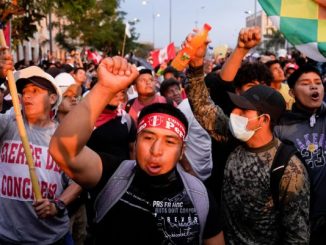
Social movements from across Peru are protesting outside the U.S. embassy in Lima to condemn the U.S. role in the coup against Pedro Castillo. The main chant from protesters is, “Yanqui murderers, get out of Peru!”

“We’re here because we love our country (..) that’s why we’re here outside the U.S. embassy because we know that it was through the U.S. embassy that Dina Boluarte and [Prime Minister] Otarola made deals to be protected by that country,” said one protester from the Sandia province, Puno.

“The U.S. embassy has always tried to control us (..) we’ve had enough of being dominated by the U.S., we want to be a free country, a free Peru, with sovereignty. We mustn’t surrender, this mobilization is in defense of our natural resources, to close congress, the resignation of Dina Boluarte, a new constitution, general elections”, said another protester to Radio Pachamama.

The general strike in Peru, against the coup regime of Dina Boluarte, has been raging since January 4th, but protests have been ongoing since December 2022. In that time, Peru’s coup regime has killed more than 60 protesters.

Almost immediately after the coup against Pedro Castillo, the U.S. ambassador in Peru announced an $8 million grant to the regime, supposedly to fight drug trafficking. Her previous jobs include nine years at the CIA, senior adviser to Mike Pompeo, political adviser at the Pentagon, director of the State Department’s Iraq office, and Deputy Director of the Iraq political office.

Source: Kawsachun News

Strugglelalucha256


Damar Hamlin’s collapse exposes NFL greed, racism

Another chilly Monday night, another football game, and another demonstration of the racist callousness at the very heart of the National Football League. 

The entire country watched in horror as Buffalo Bills safety Damar Hamlin suddenly collapsed on Jan. 2 after taking what is considered a “routine hit” in the NFL. As the minutes ticked on, it became clear that something was seriously wrong as both Bills and Cincinnati Bengals medical staff rushed to Hamlin’s side and made panicked calls for an ambulance. 

Hamlin received CPR and was defibrillated before an ambulance arrived on the field to transport the 24-year-old to a local trauma unit. This was accompanied by images of Buffalo and Cincinnati players weeping and holding their heads in distress. 

Hamlin suffered a cardiac arrest and has remained under intensive medical care at the University of Cincinnati Medical Center since he collapsed. 

To the shock of many, the NFL did not cancel the game immediately. Instead, officials informed players and coaches on both sidelines that the players would have just five minutes to warm up before the game would resume. That’s right: five minutes. 

A young man was fighting for his life on the field after a “routine hit,” and the league’s response was a five-minute break. Joe Burrow, the Cincinnati quarterback, could be seen on camera warming up to play during this period. 

The only reason the game did not continue is because the players rightfully refused and exited the field to their locker rooms. No one should have to continue on with an already violent and stressful game after seeing one of their brothers fight for his life on the field. 

An hour after Hamlin collapsed, the NFL finally officially suspended the game. Later, the NFL made a pathetic attempt to cover up its callousness, even though multiple veteran sports broadcasters from various sports news outlets reported officials’ intent to resume play. 

NFL violates health and safety rules

The past year, in particular, has highlighted the brutality upon which capitalist fat cats like Jerry Jones and Robert Kraft rake in billions. In a week three game against the Cincinnati Bengals, Miami Dolphins star quarterback Tua Tagovailoa suffered a brutal concussion that caused him to convulse uncontrollably on the field. 

The horrific scene came less than a week after Tagovailoa had been placed in concussion protocol for a different hit to the head during a game against the Buffalo Bills. 

It was and is commonly thought that Tagovailoa actually suffered a concussion during the Bills game, that the Dolphins organization knew this and allowed him to play anyway. This would not be the first time that the Dolphins engaged in shady practices that violated NFL rules and common sense. 

A lawsuit against the NFL for racist hiring practices, filed by Dolphins ex-head coach Brian Flores, uncovered that Dolphins owner Stephen Ross offered $100,000 to Flores for purposefully losing games so the team could get a better pick in the upcoming player draft. 

It’s important to note that Flores, who at the time was one of the few Black NFL coaches, was fired from his Dolphins job after two winning seasons. 

As if that wasn’t bad enough alone, Tagovaloia’s entirely preventable injury came less than six months after a lawsuit uncovered that the NFL’s concussion settlement payments to previous players were tilted to pay out less to Black players. 

In particular, the NFL had established a different set of brain testing standards for Black retirees suffering from CTE or Alzheimers due to injuries sustained while they played professional football. This is the real face of the NFL: racism, eugenics, and exploitation.

Who’s really greedy?

Damar Hamlin’s collapse, along with the greed-driven callousness of NFL owners, gave the entire country a front-row seat to the true nature of the NFL as the racist gladiatorial bloodsport that it is. Black men sacrifice their bodies so white billionaires can make billions more in profits. 

And if that wasn’t bad enough, it is the players who are derided by fans, media, and owners alike for allegedly being greedy when they demand better working conditions. 

Former NFL cornerback and NFL Players Association President Domonique Foxworth raised this point on the air the morning after Hamlin’s injury. Foxworth called out the league, media, and fans for the treatment of NFL players, the vast majority of whom are Black:

“I remember going through CBA negotiations, and I remember fighting for health and safety advancements and fighting for a higher salary cap … I also remember some of these people in the media who were outpouring and caring last night. They were calling us greedy.”

Foxworth’s point cannot be overstated. The owners must revel in the fact that they exploit the players and make billions of dollars, but it is the players, the majority of whom are from Black working-class neighborhoods, who are painted as the greedy party. 

Damar Hamlin’s salary for this season is roughly $900,000. While it is true that for most workers, that would be an incredible amount of money, the reality is not as simple. Many professional athletes carry with them the financial hopes and dreams of entire families and, really, entire communities. Their careers can be very short and leave them with life-changing disabilities.

On top of that, NFL players are expected to live a certain lifestyle. The expenses add up quickly, yet the league, media, and fans insist that the players are overpaid and spoiled. 

Meanwhile, the owner of the Buffalo Bills has a net worth of $4 billion. The team made $470 million in profits last year and is valued at approximately $3.4 billion. 

The NFL and its allied institutions have some nerve accusing players of greed; the same players who put their bodies and lives on the line every week for the entertainment of millions and the wealth of a few. 

Strugglelalucha256


The U.S. blockade of Cuba hurts medical patients in both countries

Scientists in Cuba believe that the breakthroughs they have made in the healthcare and technology sectors should be used to save and improve lives beyond the country’s borders. This is why the island nation has developed important scientific and medical partnerships with organizations and governments across the globe, including with those in Mexico, Palestine, Angola, Colombia, Iran, and Brazil. However, such collaborations are difficult due to the blockade imposed on Cuba by the United States, which has now been in place for the last six decades.

In a conference, “Building Our Future,” held in Havana in November 2022, which brought together youth from Cuba and the United States, scientists at the Cuban Center of Molecular Immunology (CIM) stated during a presentation that the blockade hurts the people of the United States, too. By lifting the sanctions against Cuba, the scientists argued, the people of the United States could have access to life-saving treatments being developed in Cuba, especially against diseases such as diabetes, which ravage working-class communities each year.

A cure for diabetes

Cuban scientists have developed both a lung cancer vaccine and a groundbreaking diabetes treatment. The new diabetes treatment, Heberprot-P, developed by the Cuban Center for Genetic Engineering and Biotechnology (CIGB), can reduce leg amputations of people with diabetic foot ulcers by more than four times. The medication contains a recombinant human epidermal growth factor that, when injected into a foot ulcer, accelerates its healing process, thereby, reducing diabetes-related amputations. And yet, despite the fact that the medication has been registered in Cuba since 2006, and has been registered in several other countries since, people in the United States are unable to get access to Heberprot-P.

Diabetes was the eighth leading cause of death in the United States in 2020, according to the Centers for Disease Control and Prevention, killing more than 100,000 patients in that year. “Foot ulcers are among the most common complications of patients who have diabetes,” which can escalate into lower limb amputations, according to a report in the National Center for Biotechnology Information. Each year, around 73,000 “non-traumatic lower extremity amputations” are performed on people who have diabetes in the U.S. These amputations occur at a disproportionate rate depending on the race of a patient, being far more prevalent among Black and Brown people suffering from diabetes. Many point to racial economic disparities and systemic medical racism as the reason for this.

“If you go into low-income African American neighborhoods, it is a war zone… You see people wheeling themselves around in wheelchairs,” Dr. Dean Schillinger, a medical professor at the University of California-San Francisco, told KHN. According to the KHN article, “Amputations are considered a ‘mega-disparity’ and dwarf nearly every other health disparity by race and ethnicity.”

The life expectancy of a patient with post-diabetic lower limb amputation is significantly reduced, according to various reports. “[P]atients with diabetes-related amputations have a high risk of mortality, with a five-year survival rate of 40–48 percent regardless of the etiology of the amputation.” Heberprot-P could help tens of thousands of patients avoid such amputations, however, due to the blockade, U.S. patients cannot access this treatment. People in the U.S. have a vested interest in dismantling the U.S. blockade of Cuba.

“So after five years [post-amputation], that’s the most you can live, and we are preventing that from happening,” said Rydell Alvarez Arzola, a researcher at CIM, in a presentation given to the U.S. and Cuban youth during the conference in Havana. “And that also is something that could bring both of our peoples [in Cuba and the U.S.] together to fight… to eliminate [the blockade].”

Cuban health care under blockade

Perhaps one of Cuba’s proudest achievements is a world-renowned health care system that has thrived despite economic devastation and a 60-year-long blockade.

After the fall of Cuba’s primary trading partner, the Soviet Union, in 1991, the island saw a GDP decrease of 35 percent over three years, blackouts, and a nosedive in caloric intake. Yet, despite these overwhelming challenges, Cuba never wavered in its commitment to providing universal health care. Universal health care, or access to free and quality health care for all, is a long-standing demand of people’s movements in the United States that has never been implemented largely due to the for-profit model of the health care industry and enormous corporate interests in the sector.

As other nations were enacting neoliberal austerity measures, which drastically cut social services in the 1980s and 1990s, Cuba’s public health care spending increased by 13 percent from 1990 to 1994. Cuba successfully raised its doctor-to-patient ratio to one doctor for every 202 Cubans in the mid-1990s, a far better statistic than the United States’ ratio of one doctor for every 300 people, according to a 2004 census.

As the blockade begins its seventh decade, Cuba is not only upholding universal health care but also continues to be at the forefront of scientific developments globally.

This was evident during the COVID-19 crisis. Cuba, faced with the inability to purchase vaccines developed by U.S. pharmaceutical companies due to the U.S. blockade, developed five vaccines. The nation not only achieved its goal of creating one of the most effective COVID-19 vaccines but also launched the first mass COVID-19 vaccination campaign for children from two to 18 years old in September 2021.

To share knowledge without restrictions

Despite its achievements, Cuban health care still faces serious, life-threatening limitations due to the economic blockade. CIM, for example, has struggled to find international companies willing to carry out vital services for them. Claudia Plasencia, a CIM researcher, explained during the conference that CIM had signed a contract with a German gene synthesis company which later backed out because it had signed a new contract with a U.S. company. “They could not keep processing our samples, they could not keep doing business with Cuba,” Plasencia said.

Arzola explained how it is virtually impossible to purchase top-of-the-line equipment due to trade restrictions. “A flow cytometer is a machine that costs a quarter-million dollars… even if my lab has the money, I cannot buy the best machine in the world, which is from the U.S., everyone knows that,” he said. Even if CIM were to buy such a machine from a third party, it cannot utilize the repair services from the United States. “I cannot buy these machines even if I have the money, because I would not be able to fix them. You cannot spend a quarter-million dollars every six months [buying a new machine]… even though you know that this [machine] is the best for your patients.”

I spoke to Marianniz Diaz, a young woman scientist at CIM. When asked what we in the U.S. could do to help CIM’s scientists, her answer was straightforward: “The principal thing you can do is eliminate the blockade.”

“I would like us to have an interaction without restrictions, so we [Cuba and the U.S.] can share our science, our products, [and] our knowledge,” she said.

This article was produced in partnership by Peoples Dispatch and Globetrotter. Natalia Marques is a writer at Peoples Dispatch, an organizer, and a graphic designer based in New York City.

Strugglelalucha256


Outrage mounts after Korean Confederation of Trade Unions is raided by intelligence and police

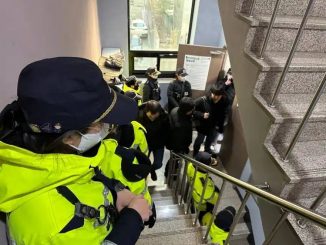
On Wednesday, January 18, the Korean Confederation of Trade Unions (KCTU), one of the largest workers’ organizations in South Korea, was raided by the intelligence and the police as the government escalated its persecution of trade unions and progressive groups in the country. Multiple raids were conducted at the offices of the KCTU and its affiliates by the National Intelligence Service (NIS) along with the National Police Agency.

As per reports, the NIS procured a search and seizure warrant from the court against the KCTU based on alleged charges of violating the controversial National Security Act of 1948. NIS officials reportedly stated that the search came after years of “internal investigations into … alleged links to North Korea,” but refused to divulge any further information.

Four people were the prime targets of the raid. These include a senior KCTU leader, one official each from its affiliates, the Korean Health and Medical Workers’ Union and the Korean Metal Workers’ Union, and a union organizer and anti-war activist from Jeju Island.

Apart from the trade union’s headquarters in Seoul, raids were carried out at multiple locations, including at the homes of the accused union leaders. At its Seoul headquarters, KCTU officials confronted the investigators, demanding that the search be conducted in the presence of a lawyer, but the NIS and the police investigators reportedly pushed their way into the office.

The confrontation lasted more than three hours before the search could proceed. The KCTU live-streamed the confrontation and parts of the raids on YouTube showing investigators forcing their way into the office. KCTU officials also stated that IDs were taken along with photographs of the people present at the headquarters without their permission.

In a press conference held in the afternoon, shortly after the raid started, Han Sang-jin, a spokesperson of the KCTU, stated that the raid appeared to be an attempt to forcibly link the ongoing persecution of trade unionists to an alleged North Korean “spy ring.”

“(Investigators) deployed hundreds of police personnel and even brought air mattresses, creating a scene, even though we don’t have much reason to resist,” Han said. The union also decried the misuse of the controversial National Security Act.

This law, passed in the middle of the Korean War, contains sections that criminalize meetings with North Korean officials, as well as praising or promoting North Korea or communism. It was widely used for anti-communist and anti-trade union persecution and to suppress democratic voices during the Cold War.

The raid comes as the conservative right-wing government of President Yoon Suk-yeol is targeting leaders of progressive groups and labor movements in the country using unsubstantiated allegations of links to, and espionage for, North Korea.

Intelligence officials have alleged that some of the recent workers’ strikes and anti-war protests held after Yoon took power were carried out under orders from North Korea. The National Security Act was used as the basis for investigations and raids in these cases as well.

Over the past several weeks, multiple raids have been conducted at the homes of progressive activists and KCTU organizers, reported The Korea Times. These have taken place in Jeju Island, Jinju and Changwon in the South Gyeongsang province, and in Jeonju in the North Jeolla province. The raids have been part of the NIS investigation into a supposed “spy ring” within progressive groups in the country.

While the NIS has denied that the “spy ring” investigation is connected to Wednesday’s raid at KCTU, activists have decried the intimidation and targeting of progressive opposition voices with Cold War-era laws and anti-communist witch-hunts, which were common during the military dictatorship era.

The raids also come at a time when president Yoon is facing low approval ratings, along with corruption allegations against his wife, growing anti-war sentiment, and protests against US military presence in South Korea. There have also been widespread trade union strikes across the country, like the recent truckers’ strike.

Last week, in a joint press conference at Jeju Island, a group of civil society activists, anti-war advocates, opposition political leaders, and trade unionists denounced the raids as an attempt to suppress progressive movements with false claims.

“The investigation is still underway and no one has been indicted. Yet solely based on what’s written on search warrants, it has been exaggerated as a spy ring case,” the group said in a statement quoted by The Korea Times. The statement also noted that they suspected the government was leaking “falsified information to conservative media outlets” to avoid criticism over recent lapses in border security.

Source: Peoples Dispatch

Strugglelalucha256
https://www.struggle-la-lucha.org/2023/01/page/3/