The ‘debt ceiling’ and our struggle to live: No limit to capitalist crimes & cutbacks

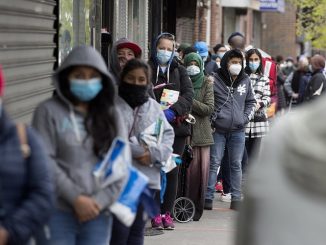
People line up for assistance at a food bank in Brooklyn, New York.

Jan. 19 was the date that the United States government was supposed to go bankrupt. Or at least had to start shuffling around bills to be paid, according to Treasury Secretary Janet Yellen.

What’s called the “debt limit” or “debt ceiling,” reached by Jan. 19, is the amount of money that can be owed by the federal government. First imposed by Congress in 1917 during World War I, the amount is currently set at $31.4 trillion.

Since the 1990s, the need to raise the debt limit has been used to demand cutbacks in any programs that benefit poor and working people. Social Security, Medicare, Medicaid, and SNAP benefits (food stamps) are the biggest targets.

Cruel, lengthy lockouts of government workers took place during 1995-1996, 2013, and 2018-2019. The last one lasted five weeks.

The $31-trillion federal debt is the result of continuous wars for the banksters and Big Oil while giving tax cuts to the rich. Two-thirds of the $1.7 trillion “omnibus” spending bill approved by Congress last December went to the Pentagon, spy agencies, and cops. That’s a $1.1 trillion Christmas gift for those who deserve it the least.

The cost of the U.S. wars since Sept. 11, 2001, is estimated to be $8 trillion. Total Pentagon spending since 2001 has been more than $14 trillion. That amounts to $42,000 for every person in the United States or $168,000 for a family of four.

Hundreds of thousands of people were killed by U.S. bombs and sanctions. It was a bonanza for the war profiteers.

Halliburton charged $100 to wash every 15 pounds of laundry for GIs in Afghanistan. Then Vice President Dick Cheney got a lush $33.7 million retirement package from Halliburton, his old employer.

Back in 1996, the Brookings Institution ― a Washington think tank ― estimated that the U.S. nuclear weapons arsenal cost $5.8 trillion. That’s worth $11 trillion in current dollars

Just one of these nukes can kill millions. There are 3,608 of them in the Pentagon stockpile. 

These fantastic sums could have been used to lift people out of poverty around the world. That’s reparations money. 

The truth about the debt 

The congressional debt limit is arbitrary. The real limit is how many of Uncle Sam’s IOUs can be sold on the world capitalist market.

Foreign capitalists and their governments hold $7.5 trillion of the debt because the interest is guaranteed. This helps finance the Pentagon war machine. Buying U.S. Treasury Bills also recycles the dollars accumulated because of the huge U.S. trade goods deficit that reached $1.1 trillion in 2021.

This deficit is the result of deliberate deindustrialization that has been the biggest cause of union busting. Between 1979 and 2019, 6.7 million U.S. manufacturing jobs were destroyed. Nearly 70,000 factories have been shut down since 1998.

Many of the employees in the abandoned factories had union jobs. The biggest losers were Black workers.

The more developed capitalism is, the more it wallows in debt. Non-financial corporations in the United States owed almost $13 trillion in 2022. 

During the bloody rise of capitalism, establishing national debts accompanied the African Holocaust and the Holocaust of Indigenous peoples in the Americas. 

The need for the U.S. government to establish a national debt played a crucial part in adopting the Constitution. The historian Charles Beard showed this in his book, “An Economic Interpretation of the Constitution of the United States.” 

Karl Marx described the historical role of national debt in “Capital”: “As with the stroke of an enchanter’s wand, it endows barren money with the power of breeding and thus turns it into capital, without the necessity of exposing itself to the troubles and risks inseparable from its employment in industry or even in usury.”  

U.S. capitalism is so decayed that the $475 billion in interest that capitalists collected from the national debt in 2022 was greater than the $447 billion in profits they got from their factories in 2021.

Lenin — the leader of the Bolshevik Revolution — described this “parasitism and decay of capitalism” in “Imperialism, the Highest Stage of Capitalism.”

In 1911, 146 garment workers died miserably in New York City’s Triangle Shirtwaist fire. Many of the young immigrant women workers leaped to their deaths rather than burn alive.

A century later, the garment industry has virtually disappeared in the United States. Sweatshop conditions were exported. In 2013, 1,134 garment workers were killed in the collapse of the Rana Plaza garment complex in Dhaka, Bangladesh. 

‘Only the little people pay taxes’

New York hotel boss Leona Helmsley was right when she said, “Only the little people pay taxes.”

All taxes are taken out of the surplus value produced by the working class, both employed and unemployed. That includes 2 million workers in prison.

Commonly called profits, surplus value is the difference between what the working class produces and what they get back in wages and benefits.

The huge tax cuts given to the wealthy over the past 40 years have been a way to raise the average rate of profit. None of the politicians who want to cut Social Security and Medicare wants to cut sales taxes.

Thirteen states charge sales taxes on groceries. In Mississippi—the poorest state in the country—people have to pay a 7% sales tax on a loaf of bread.

House of Representatives Speaker Kevin McCarthy is going to use negotiations over the debt limit to demand more cutbacks. Despite people lining up at food banks coast to coast, SNAP benefits (food stamps) may be cut.

President Reagan raised the retirement age to 67. Some in congress want to raise it to 70.

We can’t trust “Amtrak Joe” in the White House — who double-crossed the railroad workers — to stop new cutbacks. The money for the war against Russia is being stolen from the working class.

The wealthy and powerful will continue to grind us down if we don’t fight back. Look at the tragedy unfolding in Britain. Cutbacks in the country’s National Health Service have resulted in tens of thousands of people needlessly dying.

Only the power of the people can reverse the cutbacks and prevent the Pentagon from launching World War III against Russia and China.

Strugglelalucha256


The whole of Europe turned into a battlefield

The Federation of American Scientists confirms in January the news given by Grandangolo in December 2022 based on a U.S. Air Force document: the C-17A Globemaster aircraft has been authorized to carry the U.S. B61-12 nuclear bomb to Italy and other European countries. Since Biden Administration officials had announced that the B61-12 shipment would be brought forward to December, we believe that the new US nuclear bombs are already arriving in Europe to be deployed against Russia.

The U.S. and NATO are pouring into Ukraine huge amounts of heavy artillery munitions supplied to the Kiev armed forces. The U.S.-according to official figures-has so far sent more than one million rounds of ammunition for 155 mm howitzers to Ukraine, plus tens of thousands of missiles. About 300,000 rounds of ammunition come from U.S. military depots in Israel. The arms shipment is managed by an international network, in which Camp Darby- the largest U.S. arsenal outside the motherland, connected to the port of Livorno and Pisa military airport – plays a central role. Britain, France, Poland and Finland are supplying Kiev with tanks, and Poland is purchasing Abrams tanks from the U.S. Some of which may be destined for Ukraine.

At the same time, the U.S. and NATO are enhancing the deployment of their forces in Europe, increasingly close to Russia. In Romania, NATO deployed AWACS aircraft, equipped with the most sophisticated electronic equipment, kept constantly in flight near Russian airspace. Also in Romania, the Pentagon deployed the 101st Airborne Division, which is being deployed to Europe for the first time since World War II.

NATO and the EU establish “a task force on resilience and critical infrastructure.”

“NATO,” declares the Council of the European Union, “remains the foundation of our collective defense. We recognize the value of a stronger European Defense that contributes to transatlantic security and is complementary and interoperable with NATO.”

Source: Voltairenet

Strugglelalucha256


‘People in the U.S. have a lot to learn from Cuba’s Families Code’

Talk by Gloria Verdieu of the Prisoners Solidarity Committee at the webinar “What We Can Learn from Cuba’s ‘Code of Freedom’ for Families,” hosted by Women In Struggle/Mujeres En Lucha on Jan. 22.

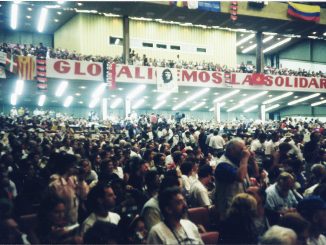
I remember my first trip to socialist Cuba in November 2000. I attended the Second World Meeting of Friendship and Solidarity. I have the poster that was given to all participants. It has a quote from José Martí: “The world is a beautiful temple where all men on earth fit in peace.”

I knew then and I know now that “all men” translates to “all of humanity.” We can all fit in peace on this beautiful earth — our home. 

The reason I went on this trip was that I wanted to see what socialism looked like.

The conference was attended by people from over 60 countries condemning the U.S. blockade.  I came with a delegation; buses took us to the many programs on our packed schedule. We visited factories, polyclinics and communities, where we learned about the Committees for the Defense of the Revolution (CDRs). There were cultural performances in these communities.

The daily events gave the delegates a chance to experience what life is like with a government that is concerned with the needs of the people rather than profits.

The delegates gathered daily at the Karl Marx Theater, within walking distance of our hotel. When I went walking, I did not feel any restrictions, though I did not wander too far.

We didn’t know if President Fidel Castro would speak at any of the conference gatherings.  I figured not – with thousands of people there, it would be a big security risk.

During our final meeting at the Karl Marx Theater, Fidel appeared on the stage. No bulletproof glass barriers, no extra security checks that I was aware of.

Fidel began to speak; we were given devices for interpretation. People listened and listened until it was time for discussion. Fidel gave lengthy, thoughtful answers to questions, not only from the delegates, but from Cuban workers. 

At one point a child ran on stage and Fidel gave him a hug and said something that I could tell was a show of affection for him and his family.

Healthcare in Cuba vs. U.S.

One of the many things that had an impact on me was when we visited one of the polyclinics. 

There was a group of doctors at the clinic, and one explained to us how closely connected doctors are with the communities they serve. They know who smokes, drinks, takes drugs (prescribed or not), struggles with mental illness, which teenagers are sexually active – intimate details that individuals voluntarily share with their doctors. Doctors know the health of families in their community through home visits and family counseling. 

Doctors were told things that we in the U.S. would not dare tell our primary health care provider, because it could mean higher monthly costs for those who have insurance coverage, or changing health care providers, which means transferring all your health history to another doctor. You can be denied coverage or even lose your job because of a chronic health issue.

Health care is a huge problem in the U.S. There have been many reforms, many updates to the system, and yet there are still millions of people who have minimal or no health insurance.

I continue to learn what socialism looks like and how participatory democracy works. I was impressed with the way Cubans at home and abroad were involved in the decision-making process of updating Cuba’s Families Code. Some 6.5  million people participated, a sincere display of democratic centralism.

As an organizer of the Socialist Unity Party’s Prisoners Solidarity Committee, one of the many things that registered with me in Cuba’s new Families Code is its promise to promote happy, healthy families. Everyone is included (great-grandparents, grandparents, aunts, uncles, nieces, nephews, in-laws, close partners), from the most senior members to the youngest, and everyone in between. You choose your family.  

It also promotes the right to a family life free from violence and unprovoked stress. A family life that values love, affection, solidarity and responsibility.  

I recently attended a day of solidarity with formerly incarcerated prisoners and families in California’s capital, Sacramento. So many things are wrong with the “criminal justice system” in the U.S., which is why we know that it cannot be reformed or updated; we must shut it down.

You can see and feel the grief and stress of the families with loved ones in prison, and of those recently released, who are having a difficult time transitioning to life outside. Housing, healthcare, jobs and community acceptance are some of the obstacles that formerly incarcerated individuals face. 

There are over 2 million people in prison in the U.S. Many more are detained in immigration centers and holding cells awaiting litigation, affecting millions of families.

Cuba: ‘We encourage family to stay involved’

Gerardo Hernández, who was one of the Cuban 5 political prisoners held in the U.S., and is now head of the Committees for the Defense of the Revolution, highlighted the differences for families in Cuba: “Our purpose is to help. We talk with the family, we encourage the family to stay involved, because it is understood that the family suffers when a loved one is incarcerated.

“Prisoners need not be discriminated against because they went to jail. Our objective is not to make a repressive action against those persons but to help those persons, who are victims themselves in many cases.”

Cuba’s neighborhood CDRs number 138,000, with over 8 million members, and continue to work on programs and solutions to the problems of petty crime, drugs and mental illness.

The United States incarcerates more of its youth than any other country in the world. Most states continue to use outdated and harmful “training school” models, confining children in remote, prison-like facilities cut off from their families and communities. 

Overcrowding and violence, prosecution of youths as adults, and the long-term consequences of incarceration on the individual’s chances for success in adulthood are huge controversies.

President Miguel Diaz-Canel stated, “before our people and the world, that in Cuba no one under 16 years of age is imprisoned!”

People in the U.S. have a lot to learn from Cuba’s Families Code, especially from the process in which it was passed. All citizens over 16 years of age were eligible to vote in the Families Code referendum. 

We must support Cuba by demanding the U.S. government end the more than 60-year blockade and remove Cuba from the so-called “State Sponsors of Terrorism” list. We must demand normalization of relations and an open dialog with Cuba.

We must learn about socialism and Cuba’s participatory democracy. Socialism is the path to a better world for everyone.

Strugglelalucha256


‘Struggle against sexual and gender violence goes hand in hand with struggle for decolonization’

Remarks by Berta Joubert-Ceci of Mujeres En Lucha/Women In Struggle at the webinar “What We Can Learn from Cuba’s ‘Code of Freedom’ for Families” on Jan. 22.

Buenas tardes compañeras y compañeros,

First, I wanted to thank Mariela Castro for taking the time to record this message. Because as we know, part of the effect of the U.S. blockade against Cuba is that the application Zoom cannot be used there.

As a member of Mujeres En Lucha/Women In Struggle, which is a member organization of the Women’s International Democratic Federation (WIDF or FDIM in Spanish), I also wanted to acknowledge the fact that Mariela’s mother, Vilma Espín, was instrumental in saving the FDIM after the dismemberment of the European socialist countries. 

At that time, Vilma was vice president while the FDIM headquarters was in Berlin. And it was her swift action of saving documents and materials from that office, securing them, that preserved the FDIM from extinction.

Compañeres, this topic is also very pertinent to our process in Puerto Rico. As a colony of the U.S., we suffer in greater degree some of the ills that affect the U.S. Violence against women and LGBTQ+ people have been on the rise, including against children. This has been fueled by a rising wave of fundamentalist religious sectors that affect the government’s actions and policies and seem to be a copy and paste of what happens in the U.S. 

So, for us here, the struggle against sexual and gender violence has to go hand in hand with the struggle for decolonization, for independence.

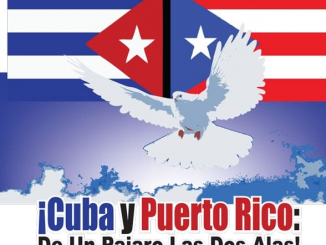
But as the poem of Lola Rodríguez de Tió says, “Cuba y PR son, de un pájaro las dos alas,” “Cuba and Puerto Rico are wings of the same bird.” We can look up to Cuba’s development and Families Code as an inspiration.

We hope to fulfill here in PR what is expressed in the introduction of the new Cuban Families Code: “The emancipatory conception of the family that guides the transformation of Cuban socialist society intertwines social interest and personal interest, promotes its development, contributes to the formation of the new generations and satisfies deep human, affective and social interests of the person.”

Strugglelalucha256


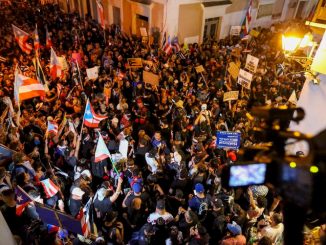
Nuevo junte electoral da esperanzas en Puerto Rico

Mientras el gobierno de Puerto Rico y sus secuaces hacen todo por vender nuestro patrimonio por medio de privatizaciones a entes extranjeros, hay sin embargo una noticia muy esperanzadora.

Y es que se está forjando una unión de voluntades de dos partidos progresistas: el Partido Independentista Puertorriqueño y el Movimiento Victoria Ciudadana, para hacerle frente a ese gobierno en el terreno electoral.

Las próximas elecciones generales están pautadas para el 2024 y un junte de estos dos partidos tiene una gran posibilidad de ganar. Ya en las pasadas elecciones demostraron que tienen la simpatía de una cantidad considerable del pueblo que votó. Y si se unen, no cabe duda de que podrían ganar la gobernación.

Pero en Puerto Rico está prohibido un frente electoral. Los partidos PNP y PPD que se han alternado en el gobierno para destruir el país, han implantado leyes en contra de la formación de cualquier unión de partidos que amenace su supremacía en el gobierno. 

Así que este nuevo junte tiene como estrategia varias vías: La Judicial, para desafiar esta ley retrógrada; la Legislativa para enmendar la ley; y la de un entendido político que exhorta a sus seguidores a votar por candidatos fuera de líneas partidistas. 

Ganar las próximas elecciones es esencial para derrotar el bipartidismo que está acabando con el país. Sabemos que lo crucial es la descolonización con independencia, pero mientras se lucha para ese último fin, se necesita urgentemente detener el saqueo, la destrucción y la migración masiva que nos deja sin boricuas mientras extranjeros millonarios se quedan con el país.

Desde Puerto Rico, para Radio Clarín en Colombia, les habló Berta Joubert-Ceci.

Strugglelalucha256


Baltimore emergency protest: Justice for Tyre Nichols, Jan. 28

Baltimore emergency protest: Justice for Tyre Nichols
Justice for Tyrone West & all victims of police brutality
Saturday, January 28 – 3:00 p.m.
Corner of North Ave and N. Charles St., Baltimore
Called by People’s Power Assembly
On Facebook
Strugglelalucha256


Death toll rises to 10 following Israeli army ‘massacre’ in Jenin

In a brutal assault on the Jenin refugee camp Thursday morning, Israeli forces killed nine Palestinians and injured over a dozen others, making it the deadliest day for Palestinians in 2023 and one of the single deadliest raids in the West Bank in years. A tenth Palestinian was killed later in the day in al-Ram during clashes with the Israeli army.

According to the Palestinian Ministry of Health (MOH), among those killed was an “elderly” woman identified as Magda Obaid, 61. Eight others were killed in the brutal assault on the camp.

According to Defense for Children International Palestine, two of the Palestinians killed during the raid were children. DCIP identified them as Abdallah Marwan Juma’a Mousa, 17, and Waseem Amjad Aref al-Ja’s, 16. DCIP’s reports conflict with initial reports from the MOH, which reported Mousa to be 18, and al-Ja’s to be 22.

The others were identified by the MOH as Motasem Mahmoud Abu Hasan, 40, Noor Eldin Sami Ghnaim, 25, Mohammad Sami Ghnaim, 28, Mohammad Mahmoud Subuh, 30, Saeb Izreiqi, 24, and Izzidin Salahat, 22.

The ministry reported that more than 20 people were injured, including four in critical condition. Among the injuries were gunshot wounds to the chest, abdomen, and lower extremities. “Most injuries that arrived at the hospital today were in the head and chest area,” the MOH said in a statement on Thursday evening. “This means that the shooting of live ammunition towards residents was with the intent to kill,” the statement said.

Though the identities of the remaining six slain Palestinians were being reported by local media, their names had not yet been confirmed by the MOH as of Thursday afternoon.

Minister of Health Mai al-Kaileh said in a statement that Israeli forces “hampered” ambulances from evacuating the wounded from the camp during the raid and restricted the access of medics to the camp. Local media reported that some ambulances were shot at.

Al-Kaileh added that Israeli forces fired tear gas toward the pediatric unit of the Jenin Government Hospital, causing suffocation cases from gas inhalation among patients at the hospital, including mothers and children.

“We deplore in the strongest terms what happened…in terms of a fierce and barbaric attack against medical and emergency personnel, and the obstruction of their work in transporting the injured and treating patients,” al-Kaileh said.

The raid 

The raid began around 7:15 am on Thursday morning when undercover Israeli special forces entered the camp in a commercial truck. According to local sources, the special forces were targeting the apartment of Alaa Sabbagh, a former leader of the Al-Aqsa Martyrs Brigade, Fatah’s armed wing, who was killed by Israeli forces in the camp in 2002.

Sabbagh’s home was reportedly being used by a number of fighters affiliated with the Jenin Brigade, an armed resistance group from the camp composed of fighters from various political factions.

Israeli forces fired rocket launchers and other explosives at the apartment building, causing the fighters inside to respond with live ammunition. The attack on the apartment also sparked clashes in the surrounding areas, with armed fighters firing toward the Israeli troops.

Shortly after the operation began, “hundreds” of Israeli troops raided the area, with a convoy of military jeeps and bulldozers entering the boundaries of the camp. Sources told Mondoweiss that as the bulldozers moved through the streets, they destroyed cars parked in the area and “everything in their wake.”

The troops entered the camp from the north, south, and western entrances of the camp, Mohammad Abed, a local journalist, told Mondoweiss. He added that Israeli forces closed off all the entrances and exits of the camp, preventing anyone from moving in or out.

Abed said that Israeli forces “completely destroyed and ransacked” the local community center in the camp, which is used by residents for community gatherings, funerals, and other events.

He added that at least three people were killed inside the Sabbagh family apartment building. “The building is completely destroyed due to the sheer number of bombs and explosives fired toward it,” he said.

The Israeli army released a statement saying that its forces “were active in the Jenin refugee camp” under the pretext of searching for fighters with the Islamic Jihad movement. The army claimed the raid was conducted to “foil imminent attack plans” by fighters in the camp.

No Israeli forces were injured during the assault, Israeli media reported.

The local branch of the Islamic Jihad movement said its fighters responded to Israeli forces with live fire and explosives.

‘A real massacre’

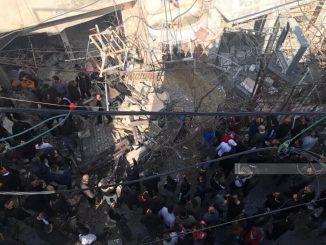
Israeli forces began pulling out of the camp around noon, close to five hours after the raid began, leaving devastation and destruction in their wake.

Videos posted on social media show rubble strewn across the street of the camp, bombed out buildings, and damaged vehicles, including cars that had been flipped over by Israeli bulldozers.

“It was a massacre, a real massacre,” Abed told Mondoweiss, saying that it was “the
worst and most violent” raid he had seen on the camp in years.

“There was another raid last year on the camp that lasted several hours, but this one is not even comparable. Nine people were killed. That is not an insignificant number,” he said.

Abed added that Israeli forces were “shooting everywhere,” not just towards resistance fighters who were engaging in shootouts with the army. “They were shooting at anything that moved. This is evidenced by the 60-year-old woman who was killed. How can you explain that?”

Israeli media reported that the army was “launching an investigation” into the death of Magda Obaid, the woman who was killed.

The raid on Thursday brought the death toll of Palestinians killed by Israeli gunfire this month to 29. Less than 24 hours prior, on Wednesday January 25, two Palestinians were killed in separate incidents in the West Bank and Jerusalem, including 20-year-old Aref Lahlouh, a resident of the Jenin refugee camp.

2022 was one of the deadliest years for Palestinians in the occupied West Bank in decades, with 173 Palestinians killed in the territory. According to Mondoweiss documentation, 34% of the total casualties in the West Bank in 2022 were from Jenin.

Provoking confrontations across Palestine

Palestinians held the funeral of the slain nine later in the afternoon where thousands participated in the procession. Mourners chanted for the martyrs and vowed to persist for freedom as armed resistance fighters shot live ammunition in the air as a symbol of continued confrontation.

The particularly high number of killings in the northern West Bank city can be attributed to the resurgence of armed resistance witnessed in the area, which the Israeli military focused its efforts on quashing last year. 

However with the persistence of Israeli settler expansion in tandem with a large-scale military assault dubbed Operation Break the Wave, Palestinian confrontation continues to grow.

Since the beginning of the year, 178 acts of resistance were conducted from armed resistance groups in Jenin alone (also known as “the Wasp’s Nest“), according to the Palestinian Center for Information. This includes 42 shooting operations, while the rest range from stone throwing to impeding settler invasions into Palestinian towns and villages.

Following Thursday’s lethal assault in Jenin refugee camp, protests and clashes erupted in cities across the West Bank including Bethlehem, Ramallah, Qalqilya, Hebron, and Nablus. Additional protests by Palestinians with Israeli citizenship in Akka, Nazareth, and Umm El-Fahem were also planned for later Thursday evening. Youth in Gaza also set tires aflame near the border fence with Israel in protest against the killings in Jenin, according to local news reports.

Israeli forces responded with lethal weapons against youth, leading to the death of 22-year-old Yousef Abdul Karim Muheisin, who was fatally injured by Israeli forces in the town of al-Ram outside of Jerusalem during clashes, and was pronounced dead at the Ramallah Medical Complex, raising that day’s death toll to 10, according to the MOH. The ministry also recorded four injuries in Ramallah, and two others in Qalqilya and Bethlehem. Dozens of injuries as a result of teargas inhalation and high velocity canisters were treated on the field, according to the ministry.

The first month of 2023 has witnessed a steep increase in the average number of Palestinians killed compared to previous years. With 30 Palestinians killed in the first month of 2023 according to the MOH, the new year shows an intensified escalation in the Israeli assault on Palestinians. More Palestinians were killed in January of this year than in the first three months of 2022 combined.

Source: Mondoweiss

Strugglelalucha256


International dockworker unions gather in Durban

A delegation of international and local dockworker trade unions and academics have descended on Durban to mark the anniversary of the 1973 Durban strikes that preceded the formation of South Africa’s powerful trade union movement.

Trade union representatives from the United States-based International Longshore & Warehouse Union (ILWU) and Namibia will gather in the city with international and local activists, academics, and leaders of the Revolutionary Transport Union of South Africa (Retusa) and the General Industries Workers Union of South Africa to tackle issues currently facing dockworkers, at the 1973 Durban Strikes Conference from January 26-28.

Academic and historically focused sessions will take place at the Durban University of Technology, and union and academic discussions and a photographic exhibition of the 1973 strikes and dock struggles in Durban and Oakland will be held at the BAT Centre on the Esplanade.

The event marks the 50th anniversary of the strikes, which saw some 100 000 African and Indian workers downing tools to demand better wages and working conditions, impacting more than 100 firms – from textile and brick factories to metal and chemical plants. The strikes were followed by the formation of the Federation of South African Trade Unions in 1979 and the Congress of South African Trade Unions in 1985, which played a pivotal role in the liberation struggle against Apartheid.

In 1984 members of the ILWU Bay Area’s branches, Locals 10 and 34, refused to offload South African cargo for 11 days, inspiring local residents to join the US anti-apartheid movement.

ILWU Local 10 retired Secretary-Treasurer, Clarence Thomas, speaking at a media briefing ahead of the conference on Tuesday, said dockworkers held a strategic position of power to wield influence on how governments managed their economies.

“Dockworkers have more leverage than any workers in the world, being at the point of the global supply chain, because when we shut down – rail, trucking, cargo flight schedules – the food we eat, the fuel we put into cars, computers, handheld devices, and the shoes we wear, all come off a ship.  There are no workers in the world that understand capitalism better than longshore workers because before the cargo can be stored it has to come off that ship – and if we don’t load and offload it, nothing is going to happen,” he said.

ILWU said in a statement that it would hold an exchange with local unions to focus on how unions can work together to organize and carry out international dockworker blockades against ships and “how to fight the privatisation of public services.”

Retusa general secretary, Joseph Dube, welcomed the collaboration between unions.

“We are fighting privatisation as you are. We need to learn from each other and make our unions an active fighting force for permanent jobs, democratic workers’ control over the harbour facilities, and above all to fight for a living wage for all,” Dube said.

Conference sessions and discussions will include a review of historical mass strikes against capitalism, trade unions and economic policy, foreign investment and labor rights, how to fight privatization, how to organize mass worker parties, and how to tackle the future challenges of the release of political prisoners, pandemics, war and peace, and climate change.

SA History Online is hosting the conference in partnership with the Durban University of Technology, Wits History Workshop, University of Fort Hare, Southern Centre for Inequality Studies, University of Cape Town Department of Sociology, University of KwaZulu-Natal, the Chris Hani Institute, and Workers College based in Durban.

Source: South Africa Freight News

Strugglelalucha256


New Orleans: Eyewitness Report – US/NATO Out of Ukraine!


Strugglelalucha256


Bronx, NYC: Transit Equity Day of Action, Feb. 4

Feb 4, 2023 Community Panel for Transit Equity Day of Action

Mark the birthday of late Transit Equity fighter Rosa Parks with school bus activists and others.

Saturday February 4th from 12 noon to 2 p.m., at Truman High School, 750 Baychester Avenue in the Co-op City area of the Bronx, 10475.

All 8 schools at that campus are coping with transportation issues, and we will hear from the community there.

We are excited to have an exchange with activists of all ages about the goals of our School Bus Bill of Rights campaign.

Contents of this page:

  • Live stream of Feb 4 panel is the link for those who cannot attend in person

  • Flyers in English and Spanish with image descriptions

  • Map with controls

  • Information about national Transit Equity Day

  • (in progress) information about participating panelists,

  • (in progress) provisions for access for persons with mobility disabilities, those who need childcare on site, etc. ASL interpretation is confirmed as of 1/24/23.

  • (in progress) sources for more about the contribution of Mrs. Rosa Parks

  • (in progress) guide on ways to help the event and/or the ongoing campaign (see home page)

Please email questions or suggestions to pistnyc@gmail.com or call/text us at 631.743.6296 in English or Spanish.

Transit Equity is a lifelong fight – it starts on the school bus – Access to school is a Civil right!

Strugglelalucha256
https://www.struggle-la-lucha.org/2023/01/page/2/