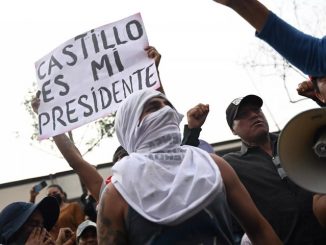
Estados Unidos y su rol en el golpe de Estado en Perú

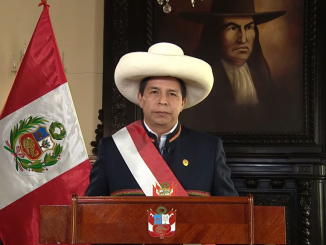
El 7 de diciembre de 2022, Pedro Castillo se sentó a trabajar en su despacho, durante el que sería su último día como presidente de Perú. Sus abogados revisaban los documentos que mostraban que Castillo triunfaría sobre una moción en el Congreso para destituirlo. Iba a ser la tercera vez que Castillo se enfrentaba a una impugnación del Congreso, pero sus abogados y asesores – entre ellos el ex primer ministro Aníbal Torres – le decían que tenía ventaja sobre el Congreso en las encuestas de opinión (su índice de aprobación había subido al 31%, mientras que el del Congreso apenas rondaba el 10%).

Desde hacía un año, Castillo estaba sometido a una enorme presión por parte de una oligarquía que no veía con buenos ojos a este antiguo profesor. Sorpresivamente, el 7 de diciembre anunció a la prensa que iba a “disolver temporalmente el Congreso” y a “establecer un Gobierno excepcional de emergencia”. Esta medida selló su destino. Castillo y su familia corrieron hacia la Embajada de México, pero fueron detenidos por los militares en la Avenida España, antes de que pudieran llegar a su destino.

¿Por qué Pedro Castillo dio el paso fatal de intentar disolver el Congreso cuando estaba claro para sus asesores – como Luis Alberto Mendieta – que se impondría en la votación de la tarde?

La presión pudo con Castillo, a pesar de la evidencia. Desde su elección en julio de 2021, su oponente en las elecciones presidenciales, Keiko Fujimori, y sus asociados han tratado de bloquear su ascenso a la presidencia. Ella trabajó con hombres que tienen estrechos vínculos con el Gobierno de los Estados Unidos y sus agencias de inteligencia. Un miembro del equipo de Fujimori, Fernando Rospigliosi, por ejemplo, había intentado en 2005 implicar a la embajada estadounidense en Lima contra Ollanta Humala, quién se presentó en las elecciones presidenciales peruanas de 2006. Vladimiro Montesinos, ex agente de la CIA que cumple condena en una prisión de Perú, envió mensajes a Pedro Rejas, ex comandante del ejército peruano, para que fuera “a la embajada de los Estados Unidos y hablara con el oficial de inteligencia de la embajada”, para intentar influir en las elecciones presidenciales peruanas de 2021. Justo antes de las elecciones, EE. UU. envió a una ex agente de la CIA, Lisa Kenna, como embajadora en Lima. Se reunió con el ministro de Defensa de Perú, Gustavo Bobbio, el 6 de diciembre y al día siguiente envió un tuit de denuncia contra la medida de Castillo de disolver el Congreso (el 8 de diciembre, tras la destitución de Castillo, el Gobierno estadounidense – a través de la embajadora Kenna – reconoció al nuevo Gobierno de Perú).

Una figura clave en la campaña de presión parece haber sido Mariano Alvarado, oficial de operaciones del Grupo de Asistencia y Asesoramiento Militar (MAAG), que funciona efectivamente como agregado de Defensa de los Estados Unidos. Se dice que funcionarios como Alvarado, que están en estrecho contacto con los generales militares peruanos, les dieron luz verde para actuar contra Castillo. También es sabido que la última llamada telefónica que Castillo tomó antes de abandonar el palacio presidencial provino de la Embajada de los Estados Unidos. Es probable que le advirtieran que huyera a la embajada de una potencia amiga, lo que le haría parecer débil.

Este artículo fue producido para Globetrotter.

Vijay Prashad es un historiador, editor y periodista indio. Es miembro de la redacción y corresponsal en jefe de Globetrotter. Es editor en jefe de LeftWord Books y director del Instituto Tricontinental de Investigación Social. También es miembro senior no-residente del Instituto Chongyang de Estudios Financieros de la Universidad Renmin de China. Ha escrito más de 20 libros, entre ellos The Darker Nations y The Poorer Nations. Sus últimos libros son Struggle Makes Us Human: Learning from Movements for Socialism y The Withdrawal: Iraq, Libya, Afghanistan, and the Fragility of U.S. Power (con Noam Chomsky).

José Carlos Llerena Robles es educador popular, miembro de la organización peruana La Junta y representante del capítulo peruano de Alba Movimientos.


Strugglelalucha256


The U.S. egged on the coup in Peru

On December 7, 2022, Pedro Castillo sat in his office on what would be the last day of his presidency of Peru. His lawyers went over spreadsheets that showed Castillo would triumph over a motion in Congress to remove him. This was going to be the third time that Castillo faced a challenge from the Congress, but his lawyers and advisers—including former Prime Minister Anibal Torres—told him that he held an advantage over the Congress in opinion polls (his approval rating had risen to 31 percent, while that of the Congress was just about 10 percent).

Castillo had been under immense pressure for the past year from an oligarchy that disliked this former teacher. In a surprise move, he announced to the press on December 7 that he was going to “temporarily dissolve the Congress” and “[establish] an exceptional emergency government.” This measure sealed his fate. Castillo and his family rushed toward the Mexican Embassy but were arrested by the military along Avenida España before they could get there.

Why did Pedro Castillo take the fatal step of trying to dissolve Congress when it was clear to his advisers—such as Luis Alberto Mendieta—that he would prevail in the afternoon vote?

The pressure got to Castillo, despite the evidence. Ever since his election in July 2021, his opponent in the presidential election, Keiko Fujimori, and her associates have tried to block his ascension to the presidency. She worked with men who have close ties with the U.S. government and its intelligence agencies. A member of Fujimori’s team, Fernando Rospigliosi, for instance, had in 2005 tried to involve the U.S. Embassy in Lima against Ollanta Humala, who contested in the 2006 Peruvian presidential election. Vladimiro Montesinos, a former CIA asset who is serving time in a prison in Peru, sent messages to Pedro Rejas, a former commander in Peru’s army, to go “to the U.S. Embassy and talk with the embassy intelligence officer,.” to try and influence the 2021 Peruvian presidential election. Just before the election, the United States sent a former CIA agent, Lisa Kenna, as its ambassador to Lima. She met Peru’s Minister of Defense Gustavo Bobbio on December 6 and sent a denunciatory tweet against Castillo’s move to dissolve Congress the next day (on December 8, the U.S. government—through Ambassador Kenna—recognized Peru’s new government after Castillo’s removal).

A key figure in the pressure campaign appears to have been Mariano Alvarado, operations officer of the Military Assistance and Advisory Group (MAAG), who functions effectively as the U.S. Defense attaché. We are told that officials such as Alvarado, who are in close contact with the Peruvian military generals, gave them the greenlight to move against Castillo. It is being said that the last phone call that Castillo took before he left the presidential palace came from the U.S. Embassy. It is likely he was warned to flee to the embassy of a friendly power, which made him appear weak.

This article was produced by Globetrotter.

Vijay Prashad is an Indian historian, editor, and journalist. He is a writing fellow and chief correspondent at Globetrotter. He is an editor of LeftWord Books and the director of Tricontinental: Institute for Social Research. He is a senior non-resident fellow at Chongyang Institute for Financial Studies, Renmin University of China. He has written more than 20 books, including The Darker Nations and The Poorer Nations. His latest books are Struggle Makes Us Human: Learning from Movements for Socialism and (with Noam Chomsky) The Withdrawal: Iraq, Libya, Afghanistan, and the Fragility of U.S. Power.

José Carlos Llerena Robles is a popular educator, member of the Peruvian organization La Junta, and representative of the Peruvian chapter of Alba Movimientos.

Strugglelalucha256


Mexico, Argentina, Bolivia, Colombia back Peru’s President Castillo, condemn ‘anti-democratic harassment’

The governments of Mexico, Argentina, Colombia, and Bolivia released a joint statement supporting Peru’s democratically elected President, Pedro Castillo, saying he is the victim of “anti-democratic harassment.”

Castillo was overthrown in a coup d’etat on December 7, led by the infamously corrupt right-wing opposition that controls Peru’s unicameral congress, which has an approval rating of between 7% and 11%.

The U.S.-dominated Organization of American States (OAS) and State Department have openly supported the coup, backing unelected leader Dina Boluarte, who declared herself president in collaboration with the congress.

Mexico, Argentina, Bolivia, and Colombia wrote that they “express their profound concern for the recent events that resulted in the removal and detention of José Pedro Castillo Terrones, president of the Republic of Peru.”

“For the world, it is not news that President Castillo Terrones, since the day of his election, was victim of anti-democratic harassment,” the countries wrote.

They added that Castillo has also been subjected to illegal “judicial treatment” – an allusion to the relentless lawfare (judicial warfare) that Peru’s right-wing opposition has waged against the president and his top officials and political allies.

Mexico, Argentina, Bolivia, and Colombia stressed that this harassment violates the 1969 American Convention on Human Rights.

“Our governments call on all actors involved in the previous process to prioritize the citizens’ will that was expressed at the ballot box,” they wrote, adding, “We urge those who make up the institutions to refrain from reversing the popular will expressed by the free vote.”

In other words, they called for recognizing Castillo as the only democratic, constitutional president of Peru.

The countries emphasized, “We also request that the authorities full respect the human rights of the President Pedro Castillo and that he is guaranteed legal protection,” that is established in the American Convention on Human Rights.

Presidents of Mexico, Colombia, Bolivia denounce coup against Peru’s Castillo

When the coup in Peru was carried out on December 7, Mexico’s left-wing President Andrés Manuel López Obrador (AMLO) wrote:

“We considerate it terrible that, because of the interests of economic and political elites, since the beginning of the legitimate presidency of Pedro Castillo, an environment of confrontation and hostility was maintained against him, leading him to take decisions that have served his adversaries to remove him.”

AMLO was referring to Castillo’s decision to dissolve Peru’s coup-plotting congress – an action that is allowed in certain cases of obstructionism according to article 134 of the country’s constitution.

Colombia’s first-ever left-wing president, Gustavo Petro, likewise wrote that “Pedro Castillo, for being a teacher from la Sierra [the mountainous rural region in the Andes], elected by the people, was cornered from the first day.”

“When I met Pedro Castillo, they [the right-wing opposition] were trying to break in to the presidential palace to detain his wife and his daughter,” Petro recalled.

“He received me distressed. A parliamentary coup was already being developed against him,” the Colombian president said.

On the day of the coup, Bolivia’s President Luis Arce also publicly warned, “Since the beginning, the Peruvian right tried to overthrow the government that was democratically elected by the people, by the humble classes that seek more inclusion and social justice.”

“We regret what has occurred in the sisterly republic of Peru, where we send our solidarity,” he said.

The Bolivian president added, “The constant harassment by anti-democratic elites against progressive, popular, and legitimate governments should be condemned by everyone.”

Bolivia’s former President Evo Morales, who was himself overthrown in a U.S.-backed right-wing coup in 2019, said the latest putsch showed “once again that the Peruvian oligarchy and the U.S. empire do not accept that leaders who are union organizers and Indigenous rise to government to work for the people.”

Morales added that “the political crisis” in Peru “was provoked by the permanent conspiring of the Fujimorista right wing and right-wing media outlets against a government elected at the ballot box, whose ‘unforgiveable crime’ was representing the poorest people.”

Morales later tweeted that the “congressional coup by the right wing in Peru calls us to have a deep reflection.”

“A government elected by the people never should abandon its ideological base, or distance itself from its militancy. Thinking that the right wing will accept presidents from popular movements is the worst historical error,” he cautioned.

When the Peruvian people took to the streets in large protests against the coup, demanding the freedom of Castillo, fresh elections, and a new constitution, Morales wrote on December 12:

“In the November 2019 coup, humble people confronted the armed repression of the coup-plotters in Bolivia. In the congressional coup in Peru, humble people are confronted by the repression of the coup-plotting right wing. The Patria Grande [movement seeking Latin American regional unity] demands justice for our massacred brothers.”

Morales followed up again on December 13, stating:

“We join the shout that defenders of life and human rights are making demanding a stop to the massacres of our Indigenous brothers in Peru, that they respect their vote and a democracy that represents them. No government whose hands are stained with the blood of the people is legitimate.”

Source: Multipolarista

Strugglelalucha256


Five killed by police during anti-coup protests in Peru

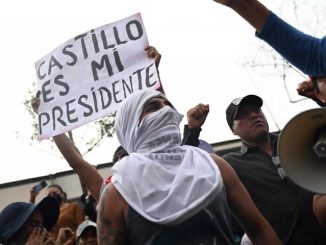
Dec. 12 — Since December 7, tens of thousands of Peruvians have been protesting in different parts of the country in rejection of the parliamentary coup that took democratically elected left-wing President Pedro Castillo out of office and led to his arrest. On December 7, Peru’s right-wing dominated unicameral Congress approved the third vacancy (impeachment) motion against Castillo. Hours following his removal from office, he was arrested and charged with allegedly “breaching constitutional order” for having tried to dissolve the Congress before the vote on the motion.

Citizens’ resistance

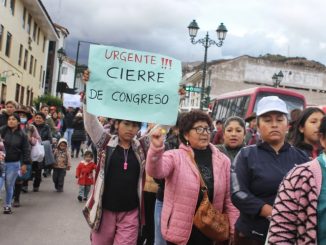
For the past five days, the protesters have been organizing peaceful mobilizations and roadblocks across the national territory demanding that former President Castillo be immediately released and reinstated as the president of the country.

In the capital Lima, despite heavy police repression, the protesters have been maintained a nearly permanent protest in front of the Congress. Another central demand of protesters has been the effective dissolution of the right-wing-controlled parliament. Some have also demanded that fresh elections be organized to change the country’s legislature.

The protesters have also expressed their rejection of the appointment of Castillo’s Vice President Dina Boluarte as the new president. They are calling for Boluarte’s resignation, arguing that she is not an elected leader. They also condemned her for making a political alliance with the right-wing to govern.

The citizens are also demanding that a Constituent Assembly be called to draft a new constitution to replace the current neoliberal one, which was written and imposed in 1993 during the dictatorship of Alberto Fujimori (July 1990–November 2000). They have stressed that it is time that this long-standing demand of the Peruvian people be addressed and fulfilled. Before being overthrown, Castillo had declared that the Congress would remain dissolved until the Constituent Assembly was installed, making good on his presidential campaign promise.

In addition to the capital, protests against the coup have been registered in regions across the country including Andahuaylas, Arequipa, Trujillo, Iquitos, Madre de Dios, Ica, Tacna and Huacho provinces.

Police repression

The police have been responding to these peaceful protests with violence and repression. The police officers have been using tear gas and even live bullets against demonstrators.

According to reports from local media and the National Ombudsman Office, at least two protesters, 15 and 18 years old, were killed in police repression on Sunday, December 11, in the city of Andahuaylas, in Apurímac region. On Monday December 12, in the city of Chincheros, the local hospital confirmed that two protesters died as a result of the police repression, including a 16-year-old and 26-year-old Jonathan Lloclla Loayza. A fifth protester was killed in Arequipa by police.

In the early hours of Sunday morning, residents had been demonstrating outside the local airport in Andahuaylas and blocked the entrance. In an attempt to unblock the airport, the police agents brutally repressed the people. Videos on social media showed the police running over a woman and attacking the press. In the incident, over 20 people were severely injured and over a dozen were arrested. The hospital in the city reported that one of the deceased died due to a gunshot injury in the neck.

The same day, the police also violently repressed the residents in Arequipa and Ica, who had blocked the Pan-American highway since December 7 in protest. The police reopened the highway, but failed to dismantle other roadblocks maintained by the residents, mainly erected by peasant and Indigenous communities, across the provinces.

The Office of the United Nations High Commissioner for Human Rights in Peru condemned “the death of a minor and a young man in Andahuaylas, Apurímac,” and called for “a prompt, impartial and exhaustive investigation of the facts, providing access to justice to the next of kin of the victims.” The OHCHR also urged Peruvian citizens and authorities to maintain “calm” and avoid “escalation of tensions,” stressing that “the right to peaceful assembly must be guaranteed.”

Upon the confirmation of two deaths in Andahuaylas, the protesters intensified the measures of protests across the country. The residents of Arequipa immediately organized the closure of the local airport in solidarity.

The social organizations from Apurímac called for an indefinite regional strike, starting at zero hours on December 12. The Agrarian and Rural Front of Peru (FARP), an umbrella organization bringing together over a dozen Indigenous, peasants, women’s movements and social organizations, also called for an indefinite national strike beginning Tuesday, December 13.

In response to increasing popular pressure, in the early hours of Monday, December 12, President Boluarte announced that she would send a bill to Congress to advance the general elections to April 2024.

She also declared a “state of emergency in the areas of high social conflict,” which was denounced as a clear attempt to criminalize protests by various social movements.

Despotism of the Peruvian right

The right-wing opposition majority Congress, which has an 11% approval rating, waged almost constant attempts to overthrow Castillo and destabilize his government as soon as he entered office in late July 2021. On December 12, Congress advanced its attacks and approved a bill to lift Castillo’s immunity, making way for his prosecution. The decision was made by 64 votes in favor, 35 against and 1 against.

Castillo had been preliminarily detained for a period of seven days. Following the removal of his immunity, now, the Prosecutor’s Office can use its powers to request up to 36 months of preventive detention for Castillo.

The Prosecutor’s Office is investigating Castillo for the crimes of rebellion and conspiracy, abuse of authority and public disturbance for announcing the dissolution of Congress. Castillo has alleged that the office is controlled by the oligarchy.

Peruvian activist Daniela Ortiz, in an interview with Multipolarista editor Ben Norton, pointed out that the parliamentary coup against Castillo was aimed at “putting the right in power.”

“It is not about taking down Castillo, it is about putting themselves in power, because it is something that we have seen before. He is not the first president to be taken out by the right-wing, he is actually the third president. And we’re not talking of just any right-wing. We’re talking about the Fujimori right-wing that wants to be in power and continue that dictatorship that we had with Alberto Fujimori. Now, we have Keiko Fujimori, his daughter, and all the people from her party, Popular Force, who are aiming basically to take power and not let anyone be in the executive power. It has been happening for many years. The Popular Force has been controlling the congress and creating the laws to be able to control the executive power and not let the Peruvian people have the president that we have elected,” said Ortiz.

Ortiz added that “the demand to close the Congress was a popular demand. Many of the recent marches, blockades and demonstrations were not against Castillo, but were to push him to work on the agenda he entered with…And what happened was that he did what the people were asking him to do…Many of us understand that the detention of Castillo is absolutely illegal. Even under the rules that they have imposed.”

Source: Peoples Dispatch

Strugglelalucha256


Miami hearing continues for illegally jailed Venezuelan Ambassador Alex Saab

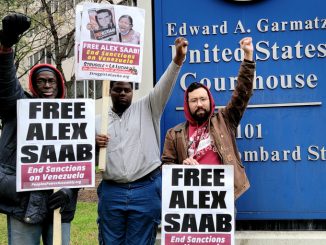
On Dec. 12, the U.S. federal court in Miami began hearings in the case of Venezuelan Ambassador Alex Saab, who has been falsely arrested and is presently imprisoned in a Miami federal penitentiary on trumped-up charges of money laundering. 

His attorneys called on District Judge Robert Scola to dismiss the charge as Saab’s status as a diplomat gives him immunity. Alex Saab was on a diplomatic mission from Venezuela to Iran to buy fuel and humanitarian supplies when he was seized as his plane refueled in the Cape Verde islands.

A decision is expected to be rendered by Dec. 20.

Who is Alex Saab?

The Venezuelan people consider Alex Saab a national hero. Saab helped procure and arrange shipments of desperately needed food, medicine, and supplies to Venezuela’s population, who have suffered immensely because of U.S. sanctions that block the shipment of crucial supplies.

U.S. sanctions have not only caused deep hardship from lack of food, fuel and medicine; they have led to death, especially for children and the elderly. In the film “Alex Saab, a Kidnapped Diplomat,” Ana Araujo, from Caribe La Guaira, Venezuela, describes the death of three of her five children, deaths that could have been prevented if there were no U.S. sanctions. The most recent death resulted from not getting diabetic medicine.

Dr. Alfred de Zayas, who served as an independent expert for the United Nations Human Rights Council, estimates 100,000 Venezuelans have died as a result of the sanctions implemented by the U.S. government.

You can see Alex Saab’s picture painted on murals and posters on street corners calling for his release. Massive protests have brought out workers and poor people from Venezuela’s communities to demand his release.

To his family, Alex Saab is a loving father of five children and husband of Camilla Fabria Saab, who has also been the target of official U.S. harassment and sanctions. Alex Saab’s two youngest children, three years old and five months old at the time of his arrest, have not seen their father for over two years.

In the U.S., he is mostly unknown  

The State Department, which orchestrated Saab’s kidnapping, and the paid corporate media are not publicizing the U.S. kidnapping of the Venezuelan diplomat. So it is no surprise that few inside the U.S. are familiar with his case. What has been reported has been a shameful gaggle of lies.

Ambassador Saab was illegally seized and arrested for allegedly violating the Vienna Convention when his plane was refueling in Cape Verde. While jailed, Saab was tortured by English-speaking captors who demanded that he denounce Venezuela’s President Nicolas Maduro. He was denied medical treatment for cancer, beaten and cut on his ankles and wrists. 

This is despite the Economic Community of West African States, the African Bar Association, and the United Nations Human Rights Committee speaking out against his false imprisonment and plans to extradite him to the United States.

The appeals process in Cape Verde had not been completed, nor were his lawyers or family informed, when Ambassador Saab was shuttled out of the Cape Verde jail on an aircraft to the U.S. Suspiciously, this took place the day before the election in Cape Verde. The winning party had announced they planned to release him. 

While he remained jailed in Cape Verde, both of Saab’s parents, who were immigrants from Palestine and Lebanon, died due to the COVID pandemic.

Why and how can such cruel and illegal actions take place?

It is through sheer might and arrogance that the State Department has scuttled international law and has used covert and overt military violence. The mentality of U.S. imperialism is “no one can stop us since we have the guns and economic might.”

The same flagrant disregard for world opinion and law has fueled the U.S. blockade of Cuba. For the last 30 years, the member nations of the U.N. have voted to end the criminal blockade of Cuba. Only two countries, the United States and Israel, continue to vote no.

Similarly, Cuba, which has neither threatened nor perpetuated violence, continues to be classified by the U.S. as a terrorist country. 

Remember the Cuban 5

Despite the military might of U.S. imperialism, the united action of the world’s people, particularly Cuba, ultimately freed these five heroes who were falsely accused of being spies. 

Well-documented facts confirm that the five Cuban heroes were on a mission to stop terrorist attacks on Cuba, not spy on the United States. Their mission followed the horrific bombings orchestrated by Posada Carriles, a former CIA operative. This included the infamous bombing of Cubana de Aviacion Flight 455, which was in flight from Barbados to Cuba. This was the first bombing of a civilian airplane in flight in the Western hemisphere. 

All 73 people on board perished, including the entire Cuban Olympic fencing team who had just won all the gold medals in the Central American and Caribbean Championship Games. Most were teenagers. The Cuban pilot averted crashing into the beach, saving the lives of countless tourists. 

Cuba’s people, led by comandante Fidel Castro, made it a priority to gain the release of the Cuban 5. Millions of people in Cuba and worldwide protested and joined a massive campaign. What seemed impossible happened when the last of the Cuban 5 were released in 2014 and returned to Cuba. 

It proved that what seemed impossible was possible.

People’s actions can change history, and we can free Alex Saab. An important step is to break the information blockade. You can watch the film “Alex Saab, a Kidnapped Diplomat” on YouTube for a detailed explanation of his case. View it and make sure your friends and family see it too.

Strugglelalucha256


Retired railroad worker Stephen Millies on Biden & Congress collaborating against railroad workers

Strugglelalucha256


To hell with the railroad barons: The railroads belong to the people!

Nobody should be surprised by President Joe Biden’s strikebreaking role in imposing a contract on railroad workers. The agreement had already been voted down by workers in several unions.

The imposed contract fails to address the need for sick days or any time off — paid or unpaid — for employees subject to call 24/7. Workers can still be written up for seeing a doctor or taking their children to a clinic.

Remember that “Amtrak Joe” had represented the Du Pont dynasty as a U.S. senator from Delaware for 36 years. He loyally served the Mastercard plastic loan sharks, also based in Delaware, in that U.S. House of Lords.

Biden worked with the late Senator Strom Thurmond, a vicious racist, to fight school integration. In the 1990s, Biden helped pass laws that increased the prison population to over two million.

The man in the White House can stop a strike of working people seeking fair treatment. But Biden refuses to use his pen to free 78-year-old Leonard Peltier. The Indigenous political prisoner, a leader of the American Indian Movement, has spent 46 years in jail after being framed.

What now?

The BNSF Railway’s harsh and arbitrary attendance policy remains in place. This scheme assigns 30 points to every employee.

Except for vacation days, two points will be deducted for being absent on any day from Monday through Thursday. Three points will be taken away for taking off on a Sunday.

Workers will be fined four points if they don’t come in on Friday or Saturday. Federal holidays are the grand prize.

Being sick on those days will cost an employee seven points. Never mind that workers and their family members get sick on holidays, too. Many days of overtime are required to earn back new points.

Even the capitalist courts claim to consider people innocent until proven guilty. The BNSF — completely owned by super billionaire Warren Buffett’s Berkshire Hathaway hedge fund — automatically penalizes workers who “mark off” whether or not they and their children are ill.

One of Buffett’s BNSF serfs can be fired for “losing” 30 points despite having a decades-long good record. Railroad management imposed this crap in the middle of the COVID-19 pandemic without any negotiating with the unions.

The contract imposed by Biden and Congress doesn’t address any working conditions. Many freight engineers and conductors are on call with no set work schedule. They may be forced to be away from their families for a week or more.

So are the maintenance-of-way employees who fix the track. They have to live in bunk cars or motels during the week, sometimes hundreds of miles away from home.

These issues go beyond wages, although that “big wage increase” that the media mentions will be eaten up by inflation. All workers deserve dignity.

An Amtrak yardmaster told this writer that when he worked on the Norfolk Southern Railway, a trainmaster demanded that he do stretching exercises. It was as if this worker and father were back in kindergarten.

Profits first, safety last

This lack of respect has only increased since the introduction of the speed-up system called Precision Scheduled Railroading. There’s nothing precise about PSR.

Even capitalists in the chemical, food and other industries have complained of increased train delays. “They’ve cut labor below the bone, really,” Surface Transportation Board Chair Martin Oberman told the House Transportation Committee on May 12. “In order to make up for the shortage of labor, they are overworking and abusing the workforces.”

PSR helped destroy 62,000 railroad jobs between March 2015 and November 2022. The 30% plunge in jobs and service delays is linked to increasing the average train length by 25%. Many railroad yards were closed or downsized.

A relentless drive to reduce crew size resulted In the Lac-Mégantic, Quebec, tragedy. Forty-seven people were killed there in 2013 when a runaway train of oil tank cars exploded. There was only one crew member, an engineer, on the train.

PSR was the brainchild of the late Hunter Harrison, the son of a Memphis, Tennessee, cop. Harrison’s daddy helped enforce racial segregation laws for a local ruling class that helped kill Dr. Martin Luther King.

Harrison introduced PSR on the old Illinois Central Railroad, which was gobbled up by the Canadian National Railway. Harrison became the Canadian National’s CEO and imposed PSR on all the railway’s workers.

Yet as of Dec. 1, all Canadian railroad workers and a million other “federally regulated” employees in Canada will get 10 sick days annually. Why are Canadian railroaders getting sick days while the U.S. Congress refused to provide any?

Canadian Prime Minister Justin Trudeau serves the banksters just as U.S. politicians do. A big difference is that a million workers joined a general strike called by the Canadian Labor Congress on Oct. 14, 1976. They were protesting the cutback policies of Justin Trudeau’s father, Prime Minister Pierre Trudeau.

Many Canadian workers vote for the New Democratic Party, which was co-founded by the Canadian Labor Congress. That’s unlike the U.S. Democratic Party, which was founded by the slavemaster and rapist Thomas Jefferson.

This greater political awareness includes labor defending former Black Panther Party member Mumia Abu-Jamal, who was framed and has spent 41 years in Pennsylvania prisons. The Ontario Federation of Labor voted in 2011 to “reaffirm its support of Mumia Abu-Jamal and step up its efforts to win his freedom.” 

We need a people’s takeover

The mere threat of a strike has forced both the Union Pacific and CSX railroads to slightly modify their severe attendance policies. As Frederick Douglass declared, “If there is no struggle there is no progress.”

In 1877, a co-worker of Douglass, Peter Clark, addressed striking railroad workers in Cincinnati. (“1877: Year of Violence” by Robert V. Bruce.)

The drop in railroad employment from 2 million workers in 1920 to 150,000 a century later has devastated communities coast-to-coast. These job cuts accelerated as Black workers and women workers were finally being hired in more jobs.

Hamlet, North Carolina, was an important junction on the old Seaboard railroad, now part of the CSX system. Because of the loss of railroad jobs, many local workers were hired by the non-union, low-wage Imperial Foods plant instead.

Twenty-five workers were killed there on Sept. 3, 1991, when a fire broke out. The plant’s owner, Emmett J. Rowe, locked the doors because he thought workers – many of whom were Black – would steal chickens. 

White and Black workers died together because of Rowe’s racism. Forty-nine children were orphaned.

Over 50,000 miles of U.S. railroad lines have been abandoned. The seven big U.S. and Canadian “class 1” railroads hauled in profits of $27 billion last year. 

That’s more than double what these railroads paid in wages. Meanwhile, CSX CEO James Foote raked in $20 million

The railroad monopolies owe not only sick days but reparations. Nine thousand miles of track were laid by enslaved Africans before the Civil War.

Thousands of more miles were built afterward by Black prisoners like John Henry, the “steel driving man.” Henry was worked to death by the Chesapeake and Ohio Railroad, then run by Collis P. Huntington, and now part of CSX.

Hundreds of Chinese workers died building Huntington’s Central Pacific Railroad across the Sierra Nevada mountains. General George Custer had it coming, and he died while leading an incursion into Lakota Sioux land for the Northern Pacific Railway, now part of BNSF.

Instead of BNSF being owned by Warren Buffett with his $100 billion-plus fortune, it should be run by the people. To guarantee jobs, service, and safety, we need a people’s takeover of the railroads.

The writer is a retired Amtrak worker and a member of the American Train Dispatchers Association and Transportation Communications Union.

Strugglelalucha256


Baltimore supports railroad workers’ right to paid sick leave

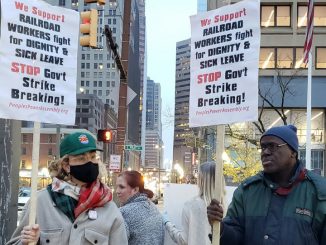
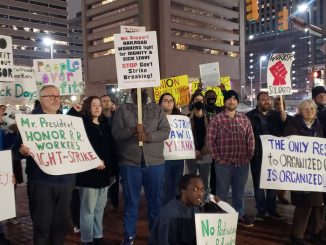
December 8 — A rush-hour protest in downtown Baltimore showed support for railroad workers under attack. The newly formed Ad Hoc Committee To Support Railroad Workers called the action.

Protesters expressed their outrage at the railroad bosses for refusing to pay workers sick pay and at Biden and Congress for the “no strike law” that bars workers from walking out.

Cindy Farquhar, a local activist who emceed the action, exclaimed, “The railroad industry is the most profitable sector in the U.S. today. We in Baltimore will not roll over when they attack unions — rail workers deserve a decent job.” 

Sharon Black, a local Amazon warehouse worker who came straight from work, proclaimed, “We need a union at our warehouse, and I am here today to show support for the railroad workers.”

A group from the newly founded union, Pratt Workers United, attended and spoke. Ellie McCrow stated, “We are here to say no to government strikebreaking and that all workers have a right to a union.”

Maximillian Alvarez, the editor-in-chief of the Real News Network, pointed out that the railroad industry should be publicly owned.

Other union and community representatives participated, including the American Federation of State County and Municipal Employees (AFSCME); Unemployed Workers Union; Peoples Power Assembly; American Federation of Government Employees (AFGE); and the International Brotherhood of Electrical Workers (IBEW) Local 24.

Passing motorists honked in support, and two members of the Airline Pilots Association stopped to thank protesters, explaining that they are up against the same thing.

Baltimore is the city where the Great Railroad Strike was launched in 1877. The Maryland governor used armed troops to attempt to crush it, murdering 22 railroad workers.

Strugglelalucha256


Zero COVID: Don’t be deceived by U.S. reports on the protests in China

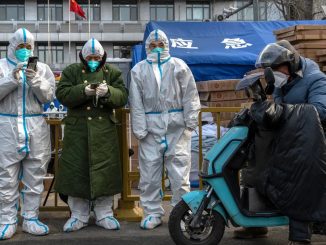
The opportunism of the major U.S. media was on full display in late November over the protests against China’s anti-COVID lockdowns. The protests began in the Xinjiang city of Urumqi after a terrible fire took the lives of 10 people on Nov. 24. People in the district responded to the tragedy by protesting the lockdown that had gone into effect after a COVID outbreak in late summer. 

The protests occurred in somewhere between 15 and 20 cities, including Beijing and Shanghai. The numbers reported by the U.S. press were purposely vague. The liberal PBS claimed thousands in a Nov. 29 headline and then “tens of thousands” in the article. Some reports indicated hundreds in Shanghai, and many pieces didn’t estimate crowd size at all. 

For context, there are about 60 cities of a million people or larger in China, and about 20% of the world lives in China. So even if the claim by PBS of “tens of thousands” is true, this brief series of protests was not the mass uprising against the leadership of China that the U.S. capitalist class and their loyal media salivate over. 

Hoping the protests would mark the beginning of their long-desired “color revolution” in China, the U.S. media’s elation got the best of them and led to the overblown coverage. But the hyperventilating reportage wasn’t limited to slander. There are reports of Western journalists using Telegram channels to guide “activists” from Hong Kong and Taiwan to the locations of some of the protests. 

When the “color revolution” failed to materialize, their giddy predictions gave way to another distortion of the facts. They claimed the CCP is being pushed by the momentum of the protests to ease its COVID policy, which they claim is the result of Xi’s authoritarianism and his desire to always be correct regardless of consequences. 

Zero COVID 

Their omission of the fact that President Xi Jinping had already signaled a relaxation of the “Zero COVID” measures a full two weeks before the protests broke out was not an error. It was imperialist media policy.

The decision to announce adjustments to the Zero COVID policy in a major speech by President Xi on Nov. 11 is only one indication that the national leadership of China was cognizant of the fact that people’s patience was exhausted. 

Even before the Nov. 11 speech, it was clear that national authorities were trying to address a gap between the thinking of national health officials and the officials in some provinces using a one-size-fits-all approach to lockdowns. The website of Friends of Socialist China reports that national officials reminded “authorities in Henan’s capital Zhengzhou … of the exceptions that need to be made to stay-home orders” and rebuked “police in Anhui for over-strict enforcement of quarantine.”

Moving toward a relaxation of quarantine times and lockdowns shows that China’s battle against COVID is based on not only physical science but also social science. From the beginning of the outbreak, it was meant to be a dynamic approach that would adjust based on the ever-changing characteristics of the virus and even on differences between locations.  

Even if greatly exaggerated by the U.S. press, the tragedy in Urumqi brought frustrations to the surface after three years of dealing with the pandemic. But that doesn’t mean there is broad dissatisfaction with the leadership of the campaign against COVID. 

Just 5,000 COVID deaths

On the contrary, what was smeared in the Western media as extreme has limited the number of deaths in China to just over 5,000. Moreover, the success of the “People’s War” against COVID, with widespread testing, lockdowns, and quarantines as essential elements, is nothing short of astounding compared to major capitalist countries. With quadruple the population, the Chinese death toll is 200 times less than the more than 1 million deaths in the U.S. 

China’s sustained policy of lockdowns was unique in the world. It was borne out of necessity and likely saved millions or tens of millions of lives. After more than a hundred years of being ravaged by colonizers and then imperialist countries, the physical health of Chinese people was among the priorities of the 1949 revolution. 

China was weak and sick. When Mao Zedong declared that “the Chinese people have stood up!” foremost on his mind must have been bringing the health of a giant, poverty-stricken nation up to par. Britain and France had waged war to force opium on the Asian giant, and opium addiction was widespread. Diseases that were inexpensive to treat and, in many cases, eradicate were rampant at the time of the revolution.

China’s campaign of “barefoot doctors” headed to the countryside. Hospitals were constructed. But bringing a nation of hundreds of millions of people back to health isn’t an overnight process. 

A developing country

While China is now on its way to achieving a higher GDP than the U.S., it is still a developing country, and building a complete healthcare system is an ongoing process. When COVID emerged, China still had only 4 ICU beds per 100,000 people. 

Even though health care has improved dramatically over the seven decades, the availability of ICU beds was, and is, inadequate for dealing with COVID. During February 2020, the severe symptoms quickly overwhelmed hospitals. That hurdle had to be overcome, and China’s leadership and people swung into action. 

Some 10,000 volunteer medical workers from all over the country traveled to the areas hit hardest by the virus. Emergency, makeshift hospitals were constructed at speeds the world had never seen. Given the highly transmissible feature of the virus, and as-of-then unavailable treatment, widespread testing, quarantine, and lockdowns emerged as the best plan to prevent catastrophic death rates. Early on, China’s scientists shared the DNA of the virus with the world and then developed vaccines that protect from severe symptoms and death. The campaign to continue vaccination — especially among the elderly — is ongoing.

COVID-19 has tested the world’s healthcare capabilities more than anything in living memory. Socialist planning and science saved tens of millions of lives in China and will keep China on the right path as the virus ebbs and flows. Socialism must be the future.

Strugglelalucha256


Peru: Was it a coup?

When Professor Pedro Castillo won the presidential election against Keiko Fujimori — in the second round and by a very narrow margin of 50.125% against 49.875%, a difference of just over 40 thousand votes in a country of 33 million inhabitants — he had two possible paths.

The first was to take to the streets the people of the regions historically forgotten by the political, economic, and media elites, as opposed to the middle and upper classes of the capital Lima, which, with 35% of the electoral roll, had traditionally defined the President of Peru. To take to the streets a people that demanded a new Constitution to replace the one promulgated by Fujimori in 1993. To convene a Constituent Assembly that, faced with the power of a unicameral Parliament designed as a counterweight to presidential power, would give rise to a power capable of generating the necessary balance.

The other path, the other alternative, was to try to govern. And Pedro Castillo, in what -now it is easy to say- was his first big mistake, chose to govern.

The problem is that he had to govern in the court (a perverse institutional system totally inclined and designed to the detriment of popular interests), with the rules (Fujimori’s Constitution), and with the referee against him (a Parliament with a Fujimori majority and a leftist minority).

Once Pedro Castillo chose to try to govern, an impeachment process was set in motion, driven by Fujimorism with the coverage of the media oligopolies. And obviously, he could never govern with an ultra-fragmented Congress from which he had to ask permission even to appoint ministers.

But Fujimorism had a weapon as perverse as it was powerful, Article 113 of the Constitution, which establishes among the different causes for the vacancy of the President (some are common sense, such as death or resignation) the “permanent moral or physical incapacity, declared by the Congress.”

The first motion of vacancy for permanent moral incapacity came in November, only four months after having been in office, followed by a second one in March 2022 and the third and last one this December. To illustrate the powerful arguments of the parliamentary opposition to Pedro Castillo, one only has to read the 20 points of the second motion of vacancy, where in addition to accusing Castillo of systematically lying, it is stated that “he has not reflected, much less corrected his conduct; on the contrary, he has insisted on defending his actions.” There are no more words, your honor.

But if we take any definition in political science of coup d’état (translation from French coup d’État), which is normally understood as a usurpation (often violent) of the government of a country, and which we can clearly visualize in what happened in 2019 in the neighboring country, sister Bolivia, we could affirm that the only coup plotters were those who tried to usurp from the legislative power the executive power through motions of vacancy due to permanent moral incapacity.

It is not the purpose of this brief analysis to point out Pedro Castillo’s mistakes: whether he managed the post-pandemic and vaccination well or not, whether he should have been tougher or more inflexible both with the caviar left and with his (former) allies of Perú Libre, whether Aníbal Torres had more or

less power than he should have as President of the Council of Ministers, even less if Pedro Castillo was wrong to isolate himself or to look for the OAS as a salvation/legitimization table. Not even if there were enough votes for the vacancy motion or if his actions in the last hours of his term were clumsy, not to say suicidal.

None of the above justifies the parliamentary coup by Fujimorism and its political, economic, and media allies before the complicit silence of the international community and the loneliness in which it was left by a good part of the left that continues to seek revolutions in their classic 20th-century format, and does not understand (not to say despises) the popular and the forms of representation, full of contradictions, that it finds to dispute power.

Now it is the turn of Dina Boluarte, the sixth President in six years of a country once ruled by Marshal Santa Cruz. Before her the dilemma is repeated for the second time (and if the first one ended in tragedy with the imprisonment of Pedro Castillo, let us hope this second one does not end in farce): either she tries to govern and finish the mandate in 2026, for which she will undoubtedly have to make a pact with the coup plotters, which is a good part of her cabinet (and policies), or she brings forward the elections to place the Constituent Assembly again on the horizon.

In the meantime, it is about time to change the question Vargas Llosa asks in Conversation in the Cathedral, “when did Peru get screwed” to the question of who screwed Peru. Peru was and continues to be screwed by the political, economic, and media coup plotters, with the complicity of some sectors of the left, who do not respect the will of the social majorities.

Source: Tierra Adentro, translation Resumen Latinoamericano – US

Strugglelalucha256
https://www.struggle-la-lucha.org/2022/page/5/