Former German Chancellor Merkel admits that Minsk peace agreements were part of scheme for Ukraine to buy time to prepare for war with Russia

Vladimir Putin, left, Emmanuel Macron, Angela Merkel and Volodymyr Zelensky at meeting in Paris.

War was inevitable outcome of 2014 U.S.-backed coup in Ukraine

Former German Chancellor Angela Merkel said in an interview with Die Zeit, published on December 7, that “the 2014 Minsk agreement was an attempt to give time to Ukraine. It … used this time to become stronger as can be seen today. The Ukraine of 2014-2015 is not the modern Ukraine.”

These comments echoed those of Petro Poroshenko, the former president of Ukraine, who came to power in snap elections after the 2014 coup d’état. Regarding his signing of the Minsk Accord, Poroshenko repeated in a Deutsche Welle interview last June his previous admission: “Our goal was to, first, stop the threat, or at least to delay the war—to secure eight years to restore economic growth and create powerful armed forces.”

Meaning that Ukraine had no real intention of following the accords, but wanted to buy time while Ukraine built fortifications and developed a military strong enough to wage a war of aggression against the Russian-tilted Donetsk and Luhansk regions, which had demanded autonomy from the Ukrainian government installed in the February 2014 coup.

Ukrainian President Viktor Yanukovych (2010-2014) became a target for regime change when he spurned an International Monetary Fund (IMF) loan and instead drew his country closer to Russia.

When protesters backed by the U.S. did not have enough signatures for Yanukovych’s impeachment, they overthrew his government by force and hunted down Yanukovych’s supporters. The new Ukrainian government further tried to impose draconian language laws and attacked the people of eastern Ukraine after they voted for their autonomy after the coup—an attack that began right after then-CIA director John Brennan visited Ukraine.

Signed originally on September 5, 2014, by Ukraine, Russia, rebel leaders in eastern Ukraine and the Organization for Security and Cooperation in Europe (OSCE), with mediation by leaders in France and Germany, the Minsk agreement had followed a twelve-point protocol advocating for a cease-fire in the fighting between the Ukrainian military and Donetsk and Luhansk People’s Republics and to decentralize power, giving those Republics autonomy which they had voted for in popular referenda.

Additional provisions included the withdrawal of illegal armed groups and mercenaries from Ukraine, the release of hostages and illegally detained persons, the establishment of security zones and independent monitoring of the conflict zones, prosecution and punishment of war criminals, and continuance of inclusive national dialogue.

Unfortunately, the Minsk protocol was never followed, and conflict in eastern Ukraine persisted, leading to the signing of the Minsk II protocol in February 2015.

This protocol reaffirmed many aspects of the first Minsk agreement, including the promotion of decentralization and autonomy for the Donetsk and Luhansk Republics, which was to be enshrined in a new Ukrainian constitution that was to recognize the diversity of religions, languages and cultures within Ukraine.

The Ukrainian right sector, however, vowed not to follow Minsk II, claiming that it was unconstitutional and the U.S. State Department accused Russian President Vladimir Putin of violating the protocol by deploying Russian Armed Forces around the contested city of Debaltseve to assist the Donetsk Army. (Putin’s spokesman denied this and said that Russia could not assist in the implementation of Minsk II because it was not involved in the conflict.)

When a law was passed in the Ukrainian parliament granting Donetsk and Luhansk partial autonomy, Russian Foreign Minister Sergey Lavrov said that the “law was a sharp departure from the Minsk agreements because it demanded local elections under Ukrainian jurisdiction.”

Russian Foreign Ministry spokeswoman Maria Zakharova said that Angela Merkel’s comments on December 7 were nothing short of the testimony of a person who openly admitted that everything done between 2014 and 2015 was meant to “distract the international community from real issues, play for time, pump up the Kyiv regime with weapons, and escalate the issue into a large-scale conflict.”

Merkel’s statements “horrifyingly” reveal in turn that the West uses “forgery as a method of action,” and resorts to “machinations, manipulation, and all kinds of distortions of truth, law, and rights imaginable.”

Loss of trust

Russian President Vladimir Putin for his part told journalists at a Eurasian Union Summit in Bishkek, Kyrgyzstan, on December 10 that he had thought the leader of the Federal Republic of Germany, even though Germany was on Ukraine’s side, had been sincere in negotiating the Minsk agreements, but now it was apparent that “they were deceiving us. The only purpose was to pump arms into Ukraine and get it ready for hostilities. We are seeing this, yes. Apparently, we got our bearings too late, frankly. Perhaps we should have started all this sooner, but we still simply hoped to come to terms under these Minsk peace agreements.”

For Putin, Merkel’s admission shows that “we did everything right by starting the special military operation. Why? Because it transpired that nobody was going to fulfill these Minsk agreements. The Ukrainian leaders also mentioned this, in the words of former President Poroshenko, who said he signed the agreements but was not going to fulfill them.”

According to Putin, now the issue of “trust is at stake. Trust as such is already close to zero, but after such statements, the issue of trust is coming to the fore. How can we negotiate anything? What can we agree upon? Is it possible to come to terms with anyone, and where are the guarantees? This is, of course, a problem. But eventually we will have to come to terms all the same. I have already said many times that we are ready for these agreements, we are open. But, naturally, all this makes us wonder with whom we are dealing.”

Fitting a larger pattern of deception

Western treachery over the Minsk agreements is far from a historical anomaly.

Following the end of the Cold War, the George H. W. Bush administration promised Mikhail Gorbachev that NATO would not be expanded one inch eastward in exchange for Russia accepting the reunification of Germany and removing troops it had stationed in East Germany.

But in 1998, the Clinton administration certified NATO expansion into Romania, Poland and Hungary, triggering a new Cold War.

Decades earlier, the United States had deceived the Soviets by failing to abide by the Yalta agreements when it covertly armed neo-Nazis to try to foment counter-revolutions in pro-communist governments that were being established in Eastern Europe.

When the U.S. invaded Russia with six other countries in 1918 following the Bolshevik Revolution, President Woodrow Wilson deceived his own commanding General, William S. Graves, who was told that he was going to Russia to protect the Trans-Siberian Railway and a Czech military delegation when his real purpose was to support Czarist military officers intent on re-establishing the old order in Russia.

How the West brought war to Ukraine

Benjamin Abelow’s new book, How the West Brought War to Ukraine: Understanding How U.S. and NATO Policies Led to Crisis, War, and the Risk of Nuclear Catastrophe (Great Barrington, MA: Siland Press, 2022), demonstrates that the official U.S. narrative about the war in Ukraine is not only wrong but “the opposite of truth.”

A lecturer in medicine at Yale University with a degree in European history who lobbied Congress on nuclear weapons policy, Abelow writes that “the underlying cause of the war lies not in an unbridled expansionism of Mr. Putin, or in paranoid delusions of military planners in the Kremlin, but in a 30-year history of Western provocations, directed at Russia, that began during the dissolution of the Soviet Union and continued to the start of the war.”

The key U.S./Western provocations detailed by Abelow are:

  1. The expansion of the North Atlantic Treaty Organization (NATO), a hostile anti-Russian military alliance, over a thousand miles eastward, pressing it toward Russia’s borders in disregard of assurances previously given to Moscow.
  2. Withdrawal from the Anti-Ballistic Missile Treaty and the placing of anti-ballistic launch systems that could accommodate and fire offensive nuclear weapons such as nuclear-tipped Tomahawk cruise missiles at Russia, from newly joined NATO countries.
  3. The Obama administration’s laying the groundwork for and possibly directly instigating an armed, far-right coup in Ukraine, which replaced a democratically elected pro-Russian government with an unelected pro-Western one that had four high-ranking members who could be labeled neo-fascist.
  4. The conducting of countless NATO military exercises near Russia’s border, including ones with live-fire rocket exercises whose goal was to simulate attacks on air-defense systems inside Russia.
  5. The assertion that Ukraine would become a NATO member.
  6. Withdrawal by the U.S. from the Intermediate-Range Nuclear Forces (INF) Treaty, increasing Russia’s vulnerability to a U.S. first strike.
  7. The U.S.’s arming and training of the Ukrainian military through bilateral agreements and holding of regular joint military training exercises inside Ukraine.
  8. Leading the Ukrainian leadership to adopt an uncompromising stance toward Russia, further exacerbating the threat to Russia.

Abelow makes clear that, if the situation were reversed and Russia or China carried out equivalent steps near U.S. territory, the U.S. would surely respond with a preemptive military attack on the aggressors that would be justified as a ‘matter of self-defense.’

So why should Russia be maligned when it is acting as any country would under similar circumstances? And why is it so hard for Americans to stand against their government’s reckless, deceitful and criminal policies that have greatly heightened the risk of nuclear war?

Source: CovertAction Magazine

Strugglelalucha256


Taiwan local election shocks U.S. imperialism

On November 26, local elections were held throughout Taiwan, an island that has always been part of China but since 1949 has been ruled by a fascist leadership driven out of the mainland by the victorious Chinese People’s Liberation Army (PLA). Taiwan has since been “protected” by the military U.S. fleet, while Taiwan’s rulers maintained 48 years of martial law and a brutal regime of “White Terror.” In 1987, the regime allowed bourgeois elections.

Before the 2022 elections, Taiwan’s president, Tsai Ing-wen, had campaigned for her ruling “Democratic Progressive Party” (DPP) candidates with the assertion that Taiwan is an independent nation and should prepare to wage war. As a Nov. 25 CNN article describes:

Polls opened in Taiwan on Saturday in local elections that President Tsai Ing-wen has framed as being about sending a message to the world about the island’s determination to defend its democracy in the face of China’s rising bellicosity.

The local elections, for city mayors, county chiefs and local councilors, are ostensibly about domestic issues such as the Covid-19 pandemic and crime, and those elected do not have a direct say on China policy.

But Tsai has recast the election as being more than a local poll, saying the world is watching how Taiwan defends its democracy amid military tensions with China, which claims the island as its territory.

China carried out war games near Taiwan in August to express its anger at a visit to Taipei by then-US House Speaker Nancy Pelosi and its military activities have continued, though on a reduced scale.

Taiwan’s main opposition party the Kuomintang, or KMT, swept the 2018 local elections, and has accused Tsai and the DPP of being overly confrontational with China.

Election results a shock to the DPP and Washington

The results of the election were a major defeat for the pro-independence DPP and to Washington’s plans to attack the People’s Republic of China (PRC). As a British newsletter reported:

While Tsai’s personal brand as the quiet yet determined pro-democracy politician standing up to China has been a key component in Taiwan’s strengthening relationships overseas, her latest appeals appeared to fall flat with Taiwanese voters at home. Last Friday, Tsai’s party – the Democratic Progressive Party (DPP) – suffered one of its most significant electoral defeats in over thirty years. The more China-friendly rival Nationalist Party (Kuomintang or KMT) triumphed by winning 13 of 21 seats at the mayoral and magisterial levels, while the DPP only took five. The Taiwan People’s Party (TPP), a third party growing in popularity under founder and former Taipei mayor Ko Wen-je, won its first mayoral seat in the influential Hsinchu City, dealing another blow to the ruling DPP.

The results were so bad for the ruling DPP that President Tsai Ing-wen resigned her position as head of the party and will not run for reelection in 2024.

Washington has signaled it has no intention of allowing the people of Taiwan to slow down its drumbeat for war. A December 14th article from the U.S. Naval Institute describes U.S. imperialism’s new aggressive stance:

The U.S. military must be able to deter China from taking over Taiwan by force, a provision in the compromise Fiscal Year 2023 National Defense Authorization Act (NDAA) stipulates.

In accordance with the Taiwan Relations Act, the U.S. must “maintain the ability of the United States Armed Forces to deny a fait accompli against Taiwan in order to deter the People’s Republic of China from using military force to unilaterally change the status quo with Taiwan,” according to the policy bill’s explanatory statement.

Of course, the PRC has always considered Taiwan to be part of China. In 1979, in return for the PRC’s “opening up” of China to U.S. big business, the U.S. agreed to the “One China Policy,” clearly agreeing with the PRC’s position on the status of Taiwan.

But now China has become a powerful force in the world economy. It uses its socialist foundation to technically develop the country to an amazing degree. Through its “Silk Road” initiative, it offers a much brighter future to developing countries than Western Imperialism’s exploitation and weaponizing. That is why it has been targeted by the White House, Congress, and the mad generals at the Pentagon. The Naval Institute article continues:

The NDAA also includes language calling on both the Secretary of Defense and the Secretary of State, in accordance with the Taiwan Relations Act, to help upgrade Taiwan’s military capabilities and its collaboration with the U.S. military.

The FY 2023 policy bill, which the House passed last week and is awaiting action from the Senate, also calls for the U.S. Navy to invite the Taiwan Navy to the Rim of the Pacific 2024 exercise. Taiwan did not participate in RIMPAC 2022 this summer.

Although after the election, the U.S. and Taiwan corporate media downplayed the role of Taiwan’s relations to Washington’s pressing Taiwan into a new Ukraine-style proxy war against the PRC, it obviously played a key role to Taiwan’s people. An October article in gizmodo.com tells how government officials tried to discount reports that Washington was urging Taiwan to prepare to remove workers to the U.S. from the TSMC computer chip-making factory as they spoke to Taiwan’s legislature:

The country’s defense minister Chiu Kuo-cheng reportedly said ‘there is no such plot’ for the U.S. to start dropping bombs on TSMC factories if the country were invaded.

National Security Bureau Director-General] Chen further tried to tamp down on fears the U.S. is going to sap Taiwan’s top chipmaking minds from the country, calling those wargaming plans “just scenarios” while adding “If they understood TSMC’s ecosystem better, they would realize that it’s not as simple as they think. That’s why Intel can’t catch up with TSMC.

In fact, an article was written at the U.S. Army War College proposing that the U.S. urge Taiwan’s DPP government to plant bombs around the TSMC facility threatening to blow it up if it were to fall into the hands of the PRC. Obviously, Washington’s “wargaming” has grown more and more unpopular among Taiwan’s people.

Statement from the PRC on Taiwan’s election: “Peace, stability and a good life”

A Nov. 27th report from Reuters details the position of the PRC government on the Taiwan election results:

China’s government said on Saturday the results of local elections in Taiwan “revealed that mainstream public opinion in the island is for peace, stability and a good life”, after the ruling Democratic Progressive Party performed badly.

China will continue to work with Taiwan’s people to promote peaceful relations and firmly oppose Taiwan independence and foreign interference, China’s Taiwan Affairs Office said in a statement carried by the official Xinhua news agency.

We who live in the “belly of the beast” must mobilize all the anti-war forces to oppose Washington’s push for a new war directed against Socialist China.

Source: Fighting Words

Strugglelalucha256


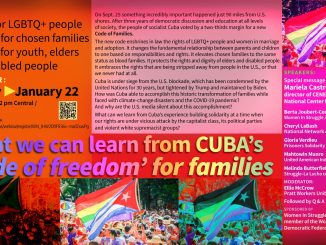
Webinar: What We Can Learn from Cuba’s Families Code, Jan. 22

Webinar: What we can learn from Cuba’s ‘code of freedom’ for families

Sunday, Jan. 22
3:00 p.m. Eastern / 2:00 p.m. Central / 12 noon Pacific

Register here: https://tinyurl.com/CubaFamilyCode

Rights for LGBTQ+ people * Equality for chosen families * Respect for youth, elders, and the disabled

On Sept. 25, something incredibly important happened just 90 miles from U.S. shores. After three years of democratic discussion and education at all levels of society, the people of socialist Cuba voted by a two-thirds margin for a new Code of Families.

The new code enshrines in law the rights of LGBTQ+ people and women in marriage and adoption. It changes the fundamental relationship between parents and children to one based on responsibilities and rights. It elevates chosen families to the same status as blood families. It protects the rights and dignity of elders and people with disabilities. It embraces the rights that are being stripped away from people in the U.S. or that we never had at all.
Cuba is under siege from the U.S. blockade, which has been condemned by the United Nations for 30 years but tightened by Trump and maintained by Biden. How was Cuba able to accomplish this historic transformation of families while faced with climate-change disasters and the COVID-19 pandemic? And why are the U.S. media silent about this accomplishment?

What can we learn from Cuba’s experience building solidarity at a time when our rights are under vicious attack by the capitalist class, its political parties, and violent white supremacist groups?

SPEAKERS
– Special message from Mariela Castro Espín, director of CENESEX – Cuba’s National Center for Sex Education
– Berta Joubert-Ceci, Women In Struggle / Mujeres En Lucha
– Cheryl LaBash, National Network on Cuba co-chair
– Gloria Verdieu, Prisoners Solidarity Committee
– Mahtowin Munro, United American Indians of New England
– Melinda Butterfield, Struggle-La Lucha co-editor
– Moderator: Ellie McCrow, Pratt Workers United

Followed by Q & A
Register here: https://tinyurl.com/CubaFamilyCode

Sponsored by Women In Struggle / Mujeres En Lucha, member of Women’s International Democratic Federation

Strugglelalucha256


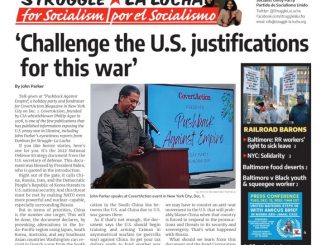
Struggle ★ La Lucha PDF – December 19, 2022

Get PDF here

  • ‘ Challenge the U.S. justifications for this war’
  • Food deserts: Grocery giant shuts down in southwest Baltimore
  • Baltimore City escalates racist attack on squeegee workers and Black youth
  • To hell with the railroad barons: The railroads belong to the people!
  • New York City in solidarity with railroad workers
  • Baltimore supports railroad workers’ right to paid sick leave
  • Fight to free Mumia Abu-Jamal continues
  • U.N. rights group files brief about systemic racism in Mumia Abu-Jamal’s case
  • 48,000 student-workers in California strike for their rights
  • Report from Honduras on the new government of Libre Party leader Xiomara Castro
  • The U.S. egged on the coup in Peru
  • Zero COVID: Don’t be deceived by U.S. reports on the protests in China
  • U.S. sanctions Haiti
  • 75 years after partition, U.S. guns and dollars still murder Palestinians
  • Uncertainty in Peru as the people remain in the streets
  • Miami hearing continues for illegally jailed Venezuelan Ambassador Alex Saab
  • Cluster bombs: Biden considers sending banned weapons to Ukraine
  • ¿Derechos Humanos en una colonia?
Strugglelalucha256


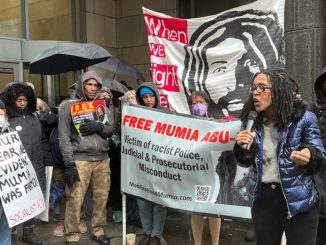
Philadelphia: Fight to free Mumia Abu-Jamal continues

Dec. 16 ― Supporters packed the courtroom at Mumia Abu-Jamal’s Post-Conviction Relief Act hearing today before Common Pleas Court Judge Lucretia Clemons. Outside, more supporters demonstrated in the rain.

Mumia Abu-Jamal is a world-renowned political prisoner and past president of the  Philadelphia Association of Black Journalists who was framed when Philadelphia police officer Daniel Faulkner was killed in 1981. Originally sentenced to death, the former Black Panther Party member has been jailed for 41 years. That’s over 13 years longer than the imprisonment of Nelson Mandela.

Defense attorneys pointed out new information about the credibility of prosecution witnesses and bias in jury selection.

One of Abu-Jamal’s lawyers, Judith Ritter, raised that prosecution witness Robert Chobert demanded money for his testimony. Another state witness, Cynthia White, sought to have several prostitution charges dropped in exchange for her testimony. Prosecutor Joseph McGill also sought to limit the number of Black jurors. 

Evidence of these claims by Mumia Abu-Jamal’s lawyers was “suddenly found” in six boxes of material that were stored in District Attorney Larry Krasner’s office.

Assistant District Attorney Grady Gervino sought to dismiss these defense claims. His arguments, particularly regarding the bias in jury selection, were flimsy. Former assistant Philadelphia D.A. Jack McMahon actually made a 1986 training video teaching younger prosecutors to avoid selecting Black jurors.

“In selecting Blacks—you don’t want the real educated ones,” McMahon said. “Again, this goes across the board of all races. You don’t want smart people.”

Although this video was made several years after Jamal was convicted, it shows the bigoted atmosphere in the Philadelphia District Attorney’s office.

There are dozens of boxes of material that were withheld from Abu-Jamal’s lawyers that have to be searched. All of these facts demand a new trial for Mumia Abu-Jamal or throwing out his conviction.

Judge Clemons said she would make a ruling in 60 to 90 days. Supporters of justice need to spread the truth: Mumia Abu-Jamal is innocent.

Strugglelalucha256


The road to de-dollarisation will run through Saudi Arabia

On 9 December, China”s President Xi Jinping met with the leaders of the Gulf Cooperation Council (GCC) in Riyadh, Saudi Arabia, to discuss deepening ties between the Gulf countries and China. At the top of the agenda was increased trade between China and the GCC, with the former pledging to “import crude oil in a consistent manner and in large quantities from the GCC” as well as to increase imports of natural gas. In 1993, China became a net importer of oil, surpassing the United States as the largest importer of crude oil by 2017. Half of that oil comes from the Arabian Peninsula, and more than a quarter of Saudi Arabia”s oil exports go to China. Despite being a major importer of oil, China has reduced its carbon emissions.

A few days before he arrived in Riyadh, Xi published an article in al-Riyadh that announced greater strategic and commercial partnerships with the region, including “cooperation in high-tech sectors including 5G communications, new energy, space, and digital economy.” Saudi Arabia and China signed commercial deals worth $30 billion, including in areas that would strengthen the Belt and Road Initiative (BRI). Xi”s visit to Riyadh is only his second overseas trip since the COVID-19 pandemic; his first was to Central Asia for the summit of the Shanghai Cooperation Organisation (SCO) in September, where the nine member states (which represent 40% of the world”s population) agreed to increase trade with each other using their local currencies.

At this first China-GCC summit, Xi urged the Gulf monarchs to “make full use of the Shanghai Petrol and Gas Exchange as a platform to conduct oil and gas sales using Chinese currency.” Earlier this year, Saudi Arabia suggested that it might accept Chinese yuan rather than U.S. dollars for the oil it sells to China. While no formal announcement was made at the GCC summit nor in the joint statement issued by China and Saudi Arabia, indications abound that these two countries will move closer toward using the Chinese yuan to denominate their trade. However, they will do so slowly, as they both remain exposed to the U.S. economy (China, for instance, holds just under $1 trillion in U.S. Treasury bonds).

Talk of conducting China-Saudi trade in yuan has raised eyebrows in the United States, which for fifty years has relied on the Saudis to stabilize the dollar. In 1971, the U.S. government withdrew the dollar from the gold standard and began to rely on central banks around the world to hold monetary reserves in U.S. Treasury securities and other U.S. financial assets. When oil prices skyrocketed in 1973, the U.S. government decided to create a system of dollar seigniorage through Saudi oil profits. In 1974, U.S. Treasury Secretary William Simon – fresh off the trading desk at the investment bank Salomon Brothers – arrived in Riyadh with instructions from U.S. President Richard Nixon to have a serious conversation with the Saudi oil minister, Ahmed Zaki Yamani.

Simon proposed that the U.S. purchase large amounts of Saudi oil in dollars and that the Saudis use these dollars to buy U.S. Treasury bonds and weaponry and invest in U.S. banks as a way to recycle vast Saudi oil profits. And so the petrodollar was born, which anchored the new dollar-denominated world trade and investment system. If the Saudis even hinted towards withdrawing this arrangement, which would take at least a decade to implement, it would seriously challenge the monetary privilege afforded to the U.S. As Gal Luft, co-director of the Institute for Analysis of Global Security told The Wall Street Journal, “The oil market, and by extension the entire global commodities market, is the insurance policy of the status of the dollar as reserve currency. If that block is taken out of the wall, the wall will begin to collapse.”

The petrodollar system received two serious sequential blows.

First, the 2007–08 financial crisis suggested that the Western banking system is not as stable as imagined. Many countries, including large developing nations, hurried to find other procedures for trade and investment. The establishment of BRICS by Brazil, Russia, India, China, and South Africa is an illustration of this urgency to “discuss the parameters for a new financial system.” A series of experiments have been conducted by BRICS countries, such as the creation of a BRICS payment system.

Second, as part of its hybrid war, the U.S. has used its dollar power to sanction over 30 countries. Many of these countries, from Iran to Venezuela, have sought alternatives to the U.S.-dominated financial system to conduct normal commerce. When the U.S. began to sanction Russia in 2014 and deepen its trade war against China in 2018, the two powers accelerated upon processes of dollar-free trade that other sanctioned states had already begun forming out of necessity. At that time, Russia”s President Vladimir Putin called for the de-dollarisation of the oil trade. Moscow began to hurriedly reduce its dollar holdings and maintain its assets in gold and other currencies. In 2015, 90% of bilateral trade between China and Russia was conducted in dollars, but by 2020 it fell below 50%. When Western countries froze Russian central bank reserves held in their banks, this was tantamount to “crossing the Rubicon,” as economist Adam Tooze wrote. “It brings conflict in the heart of the international monetary system. If the central bank reserves of a G20 member entrusted to the accounts of another G20 central bank are not sacrosanct, nothing in the financial world is. We are at financial war.”

BRICS and sanctioned countries have begun to build new institutions that could circumvent their reliance on the dollar. Thus far, banks and governments have relied upon the Society for Worldwide Interbank Financial Telecommunications (SWIFT) network, which is run through the U.S. Federal Reserve”s Clearing House Interbank Payment Services and its Fedwire Funds Service. Countries under unilateral U.S. sanctions – such as Iran and Russia – were cut off from the SWIFT system, which connects 11,000 financial institutions across the globe. After the 2014 U.S. sanctions, Russia created the System for Transfer of Financial Messages (SPFS), which is mainly designed for domestic users but has attracted central banks from Central Asia, China, India, and Iran. In 2015, China created the Cross-Border Interbank Payment System (CIPS), run by the People”s Bank of China, which is gradually being used by other central banks.

Alongside these developments by Russia and China is a range of other options, such as payment networks rooted in new advances in financial technology (fintech) and central bank digital currencies. Although Visa and Mastercard are the largest companies in the industry, they face new rivals in China”s UnionPay and Russia”s Mir, as well as China”s private retail mechanisms such as Alipay and WeChat Pay. About half of the countries in the world are experimenting with forms of central bank digital currencies, with the digital yuan (e-CNY) as one of the more prominent monetary platforms that have already begun to sideline the dollar in the Digital Silk Roads established alongside the BRI.

As part of their concern over “currency power,” many countries in the Global South are eager to develop non-dollar trade and investment systems. Brazil”s new minister of finance from 1 January 2023, Fernando Haddad, has championed the creation of a South American digital currency called the sur (meaning “south” in Spanish) in order to create stability in interregional trade and to establish “monetary sovereignty.” The sur would build upon a mechanism already used by Argentina, Brazil, Paraguay, and Uruguay called the Local Currency Payment System or SML.

A March 2022 report by the International Monetary Fund (IMF) entitled “The Stealth Erosion of Dollar Dominance” showed that “the share of reserves held in U.S. dollars by central banks dropped by 12 percentage points since the turn of the century, from 71 percent in 1999 to 59 percent in 2021”. The data shows that central bank reserve managers are diversifying their portfolios with Chinese renminbi (which accounts for a quarter of the shift) and to non-traditional reserve currencies (such as Australian, Canadian, New Zealand, and Singaporean dollars, Danish and Norwegian kroner, Swedish krona, Swiss francs, and the Korean won). “If dollar dominance comes to an end,” concludes the IMF, “then the greenback could be felled not by the dollar”s main rivals but by a broad group of alternative currencies.”

Global currency exchange exhibits aspects of a network-effect monopoly. Historically, a universal medium emerged to increase efficiency and reduce risk, rather than a system in which each country trades with others using different currencies. For years, gold was the standard.

Any singular universal mechanism is hard to displace without force of some kind. For now, the U.S. dollar remains the major global currency, accounting for just under 60% of official foreign exchange reserves. Under the prevailing conditions of the capitalist system, China would have to allow for the full convertibility of the yuan, end capital controls, and liberalize its financial markets in order for its currency to replace the dollar as the global currency. These are unlikely options, which means that there will be no imminent dethroning of dollar hegemony, and talk of a “petroyuan” is premature.

In 2004, the Chinese government and the GCC initiated talks over a Free Trade Agreement. The agreement, which stalled in 2009 due to tensions between Saudi Arabia and Qatar, is now back on the table as the Gulf finds itself drawn into the BRI. In 1973, the Saudis told the U.S. that they wanted “to find ways to usefully invest the proceeds [of oil sales] in their own industrial diversification, and other investments that contributed something to their national future.” No real diversification was possible under the conditions of the petrodollar regime. Now, with the end of carbon as a possibility, the Gulf Arabs are eager for diversification, as exemplified by Saudi Vision 2030, which has been integrated into the BRI. China has three advantages that aid this diversification that the U.S. does not: a complete industrial system, a new type of productive force (immense-scale infrastructure project management and development), and a vast growing consumer market.

Western media has been near silent on the region”s humiliating loss of economic prestige and dominance during Xi”s trip to Riyadh. China can now simultaneously navigate complex relations with Iran, the GCC, Russia, and Arab League states. Furthermore, the West cannot ignore the SCO”s expansion into West Asia and North Africa. Egypt, Saudi Arabia, Iran, Turkey, and Qatar are either affiliated or in discussions with the SCO, whose role is evolving.

Five months ago, U.S. President Joe Biden visited Riyadh with far less pomp and ceremony – and certainly with less on the table to strengthen weakened relations between the U.S. and Saudi Arabia. When asked about Xi”s trip to Riyadh, the U.S. State Department”s spokesperson said, “We are not telling countries around the world to choose between the United States and the PRC.” That statement itself is perhaps a sign of weakness.

Source: Tricontinental

Strugglelalucha256


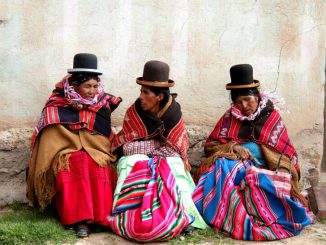
Peru: the uprising of the Cholos

“I am a Cholo and don’t pity me,
those are coins that are worthless
nothing
and that the whites give like those who give
money.
We cholos don’t ask for anything,
because if we lack everything, everything is enough for us”.
Luis Abanto Morales

The seigniorialist coup d’état carried out in Lima against President Castillo once again reveals the fallacy of “democracy” made in the USA, which is what we suffer from as a “democratic system.” Since democracy has been reduced to fetishist institutionalism, democracy itself has been abducted as a discursive guarantee of the defense of the existing order; that is, democracy ceases to be democracy and becomes merely a political convention of the powers that be. In this sense, the people are no longer of interest; that is, the subject of democracy is displaced, and power is emptied of legitimacy, leaving politics as a captive market at the mercy of speculators.

That is why the presence of the people bothers, because it delays business, because the times of capital do not allow for delay or hesitation. That is why gringo mythology has devised an “ideal democracy” to undermine any possible democratization of power; that “democracy” responds to the famous Powell memorandum of 1971, adopted by the Trilateral Commission in its 1975 report, Crisis of democracy, which, in short, says that democracy enters into crisis when the people become protagonists; that is why governance, since then, has been imposed as the only democratic dilemma.

All the hybrid coups we are witnessing, which mislead the unwary because they appear in democratic guise, are part of the repertoire of the new doctrines of imperial geopolitics. The appropriation by dispossession of the democratic discourse by the elites is what has been dislodging the left and cornering it, in the public perception, to the anti-democratic spectrum.

This deserved a thorough and systematic critique of the concept of democracy that the political-academic establishment brandishes, but the Latin American left, disguised as “progressivism”, never did its homework and was content to conform to the hegemonic language that charged the left with all the anathemas that gringo mythology had imposed as a social curse. This inevitably produces early capitulation and even if political power is achieved, the fate of the left is already excommunicated when its only bet is to accommodate, that is, to subordinate itself obediently to accept “rules of the game” that were never democratic and even less popular.

Now that the left of wine and tapas accuses Pedro Castillo of being ignorant, foolish, weak, or innocent, shows its arrogance and does nothing more than portray its stately origins; because that is the same qualification that the right-wing gives to someone who, according to the miserable Lima elite, did not deserve power. If the Peruvian people opted for a professor from the provinces who, in effect, had no political experience, it is because the left itself no longer smells of the people (the usurper Dina Boluarte is proof of this, even Antauro Humala, in the decisive hour, cannot offer any certainty either).

This is the misery of politics thought “from above.” It is the legacy of colonialism and colonization, which the elites suffer above all because they are deformed in the intellectual universe of the dominator (thus taming their revolutionary passions at an early stage).

This is also why “progressive” governments only advocate the preservation of democratic institutionality in the face of a flagrant constitutional violation of that very institutionality. It seemed that they had learned something from the Zelaya, Lugo, Lula, Dilma, Correa, Evo, and now Cristina episodes, but nothing. When coloniality has been subjectivized, that is, naturalized in the social consciousness, the left itself is too obedient to the gringo democratic mythology. That is why they prefer to get along with the powers that be rather than with the people because, ultimately, they do not believe in the people. And that is also why we see their political capitulation reiterated each time. Even their “progressive” intellectuals flaunt their clairvoyance and paternalistic inculpation without ever admitting their clear epistemic limitations (they abound in academic circuses and become famous thanks to our processes, appearing as sacred cows in the media spectrum, dominated by the dictatorship of “fast information”).

Knowing the ungovernability provoked in Peru by the Congress, our governments should have immediately disowned this spurious declaration of “moral incapacity” and the slight dismissal that betrayed, even to common sense, something already obscenely sacramentalized. But the discourse of Latin American unity is only a pretext for lavish “summits” because what we saw is, once again, regional abandonment (abandoning another legitimate president to his fate, as usual, is costing us the minimum consolidation of popular processes).

None of our processes will be able to remain stable under internal subjugation, and this focused threat cannot be confronted only locally. Our governments must realize that internal threats are part of imperial geopolitics in our region and that, under the same script, the purpose is not diluted at the local level but opens up to generalization and the spread of regional chaos. Political perspectives can no longer be confined to localism. As a region, the response to imperial geopolitics can only be regional. Up to now, diplomatic obedience has only served to watch from the sidelines as coups in all their variants take place, afterward being reproduced locally.

In every coup, imperialism does not think locally. In the latest imperial doctrines, regions are the issue. Every particular destabilization has purposes of general irradiation. The righteous oligarchies of the declining empire neither know nor care to know the profound national and regional damage to which they are directing their follies.

But in times of civilizational decadence, sanity is the most absent thing because everything boils down to survival at any cost, and that is what the right-wing shows in politics; that is why they resort to the filthiest tricks because, in addition, they count on the complicity of all the powers, from the judiciary to the media, from the congress to the military, and so on.

In all the years of the “democratic spring,” the “progressive” governments have not generated a minimum policy of containment of the hegemonic power; some have even naively tried to “pact” with them, believing that a revolution can be attempted under oligarchic consent, without knowing that, in this way, they dig their own grave and, more seriously, they risk the popular project that brought them to power.

That project is the one that, as a horizon, opens up in the midst of the void that the left itself manifests in its historical deviation. It has a people that can no longer be summed up in the creeds of the 20th century.

The historical subject is no longer the proletariat because in the social classification that capitalism has produced, the real absent one, the one that has even resignified the language of the left itself, is the subject of change; this is the subject that our processes must empower because it no longer charges the systemic contradictions that modern society has designed for it to make the social, political and economic machinery functional. This absentee no longer seeks inclusion in the system but its radical transformation. That is why it postulates a “world where everyone fits.” Because only from extreme exclusion can a world valid for all be imagined.

This is the one despised by “stately” Lima, the one who cannot be considered an equal, the “cholo”, the “serrano,” the one represented by Castillo, and whom the false democratic tolerance of Lima’s stately society could not tolerate. That is why this elite embraces gringo democracy, because in it they empty and justify all their racist prejudices in the name of the most sacred thing in political language. That is why it is possible to be totally and absurdly democratic while being, in reality, a fascist.

This is not a current gamble but the historical decantation of a tradition that brings us back, once again, to the origin of the matter: the eternal return of conquest, now in the form of democracy. That is why Luis Abanto Morales is still alive in the popular soul: “Wasn’t it the whites who came from Spain/Who gave us death for gold and silver/Wasn’t there a certain Pizarro who killed Atahualpa/After many promises, beautiful and false?”.


Rafael Bautista S. author of: “The Angel of History. Genealogía, ejecución y derrota del golpe. 2018-2020”, “Yo soy si Tú eres” ediciones rafaelcorso@yahoo.com

Source: Redacción Perú

Strugglelalucha256


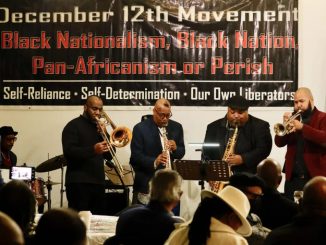
December 12th Movement International Secretariat celebrates 35 years in the struggle

In the People’s Republic of Brooklyn, well-wishers and comrades came out to honor one of the premier movements for self-reliance, self-determination, liberation, reparations, and many of the struggles for Black people in America and in the African Diaspora at The SkyLight Gallery in Bed-Stuy, Brooklyn.

The D12 Movement is a Black human rights organization founded in 1987 on Dec. 12  by five Black Power movement mavericks, Elombe Brath, Sonny Abubadika Carson, Coltrane Chimurenga, and Father Lawrence Lucas, who all returned to the realm of the ancestors, and currently, the longtime Chairperson Viola Plummer, affectionately known as the modern day Mother of the Revolution.

To rousing applause, respect and admiration, Sister Viola spoke of the crucial work they had done over the years. She acknowledged with great love the supporters of over three decades and the standing-room-only attendees at the packed event. After regaling the audience with the  D12 history, she said, “The struggle is about freedom.”

“It is a blessing to be here tonight in honor of the great works that D12 has done over the years,” stated Newark activist and Chairperson of WISOMM (Women In Support of the Million Man March) Frederica Bey. “D12 has been fighting to lift the sanctions on Zimbabwe for a long time. I remember when I was over there in Africa with them, it lifted my spirits to see a country ran by all Africans [Blacks],” she recalled.

The December 12th Movement and secretariat is also a non-governmental organization (NGO) that has sat on panels at the United Nations and in Durban, South Africa, to address political and economical redress, particularly in the form of reparations for the atrocities from the Trans-Atlantic holocaust of slavery.

D12 and its members have been on the frontline to close crack houses, fight to free political prisoners, and remember Minister Malcolm X on the Annual Shut ‘Em Down marches in Harlem. They were also the organizers of the Millions March in Harlem and the Millions Youth March alongside the late Dr. Khalid Muhammad, also in Harlem, N.Y. And led the call for reparations in Washington, D.C., Millions for Reparations Rally.

Comrades from far and near came out to support the movement from Cuba, Africa, New York, and New Jersey, and from a cross-spectrum of clergy, elected officials, activists, and musicians. Minister Akbar Muhammad, International Representative of Min. Louis Farrakhan and the Nation of Islam, called in to honor his long-time comrade and extend congratulatory greetings from the minister.

“We will always speak fondly of my friend Viola Plummer and its members for their work in the National Black United Front with Reverend Herbert Daughtry, and whether it’s fighting to lift sanctions on Cuba, Venezuela, or Zimbabwe, they have been there on the frontline,” stated Councilman Charles Barron. “Even when it comes to electoral politics, Sister Viola and D12 are the reason why we won.

“D12 has been the most consistent revolutionary organization that we ever had,” Barron went on to say. “So when we honor D12, we are honoring the best!”

Another longtime friend, activist, and radio personality Bob Law, who also hosted the 35th Anniversary Celebration, said, “Viola Plummer and D12 is a community-based organization that is committed to the best interests of the community. Over the many decades that they have worked in the community, they have stayed committed not only to our people on the African continent but they are also committed to the welfare of the Black community here in America. “They were part of the leadership to bring justice to Tawana Brawley, Yusef Hawkins, and many other struggles, so they built a legacy to leave behind.”

He added, “I’ve known Viola Plummer for over 40 years, from the days of my Respect Yourself Youth Crusade to the Collective to the forming of D12 with Father Lucas, Coltrane, Elombe, Sonny and Viola, and they always been consistent and leaders with integrity.”

The celebration was filled with musical interludes from The Reggie Woods band led by musical director Ahmad Abdullah.

Source: Amsterdam News

Strugglelalucha256


Jose Maria Sison, founding chair of the Communist Party of the Philippines

From the Philippine Revolution Web Central:

The greatest Filipino of the past century bereaved us peacefully last night.

Prof. Jose Ma. Sison, founding chair of the Communist Party of the Philippines, passed away at around 8:40 p.m. (Philippine time) after two weeks confinement in a hospital in Utrech, The Netherlands. He was 83.

The Filipino proletariat and toiling people grieve the death of their teacher and guiding light.

The entire Communist Party of the Philippines gives the highest possible tribute to its founding chairman, great Marxist-Leninist-Maoist thinker, patriot, internationalist and revolutionary leader.

Even as we mourn, we vow continue to give all our strength and determination to carry the revolution forward guided by the memory and teachings of the people’s beloved Ka Joma.

Let the immortal revolutionary spirit of Ka Joma live on!

December 17, 2022

Tribute of the 2nd Congress to Comrade Jose Ma. Sison

Resolution of the Second Congress of the Communist Party of the Philippines
November 7, 2016

The Second Congress of the Communist Party of the Philippines (CPP) extends its profound appreciation and expresses deepest gratitude to Comrade Jose Ma. Sison for his immense contribution to the Philippine revolution as founding chair of the Party, founder of the New People’s Army and pioneer of the People’s Democratic Government in the Philippines.

Ka Joma is a Marxist-Leninist-Maoist extraordinaire and indefatigable revolutionary fighter. He applied dialectical and historical materialism to expose the fundamental nature of the semicolonial and semifeudal social system in the Philippines. He put forward an incisive class analysis that laid bare the moribund, exploitative and oppressive rule of the big bourgeois compradors and big landlords in collusion with the US imperialists.

He set forth the program for a people’s democratic revolution as immediate preparation for the socialist revolution. He always sets sights on the ultimate goal of communism.

Ka Joma was a revolutionary trailblazer. In his youth, he joined workers federations and helped organize unions. Ka Joma formed the SCAUP (Student Cultural Association of the University of the Philippines) in 1959 to promote national democracy and Marxism-Leninism and wage ideological and cultural struggle against the religio-sectarians and anti-communist forces among the student intellectuals. Together with fellow proletarian revolutionaries, he initiated study meetings to read and discuss Marxist-Leninist classic writings.

Under Ka Joma’s leadership, the SCAUP organized a protest action in March 1961 against the congressional witchhunt of the Committee on Anti-Filipino Activities which targeted UP faculty members accused of writing and publishing Marxist materials in violation of the Anti-Subversion Law. Around 5,000 students joined the first demonstration with an anti-imperialist and anti-feudal character since more than ten years prior. As a consequence, Ka Joma became a target of reactionary violence and survived attempts on his life. Unfazed, he and the SCAUP continued to launch protests against the Laurel-Langley Agreement and the Military Bases Agreement and other issues as land reform and national industrialization, workers rights, civil and political liberties and solidarity with other peoples against US acts of agression up to 1964.

He and other proletarian revolutionaries eventually joined the old merger Socialist and Communist Party in 1961. In recognition of his communist and youthful fervor, he was assigned to head the youth bureau of the old Party and appointed as member of the executive committee. He initiated meetings to study the classic works of Marx, Lenin, Mao and other great communist thinkers which challenged the stale conditions of the old Party.

He founded the Kabataang Makabayan (KM) in November 1964 and led its development as one of the most important youth organizations in Philippine history. As KM chair, and as a young professor and militant, he went on campus tours and spoke before students as well as young professionals to espouse the necessity of waging a national democratic revolution. His speeches compiled in the volume Struggle for National Democracy (SND) served as one of the cornerstones of the national democratic propaganda movement. The KM would eventually be at the head and core of large mass demonstrations during the late 1960s up to the declaration of martial law in 1972.

As one of the leaders of the old party, Ka Joma prepared a political report exposing and repudiating the revisionism and opportunism of the successive Lava leadership as well as the errors of military adventurism and capitulation of the Taruc-Sumulong gang of the old people’s liberation army. The old party had deteriorated as an out-and-out revisionist party.

Despite Ka Joma’s effort, the old party proved to be beyond resuscitation from its revisionist death. Gangsters in the old party would carry out attempts on his life to snuff the revolutionary revival of the Filipino proletariat.

As Amado Guerrero, Ka Joma led the reestablishment of the Communist Party of the Philippines on the theoretical foundations of Marxism-Leninism-Maoism. He prepared the Party constitution, the Program for a People’s Democratic Revolution and the document Rectify Errors and Rebuild the Party and presided over the Congress of Reestablishment held in Alaminos, Pangasinan on December 26, 1968. In 1969, he authored Philippine Society and Revolution which presents the history of the Filipino people, analyzes the semicolonial and semifeudal character of Philippine society and defines the people’s democratic revolution. He prepared the Basic Rules of the New People’s Army and the Declaration of the New People’s Army and directed the Meeting of Red commanders and fighters to found the New People’s Army (NPA) on March 29, 1969.

He led the Party in its early period of growth. He wrote the Organizational Guide and Outline of Reports in April 1971 and the Revolutionary Guide to Land Reform in September 1972 which both served to direct the work of building the mass organizations, organs of political power, units of the people’s army and the Party, as well as in mobilizing the peasants in waging agrarian revolution. He authored the Preliminary Report on Northern Luzon in August 1970 which served as a template in the work of other regional committees.

While directing the development and training of the New People’s Army from its initial base in Central Luzon to the forests of Isabela in Cagayan Valley, he also guided the youth activists in waging mass struggles in Metro Manila against the US-Marcos dictatorship.

Ka Joma was ever on top of the revolutionary upsurge of the students and workers movement in 1970 and 1971. Chants of Amado Guerrero’s name reverberates in Manila and other cities in harmony with calls to join the people’s war in the countryside.

The CPP grew rapidly in its first few years under Ka Joma’s leadership. The Party established itself across the country and led the nationwide advance of the revolutionary armed struggle. He personally supervised the political and military training of Party cadres and NPA commanders in the forested region of Isabela from where they were deployed to other regions.

In 1971, he presided over the Central Committee and presented the Summing-Up Our Experiences After Three Years (1968-1971). He prepared in 1974 the Specific Characteristics of Our People’s War which authoritatively laid out the strategy and tactics for waging people’s war in the Philippines. In 1975, he authored Our Urgent Tasks, containing the Central Committee’s report and program of action. He served as editor-in-chief of Ang Bayan in its first years of publication.

In the underground movement, Ka Joma continued to guide the Party and the NPA in its growth under the brutal fascist martial law regime of dictator Marcos. He issued advisories to underground Party cadres and mass activists. Inspired by the raging people’s war in the countryside, they dared the fascist machinery and carried-out organizing efforts among students and workers.

The first workers’ strike broke out in 1975 preceding the growth of the workers movement. Large student demonstrations against rising school fees and the deterioration of the educational system were carried out from 1977 onwards completely shattering the terror of martial law.

Ka Joma continued to lead the Party in nationwide growth until 1977 when he and his wife Julie were arrested by the wild dogs of the Marcos dictatorship while in transit from one guerrilla zone to another. He was presented by the AFP to Marcos as a trophy. He was detained, subjected to severe torture, put under solitary confinement for more than five years interrupted only by joint confinement with Julie in 1980-1981, and later partial solitary confinement with one or two other political prisoners from 1982-1985.

While in prison, Ka Joma was able to maintain contact with the Party leadership and revolutionary forces outside through clandestine methods of communication. With the collaboration of Ka Julie, lifelong partner and comrade of Ka Joma, they produced important letters and advisories. In 1983, Ka Julie released the article JMS On the Mode of Production which served as a theoretical elucidation and clarification of the nature of the semicolonial and semifeudal social system in order to cast away confusion brought about by claims of industrialization by the US-Marcos dictatorship. It counterattacked claims made by pretenders to socialism who insist that the Philippines had become a developing capitalist country under the fascist dictatorship.

A powerful upsurge of the anti-fascist mass movement followed the assassination of Marcos archrival Benigno Aquino in 1983. This was principally propelled by the workers and student movement which could mount demonstrations of 50,000 or greater from the late 1970s and early 1980s. In 1984, Ka Joma released the paper On the Losing Course of the AFP under the pseudonym Patnubay Liwanag to assess the balance of forces and to signal to or sway the Pentagon to better drop Marcos, which would entail causing a split in the AFP. In September 1984, the Pentagon acceded to the Armacost formula and decided to join the US State Department and other US agencies to drop him. By early 1985 Reagan signed the National Security Directive with definite plan to ease out Marcos.

Ka Joma also asserted the need to weaken the reactionary armed strength in the countryside and expand the people’s army to a critical mass 25,000 rifles and one guerrilla platoon per municipality as constructive criticism of the plan to carry out a “strategic counter-offensive.”

The anti-fascist upsurge culminated in a people’s uprising supported by a military rebellion of elements in the reactionary AFP. The Party’s persevering and solid leadership of the anti-fascist movement and revolutionary armed struggle created favorable conditions that led to the overthrow the US-Marcos dictatorship in 1986. Despite strong opposition by the US and reactionary defense establishment, the Aquino regime was compelled to open the detested gates of the Marcos dungeons allowing Ka Joma to be released.

He wasted no time resuming revolutionary work. In a few months time, he mounted a major lecture series to propound a critical class analysis of the Corazon Aquino regime and expose it as representative of big bourgeois comprador and landlord rule. The series of lectures which later comprised the volume Philippine Crisis and Revolution countered the “political spectrum” analysis of populists which pictured the Aquino regime as a bourgeois liberal regime to goad the revolutionary forces along the path of class collaboration and capitulation.

These populists as well as other charlatans carried out a campaign to undermine the basic analysis of classes and production system in the Philippines to justify the convoluted concept of a strategic counter-offensive wishfully thinking that the people’s war can leapfrog to strategic victory bypassing the probable historical course. A number of key leaders of the Party and revolutionary forces were drawn to the self-destructive path of insurrectionism and premature regularization and military adventurism. This would later bring about grave and almost fatal losses to the Party and the NPA, as well as to the urban mass movement.

Forced to exile in 1987 by the Aquino regime which canceled his passport and travel papers, Ka Joma sought political asylum in The Netherlands while on a lecture tour. He eventually resided in Utrecht and work with other comrades in the international office of the National Democratic Front. Although thousand of miles away from the Philippines, he continued to maintain close contact with the Party leaders in the country and provide advise and guidance to help them in their work.

Ka Joma served as one of the steadfast exponent of the Second Great Rectification Movement launched by the 10th Plenum of the CPP Central Committee in 1992. The Party leadership actively sought Ka Joma’s theoretical insights and analysis. In preparing the key document Reaffirm Our Basic Principles and Rectify Errors, the Party leadership referred to Ka Joma and the Party’s founding documents which he authored. With Ka Joma’s full support, the rectification campaign of 1992-1998 united and strengthened the Party to ever greater heights.

Ka Joma also played a key role in authoring the paper Stand for Socialism Against Modern Revisionism which illuminated the path of socialist revolution during the dark hours of the complete restoration of capitalism in the Soviet Union in 1990 touted in the monopoly bourgeois mass media as the fall of socialism, a refutation of communism, and the “end of history” and final victory of the capitalist system.

Reflecting Ka Joma’s sharp Maoist critique of modern revisionism, the paper presented a clear historical understanding of the process of capitalist restoration in the USSR from 1956 onwards. This served as key to understanding the continuing viability of socialism and to inspiring the Filipino proletariat to persevere in the two-stage revolution and the international proletariat to carry forward the socialist cause.

Ka Joma’s Utrecht base eventually became a political center of the international communist and anti-imperialist resistance movements. He played an important role in the centennial celebration of Mao Zedong in 1993 which served as a vigorous ideological campaign to reaffirm Marxist-Leninist views and to proclaim Maoism as the third epochal development of Marxism-Leninism.

Up to the early 2000s, he also played a lead role in the formation of the International Conference of Marxist-Leninist Parties and Organizations (ICMLPO) which serves as a center for ideological and practical exchange among communist and workers parties which stood for socialism and opposed modern revisionism. He provided valuable insights and practical assistance to numerous communist parties from Asia to Europe and the Americas.

Over the past decade, he has led the International League of People’s Struggles or the ILPS which has served as coordinating center for anti-imperialist movements around the globe. He authored the paper “On imperialist globalization” in 1997 which clarified that the proletariat remains in the era of imperialism and socialist revolution.

Because of his role in guiding the advance of the international anti-imperialist struggle, Ka Joma was put in the crosshairs of US imperialism. He was included in the US list of “foreign terrorists”, together with the CPP and NPA. At 68 years old, he was arrested in 2007 by the Dutch police and detained for more than 15 days.

Since 1992, together with the NDFP Negotiating Panel, Ka Joma has also ably represented the interests of the Filipino people and revolutionary movement in peace negotiations with successive representatives of the Government of the Republic of the Philippines (GRP). He has been appointed as Chief Political Consultant of the NDFP Negotiating Panel and has deftly guided it in negotiations with the GRP over the past 25 years.

Over the past several years, Ka Joma continued to provide invaluable insights into the domestic crisis and the situation of the revolutionary forces. He continues to provide advise to the Party and the revolutionary forces in the Philippines on resolving the problems of advancing the revolution to a new and higher stage.

He has set forth critical analysis of the objective international conditions. He has put forward a Marxist-Leninist critique of the capitalist crisis of overproduction which is at the base of the international financial crisis and the prolonged depression that has wracked the global capitalist system. He has reaffirmed that we are still at the historical epoch of imperialism, the last crisis stage of capitalism.

Ka Joma is the torch bearer of the international communist movement. Through the dark period of capitalist restoration, he has kept the flames of Marxism-Leninism-Maoism burning and inspired the proletariat to take advantage of the crisis of global capitalism, persevere along the path of socialism and communism and bring the international communist revolution to a new chapter of revival and reinvigoration.

Resolutions:

The Second Congress of the Communist Party of the Philippines (CPP) resolves to give the highest honors to Comrade Jose Ma. Sison, great communist thinker, leader, teacher and guide of the Filipino proletariat and torch bearer of the international communist movement.

In recognition of Ka Joma’s immense contribution to the Philippine revolution and the international workers movement, the Second Congress further resolves:
1. to instruct the Central Committee to continue to seek Ka Joma’s insights and advise on various aspects of the Party’s work in the ideological, political and organizational fields.

2. to endorse the five volume writings of Jose Ma. Sison as basic reference and study material of the CPP and to urge the entire Party membership and revolutionary forces to read and study Ka Joma’s writings.

The Second Congress of the Communist Party of the Philippines (CPP) is certain that with the treasure of Marxist-Leninist-Maoist work that Ka Joma has produced over the past five decades of revolutionary practice, the Party is well-equipped in leading the national democratic revolution to greater heights and complete victory in the coming years.


Strugglelalucha256


New York City: People speak out to stop racism, poverty and World War III, Jan. 13

FRIDAY, JANUARY 13, 2023 AT 6 PM – 9 PM
People Speak Out to Stop Racism, Poverty and World War III

at St. Mary’s Episcopal Church, Harlem
521 W 126th St, New York

We need jobs, housing, food & healthcare

NO WAR & SANCTIONS on the people of Russia, Donbass, China, Cuba, Haiti, Zimbabwe, Palestine, Yemen, Philippines, Venezuela, Iran, Syria, Puerto Rico

STOP FUNDING white supremacy from Ukraine to the U.S.

SHUT DOWN NATO, the Pentagon & the CIA

STOP racism, transphobia, union busting, and attacks on women’s rights, LGBTQ+ people and immigrants

SPEAKERS INCLUDE:
– Rev. Annie Chambers, National Welfare Rights Union co-chair & public housing advocate;
– John Parker, Socialist Unity Party, Calif. U.S. Senate Candidate who recently traveled to Donbass;
– Margaret Kimberley, Black Agenda Report executive editor;
– David Clennon, action & activist;
– Melinda Butterfield, Struggle-La Lucha co-editor & author of “U.S. Proxy War in Ukraine & Donbass”;
– Berta Joubert-Ceci, Women In Struggle/Mujeres En Lucha;
– Joe Lombardo, United National Antiwar Coalition national coordinator;
– Omowale Clay, December 12 Movement
– Ellie McCrow, Pratt Workers United organizing committee
(partial list)

SPONSORS INCLUDE: Struggle-La Lucha newspaper; Harriet Tubman Center for Social Justice; Women In Struggle/Mujeres En Lucha; Voices of Resistance; United National Antiwar Coalition; Youth Against War & Racism; Socialist Unity Party; Peoples Power Assembly; Freedom Road Socialist Organization; December 12th Movement; Shut Down the Pentagon & CIA (list in formation)

Info@StopNato.org
Text: 410-218-4836

Strugglelalucha256
https://www.struggle-la-lucha.org/2022/page/3/