Delbert Africa Passes Mon., June 15, 2020

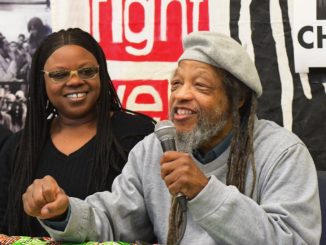
Delbert Africa & daughter, Yvonne Orr-El. Photo: Abdul R. Sulayman

Delbert Africa passed away last night on Monday, June 15, 2020. He was at home with his family around him. Delbert Africa was an early counterpart 42 years before George Floyd. Besides his original, brutal attack by Philadelphia police, Delbert was deliberately killed, methodically assassinated, by officials at the State Correctional Institution – Dallas as part of the government’s plan to get rid of all MOVE men they could get their hands on.

Delbert was receiving care for cancer at the end of his prison sentence at the local hospital. There the doctors and nurses said the prison provided a lot of wrong treatments on Delbert and they couldn’t even understand why the prison did what the doctor and staff did. But, MOVE knows, and Delbert’s supporters know why–it’s murder by prison officials. The same fate that Phil Africa and Merle Africa suffered. The same fate that is occurring to Black men and women all over America by brutal, racist police, and the system they serve.

The MOVE Family
Long Live John Africa Forever!

Source: On A Move

Strugglelalucha256


Now’s the time to join a revolutionary organization fighting for socialism!

[su_row][su_column size=”1/2″ center=”no” class=””]

We all know that something is deadly wrong with this system. Capitalism is failing to meet the basic needs for human survival. If you’re a member of the working class, you don’t need a lecture from us telling you what you already know — especially if you’re Black, Brown, an im/migrant, a woman or LGBTQ2S.

It would be good to know who allows this system to continue to cause massive death and poverty on the continent of Africa, in Yemen, Haiti and Puerto Rico, or to sabotage the economic welfare and threaten war against the people of Latin America. Why do the Democratic and Republican parties, both owned by the financial and industrial monopolies, enable this system to continue denying your parents, your neighbors and your children the right to live without the fear of hunger, homelessness, sickness or the terrorism of racist police? And what is the most effective way to fight back?

Any organization that aspires to make revolutionary change in this country must not only answer those questions, but help communicate those answers to our entire working class.

And in building up the consciousness and independence of the working class, an organization worth joining must also actively help build unity among our class and among our progressive organizations, especially solidarity with the oppressed peoples most acutely affected by this racist capitalist system of war and poverty.

The Socialist Unity Party/Partido de Socialismo Unido is serious about making revolutionary change. That’s why we use the well-tested science of social change, Marxism, to clarify what’s needed in society. It’s this science that helps us realize the overwhelming power of our class to take the reins of production, putting us, the majority, the poor, the unemployed, the gig workers — you and I, not the billionaires and the 1% — in charge of our lives.

It’s no accident that the countries building socialism are the ones that have already stopped the rising tide of COVID-19 infections and are actively helping other countries fight the virus. They can do that because their production is not controlled by the rich, but by their respective working classes. That’s what we need.

But we’re not just about understanding the science of society. Like Marx said, the point is to change it. That’s why you’ll find us in the streets from coast to coast, organizing marches, hosting car caravans, joining our communities in protest, holding educational webinars and meetings, and spreading the word with our publication, Struggle-La Lucha. But with your help, we can accomplish so much more.

So, if you’re looking for a socialist group that is working towards building a revolutionary, united working-class movement in this society, then this is the organization for you.

Fill out the form and let us know when we can reach out to you. Thanks for your interest in our Party.

[/su_column]
[su_column size=”1/2″ center=”no” class=””]

[/su_column][/su_row]

Strugglelalucha256


Los Angeles: LGBTQ2S march in solidarity with Black lives

On June 14, the LGBTQ2S community in Los Angeles chanted and shouted their anger over police racism and violence in solidarity with the Black Lives Matter movement in a huge march. 

Thousands of handmade signs and banners expressed the rage that erupted and continues over the police murders of George Floyd in Minneapolis and Rayshard Brooks in Atlanta, and took up the epidemic violence against Black Trans and Black Queer lives.

The march snaked its way through the heart of Hollywood past the famous sidewalk tributes to movie stars and into the LGBTQ2S city of West Hollywood.

https://www.facebook.com/strugglelalucha/videos/1504030429775054/

Strugglelalucha256


Racism in sports: Drew Brees and whitewashing history

Since late May, oppressed and working-class people across the United States have risen up and rebelled against racism and the brutal police war on Black and Brown communities. From major metropolitan areas like Minneapolis and Washington, D.C., to more rural communities like Evansville, Ind., and Frederick, Md., thousands of people have taken to the streets demanding the end of racist police violence and, in many cases, of the police entirely.

This incredible movement against racism was born from righteous outrage at the police murder of George Floyd. Floyd’s name has become a rallying cry against the racism that is at the heart of the U.S. capitalism system. 

In light of this, the professional sports industry has been forced to revisit the controversy of Colin Kaepernick’s 2016 protest. 

Kaepernick debate renewed

During the 2016-2017 National Football League season, San Francisco 49ers quarterback Colin Kaepernick took a knee during the national anthem at the beginning of every game. This action was a protest against continued racism and police brutality in the U.S. in the wake of the police murders of Mike Brown, Eric Garner and Black and Brown people. Kaepernick was subsequently banned from the NFL.

Since George Floyd’s murder, many athletes and public figures have made public statements about the continued relevance of Kaepernick’s protest. National Basketball Association superstar Lebron James posted a picture of Kaepernick kneeling, juxtaposed with Minneapolis cop Derrick Chauvin pressing his knee onto Floyd’s neck. James asked the world, “Do you understand NOW!!??”

Unfortunately, not every professional athlete was inclined towards justice and anti-racism. In an interview, a Yahoo Finance reporter asked New Orleans Saints Quarterback Drew Brees about the possibility of NFL players renewing kneeling protests in light of Floyd’s murder. Brees’ response was insensitive, pig-headed and racist.  

Brees began his response stating, “I will never agree with anybody disrespecting the flag of the United States of America or our country.” Unfortunately, he didn’t stop there. Brees went on to discuss “what he feels” when he hears the national anthem and sees the U.S. flag. 

At the center of Brees’ opinions were his two grandfathers who served in the U.S. military during World War II. Essentially, Brees argued that no oppressed person should dare protest against the United States because Brees’ white family members “fought for this country.” 

New Orleans a hub of Black culture

There’s something glaring about Brees being the quarterback for the New Orleans Saints. New Orleans is a hub of Black culture and history. For Brees to entirely invalidate the racism and oppression the Black community has faced from the government represented by the U.S. flag and national anthem, while that same community has supported him in New Orleans for over a decade, seems particularly obtuse. 

The question that quickly comes into mind is: Why exactly should oppressed communities in the U.S. respect its flag or anthem at all? 

For hundreds of years, the U.S. and its symbols have been at the center of a global system that does nothing but murder, steal from and repress Black, Brown and Indigenous communities. 

Whether it is the police occupation of Black neighborhoods here or military invasion of oppressed nations abroad, the U.S. ruling class has made its policy of racism abundantly clear. Not to mention chattel slavery, Jim Crow, the reservation system violently imposed upon Indigenous people, Japanese internment, Immigration and Customs Enforcement concentration camps, the racist war on drugs, mass incarceration, etc. 

Fortunately, there was an anti-racist uproar in the sports community against Brees’ statement. NBA star Stephen Jackson, a friend of George Floyd, took to Instagram in support of Saints players who criticized Brees. Jackson spoke plainly: “Bad timing Drew Brees. You play for New Orleans … all those Black people who support you, you need to be more sensitive of the timing … you’re either with us or you’re on the other side.” 

The most powerful response came from New Orleans Saints safety Malcolm Jenkins. Jenkins opened his emotional statement, “Drew Brees, if you don’t understand how hurtful and insensitive your comments are, you are part of the problem.” 

Jenkins continued, saying that it was ridiculous for Brees to expect everyone to have his same values because his white grandfathers fought in World War II. Jenkins directly attacked the insidious assumption at the center of Brees’ rationale, that all communities in the U.S. have the same historical and contemporary experiences. 

Choking back tears, Jenkins continued: “Here we are now with the world on fire, and you continue to criticize how we protest because it doesn’t fit in your beliefs … without ever acknowledging that a man was murdered in front of us all and it has been continuing for centuries. The same brothers you go to battle with every day [on the football field] go home to communities every day that have been decimated.” 

Jenkins’ analysis highlights the racism at the core of Brees’ comments. For the past decade, Drew Brees has made millions of dollars throwing the football to majority Black wide receivers, being protected in the pocket by a majority Black offensive line, and handing the ball to majority Black running backs. 

Sure, Brees is a great quarterback. But he has leaned on the backs of dozens of Black teammates over the years for his success. Yet, in a time of a tremendous countrywide movement against racism, after the brutal police murder of a handcuffed Black man, all Brees can do is spout his reactionary views without stopping to empathize with the Black community. 

World War II, Black soldiers and capitalism

In Brees’ view, any protest against the symbols of a racist government are a direct affront to his grandfathers and other U.S. military veterans. 

The problem with his view is two-pronged. First, Brees misunderstands the historical role of the U.S. military. The Pentagon doesn’t spread freedom and democracy across the globe. It simply sends thousands of workers to fight and kill other workers to increase the coffers of bankers and other capitalists. 

Second, Brees entirely ignores the historical experiences of Black soldiers in the U.S. military. Malcolm Jenkins also tackled this in his poignant response to Brees: “Drew, it shows that you don’t know history. Because when our grandfathers fought for this country, they didn’t come back to a hero’s welcome. They came back and got attacked for wearing their uniforms. They came back to racism and complete violence.” 

Jenkins’ words have great historical weight. In the U.S. there exists a mythology around the white soldier, especially in regards to World War II. The U.S. military often falsely credits itself solely for the defeat of fascism and preservation of “global democracy.” Furthermore, U.S. capitalist society prides itself on “honoring the troops” and “remembering those who served.” But this is almost entirely for propaganda purposes. And it certainly doesn’t apply to soldiers who are Black, Brown, Indigenous or otherwise nationally oppressed. 

The history of racism that Black soldiers experienced before, during and after World War II is well documented. Black soldiers served in segregated units. In the small towns where they trained, usually in the South, they were often denied service by local businesses and were sometimes chased out of establishments. 

Housing, food and equipment for Black soldiers were all of lower quality than that of their white counterparts. Black soldiers were also used as subjects in brutal chemical weapons experiments conducted by the military. 

Once Black soldiers were deployed to Europe and the Pacific, the racism only intensified. 

The case of the 92nd Infantry

A famous example is the case of the 92nd Infantry, which fought against the Italian fascist forces of Benito Mussolini. In a 1987 University of Chicago Press article, Holocaust scholar Robert Kiesling detailed a racist conspiracy by white U.S. Army officers to discredit the 92nd’s combat performance and place the unit in scenarios where it was set up to fail. 

Kiesling details white officers not wanting to “waste their time” with Black soldiers. This meant watered-down training exercises, lack of training manuals and fewer requisitions for needed supplies. Furthermore, white officers higher in the chain of command regularly refused to reinforce the 92nd after it took losses in combat. 

In one case, the 92nd Infantry was ordered to attack a heavily fortified Italian position even though they were completely depleted of machine gunners from their last engagement. The subsequent losses were devastating. 

Time and time again, the members of the 92nd were sent forward as nothing more than human shields. The white commanders used their bodies and fighting spirit to determine the strength of the enemy. Then, better equipped white units would be sent forward to “save the day.” 

Over time, racist propaganda was spread through the military and the U.S., claiming that Black units just weren’t capable of soldiering at the same level as their white counterparts. This campaign of lies was born from the racism at the heart of U.S. capitalism. 

As if this abuse wasn’t enough, Black soldiers had to tolerate the incessant barrage of racist flyers dropped from planes by Italian fascist and German Nazi troops. The message of these pamphlets was pointed and clear. They asked Black soldiers to lay down their weapons and stop fighting for a country with Jim Crow racism. 

Jim Crow policies and lynchings were almost always mentioned. This strategy was certainly not based in actual critiques of racism, considering that the Nazi regime was heavily inspired by the eugenics movement and institutionalized racism in the U.S. What made this strategy so horrifying was the imposition of psychological terror based on real material conditions that the Nazis knew Black soldiers faced back home.

The trials and tribulations of Black soldiers deployed by one racist army to fight against an even more racist army were immense. After experiencing intense racism from white officers and Nazi propaganda, these soldiers returned to a country still hell-bent on the superexploitation of oppressed people under apartheid-like conditions. This is the sort of struggle that Drew Brees fails to even consider.

Upon examination of this history — one all-too-well known by the Black community — Brees’ comments seem only possible through racist ideology. The abusive racism experienced by Black soldiers in the U.S. military is not a secret. Nonetheless, Brees never stopped to consider anything but his narrow view of who he thinks really matters in this country. 

Brees made it clear that he doesn’t care about fighting racism. He doesn’t care about justice for oppressed communities. The only thing that matters to Brees is a comfortable, whitewashed view of history that hides the true nature of U.S. capitalism. 

Enter Trump

Following the righteous outrage of Black athletes, Brees issued a series of apologies for his statements. Brees lamented the insensitivity of his comments and affirmed his commitment to opposing racism. 

Part of Brees’ apology seemed to be a direct response to Malcolm Jenkins. Brees admitted he would never understand what it is like to be Black and to raise Black children, but, nonetheless, he would work to be more empathetic as the country struggles against racism. 

Shortly after Brees’ public apology, President Donald Trump took to Twitter regarding the controversy. Trump stated he respected Brees but was disappointed he retracted the original statements. 

One Trump tweet read: “We should be standing up straight and tall, ideally with a salute, or a hand on heart. There are other things you can protest, but not our Great American Flag — NO KNEELING!” This hard line “America first” attitude is on-brand for Trump, and came on the heels of Trump threatening to unleash the military on anti-racist protestors.

Brees responded directly to Trump on Instagram. His post was framed as an open letter to the president: “We can no longer use the flag to turn people away or distract them from the real issues that face our Black communities. We did this back in 2017, and regretfully, I brought it back with my comments this week. We must stop talking about the flag and shift our attention to the real issues of systemic racial injustice, economic oppression, police brutality, and judicial and prison reform.”

This 180-degree turn by Brees and his public challenge to Trump’s racism is certainly a positive development. However, the sea change has less to do with Brees personally and more so the anti-racist struggle that pushed him in the right direction. 

Brees’ original statements are still racist. Brees’ still deserved the anger from his Black teammates. The political implications of his comments remain relevant and important to analyze. 

With that said, it’s important to acknowledge that his apology and break with Trump demonstrates a victory of the struggle. Several years ago, it would have been unthinkable for a white quarterback to back down from such a defiant display of “patriotism.” 

The fact that Drew Brees changed his tune and challenged Trump shows the immense strength of the working class and its ongoing struggle against racism and capitalism.

Strugglelalucha256


Longshore workers call for strike on Juneteenth

On Friday, June 19, 2020, the International Longshore and Warehouse Union (ILWU) Coast Longshore Division will stop work for eight hours on the first shift in 29 West Coast ports from Bellingham, Wash., to San Diego in observance of Juneteenth. This action follows on the heels of the June 9, 2020, action in which the ILWU Coast Longshore Division stopped work coastwide at 9 a.m. for nine minutes in honor of George Floyd, adding to the chorus of voices protesting police brutality and systematic racism.

Juneteenth commemorates the end of slavery in the United States. On this date in 1865, Black slaves in Texas were told of their emancipation from slavery two years after the Emancipation Proclamation became effective, changing the legal status under federal law of enslaved African Americans in the Confederate states from slave to free. In the 157 years since the Emancipation Proclamation, our nation has made progress but the changes necessary to end systemic racism have come slowly or not at all, as the murder of Mr. Floyd on May 25, 2020, demonstrated.

On June 19, ILWU workers and their local unions up and down the West Coast will take action to reject racism, hate and intolerance at this unprecedented moment in time amid a global pandemic, domestic unrest made worse by a president who sows the seeds of division for his own personal gain and systematic racism laid bare by the recent brutal murder of Mr. Floyd.

As we stop work on Juneteenth, we do so in honor of our African American brothers and sisters and in recognition of the fact that we still have much to achieve as a society in order to carry out the promise of freedom in this country. On Juneteenth, we recommit ourselves to that promise.

Strugglelalucha256


Haiti: We stand in solidarity to demand an end to police terror

Port-au-Prince, May 31 — We strongly denounce the brutal acts of the police against people in the United States who are demonstrating to demand justice for George Floyd, who died tragically at the hands of racist police in Minneapolis on May 25, 2020. We know also that there are many other Black people who 

are victims at the hands of racist police in the United States. This includes:

  1. Breonna Taylor, whom the police in Kentucky killed inside her home.
  2. Ahmaud Arbery in Georgia who was killed by two racist whites connected with the police.
  3. And the list goes on.

The police in Haiti act with the same brutality against the Haitian people, especially when we demand our rights guaranteed by the Constitution. Here are the names of some of the people whom the police in Haiti assassinated in the past several days:

  1. May 30, 2020 — Walking Blanc and another young man were shot by the police at about 8 p.m. in Kazo (Port-au-Prince) because they were in the street during curfew.
  2. May 22, 2020 — Louis, an employee of the Ministry for Social Affairs, shot by the police while on his way to buy milk for his child.
  3. May 16, 2020 — James, a young man on St. Martin Street, shot by a police armored vehicle as he was helping his brother, who had difficulty walking, cross the street.
  4. May 10, 2020 — Two young men killed as a police armored vehicle opened fire on a group of young men on Dechant Street in the area of Pont-Rouge.
  5. We cannot forget Roberto Badio Thelusma, 14 years old. The police shot him in February 2019 as he was helping his mother with her soft drinks business.
  6. And the list goes on.

These crimes were committed just in Port-au-Prince alone. It is the police from the U.S. and Canada that train the police of Haiti.

People in the U.S. have always acted in solidarity with the people of Haiti as we struggle to become a country with full respect for human rights. Today, we follow the history of our ancestors as we stand in solidarity with the people of the U.S., particularly the Black community that is subjected to racist attacks and oppression.

Hand in hand, let us struggle together to eradicate racism and injustice.

Signers below are representatives of peasant organizations:

Potoprens: Jeanette Denis, Oswald Jean
SenMak: Frantz Malherbe, Dorain Pierre
Jeremie: Marie Carmelle Destin, Thony François
Lenbe: Paul Godin, Ignace Celestin
Terye Wouj: Marie Rene Janvier, Paul Desmarais
Jan Rabel: Octavius Pierre, Ronald Jacques
Lazil: Kesnel Solitaire, Justin Sanon
Aken: Sonel Piercin, Marc Evalis
Bene: Jean Marc Leger, Sony Sanon
Belade: Pierre Noel

Source: Haiti Action Committee

Strugglelalucha256


Black socialist leader: ‘Demands must clarify our reality’

These words are inspired by Joe Biden telling us what it is to be Black

You see, not all Black folk look or think alike. And not every organization will have the same political analysis of the events before our eyes. Now, we respect all of those honest organizations that hold different views on how we can go about liberating ourselves, and we respect your right to choose what organizations you believe tell more of the truth as you see it. And we encourage you to find out and participate in the activities of all honest organizations to find what best fits.

So don’t let anyone tell you not to attend a demonstration from any honest organization. No one organization owns the movement, nor any issue. Yes, if it’s a Black issue, then Black organizations should take the lead — but there are more than a few, and just like we don’t all look alike, neither do our organizations. 

I’m a member of the Socialist Unity Party and its Black Caucus, which is a member organization of the National Alliance Against Racist and Political Repression. You’d be surprised at how many Black socialists and communists there are, like George Jackson, a Black Panther and political prisoner who was assassinated by the pigs. I mention George Jackson because we have to begin to truly honor our ancestors by studying them and the people they studied.

In regards to unity, we must get serious and, like Jackson, study Amilcar Cabral, the African communist revolutionary liberator of Guinea Bissau and his skillful guidance for building the unity of the entire working class.

Now, some organizations or church leaders (not all church leaders, mind you) will tell you to denounce or strongly condemn our youth if, in the course of their displays of anger, they happen to vandalize or take back some of the wealth that is stolen from them 24/7 by this capitalist system and the corporations that exploit them.

I and the Black folks I associate with believe that the vandalism and so-called looting are created by conditions that these youth did not create. See, the rebellion that oppression inspires is not going to always look pretty, but it carries a message of warning to the powers that be, an essential message that has the power to push them back. The monopoly corporations that run this country and own the politicians like Trump and Biden are afraid of those rebellions because it challenges their right to rule over us.

When the four cops finally got charged — was that from us begging? No, it happened after a Minneapolis police precinct got burned to the ground.

Disarm the police

So I’m not one of those Black leaders who condemn our youth because their messages or actions may not be perfect. I and the Black folk I associate with applaud them and will do everything we can to amplify their message and give them a platform and guide them as well toward a revolutionary direction that is not confined by the ideological limitations that this system dictates.

There are some organizations that are happy to replace one treacherous Black official cop with another cop, or are happy to hug or kneel with or include pigs in their actions, or make demands that are so weak they can easily be wiggled out of.

I and the Black organizations I associate with don’t want demands that give Los Angeles Mayor Garcetti — who praises the attack dogs in blue he sics on us — too much wiggle room. Because when the politicians have too much wiggle room, they use it to wiggle a noose around our necks. 

There’s a shell game going on right now with Garcetti’s budget. See, he knows in this moment he’ll need to give an appearance of compromise, so he’s already figured out the small pittance he’ll give away that still allows business as usual. A couple hundred million dollars from a $2 billion or more budget is nothing, because it leaves plenty of money for the purchase of the bullet that is aimed at my son’s head, or your daughter’s.

This is an existential threat — this is life and death and the only way to stop that bullet from killing my son or your daughter is to take their damn guns away. So, when we say “Defund the police,” we must include the demand to disarm the police immediately. Maybe there needs to be more emphasis on the gun because, yes, we should also defund the police, but that demand alone leaves them holding guns. Too much wiggle room for me.

Study like George Jackson did

See, we have to get serious and study like George Jackson did. 

Know who else George Jackson studied when he wanted to understand the nature of the police in this country? He studied Lenin, the leader of the Russian Revolution. Lenin understood that capitalism and its superrich monopolies that run things cannot survive without the police protecting the wealth they stole from you and me. To keep us from protesting that theft against us, police are used to keep us in fear as they push us further into poverty.

That right arm of capitalism — the police — will never be negotiated or voted away as long as capitalism exists, unless the ruling class is forced to disband them by a mightier force than their cops and military. 

We have the potential to become that force. Not by begging or playing within their rules, but by building the understanding of what’s needed and doing the things that make their system come to a halt.

When we study history and social science in a serious way, as George Jackson did, we’ll understand that demands must clarify what is actually needed to the people. We also need to understand that our Black, Brown and Indigenous communities must have the right to banish these pigs from our neighborhoods and the right to the resources to train and develop our own community entities of safety and protection.

We are in a war — a war from an oppressor that is attempting genocide against us. And when you are fighting genocide, you can’t play nice. You gotta scrap, you gotta bite, you gotta do whatever is necessary and use any means to get that knee off your neck. That’s the kind of Black revolutionary I am. What kind of revolutionary are you?

If you’re the kind I think you are, then maybe we should talk. Maybe you should talk to the organizations with demands that are clear about what’s needed. Get in touch so we can build that mighty force whose aim is to build a better world and take down this genocidal system.

Strugglelalucha256


Thousands in Baltimore march against racist police system

On Saturday, June 6, the Peoples Power Assembly led a demonstration in Baltimore demanding justice for George Floyd and the abolition of the Baltimore Police Department. Other demands included not one more dollar for the police and complete community control. 

Approximately 8,000 people marched through the city, followed by over 200 cars. Marchers started outside the Harriet Tubman Solidarity Center on North Charles Street. 

The demonstration’s first stop was the Baltimore City Jail complex. As marchers chanting “Free them all!” approached, hundreds of prisoners could be heard chanting back “Black lives matter!” and “Thank you.”  This demonstration is one of several to visit the jail complex in the last two months as local organizers have demanded universal testing and full personal protective equipment (PPE) for all prisoners. 

From the jail complex, the march traveled east to the Douglas Homes public housing development. The Rev. Annie Chambers, a PPA organizer and former Black Panther, has been holding free food giveaways to the residents there since the beginning of the pandemic. Demonstrators wanted to show solidarity with the residents of Douglas Homes, who find their homes a target for sale to and redevelopment by wealthy Johns Hopkins University. 

Next, the march traveled to the Baltimore City Police Headquarters. Marchers shouted “No justice, no peace! No racist police!” and “Money for jobs and education, not for police occupation!” 

The march culminated at the Maryland National Guard 5th Regiment Armory. Marchers chose this location to conclude because of Maryland Gov. Larry Hogan’s plans to send the Maryland National Guard to illegally occupy Washington, D.C. 

Speakers from the Ujima People’s Progress Party and the Socialist Unity Party gave talks denouncing imperialism. This included a powerful message from UPP organizer Brandon Walker, who argued that one cannot be anti-racist without being anti-imperialist. 

Socialist Unity Party national spokesperson Sharon Black talked about how the acts of war by the U.S. against countries like Syria and Venezuela are echoed in police violence against oppressed communities in the U.S.

https://www.facebook.com/PeoplesPowerAssembly/videos/606139380000723/

Strugglelalucha256


From a high school activist: Getting radical during George Floyd protests

My name is Ripley, and I’m a tenth grade student from Brooklyn. For the past few months, I’ve been reflecting a lot on my political and activist identity, something I neglected for years. As a younger kid, I went to dozens of protests with my dad. I wasn’t unaware in doing so — I knew that I was supporting people similar and different to me, those of varied race, religion, ability, sexual orientation, gender identity and so on. I understood that police were bad, and were constantly hurting Black people. I held up signs and banners, posed for many photos and did my best to chant along with the crowd. Although I didn’t completely know what certain terms I saw meant, like “communism,” “socialism” and “anti-imperialism,” the importance of my participation in things like worker’s rights protests was not lost on me.

I began to stop attending these events when I was a pre-teen.  At first, it just felt good to exercise some choice in the matter. I was old enough to watch myself for a few hours while my dad was at a demonstration, and it was a Saturday. Why go? This repeated again and again, and eventually I was more passionate about my right to refuse to participate in protests than any sort of activist work. It wasn’t that I didn’t care about social issues, rather I felt disconnected from them. I think, weirdly enough, it felt like “rebellion” to not fight injustice and oppression, having been raised by a parent who always encouraged me to do so. Thankfully, my thinking has changed a lot since middle school. 

In the past year or so, I’ve started reading revolutionary works on my own and questioning the systems that public education teaches us to accept. I went to the highly publicized climate march in September 2019, along with many other high school students. It wasn’t a great experience for me. The entire ordeal felt performative, and staged. I kept wondering, as wealthy white students were photographed and interviewed around me, where were these activists during events protesting U.S. invasions of other nations? Or inhumane treatment of refugees? The image of an attractive white teen holding a sign that says “Save our earth” is palatable to most media, I suppose.

I have since developed a strong passion for the movement to liberate oppressed people, especially Black people. Like most teens, my identity has been a source of confusion, contention and pride, all at the same time. In understanding myself as a biracial Black lesbian, I have to fight for my voice to be heard, while considering the privileges I have. I need to defend myself in homophobic spaces and contexts, and in white or anti-Black ones. Yet, in fighting oppression it’s imperative that I step down and listen to Black people who are impacted by colorism. I am mixed, with lighter skin, and that makes my abuse in this oppressive system much less violent than dark-skinned Black people who are not of mixed descent. I also need to listen to Black trans people and be aware of my privilege as a cis person. Admitting this isn’t enough: what do these actions entail for me? How do I constantly ensure I am centering the people in my community who are the least privileged? These questions have fueled my devotion to fight the racism that permeates the entire institution of the United States.

Of course, COVID-19 had smothered any opportunity to attend physical protests. I spent a good chunk of time in “quarantine” thinking about all the demonstrations I’d attend once it was all over. Or so I thought. Then, the video of George Floyd’s murder exploded onto the internet.

An innocent Black man was killed by a white police officer in Minneapolis. The ordeal, lacking the slightest bit of humanity, was inescapable to even the least “political” figures online. It was there, in recorded, shareable proof.

I’m very angry that the death of a Black person at the hands of a racist cop is only this moving, or worth speaking about, when a graphic video is available. The internet was aware of Breonna Taylor’s murder in Louisville, Ky., two months prior, yet seemed to move on quickly. I’m also frustrated that everyone’s initial reaction was to retweet, post, direct message and generally spread this video. It is quite frankly traumatic for Black people to watch Black people die, over and over, for being Black. I don’t think that should require further explanation. I wholeheartedly believe that Black people in the U.S. are collectively being traumatized and re-traumatized by the racism we are forced to endure in all walks of life: at schools, in the workplace, in public spaces, online, and by our government and law enforcement officials. The video evidence of George Floyd’s killing is just a particularly striking example. 

On the other hand, I am glad that the murder was filmed: without the video, people in privileged positions would not have cared enough to contribute to the movement that is taking place. It is shameful that so many non-Black people needed to watch a cop kneel on George Floyd’s neck for almost nine minutes in order to do so, but action is needed. Large scale protests began to occur, and while the rebellions in Minnesota polarized the topic (and became a frequent subject of demonization by the media),  there seems to be overwhelming support for the movement. I’ve witnessed apolitical students start to express hatred towards police, and calls for defunding and abolition over reform are growing louder and louder.

I felt strongly that I should participate in my city’s protests. On Saturday, May 30, I went to two: first, a rally in Harlem. The initial gathering, which happened on 125th Street, was kind of off-putting to me. Speakers made repeated references to “Black on Black crime” and the importance of keeping all protests peaceful. At one point, a speaker said, “It is one thing to march, but it is another thing to vote.” The constant emphasis on voting as a primary means of progress made me uncomfortable — it seemed to diminish the work of protesters within an event full of them.

It called to mind tone-deaf celebrity posts that have been circulating lately. Taylor Swift recently tweeted, “After stoking the fires of white supremacy and racism your entire presidency, you have the nerve to feign moral superiority before threatening violence? ‘When the looting starts the shooting starts’??? We will vote you out in November @realdonaldtrump.” Her statement was applauded among many for its apparent support of protesters. A number of news outlets even reported about this tweet — now her most liked. I found it a bit infuriating: why do white liberals focus on Trump as if he is the root cause of U.S. racism? Why are they celebrated for denouncing only this easy target? 

Making a vow to not re-elect the current president means nothing. The only reason Donald Trump angers Democrats is because he relies on shock value. He is virulently, loudly anti-Black, and it makes liberals feel that same “moral superiority” for keeping their prejudice mostly hidden. It is worth mentioning that President Barack Obama, who Taylor Swift supported in 2008, deployed the National Guard into Ferguson, Mo., to brutalize protesters after the murder of Michael Brown by a cop. He also supported the grand jury’s decision to not charge Brown’s killer. Still, public figures hearken back to his time in office, claiming that things would be better if only Trump was not in the White House.

As I stood in the crowd with my sign, I and other younger attendees awkwardly shuffled when questionable statements echoed across the sidewalk. The rally started to wrap up after about an hour and a half after my arrival, and because I was unsure as to where nearby groups were marching, I left. I decided to go straight to the protest on Parkside and Ocean avenues in Flatbush, Brooklyn. 

I walked out of the train station and into a huge crowd of protestors. The group spilled across multiple streets and into Prospect Park. There were a good number of people attending from their fire escapes across the street, too. I should also mention that every person I saw was wearing a mask to cover their mouth and nose, except for police. Ahead of me, comrades took turns standing on a makeshift podium and addressed the thousands of protestors. The speakers were all wonderful and came from a variety of backgrounds, but one impacted me especially. I wish I remembered her name — a young woman who introduced herself as a Brooklyn high schooler. She went on to explain the countless ways she and other students of color had been racially profiled. Her voice faltered with emotion as she denounced killer cops, and demanded justice for George Floyd, Breonna Taylor, Tony McDade and others. The frustration and anger she spoke with resonated with me deeply.

Sometimes, there is such a disconnect I feel when listening to the words of older white male activists. It often feels like those people, often the most outspoken and respected of radical leftists, are concerned most with concepts and combating oppression solely because it threatens their political theories. I think organized action is crucial, and I admit that I have a lot of reading to do, as I have limited knowledge in this realm. Even so, there will never be anything more powerful to me than the words of young Black and Brown women. The thoughts of oppressed people are strong, they are honest, they are based upon experience and pain. And yet, so often these voices aren’t valued to the same extent as white scholars of socioeconomics. 

The young woman declared in no uncertain terms that the only way to achieve universal justice is to liberate the oppressed and unite for the struggles of the working class. I was biting my lip a little bit when she announced that a communist society was necessary, because many white protesters in attendance appeared to be of a certain liberal-hipster-gentrifying type. I was afraid that this person, who I identified with and admired so strongly, would be met with angry shouts. Instead, there was immense support amongst the protesters. I felt, in that moment, so much hope for the broader movement towards liberation. Others had great speeches too: one highlighted the need to center and protect Black women and LGBTQ+ identifying Black people. A group of three young Black women led the crowd in chanting a quote from Assata Shakur. “It is our duty to fight for our freedom! It is our duty to win! We must love each other and support each other! We have nothing to lose but our chains!” and so on. We repeated this again and again, louder and stronger each time.

While standing on that street corner, I could see a group of police officers standing on top of a building opposite me. This was no shock. However, someone near me motioned to the crowd to look up — the cops were flying a drone just above our heads. It shouldn’t have been so startling considering the amount of surveillance the NYPD conducts on a day-to-day basis in New York, when protests aren’t even occurring. I still felt deeply unsettled knowing I was being watched so closely.

As we started to march down Parkside Avenue, thousands chanted “No justice, no peace! Fuck these racist-ass police!” Many protesters offered food and water, as well as personal protective equipment (PPE) to those who needed it. As we moved along, local residents of Flatbush showed support from their cars and the sidewalks. A bus driver in a stalled B41 bus, who was a Black woman, honked the horn in time with our chants and raised her fist. The group erupted in cheers and applause at this and other acts of solidarity.

The protesting experience was one unlike any I can remember. Tips I had read online in activist resources really came into play — staying tight at corners, moving quickly and confidently, and avoiding police interaction at all costs. The cops were running alongside us in groups of five or six, rushing to barricade every cross street they could. A lot of younger protesters seemed to get very nervous watching them act so ferociously, but the organizers did a good job keeping everyone moving. At intersections, white demonstrators formed human chains to create a barrier between officers in riot gear and the main body of protesters, who were mostly Black and Brown youth. 

I marched a little over an hour. In that time we dominated many major streets in addition to Parkside Avenue: Flatbush, Church and Bedford avenues are just a few. I didn’t witness any major conflict between police and protesters until I was leaving. By that time, they had managed to separate the march into three or four different groups, and it seemed as though each was starting to be cornered. 

I was a bit anxious heading home alone. I kept finding myself on blocks lined with police cars and helicopters seemed to be approaching from all directions. I passed by a bloodied protester being treated by street medics, and later stumbled upon a blockaded group on a residential block. I had to stop and watch for a moment — dozens and dozens of police cars sped onto this street and stopped in a frighteningly militant formation. Officers wielding batons and shields were sprinting out of their vehicles and towards the demonstrators, who were standing and chanting the names of police brutality victims. A helicopter lowered itself until it was practically touching the people protesting, causing dangerous whirlwinds and flying dirt. The group held strong, though. I would have joined in resistance if my parents weren’t urging me to go home.

This was all before 6:30 p.m. I found out later that evening that violent arrests started very soon after my departure. This march was also the one in which two NYPD SUVs ran straight into a crowd of protesters. Video footage of that awful moment has been seen across the world at this point. Clearly, the NYPD and all of the other police departments in the United States do not exist to “protect and serve” the people. They are actively harming and killing oppressed communities.

I’m so glad that I attended these recent protests. I will no doubt go to many more in the future. Anything I can contribute to the dismantling of the police state, and of every single racist institution that makes up this country, is worth doing.

Strugglelalucha256


Los Angeles: Caravan Against Police Terror draws community support

Los Angeles — The recent death of George Floyd due to police brutality has caused a lot of people to unite through this very heartbreaking and difficult situation. It’s not the first time this has happened, and the people want change. People want justice — not only for Floyd, but also for the many others who have lost their lives due to inhumane police officers. 

On Sunday, June 7, a “Community Caravan Against Police Terrorism” was held. The caravan was hosted by Unión del Barrio and co-hosted by Struggle-La Lucha, the Harriet Tubman Center for Social Justice, Witness for Peace Southwest, the Socialist Unity Party, the Human Rights Alliance for Child Refugees and Families, and Frente Indígena de Organizaciones. In addition, over 40 organizations endorsed. 

Hundreds of vehicles joined the historic protest caravan.

Honoring Bunchy Carter

We started at Woodlawn Cemetery in Compton, where Black Panther Party leader Bunchy Carter, a victim of the U.S. government’s Cointelpro program, is buried. Former Black Panther Harold Welton gave a speech. There were news reporters and other people recorded and shared the commemoration on social media.

The commemoration began with remarks from Celestinia Bishop, who leads volunteer efforts at the cemetery to clean a peoples’ landmark where Black slaves were also buried. Her grandmother, grandfather and other close relatives were buried in the cemetery. 

She spoke about how she and her family have been affected by police terror. Her son, who has disabilities, saw the latest videos on police brutality and now has fear of cops, whom he thought were heroes at first. Bishop also stated, “If we were to cut each other, we all would bleed the same.”

Before the caravan left the cemetery, I interviewed another of the volunteers who participated in the caravan. She said: “I want to support the community. To live with respect from the people who should be protecting us. I am indignant seeing these things happen to people from our communities. I came today to support this caravan because I don’t want this to keep happening to our future generations. 

“I want this to change people’s views,” she continued, “and this time change the world and have a peaceful life,” referring to the changes she would like to see happen in the communities. She also expressed that she would like more respect from those who are called “hero cops.” She doesn’t want her grandkids to grow up with the fear she grew up with.

‘The problem is the system’

The caravan started moving around 12:30 p.m., driving through Compton up to Watts. Moving through these neighborhoods, we saw many people outside their homes supporting the caravan. Some held posters while others just watched and recorded from a distance. 

From Watts, the caravan moved all the way through Los Angeles along Central Avenue to the Los Angeles Police Department headquarters. We got to City Hall around 3:40 p.m., where another protest was already going on. 

There, one of the hosts of the protest said, “We speak the power, we are here today protesting because you all want the power to speak,” referring to how the people want to be heard, especially with injustice that happens on a daily basis. 

“The problem isn’t our skin color. The problem is how the system has created stereotypes for people of color. This, today, is how the U.S. should be: people being united.”

The U.S. has never been great. It has always had wars, racism, stereotypes, violence and corruption amongst the people. The people should be united, but for too long the system has put fear into people to unite when it comes to any type of situation. 

Now things are starting to change.

Dulce Garcia (writer) and Benie Ramos (photographer) are journalists, high school students and activists who helped organize the caravan.


https://www.facebook.com/strugglelalucha/videos/905376449960451/

Talks by Unión del Barrio’s Ron Gochez and Struggle-La Lucha’s Rebecka Jackson-Moesser during June 7 caravan.

Strugglelalucha256
https://www.struggle-la-lucha.org/2020/06/page/5/