It’s about making trans people unemployable

Trans

By now, you may have seen the story making the rounds. It’s about a University of Oklahoma student named Samantha Fulnecky who received a zero on a psychology essay, filed a discrimination complaint, and got her trans graduate instructor placed on administrative leave. Conservative media have framed this as religious persecution: a brave Christian student punished for citing the Bible. The governor of Oklahoma has weighed in. Libs of TikTok has amplified it to hundreds of thousands of people. Turning Point USA is demanding that the instructor be fired.

But if you actually read the essay — which TPUSA helpfully published — you’ll find something different than what’s being advertised.

The assignment asked students to write a 650-word reaction paper responding to an article about “Gender Typicality, Peer Relations, and Mental Health.” The rubric was straightforward: 10 points for showing a clear tie to the assigned article, 10 points for providing a thoughtful reaction rather than a summary, and 5 points for clarity of writing. Students were given suggested approaches like discussing whether the topic was worthy of study, applying the findings to their own experiences, or offering alternate interpretations of the researchers’ conclusions.

Fulnecky’s essay mentions the article exactly once: “The article discussed peers using teasing as a way to enforce gender norms.” That’s it. The remaining words are a sermon about what God wants for gender roles, culminating in the claim that “society pushing the lie that there are multiple genders and everyone should be whatever they want to be is demonic and severely harms American youth.”

She also calls her classmates “cowardly” for not sharing her views.

This is not a good essay. Not because of the religious content — you can absolutely bring religious perspectives into academic work — but because she just. … didn’t do the assignment. A reaction paper is supposed to react to something. Fulnecky barely acknowledged the source material existed before launching into a position statement that would have worked just as well (or poorly) for any article tangentially related to gender.

The graduate instructor, Mel Curth, gave remarkably patient feedback. “Please note that I am not deducting points because you have certain beliefs,” Curth wrote, “but instead I am deducting point[s] for you posting a reaction paper that does not answer the questions for this assignment, contradicts itself, heavily uses personal ideology over empirical evidence in a scientific class, and is at times offensive.”

Curth explicitly told Fulnecky that it’s “perfectly fine to believe” normative gender roles are beneficial. The problem was the logical contradictions (arguing people aren’t pressured into gender roles while simultaneously arguing religious pressure to conform is good), the lack of engagement with actual course material, and, yes, calling a group of people “demonic” in an academic paper.

“I encourage all students to question or challenge the course material with other empirical findings or testable hypotheses,” Curth wrote, “but using your own personal beliefs to argue against the findings of not only this article, but the findings of countless articles across psychology, biology, sociology, etc. is not best practice.”

Another instructor, Megan Waldron, who teaches a different section of the same course, backed the grade. She found it “concerning” that Fulnecky didn’t view bullying or teasing as a bad thing, and noted that “your paper directly and harshly criticizes your peers and their opinions.”

None of this matters to the people amplifying this story. The essay is a prop. The point is that Curth is trans.

The quiet part out loud 

Fulnecky’s mother, Kristi Fulnecky, a lawyer who defended a number of Jan. 6 rioters, has been busy on social media. She’s been retweeting posts that say things like “If you claim to be a transgender — you should be banned from working in any school. Transgenderism is a mental illness,” and “Individuals who identify as trans should be automatically disqualified from holding any position as teacher or professor.”

To that last one — a post explicitly calling for employment discrimination against all trans people — Kristi Fulnecky replied: “Agreed! Proud of my daughter!”

This is the tell. The family isn’t arguing that this particular grading decision was wrong. They’re celebrating their daughter’s role in a broader campaign to make trans people unemployable. The discrimination complaint, the media tour, the outrage — it’s all in service of the goal stated plainly in the posts Kristi Fulnecky is boosting: Trans people should not be allowed to work in education.

Chloe Cole, a detransitioner who’s built a lucrative career as an anti-trans activist, demanded that the university be defunded until Curth is fired. TPUSA’s post about the incident included the line: “We should not be letting mentally ill professors around students.”

The playbook here is familiar. Find a trans person in a position of minor institutional authority. Manufacture or amplify a confrontation. Blast it through the conservative media ecosystem until it becomes national news. Watch as institutions capitulate.

It works. Curth — who, by the way, had reportedly just received an Outstanding Graduate Teaching Award from OU’s Department of Psychology — is now on administrative leave. The university’s statement emphasized its commitment to “protecting every student’s right to express sincerely held religious beliefs,” which is a fascinating way to describe giving a bad grade to a bad essay.

The targeting system

The throughline in all of these cases is Libs of TikTok, an account run by Chaya Raichik that has become a kind of targeting system for the anti-trans movement. Raichik reposts content from LGBTQ people and their allies, often with mocking commentary, and her millions of followers do the rest.

Schools, children’s hospitals, and libraries featured on the account have reported receiving bomb threats. Teachers have resigned or been fired. Medical providers have faced death threats. The pattern is consistent enough that critics have called Raichik a “stochastic terrorist” — someone who publicly demonizes people in ways that predictably inspire supporters to commit violence, while maintaining plausible deniability about any specific act.

The case studies are piling up.

Remember Dylan Mulvaney? In April 2023, she posted a single sponsored Instagram video featuring a personalized Bud Light can. That was it. That was the whole controversy — a trans woman appeared in a beer ad. … to her own audience. The resulting harassment campaign left her scared to leave her house, ridiculed in public, and followed. Kid Rock filmed himself shooting cases of Bud Light with a rifle. The company’s sales tanked, and Bud Light never publicly stood by her.

“For a company to hire a trans person and then not publicly stand by them is worse, in my opinion, than not hiring a trans person at all,” Mulvaney said. “It gives customers permission to be as transphobic and hateful as they want.”

Or take what happened at Texas A&M just a few months ago. In September, a Republican state representative named Brian Harrison posted a 23-part social media thread with the headline: “CAUGHT ON TAPE. TEXAS A&M STUDENT KICKED OUT OF CLASS AFTER OBJECTING TO TRANSGENDER INDOCTRINATION.” The post got millions of views. Within days, the professor — Melissa McCoul, who had taught the same children’s literature course at A&M at least 12 times since 2018 — was fired. The dean and department head were removed from their positions. And then the university president resigned.

A faculty committee later unanimously ruled that “the summary dismissal of Dr. McCoul was not justified” and that the university failed to follow proper procedures. But by then the damage was done. The message had been sent.

This is Oklahoma

It’s worth noting that this is all happening in Oklahoma, a state that has become something of a laboratory for anti-trans policy. Governor Kevin Stitt has signed bills barring trans students from using bathrooms consistent with their gender identity, banning gender-affirming care for minors, prohibiting nonbinary gender markers on IDs, and blocking trans girls from girls’ sports.

In January 2024, the state’s then-Superintendent of Public Instruction, Ryan Walters, appointed Raichik, who has no connection to the state and does not live there, to the Oklahoma Department of Education’s Library Media Advisory Committee — giving the person behind Libs of TikTok an official role in deciding what books Oklahoma students can read.

A month later, a 16-year-old nonbinary student named Nex Benedict died. Just one day after being beaten in a school bathroom at Owasso High School — the same district where, in 2022, a teacher “greatly admired” by Nex had resigned after being targeted by a Libs of TikTok post. According to Nex’s mother, the bullying had started after Stitt signed the bathroom bill.

Nex’s death was ultimately ruled a suicide. The climate in which Nex lived — a climate shaped by the very people now celebrating Samantha Fulnecky as a “warrior of Christ” — is not incidental to this story.

What this is actually about 

There’s a reason Riley Gaines, a middling college swimmer who once tied for fifth place in an NCAA championship, now has a full-time career as an anti-trans activist with a nonprofit, speaking fees, and congressional testimony.

In 2023, the Leadership Institute — a nearly 50-year-old nonprofit that trains conservative activists and counts Mitch McConnell and Mike Pence among its alumni — launched the Riley Gaines Center with the goal of “protecting women’s sports.” The organization is funded by the Charles Koch Foundation and serves as a member of Project 2025’s advisory board. The Dick & Betsy DeVos Family Foundation donated $100,000 to the center in 2023. In the first five months of its existence, the Leadership Institute paid Gaines more than $126,000 as director.

She now has a podcast on Fox Nation, a merchandise line, two book deals, and has testified in or appeared with politicians in at least 21 states. Ron DeSantis’s presidential campaign paid her nearly $12,000 for travel and consulting. She stood next to Donald Trump when he signed his executive order banning trans women from sports. This is what a fifth-place finish buys you if you’re willing to make hating trans people your full-time job.

And it’s not just Gaines. The infrastructure is growing. The Independent Council on Women’s Sports (ICONS), a nonprofit that describes itself as “not political,” went from about $100,000 in revenue in 2022 to over $1 million by 2024. ICONS is now funding three major lawsuits against the NCAA, arguing that trans athletes should be banned from women’s sports entirely. Chloe Cole, the 20-year-old detransitioner who demanded OU defund itself over the Fulnecky essay, testified in court that she earns upwards of $200,000 annually for opposing gender-affirming care — money that flows through speaking engagements, donations, and her employment with the far-right organization Do No Harm.

This is an industry now. There are jobs, salaries, speaker bureaus, and career tracks. The right is always looking for new faces to put on this movement — young, photogenic people who can be positioned as victims of trans overreach. The detransitioner who regrets her surgery. The swimmer who tied with a trans woman. The Christian student whose essay got a bad grade.

Samantha Fulnecky fits the profile. She’s a college student. She’s Christian. She wrote about her faith and got a bad grade from a trans instructor. It doesn’t matter that the essay was genuinely bad, that two instructors agreed on the assessment, that the feedback was professional and patient, or that the grading rubric supports the decision. The narrative writes itself: trans professor fails Christian student for quoting the Bible.

What Fulnecky’s mother is saying out loud — that trans people shouldn’t be allowed to teach at all — is what this movement actually wants. The individual controversies are just vehicles to get there. Each one is designed to make an example of a trans person, to signal to every other trans person in education or health care or any public-facing role: This could happen to you. Keep your head down. Better yet, leave.

The next one

Here’s what’s going to happen next.

Somewhere, right now, a trans person is teaching a class, or coaching a team, or working at a library, or providing health care. They’re doing their job. They’re probably good at it. And at some point, someone is going to have a problem with them. Maybe a parent, maybe a student, maybe a coworker. The problem won’t really be about job performance. The problem will be that they’re trans.

That person, or someone connected to them, will take their grievance to social media. If they’re lucky, Libs of TikTok will pick it up. Or Turning Point. Or one of the other accounts that have built massive followings by turning trans people into content. The post will frame the trans person as a predator, or a groomer, or a bully, or a tyrant. It won’t matter what actually happened. The framing is the point.

Then the calls will start. To the school board, to the administration, to the HR department. Local news will cover the “controversy.” A state legislator will demand an investigation. The institution, desperate to make the problem go away, will put the trans person on leave. Maybe they’ll be fired outright. Maybe they’ll resign because the harassment makes it impossible to do their job. Either way, they’re gone.

And then the person who started it all will go on Fox News. They’ll get a GoFundMe. Maybe a speaking gig at a conservative conference. If the story is big enough, if it goes viral enough, they might get something more. A podcast. A book deal. A center with their name on it.

This is not a guess. This is a pattern. We’ve watched it happen over and over again, and we will keep watching it happen until the institutions that capitulate to these campaigns start recognizing them for what they are: coordinated attempts to purge trans people from public life, dressed up as individual controversies.

Oklahoma University had a choice. They could have looked at the essay, looked at the rubric, looked at the feedback, and said: this grade was justified. They could have noted that two instructors independently reached the same conclusion. They could have pointed out that Curth had just won a teaching award. They could have said, simply, that they don’t put instructors on leave for doing their jobs.

Instead, they folded. They issued a statement about protecting religious expression, as if the issue were ever about that. They gave the machine exactly what it wanted: another trans person removed from a position of authority, another signal sent to every other trans person watching.

The next time this happens, and there will be a next time, the institution will face the same choice. Most of them will make the same decision Oklahoma did. They’ll calculate that the cost of standing firm is higher than the cost of sacrificing one employee. They’ll tell themselves it’s just one case, one person, one controversy. They won’t see, or won’t admit, that each capitulation makes the next one easier.

Mel Curth did nothing wrong. They graded a bad essay honestly and gave thoughtful feedback that any reasonable educator would recognize as fair. For that, she’s on administrative leave, her name is circulating through right-wing media as the latest villain, and her career may never recover.

The essay isn’t the point. Curth is the point. And the point after Curth will be someone else — another trans teacher, another trans health care provider, another trans person who made the mistake of existing in public while the machine was looking for a new target.

That’s what this has always been about.

Parker Molloy is the writer of The Present Age newsletter.


Strugglelalucha256


Cuban trans activist says LGBTQI+ people in the U.S. and Cuba must unite

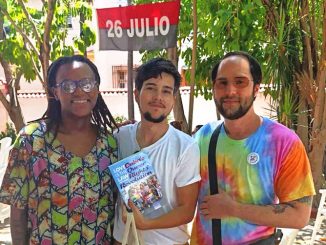
The following talk by Verde Gil Jiménez was presented on July 29 at the ICAP (Cuban Institute of Friendship with the Peoples) Friendship House in Havana, Cuba, with the participation of the Venceremos Brigade and LGBTQI+ activists from the U.S., along with members of community networks linked to Cenesex (National Center for Sexual Education), among other guests.

This event was the Cuban launch of the book published in the U.S. by Struggle-La Lucha, “Love is the law: Cuba’s queer rights revolution.” Gil Jiménez is the General Coordinator of Grupo Trans Masculinos de Cuba and a contributor to the book.Transcribed and translated by Gregory E. Williams and edited by Verde Gil Jiménez

We are members of the Trans Male Group of Cuba (Grupo Trans Masculinos de Cuba). It’s always very exciting to see the U.S. and Cuban people unite for social justice. 

I think that, if we talk about some of the limitations or difficulties we’ve encountered with the Family Code, these are more related to cultural and technical barriers that still exist. The Family Code still has great potential to improve the quality, well-being, and happiness of families in Cuba. But this requires changing people’s education and mentality, which happens more slowly than enforcing a law.

I think it’s prudent to point out that my colleague Maité [in the previous intervention] mentioned the approval of more than 3,000 assisted reproduction techniques; however, it’s good to clarify that these are [administrative] approvals, not specific implementation data. This is, evidently, a technological and logistical limitation that our country has [structural deficiencies in the health system], not only with LGBTQI+ people, but with any family or citizen who requires this type of technique. I say this [in response to the questions that were asked] to specifically point out a limitation because, although we already have a revolutionary Code, it has not been able to materialize quickly [nor with all its potential] in the life of Cuban society.

Regarding the question of how the U.S. and Cuban people can unite in these struggles for social justice and activism, I think it’s very important to share our experiences, especially from a more holistic perspective, which allows us to gain awareness of all the forms of oppression that impact us.

I wanted to thank the solidarity of the groups that have come to this space to listen, to learn, and also to give us some donations to the LGBTQI+ community, which are a great help to us, because the U.S. blockade also affects our populations’ access to these types of products, which are important for our gender affirmation.

I also wanted to point out that we, as activists, are also greatly influenced by the U.S. imperialist persecution of Cuba, of the Cuban government. They often deny us aid, refuse to listen to us and refuse to include us in spaces for dialogue within international activism, simply because we’re in Cuba. They judge the politics of the Revolution.* It’s important for people in the U.S. to know that we also live our activism under this constant blockade. It’s something we’re also fighting against.

Larian adds an example : We have occasionally tried to participate in online debates using platforms like Zoom, but have been unable to do so because they are blocked in our country.

We are incredibly grateful that these spaces for counter-hegemonic dialogue exist and hope they continue to be sustained over time. It’s important for us to be aware of how much an exchange like this can transform the culture of the societies in which we live.

Larian adds in closing : It is the way we have to change the dominant system. 

* There is a tendency to favor LGBTQI+ activist projects that openly oppose the Cuban government and socialism. Some international organizations are even prohibited from providing funding to activist groups that are in any way linked to Cuban institutions, under the pretext that Cuba is included on the (false) list of state sponsors of terrorism.

Strugglelalucha256


Bob McCubbin – LGBTQ+ rights pioneer, Marxist revolutionary

It is with deep sorrow that we announce the loss of lifelong revolutionary Bob McCubbin (June 23, 1942 – Aug. 31, 2025). McCubbin, 83, died from injuries sustained when he was hit by a car while taking his daily walk through Balboa Park in San Diego, California, where he lived and was active in the struggle for justice for 35 years.

McCubbin was an early pioneer in defense of LGBTQ+ rights. He wrote one of the first Marxist analyses of gay oppression titled “The Gay Question: A Marxist Appraisal,” published in 1976; a second edition published in 1993 changed the title to “The Roots of Lesbian & Gay Oppression.”  

The Stonewall Rebellion and the struggles of that period informed his writing and activism. McCubbin was inspired and worked closely with Marxist thinkers Sam Marcy, Dorothy Ballan, founders of Workers World Party and Fred Goldstein, an early leader.

McCubbin was equally active in the streets, participating in the many marches, pickets and strikes. His fight against gender oppression was matched by his fierce solidarity with the Black Liberation and Civil Rights movements of the era. Later, he looked to Leslie Feinberg to sharpen his understanding of transgender liberation to include it in his writing.

In 2018, Bob McCubbin helped found the Struggle for Socialism Party and became a writer and contributor to Struggle-La Lucha. During this period, he finished writing and published “The Social Evolution of Humanity, Marx and Engels Were Right!” 

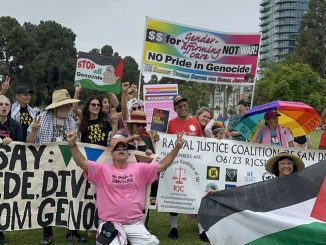
In July of this year, he helped organize a contingent in support of Gaza and Palestine at the annual San Diego Pride March in addition to opposing attacks on im/migrants.

Bob McCubbin’s comrades and many friends in San Diego will remember him as a kind and generous friend. He is remembered as a courageous person who stood on ethics and principle regardless of whether it was difficult. McCubbin was a retired teacher and active member of the teachers’ union.

Memorial events will be held on both the West Coast and the East Coast in the coming months.

Bob McCubbin ¡Presente!

Struggle for Socialism Party and Struggle-La Lucha


An interview with Bob McCubbin: 

Strugglelalucha256


Defying Trump’s cuts: L.A. LGBT Center activist shares resistance strategy in Havana

The following talk was presented on July 29 at the ICAP (Instituto Cubano de Amistad con los Pueblos / Cuban Institute of Friendship with the Peoples) House of Friendship, in Havana, Cuba, with the participation of the Venceremos Brigade and LGBTIQ+ activists from the United States, along with members of the community networks linked to Cenesex (Centro Nacional de Educación Sexual / National Center for Sex Education), among other invited individuals.

This event was the Cuban launch of the book published in the U.S. by Struggle-La Lucha, “Love is the law: Cuba’s queer rights revolution,” which is about the revolutionary Families Code that has expanded the legal rights of women, children,  seniors, LGBTQI+ people, and more.  Onyịnye Alheri is a social worker in Los Angeles and an activist with the Harriet Tubman Center for Social Justice and the L.A. LGBT Center. She went to Cuba with the book delegation. 

I’m going to try my Spanish here because we’re in Cuba and it’s important to talk the language of the people that we’re visiting, but I will also speak some moments in English. Thank you. 

Entonces, yo soy Onyịnye. Yo soy una trabajadora social en Los Angeles, California.

So I’m Onyịnye. I’m a social worker in Los Angeles, California. Like Gregory mentioned, we at the L.A. LGBT Center have been fighting all year, especially in support of trans people and gender non-conforming people. 

Entonces, como Greg nos dijo, yo estoy trabajando para el centro LGBT y hemos estado luchando en defensa de las personas trans durante todo el año.

And it’s been a huge struggle, but the L.A. LGBT Center is fortunate to be well-funded.

Ha sido una lucha difícil, pero por suerte el centro LGBT está bien financiado. 

But at the same time, due to the attacks by Donald Trump’s administration, we have lost millions of dollars in the last seven months alone. 

Aún así, debido a los ataques de la administración Trump, el centro ha perdido bastantes millones de dólares para su financiación.

But to Gregory’s point [asking how the struggle in L.A. is going], I wanted to just highlight some of the wins that we have made. Because, initially, I was going to present on all the laws that are in place to attack trans people and queer people in the U.S.

Aún así, me interesa mucho presentar las victorias que hemos tenido. Hay muchos ataques hacia la comunidad, pero es importante destacar lo que hemos ganado. 

So recently, we, the L.A. LGBT Center, sued the Trump administration along with six other organizations around the United States. And we won. 

Recientemente nuestra organización junto a otras seis organizaciones en Estados Unidos demandó a la administración de Donald Trump. Y ganamos. 

I don’t know how widely this was publicized. Definitely not by the liberal media for obvious reasons. But it’s important to say that we did this after having lost $21 million, after being attacked, after having MAGA supporters come to our homeless shelters and threaten our young trans and queer people.

No sé cómo habrá sido publicitado esto por los medios liberales, pero bueno, vencimos después de haber perdido $21 millones, después de haber sido atacados por miembros de MAGA, personas que estaban a favor de la administración de Trump, después de una larga lucha contra grupos de este tipo.

And the way that we did this is what feels most important to highlight because it’s very similar to how the Families Code was passed here in Cuba. And that was through grassroots outreach, including knocking on neighbors’ doors, flyering at different events, raising money from non-federal sources.

And that’s something that felt important for me to highlight because what stood out in this book was how democracy was truly implemented in the passing of this law. Unlike in the United States, where even on the first day of Trump’s presidency, we saw executive orders made without any input or approval from the people.

Esto es muy diferente a lo que sucede en los Estados Unidos donde la administración de Trump enseguida, en su primer día, empezó a llevar a cabo leyes ejecutivas o órdenes ejecutivas que es totalmente contrario a lo que muchas veces es lo que quiere el pueblo.

I want to close out our talk with some inspiration and just say that despite all of the federal attacks and all of the state-sanctioned violence against us, we can fight back and we can win!

Quiero cerrar nuestra charla con algo de inspiración y simplemente decir que, a pesar de todos los ataques federales y toda la violencia sancionada por el estado contra nosotros, podemos contraatacar y podemos ganar!

Strugglelalucha256


At San Diego Pride: ‘If you support trans rights, support ending genocide in Gaza’

San Diego, July 19 – A contingent from the Harriet Tubman Center for Social Justice in Los Angeles joined members of the San Diego Struggle for Socialism Party to participate in San Diego’s 2025 Pride March. The group highlighted the Palestinian struggle and demanded an end to ICE raids. The Harriet Tubman Center for Social Justice is also part of L.A.’s Community Self Defense Coalition, which has been in the streets protecting community members from ICE.

The Harriet Tubman Center’s John Parker spoke with Nico, a local trans community member, about trans solidarity with Palestine.  

Sd2

Nico: “I’m a San Diego native born and raised. I grew up in the ‘gayborhood,’ and in regards to the work that you guys are doing, I just want to say first and foremost, thank you so much for the work that you guys are doing. It’s important.

“And second of all, as someone who is politically minded and active, the amount of times that I have heard Zionists specifically use my trans identity and try to weaponize that as a means to divide me against what I believe is a fight for human rights.

“And if you support trans rights, then you have to support ending the genocide in Gaza. There’s no way that you can explain it away. There’s no dividing that. It’s very, very simple. It’s an all or nothing thing. This is a zero sum game. Are you for human rights or are you not for human rights?”

Strugglelalucha256


Palestine contingent in Baltimore Pride Parade met with applause

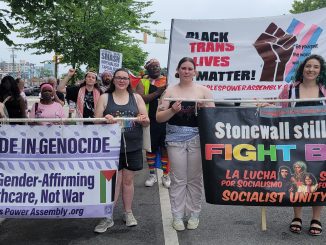
June 14 – The energy was electric at this year’s Baltimore Pride Parade, as activists in the Palestine contingent, led by the People’s Power Assembly and Struggle for Socialism Party, marched on the parade route for a mile on North Charles Street up to Wyman Park Dell near Johns Hopkins University. This marks the second straight year in Baltimore Pride’s history that such a pro-Palestine contingent has participated. 

Historically, the People’s Power Assembly has strived to set the more political tone at Pride amidst the endless sea of rainbow capitalist sponsors, which was especially crucial for this moment, as Israel continues its all out genocidal assault on the people of Gaza and now is trying to initiate a fully U.S.-backed regional war against anti-imperialist and anti-Zionist Iran. 

A large Palestine flag was held front and center alongside three main banners: “No Pride in Genocide, $$ for Gender-Affirming Healthcare, not War,” “Stonewall Still Means Fight Back,” and “Black Trans Lives Matter — ‘Be yourself, the world will adjust’ – Manabi Bandyopadhyay.” Drummers flanked each side.

Connecting the current migrant liberation struggle in L.A. (against ICE raids and National Guard / Marines terror) to the roots of the queer liberation struggle, participants chanted “Stonewall was a riot! We will not be quiet!” and “Power to the people! No one is illegal!” which drew roaring cheers from the crowd. Local rapper and activist Slim Rob also performed a solo rap during the march, which further hyped up both the contingent and the crowd.

People in the contingent distributed copies of the Struggle-La Lucha paper, which contained flyers advertising both the “Free Kilmar! Free Them All!” Car Caravan happening in the city on June 28, as well as the Defend Black History Petition to Rename the Francis Scott Key Bridge to either the Frederick Douglass or Harriet Tubman Memorial Bridge. So many people wanted copies because they were drawn by the cover page depicting the current struggle in L.A. against ICE raids; the folks distributing had to keep running back to the supplies wagon to grab more papers until they eventually ran out! 

The crowd response was overwhelmingly positive and supportive. Some participants even noted the increase in onlookers wearing keffiyehs in solidarity and signs reading “ABOLISH ICE” or “ACAB.” Now imagine if all those supportive people in the crowd took to the streets with us and joined in the struggle! 

Strugglelalucha256


Reimagining family and love in a post-capitalist world

Following is part five of an interview with gay communist activist Bob McCubbin, who has organized and written political analyses since the 1960s. He is the author of the 2019 book, “The Social Evolution of Humanity: Marx and Engels Were Right!For Pride Month, Struggle-La Lucha writer Gregory E. Williams sat down with McCubbin to explore the revolutionary history of the LGBTQ+ struggle and what it means for today’s fightback. 

Two follow-up questions for Bob 

Gregory Williams: At the beginning of this interview, we talked about the extreme repression in the 1950s and how the ’60s youth movement was a reaction to that. The 1960s represented a big explosion of struggle. But there was also a lot going on in the ’50s, as you wrote about. For example, you wrote about the gay men’s organization, the Mattachine Society, and the Daughters of Bilitis, a lesbian rights organization, both founded in the ’50s. How did they relate to the Civil Rights movement of their period and the later LGBTQ+ struggle?

Bob McCubbin: I’ve characterized “the ‘50s” as a time of terrible reaction (I could have cited the ruling-class-ordered executions of Julius and Ethel Rosenberg and the so-called “Korean War” (the U.S. invasion of Korea) as particularly horrific examples of that reactionary decade), but, as you note, it was also a period not at all devoid of progressive and even revolutionary struggle.

As well as the pre-Stonewall gay and lesbian organizations you mentioned, there was the pre-Stonewall Compton’s Cafeteria riot / rebellion in 1966. It was highly significant that trans people were in the leadership of both pre-Stonewall, Stonewall and post-Stonewall mass resistance. It was the inspiring struggles of the 1950s that led to significant political advances for Black and other communities of color in the 1960s.

How did the early “gay and lesbian” movement relate to the Civil Rights movement unfolding in the same period? In general, as the Black Civil Rights movement became increasingly militant, so did the LGBTQ+ movement. And the LGBTQ+ movement certainly drew great inspiration from the Black and Latinx revolutionaries.

Chairman Huey P. Newton of the Black Panther Party demonstrated the vanguard role of himself and his party with an extraordinary public statement of support for the LGBTQ+ (at that time “Gay”) movement. It was the first such act of solidarity by any internationally known political leader anywhere in the world.

GW: In our first phone conversation, you said, “the struggle for LGBTQ+ rights is the beginning of something far more powerful in terms of changes in society and the family.” Could you say more about this? 

BM: At the end of my book, “The Social Evolution of Humanity: Marx and Engels were right!,” I borrowed from Fred Goldstein’s 2012 book, “Capitalism at a Dead End,” where he asks his readers to begin thinking seriously about what a post-capitalist society would look like. 

Goldstein writes: “There needs to be a serious conversation within the movement about what to replace the present system with. It is the thesis of this work that capitalism has reached a dead end. It is bringing humanity and the environment down. It must be abolished. The starting point for that conversation should be that the new society must be free of class exploitation; must be free of national, sexual and gender oppression; must put an end to war; must be free of all forms of domination and have respect for the planet. Above all, it must use the wealth of society to benefit all of society.”

So what would it mean for post-capitalist society if, like in Indigenous, hunting and gathering societies, and in socialist Cuba, children were the serious responsibility of the whole community? What if, as already exists in Cuba, lovers came together purely based on their mutual feelings of love and / or physical attraction? And were able to separate without complications if and when those feelings faded?  

With the abolition of private property, wouldn’t the tendency to view the ones “loved” (including one’s children) as one’s private or personal property disappear? Wouldn’t all the horrors of patriarchal culture be consigned to the garbage dump of history along with all manifestations of economic, social and political injustice that that culture bolstered through the various stages of class society?

Okay. But just so our immediate challenges of racism, imperialist war and economic injustice aren’t forgotten, let’s remember Che’s admonition: “The present is for struggle. The future is ours.”

Strugglelalucha256


Leslie Feinberg, Minnie Bruce Pratt, and the radical legacy of LGBTQ+ communists

Following is part four of an interview with gay communist activist Bob McCubbin, who has organized and written political analyses since the 1960s. He is the author of the 2019 book, “The Social Evolution of Humanity: Marx and Engels Were Right!For Pride Month, Struggle-La Lucha writer Gregory E. Williams sat down with McCubbin to explore the revolutionary history of the LGBTQ+ struggle and what it means for today’s fight back.

Gregory Williams: You’ve been describing the early LGBTQ+ movement and what it was like being in a revolutionary party. You were doing a lot of practical work, but always studying at the same time, always analyzing. You published a pamphlet in 1976, “The Roots of Lesbian and Gay Oppression, A Marxist View.” Just as an aside, I was in a study group in New Orleans, and we were still using it around 2017, when we were doing interventions in the Pride march here, forming a radical contingent. You know, Stonewall means fight back, take back pride! And we felt that we needed to study what the roots of this are. What led you to write that?

Bob McCubbin: The need for a deeper understanding of that struggle, the struggle of – at that point – of lesbians and gays. Now, we were proud to say that we didn’t need a theoretical background to understand that there was oppression going on, that it was oppression of members of our class, and we should fight that. And those are words, of course, but they really instituted the truth of the plan of the leading comrades to overthrow capitalism. 

So, we were out on the streets even without theory, but it’s good to have guidelines, and it’s good to deepen your understanding of your own situation and the situation of your comrades. 

I actually wrote something fairly early in the party’s development, and I showed it to Comrade Dorothy Ballan. She didn’t want to hurt my feelings, but it was terrible. It was unbelievably bad. So she didn’t mince words. She said, “No, this is not Marx. This is not a dialectical analysis.”

So I went back to the drawing board because I wasn’t about to give up. She had actually given me some ideas on how to improve my thinking on this issue. But in terms of when I started writing – this sounds terrible. I did it secretly. I didn’t want influences. 

I wanted to break with the prevailing ideas that were floating around the progressive community. All idealistic, all having to do with ideas rather than struggle and social change and all that. There were some very good books about the oppression of homosexuality, but they all ended on that liberal, happy note: “Now we know more about these people and we want them to be part of the human family, and blah, blah, blah. Yeah, yeah, yeah, yeah.”

GE: But how are you going to do that?

BM: Right. Well-intentioned, there was a lot of well-intentioned stuff. I didn’t want that to creep in because it was dominant, it was prevalent. I didn’t want to do that. We had leading comrades – incredibly developed comrades – who hadn’t given any thought to it and openly admitted that. They said, “We need your help, Bob.” And then a lot of new comrades were bringing in these ideas. 

You know, all of the great revolutionaries have talked about the cultural struggle, which usually follows the physical seizure of power. And it’s absolutely necessary because just the physical seizure of political power in a particular country or a particular region or area – it doesn’t do the job. For one thing, people think, “Oh, the revolution has succeeded, now where’s the reward for it?” 

Well, usually, following a revolutionary war, there is social exhaustion. It takes a while to recover from any kind of military struggle. And so, the issue of culture arises. 

And in the late ‘60s and early ‘70s, there were a lot of – with all due respect – hippie-type ideas about who we were and all that. I didn’t want that to creep in. 

I wanted to develop it in a materialist fashion, to develop the idea, to develop the situation. And to really show the power of the Marxist method to deepen understanding of our situation and the struggle we face, what our goals should be. 

So, yeah, I wrote it all, and I had some confidence, but not a lot of confidence. I’m not an anthropologist. I’m not a historian. I don’t have training in any of those areas. So that was another reason I kept it secret. I wasn’t sure it would be successful. I had another meeting with Dorothy, and she tried to be polite, telling me, “No, you’re not on the right track yet.”

And when I finally had something I felt I could show, I made three copies. I gave one to Dorothy and one to Sam Marcy. And then the third copy I gave to Fred Goldstein, who was a cis man, a heterosexual man, a wonderful communist. 

I hope this doesn’t sound prejudicial, but as a gay man, I really appreciate heterosexual men who aren’t afraid of me, who are warm to me. And Fred was like that. And in terms of what he said at meetings, he struck me as the most politically developed among the youth. I thought, let’s find out if he has anything to say about this text I’ve written. So anyway, those three. And I got good feedback. 

That booklet was released in late winter or early spring of 1976. However, in January 1976, a very important national meeting took place. It was called the Hard Times Conference. And it was called by the Prairie Fire Organizing Committee, which was the above-ground, open organization for the Weather Underground.

And this meeting in January 1976 was kind of like the last hurrah for the so-called New Left movement of the 1960s and early 1970s, but dominated by the Prairie Fire Organizing Committee. 

Their political line was perhaps typical of the left dealing with a new political phenomenon, such as the gay liberation movement. They reacted defensively – forgive me – even stupidly. The Prairie Fire Organizing Committee probably had many LGBTQ+ people involved in it, but their theoretical position, basically, was that homosexuality is a secondary contradiction. What the hell is that? 

My point is, they didn’t have a good position. They had a homophobic position, right? The U.S. Communist Party had a homophobic position. And the Socialist Workers Party went back and forth on it. But basically, they would have preferred not to have to deal with it. 

However, at the time of the conference, the book was ready for publication but had not yet been published. The comrades got on the Xerox machine and printed 300 pre-publication copies of “The Roots of Lesbian and Gay Oppression” – at that point called “The Gay Question.” And Leslie Feinberg, who was pretty new – she/zie had joined the Buffalo branch a few years earlier, and zie’d just moved to New York City around that time, maybe ‘74, ‘75 – zie grabbed them up when we got to Chicago, and zie spent the whole time, the two or three-day conference, zie spent the whole conference selling them. And zie sold all 300. 

That was the kind of incredibly dynamic revolutionary zie was. Full of energy, full of enthusiasm, full of great ideas. And you know, I saw a photo of her/hir recently and it reminded me: Hir eyes projected love. Zie loved hir class. Zie loved children. Zie loved the comrades. And lucky for hir, zie was also brilliant. And people paid attention to hir writings. And zie was invited all over the place. 

I was thinking about it last night, and I’d actually forgotten. Zie spoke in Balboa Park in San Diego. Pride March was on Saturdays, and on the night before, there was always a rally outside the center, with leaders in the struggle speaking. And one year, out of all the national figures who could have been picked, zie was picked to be the spokesperson. 

I remember another time we drove up to Las Vegas. An ex-comrade, who still liked us, had organized a meeting for us in Las Vegas, where Leslie spoke. And zie spoke in San Francisco to an incredible crowd of young people who were just crazy about hir. And in L.A., too. My point is that zie spoke all over the U.S., as well as in Europe and Asia. 

And zie loved our class, zie loved our class very much. And zie made a tremendous contribution. I didn’t have great insight into the trans struggle, but hir friendship and comradeship meant everything. And any mention of Leslie should also include Minnie Bruce Pratt, who was hir life companion, who was also a great revolutionary. Minnie Bruce’s children had been taken away from her by the state because she was a lesbian. That didn’t stop her from a lifelong struggle for justice.

GW: They definitely contributed so much to our understanding of gender and the trans struggle, the way that it’s come down to us today. Our orientation in the Struggle for Socialism Party, of which you and I are members, owes much to the foundation laid by pioneering comrades like Leslie Feinberg and Minnie Bruce Pratt, who were willing to go against the grain, even within the revolutionary movement.

Not everybody understood the importance of these struggles, as you described. It may be hard for young comrades to understand now, but all of these positions had to be fought for in the progressive and even revolutionary movements, just as opposing the war in Vietnam and supporting the Black Panthers had to be fought for.

There’s a good quotation from Leslie Feinberg: “Remember me as a revolutionary communist.” Zie was of Jewish background and deeply committed to the Palestinian liberation struggle — just an incredible example.

And zie left behind many writings that are still so valuable. Aside from your book, I was given copies of Leslie’s writings. That’s how I learned about the history of the gay and lesbian struggle and the trans struggle within the communist movement and the advances that the Bolsheviks made in ending the discrimination against homosexuality and guaranteeing abortion rights very early on, way before the capitalist countries. 

And then you can trace the line through the developments that happened in socialist East Germany, the German Democratic Republic. They recovered a lot of the work that was being done in Germany before the Nazi takeover. Germany had a revolutionary situation before the Nazis came to power, they were going to be possibly the next socialist country. And they were making huge strides in the world of sexology. And the gay and lesbian and trans subcultures were very prominent – all this cultural experimentation that was happening, and the Nazis tried to destroy that totally. 

And then, when socialist East Germany came into being after WWII, they revived what they could, but had to build a lot from scratch. They had to rebuild housing and everything, but also recover what was lost or what had been taken away in terms of gender and sexual struggle. And then, onward through the advances that have been made in Cuba, all the stuff I learned about through Leslie Feinberg’s writing. Just an incredible touchstone for anybody who wants to be a revolutionary today, anybody who’s in the LGBTQ+ struggle. There’s a lot to learn there.

To be continued 


Strugglelalucha256


Mumia embraces the LGBTQ+ movement

Mumia Abu-Jamal is a brilliant and empathetic revolutionary journalist known as “the Voice of the Voiceless,” hailed as a leader of people working for peace and justice. He is a father, a grandfather, and a longtime ally of the lesbian, gay, bi, trans, queer plus (LGBTQ+) movement. He has been incarcerated for 43 years, since Dec. 9, 1981. Few political prisoners have been held behind bars for this staggering length of time.  

At the time of his arrest, Mumia, a reporter for the Black Panther Party, was president of the Philadelphia chapter of the National Association of Black Journalists. By the age of 15, because of his news reports, the FBI had begun tracking the young writer through its draconian and illegal program known as COINTELPRO – not for violent behavior, but because of his “inclination to appear and speak at public gatherings.” 

Reporting on police brutality and the MOVE siege

It is widely viewed that the racist Philadelphia Police Department targeted Mumia because of his courageous reporting on police brutality. Specifically, he was writing about the police attacks on the MOVE organization, which culminated in a year-long siege of the MOVE house. In 1978, nine members of MOVE were falsely charged with the murder of a police officer. In his coverage of the trial, Abu-Jamal pointed out that the officer was most likely killed in the barrage of police crossfire.

Decades of solitary confinement

Mumia, a U.S. political prisoner, served 29 years in solitary confinement on death row. Following a powerful international campaign demanding “Freedom for MUMIA,” his death sentence was ruled unconstitutional. Now he has a life-without-parole sentence. Mumia Abu-Jamal has said: “My only crime that night is that I survived.” 

Countless due process violations began just moments after Abu-Jamal was found critically wounded, shot through the chest near the prone body of Officer Daniel Faulkner. From that moment on, members of the Philadelphia Police Department began to manufacture Abu-Jamal’s guilt, conceal his innocence, and charge him with murder. 

From early on, it was established that Abu-Jamal’s trial was patently unjust. Philadelphia prosecutors excluded Black people from juries. In Abu-Jamal’s case, 11 out of the 15 peremptory strikes were made to bar Black people from his jury. 

His conviction came in a trial that Amnesty International and numerous human rights groups said showed extensive evidence of prosecutorial, judicial, and police misconduct, and “effectively strip[ped] Mumia Abu-Jamal of any meaningful legal representation,” all seriously violating international legal standards.

A few years ago, it was officially disclosed that cartons full of evidence had been discovered, hidden in a Philadelphia City Hall closet 36 years earlier. Mumia’s legal defense team said this evidence would establish his innocence. Despite that, in 2023, Philadelphia Common Pleas Judge Lucretia Clemons ruled that it was too late for the evidence to be heard.

Support of the LGBTQ+ movement

In recent years, Mumia has become increasingly outspoken about queer and trans issues. In 2000, he wrote a commentary denouncing the brutal murders of three white gay men: Matthew Shepard in Wyoming in 1998, Billy Jack Gaither in Alabama, and Eddie Northington in Virginia, both in 1999. He was responding to an LGBTQ+ campaign in support of his freedom, called Rainbow Flags for Mumia, that Leslie Feinberg initiated.

“The sickening attacks on gay people in cities across the nation recently are a reflection of the sickness that simmers at the core of the American soul. It is here that a truly perverse hatred is bred, and from here that all attacks are launched against all who are seen as Other.

“This violence, which seems psychosexual in nature, is an attack on the self that seeks to destroy a part of the self that threatens the self. From Matthew Shepard, to Alabama, to that bloody American ground that was once the seat of the Confederacy, Richmond, violence, spawned by the dark pit of hatred and fear, is unleashed by men who claim a false and twisted ‘purity.’

“More often than not, those who find themselves attacking gay folks violently are replaying a violence that they grew up with, or that they continue to act out of, against their family or children.

“Is it a coincidence that Richmond, the city where a Black man was burned to death and decapitated, is followed several months later with the decapitation and torture of a gay man? I think not.

“This cruel and savage violence must be stopped — but it won’t be the cops that stop it, for they are the agents of legalized state violence. The brutality that occurs in their own homes daily, the recent spate of cops who kill their wives and kids, more than proves it.

“The people are the solution! So, my thanks to the Rainbow! Ona Move! To Freedom! 

In the 2012 book “The Classroom and the Cell: Conversations on Black Life in America,” Mumia said in a transcript that “Huey P. Newton spoke out, back in 1970, about gay liberation. He didn’t just mention it. He said, ‘We, the Black Panther Party, support gay liberation just as we support women’s liberation.’ He saw it as part of the struggle for human liberation. … It was the most forward position of any radical and revolutionary movement of the period, and reflected Huey’s keen thinking on issues before his time.

Newton’s 1970 statement, made by a Black Panther Party (BPP) leader, came just a year after the Stonewall rebellion, giving ground-breaking support to the then-strong and growing movements for women’s and gay liberation. Newton called for building an alliance with both movements.”

Radio documentary: A revolutionary evolution

Mumia Abu-Jamal explained his decades-long evolution to open solidarity with queer and trans liberation in a radio documentary, “Mumia Abu-Jamal Embraces LGBTQ Liberation” produced by Bob Lederer, host of the program Out-FM on WBAI in New York. Out-FM is a weekly anti-racist program by and for the lesbian, gay, bisexual, transgender, two-spirit, gender non-conforming, intersex, queer, and questioning communities.

In his interview with Mumia, Lederer included an account of the prisoner’s evolution on queer issues by Noelle Hanrahan, a lesbian journalist who has recorded more than 3,000 of Abu-Jamal’s radio essays on prisonradio.org, which airs the voices of incarcerated people. 

In the interview  Mumia said: “When you think about what Huey said at the Revolutionary People’s Constitutional Convention about gay folks and lesbian and queer folks, I must be honest with you, it was not well received by members of the Party. We were shocked in some ways, confused in other ways. But as usual, this was Huey at his finest. And he was a true revolutionary intellectual, who was usually ahead of his peers. …

“And I thought about it in the same context as Dhoruba bin Wahad, who was one of the Panther 21, and he talked about gay liberation. So some of the most advanced sectors of the Black liberation movement began to think about it far more broadly and deeply than even when Huey made his call.”

In Mumia’s 2004 book, We Want Freedom: A Life in the Black Panther Party, he wrote about the Panthers’ 1970 Revolutionary People’s Constitutional Convention in Philadelphia, which around 6,000 activists attended. He called it “a way of developing a revolutionary superstructure that would be the groundwork for a new society” and noted the wide array of groups – of students, socialists, Native peoples, women, and gay and lesbian groups – were invited to contribute. Workshops were held separately by gay men and lesbians, the former more multi-racial than the latter, and the gay men – but not the lesbians – were allowed to present to the larger convention.” 

Mumia wrote: “The many diverse workshops provided the basis for one of the most progressive Constitutions in the history of humankind,” citing calls for Black and Third World representation in governing institutions, national self-determination, sexual self-determination for women and homosexuals,” and the universal rights to housing, health care and day care. … Much of the movement was. … deeply macho in orientation and treated women in many of these groups in a distinctly secondary and disrespectful fashion.” 

But he also noted that “women were far more than mere appendages of male ego and power, they were valued and respected comrades. The women really were the glory of the Party. And I mean, they were the Party’s hardest workers, the most disciplined members and leaders.” 

Mumia cited the emergence in the 2010s of the queer-led Black Lives Matter movement as a major spur for straight Black liberation leaders to embrace LGBTQ+ liberation: 

Mumia also spoke movingly of the lessons he has learned from gay and trans prisoners in the institutions where he has been incarcerated: He gave an eyewitness account of the horrendous oppression of incarcerated gay men and trans women. 

“Well, you know, being in many ways, a blockhead and a nerd, I used to think that for a gay or even a trans man in prison would be a touch of heaven. It’s quite the reverse. They catch hell from prisoners and staff alike. So think about the alienation in isolation that breathes in such a person. I’ve seen people – literally seen them – try to commit suicide by jumping off of a rail onto the floor. If you hit your head or your neck, you can kill yourself, and I’ve seen that several times, in several places, in several prisons. Prison, by its nature, breeds isolation in human beings and atomizes them to the extent that it further isolates and separates them. And for trans and gay men in prison, it’s a hell in a hell, you know? They get the worst of it.” 

Confronting anti-trans violence 

In 2019, Mumia released a commentary denouncing a wave of murders of Black trans women:

“In recent weeks, we have seen naked violence unleashed against trans women, directed against them by the state in the form of police beating and by rightist forces in this emerging fascist movement in America.

“What does this mean? Why now? I believe it comes now for a specific strategic purpose, for trans women stand on the periphery of the gay rights movement, not its nucleus. This means they are isolated and, as such, targeted by rightist forces to isolate them further.

“We must not forget that they are, after all, Black folks in the land and at an era where and when Black life remains cheap. Now add Black, gay, and transgender. See where the analysis goes? And if it’s Black trans women today, it’ll be Black straight women tomorrow and Black children soon thereafter.

“That’s the nature of the fascist beast: attack those who seem weak, isolate them, destroy them. Since Charlottesville, we’ve seen the emergence of rightist racist forces that are committed to destroying Black life and to proving that Black lives don’t matter.

“The lines of Black people are the literal foundation not just of America but all of us. We need to build a radical movement that protects all of us, for all of us can consign such racist violence to the trash heaps of history.

“From Imprisoned Nation, this is Mumia Abu-Jamal.”

Noelle Hanrahan of Prison Radio wrote: “I ‘came out’ to Mumia on my second recording trip in 1992. Sitting across from him, I said you know the committee in San Francisco that is your defense committee has 10 women on it. Seven are lesbians. He was shocked, yet open. I told him Alice Walker was bi, Angela Davis was a lesbian, Bayard Rustin, James Baldwin were gay.

“He was profoundly curious. Warm. He asked, ‘Why?’ I said, ‘We’re deeply oppressed by this society and those of us who are revolutionaries see our liberation bound intrinsically with yours.’

“Mumia, while complicated, is one of the warmest persons I have ever met. Mumia Abu-Jamal’s instinctual curiosity and warm wonder, his lack of judgment or distance and harshness, kept me coming back. I see him 3-4 times a month, strategizing about his freedom, because when we love we win, when we survive we win, when we fight we win.”

Bob Lederer ended his interview by thanking “the amazing Mumia Abu-Jamal for the interviews. Special thanks to two dedicated Free Mumia activists, Dr. Suzanne Ross of International Concerned Family and Friends of Mumia, Noelle Hanrahan of PrisonRadio.org, Johanna Fernandez of the Campaign to Bring Mumia Home, Pam Africa, Dawn Reel, and Betsy Mickel. Thanks to Nathaniel Moore and Claude Marks of the Freedom Archives for providing the audio of Dhoruba Bin Wahad. And thanks to my Out-FM colleague and husband John Riley for providing production support, as well as to my two collectives, Out-FM and Resistance in Brooklyn, for advice. And thanks to WBAI studio engineer Max Schmid. Our closing music will be ‘Never a Prisoner! Free Mumia,’ by Rebel Diaz.”

Strugglelalucha256


Bob McCubbin on LGBTQ+ liberation and Marxist organizing

Following is part three of an interview with gay communist activist Bob McCubbin, who has organized and written political analyses since the 1960s. He is the author of the 2019 book, The Social Evolution of Humanity: Marx and Engels were right! For Pride month, Struggle-La Lucha writer Gregory E. Williams sat down with McCubbin to explore the revolutionary history of the LGBTQ+ struggle and what it means for today’s fight back.

Gregory Williams:  So, after Stonewall, you came to a point where you felt you needed to come out. What was it like when you came out as a member of a revolutionary party? Was it difficult?

Bob McCubbin: I would say it didn’t change anything. What do I mean by that? I was already in the party, and Sam Marcy characterized the party as a combat organization. And within the world that we were living in at that time, a world with incredibly inspiring anti-colonial struggles and everything else progressive that was going on – and again, being in what Sam Marcy characterized as a combat organization – there was a lot of discipline, but it was self-discipline. There were party requirements. 

Those of us in the New York branch, which was very large, were under obligation to call in to the office at least once a day to see what was going on and if anything was going to be happening in the evening that we could plug into. Most of us had jobs, regular-paying jobs. And the social life was largely during breaks at our meetings. 

Our meetings were wonderful. They were so educational, but also organizing. We were always organizing. And other groups on the left, on occasion, referred to us as the mindless activists, because we were always out on the street with our banners. But we weren’t mindless at all. Under the leadership of Sam and Vincent and Dorothy, we knew a lot. We knew a lot about the past at some point. 

Maybe I’ll mention a little bit about Friedrich Engels’ book On the Origin of the Family, Private Property, and the State, because that book was full of evidence that our species need not self-destruct. On the contrary, it was the most social of the animals, the most social of the mammals. I’m talking about our species, Homo sapiens.

Many scientists felt the development of language was based on this incredible sociality. When you were faced with, let’s say, in a particular indigenous group, there might be 30 to 50 families or maybe 100 families. But the point is, under the conditions of sociality. Other animals were social to one extent or another. But we’re talking about profound sociality. 

Your mind had to be able to deal with 30, 50, maybe 100 different personalities. And in any case, whatever the reason was, our brains got larger and larger until we actually entered the Homo sapiens species. And it bodes well for us as a species that we have such intense cooperation with each other. 

But what did the introduction of private property do? It introduced poison into that system. And together with the patriarchal culture that it created, fomented, increased, promoted, it left us with this problem. It’s a problem of private property. And we’re not talking about your toothbrush or even your home. We’re talking about the capitalist system. Money makes money. Well, not really. People, workers, make value. And the ruling class, as long as there is a ruling class, confiscates most of that value, demands ownership of it. 

GE: I’m reminded, a few months ago, there was an article about a new scientific study, I believe it was an anthropological study. They looked at child care in societies that have preserved some of these more communalistic aspects that predate class. And I think they were looking at existing peoples, maybe in the Amazon. 

And they quantified how many people it takes to care for a child. And the short answer is it’s a lot of people. [The study looked at the circle of non-maternal caregivers among contemporary hunter-gatherers, the Mbendjele BaYaka people in the Republic of Congo.]

It takes a village to raise a child. And contrast that with the extreme pressure that’s put [on parents], especially on women, in this modern capitalist society to take care of a child. That’s not how our species evolved. We didn’t evolve to live in these very isolated conditions. And it takes a toll on people. I think that we don’t, maybe even in the revolutionary movement now, we don’t talk enough about that psychological aspect of the extreme alienation that people are feeling. 

But when we look back at society before class and some of the structures that have survived from that time period, we see a different way, a totally different way of living. [As you recommended], I was looking at Dorothy Ballan’s pamphlet earlier [Feminism and Marxism, 1976]. She said that in the earliest societies, cooperation was necessary to survive.

BM: You had to have cooperation.

GW: And now, you know, it strikes me that in order to survive what we’re facing with the capitalist-driven climate crisis – or even the advent of the nuclear bomb – that class society has developed to a point where we’re a factor in nature, almost like an external factor that’s threatening us with extinction. [Like the commodity in Marx’s analysis, which is the product of human labor but appears as something external, wielding power over us.]

Because of that, we need cooperation. We can’t continue in this way. We need cooperation to survive the conditions that class society has created. And so we have to look back, you know, not that we can just recreate early hunting-gathering society, for example, but we can draw from that by dismantling capitalism and living more communally. It’s a question of survival.

Strugglelalucha256
https://www.struggle-la-lucha.org/lgbtq/