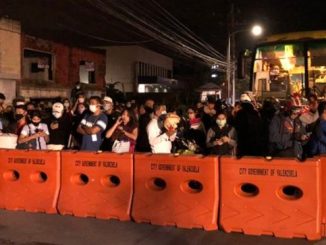
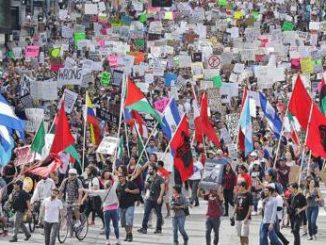
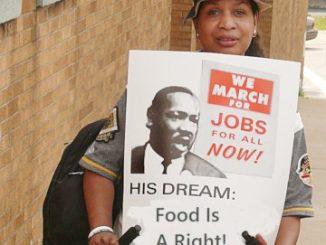
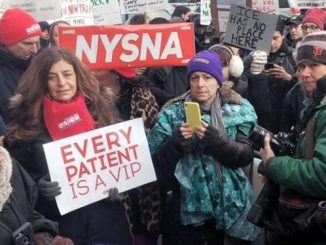
Black Mississippians respond to the ICE raids conducted in Mississippi on August 7, 2019

We, as descendants of enslaved African people, stand here today in solidarity, in determination, and in righteous outrage at the unwarranted and heavy-handed actions of the federal government. On August 7th, 2019, hundreds of ICE agents descended upon four cities in our state, where they arrested nearly 700 workers because they believed that they might be undocumented. These men and women were hauled away, bus load after bus load, with none of the workers able to see to their families and their children – children who would return from the first day of school to find their parents ripped from their lives.

The federal raids in Mississippi are immoral, cruel, inhumane and inherently undemocratic. The words on the Statue of Liberty eloquently state “Give me your tired, your poor/ Your huddled masses yearning to breathe free/ The wretched refuse of your teeming shore./ Send these, the homeless, tempest-tossed to me,/ I lift my lamp beside the golden door!”

The people that were swarmed upon and herded away from their jobs like cattle did not experience this America. Under this administration, the “poor huddled masses yearning to breathe free” are treated with contempt. They are called criminals. They are separated like slaves and caged like animals. Because these immigrants are Brown, the President and some of our own elected officials have decided that these people are not worthy of compassion, inclusion, or basic human decency.

The Brown people that are being targeted are indigenous peoples to this land called America. They were here before Christopher Columbus. Yet, they do not feel the welcome that Polish, Italian, German, and other European immigrants were and are granted. Lady Liberty’s “golden door” is slammed in their faces, as the policies of the President reinforced the fact that America’s immigration policy is a ‘Whites Only’ welcome.

This is a nation of immigrants. Its strength lies in its diversity. Its shame lies in its racial bias. People of color – whether citizens or immigrants, legal visitors or desperate individuals seeking a better, safer, happier lives – are not nameless, faceless pieces to be shuffled across a political game board.

The anti-immigrant, anti-Latinx, anti-Black, anti-human rights policies created by this administration shocks the conscience of all reasonable people. We call on the United States government to rescind these policies and reverse all prior decisions that deny affected people their basic human rights.

We in Mississippi demand better.

Signed:

the People’s Advocacy Institute

the Malcolm X Grassroots Movement

Jaribu Hill/the Mississippi Workers Center for Human Rights,

the NAACP,

One Voice of Mississippi,

the Children’s Defense Fund of Mississippi,

Black Voters Matter of Mississippi,

FWD.us, Mississippi Office

Black With No Chaser,

Higher Ground Strategies,

Mississippi Votes,

MOJO Mamas

Republished from iPetitions via LatinoRebels.

Strugglelalucha256


The anti-people U.S. budget

The U.S. government will spend over $4.7 trillion in the coming year. The federal budget is larger than the entire economies of every other country in the world except for China and possibly Japan.

Every cent of this vast sum comes from the surplus value ― commonly known as “profits” ― produced by the working class in this country and also from workers in Africa, Asia and Latin America.

At least $738 billion of the money voted by Congress will go directly to the Pentagon to kill and subjugate poor people around the world. Big Oil is always the greatest beneficiary of this bloodshed.    

But the military budget just begins there. Fifty-nine billion dollars is slated for the world’s largest terrorist network: the CIA and a dozen other spy agencies.(https://fas.org/irp/budget/)

The State Department and the Agency for International Development will get $56 billion. These are spy agencies too and work hand-in-hand with the CIA to overthrow governments that Wall Street doesn’t like. Secretary of State and ex-CiA director Mike Pompeo is plotting around-the-clock to oust Venezuela’s elected government.

The Energy Department doesn’t just promote fracking and nuclear energy. Close to 90 percent of its $31 billion appropriation is for handling nuclear weapons and developing new ones. 

Then there’s Homeland Security, with a name that sounds like it came out of the Third Reich. Ninety-two billion dollars will be handed over to this Gestapo agency that includes U.S. Immigration and Customs Enforcement, which forcibly separates immigrant families and puts children in cages. 

What this wealth could do

The total amount that will be spent for war and terror in 2020 will be $989 billion. Yet only 16 members of the House of Representatives and five senators voted against Trump’s budget.

Just think if this money were used to help people instead of oppressing them. Taking $31 billion from the nuke makers at the Energy Department could largely fix up New York City’s public housing. 

Here are some other things this $989 billion in war money could do:

  • $450 billion for $30,000 annual college scholarships for 15 million working and poor students. No more student debt!
  • $150 billion to build and repair mass transit systems across the U.S. with free fares.
  • $150 billion to train more doctors and other medical workers.
  • $200 billion in genuine aid to countries around the world that have been bombed, pillaged and economically sanctioned by the U.S. big business government.

These programs could create millions of union jobs with union wages and benefits. 

What about housing? Just in New York City alone there are 25,000 homeless children. Throughout the U.S. there are millions of families who are doubled-up.

But there’s no housing shortage. In New York City, one out of nine housing units — nearly 250,000 apartments — are empty, either because of speculators holding them off the market or because people can’t afford the high rents. A growing people’s movement can and will seize these empty homes. 

What about the deficit?

In the coming year, the U.S. government will spend more than a trillion dollars more than it takes in. Right-wingers in the media and Congress howl about this deficit and advocate cutting Social Security, Medicare and Medicaid to pay for it.

But this deficit doesn’t bother the billionaire class at all. The wealthy and their banks and insurance companies will collect almost all of the $430 billion tax-free interest on the national debt. Only a small amount of that interest goes to holders of savings bonds.

This risk-free bonanza of $430 billion is two-thirds of the $650 billion that capitalists raked in profits from all of U.S.manufacturing last year.

U.S treasury bonds are considered so lucrative that $6 trillion worth of them are held abroad. This goes a long way to finance the U.S. empire’s 4,000 ready-to-shoot nuclear weapons, 800 military bases in 70 countries and 11 aircraft carriers.

Karl Marx called this national debt “one of the most powerful levers of primitive accumulation. As with the stroke of an enchanter’s wand, it endows barren money with the power of breeding and thus turns it into capital, without the necessity of its exposing itself to the troubles and risks inseparable from its employment in industry or even in usury.”  

The entire U.S. budget is a gigantic piñata for the rich. Pfizer, Merck and the rest of Big Pharma rip off Medicare for at least $15 billion in additional profits every year.

That’s because Medicare Part D, which is prohibited by Congress from negotiating prices, pays 73 percent more than Medicaid and 80 percent more than the Veterans Administration for brand name drugs.  

It’s their federal budget, not ours.

Strugglelalucha256


Klansmen in the White House

California Gov. Ronald Reagan was angry that the most populous country in the world―the People’s Republic of China―had finally taken its rightful seat in the United Nations in 1971. But he was furious at the African delegates who welcomed their friend to the U.N.

So Reagan called the White House and talked to President Richard Nixon. “Last night, I tell you, to watch that thing on television, as I did, to see those, those monkeys from those African countries—damn them—they’re still uncomfortable wearing shoes!”   

This repulsive exchange was recorded on the Nixon tapes. It could and should have been made public in time for the 1980 election, when racist Reagan was elected president. But it was suppressed for 48 years.

No surprise

The reaction of most of the media to Reagan’s comments was like the Claude Rains character in the movie “Casablanca.” Rains told the cafe owner played by Humphrey Bogart that he “was shocked, shocked to discover that gambling is going on here!”

Nobody should be shocked by Reagan’s racism — or Nixon’s. While Reagan was on the phone with the White House, he was trying to railroad Dr. Angela Davis to California’s gas chamber.

The month before, in September 1971, Nixon congratulated New York Gov. Nelson Rockefeller for massacring 29 prisoners at Attica. Nixon himself was massacring hundreds of thousands of Vietnamese, Cambodian and Laotian people.

Nixon used the tag team of Donald Rumsfeld and Dick Cheney to dismantle the meager anti-poverty programs that had been started in the 1960s. These two war criminals later played key roles in the bloody invasions of Iraq and Afghanistan.

Reagan called Black people in Watts “mad dogs” when he successfully ran for governor of California in 1966. (“The Metropolitan Frontier” by Carl Abbott.) When hungry people lined up for food packages during the kidnapping of millionaire heiress Patty Hearst, the California governor asked “whether there shouldn’t be an outbreak of botulism.” (Sarasota Journal, March 7, 1974)

Reagan deliberately started his 1980 presidential campaign in Philadelphia, Miss., where three civil rights workers—James Chaney, Andrew Goodman and Michael Schwerner — had been murdered by the Klan. 

Reagan didn’t mention these Black and Jewish martyrs in his speech that day. Instead he called for “states’ rights”—the slogan of the slave-owning confederacy — in a blatant appeal for racist votes. 

Ku Klux Klan Imperial Wizard Bill Wilkinson endorsed Reagan and said that the 1980 Republican platform “reads as if it was written by a Klansman.” (“The Fiery Cross: The Ku Klux Klan in America,” by Wyn Craig Wade) Thirty-six years later the Klan endorsed Donald Trump.

Inciting racist violence

Once in the White House, Reagan busted the strike of the PATCO air traffic controllers in 1981. Union busting and all forms of bigotry go hand-in-hand.

Reagan ignored the HIV/AIDS epidemic for years while his press secretary Larry Speakes laughed about it.

Racist violence spiked before and after Reagan’s 1980 election. Black churches were burned. White racist Joseph Christopher killed a dozen Black and Latinx men in the Buffalo, N.Y., area, Rochester, N.Y. and New York City.

Thirteen days after Reagan was elected, an all-white jury ignored video evidence and acquitted five Klansmen of murdering Comminist Workers Party members César Cauce, Mike Nathan, Bill Sampson, Sandy Smith and Jim Waller. They had been killed in the 1979 Greensboro, N.C., massacre. 

During this same period, at least 28 Black children were killed in Atlanta. Although Wayne Williams was controversially convicted of some of the murders, there’s no way he could have killed all the victims.

Reagan fueled his 1984 re-election by invading Grenada in the Caribbean. Two aircraft carriers and thousands of troops attacked the Black population living on the small, 135-square-mile island.

Hatred of China

The victory of the Chinese Revolution in 1949 was a defeat of white supremacy, colonialism and capitalism. Wall Street and Reagan never got over it. The U.S. Navy occupies the Pacific Ocean today to target China.

Malcolm X wrote how China impressed him when he was imprisoned. The Chinese Revolution was part of the reason for a unanimous Supreme Court decision against school segregation in Brown v. Board of Education.

All the Asian revolutions had a big impact on Africa. After the Vietnamese defeated the French colonialists in the battle of Dien Bien Phu, Frantz Fanon wrote in “The Wretched of the Earth” that Africans were asking, “What must we do to have a Dien Bien Phu?”

Chinese premier Zhou Enlai declared Africa was “ripe for revolution” when he visited several African countries in 1963 and 1964. Thousands of Chinese volunteers helped build a railroad from Tanzania to landlocked Zambia. It was being blockaded by the racist white settler regime of Ian Smith in occupied Zimbabwe. (The settlers called it “Rhodesia.”)

After African U.N. delegates welcomed China, the U.S. Senate voted to violate U.N. sanctions on Zimbabwe. Led by the longtime segregationist Strom Thurmond, they allowed chrome to be imported from there.

Thurmond and the other racist senators couldn’t stop the liberation fighters in Zimbabwe from defeating Ian Smith and winning independence in 1980.

Both Democratic and Republican administrations have since enacted economic sanctions on Zimbabwe, just as they have on Iran, Cuba, Syria, Venezuela and Yemen. Zimbabwe’s “crime” was to take over the land occupied by white settlers and return it to African farmers. 

But China has stood by Zimbabwe and has extended aid to this embattled African country.

Strugglelalucha256


How they made Baltimore poor

Trump’s repeated attacks against Baltimore and Maryland congressperson Elijah Cummings have the smell of fascism. Describing the Black-majority city of Baltimore as a “very dangerous & filthy place,” the White House bigot also tweeted that “no human being would want to live there.”

Trump is telling his supporters that Baltimore’s 400,000 African Americans are less than human, maybe three-fifths of a person, as was specified in Article 1, Section 2 of the U.S. Constitution.

The billionaire president called the city that was the home of Frederick Douglass and Billie Holiday a “rat and rodent infested mess.” Whenever Trump uses the term “infested,” he refers to places with Black people and other people of color. One of Hitler’s favorite phrases was “Jew infested.” 

I lived in Baltimore for six-and-a-half years, from 1978 to 1984 and have gone back frequently to visit. I saw how the city was made poor by deliberate deindustrialization and massive housing foreclosures by the banks.

When I arrived in Baltimore, Bethehem Steel’s Sparrows Point plant just outside the city employed over 17,000 workers. 

The Guiness Book of World Records in 1969 described it as the world’s largest steel plant, with an annual capacity of nine million tons. The Golden Gate and San Francisco-Oakland Bay Bridges were built with steel from Sparrows Point.

Bethehem’s shipyards at the Point and Key Highway—in Baltimore’s Inner Harbor—employed thousands more. Nobody does now.

After years of dwindling employment, the great steel mill completely closed in 2012. The shipyards had shut down earlier.

In their place is an Amazon warehouse at Sparrows Point with 2,000 workers. They make half the pay of the union members at the former steel mill and shipyards, with almost none of the benefits.

A key player in Bethlehem Steel’s destruction is Trump’s commerce secretary, Wilbur Ross. This vulture capitalist owned the Sago coal mine in West Virginia, where 12 miners were killed in 2006.

In 2003, Ross got rid of health care for thousands of Bethlehem’s retirees and spouses. The U.S. government’s Pension Benefit Guaranty Corp. took over their pensions and cut them. 

160,000 factory jobs lost

Like dozens of cities in the Midwest and Northeast, Baltimore was devastated by plant closings. Between 1957 and 2012, the Baltimore area lost 160,000 manufacturing jobs. 

Many of the workers who lost their jobs were African American. Fifty years ago, 35 to 37 percent of the United Steel Workers members in Maryland were Black. (“Toil and Trouble: A History of American Labor” by Thomas R. Brooks) 

Thousands of workers lost their jobs when GM’s Baltimore assembly plant on Broening Highway closed in 2005. Armco’s stainless steel plant in East Baltimore shut down in the 1990s. So did the Koppers plant at Bush and Hamburg streets.

The workers at these plants were union members and had won union pay and benefits. So did most of the workers at the other shutdown factories.

That’s a big reason why the majority of Black families in Baltimore, like those in Detroit and Milwaukee, were homeowners. But in the last fifteen years, thousands of African Americans in Baltimore have had their homes stolen by banks through foreclosures. In just the first six months of 2007, foreclosures increased five times. 

Wells Fargo is the biggest criminal. Half of the bank’s foreclosures in 2006 occurred in neighborhoods that were at least 80 percent African American. That’s because 65 percent of its Black customers had high interest rate loans compared to only 15 percent of its white customers.

Now there’s a new slumlord on the scene: the Kushner family. More than 20,000 people live in the 15 complexes the family owns, most just outside Baltimore city in surrounding Baltimore County. 

The Kushners viciously evict tenants, have taken hundreds to court and garnished their wages. They sued Joan Beverly, who was dying of cancer, for back rent. Some of their buildings have dangerous mold and others, to use Trump’s words, are a “rat and rodent infested mess.”

Unitil January 2017, Jared Kushner was the chief executive of the Kushner Companies. He is still a son-in-law of Donald Trump. 

Racism and unemployment 

It wasn’t just automation or even capitalist decay that destroyed thousands of jobs in Baltimore. Big business was determined to drive Black workers out of basic industry.

In the early 1980s, Western Electric switched over from making copper cable for telephones to manufacturing optical fiber. Thousands of jobs were lost at both Western Electric’s Baltimore plant and its Kearny, N.J., plant near the Black-majority city of Newark. I lost my job in a Baltimore foundry that sold a quarter of its castings to Western Electric. 

Instead of making the new optical cable in either Baltimore or Kearny, production was shifted to Omaha, Neb., whose population was 84 percent white in 1990.

The biggest employer in Baltimore today is Johns Hopkins Hospital, with over 30,000 employees. Thousands more work at Johns Hopkins University.

They’re named for a former slave master who was one of the owners of the Baltimore and Ohio railroad, now part of CSX.

Hopkins Hospital didn’t allow any Black physicians to practice until Dr. Roland Smoot was given admitting privileges in 1966. Over the past decade, it has sued nearly 2,500 poor people for unpaid hospital bills while it gets over $2 billion a year in federal funding. Hopkins is now trying to bust a union organizing drive by its nurses.

A city of struggle

Trump’s racist attacks are all the more painful because Baltimore was a totally segregated city until the early 1960s. Black people couldn’t shop downtown.

The late Bob Cheeks, who played for the New York Giants and had a masters degree in English Literature, told me he couldn’t enter a movie theatre. He was wearing his U.S. Army sergeant’s uniform at the time.

When I came to Baltimore, there were four department stores at Lexington and Howard streets, one on each corner. Within a few years, they were all closed, hardly 20 years after African Americans could first shop in them. The former busy shopping corridors of Howard and Lexington now seem like a ghost town.

But Frederick Douglass’ hometown is also a city of struggle. In 1979, Bob Cheeks, as head of the Baltimore Welfare Rights Organization, helped lead a drive for rent control. 

Despite the landlords spending a million dollars, a majority of people voted in a 1979 referendum to limit rents. But a judge immediately called it illegal. That’s the sort of “democracy” that Trump likes.

In 2015, Black people righteously rebelled against the police killing of Freddie Gray. The people of Baltimore, along with the entire multinational U.S. working class, will defeat all the Trumps.

Strugglelalucha256


A Marxist view of the U.S. Supreme Court

In late June, the U.S. Supreme Court released a wave of decisions, as it does every year at the end of its session. Among them was a ruling giving the responsibility for decisions on partisan gerrymandering to state governments — a big attack on voting rights for Black and other oppressed peoples and all workers. 

With the court now having a far-right majority that includes Trump-appointed anti-woman bigot and serial abuser Brett Kavanaugh, many workers fear what future Supreme Court sessions may bring on reproductive rights, LGBTQ2S equality, police abuse and a host of other issues.

Following are excerpts from a talk given in July 1989 by Sam Marcy, a leading Marxist thinker and fighter, on the history of the Supreme Court and its role in the U.S. capitalist system.

By Sam Marcy

Comrades and friends, we all know that the U.S. Supreme Court last Monday dealt a very heavy blow to the women’s movement in the United States, and by implication, to all of the oppressed and the working class. [The court’s decision in the 1989 case Webster v. Reproductive Health Services upheld a Missouri law prohibiting the use of public facilities, employees or funds to provide abortion counseling or services. The law also placed restrictions on physicians who provided abortions.] Its aim was to set back the women’s movement, the civil rights movement and the liberation struggle everywhere. 

I believe my task in connection with this vicious Supreme Court decision is to put it in the historical and political context, show its connection with the previous historical movement of the workers and oppressed in this country, and how it came to be that a group of appointed, not elected, people, can invalidate the rights of the overwhelming majority of the people in this country.

It is very important for us to know the processes by which this happens so that we are not misled to believe that it is just the Reagan appointees, just Bush, just the negligence of Congress.

For weeks and months the capitalist press played up how the Constitution, adopted 200 years ago in 1789, was one of the most revolutionary documents, that it affirmed a form of government never seen before in the history of humanity, that it was the very paragon of democracy and accorded equal rights to all.

But it is this Constitution, this structure of government and of the state, that explains how these and other decisions have been made and carried out that are so contrary to the opinion of the majority of the people.

Our job is not only to condemn the Supreme Court’s decision but to know why and how this came about and how this decision of the judicial branch of the government relates to the Congress and to the presidency. We must see it in relation to the three branches of the capitalist government and know to what extent the masses of the people, the workers, all of the oppressed, can express themselves within the framework of that government.

When they sat down to frame the Constitution in 1789, they discussed what the powers of Congress, the presidency and the Supreme Court should be. We’ve been told again and again that the purpose of having the government divided into three branches is to see that one doesn’t carry out aggression against the other, that they complement and balance each other so that equal rights are afforded to the majority.

Now mind you, they did not mean the Native people. Nor were the slaves considered. We all know that.

In framing the Constitution they argued for weeks on how to divide the power and what the president should have, because they were not sure whether they wanted a monarchy or a republic. At that time they were not afraid of the Supreme Court. The issue was whether Congress or the president was to have the ultimate authority.

Long history of anti-people decisions

But in 1803 an important decision came up in what seemed a minor dispute. The issue was, did the Supreme Court have the right to nullify a law of Congress? And this decision affirmed that the last word was not with the Congress, not with the elected branch of the government. The last word was with an appointed group of people.

So how did that happen? Was it just a mistake that could be corrected by the next president and Congress? But there came new Congresses, new presidents, new secretaries of state and new judges. That decision was never revoked and hasn’t been to this day.

The abortion decision confirms that whenever the bourgeoisie is in a crisis, they will let nine people, unelected, appointed for life, decide the most critical issues concerning life in the United States.

With something that happened in 1803, so long ago, you could say it was an isolated decision. But in 1853, 50 years later, the court affirmed slavery with the Dred Scott decision. If there was any doubt as to where the real power was, it was right there in affirming the rights of the slave owners as against a majority of the people opposed to slavery.

I want to give you one more example. During the Depression the Roosevelt administration was forced to institute the National Recovery Act in order to save capitalism. It granted the workers the right to organize and established some forms of social insurance, all under the pressure of the working class. 

As soon as it became clear that the capitalist recession was slowly ending, in one day the Supreme Court nullified this whole mass of legislation in the infamous Schechter case and began to roll back the progressive legislation. And to this day the Supreme Court has upheld the anti-labor strike-breaking policies of the National Association of Manufacturers, of the multinational corporations and of the banks. The plight of labor today, at least from the point of view of legality, can be shown to come from this — that in the last resort the ruling class resorts to an instrumentality that is as undemocratic as it is reactionary.

Every day we see new and more glittering inventions that hold so much optimism for the future; they disclose what is happening in outer space, under water. The processes of the physical universe are being disclosed every day. But what about the social processes, the relations between people, between the classes, between the workers and the bosses, the oppressed and the oppressors? At a time when technology uncovers the variety and multiplicity of processes in the physical universe, the real relations in human society are covered up.

It is a contradiction that we as a revolutionary Marxist party must continually unravel. You see, from the time of the Constitutional Convention of 1787 to the present day there has been a gradual democratization of the political process. The franchise used to be denied to the Native people, to Black people, to women, to the youth. But over years of struggle the franchise has been won.

However, alongside this bourgeois democratization of the political process, there has been a simultaneous social and economic process which is superior in strength. That is the process of the concentration of power in undemocratic bodies. It comes from the concentration of the means of production in the hands of a ruling class which holds the power and distributes it in areas most conducive to them. So it’s not an accident that power should ultimately be exercised by the Supreme Court. That’s most reliable to them, most conservative, responsive only to those who have appointed them.

Concentration of wealth and power

So much talk goes on about democracy, about the rights of the people to vote and to elect, but when it gets down to the really critical issues, political power is concentrated in undemocratic bodies that are removed from the control of the masses.

The Congress has power to declare war or to stop war, but it hasn’t done that in a long time. Not in the Vietnam war, the war in Lebanon, the merciless war carried on by the Israeli stooges of U.S. imperialism, or in South Africa, or elsewhere. The Congress does not exercise the power.

We ourselves are in the forefront of fighting to retain, widen and make more effective democratic political rights, not giving up any of them. But we must recognize that alongside this political process of democratizing the organs of the capitalist state, there is the process of concentration of wealth which leads to the concentration of power in the most undemocratic and reactionary elements of the capitalist government.

If we need an example of how the capitalist government deals with democracy, just the other day the Congress unanimously passed an anti-China sanctions bill. First, the capitalist media carried out a monstrous media blitz and cowered all the congress people, and in a couple of hours they passed this law, some of them not even reading it.

While they were doing all this, the Boeing Corporation was meeting with the White House and telling them: You’re forgetting Boeing has a big contract with China for jetliners worth some $400 million. So you’d better not cut that off. So the congressmen got up the next morning and saw that it got stricken from the bill.

And who do you think objected? The competitors of Boeing. Not anybody else. It shows the farcical character of the democratic process.

We don’t wish to convey the impression that we’re against participation in the congressional campaigns, or in any way want to undermine the enthusiasm or militancy of workers, and particularly the oppressed, to try in every way to utilize the capitalist electoral process for progressive purposes. But it’s very necessary to know what we are doing. It’s necessary to know that the politicians do not control the vast machinery of the capitalist state but are controlled by it, and that the state machinery is controlled by the industrialists and above all by the biggest banks.

Strugglelalucha256


The ultra-right Uline

Whenever you see the ULINE trademark on plastic trash cans or any other cleaning and business supplies, think of the word “bigot.” That’s because the outfit’s private owners, Richard and Elizabeth Uihlein, are two of the biggest bankrollers of racism and reaction.

According to the Center for Responsive Politics, the Uihleins donated nearly $40 million to right-wing candidates in the 2018 elections.

In 2017, Richard Uihlein gave $100,000 to Alabama Senate candidate Roy Moore even after he was accused of serial sexual assault. (Chicago Tribune, Nov. 28, 2017)

In an Illinois school district, Richard Uihlein was the financial angel for an anti-transgender school board candidate.

In his residence of Lake Forest, Ill., “where 90 percent of students are white, he backed a school board slate led by the chief critic of Lake Forest High School’s first Black principal, who had criticized honors classes for tracking Black students into lower classes.”

For 150 years, the Chicago suburb of Lake Forest has been an exclusive enclave for rich families like the Uihleins. Among its former residents was the department store magnate Marshall Field, who insisted that the leaders of the eight-hour workday movement — George Engel, Adolph Fischer, Albert Parsons and August Spies — be hanged in Cook County Jail on Nov. 11, 1887.

The wealthy in Lake Forest were so afraid at the time that they sold a square mile of land to the U.S. government for just $10. This was in exchange for the army establishing Fort Sheridan to protect them against a working-class uprising.

Racist real estate covenants kept African-American and Jewish families out of the suburb until at least the 1960s. Black and Latinx swimmers are kept from Lake Forest’s beaches by an annual $750 fee for nonresidents. (“Privilege, Power and Place: The Geography of the American Upper Class” by Stephen R. Higley)

The beer destroyed by greed

The commercial data company Dun and Bradstreet reports that Uline has estimated sales of $3.6 billion.

All of it is owned by Richard and Elizabeth Uihlein, which makes them billionaires according to Forbes magazine. The $40 million the Uihleins gave to bigots could have provided a $3 per hour wage increase for each of their 6,000 employees.

But Richard Uihlein is no “self-made” tycoon. The Uihlein family grew rich by owning Schlitz beer for a century.

In the 1940s and 1950s, Schlitz and Budweiser traded places several times as the No. 1 selling brand of beer in the U.S. As late as 1977, Schlitz had 14 percent of the market, double the share it had in 1950.

But that wasn’t enough profit for Schlitz’s CEO, polo-playing Robert Uihlein Jr. He cut expenses by reducing the brewing time from 25 to 21 days and then to 15 days, while it still took 32 to 40 days to make Budweiser. Corn syrup was used by Schlitz to replace some of the malted barley, while cheaper hop pellets were substituted for fresh hops.

Uihlein figured that workers were too stupid to notice the gradual decline in taste. Of course, only Uihlein is that stupid and beer drinkers did notice the lower quality. Schlitz, with plants around the country, went into free fall. Workers’ control of industry would have stopped this fiasco.

Thousands of union jobs were lost but the Uihlein fortune — interlocked with other Midwestern banking and business families — remained.

What happened to Wisconsin?

Wisconsin was considered a progressive state and a union stronghold. The Badger state passed the first workers’ compensation law in the U.S. in 1911.

So how was Gov. Scott Walker able to attack the public workers’ unions and pass a “right-to-work” union busting law?

In 1976, this writer heard Assemblyman Lloyd Barbee declare, “Wisconsin is a progressive state for white people.” Barbee, who died in 2002, and Vel Phillips, who passed away last year, were two leaders of Milwaukee’s Black community.

In 2010, one out of every 25 African Americans in Wisconsin — from the newborn in an incubator to an elder trying to blow out a hundred candles — were incarcerated. Wisconsin in 2013 had the country’s highest incarceration rate for Indigenous people.

Milwaukee was the last big manufacturing center that the Great Migration of African Americans came to. It wasn’t until 1951 that any African Americans were hired in any of Milwaukee’s breweries, despite the Schlitz brewery being located next to the heart of the Black community at the time. (“Black Milwaukee: The Making of an Industrial Proletariat, 1915-45,” by Joe William Trotter Jr.)

In 1973, members of the American Servicemen’s Union staged an action demanding jobs at Schlitz, which sold a lot of beer to GIs in Vietnam.

The Uihleins and the other wealthy families in Milwaukee were never progressive and helped keep Milwaukee, along with Chicago, two of the most segregated cities in the U.S. The Milwaukee Police Department killed four Black people in December 1974, including 16-year-old Jerry Brookshire on Christmas Eve.

Over 50,000 union jobs were lost in Milwaukee County because of deliberate deindustrialization. But in 2018, voters threw Scott Walker out of Wisconsin’s governor’s mansion. They elected the African American Mandela Barnes as lieutenant governor.

Uline workers need a union. They’ll force the Uihleins to sign a union contract, just like the workers at Schlitz did.

The writer was an organizer of the 1973 ASU action at Schlitz.

Strugglelalucha256


Strikes, protests as rents skyrocket across U.S.

Across the country, working-class tenants are organizing rent strikes, holding protest rallies, taking arrests, occupying state office buildings and forming alliances of tenant groups to confront a national, greed-fueled housing crisis that has simply exploded in recent years.

After some 10 million homes were lost to foreclosures in the Great Recession of 2008, there are now more renters than any time in the last fifty years. And rents are skyrocketing. The crisis has taken the worst toll on those who suffer unemployment, low wages and all forms of economic punishment dished out by the capitalist economy. African-Americans, LGBTQ2S folk, seniors and immigrants are more likely to face evictions and homelessness.

Laws that came about in response to militant tenant struggles and the civil rights movement in the 1960s and 1970s offered some protection against sudden spikes in rent and evictions. But they have been chipped away in the decades that followed, allowing landlords to trample the rights of working-class renters.

Landlord cartels have become more powerful and more ruthless as the wealth gap has widened. While tenants in the past faced a landlord that may have owned a few buildings in the neighborhood, today, apartment buildings and even mobile home parks are being bought up and consolidated by big alliances of investors — hedge funds.

Which partly explains why developers are now only building luxury housing.  Another reason, says Zillow Research’s senior economist Sarah Mikhitarian, is the tariffs. “We’ve already seen tariffs impact the cost of building new homes across the board.”

On June 4, tenants from throughout New York state traveled to the state capitol in Albany to demand a list of tenant protection laws. They blocked three entrances and took arrests. Longtime housing activist/fighter Anne Pruden, a member of Crown Heights Tenants Union, spoke to Struggle-La-Lucha: “The cops arrested 75 people but that won’t stop us. The movement’s getting stronger – there is unity between people of color, progressive white people, labor and the left in NYC and statewide. After this, more attention to public housing is on the agenda.”

In Los Angeles, the L.A. Tenants Union has organized rent strikes, protested in front of the posh homes of landlords and traveled to Sacramento, the state capital, to demand the repeal of the Costa Hawkins Rental Housing Act, which prohibits any strengthening of rent control in California.

Rent strikes have had some success. The 2018 mariachi tenant’s strike helped LATU gain popularity in L.A. The building in the Latinx neighborhood of Boyle Heights is mostly populated by mariachi musicians and their families. The tenants held back their rent, hung banners all over the building and even had a mariachi band playing outside. In addition to not receiving rent payments, the landlord couldn’t attract new tenants during the monthslong struggle and finally began talking with LATU, which gained some concessions from the strike.

Homelessness in L.A. is the second highest in the country, surpassed only by New York City. A shocking report came out on June 4 that revealed an increase of 16 percent over the previous year. It was shocking because in 2017 a local initiative to aid people in need included almost $2 billion to build thousands of housing units.

Some of those funds are being used and some people are being helped. But the number of people being forced out of their homes by capitalist investors exceeds the number that are being housed by a longshot.

According to the website shelterforce.org, Boston has also seen a revival of rent strikes and protests. Rent increases of up to 66 percent have become commonplace, and tenants are getting organized.

In Nashville, rent costs have increased by 70 percent in recent years, and many tenants have been displaced. Tenants’ groups are organizing and have had some success but also face challenges. More than one tenants’ organization has dissolved after landlords threatened to call Immigration and Customs Enforcement on tenants. One tenants’ group though, Homes for All, still holds an annual demonstration against landlord greed.

Corporate-owned media have suddenly begun reporting on the correlation between gentrification and the tent cities of homeless people appearing on the streets of big cities across the country. Two recent studies confirm higher rates of homelessness in rent-burdened (when rents are 30 percent or more of income) cities.

One study by the University of New Hampshire, Boston University and the University of Pennsylvania examined clusters of rent-burdened cities to find the relationship between rents and homelessness. One such cluster — New York City, Los Angeles, Las Vegas, St. Louis and Anchorage — contained only 15 percent of the U.S. population, but 47 percent of the homeless population.

Rent strikes and other forms of activism over the last couple of years have also been reported in Denver; Chicago; Seattle; Rochester, N.Y.; and Austin, Texas, all cities where large parts of the population fit the definition of being rent-burdened or severely rent-burdened.

Rent is one way for the capitalists take back some of the wages paid to workers. It is the organizations of tenants, just as it is the workers in labor unions that fight for wages and job security, that will be the motor force in fighting this torrent of landlord greed.

Strugglelalucha256


The evolving Tiananmen Square narrative, Part 2

Especially in regard to the torturous murder of soldiers, it is clear that not all of the protesters were the same. In that regard, let’s look back at the aforementioned Wikileaks leaked document in Part 1 of this report. That document exposed the cable sent on June 12, 1989, by James Lilley, then U.S. ambassador to China, that gives the eyewitness report of two Latin American diplomats that there was no massacre at Tiananmen Square.

It’s very significant that the author of this cable is Lilley, the U.S. ambassador to China at the time of the Tiananmen Square protests. Lilley was appointed to the position by then President George H. W. Bush, the former head of the CIA.

The Los Angeles Times, in an obituary, describes Lilley like this: “James R. Lilley, a longtime CIA operative in Asia … . He housed top Chinese dissident Fang Lizhi in the embassy for a year and a month before the Chinese allowed Fang to leave for the United States. … He helped insert agents into China, gathered intelligence in Hong Kong and battled against the communist takeover in Laos. He served as ambassador to South Korea, among other posts.”

Add to this the revelations brought out by Robert Rodvick on Voltairnet.org regarding the role of the CIA and the picture becomes even clearer. Rodvick quotes an article in the Vancouver Sun of September 17, 1992: “The CIA Station Chief in China left the country two days before Chinese troops attacked demonstrators in the capital Beijing in 1989, after predicting the military would not act, U.S. officials said. … The Central Intelligence Agency had sources among protesters, as well as within China’s intelligence services with which it enjoyed a close relationship since the 1970s, said the officials, who spoke this week on condition of anonymity. …

CIA helped form anti-government movement

“For months before the June 3 attack on the demonstrators, the CIA had been helping student activists form the anti-government movement, providing typewriters, facsimile machines and other equipment to help them spread their message, said one official. The CIA declined all comment.”

One of those student activists was Chai Ling, who was assisted by then U.S. ambassador Lilley. She, like almost all of the primary student leaders, left China to wind up in the U.S., to enroll in elite universities here. Ling and Lilley appeared on Charlie Rose’s news program on June 4, 1996 — the 7-year anniversary of the protest confrontation at the square. At no time did either of them mention the fact that the “massacre” never occurred at Tiananmen Square and Ling, in fact, took issue with some in the media who called the events at the square violence, rather than a massacre. Also, remember that former Ambassador Lilley had received the cable leaked by Wikileaks, so he knew that there was no massacre.

The other very significant part of the interview was the exposure of Ling’s role in the student protests. Rose referred to a documentary called “The Gate of Heavenly Peace” that came out in 1995 featuring Ling as one of the most prominent student leaders of the protest in Tiananmen Square. The documentary questioned whether more radical students were trying to intentionally force a violent confrontation with the Chinese government. Rose ran the clip in the documentary where Ling was quoted saying on May 28, 1989, one week prior to the Tiananmen Square Incident:

“What we actually are hoping for is bloodshed, the moment when the government is ready to brazenly butcher the people. Only when the Square is awash with blood will the people of China open their eyes. Only then will they really be united. But how can I explain any of this to my fellow students?”

Rose mercifully ends the clip there but here’s the rest of what Ling said:

“And what is truly sad is that some students, and famous well-connected people, are working hard to help the government, to prevent it from taking such measures. For the sake of their selfish interests and their private dealings they are trying to cause our movement to disintegrate and get us out of the Square before the government becomes so desperate that it takes action.”

Interviewer: “Are you going to stay in the Square yourself?

Chai Ling: “No.”

Interviewer: “Why?”

Chai Ling: “Because my situation is different. My name is on the government’s blacklist. I’m not going to be destroyed by this government. I want to live. Anyway, that’s how I feel about it. I don’t know if people will say I’m selfish. I believe that people have to continue the work I have started. A democracy movement can’t succeed with only one person. I hope you don’t report what I’ve just said for the time being, okay?”

And, sure enough, hours before the soldiers entered Tiananmen Square she was whisked away and eventually wound up getting an invitation to attend Princeton University in the U.S., then to Harvard Business School to get her MBA.

The government did show it was desperate to end the occupation of Tiananmen Square, but not as Ling intended. Every effort was made to invite dialogue with other student organizations, and even with top government officials visiting the occupation.

The Chinese government had also claimed that the U.S. directly manipulated the protests with infiltrators, plans and funds to take it further than most protesters had intended.

It’s fitting to compare this to the Occupy Wall Street movement in the U.S. and their treatment. The obvious difference of no one being killed in the breakups of Occupy should be put in the context of the fact that there were no weapons wielded against the police by the Occupy movement. No one from Occupy was holding AK-47s or burning and killing the police or soldiers. (See Part 1 of this report – JP)

If that had happened in this land of the most trigger-happy police force in history, you can imagine the result. No, a fair comparison to the Occupy movement can only come from the treatment of the protesters while they were nonviolent. And, as compared to the U.S., China’s treatment is far more humane. Not only did the government supply buses to give shelter to the Tiananmen Square occupiers when it rained, but it provided cleanup services as well, according to the book by Wei Ling Chua, Tiananmen Square “Massacre”? – The Power of Words vs. Silent Evidence. The students — including their leading spokespersons Wu’er Kaixi and Wang Dan, both of whom were caught in blatant lies about the “massacre” — were given a national platform to discuss with top leaders of the Chinese Politburo Standing Committee their grievances and begin negotiations, which were rejected by the students during that nationally televised meeting that lasted one hour.

Just imagine if leading members of the U.S. Congress had held a nationally televised dialogue with representatives of the Occupy Wall Street movement, where they could speak about the problems of the 1% vs. the 99%. As things are today, it couldn’t happen here. Yet we are told that this is a country that is more democratic and open. But not when it counts.

In that context, it is comical that the Wall Street Journal is now peddling their 11 photos in their May 30, 2019, issue with the foreboding title: “Images Hidden for 30 Years — Liu Jian took memorable photos around Tiananmen Square in 1989. Then he tried to forget them.” The photos don’t show a hint of repression. Compare that to the very real examples of police violence that can be found in photos in which the Occupy Wall Street movement was suppressed from New York to Los Angeles.

Where did the 1989 movement in China come from?

As mentioned before, the protests were made up of various groups. Most of them were students who were joined by workers who were also upset about the overwhelming inflation eating at their wages.

However, there was a class difference in the majority of students as compared to many of the workers in Beijing who may have joined them. In the first place, the student population was just around 0.2 percent of the population at the time. At this same time, the U.S. population of students was 4 percent. Instead of representing any large majority in society, these students instead reflected the problems of privilege that arose after affirmative action to help equalize the population was rejected as part of market reforms steering towards capitalist economics and away from socialist planning.

An attempt to partly rectify that problem and allow a fairer distribution of jobs by the government was met with anger by the students in 1989. Just a year prior, it was these students who were attacking African students studying in China, probably seeing them as competition and reflecting backwardness in regards to racism, forcing the Chinese government to provide protection to the African students.

Many of these students also reflected the policy of the Chinese government to send students abroad to the imperialist countries to increase technological skills and also to learn capitalist business practices. Unfortunately, many brought back the capitalist ideology with their technical education.

Some of the workers in Beijing who joined with the protesters, however, were feeling the effects of a retreat from socialist planning with wages being eaten up by inflation, reflecting the move toward more privatized production. It’s ironic that the very students leading the movement were advocating for market policies that would have forced the workers out of jobs and job security.

Then there were the collaborators with imperialism and imperialist agents who were able to manipulate genuine frustration, encouraging it down the road of recolonization, a road the leadership in China was not willing to traverse.

What about democracy?

Democracy has to be defined because what people mean when they say it is not what is meant in defining the economic system of capitalism. Capitalist countries are usually called “democracies.” But what does that mean? A free market, that is, a privatized market, with no socialist planning regarding production. Is the workplace democratic? Can you elect the boss? Choose your own hours?

Capitalist democracy has nothing to do with the right to determine how the wealth that you and other workers create is used. That wealth, created by working people, is no longer in the hands of the majority. It’s in the hands of those who now own the productive forces — the machines and land — and control the labor force. This is made up of a rich minority who could care less about the majority’s needs for jobs, housing, food and health care. Instead, the focus is on constantly increasing profits for the rich minority. That’s democracy for the rich and dictatorship for poor and working people.

V.I. Lenin, leader of the Russian Revolution of 1917, said it best in his critique of Karl Kautsky: “It is natural for a liberal to speak of ‘democracy’ in general; but a Marxist will never forget to ask: ‘for what class?’ Everyone knows, for instance (and Kautsky the ‘historian’ knows it too), that rebellions, or even strong ferment, among the slaves in ancient times at once revealed the fact that the ancient state was essentially a dictatorship of the slave owners. Did this dictatorship abolish democracy among, and for, the slaveowners? Everybody knows that it did not.” (The Proletarian Revolution and the Renegade Kautsky, 1918)

Always remember to ask in evaluating movements calling for “democracy” and willing to ignore the millions upon millions killed by U.S. imperialism around the world with their endless wars, nuclear bombings, assassinations, occupations and sustaining dictatorships from Israel to Saudi Arabia: Democracy for whom?

And, speaking of pictures, could we retire the Tank Man picture for this one from Palestine:

Strugglelalucha256


Why they want to stop Bernie

The capitalist media have crowned Joe Biden as the likely candidate to win the 2020 Democratic presidential nomination. This isn’t just because the former vice president is leading in the early public opinion polls.

Biden was brought into the race to stop Bernie Sanders. The billionaire class can’t tolerate someone calling themselves a socialist going to the White House. The wealthy and powerful consider it a threat to their system that millions of people in the U.S., including fifty percent of youth, have a favorable opinion of socialism.

Leading the charge against Sanders are so-called liberal publications like the Washington Post, which on May 3 attacked Sanders for taking a 1988 honeymoon trip to what was then the Soviet Union. Fox News gleefully used the Post’s article to condemn the Vermont senator’s “infamous honeymoon.”

On Feb. 20, Slate claimed that “Sanders has a soft spot for Latin American strongmen” because he praised Cuban health care and didn’t immediately condemn Venezuela’s elected president, Nicolás Maduro.   

Four years before, CNN’s Anderson Cooper had also red baited Bernie Sanders about his honeymoon.

It isn’t just about jobs

Underhanded support from the Democratic National Committee ― as exposed by WikiLeaks ― and a massive bankroll paved the way for Hillary Clinton to win the presidential nomination in 2016. But that wasn’t the whole story.

How did Hillary Clinton get to Flint, Mich., before Bernie Sanders did?

To Sanders, progressive politics, even “socialist politics,” consists of raising economic issues like jobs, health care and free education. These are all good things, and who needs them more than the over 110 million Black, Latinx, Indigenous and Asian/Pacific Islander people in the U.S.?

But the lead poisoning of Black and some white children in Flint didn’t seem like a burning political issue to Sanders, at least at first. Otherwise, he would have showed up in Flint well before Clinton did.

Sanders toured the Sandtown neighborhood in Baltimore where Freddie Grey Jr. was arrested by police and given a “rough ride,” resulting in Grey’s death. At the Dec. 8, 2015, news conference that followed, Sanders said that it “makes a lot more sense to me to be getting kids jobs than hanging out on street corners and seeing them end up in jail.”

Young people need jobs and Sanders did call for an end to mass incarceration and federal investigations of all police killings. But Freddie Grey wasn’t killed because he was jobless. He was killed because he was a Black youth.

Sean Bell had a job when police fired 50 shots on Nov. 25, 2006, killing him on what was supposed to be his wedding day. Teamsters union member Philando Castile was killed inside his car on July 6, 2016, after being stopped by police.

What Sanders needed to do was to denounce police terrorism.

Socialists must fight racism

In 2016, Sanders called reparations for the African Holocaust “devisive.” This wasn’t just repulsive; it cost Sanders the votes of many African Americans.

This is an old story in the U.S. socialist movement: If we can just avoid “divisive issues” like reparations, we can unite Black (and other oppressed) voters with white voters on economic issues.

But these “divisive issues” can’t be avoided. Socialists have to fight for justice.

It’s hopeful that Sanders is now supporting a bill to create a reparations study commission.

Bernie Sanders supports many good things, like Medicare For All. But he isn’t calling for a revolution. Revolutionary socialists know that to stop capitalism from cooking the earth we need to overthrow this rotten system. Wall Street and its military machine have to be smashed.

In order to organize this revolution, socialists need to appeal to Sanders’ supporters to stop any U.S. war against Venezuela and Iran. And to join the struggle to free U.S. political prisoners like Leonard Peltier, Mumia Abu-Jamal and Chelsea Manning.

Strugglelalucha256


Fulton Houses tenants say: ‘Keep public housing public’

Over 50 tenants left their homes at the Fulton Houses to unite outside of New York City Hall on May 29. They were rallying to challenge the privatization plan of local politicians and officials of the nearby New York City Housing Authority. “Keep public housing public!” they chanted.

Tenants of the Fulton Houses — a public housing complex run by NYCHA — face the loss of two of their high-rise buildings and other affordable apartment buildings in Manhattan’s Chelsea neighborhood.

NYCHA was established in 1935, during the working-class struggles of the Great Depression. The Fulton Houses were opened in 1965, at the height of the struggle for civil rights. The tenants know their history and the fightback that was needed to win and keep public housing.

NYCHA houses approximately 400,000 tenants in the city’s five boroughs.

For years, the local, state and federal government agencies that control NYCHA have delayed and prevented urgently needed repairs and refused to address lack of heat, unreliable elevators and lead paint in the apartments. Not to mention allowing the buildup of a waiting list of over 10 years for affordable housing in this ever more gentrified city.

Tenants have been protesting the government’s deal with realtors to privatize NYCHA units: an unholy alliance called RAD — Rental Assistance Demonstration. It would remove 62,000 NYCHA units from public housing and move them to market rate, supposedly to subsidize repairs.

Calling this racist and unacceptable, tenant leader Louis Flores demanded: “Public housing residents should have a voice!”  

Tenants demanded public hearings on the plan and called for repair costs to be covered by taxing corporations plus $10 billion from the city’s treasury.

The multinational rally was presented in three languages. It received media coverage and inspired tenants to continue organizing. The event was organized by Fight For NYCHA.

As neighbor Linda said at the end of the rally: “Don’t give up. It’s our community!  We walk another mile today … joining all the way!”

SLL photos: Anne Pruden

Strugglelalucha256
https://www.struggle-la-lucha.org/in-the-u-s/page/60/