Harlem rallies for Cuba, Colombia and Venezuela

Harlemrally
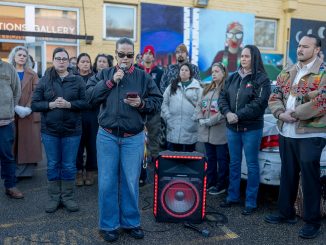
Roger Wareham, of the December 12th Movement, speaking; William Camacaro of the Bolivarian Circle, seated center. SLL photo: Stephen Millies

Oct. 26 — Under the statue of Congressperson Adam Clayton Powell, Jr., people rallied in Harlem today to say no to Trump’s war moves in the Caribbean.

The rally’s co-chair — long-time Cuba activist Rosemari Mealy, JD, Ph.D. — pointed across the street to the former Hotel Theresa, where Cuban leader Fidel Castro met Malcolm X in 1960. Mealy, a member of the New York / New Jersey Cuba Sí Coalition, wrote about that famous encounter in her book, Fidel & Malcolm X: Memories of a Meeting.” 

Ike Nahem of the coalition also co-chaired the rally. It was held on the eve of the annual vote in the United Nations General Assembly condemning the U.S. economic blockade of Cuba. According to Cuban Foreign Minister Bruno Rodríguez Parrilla, the country has suffered over $170 billion in losses over the decades because of it.

Just two months of the blockade cost Cuba $1.6 billion. That’s enough money to pay for the imported fuel needed to power all of Cuba’s electricity. 

The Trump regime is strong-arming countries to vote against condemning the blockade or at least abstain during the roll call. Trump’s flunky Secretary of State Marco Rubio wants to avoid last year’s humiliating 187 to 2 vote denouncing the vicious blockade.

Speakers at the rally reminded onlookers of Cuba’s aid to oppressed people around the world. As the late Pan-African educator and organizer Elombe Brath declared, “When Africa called, Cuba answered.”  

Thousands of Cuban volunteers died fighting alongside their African comrades, defeating the Nazi armies of then apartheid South Africa invading Angola.

The Cuban people shielded the Black revolutionary Assata Shakur from U.S. bloodhounds despite a $2 million bounty on her. Shakur, who became a doctor in Cuba, died free there on Sept. 25.

Thousands of people from around the world, including hundreds from the United States, have received free medical education in Cuba. The only condition is that they go back to their countries and help heal the poor.

Defend Cuba, fight ICE

William Camacaro of the Bolivarian Circle denounced Trump’s war threats to Colombia and Venezuela. Ten thousand sailors and marines are on an armada of warships in the Caribbean.

Ed Ventura of the Bronx chapter of JUPI — Youth United for Independence — denounced Trump for using Puerto Rico as a staging ground for threatening Colombia and Venezuela.

The human rights attorney Roger Wareham, a member of the International Secretariat of the December 12th Movement, pointed out that Zimbabwe — like Cuba — has been sanctioned by the United States. Zimbabwe’s “crime” was to take back land stolen from Africans by European settlers.

Cesar Santos, a co-chair of the National Network on Cuba, urged people to keep on fighting to defend Cuba. Santos also videotaped the rally.

New York State Senator Cordell Cleare, whose 30th district includes Harlem, mentioned how the blockade of Cuba harms people in the United States as well. She described how the Roswell Park Comprehensive Cancer Center in Buffalo, New York, is hindered in its collaboration with Cuban scientists to fight lung cancer. 

Different artists, including a spoken-word performance from the Harlem Bomb Shelter, gave cultural performances.

Cuba Sí Coalition member Jason Corley urged people to check out books about Cuba.

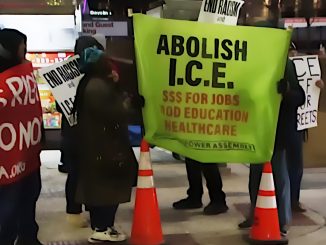
The rally was held while ICE agents were kidnapping people across the United States. National Lawyers Guild President Suzanne Adely urged people to unite against this terror campaign and connected the struggle with defending Cuba.

Hands off Cuba, Colombia and Venezuela! Stop ICE!


Strugglelalucha256


Intelligence artificial, profits fictitious

Aigenerated

The U.S. economy isn’t booming — it’s levitating. What keeps it up isn’t productivity or innovation, but speculation.

The so-called “AI revolution,” hailed as a new industrial dawn, is in reality a massive bubble — a speculative fever driving stock prices far beyond what the technology can actually deliver.

The anatomy of a bubble

A speculative bubble forms when the price of something — like tech stocks — rises far beyond its real, sustainable value. 

That real value comes not from market hype or quick profits, but from workers’ labor power — their capacity to create more value than they’re paid for.

But in a bubble, prices rise not because real production or value creation is expanding, but because investors are chasing promises — each betting that someone else will pay even more for the same asset.

The pattern isn’t accidental. It’s built into capitalism itself.

Step one: Capital needs to expand

Capitalism runs on an “expand or die” engine. Every firm must grow constantly to survive — outspending, outproducing, and out-innovating its rivals.

When one wave of growth slows, capital hunts for another.

After smartphones and social media stopped generating explosive profits, investors went searching for a new frontier. They found one in artificial intelligence.

The dream of “intelligent machines” became a new gold rush. Investors declared that AI would transform every industry — from health care to law — and didn’t care that most promises were decades from reality. The only thing that mattered was that AI looked big enough to sustain the expansion.

Step two: Credit makes it look real

Once hype takes hold, the credit floodgates open. Trillions pour into data centers, chips, and cloud infrastructure — all on the assumption that future profits will justify today’s staggering costs.

Marx called this stage “fictitious prosperity” — an expansion of paper claims on future profits that have no immediate basis in the value created by labor. It makes the appearance of growth without its substance.

AI now fills that role. Capital is pouring into technologies that do not yet produce surplus value, but inflate the balance sheets of corporations through speculation and state contracts.

Stock markets surge, investment booms, and politicians hail the “AI economy” as proof of recovery for an economy still addicted to cheap credit. Beneath the surface, profits are scarce — it’s all fueled by expectations and debt.

At its peak, Nvidia’s stock traded at roughly 138 times its annual profits — a level of frenzy that made the dot-com era look restrained. Nearly 60% of the 2024 S&P 500 gains came from just seven companies. The AI mania has now surpassed the dot-com madness of 1999.

Step three: When illusion meets limits

Eventually, reality breaks through. Chatbots hallucinate. Image models can’t pay their own server bills. Consumers aren’t buying AI products in meaningful numbers.

Yet stock prices keep climbing because no one wants to be the first to admit that capital’s paper claims have outgrown the value created by labor. That’s when the bubble is complete — when financial values are totally unmoored from production and profit.

The new U.S. mirage

AI is the latest chapter in speculative capitalism. Beneath the rhetoric of innovation lies a simple truth: The U.S. economy is being propped up by fictitious capital, not productive labor.

Manufacturing is shrinking. Service jobs are fading. Household debt is climbing. The glittering tech boom hides stagnation everywhere else.

Even figures within the tech establishment — from Eric Schmidt, Google’s former CEO, to analyst Selina Xu — admit Silicon Valley’s obsession with Artificial General Intelligence (AGI) has bypassed the real opportunities to use the AI that already exists. 

AGI refers to a hypothetical machine intelligence that could learn and reason across any task as flexibly as a human being — a kind of “universal mind.”

Unlike today’s narrow AI systems, which are built for specific functions, AGI would supposedly understand and act in many domains on its own.

In reality, AGI doesn’t exist. Its promise serves capital as a speculative frontier — a projection of limitless productivity used to justify vast investment and state subsidies.

From a Marxist perspective, the AGI hype embodies capitalism’s technology fetish — the belief that machines, not labor, create value.

The pursuit of AGI is a chase for power and profit, not progress.

AI as empire

Behind the bubble lies empire. The Pentagon, CIA, and venture capital share the same fantasy: that AI supremacy will guarantee U.S. global dominance.

Massive government contracts — from surveillance software to autonomous weapons — now serve as subsidies for Silicon Valley. Nvidia, Microsoft, Amazon, and Palantir sit at the crossroads of finance capital and the military-industrial complex.

Even Joe Biden, in his farewell address from the White House in January 2025, spelled it out plainly — a rare moment of honesty.

Biden said that “an oligarchy is taking shape in America of extreme wealth, power and influence that literally threatens our entire democracy, our basic rights and freedoms.” 

He spoke of “a dangerous concentration of power in the hands of a very few ultra-wealthy people.” 

He specifically talked about the rise of a “tech-industrial complex,” deliberately echoing Dwight Eisenhower’s 1961 warning about the “military-industrial complex.” Biden said this new power bloc is “infringing on Americans’ rights and the future of democracy.”

The fusion is now complete — a military-tech-industrial complex, edging toward what some have begun calling tech fascism.

Biden compared today’s situation to the Gilded Age of “robber barons” — a time when the U.S. economy was dominated by extreme wealth and imperialist expansion into Cuba, Puerto Rico, and the Philippines. It was also a time when Mark Twain and organizations such as the American Anti-Imperialist League were fighting the expanding empire.

Biden didn’t name names. But his remarks landed as Elon Musk, Mark Zuckerberg, and Jeff Bezos aligned themselves with the incoming Trump administration, planning to attend Trump’s inauguration.

Silicon Valley has metastasized into a merger of big capital, big tech, and big war. The empire’s newest weapon isn’t a missile — it’s the algorithm.

Washington’s chip bans on China, its trade sanctions against Huawei, and its AI-driven military pacts — from AUKUS to its defense-tech alliances with Japan and South Korea — all follow the same imperialist logic. Civilian technology and military infrastructure are being fused into a single system of global dominance.

China’s different path

China, by contrast, is treating AI not as a casino chip but as a tool. Instead of betting on abstract intelligence for future profit, China applies AI to real sectors — manufacturing, logistics, energy, and urban planning.

Chinese government white papers outline over 400 industrial-AI pilot zones focused on logistics, steel, and energy — showing production-first deployment.

The difference is stark. The U.S. is using AI to inflate a bubble. China is using it to build.

Industrial policy or financial subsidy

Washington insists it’s rebuilding industry through the CHIPS and Science Act, the Inflation Reduction Act, and new “AI innovation zones.” In reality, these are less industrial policy than corporate welfare — government funds funneled into private monopolies.

Billions more flow to Intel, TSMC, and Nvidia — the same firms driving speculation. The state isn’t reviving manufacturing; it’s financing and guaranteeing corporate profits, socializing risk while privatizing gains. The “AI economy” isn’t rebuilding the U.S. productive base; it’s inflating the next crash.

While the U.S. bankrolls hype, China retools for production. This isn’t just a tech race — it’s a clash between two systems: finance-driven capitalism versus planned development.

Breaking the cycle

Real progress means ending the profit system itself — where production serves private wealth, not human needs. Capitalism turns every advance into a new source of profit, not a means to improve life.

Technology should serve society, not capital. The wealth created by human intelligence — through research, education, and labor — shouldn’t be siphoned off into yet another speculative frenzy.

Until we take tech out of the casino, every so-called “revolution” will end the same way: the bubble bursts, and workers are the ones who pay — with layoffs, wage cuts, and gutted public services.

The rich walk away richer. Everyone else is left to bear the cost of their crash.

Strugglelalucha256


If people have a right to live, don’t they have a right to health care?

The only parts of the U.S. Government that have been shut down are those that are actually trying to help people. Three-quarters of a million workers have been locked out of their jobs by Trump.

Other federal employees have been forced to work without getting paid, including air traffic controllers. That’s the sort of stress that they — as well as passengers and crew members — don’t need.

Inspectors from the Occupational Safety and Health Administration (OSHA) have been told to stay home. Meanwhile, 16 workers were killed in an explosion at the Accurate Energetic Systems munitions plant in Tennessee. 

However, the ICE Gestapo agents terrorizing Chicago and the rest of the United States are still getting paid. The U.S. Navy is executing people in the Caribbean while plans for invading the Bolivarian Republic of Venezuela are going ahead.

The shutdown didn’t prevent live artillery shells from being fired from the Marine Corps Base Camp Pendleton across Interstate Highway 5, stopping traffic between Los Angeles and San Diego. (Amtrak trains were also halted.) One shell exploded prematurely, showering shrapnel over two vehicles.

The Oct. 18 spectacle was presided over by Vice-Führer JD Vance and Secretary of War Pete Hegseth. It was a not-too-subtle threat to the millions of people demonstrating the same day across the United States in the “No Kings” rallies against Trump.

That’s more proof that the real capitalist state is the “deep state” of violence, prisons, cutbacks and war.

We need to organize our own resistance

Almost all Democrats in Congress are refusing to vote for a “continuing resolution” that will fund Trump’s regime. It was another story back in March, when Charles Schumer, the Democratic majority leader in the Senate and nine other members of the Democratic caucus voted for a similar measure.

Trump praised Schumer for capitulating. A few days earlier, almost none of the over 200 Democrats attending Trump’s March 4 speech to a joint session of Congress did anything to protect Texas Rep. Al Green. The 77-year-old Black congressperson was dragged off the floor for shouting, “You have no mandate to cut Medicaid.” 

The reason for Schumer’s about-face is that millions of voters are demanding resistance to Trump’s march towards fascism. The Democratic Party establishment wants to keep this struggle within the bounds of capitalist elections.

They don’t want anti-war and pro-Palestinian slogans raised at the No Kings rallies. The wealthy and powerful are fearful of an even larger struggle than the Black Lives Matter demonstrations in 2020. 

The Democratic Party leadership’s opposition to the “continuing resolution” is centered against the so-called Big Beautiful Bill that will force millions of people off Medicaid. It will also remove the subsidies for getting health insurance under the Affordable Care Act, which will make monthly premiums skyrocket. 

The response of Trump and his Fox News cheerleaders is to claim that Democrats want to provide free health care to undocumented immigrants, who these bigots call “illegal aliens.” 

No child is illegitimate, and no human being is illegal. Without the absolutely essential labor of undocumented workers on the farms and in the food processing plants, we would starve.

Instead of denouncing this hate mongering, Democratic Party spokespeople are denying they want to give any aid to human beings without papers. 

Are people born in other lands supposed to be denied medications and drop dead in front of hospitals? Are immigrant children needing treatment to be left to die? 

Health care is a human right!

Refusing poor people health care is old news in the United States. Hundreds of Black men were deliberately denied treatment for syphilis in the notorious Tuskegee Study. These experiments lasted from 1932 to 1972.

T. Harry Moore and Harriette Moore were murdered in their Brevard County, Florida home on Christmas Day, 1951, by Ku Klux Klan members who planted a bomb. The Black couple helped tens of thousands of Black people to register to vote.

Both were driven 30 miles away to a Black hospital because the nearby white hospital would have denied them admission. Hundreds of medical facilities refused treatment to Black, Indigenous or Latine people until well into the 1960s.

It’s political cowardice for Democratic congressional leaders to say they’re against providing health care for the undocumented. It’s capitulating to racist Trump.

People’s movements, especially the labor movement, need to declare that health care is a human right. Our enemies are the billionaires, not our fellow poor and working people. 


Strugglelalucha256


No Kings, No Empire: Protest and the war economy

Millions filled the streets on Oct. 18.

The “No Kings” protests erupted in more than 2,700 locations across all 50 states — the largest coordinated action against Donald Trump since his return to office, and perhaps one of the biggest mass mobilizations in recent U.S. history.

Crowds surged through New York, Washington, Los Angeles, Chicago, and Boston. But resistance spread far beyond the major cities. Workers marched in Birmingham, Alabama. Demonstrators filled the streets of Billings, Montana.

The protests were against the authoritarian actions of the Trump administration, ICE operations, federal program cuts, and for constitutional rights.

Yet the leadership of the “No Kings” campaign is firmly rooted in the Democratic Party.

Groups like Indivisible and MoveOn — both pillars of the Democratic establishment — were listed as official sponsors. Their involvement shaped the movement’s limits, especially around foreign policy: the U.S.-NATO proxy war in Ukraine, the genocide in Gaza, and Washington’s escalating confrontation with China.

The color of empire

The official No Kings website encouraged participants to wear yellow, referencing the pro-NATO Yellow Ribbon Movement in Ukraine and the anti-China Yellow Umbrella protests in Hong Kong. Whether coincidence or design, the symbolism signals alignment with U.S. imperialist foreign policy.

Since 2016, Democratic opposition to Trump has often focused not on his attacks on workers or the poor but on his supposed “softness” toward Russia and China. His first impeachment, in 2019, wasn’t for caging migrants or gutting health care programs — it was for delaying weapons to Ukraine.

Biden continued that trajectory. From day one, his administration poured billions into NATO and armed Ukraine to the teeth, even as it funded and defended Israel’s campaign of mass genocide in Gaza. At the same time, it intensified the tech and trade war with China, maintaining Trump-era tariffs while launching new measures to block Beijing’s access to advanced semiconductors. Washington also deepened military alliances: forming AUKUS, strengthening the Quad, and integrating Japan and South Korea into its Indo-Pacific war plans. The strategy is clear — to build a NATO-style military bloc aimed at containing China. “Containing China” is what Obama said.

By adopting the color yellow, the “No Kings” organizers effectively tried to merge domestic opposition to Trump with support for U.S. wars abroad. But anti-imperialism is not a distraction from the struggle against authoritarianism — it is central to it. A movement that fails to challenge empire cannot defeat Trumpism, because empire is the source of its power.

The war that never sleeps

From Gaza to Ukraine, from Haiti to Venezuela, from Somalia to Yemen, and across the South China Sea, Washington’s war machine never rests.

Secretary of War Pete Hegseth has vowed to wage a “war on woke.” Every progressive cause, from Black Lives Matter to reproductive rights, from trans liberation to union power, is recast as a threat to national security. “Making America Great Again” now means silencing dissent at home and expanding war abroad.

Whenever U.S. imperialism goes on the offensive, it demands unity — and obedience. Behind the MAGA slogan lies the same order as always: Shut down the class struggle.

Every bomb dropped on Gaza, every missile launched from a U.S. destroyer, every naval drill off China’s coast is not only an attack on people abroad — it’s an attack on workers here. War budgets drain the public purse; social programs wither. The empire wears different faces, but the engine beneath never changes.

The Biden–Harris years presided over drone wars and unconditional backing for Israel’s genocidal siege of Gaza. Trump’s second term has intensified those same policies with open brutality. On Oct. 15, his administration authorized a new round of covert CIA operations in Venezuela — including lethal “paramilitary action” aimed at regime change.

While claiming to end “endless wars,” Trump surrounds himself with defense contractors and private mercenaries. Pentagon deployments in the Caribbean — including at least eight U.S. warships, a submarine, B-52s, F-35s, and thousands of troops — are an escalation of war, not a withdrawal.

Democrats, for their part, denounce Trump’s rhetoric but fund the same war budgets. They compete over who can arm Israel, Ukraine, or Taiwan faster. Their unity is bipartisan — the unity of capital.

Meanwhile, the war economy expands.

In munitions plants across Tennessee and Texas, production lines run nonstop. Workers die in preventable explosions while inspectors are furloughed under budget freezes. Defense CEOs cash in on record stock options. This is not “national defense.” It is organized theft — the conversion of public wealth into private profit.

Lessons of the past

We’ve seen this pattern before.

A century ago, President Woodrow Wilson — a Democratic demagogue and open white supremacist — promised to keep the U.S. out of war. Many progressives believed him. They abandoned the independent workers’ movement to back the “peace candidate.”

Within three years, Wilson plunged the nation into imperialist slaughter in World War I — and jailed socialists who opposed it. Eugene V. Debs, who urged workers to fight their real enemies at home, was imprisoned for speaking the truth.

The lesson endures: Every promise of “peace with honor,” from Wilson to Biden to Trump, conceals the same reality — a capitalist state beholden to Wall Street and the Pentagon. Both parties serve the same system, even as they trade places in power.

Failure to build unity against racism

The early socialist movement made another tragic error. It fought courageously for labor rights, but too often neglected the central question of racism. Many believed socialism would come first, and liberation later.

But socialism without an active struggle against racism was — and remains — an illusion. That failure fragmented the working class. Employers exploited racist divisions to crush strikes, exclude Black, Mexican, Asian, and Indigenous workers from unions, and sustain the hierarchy that capitalism requires.

Marx and Engels recognized the revolutionary role of the Black freedom struggle during the U.S. Civil War. They saw that slavery was not an aberration but the foundation of U.S. capitalism itself. Yet much of the socialist movement refused to learn that lesson, and it disintegrated under the twin pressures of racism and imperialist war.

The war economy and the working class

Today, the movement resisting Trump’s authoritarian project cannot repeat those mistakes.

A real resistance must be anti-racist, anti-sexist, anti-transphobic and anti-imperialist. The fight for liberation is one struggle with many fronts.

Look at the economy.

Manufacturing for civilian needs continues to decline, while militarized production surges — aircraft, missiles, drones, surveillance systems. Every major product from Silicon Valley ends up under a Pentagon contract. AI firms design targeting algorithms. Cloud companies build “battlefield networks.” Energy corporations secure war profits while ordinary households face shutoffs and rent hikes.

This is capitalism in its imperialist stage — a parasite that survives by producing destruction.

Workers feel it directly. Union jobs vanish while defense firms boom. Inflation erodes wages. Public services collapse. But the stock prices of Lockheed Martin, Raytheon, and Northrop Grumman soar.

The same machine that bombs Gaza and threatens Beijing is the one that closes hospitals, guts schools, and evicts tenants.

Every bomb dropped on Gaza is an attack on the working class — not only abroad but here at home.

That’s why fighting against war is inseparable from the fight against King Trump.

War dominates all issues. But it also unites our struggles — because every front, from Gaza to health care, from trans rights to housing, leads back to the same system. In that unity lies the power to change it.


Strugglelalucha256


Thousands rally against Trump in New Orleans, could have taken the streets

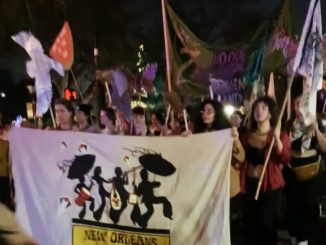
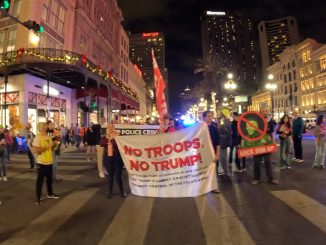
New Orleans, Oct. 18 – Thousands came out to the “No Kings” rally,  joining protesters in some 2,700 locations across the country. The crowd filled up a large section of the Lafitte Greenway. And lest anyone say that people only came out to voice opposition to Trump in “liberal” New Orleans, rallies were also held in the northshore, Baton Rouge, Lafayette and Shreveport.

For those of us who really want to take on Trump and the racist, decaying capitalist system he defends, we should be encouraged that so many came out, just as they did in earlier mobilizations this year. To stop Trump, we’re going to need more people in the streets – a lot more. 

It was the huge movement for Black Lives that pushed Trump back during his first term, not the Democratic Party, whose “resistance” centered around Russiagate conspiracy theories. (Really, they were pushing for war with Russia. That became a reality and “Trump the Peacemaker” is continuing it.) 

Here in New Orleans, the No Kings leadership decided not to march. The excuse passed among the crowd is that they were either unable or unwilling to get a permit. But groups march in the city without a permit all the time. Contingents of only 30 to 100 people do it regularly.

The thousands who came out to this rally could have easily taken the streets, permit or not. We could have marched through the French Quarter to gain the support of the hospitality workers, who have the power to bring the tourist economy to a screeching halt. We could have marched on Orleans Parish Prison like we did in the summer of 2020. On that night, people locked up in the jail came to the windows and raised their fists in the air. 

Many things were possible. The organizers squandered an incredible opportunity to show the strength of the masses. How else are we going to give Trump and Landry a run for their money?

But the Democratic Party-aligned organizations that initiate protests like these will never lead a genuine movement against fascism. For that, we need independent organizations of the oppressed and the working class.

Aside from the numbers, there was another bright spot at today’s rally. Local Palestinian organizers were actually able to take the stage. They explained the connections between what the people are facing here in the United States and this government’s imperialist assault on Palestine and others resisting domination. 

The leaders of the Democratic Party are 100% complicit in the U.S.-Israeli genocide. (Remember how they totally shut out Palestinian voices from the 2024 party convention?) But the resistance of the Palestinian people – which is bolstered by a global solidarity movement – has transformed peoples’ consciousness. That’s evident in New Orleans. Throughout the crowd people held Palestinian flags or wore keffiyehs. The rich leaders of the Democratic and Republican parties have not been able to squash this movement.

Today showed that many people already understand that all these struggles are connected. And they’re ready to fight. So, let’s actually hit the streets to bring down wannabe King Trump. There’s no other way.

Strugglelalucha256


Bob McCubbin and the untold history of queer labor solidarity

Bob McCubbin (1942-2025) was a pioneering revolutionary theorist and activist.  In 1976, he wrote one of the first Marxist analyses of LGBTQ+ oppression. His book “The Gay Question: A Marxist Appraisal,” later expanded as “The Roots of Lesbian & Gay Oppression,” was groundbreaking. The Stonewall Rebellion shaped his politics. He fought for LGBTQ+ liberation for five decades. He stood with the Black Liberation movement. He marched in the streets. He organized strikes. A co-founder of the Struggle for Socialism Party in 2018, he wrote until the end, publishing “The Social Evolution of Humanity, Marx and Engels Were Right!” in his final years. He organized for Palestine at San Diego Pride just months before his death. McCubbin died in August 2025 at age 83. 

The following paper is by Dawn Miller. She is a teacher in San Diego and a member of the Association of Raza Educators. She wrote this several years ago. It spotlights Bob McCubbin as a local activist, organizer, and mentor. McCubbin supported the Association of Raza Educators for years. He championed their mission. He embodied what it means to be a teacher of and for the people. 

No Pride Without Labor:
The Revolutionary Bond Between Queer and Working-Class Liberation

In the mid-1990s, fresh out of college, I had the unforgettable experience of meeting Leslie Feinberg, managing editor of Workers World newspaper and legendary “Transgender Warrior,” speak at a local event. I was brought there by Bob McCubbin, a close friend of Leslie’s and a fierce activist in his own right and fellow educator. I had never heard anyone articulate the intersections of oppression under capitalism as powerfully and clearly as Leslie did that day. 

That moment, and Bob’s subsequent mentorship and writings, fundamentally shifted my own trajectory and politicization as a queer person. He helped me understand that the fight against queer oppression is inseparable from the fight against capitalism, and that true liberation for all oppressed peoples demands the advancement of communism and nothing less.

Tragically, Leslie has since passed, but I’ve had the great privilege of building a relationship with Bob, who is not only part of this paper’s focus but has also been a guiding figure in my ongoing understandings of radical queer and labor histories. Through my interviews with Bob, a pattern has become strikingly clear: Over the last century, there have been deep, deliberate acts of solidarity between the gay liberation movement and the labor movement. These moments of cooperation, though often under-recognized, were mutually beneficial, and in many cases, they created key openings for queer advancement within broader struggles for justice.

Now in his 70s, Bob’s class consciousness was honed at the young age of 10, working as a paper delivery boy to supplement his family’s income in 1940s Buffalo, New York. Working through high school and college, post-graduation, Bob found himself as part of Local 1199, an independent, progressive union that organized clerical workers at Columbia University. He remarks:

“The pay was terrible, and when we would make wage demands on the administration, their position was that we should be happy with the prestige we gained being associated with such a renowned institution. Our reply was always, ‘We cannot eat prestige.’” 

Despite its anti-Vietnam war stance and massive mobilizations around social issues of the day, the union remained silent on sexual minority rights. Bob said he felt others knew and accepted his sexuality as a gay man, and he described the chapter as having an uncommonly large LGBTQ membership; however, the push for anti-discriminatory practices and clauses in contracts for queer unit members were not topics on the table yet.

Queer people have always been part of the labor movement: paying dues, organizing strikes, holding the line, and fighting tooth and nail as some of labor’s most outspoken organizers against capitalist exploitation. But for decades, their identities were buried, forced into silence by the same systems that demanded their labor while denying their humanity.

In the 1930s, the Marine Cooks and Stewards Union of the CIO deliberately organized gay workers and promoted them into union leadership, but this was an anomaly. There are a few documented examples of labor’s push for LGBTQ rights peppering the ‘50s and early ‘60s, but most unions remained complicit in erasing queer members, offering little protection as these workers faced surveillance, firings and blatant violence simply for existing. 

It wasn’t until the rebellion at Stonewall in 1969, an uprising led by working-class, Black and Brown trans and queer people, that the labor movement began to feel the pressure to confront its own failures and step up. Queer workers demanded that labor reckon with the truth: There’s no liberation for the working class without queer liberation, and there is no revolution worth fighting for that leaves anyone behind.

Bob told of life as a gay man in 1970 New York, where police would come regularly to the gay clubs, which were then illegal, and, “with pure hate in their eyes,” harass, defile, assault, and arrest the men at their whim. 

In one incident, Bob recalled the police shooting of a young gay man who was hospitalized with life-threatening injuries. When gay activists approached the young man about organizing a picket and protest against police brutality, he pleaded against it with great desperation for fear of further retaliation in the community at the hands of the cops. He did request help with his mounting hospital bills, and so Bob and friends organized a fundraiser dance, and the only venue that would hold their event was the meeting hall of the International Longshore and Warehouse Union of San Francisco. 

Bob recalled sitting with the union leadership that night, all white, older men, “You could tell that although they were a bit surprised by the crowd that flitted around them, they were committed to their progressive philosophies and belief in solidarity with all workers in pursuit of a more just world.” 

What began as a single meeting grew into a long-standing relationship rooted in mutual support and collaboration. It also underscores an often-overlooked historical truth: During a time when civil rights struggles were gaining traction, gay liberation remained deeply stigmatized, and unions were often one of the few, and sometimes the only, institutions willing to stand in solidarity with queer people and their struggle for justice.

In the mid-1970s, the gay community in California initiated a boycott of Coors Beer Company because it had fired a number of gay workers and forced new hires to submit to lie detector tests that questioned them about their sexual orientation. The boycott quickly spread to the East Coast and gained momentum as gay bars and gay-owned businesses bi-coastally refused to sell Coors products. Teamsters, who had also been planning a boycott because of unfair employment practices at Coors, approached gay organizers, specifically Harvey Milk and Howard Wallace, wanting to support and merge together to form a larger boycott. Milk and Howard insisted that the union be open to hiring gay folks as truck drivers; the union agreed, and a great moment of coalition building began. 

With the backing of the nation’s largest union, not only was the boycott ultimately successful, but discriminatory employment tactics against gays and lesbians became part of the larger societal conversation around labor rights and civil rights for the LGBTQ community. The union went on to support Harvey Milk in a successful bid for San Francisco supervisor. Ultimately, the successes were evidence of the power of collaboration and the need for interdependence between labor and queer movements.

Back at Columbia, in the wake of Stonewall, Bob and fellow gay workers were ready for action. In the ensuing protests that followed Stonewall, the call to action from gay liberation leaders for the gay community to rise up, was heard loud and clear by Bob and his comrades. During a larger strike at Columbia University for wage increases, the gay contingent insisted the union also push for contract protection for “sexual minorities.” Having been originally organized by the Communist Party, the Columbia University chapter of Local 1199 was tolerant of its gay contingent, but had yet to push for specific rights. 

As Bob recalled, “As progressive as it was, the Communist Party organizer and bargaining chair was rather cynical about our rank-and-file demand that protection for our LGBTQ members be included in the contract we were negotiating. At the ratification meeting, I asked him directly if we’d won inclusion of the clause. ‘Yes,’ he replied with a smirk, ‘we won protection for gays, bisexuals, trisexuals. …whatever.’” 

Bob believes that this clause in the contract may in fact have been one of the first times such a labor right for the queer community was won, but lamented that, “the only place it’s documented would be in a dusty file cabinet somewhere on West 43rd Street.”

Gay rights activists and labor continued in collaborative struggle in 1978 with the introduction of the Briggs Initiative (Proposition 6) in California, which would have banned “homosexuals” from teaching in the public schools. The AFL-CIO came out in full support to defeat the proposition, spending large amounts of money and sending out massive amounts of anti-6 literature. 

Importantly, during this campaign, the AFL-CIO pushed for a federal law banning discrimination based on sexual orientation. Although this legislation was never realized, and LGBTQ workers today still lack federal protection, the labor-gay alliance was successful in defeating the Briggs Initiative and further bolstered the relationship between the groups that laid ground for future successes. 

As Gerald Hunt elaborates in his book “Laboring for Rights: Unions and Sexual Diversity Across Nations,” “During the 1990s, as with California’s Briggs Initiative in 1978, union backing at the national, state and local levels was critical in defeating anti-gay initiatives and amendments in Oregon, Washington and Idaho” (82). He goes on to tell of anti-gay campaigns that were successful in places where labor was absent or late to respond to calls for support.

Throughout the history of the gay community’s struggle for liberation, labor has often been its strongest, loudest and most consistent ally. Alliances in times of struggle, on both sides, have proven advantageous, and principles of solidarity have advanced success for all involved. However, today, in a time of great attacks on labor, some critics ask where the voice and support of the gay community has gone. While gay people enjoy greater rights and more social advancement than ever before, that same community is largely silent as labor unions and workers’ rights are systematically decimated.

Author Jerame Davis writes, “If we cannot stand in solidarity with one of our oldest supporters, what is the message we are sending to the myriad of allies we’re creating today? Are we simply opportunistic friends whose relationship depends on what the other side has to offer and nothing more? Solidarity isn’t transactional, it’s transformational.”

It was Bob’s early experiences in both union work and the emerging gay liberation movement that launched him into a lifelong path as a radical organizer, prolific writer and dedicated comrade in the Workers World Party. For Bob, the solidarity he witnessed in the labor and queer movements was a political awakening. It shaped his fundamental understanding that race, gender, class and sexuality aren’t separate issues; they’re deeply entangled fronts in the same war against capitalist oppression. His analysis exposes the systems designed to divide us and insists that only through collective, intersectional struggle can liberation be won.

During one of our conversations, Bob cried as he recalled listening to the execution of Julius and Ethel Rosenberg on the radio as a child. He wept not only from the memory of that brutal, largely forgotten attack on the labor and leftist movements of the time, but from having lived long enough to see many of the hard-fought victories for labor and queer rights now being eroded before his eyes. And yet, despite having witnessed both monumental gains and devastating setbacks, Bob remains resolute.

“I’m humbled to have once seen a bright light shining, to have known and lived the meaning of true revolutionary solidarity,” he told me. “I was ready then, and I remain ready now, to tackle oppression, in all its forms, at every turn.”

Strugglelalucha256


No to Kirk, no to cops: George Floyd Day in Los Angeles

On George Floyd Day, activists from the Harriet Tubman Center L.A. took the street. The Oct. 14 rally was held at the corner of Martin Luther King Boulevard and Figueroa, in USC’s shadow. It answered right-wing calls to honor the fascist Charlie Kirk. Speakers denounced racist police killings and named the dead. They tied the police war on Black and Brown youth to the White House offensive against the working class using federal troops. 

Strugglelalucha256


Say his name: Baltimore rises for George Floyd Day

Baltimore, Oct. 14 — Activists gathered at the Billie Holiday statue in Upton to declare Oct. 14 “George Floyd Day,” marking his birthday. Protesters carried signs reading “On George Floyd Day, Say No to Racism.” The action was part of a nationwide movement to honor George Floyd — not Charlie Kirk.

The rally opened with a tribute to Assata Shakur. Colby Bryd of the Peoples Power Assembly urged the crowd to keep fighting racist violence. Watch Bryd on YouTube.

Strugglelalucha256


Harlem honors George Floyd

People gathered at the statue of Gen. Harriet Tubman in Harlem, New York, on Oct. 14 to honor George Floyd. The Black father would be celebrating his 52nd birthday that day if he hadn’t been murdered by a Minneapolis cop five years before.

People around the world saw the video of Officer Derek Chauvin putting his knee on George Floyd’s neck for nine minutes and 29 seconds, killing him. The May 25, 2020, atrocity sparked a movement of at least 20 million people who marched across the United States against police violence and all bigotry.

Yet the U.S. Congress decided to honor instead the fascist demagogue Charlie Kirk, whose birthday also happened to be Oct. 14.

Just behind Gen. Tubman’s memorial is the New York Police Department’s 28th precinct. Malcolm X led 2,000 people to surround it in April 1957, to demand medical treatment for Hinton Johnson, who police had viciously clubbed.

Omowale Clay, chairperson of the December 12th Movement, reminded people that New York City cops killed the 10-year-old Black youth Clifford Glover in Brooklyn in 1973.

At least 1,100 people are killed every year by U.S. police. That’s three homicides by cops per day.

Many organizations, including the December 12th Movement, Arm the Dollz, Black Alliance for Peace, Bronx Anti-War Coalition, Freedom Road Socialist Organization, Jazz Against Genocide, Struggle for Socialism Party and Workers World Party, endorsed the action.

People at the rally recalled other victims of the police, like Breonna Taylor and Erik Garner, who, like George Floyd, were strangled to death by police. Members of Jazz Against Genocide gave a musical tribute.

Speakers denounced the fascist roundups of immigrant workers by ICE and the genocide against the Palestinian people.

Trump has now declared war on Chicago and other cities with large Black and Latine communities while he’s preparing to attack the Bolivarian Republic of Venezuela. The people will stop him.


Strugglelalucha256


Pentagon profits, Tennessee funerals: 16 workers die feeding the war machine

Sixteen workers died in an explosion at Accurate Energetic Systems in rural Tennessee. 

AES supplies explosives to the U.S. military and major contractors. Demand for munitions is rising across the Pentagon’s supply chain. 

Routine OSHA inspections are largely suspended during the shutdown. AES previously faced citations for RDX (an explosive with neurotoxic dust) exposure at the plant. 

This is the domestic face of permanent war. More missiles, less oversight, dead workers. Factories run at wartime tempo. Working‑class communities pay with their lives.

The blast, not a glitch

A pre‑dawn explosion leveled an AES production building near Bucksnort, rattling homes miles away as Sheriff Chris Davis called the scene “devastating,” with recovery hinging on days‑long, DNA‑based identifications amid dangerous debris and unexploded ordnance. 

Authorities have now identified all 16 victims, closing one chapter of uncertainty for a town where nearly everyone knows someone who worked behind those blast walls. The cause remains under investigation by federal and state agencies, but the pattern — production pressure outrunning protection — is already legible.​

War economy squeeze

AES manufactures and tests high‑energy materials for the Army and major contractors, tying a 1,300‑acre plant and its workers directly to the Pentagon’s procurement cycle as orders surge and schedules tighten. 

Lockheed Martin and its peers are accelerating weapons production — ramping up output of missiles, launchers, and interceptors. They’re expanding automation and factory floors to “deliver more, faster,” driving a chain reaction through their suppliers, especially smaller and more vulnerable shops like AES. 

Precision Strike Missile output alone is being pushed to 400 units per year, a symbol of an industry racing to boost firepower across everything from artillery rockets to anti-ship weapons.

Boeing has locked in $2.7 billion in contracts to build more than 3,000 PAC-3 seekers — the guidance systems that let Patriot missiles find and destroy incoming targets. Production will reach up to 750 units a year through 2030, cementing Boeing’s position as a key subcontractor to Lockheed Martin and the U.S. Army.

Lockheed, the Patriot program’s prime contractor, separately won a $9.8 billion Army deal in September for PAC-3 MSE interceptors. Together, the awards mark a full-scale production ramp from top contractors to component suppliers across the missile industry.

The New York Times headline on Oct. 13 declared: “Factory towns revive as defense tech makers arrive.”:

“In January, Anduril, an artificial-intelligence-backed weapons manufacturer, announced that it was building a $1 billion factory in Ohio to make drones and other A.I.-enabled weapons. It has since said it also plans to open factories in Rhode Island and Mississippi.

“Regent, a shipbuilding start-up, is constructing a factory in Rhode Island to make electric sea gliders for military purposes. And UXV Technologies, a Danish drone and robotics company, opened a manufacturing facility in Pennsylvania last year.”

The military-industrial monopolies tie this surge directly to active wars and military buildups in Ukraine, West Asia (including Palestine and Iran), and the Indo-Pacific, where Washington is preparing for war on China. Rising conflict is being turned into production orders — and subcontractors are under intense pressure to deliver on time.

In plants that handle missile explosive components like Tennessee’s AES, workers bear the brunt of this push, as the war economy turns public funding into private backlogs and rising shop-floor risk.

Oversight on ice

Since Oct. 1, the government shutdown has sidelined most federal workplace safety programs. Routine inspections are halted, and enforcement is on hold — just when high-risk industries need the closest oversight.

This isn’t just a delay in investigating accidents; it increases the danger in real time. Workers handling explosive materials now face greater risk without regular audits or the authority to stop unsafe work. With inspectors off the job, “run harder” becomes the unspoken rule on the factory floor.

Years before the explosion, Tennessee inspectors found AES workers suffering seizures and nervous system damage from exposure to RDX, a powerful explosive compound. Tests detected explosive residue on their skin — and even in the break room — showing that toxic exposure had spread into supposedly safe areas.

Inspectors labeled the violations “serious,” but AES settled the cases with minor fixes and light penalties. The deeper hazards stayed in place. 

The Pentagon pipeline

Between 2020 and 2024, private companies took in about $2.4 trillion in Pentagon contracts. The top five defense giants alone captured $771 billion — government money funneled through corporate pipelines, while the real danger lands on the factory floor, where explosives are poured, pressed, and packed.

Missile and launcher orders are surging, and backlogs are booming. But safety investment isn’t keeping pace. The subcontractors who turn contracts into weapons bear the risk. As the arsenal speeds up, the danger moves from the battlefield to the workshop.

Defense work is now fused with cloud computing and AI. Tech giants have landed multi-billion-dollar military contracts, wiring battlefield systems into the same digital networks that power everyday life. Silicon Valley is fully woven into the war machine.

Engineers who could be designing trains, housing, or renewable energy are instead building targeting software and missile guidance systems — because that’s where the guaranteed money is. Entire workforces and regions are being reshaped around permanent, low-level war instead of social rebuilding.

Sixteen dead, little said

Sixteen workers were killed in the mass detonation at AES. The blast tore through a plant that fed the U.S. war machine — and through families who now hold vigils few national outlets cover.

Media coverage faded within days. When production outruns protection, tragedy becomes routine. The permanent war economy treats domestic risk as the cost of global power. The workers who die in these plants are casualties of that system, even if they never leave U.S. soil.

Strugglelalucha256
https://www.struggle-la-lucha.org/in-the-u-s/page/5/