Half the nations, half citizens

“Half the nation, half citizens.”

The recent Roe v. Wade decision by the U.S. Supreme Court to reverse a half century of legal precedent has sent shockwaves throughs millions of American women.

A week ago, they lived with an illusion that they were full U.S. citizens protected in their personal and professional lives, under the protections guaranteed by the constitution until, that is, the Supreme Court decided otherwise.

In one fell swoop, the court cut down the freedom to some 40 million women of child-bearing age. That freedom, of deciding when to give birth to another human being, was snatched away like Charlie Brown’s football. What is citizenship without freedom? Indeed, how can one be a half citizen without freedom?

Citizenship is but a mirage. Now, because of some coo-coo conservative theory, the rights of millions are tossed back to the states where rights are cribbed, narrowed, shoved to the corners of the dark. Legal theory thus reaches back to the 19th century when slavery was as legal as dueling and U.S. soldiers killed Indians for sport and to steal more of their lands.

Even if a woman is no longer of child-bearing age, isn’t she still a citizen entitled to certain constitutional protections? When does that end? It ends when five or more judges say it does.

In love, not fear. This is Mumia Abu-Jamal.

These commentaries are recorded by Prison Radio.

Strugglelalucha256


‘Lamarca’: Movie about Brazilian revolutionary sparks lively discussion

On a quiet Sunday afternoon in Los Angeles, folks chose to watch “Lamarca,” in a warm room, unintentionally replicating Brazil’s heat. “Lamarca” is a movie made in 1994 that depicts the true story of a Brazilian revolutionary who defected from the Brazilian army to fight against the regime. After the intense film, the viewers got up to chat and mingle. Then, a circle of chairs was made to facilitate a discussion. 

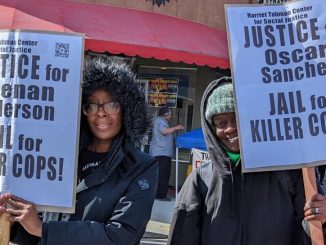
Organizers and agitated folks of various classes, age, and nations shared a space at the Harriet Tubman Center for Social Justice to answer the guiding questions: 

  1. What is the role of women and other oppressed gender people in the revolution? 
  2. What were the conditions that would’ve made Carlos Lamarca and his comrades more successful? 
  3. How do we build towards sustainability in the movement? 
  4. What can we take from this movie into our organizing here in LA? 

So much was shared, from personal life experiences to organizing successes and failures. All of these accounts and opinions capture the concerns of the left here in the imperial core: How do we build an un-psy-opable (some new terms were developed in this discussion) united movement? How do we engage with the masses? 

Though there weren’t clear answers, there were a lot of grounding ideas to work with, and some concrete proposals to pursue. For one, let’s talk to those in our lives. We should learn and be willing to engage with the struggles of the people. 

Linh Co is an organizer with LA MAS, Los Angeles Movement to Advance Socialism, the organization that put this event together. 

Strugglelalucha256


Join the National Week of Civil Disobedience to Restore Abortion Rights

Women’s Lives Are at Stake

Call for a National Week of Civil Disobedience to Restore Abortion Rights, September 18-24

Higher Wages, Workers’ Rights & Full Funding for Childcare, Healthcare & Education

No to Militarism and War

Fight the Right! No Business as Usual!

Initiated by: Workers Voice Socialist Movement, Socialist Unity Party, Louisiana Abortion Rights Action Committee, Women In Struggle/Mujeres En Lucha, Louisiana Workers Councils

Sign on to the call: Louisiana4AbortionRights@gmail.com

All Cities, All Organizations, United 

It took a mass, militant movement coast to coast, north and south, to win Roe v. Wade – not politicians or the conscience of Supreme Court “justices.” We have had to fight for abortion rights every day of the almost 50 years since—not only against the openly extreme right wing but against the Democratic Party, which has supported anti-abortion judges and laws, including the hideous Hyde Amendment that took away the right of poorer women to get abortions.

Emboldened by the overturning of Roe, the right wing is pushing forward. They are seeking a national anti-abortion law and a ban on the abortion pill. They are escalating terroristic violence everywhere—including in “abortion-protected states.” Attacks on protesters by fascists and police and bombings of abortion clinics across the country have not stopped protesters from taking to the streets. We will not let this stand.

We are not going to be content with politely lobbying Congress for a law it won’t pass, Biden’s toothless executive order, or a handful of cities making prosecution a “low priority” while the clinics stay closed and the state police take up prosecution of those who get abortions. Supporting and funding the courageous abortion underground is important, but many will be unable to travel or access their support. It is time we joined together, arm in arm, united against these assaults on our rights. They need to know that we are serious. We need to carry out mass civil disobedience across the country.

We stand against this attempt to control all women and child-bearing people of all genders, especially workers and other poor people and communities of color. We will not let them divide us. Our enemy is the super-rich and their government lackeys who are trying to strip away our rights. We fight not only for the restoration of abortion rights, but for everything necessary to be able to choose to raise children, including free childcare, parental leave and more. We fight for unions and workers’ rights, LGBTQ rights, environmental protections and universal healthcare, and we demand an end to racist terror and wars for profit. Their profits are not our concern—our survival is.

It is time to say NO to business as usual. Let’s unite to get every city, group and individual to shut it down. Let’s follow the example of the women in Ireland, Spain, Mexico, Poland and Argentina—we too can strike. We need to build up a united national fightback so we can move towards a women’s strike — even for a day — and withhold our labor. The labor of women workers is super-exploited, especially women of color, but our labor keeps everything running. We are powerful if we assert our collective power. We can and need to hit back forcefully.

Resistance inspires, resistance can win!

We ask that you or your organization endorse this call for a National Week of Civil Disobedience to Restore Abortion Rights.

Sign on to the call: Louisiana4AbortionRights@gmail.com

Strugglelalucha256


New Orleans fighters for abortion rights close down Canal St. and Loyola Ave., vow to build mass movement

Activists shutting down the streets for abortion rights. Click for Fox 8 video.

More than 150 people took the fight to restore abortion rights to the streets of New Orleans July 8. We rallied outside the courthouse to send a message to the oil industry-puppet AG Landry and his millionaire cronies: we will not let them go forward with their war on women, trans people, and all workers. We shut down both Canal St. and Loyola Ave. to tell them we’re done with business as usual.

As well as the fight for abortion rights, protesters also called for justice for Jayland Walker and Ronald Greene, murdered by racist police in Ohio and Louisiana, and for an end to attacks on LGBTQ people, immigrants, and other attacks on workers.

To no surprise, the billionaire-funded right-wing used the courts to overrule the will of the people and overturn the temporary injunction that was keeping Louisiana’s 3 clinics open. The judge moved the hearing to Baton Rouge, so AG Landry could shop for a judge as sexist, racist, and anti-worker as he is. But we are sending Landry and company notice: your legal tricks are no match for the power of an organized militant movement fighting for our lives. We are committed to building this movement.

Alongside others across the country, we have taken a step forward in the growing movement to push back the right wing and win back abortion rights and more. Dozens of protesters signed up to join the newly formed Louisiana Abortion Rights Action Committee. To get involved in organizing what’s next, email us here.

Strugglelalucha256


After Roe: From rage to revolution

As the parent of two young African American women, I’m outraged that their futures have been put in jeopardy by the attack on reproductive rights and civil rights.

As a trans woman, I’m outraged that my very right to exist, obtain medical treatment and participate in society is threatened by armed fascist gangs and capitalist politicians alike.

No doubt you are outraged as well.

Let your rage radicalize you. But more, let it revolutionize you. 

Join the Socialist Unity Party or another organization dedicated to fighting to end the capitalist system of oppression. We are stronger when we work together to build resistance. Together our work is more effective and far-reaching, and we have the confidence that comes with knowing that we have each other’s backs. 

The billionaires, the coup-makers in the Supreme Court and state houses, the police and Pentagon overlords, and their Nazi agents have shown us their true faces. Their white supremacist, patriarchal, profiteering system is in deep crisis, and they will do ANYTHING to prevent workers from uniting and fighting back. 

They no longer hesitate to strip people of their basic human rights and unleash murderous bigots against peaceful communities and individuals. We must teach them to fear the power of the working class again.

We must face this painful reality soberly, without illusions. But we can face it with the courage and confidence that comes from knowing that it is workers who make this society run. And together, united in defense of our rights, we can SHUT IT DOWN. 

We outnumber them by the millions. Organized, with clear political goals, we can slam the door closed on the coup-makers and send the fascist scum fleeing. 

We are not defeated. The battle has just begun. The first step toward victory is to recognize that each of us must do our part.

Strikes, occupations, civil disobedience, self-defense and other forms of organized resistance require time, efforts and resources to plan and organize. They require cooperation and coordination. We must begin today.

Strugglelalucha256


What was behind Nixon’s downfall?

Fifty years ago, the offices of the Democratic Party’s National Committee were burglarized on June 17, 1972. The crime at the Watergate complex led to President Richard Nixon’s resignation on Aug. 8, 1974.

The Watergate scandal’s anniversary is occurring during the congressional hearings into Trump’s attempted coup on Jan. 6, 2021. The fascist insurrection inside the Capitol, which was tolerated for hours by the Pentagon, was extremely dangerous. 

However, there’s no mention of Trump’s June 1, 2020, coup attempt, one week after George Floyd was murdered. Trump led the Pentagon’s high command and police to disperse an anti-racist protest across from the White House with clubs and tear gas. Trump wanted to declare martial law to crush the Black Lives Matter movement and send troops to shoot demonstrators across the United States.

And where was the investigation into the stolen 2000 presidential election? Five members of the U.S. Supreme Court upheld George W. Bush’s election despite Bush Junior getting 543,895 less votes than his Democratic opponent Al Gore.

John Bolton ― who later became Trump’s national security advisor ― led the “Brooks Brothers riot” that forced election officials in Miami-Dade county to stop counting ballots. (It was named the “Brooks Brothers riot” after the expensive clothing store because the Republican thugs were so well dressed.)

Trump is a far richer and stupider version of Nixon. Both scoundrels were corrupt and racist. Nixon had a greater opportunity to be a war criminal, with millions of victims in Vietnam, Laos and Cambodia.

The corporate media usually describes the Watergate scandal as a struggle to “defend democracy and the rule of law.” What democracy was there in the Black colony of Washington, D.C., where people couldn’t elect their own mayor until 1974?

The U.S. capital has more people than Vermont or Wyoming, and almost as many as Alaska or North Dakota. Yet D.C. is still denied statehood because two more Black senators would be elected.

Since the Watergate era, U.S. capitalism’s “rule of law” has increased the number of prisoners five-fold. Over two million poor people are locked up, the majority of whom are Black, Indigenous or Latinx. 

The plumbers

Millions of people viewed the hearings of the Senate Watergate Committee in May 1973. They were appalled and sometimes amused by the partial revelation of Nixon’s crimes.

The White House “plumbers” were exposed. This gang of ex-FBI and maybe not so ex-CIA agents were supposed to stop the leaks of information about Nixon’s crimes. Its leader was long-time CIA operative E. Howard Hunt.

Before committing the Watergate burglary, the plumbers’ target was former Pentagon analyst Daniel Ellsberg. He leaked the “Pentagon Papers” to the media, which exposed the lies U.S. presidents had told about the Vietnam War.

The Nixon Administration went to court trying to prevent the Washington Post and New York Times from publishing some of them. Ellsberg faced a long prison sentence, but his charges were dropped after the plumbers’ burglary of his psychiatrist was discovered. 

Fifty years later, Julian Assange is in a British jail facing extradition to the United States for exposing the truth about U.S. war crimes in Afghanistan and Iraq.

None of the Watergate committee’s seven U.S. senators were women. Senator Sam Ervin of North Carolina was the committee’s chair. The media’s crush on the segregationist led to “Quotations from Chairman Sam” being published.

Ervin had tried to block the 1965 Immigration and Nationality Act that repealed the viciously racist 1924 immigration act. “I don’t know of any contributions that Ethiopia has made to the making of America,” said the senator, in trying to limit immigration to white people from Western Europe. In 1970, Ervin joined the filibuster that attempted to stop extending the Voting Rights Act.

Another committee member was Georgia Senator Herman Talmadge. Like Ervin, Talmadge had voted against both the 1964 Civil Rights Act and the 1965 Voting Rights Act.

Many believe his daddy, former Georgia Gov. Eugene Talmadge, had four Black people lynched in 1946 to win reelection. Talmadge’s father also set up a concentration camp for workers during the 1934 textile strike. (“Testing the New Deal: The General Textile Strike of 1934 in the American South” by Janet Irons.)

Making the dollar world money

Both Ervin and Talmadge were white supremacists. So what was their beef with Nixon?

Behind Nixon’s fall was a crisis of U.S. imperialism. Its dirty war against Vietnam and Laos was lost. At tremendous cost, the Soviet Union was able to achieve nuclear parity with the U.S.

The billionaires had selected Nixon to clean up the mess. But the long slide of U.S. economic dominance versus its European and Japanese capitalist rivals continued.

From producing half of the world’s industrial goods in 1945, the U.S. now makes just a sixth. U.S. corporations, however, have $6 trillion in foreign investments, which includes factories around the globe.

Black people were in revolt, with 200 cities on fire following Dr. Martin Luther King Jr.’s assassination in 1968. Nixon’s presidential campaign called for “law and order,” an undisguised call for a racist crack-down. Nixon promised to fire Attorney General Ramsey Clark.

Nixon’s vice-presidential running mate Spiro T. Agnew’s specialty was making crude, bigoted remarks. Agnew was appealing to the followers of former Alabama Gov. George Wallace, who was running for president as a virtual Klansman.

Nixon and the FBI targeted the Black Panther Party for extermination. At least 25 Panthers were murdered, including Fred Hampton and Mark Clark on Dec. 4, 1969. The FBI’s COINTELPRO program sought to wreck all progressive movements and organizations.

It was much harder to get rid of the corporations’ dependence on Black labor. Black workers were key to winning the 1970 postal workers strike that Nixon tried to break with federal troops.

On July 24, 1973, two Black workers — Larry Carter and Issac Shorter — turned off the power at Chrysler’s Jefferson Avenue assembly plant in Detroit. The result was the first big sitdown strike in 36 years.

Fifty years ago, a quarter of U.S. auto and steel workers were Black. They helped lead a record number of 6,074 strikes in 1974. 

This strike wave followed the expiration of Nixon’s wage and price controls, which were imposed in 1971. His simultaneous abolition of the gold standard made the U.S. paper dollar world money.

This was Nixon’s greatest gift to Wall Street. It allows the U.S. to roll up huge trade deficits every year. 

The cheap shoes, clothing and other consumer goods bought by a working class that’s only 10% unionized has allowed capitalists to keep wages low. Instead of buying U.S. goods with dollars, capitalist regimes abroad hold $7.55 trillion in U.S. government debt. This helps finance the huge Pentagon war budget.

Southern textile strategy

Nixon squeaked by the Democratic candidate Hubert Humphrey in 1968. Among the reasons given for Nixon’s victory was its celebrated “Southern strategy.”

This was the deliberate appeal to racist voters in the South, as well as bigots in the rest of the country. Of the 22 U.S. senators from 11 states that made up the slave owners’ confederacy, 18 are currently Republicans.

In 1968, however, this political formula could be better described as a “Southern textile strategy.” South Carolina Senator Strom Thurmond’s machine threw its support to Nixon because of the specific needs of textile capital.

Thurmond’s ally ― the union-busting textile baron Roger Milliken ― became Nixon’s finance chairman. Milliken was no mint julep-drinking southern aristocrat. He came from an old Yankee capitalist family whose fortune began by making Union Army uniforms during the U.S. civil war. 

Milliken took the family fortune south though his company’s headquarters remained for years in New York City. The South was the textile industry’s salvation from unionism. By 1961, 89% of U.S. textiles were made in the region.

After workers in his Darlington, South Carolina, mill voted to join the Textile Workers Union in 1956, Milliken shut the plant down rather than negotiate a contract. This was completely illegal, but Milliken’s lawyers dragged out proceedings for years before paying damages.

Key to keeping unions out of the textile belt was refusing to hire Black workers. When Ezell Blair Jr., Franklin McCain, Joseph McNeill and David Richmond began their sit-in at a Woolworth’s lunch counter in Greensboro, North Carolina, on Feb. 1, 1960, just 3.3% of textile workers were Black.

By 1978, Black workers “held a quarter of all production jobs in the Southern textile industry.” (“Hiring the Black Worker: The Racial Integration of the Southern Textile Industry, 1960-1980” by Timothy J. Minchin) 

Nixon couldn’t stop this change, even though one of his first presidential acts was refusing to enforce anti-discrimination provisions in military contracts held by three big textile outfits. Nor could Nixon, under trade agreements, stop the growing amount of textile imports.

Family Assistance Plan

Roger Milliken and Strom Thurmond didn’t like these developments. Neither did the other reactionary members of Congress from the textile belt that stretched from southern Virginia through the Carolinas to Georgia and Alabama. 

Thurmond was the living symbol of the lynch rope. As a judge he sentenced four people to South Carolina’s electric chair, all of whom were Black.

Among those electrocuted was Sam Osborne, a Black teenaged sharecropper who shot his armed and drunken white landlord in self-defense. The Second Amendment was never meant for oppressed people.

In 1948 Thurmond ran as the presidential candidate of the segregationist States Rights’ Democratic Party. Twenty years later he was instrumental in putting Nixon in the White House.

With the Voting Rights Act passed and more Black workers being hired in Southern factories, the Thumonds wanted Black people to leave. With many Northern cities becoming close to a majority Black, New York Gov. Nelson Rockefeller wanted Black people driven back south. 

“They flooded into the big Northern cities,” was how the billionaire described Black and Puerto Rican people in testimony to the Senate Finance Committee. Rockefeller also lamented that those of “European origin” were leaving the cities to go to the suburbs.

This was the racist background to Nixon’s Family Assistance Plan. FAP was the brainchild of Nixon advisor and future Senator Patrick Moynihan. In 1965, Moynihan wrote a notorious report for the U.S. Department of Labor blaming Black poverty on Black women.

FAP payments would be set above the miserable benefits in Southern states. But they would be far below the Aid for Families with Dependent Children (AFDC) payments in New York, Wisconsin, Oregon and other Northern states where the labor movement was stronger.

FAP supporters believed that if welfare benefits were raised in the South, but lowered in the North, Black migration would cease. This lie was the excuse for Wisconsin’s state legislature to cancel a winter coat allowance for poor families. It was really factory owners like Wisconsin foundry owner William Grede, a founder of the John Birch Society, who summoned Black labor north.

The National Welfare Rights Organization, under the leadership of Dr. George Wiley, fought FAP. NWRO activist Lucille Berrien and Rev. James Groppi led a takeover of Wisconsin’s state capitol in Madison to demand winter coats for the poor.

But it was right-wingers centered in the South, like Strom Thurmond, who torpedoed FAP. This amounted to a dangerous split in Nixon’s coalition.

The Pentagon vs Nixon

The generals and admirals also came to distrust Nixon. Since World War II, the military-industrial complex has been the biggest factor in U.S. politics.

No questions were asked when Lincoln fired General McClellan twice during the U.S. Civil War. During the Korean War, Truman had to fly to the middle of the Pacific Ocean to get permission from the other generals to sack General Douglas MacArthur.

It was the military that stopped Senator Joe McCarthy, not liberals like television broadcaster Edward R. Murrow. When McCarthy insulted General Ralph Zwicker during a Senate committee hearing, it was time for Joe to go.

Interestingly, the army secretary at the time was Robert T. Stevens. He was past and future CEO of J.P. Stevens, then the second biggest textile manufacturer.

Like the Milliken clan, the Stevens family was an old Yankee family that took their textile mills south to get away from unions. None of the media asked what Stevens―a recipient of lush military contracts―was doing as army secretary.

During the presidential campaign, Nixon won votes by saying he had a plan to bring U.S. troops home from Vietnam. Once in the White House, Nixon escalated the dirty war by invading Cambodia.

Never forget that Nixon could have signed the same peace agreement in 1969 that he finally did in 1973. Millions of lives could have been saved in Vietnam, Cambodia and Laos, as well as 20,000 fewer GIs coming home in boxes.

Despite the massive bombing and Kissinger’s barely disguised threats at the Paris Peace Talks to use nuclear weapons, Vietnam refused to surrender. At the same time, Nixon and Kissinger were working overtime to further the split in the socialist camp between the Soviet Union and the People’s Republic of China.

Nixon’s recognition of the Soviet Union’s nuclear arsenal parity with the U.S. was recognizing what already existed. That doesn’t mean the Pentagon appreciated it nor the arms treaties that were signed.

At the same time, much of the military-industrial complex wanted to pull troops out of Vietnam faster. Congressional warhawk Melvin Laird, who became Nixon’s secretary of defense, pushed for a quicker exit.

Laird and the military brass didn’t care how many children were being burned alive by napalm. They wanted to get out because they were losing control of their troops.

Hundreds of officers were killed―”fragged” ―by GIs, usually by grenade. By 1971, mutinies like the one at Firebase Pace became front-page news. The anti-war, anti-racist American Servicemen’s Union recruited thousands of members.

The unstoppable drive for Black liberation had arrived inside the military machine and was influencing some white GIs as well. White GIs blew up Camp McCoy in Wisconsin in 1970 to stop the training of National Guard troops to shoot Black people. A rebellion against racism on the aircraft carrier Kitty Hawk broke out on Oct. 13, 1972. 

Spies turn on Nixon

Millions of people protested Nixon’s invasion of Cambodia in 1970. Nixon provoked the killing of students at Jackson State and Kent State universities by calling anti-war demonstrators “bums.”

In response to this revolt, the White House held a secret meeting on June 5, 1970, to discuss a police-state plan devised by White House staffer Tom Huston. The super-sized COINTELPRO program aimed to unite the FBI, CIA and other spy agencies to smash all progressive movements.

Even though FBI Director J. Edgar Hoover was slated to chair the new outfit, he disliked it because it took away the FBI’s monopoly on crushing political dissent. 

People were shocked when the Huston plan was partially exposed during the Senate Watergate hearings. The 2001 Patriot Act implemented some of it.

Hoover’s distrust of the Huston plan was another sign that parts of the deep state had differences with Nixon. The prized secret informant for Washington Post reporter Bob Woodward was FBI Deputy Director Mark Felt.

The Watergate burglary happened over four months before the 1972 presidential election. This crime wasn’t allowed to interfere with Nixon’s landslide victory.

Once the peace agreement with Vietnam was signed, however, the dam broke. On March 21, 1972, James McCord Jr. ― who led the Watergate burglary crew ― wrote from jail to Judge John Sirica that the White House was behind the break-in.

Longtime CIA agent McCord never thought his gang would be discovered by the $2-an-hour security guard Frank Wills. McCord had cleaned up the room at New York’s Hotel Pennsylvania where U.S. Army anthrax expert Frank Olson may have been thrown to his death in 1953.

While McCord spent just four months in jail, the Black man Frank Wills―the real hero of Watergate―could hardly get any more jobs and died in poverty. 

McCord wasn’t the only deep state player who helped bring down Nixon. Bob Woodward himself was a Naval intelligence officer before becoming a reporter.

And it was the former Air Force Col. Alexander Butterfield that revealed the White House tapes, the Watergate scandal’s “smoking gun.” 

A continuing crisis

Richard Nixon was the only U.S. president that didn’t preside over a single state or federal execution. Both the Environmental Protection Agency and the Occupational Safety and Health Administration were established under “Tricky Dick.”

Despite mobilizing the army, Nixon couldn’t stop postal workers from winning their strike. The 1970 strike against General Motors won United Auto Workers members retirement after 30 years and 95% of their pay during layoffs.

Nixon didn’t want to be known for any of these things. His cabinet was the last one that didn’t have anyone who was a woman or a person of color.

But what was Nixon to do when 29.1% of workers belonged to unions in 1970, as compared to 10.3% in 2021? 

It was the military that played a key role in dumping Nixon. But the crisis continued under the new president, Gerald Ford. Ford’s vice-president was Nelson Rockefeller, from the world’s first billionaire family that founded Big Oil.

A Vietnamese tank rammed through the gate of the former U.S. embassy in South Vietnam on April 30, 1975. Vietnam had won. In November of that year, the Angolan people with Cuban assistance threw back the invasion of the U.S.-backed South African apartheid regime.

Ford was shot at twice, once by “Squeaky” Fromme, a known follower of Charles Manson. How did the Secret Service let that happen?

There’s no stability under capitalist rule.The U.S. Supreme Court’s elimination of reproductive rights is a huge crisis both for the people and the ruling class.

Nixon was an enemy of the people. So is Trump and his Supreme Court. Only by organizing the power of the people can we stop these attacks.

Strugglelalucha256


What right does the Supreme Court have to rule?

The following article was first published Dec. 7, 2021. 

On Dec. 1, the U.S. Supreme Court heard the arguments from U.S. state attorneys supporting Mississippi’s 15-week abortion ban.

A state law was passed in Mississippi in 2018 that would make most abortions illegal after the first 15 weeks of pregnancy — including those caused by rape. The Mississippi law hasn’t yet been enforced due to a legal challenge by Mississippi’s only abortion provider, the Jackson Women’s Health Organization.

The Supreme Court is now considering the case.

The most conservative judges — including Donald Trump-­appointed anti-woman bigot and serial abuser Brett Kavanaugh — pressed forward to raise the stakes to possibly overturning Roe v. Wade, the 1973 decision that established a constitutional right to abortion.

Another Trump appointee, Justice Amy Coney Barrett, stated her position during the hearing: Why was abortion necessary, when women who do not want to be mothers can simply give their babies up for adoption? Thereby, Barrett was arguing for cruel legislation that bans abortion for those who have been raped, whose health or the baby’s health is at risk or a myriad of other legitimate issues, the most primary being control over one’s own body.

As a member of the Indiana religious organization, People of Praise, Barrett has served as a lay pastoral women’s leader known as a “handmaid.” Barrett is a millionaire — among the richest of rich justices, with a lush income from the Catholic Church’s Notre Dame Law School—and this removes her from the concerns plaguing most peoples’ lives.

One of three judges in the minority supporting women’s constitutional rights, Justice Sonia Sotomayor asked whether the court would survive the stench of being considered a political institution, a point echoed by Justice Elena Kagan. Their attempt to defend a critical right to healthcare also implied support for the legitimacy of the Supreme Court.

What right does the Supreme Court have?

The U.S. Supreme Court was established 232 years ago by the U.S. Constitution with the passage of the Judiciary Act of 1789. At that time the U.S. Constitution did not extend equal rights to people kidnapped from Africa, the Indigenous population, oppressed genders or those without property — only white men with property.

The Court was set up as one of three branches of the emerging capitalist government, which included a president and a Congress made up of a House of Representatives and the Senate, reputed to be a balance of powers. However, during a dispute in 1805 it was determined that six appointed judges held supreme authority over the elected members of Congress and the president. (The U.S. Constitution grants Congress the power to determine how many “justices” sit on the Court. The Court started with six, but the number has been between 5 and 10. Since 1869 the number has been set at 9.)

Fifty years later, in 1853, the Court affirmed slavery with the Dred Scott decision. If there was any doubt as to where the real power was, it was right there in affirming the rights of the slave owners as against a majority of the people opposed to slavery.

In the years following the Civil War to end slavery, there was a gradual democratization of the political process. The right to vote had previously been denied to the Native people, to Black people, to women, to the youth. But these groups have won voting rights through years of struggle. (See Sam Marcy’s “A Marxist View of the Supreme Court.”)

Supreme Court erodes rights

In the 2000 presidential election, the Supreme Court exercised its authority by selecting George W. Bush to be president. Bush appointed the conservative John Roberts who is currently Chief Justice.

Last June, the Court released a wave of decisions, as it does every year at the end of its session. Among them was a ruling giving the responsibility for decisions on partisan gerrymandering to state governments — a big attack on voting rights for Black and other oppressed peoples and all workers.

Along with reproductive rights other decisions currently on the courts docket include:

Gun control. The political arguments surrounding this issue never take into account official U.S. policy of militarization or the violence of other armed wings of the state against Black people and other workers, employed and unemployed.

Religious freedom. Under the guise of religious freedom the court is attacking public education by allocating funds to private institutions. This further infringes on the separation between church and state—an issue, we were taught, that laid the basis for the American Revolution.

State secrets. This year, two lawsuits concern the kind of information the U.S. government can withhold in the interest of national security.

The first involves Guantanamo Bay detainee Abu Zubaydah, who is seeking information about U.S.-run interrogation torture sites and the Central Intelligence Agency contractors he is suing for allegedly torturing him.

The second is related to a suit from a group of Muslim men in California who allege the Federal Bureau of Investigation engaged in religious discrimination when it monitored members of their community for possible terrorism connections.

An area of concern: the Shadow Docket

The court has increasingly relied on what’s been called an emergency “shadow docket” — these are short, frequently unsigned, opinions issued without full briefing and argument — used to take significant steps in a conservative direction with less opportunity for scrutiny.

Three recent examples of the “shadow docket” trend involve Supreme Court action on (1) the extremely restrictive Texas abortion law, (2) a Trump-era policy requiring asylum-seekers to stay in Mexico and (3) throwing out a presidential-ordered temporary moratorium on home evictions.

While the court’s traditional rulings take months of work — from legal briefs to oral arguments to a decision — and this term’s big cases probably won’t be announced until May or June of 2022 — the shadow docket can unfold quickly and move in unpredictable directions.

In an article titled, “Texas lawmakers: Why you gotta be so cruel?” Gloria Verdieu writes about the Texas abortion law that the Supreme Court supported through the shadow docket: “‘The Heartbeat Law’ bans abortion after five-and-a-half to six weeks of pregnancy, before most women are aware that they are pregnant. The law threatens any individual or entity who ‘knowingly engages in conduct that aids or abets,’ including paying for or reimbursing the costs of an abortion through insurance or otherwise, with a civil lawsuit. Any civilian who sues that person will be awarded $10,000 plus court costs and attorney fees.” 

Invalidating the rights the people

A clear majority of people in the U.S. support upholding Roe v. Wade, guaranteeing a constitutional right to abortion. According to an ABC News/Washington Post poll, some 60% say Roe v. Wade should be upheld. Three out of four Americans say that the decision of whether or not a woman can have an abortion should be left to the woman and her doctor.

It’s no accident that the power to make a legal decision on reproductive rights is ultimately exercised by the Supreme Court. It’s the most reliably conservative, anti-democratic arm of the government, responsive only to those who have appointed them.

During the Depression the Roosevelt administration was forced to institute the National Recovery Act in order to save capitalism. It granted workers the right to organize — union rights — and established some forms of social insurance including social security and unemployment benefits, all under pressure from the working class actions countrywide.

As soon as it became clear that the capitalist recession was slowly ending, in one day the Supreme Court nullified this whole mass of legislation in the infamous Schechter case of 1935 and began to roll back the progressive legislation. To this day the Supreme Court has upheld the anti-labor strike-breaking policies of the National Association of Manufacturers, of the multinational corporations and of the banks. The plight of labor today, at least from the point of view of legality, can be shown to come from this — that in the last resort the ruling class relies on the Supreme Court, an instrumentality that is as undemocratic as it is reactionary.

Concerning the court ‘s decision in the 1989 to upheld a Missouri law prohibiting the use of public facilities to provide abortion services and to restrict physicians who provided abortions, Sam Marcy wrote: “The abortion decision confirms that whenever the bourgeoisie is in a crisis, they will let nine people, unelected, appointed for life, decide the most critical issues concerning life in the United States.”

Strugglelalucha256


How corporate food monopolies caused the baby formula scandal

It’s a tough time to be the parent of a newborn in the United States today. Not only is child care prohibitively expensive, but the cost of all things including baby products is rising, COVID-19 poses a threat to children too young to be vaccinated—and there has been a months-long shortage of baby formula.

The formula scarcity began when the COVID-19 pandemic led to a disruption of ingredient supply chains and transportation delays. Then, this past February, the Food and Drug Administration found that several leading brands produced by Abbott Laboratories were contaminated with dangerous bacteria leading to a recall and a temporary closure of Abbott’s main Michigan factory where government inspectors found “shocking” conditions. Then, just as the Michigan plant reopened, torrential flooding forced it to shut down again.

There is nothing more important to a parent than providing for their child, especially during the most vulnerable, early years of their child’s life. As a mother who was unable to breastfeed when my children were newborns, I relied on formula and remember once having to drive quite far to a store in a neighboring town because my local store was out of the brand I relied on and that my child was used to. It was a stressful experience, one that is a mild example of what millions of parents are feeling right now as they face store shelves emptied of formula.

The shortage has driven prices up—yay, capitalism! For a variety of systemic reasons that include economics, geography, and health, Black and Latino parents are disproportionately more likely to rely on formula feeding. To add to that, low-income parents of color are also disproportionately impacted by the formula shortage, as they may live in food deserts with fewer options for formula, and they may be unable to drive long distances to search other stores or pay premium prices for online shipping.

There is a simple reason why such a shortage has transpired: global capitalism and the food monopolies it has fostered. Although store shelves (when fully stocked) appear to offer a wide variety of baby formula products, some with different name brands, only two companies produce more than 70 percent of these products, at a small handful of factories: Abbott and Mead Johnson. A third company, Nestlé, produces about 12 percent.

Therefore, when Abbott shuttered its Michigan plant, that single closure affected a very significant portion of the nation’s stock of formula.

The U.S. government has encouraged this monopoly by choosing to buy formula for the Women, Infants and Children (WIC) program from Abbott alone.

It’s the definition of putting all of one’s eggs in one basket. If that basket breaks, a shortage of eggs is inevitable.

And it’s not just baby formula. In the U.S. market, only three companies produce 81.7 percent of all baby food products; four companies produce 85.4 percent of all canned tuna; three companies make 80.3 percent of all chocolate; three companies make 78.5 percent of all pasta products; and so on.

Now, food prices overall are sharply rising this year as inflation hits grocery suppliers. In response, manufacturers are engaging in “shrinkflation,” a form of theft: shrinking their package sizes while maintaining the same price so as to dupe customers into believing they’re paying the same amount.

Meanwhile, big food manufacturers are reaping record profits, undermining claims that they’re simply passing on their higher costs to customers.

Decades ago, food policy analysts warned of the pitfalls of food monopolies, such as Vandana Shiva, author of the 2000 book Stolen Harvest: The Hijacking of the Global Food Supply, and Raj Patel, author of the 2007 book Stuffed and Starved: The Hidden Battle for the World Food System.

Both Shiva and Patel linked the profits of the world’s wealthiest food corporations to the plight of the world’s poorest farmers, and pointed out that in the relentless corporate drive to lower costs and maximize profits, food supply chains were consolidating and becoming more vulnerable to disruptions.

They also highlighted the folly of a global food supply chain relying on subsidized fossil-fuel-based global transportation systems that exacerbate climate change. The extreme flooding in Michigan that led to the closure of Abbott’s formula factory only two weeks after it reopened is a consequence of the carbon dioxide we’ve been pumping into the Earth’s atmosphere.

Advocacy organizations like Farm Action and Food and Water Watch have likewise been sounding the alarm about food monopolies for years. In late 2020, Farm Action released a report titled “The Food System: Concentration and Its Impacts” in which it drew attention to the growing monopoly power of food corporations. The report’s authors warned against the “concentration of ownership, wealth and power” in our food system, where “just a few companies dominate almost all aspects of food production.”

A year ago, Food and Water Watch did the same, warning the federal government in a report titled “Well-Fed: A Roadmap to a Sustainable Food System That Works For All” of the looming food crisis in the U.S., and saying that the only solution to creating a sustainable food future was to break up the corporate food monopolies. The organization recommended that the federal government ban the expansion of factory farms, place a moratorium on food corporate mergers, and invest in small, organic and sustainable farming systems.

On one end of the food chain there are starving farmers, and on the other end there are starving families—including babies. In the middle are a handful of fat cats—massive corporations like Abbott and Cargill—that keep getting fatter.

As is the case with most economic problems that can be traced back to corporate greed, the solutions are simple, and can be easily enacted if there is a political will to do so.

The Biden-Harris administration claims to understand the problem and the solution. For example, in a January 2022 fact sheet about the meat industry, the White House released its plan for “a Fairer, More Competitive, and More Resilient Meat and Poultry Supply Chain,” in which it acknowledged problems such as how “[f]our large meat-packing companies control 85 percent of the beef market.”

But the administration’s solutions to the problem of food monopolies did not even touch upon preventing mergers. Instead, it announced a toothless “portal” for “reporting concerns about potential violations of the competition laws.”

Representative Mark Pocan of Wisconsin has gone further than Biden, however, in sponsoring a new bill called the Food and Agribusiness Merger Moratorium and Antitrust Review Act of 2022, which would enact a moratorium on food industry mergers.

In the meantime, what are formula-feeding parents to do in order to feed their babies? Baby formula is a product that can be neither made at home nor watered down. Parents often search for the product that best suits their newborn’s sensitive digestive systems.

One mother, Laura Stewart, told the Associated Press how difficult it has been for her 10-month-old daughter to deal with switching to whatever brands are available: “She spits up more. She’s just more cranky. She is typically a very happy girl,” said Stewart. “When she has the right formula, she doesn’t spit up. She’s perfectly fine.”

Now that corporate food monopolies are impacting the most vulnerable human beings in our society—babies—will government take drastic measures to break them up?

This article was produced by Economy for All, a project of the Independent Media Institute.

Sonali Kolhatkar is the founder, host and executive producer of “Rising Up With Sonali,” a television and radio show that airs on Free Speech TV and Pacifica stations. She is a writing fellow for the Economy for All project at the Independent Media Institute.

Strugglelalucha256


Attempted U.S. coup televised: House hearings conceal more than they reveal

Voting rights still being eliminated

The public hearings of the House Committee to Investigate the Jan. 6 Attack have dramatically confirmed that Donald Trump, former president of the United States, attempted a coup d’état.

Rep. Bennie Thompson of Mississippi, head of the committee and member of the Congressional Black Caucus, said clearly: “Any legal jargon you hear about ‘seditious conspiracy’, ‘obstruction of an official proceeding’, ‘conspiracy to defraud the United States’ boils down to this: Jan. 6 was the culmination of an attempted coup.”

Thompson added: “It represented Trump’s last, most desperate chance to halt the transfer of power.”

This is unprecedented. An overt coup attempt has not happened in any of the imperialist powers in the last century and exposes the bare threads of democracy in the U.S. The coup attempt also revealed the sharp instability in the U.S. ruling class.

The House hearings, however, conceal more than they reveal.

Pentagon played key role

The Pentagon played a key role in the Jan. 6, 2021, coup attempt, but the hearing has been silent on that.

The Pentagon was deeply involved. Members of the U.S. military, both active and veterans, as well as from numerous police forces across the country, were leading participants.

The “Insurrection Timeline – First the Coup and Then the Cover-Up,” published at “Moyers on Democracy,” details the central role played by Donald Trump and his new Acting Secretary of Defense Christopher Miller.

Miller had been put at the head of the Pentagon on Nov. 9, 2020, six days after the election, in a departmental “regime change” that embedded three fierce Trump loyalists as top Defense Department officials.

Washington Mayor Muriel Bowser asked Army Secretary Ryan McCarthy — who reports to Miller — for more federal help to deal with the mob that had broken into the Capitol. McCarthy and Miller denied the mayor’s request and blocked deployment of the National Guard until hours later, after the insurrection had already been put down.

The New York Times reported: “President Trump initially rebuffed and resisted requests to mobilize the National Guard to quell violent protests at the Capitol, according to a person with knowledge of the events.

“In the end, it was Vice President Mike Pence, defense and administration officials said, who approved the order to deploy. It was unclear why Mr. Trump, who is still technically the commander in chief, did not give the order.”

How then was it possible for Pence to deploy the troops, in opposition to Trump? That could only have been done if Trump had been secretly removed as commander-in-chief.

However, Trump and the Pentagon’s coup attempt shows that a section of the ruling class supported a presidential dictatorship. This is confirmed by the fact that Trump’s actions continue to have the overwhelming support of the Republican Party.

Promoting anti-Trump right wing

The House hearings on the Jan. 6 attack are a media spectacle through which they hope to restore some belief in the U.S. government. 

The Democrats have presented a program that’s primarily given voice to right-wing opponents of Trump. As one cartoonist put it, these hearings are biased; we’ve only heard from the Republicans.

At the head of the committee, side-by-side with Representative Thompson, is Wyoming Republican Liz Cheney, who sold out her lesbian sister, opposing gay marriage in order to win the Senate seat. 

Previously Liz Cheney held a patronage post in the State Department where she promoted her father Vice President Dick Cheney’s lies for invading Iraq.

The hearings have exalted Mike Pence, William Barr, Judge J. Michael Luttig and other Republican operatives.

What about voting rights?

The hearings are about a coup attempt. But they do not confront the grave issue of voting rights that the coup attempt played upon and which continue to be under assault. 

Jan. 6 was at root an attempt to eliminate voting rights. The 2020 presidential election had set the record for the highest voter turnout in 120 years – a massive popular vote to throw out Trump.

That was a real Constitutional crisis. The U.S. Constitution was written by wealthy landlords and bankers, many of them slaveholders, to insure their class rule. The Constitution declares that enslaved peoples are not fully people and excludes the Indigenous Peoples. 

At the time, voting rights were given only to white men who owned property. Not until 1919, with the passage of the 19th Amendment to the U.S. Constitution, women won the right to vote. 

To protect the slavocracy, the Constitution imposed an Electoral College that chooses the president, not the popular vote. The slavocracy’s Electoral College was a form of voter suppression that’s continued to this day. In fact, the coup attempt used the legal vagaries of the Electoral College as part of its tactics.

Why has there been no call by the Democrats to abolish the anti-democratic Electoral College?

While staging of the House hearings has been an engrossing TV show, Congress is doing nothing about the crises of war, racism, racist police murder, sexual and gender repression and immigrant oppression. The economy is in crisis, with the threat of a recession or worse.

The hearings appear to have no goal other than to expose what is already known about Trump. They are devised to distract from the failure to implement any of the mildest solutions promised by the Biden campaign in the struggle for food, housing, healthcare, reproductive rights, education, livable incomes and the right to organize workers’ unions.

Strugglelalucha256


Watergate’s real hero was Frank Wills

Ex-CIA agent James McCord didn’t think he would be stopped from installing wiretaps at Democratic National Committee headquarters by an $80-per-week security guard. Neither did fellow Watergate burglar Bernard Barker, a former member of CIA-backed Cuban dictator Fulgencio Batista’s secret police.

On June 17, 1972, Frank Wills, a Black worker, was making his rounds on the midnight shift at the Watergate complex when he sounded the alarm about the break-in.

“I put my life on the line. I went out of my way,” Wills told a Boston Globe reporter on the 25th anniversary of Watergate. “If it wasn’t for me, Woodward and Bernstein would not have known anything about Watergate.”

Journalists Bob Woodward and Carl Bernstein got $5 million from the University of Texas in 2003 for their Watergate notebooks and files. Frank Wills didn’t even get a pension.

He died penniless in an Augusta, Georgia, hospital of a brain tumor on Sept. 27, 2000.

Wills couldn’t afford to bury his mother. He lived in a house without lights because he wasn’t able to pay the electric bill.

Wills found it hard to get a job after Watergate. One Washington area university told Wills they were afraid to hire him for fear their federal funds might be cut.

Frank Wills moved back to his home state of Georgia after his mother suffered a stroke. They lived together on her $450 monthly Social Security check.

Richard Nixon’s face was put on a postage stamp. He and his fellow war criminal Henry Kissinger made millions of dollars off their memoirs.

President Nixon’s partner in crime, Vice President Spiro Agnew, got three years’ probation for evading taxes on bribes filched from highway contractors. Frank Wills was sentenced to a year in jail in 1983 for allegedly trying to shoplift a $12 pair of sneakers.

A victim of racial profiling, Wills wasn’t arrested while leaving the store. He was nabbed just for putting the shoes in his bag. He’d wanted to surprise a friend with his gift at the check-out counter.

Never forgot Stephen Johns

Another hero was the Black security guard Stephen Johns. He was killed on June 10, 2009, by the neo-Nazi James von Brunn.

Johns and other security guards were protecting visitors going to the Holocaust Memorial Museum in Washington, D.C. Dozens of visitors, including elderly Jewish people and schoolchildren, could have been slaughtered by Van Brunn.

The attack occurred 10 days after the murder of Dr. George Tiller, an abortion provider, in Kansas. His assassination was incited by Fox News host and sexual predator Bill O’Reilly, who called him “Tiller the killer.”  

Von Brunn had taken a sawed-off shotgun to the headquarters of the Federal Reserve Bank on Dec. 7, 1981, and attempted to kidnap board members. He spent six-and-a-half years in jail for that act, which could have turned out to be as bloody as the attack on the Holocaust Museum.

Compare this with what happened to Leandro Andrade under California’s “three strikes” law. He was sentenced to two consecutive prison terms of 25 years to life. His alleged crime was shoplifting nine videotapes.

Von Brunn was a notorious figure. How was he able to stage his attack on the Holocaust Museum, just a mile from FBI headquarters?

One of Von Brunn’s friends was the retired U.S. Navy Rear Admiral John G. Crommelin. He praised Von Brunn’s armed attack on the Fed as deserving “the gratitude and assistance of every White Christian citizen.”

Crommelin, who died in 1996, was a member of the violent National States Rights Party and was its vice-presidential candidate in 1960. The leader of the NSRP, J.B. Stoner, called Hitler “too moderate.” Stoner was found guilty of the June 1958 bombing of Bethel Baptist Church in Birmingham, Alabama.

Another five NSRP members were convicted in the bombing in October of that same year of an Atlanta synagogue with 50 sticks of dynamite. (“The Temple Bombing” by Melissa Fay Greene)

FBI Director J. Edgar Hoover didn’t do anything when another NSRP member, Joseph Milteer, told FBI informant Willie Somersett on Nov. 9, 1963, that President John F. Kennedy was going to be shot in Dallas.

Security guards need union protection

Frank Wills and Stephen Johns show the plight of hundreds of thousands of low-paid security guards today, many of whom are Black. Increased employment in this field has gone hand in hand with the growing army of janitors. Growth of both jobs is a result of the office building construction boom.

The Service Employees International Union (SEIU) has been organizing security guards across the country. Frank Wills’ miserable $2-an-hour wage was worth $14.02 in May, according to the Bureau of Labor Statistics’ inflation calculator

In May, 2021, the median wage of the 1,057,100 security guards in the U.S. was $15.13 per hour. One out of four earned a median hourly wage of just $13.89.

In 2004, SEIU Local 1877 led a drive to organize 10,000 guards in Los Angeles. Union supporters staged a sit-in at the Wells Fargo Tower in September 2004. 

Several months later, with the support of Dr. King’s Southern Christian Leadership Conference, the union marched through downtown Los Angeles.

This important struggle came out of the union’s “Justice for Janitors” campaign. At one of the early actions by this campaign, on June 15, 1990, Los Angeles cops viciously attacked Service Employees members demanding a union contract at the Century City office complex. At least 148 workers were injured, including a pregnant woman who miscarried.

Despite this police riot, janitors at Century City have a union today. These overwhelming Latinx janitors, 98% of whom are immigrants, were in solidarity with efforts by security guards, many of whom are Black, to be unionized too.


Strugglelalucha256
https://www.struggle-la-lucha.org/in-the-u-s/page/43/