Charlotte students lead mass action against Trump’s immigration raids

ICEout
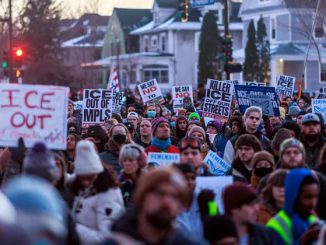
Protesters outside a closed Latine-owned bakery in Charlotte on Nov. 18 denounce the Trump administration’s Operation “Charlotte’s Web,” which has forced businesses to shut down in fear of federal raids.

As federal agents swept through Charlotte, North Carolina, the first and most powerful pushback came from the students — the young people who showed what solidarity looks like in action.

On Nov. 17, more than 30,000 Charlotte-Mecklenburg students stayed home in a coordinated “sickout” to protest a federal operation targeting immigrant neighborhoods. By the end of the week, more than 56,000 students had refused to attend school, making it one of the largest student-led actions against immigration raids anywhere in the country.

Their walkout was sparked by “Charlotte’s Web,” a large, militarized operation launched by the Trump administration in mid-November. Led by Customs and Border Protection Commander Gregory Bovino, federal agents in masks and unmarked vehicles carried out warrantless traffic stops, stormed homes, and pulled drivers over at gunpoint. Nearly 400 people were arrested across Charlotte and surrounding towns in the first week alone.

The violence of the raids was unmistakable — and so was the response. Students at East Mecklenburg High School, Philip O. Berry Academy, Ballantyne Ridge High School, Northwest School of the Arts, and many others walked out with handmade signs defending their classmates and families. 

Across the city, parents, workers, and neighbors built rapid-response networks to track federal agents in real time. When CBP tried to seize day laborers outside a Home Depot, more than 100 residents showed up, surrounding the agents and forcing them to retreat. Hundreds later marched through the streets carrying signs reading “Human rights have no borders” and “No human being is illegal.”

Strugglelalucha256


Bitcoin’s latest crash shows what it really is: speculation, not money

Bitcoin just crashed again. After hitting over $126,000 in October, it dropped more than 20% in a few weeks, falling below $90,000. All the gains it made in 2025 — gone.

This wasn’t random bad luck. Real pressures drove the crash: Electricity costs soared, making Bitcoin mining less profitable. Over $2.3 billion flowed out of Bitcoin investment funds in just the first half of November. Data shows miners dumped about 71,000 Bitcoins onto exchanges in early November, plus another 210,000 in October — some of the biggest sell-offs since 2022.

These constant wild swings raise a basic question: What is Bitcoin, really? Fans say it’s revolutionary money that gets around capitalism’s problems. But when you look at it through a Marxist lens, you see something different: Bitcoin isn’t money at all. It’s a way to gamble on prices going up — what Marx called “fictitious capital.”

What does it take to be money?

To understand why Bitcoin fails as money, we need to start with what Marx said money actually is. For Marx, money isn’t just a symbol or something the government declares valuable. It’s something real that comes out of how people produce and trade goods.

Marx was clear: Money itself must be a commodity — a real thing with physical form. He wrote that money, “the universal commodity,” must exist “as a particular commodity alongside the others.” Through trading, this “universal equivalent” takes on “the bodily form of a particular commodity.”

Throughout history, gold and silver played this role. Why them? Because they have real uses, and because their value comes from the hard work it takes to dig them out of the ground and refine them. That labor-based value made them stable enough to be the anchor for the whole trading system.

Marx insisted this physical foundation matters even when credit systems develop. Paper money and bank deposits aren’t new kinds of money — they’re IOUs that stand in for the real money (gold) behind them. Capitalism constantly tries to get around the limits of physical money, but as Marx said, “again and again it breaks its back on this barrier.”

So for something to be money, it needs three things: It must be a real physical commodity, it must be useful for something besides being money, and its value must come from the labor that went into making it.

Bitcoin fails on every count

Bitcoin doesn’t meet any of these requirements.

First, Bitcoin has no real-world use beyond speculation. Gold works in electronics, dentistry, and jewelry. Even if nobody used it as money, gold would still be valuable for these practical purposes. Bitcoin? You can’t do anything with it except buy and sell it. It’s just data on computers — not a physical thing with actual uses. Without those uses, it can’t be the solid foundation Marx described.

Second, Bitcoin’s value doesn’t come from labor. Gold’s value is tied to the hard, costly work of mining and refining it. Bitcoin’s price comes from three things instead: its built-in scarcity (only 21 million can ever exist), people betting prices will rise, and collective belief in the system. Yes, Bitcoin “mining” uses tons of electricity, but that’s not the same as productive labor that creates something useful. It’s just the cost of keeping the network running and checking transactions. That doesn’t create value the way mining gold does.

Third, Bitcoin’s wild price swings make it useless as a measure of value. Money needs to be stable so people can price things reliably. Something that loses 20% of its value in weeks can’t do that job. The recent crash proves it: When electricity got expensive and AI companies offered miners better money, they dumped Bitcoin. That’s not how real money behaves.

So what is Bitcoin?

If Bitcoin isn’t money, what is it? It’s what Marx called “fictitious capital” — a financial asset whose value comes from hoping someone will pay more for it tomorrow, not from any real production.

Stocks and bonds work this way too — they’re bets on future profits. Bitcoin fits perfectly. Its price depends entirely on what investors think others will pay for it later.

Think of the art market. A painting by a famous artist can sell for millions, but not because it’s useful or produces income. It’s expensive because it’s rare and people believe others will want it. Bitcoin works the same way. Neither pays dividends nor rent. Both have artificially limited supply — Bitcoin by computer code, art by how much an artist can create. Both markets are controlled by the super-wealthy: “whales” in crypto, big galleries in art. And in both cases, something is worth whatever the next buyer will pay — nothing more, nothing less.

Bitcoin also shows what Marx called “commodity fetishism” — when relationships between people look like relationships between things. Value seems to magically come from the object itself, not from human work. All the computing power and electricity that keeps Bitcoin running is hidden. Its value looks like it just comes from the code, growing on its own without any connection to real work or production. It’s the ultimate magic trick.

Reality crashes the party 

The proof that Bitcoin is just another investment — not some new kind of money — came with this latest crash. When electricity prices rose, miners had a choice: Keep mining Bitcoin or do something more profitable. They chose profit.

Big mining companies like Core Scientific and Iris Energy signed deals to host AI computers instead. They get paid 3-4 times more per kilowatt-hour than Bitcoin mining paid them. Bitfarms went even further, announcing plans to quit crypto mining completely by 2027.

This shows that even digital “assets” like Bitcoin follow the basic rules of capitalism. Miners ditched Bitcoin because they could make more money elsewhere. It’s just another place to invest, not a magical new form of money that escapes capitalism’s logic.

Marxist economists point out that if governments could really create crisis-proof money out of thin air, they could solve economic crashes just by printing more. They can’t, because money is tied to real commodity production. Bitcoin’s failure as stable money proves this point.

Bitcoin isn’t a challenge to the system. It’s a volatile bet that reflects all the financial chaos of the capitalism it claims to replace. It’s trapped by the same contradictions and the same endless chase for profit.

Strugglelalucha256


A presidency above the law — and the struggle ahead

The United States is living through a profound political shift. A new, executive-centered form of rule is taking shape — a strongman presidency that claims the right to act without oversight, constraint, or accountability.

Trump’s current administration is moving faster and more aggressively than before. In under a year, he has concentrated enormous power in the executive branch, pulling decision-making on trade, immigration, federal spending, and even the mechanics of elections directly into his office. Government functions that once depended on congressional authority are being folded into the presidency itself.

This is not just a policy shift. It’s a restructuring of the state.

Governing by decree

A defining feature of the new authoritarianism is the White House’s rapid takeover of powers traditionally held by Congress. Trump’s current administration isn’t just using executive power more aggressively — it is using it as the primary way it governs.

The current administration’s use of executive power has been extensive and unprecedented in the post–World War II era. President Trump has issued 212 executive orders in the first 10 months of 2025, nearly matching the 220 he issued during his entire first term. These decrees have been used to tighten control over a vast range of policy areas that constitutionally belong to the legislative branch, including international trade, federal spending, immigration enforcement, and the imposition of tariffs. One of the most significant of these actions is Executive Order 14248, signed on March 25, 2025, and titled “Preserving and Protecting the Integrity of American Elections,” which directs a sweeping overhaul of federal election procedures and places broad authority over voting access, oversight, and certification directly under the executive branch.

This isn’t a bureaucratic reshuffling — it’s the consolidation of state power into a single office. By pulling decision-making on core economic, immigration, and electoral functions into the presidency, the administration is weakening the role of Congress and reshaping the basic structure of governance. The center of gravity in U.S. politics is shifting toward unilateral rule from the top.

A national police force in all but name

At the same time, federal agencies built for very different purposes are being repurposed and merged into a single domestic apparatus — a national police force in all but name.

Constitutionally and politically, the United States has never developed a federal police force with general police powers — policing has been concentrated in the states — and no single federal agency has ever been entrusted with general police authority across the country. The FBI, for example, is a federal investigative agency — not a general police force — and its powers are limited to specific federal crimes.

ICE, the Border Patrol, and the National Guard are being deployed together across multiple states against migrants and protesters. Border Patrol tactical teams now conduct raids deep inside major cities like Chicago and Los Angeles, sometimes using military helicopters and Predator drones. Masked, unidentifiable officers appear in residential neighborhoods. Tear gas is fired into communities. These deployments erase the traditional lines between police, immigration enforcement, and the military.

This level of centralized, federal domestic force is new.

And it is being expanded by pulling thousands of personnel from the FBI, DEA, and U.S. Marshals into mass immigration sweeps — a federal police force deployed to fulfill the White House’s political priorities.

Reshaping the military for political loyalty

Inside the military, the changes go even deeper. Trump’s Secretary of War, Pete Hegseth, has launched a sweeping purge of senior officers — targeting career commanders, especially people of color, women, LGBTQ and trans officers — all under the banner of fighting “wokeness.” This isn’t about discipline. It’s about political loyalty: building an officer corps that answers directly to the executive.

The purge has been accompanied by an assault on the military’s internal legal system. The administration fired key Judge Advocate General officers — top military lawyers — after calling them “roadblocks,” undermining legal checks meant to keep the armed forces within the law.

At the same time, the Pentagon has ordered military academies to end consideration of race and gender, purge libraries of material referencing “white privilege,” and reshape training around a reactionary, politicized agenda.

Extremism moves into the state itself

As the administration tightens control at the top, racist and reactionary forces are being absorbed into the lower ranks of law enforcement.

Proud Boys and white-supremacist sympathizers have entered ICE, the Border Patrol, and local police departments. Far-right coded symbols appear in DHS and CBP recruitment materials, and officers inside these agencies increasingly align themselves openly with extremist currents.

Events like Charlottesville and Jan. 6 weren’t the creation of a mass movement capable of overthrowing the state. They were test runs — identifying recruits and networks now being folded into the state’s coercive machinery.

Political violence is being bureaucratized and professionalized under federal command.

Empire in decline, violence on the rise

This authoritarian turn at home is inseparable from the decline of U.S. global imperialism. As the U.S. slides deeper into crisis, the ruling class turns once again to militarism, economic sanctions, and the use of force — the core methods it has long used to defend imperialist power.

For most of the 20th century, the U.S. acted as a classic imperialist power — exporting capital abroad while easily attracting global investment because it was one of the most profitable places to produce. That period has ended. The Trump administration is now pressuring countries like South Korea and Saudi Arabia to pour billions into U.S. factories — like a developing country trying to force industrialization. Instead of capital flowing outward, the U.S. is using threats, tariffs, and military alliances to drag capital inward. It resembles a protection racket more than an empire: “Invest here or face consequences.”

This shift is a sign of decline: U.S. manufacturing profits are too low to attract investment on their own, so the ruling class now depends on political coercion — not economic strength — to hold its base together.

Nearly 14% of the entire U.S. Navy is now deployed to the Caribbean under Operation Southern Spear. This extraordinary buildup targets governments that refuse to bow to U.S. imperialist interests — Venezuela, Cuba, Nicaragua, and Colombia.

U.S. forces have carried out lethal strikes on vessels in international waters — killings condemned by UN human rights experts as “extrajudicial executions.”

This is what imperialist powers do in decline: Repression tightens at home and violence expands abroad.

The political space that still exists

But we need clarity about the moment we’re living in. The U.S. is moving into a harsher, more authoritarian form of rule, but it is not fascism — and that distinction matters. It means people still have room to organize, speak out, and take action. And that political space isn’t a gift from the system; it exists because working and oppressed people are fighting to keep it open.

Everything that’s still possible today — every protest, every walkout, every act of solidarity — survives because people refuse to back down.

If the system had already crossed into fascism, none of this would be possible.

The struggle is unfolding — not over

The United States is entering a new phase of authoritarian rule, driven by the crisis of capitalism and the decline of U.S. imperialist power. But the future is not predetermined. The capitalist state is tightening its grip — but there is still room to organize, resist, and push back.

Our task now is to expand that space — not retreat from it. Intensify the struggle: Stand with Palestine — stand against war — stand with all working and oppressed people. What we do now will shape what comes next.

Strugglelalucha256


Chicago Mayor Brandon Johnson calls for a general strike: Here’s why it matters

Chicago’s Mayor Brandon Johnson, in a fiery speech to a quarter million people at the recent “No Kings Protest” that went viral, declared:

“If my ancestors, as slaves, can lead the greatest general strike in the history of this country, taking it to the ultra-rich and big corporations, we can do the same thing. I’m calling on Black people, white people, Brown people, Asian people, immigrants, gay people throughout this country to stand up against tyranny. To send a clear message, we are going to make them pay their fair share in taxes, to fund our schools, our jobs, health care and transportation!”

What did Johnson mean by ‘the greatest general strike’?

Johnson was referencing the “General Strike” of enslaved Black people during the Civil War, described by scholar and activist W.E.B. Du Bois in his book “Black Reconstruction in America, 1860–1880.”

This seminal work shatters the myth that freedom was given, documenting the pivotal role that Black people played in fighting chattel slavery. Du Bois explains this in the most class conscious manner.

Chapter 4, entitled “The General Strike,” opens with:

“How the Civil War meant emancipation and how the Black worker won the war by a general strike which transferred his labor from the Confederate planter to the Northern invader, in whose army lines workers began to be organized as a new labor force.”

Du Bois correctly reframed the mass exodus of enslaved people from Southern plantations during the Civil War not as a passive by-product of the war, but as a “General Strike.”

How enslaved Black workers crippled the Confederate economy

By withdrawing their labor — the primary source of the South’s wealth — Black people disrupted agricultural production, leading to food shortages; undermined the logistics and infrastructure supporting Confederate armies; and forced the Confederacy to divert troops from the front lines to guard against insurrection and capture runaways.

This “strike” forced the hand of the U.S. government. Initially, Lincoln’s goal was to preserve the Union, not to abolish slavery. However, the flood of “contrabands” (escaped enslaved people) to Union camps created a practical and moral crisis. It became clear that the war could not be won without addressing the source of the South’s power: slavery.

Thus, the “General Strike” was a primary catalyst for the Emancipation Proclamation and the shift to a war for freedom.

As Du Bois wrote, the half-million enslaved people who walked away from plantations were the most effective “army” operating behind Confederate lines, whose actions were as militarily significant as any battlefield engagement.

Why this history matters now

It shows that a “general strike” in its many forms can act as a catalyst for historic change. It demonstrates that workers’ action does not always have to be directed solely by what’s considered the formal labor movement — though unions remain essential and powerful.

In a period of declining union membership, this history underscores the need to organize the working class broadly, across industries, identities, and geographies.

May Day 2006 ‘A Day Without Immigrants’

The catalyst for the 2006 movement was H.R. 4437, the Sensenbrenner Bill, which would have criminalized undocumented immigrants — and anyone who assisted them. This draconian measure ignited a firestorm within immigrant communities, transforming long-simmering frustration into mass action.

Organizers urged supporters to abstain from working, buying, selling and attending school. Farms, construction sites, and factories across the Midwest and South fell silent. Meatpacking plants in the Great Plains were forced to shut down. Workers at Tyson Foods and Cargill walked off the job.

Restaurants in major cities closed their doors. The Port of Los Angeles, the nation’s busiest, slowed to a crawl as truck drivers joined the boycott.

A nationwide mobilization of millions

On May 1, 2006, the nationwide “Day Without Immigrants” boycott and march drew 1.6 to 2.2 million participants. In cities like Los Angeles, Chicago, and New York, the air was filled with chants of “¡Sí, Se Puede!” and the sound of Spanish-language radio stations, which had been instrumental in organizing the masses.

In Chicago, estimates of protesters ranged from 400,000 to 700,000. Walkouts and protests occurred across the country, including Milwaukee, Phoenix, and Denver.

May Day 2006 was a moment when an often-invisible workforce made itself seen, an often-silenced community made itself heard — and for one day, the United States was forced to confront a simple, powerful truth: The nation runs on the labor of immigrants. This seismic event shook the nation’s political and economic landscape.

Ultimately, H.R. 4437 died in the Senate.

Is Johnson’s call for a general strike realistic?

The evidence suggests yes. In an interview with Block Club Chicago, Johnson clarified that he was calling for a nationwide strike as a political goal, urging workers and communities to organize toward that possibility.

Ald. Byron Sigcho-Lopez (25th) said he and other progressives fully support Johnson’s call and are exploring how the city can legally support such an effort. This includes meeting with local labor leaders and compiling a list of small businesses to support and large corporations to boycott.

The mayor’s goal, according to Sigcho-Lopez, is to “inspire conversations” among organizers and working people. Both officials have endorsed the plan by the United Auto Workers (UAW) to hold a general strike on May Day 2028.

Signs of action sooner than 2028

Some unions are preparing for action well before 2028.

Chicago Teachers Union Vice President Jackson Potter stated that the CTU is preparing for escalating actions and “strike action — probably much sooner than 2028.”

“We’re working towards building a more spectacular, broader, and stronger version of the UAW’s call for a General Strike in 2028,” Potter said. “We aim to align our contracts to make demands that benefit all working families — national health care, free college for all, and other essential needs that many are struggling to achieve.”

Other national labor voices have echoed similar calls, including Sara Nelson, international president of the Association of Flight Attendants-CWA, AFL–CIO, and Richard Hooker Jr., a Philadelphia Teamster leader preparing to challenge the reactionary Teamster president, Sean O’Brien.

Chicago’s legacy of struggle

May Day had its origins in Chicago. Two days after tens of thousands of workers marched for the eight-hour day on May 1, 1886, police and company guards opened fire on the McCormick Harvester strikers in Chicago, killing as many as six.

In the 1800s, workers toiled for 10, 12 or more hours a day. The Federation of Organized Trades and Labor Unions (a precursor to the AFL) called for a national movement for an eight-hour day, to take effect on May 1, 1886.

At a massive protest rally at Haymarket Square the next evening, a provocateur’s bomb killed several police, leading to the frame-up of eight anarchists, most of whom were not even at Haymarket Square that evening. Four of them were hanged. This familiar history is recited at annual May Day celebrations everywhere.

In 1889, the Second International declared May 1 as International Workers’ Day to commemorate the “Haymarket Martyrs” and the struggle for the eight-hour day. Around the world, May Day is celebrated as a day for worker solidarity and protest.

The 2012 Chicago Teachers’ Strike

In September 2012, the Chicago Teachers Union (CTU), representing nearly 30,000 educators, went on strike for seven days. It was the first major teacher strike in Chicago in 25 years and became a national flashpoint in the debate over public education.

The strike was notable for its strong, militant parent and community support and is widely seen as a victory for the union. It preserved key job-security provisions, limited the impact of test scores on evaluations, and provided a pay raise.

The success of the 2012 strike and the iconic “Red Wave” cemented the influence of a more progressive, social-justice-oriented caucus within the CTU and established a model of militant unionism that has shaped labor actions across the country ever since.

It helped advance a new approach where unions make demands that benefit not just members but entire communities. This legacy is directly connected to today’s CTU leadership — and to their close alignment with figures like Mayor Brandon Johnson, a former CTU organizer.


Strugglelalucha256


New Orleans elects formerly incarcerated jailhouse lawyer as clerk of court

New Orleanians elected Calvin Duncan to be the clerk of court for the parish (county) in a runoff election on Nov. 15. Duncan — who was exonerated in 2021 after spending 28 years in prison — won with 68.2% of the vote, despite intense attacks from the right wing. He ran on a platform of reforming how court records are stored and accessed so people can actually obtain the documents they need.

Both Duncan and his opponent, incumbent Darren Lombard, are Black, but only Duncan has spoken out against the racist violence of the so-called criminal justice system. He used his campaign to expose how the system fails working-class and oppressed people.

Louisiana and Mississippi are neck and neck in terms of states with the highest incarceration rate, and the U.S. as a whole has one of the highest incarceration rates in the world. In 2025, 34.9% of U.S. prisoners are Black, with 30.7% being Latine. Louisiana has also become a major hub for immigrant detention.

Duncan knows these injustices firsthand. While serving a life sentence, he educated himself to become a jailhouse lawyer, helping many others in prison. He learned exactly how this system is stacked against working-class and oppressed people, and how difficult it is just to get access to documents relating to one’s own case.

Obtaining documents is particularly difficult in New Orleans, where the court system still largely relies on paper documents, although that is set to change soon. Many were lost during Hurricane Katrina, and just this past August, the clerk’s office had to scramble to retrieve thousands of sensitive documents accidentally dumped in a landfill.

The political establishment’s reaction suggested they felt threatened by Duncan’s campaign. Incumbent Lombard joined with the racist right wing in calling Duncan a murderer to make voters doubt the legitimacy of his exoneration. Governor Landry’s attack dog, Attorney General Liz Murrill, has led the attacks.

Just as the right-wing and Democratic Party establishment failed to turn New York voters against Zohran Mamdani with Islamophobia, Murrill’s campaign against Duncan failed. Voters showed that they are more sophisticated than cynical leaders give them credit for. They are more interested in hearing truth about the oppressive systems they actually live with than whatever those leaders are offering. And they are open to a progressive platform.

I spoke with a law student who saw Duncan give a presentation all the way in Milwaukee, Wisconsin, at a Nov. 5 event put on by the Marquette Law School. He said:

“Hearing him speak, it was impossible to ignore the reality that those incarcerated in prisons such as Angola are real human beings whose lives are being stolen from them by this white supremacist system that is perpetuating the legacy of slavery through new means.

“He emphasized that defending the rights of those accused of crimes is an essential foundation enshrined in this country’s legal framework, and now that it is, at least prima facie, applicable to everyone, that foundation must be defended vigorously. I believe his perspective is crucial for those who aim to serve the most vulnerable and oppressed in society, as he has been doing so for decades.”

Duncan’s election is significant because he has sharply raised the problems of racism and police repression at a time when the Trump regime and servile state governments are attempting to stop any discussion of the real history of this country and racist oppression happening right now.

In order to have a just society, we will have to overthrow racist, capitalist institutions. That will take an incredible mass movement. But elections like this one in New Orleans and Mamdani’s election in New York are a temperature check for the mood of the masses, and progressive electoral campaigns can sometimes be used to raise awareness and mobilize people for higher-level struggles. As a temperature check, these election results are promising.


Strugglelalucha256


Remembering Bob McCubbin: revolutionary, teacher, comrade

Bobinvite HT2

Memorial held in San Diego, 2025

Comrades, friends, and family gathered in San Diego to honor the life of Bob McCubbin, a lifelong revolutionary who dedicated over 60 years to the struggle for socialism and liberation. Bob died on Aug. 31, 2025, at age 83, from injuries sustained when he was struck by a car while taking his daily walk through Balboa Park.

Bob McCubbin was a pioneering theorist of LGBTQ liberation, author of the groundbreaking 1976 work “The Gay Question: A Marxist Appraisal,” and a tireless organizer who built branches of revolutionary organization with nothing but knowledge, passion, and commitment. From the Stonewall era through his final days organizing at San Diego Pride 2025, Bob never wavered in his belief that queer liberation was inseparable from the fight against capitalism and imperialism.

An English as a Second Language professor at Southwestern College for 17 years, Bob was equally at home in the classroom and on the picket line. He organized with the Committee Against Police Brutality, ANSWER Coalition, and the Coalition to Free Mumia and All Political Prisoners. He was a founding member of the Struggle for Socialism Party, following the tradition of Sam Marcy, Dorothy Ballan, and Vince Copeland.

Those who gathered to remember Bob spoke of his unwavering principles, his mentorship of young activists, his deep understanding of the national question, and his steadfast solidarity with all oppressed peoples. Above all, they celebrated his profound loyalty to the working class and its march toward revolution.


Bobmemorial 2025 11 09 22 26

SELECTED TESTIMONIES

John Parker, Harriet Tubman Center for Social Justice / Struggle for Socialism Party, Los Angeles

They left the photos up. They put up lots of pictures. We did a little altar and things like that — honoring Bob in the tradition of Día de los Muertos, the Day of the Dead, when we remember those who have passed and celebrate their lives. It was just so beautiful — it brought tears to my eyes to know how the working class would come together. Indigenous, Black, Brown, oppressed, poor — come together and just coexist and become a powerful force that’s going to fight against this system.

What does it take to build a branch, the local organizing unit of a revolutionary party? Does it take a large staff? Well, that helps. Does it take lots of money? Well, that definitely helps. But none of these things are required — not for Bob anyway. He created branches and cadres with only the tools of knowledge, passion, and commitment.

His foundation was a deep understanding of the national question — a question that has to be answered for the people in the Global South and all those oppressed by especially U.S. imperialism. For Bob, this was key to unlocking understanding of all types of questions, especially those often ignored.

As the trans community is targeted today, as people in Latin America and the Caribbean are targeted by ICE, as Black and African people are targeted, and as the ruling class experiments with crushing our constitutional rights under Trump’s bulldozer while the Democratic Party enables the push toward fascism — Bob’s legacy is crucial.

What is the legacy of Bob’s life that we inherit? It’s a profound and unwavering loyalty to the working class and its inevitable march toward socialist revolution.

Bob Gloria2702

Gloria Verdieu, Coalition to Free Mumia / Struggle for Socialism Party, San Diego 

When I visited Bob in the hospital after the accident and saw the extent of his injuries, I was confident he would recover. Bob had no memory of what happened. His concern was that we continued to work on making a better world for all. When I reminded him that he was in the hospital, his response was: “We have a lot of work to do.”

He spoke of Demetrius DuBose, a football player killed by San Diego Police in 1999. He spoke of Mae Mallory and the Harlem Nine, who fought segregation in New York schools. Bob said we must bring working-class people together who fight for a better world. He believed that as workers, we have more in common than the system leads us to believe.

Bob touched the lives of many through bus trips to protests, meetings, conferences, rallies. He was a scholar, educator, author, and mentor who led by example. Bob not only envisioned a better world but motivated me and many others to fight for it — a socialist world.

I met Bob 25 years ago when I first learned about political prisoners. Today, I continue to organize with the Coalition to Free Mumia. Bob was my comrade, motivator, and true friend. He is physically gone, but his revolutionary spirit lives on inside of me.

Dawn Miller, Union del Barrio / Association of Raza Educators

I first met Bob in the late ’90s at an anti-police brutality march in downtown San Diego. Back then, the police would show up in full aggressive force. I remember watching officers physically intimidating Bob, bumping into him, pushing him, threatening to trample him. But Bob never flinched. He kept chanting, kept leading, fearless and unbowed, continuing with revolutionary courage as he did his entire life.

At the end of that march, he invited me to hear his close comrade Leslie Feinberg speak. That night transformed my life. Never before had I heard the truth laid out so clearly — that every form of oppression is rooted in capitalism, and that liberation for queer people and all oppressed people is inseparable from the fight for socialism.

In “The Gay Question,” Bob named the roots of queer oppression in capitalism, showing how the system thrives by dividing workers. He explained not only the nature of our oppression but also the revolutionary strategies necessary to confront it. These works were not just theoretical — they were a call to action, a blueprint for revolutionary solidarity.

Bob fought as a young man to include protections for sexual minorities in his union contract. At a time when being openly gay could cost you your job and your life, Bob refused to hide. He built alliances between the gay liberation movement and the labor movement, proving that solidarity is our greatest weapon.

Bobsunglasses

Maggie Vascassenno, Struggle for Socialism Party, Los Angeles

Bob was a friend. He was a mentor and an organizer. He was a gay man, a leader, a teacher, a theoretician, and a storyteller. Bob was always principled and disciplined, and he never wavered in his commitment to building a working-class movement for socialism. He loved our class and the struggle to free our class. He was a party member and organizer for over 60 years.

As an organizer, he was tireless. He was a full-time teacher, and for years every week he would pick up a bundle of our newspapers at the post office and distribute them to campuses, coffee shops, laundromats, and wherever workers gathered. He organized tons of people to get on the bus to travel to anti-war protests in the Bay Area and Los Angeles.

He was a writer and a voracious reader. He loved his books. His house was full of books — piles of books, books with lots of yellow sticky notes marking different pages and passages. He especially studied human social development and the class origins of women’s and sexual oppression.

Into his 80s, he went to protests and meetings. He still passed out our newspaper and talked with young people about socialism and struggle. He was always looking for a new recruit.

I got to spend a lot of time with him over the last couple of years. I was around as he transitioned from his home of more than 30 years to an apartment in senior housing at St. Paul’s Manor. He loved that the Manor was close to Balboa Park. He walked a mile or two there every morning and then went for his reward — a cafe mocha at some cafe in the park.

I remember once when we were trying to figure out a class schedule for our new candidate comrades, Bob interjected firmly: “Comrades, the best education is in the struggle.”

That’s our Bob. Live like Bob.

Lallan Schoenstein, Struggle-La Lucha Graphics Editor

Bob was a trusted comrade and a cherished friend for 50 years. He used scientific analysis based on Marxist methods to explore the basis of social oppressions. How did society reach a place where a few individuals can amass the wealth created by all working people to commit genocide? How can they create the lies to convince us that genocide is okay?

Bob challenged those feminists whose ideas are based on blaming “the patriarchy” and men for social relations that all people suffer under. Bob wrote about the root of social relations, starting with human history — millions of years when people depended on each other for survival. They needed each other to survive.

Now, more and more people are losing their food and shelter. The Supreme Court has just allowed Trump to freeze SNAP benefits. Capitalism in this recent epoch thrives on division.

Bob was a gay communist — words the capitalist culture tries to make dirty. Bob’s life was spent fighting for socialism, for a world where every child could reach their full potential and be exactly who they are.

Gary Wilson, Struggle-La Lucha Managing Editor

I first met Bob in 1974 in Boston. A federal court had just ordered desegregation of Boston’s public schools, and the city erupted in racist violence. School buses carrying Black children were being stoned. We were organizing the historic March Against Racism on Dec. 14, 1974, which brought together 25,000 people.

Bob came up from New York City to help organize that march and stayed at my apartment. What struck me most was how deeply Bob understood that fighting racism was central — not secondary — to the struggle for liberation. For Bob, the fight against racism was inseparable from the fight for LGBTQ liberation, workers’ rights, women’s equality, and justice.

That spirit carried through everything he did, from his groundbreaking book “The Gay Question” to his lifelong organizing. When I think of Bob, I remember a teacher — someone who showed by example that solidarity is at the heart of revolution. That’s how I first knew him, and that’s how I’ll always think of him.

Matsemela Odom, African People’s Socialist Party / Uhuru Movement

Some important principles I learned studying with Bob: fighting against spontaneity, fighting against opportunism. We know that opportunism is the willingness to forego the overall objectives of a struggle for an immediate gain. And Bob stood up against that.

When the Uhuru Movement was attacked in 2022, Bob was among the first here in San Diego to show his support, donating money and resources. Bob wasn’t rich. He just poured all his resources into the struggle.

People from the queer community have made important advancements to the overall revolutionary struggle in understanding what family is. It’s even more important to understand that Bob reproduced through revolutionary struggle. That’s what he learned from his mentors, who went down to the worst parts of the South before the liberal left got into the Civil Rights struggle. It’s around the national question that they learned to step out and challenge the opportunism built into white nationalist Americanism. That’s what Bob and his generation importantly turned against.

SanDiegoIWD LGHB5429 s

Melinda Butterfield, Struggle for Socialism Party, New York City

A few years ago, Bob was the first comrade I came out to as a trans woman. It felt like the right thing to do. I was nervous because of the weight of the thing. Bob listened thoughtfully as I explained my name, pronouns and plans for coming out. He was kind and supportive, just as I expected. Despite his health limitations, he didn’t hesitate to offer me any support I might need. That conversation was such an important moment for me.

Our late comrade Leslie Feinberg is lovingly regarded in the trans and queer movement worldwide. Bob was a mentor to Leslie. Bob was an example for Leslie. Bob helped pave the way for Leslie. They shared a hatred of racism, imperialism, and Zionism, and deep dedication to LGBTQIA+ liberation.

In Bob’s most recent book, “The Social Evolution of Humanity,” he devoted a chapter to Leslie Feinberg’s work on the materialist understanding of transgender people and trans liberation. What he didn’t mention, in his characteristic modesty, was how his own work helped make Leslie’s work possible, just as the work of Frederick Engels, August Bebel and Dorothy Ballan did for him.

Bob embodied Sam Marcy’s phrase: “Mild in manner, bold in matter.”

Scott Scheffer, Struggle for Socialism Party, Los Angeles

I visited Bob while he was in the hospital. When I came into the room, he couldn’t remember my name, but he told the nurses, “I’ve known him since 1977.”

In 1977, Bob came to Rochester to speak about “The Gay Question.” I helped organize the meeting, and afterward we had a chance to talk. It was all political — he was explaining all the different forms of oppression under capitalism.

After learning from Bob and Leslie Feinberg’s writings, I realized there’s nothing natural about bigotry. There’s nothing about homophobia that’s natural. It’s inherited under capitalism. If you read Bob’s books carefully, that leads you to understand that the struggle against sexual oppression, against racism, against violent misogyny — all of that is struggling against things that originated under capitalism.

Bob’s work explaining the different historical stages showed that each social system came into being because it fit the needs of production at the time, and when it became outdated, it was time for a new social system.

Thank you, Bob McCubbin, for helping me understand that sexually oppressed people are real, and that every struggle we are part of is because of capitalism, and we have to bury capitalism.

Forest, Party for Socialism and Liberation / ANSWER Coalition

I stand here today in solidarity, in mourning, and in celebration of a dedicated, passionate, principled man. Bob McCubbin lived and breathed for the movement. He led by example, and he will continue to move people to action.

On behalf of the Party for Socialism and Liberation and the ANSWER Coalition, I extend our warmest embrace regarding the passing of Bob McCubbin. We need more people like Bob — people who are ahead of their time, who can look backward at history with clarity, analyze the current moment with sincerity, and decide to do something about it.

Bob McCubbin knew what it meant to be a comrade and showed us how to walk in that way. We’re stronger today because of Bob, and we see with more clarity today because of Bob.

Sharon Black, Struggle for Socialism Party, Baltimore

People in Cuba knew about Bob’s writings and were inspired by them. There was going to be a new definition of what family is in Cuba — progressive and amazing. We were planning to go there to do a book signing, and Bob was going to come. I was so sorry that he couldn’t make the trip. His work had international reach and showed how revolutionary theory can inspire movements across borders. Bob’s dedication to building solidarity across all struggles, from the Black Panther Party to Cuba to the fight for LGBTQ liberation, exemplified what it means to be an internationalist revolutionary.

Bob McCubbin, presente!

A second memorial will be held in New York City in early spring 2026.


Strugglelalucha256


32 days to surgery: How health care privatization kills

There are over 14 million people in California enrolled in Medi-Cal, making it one of the largest Medicaid programs in the U.S. Below is my story, one of many stories of people who face barriers to accessing services through this program.

The 32-day odyssey

On Oct. 4, 2025, I ruptured my Achilles. I was brought to the ER in Gardena, California, where the ER doctor claimed that the MRI unit was “non-operational” that night. I later looked on their website, which states that their MRI unit is operational “24/7.” Did I mention I have Medi-Cal for health insurance?

The doctor then prescribed me codeine to manage the pain, and said that I need to see my primary care physician (PCP), to get a referral to see an orthopedic doctor, to get a referral to get an MRI, to get the MRI of my Achilles, to prove that I need surgery. All the while, the ER doctor tested me in the ER and confirmed that I had ruptured it.

I see my PCP a few days later, and they write me a referral for me to see an orthopedic doctor. Through my insurance, the referral is sent to an entity called the “Medical Group,” which handles the finances for my subsidized health care — they take my referral and distribute that money to private companies, so that everyone gets their profit from someone’s injury / illness. It took the Medical Group, “Prospect Health,” seven days to approve an “urgent” referral for me to see an orthopedic doctor. At Los Angeles Orthopedic Surgery Specialists (LAOSS), the doctor examined me and said, “This patient needs surgery ASAP” (10 days post-rupture).

LAOSS sends another “urgent” referral to Prospect Health to approve an MRI for me. After calling back and forth to each entity for a week and getting nowhere, I decided to go to the ER to see if I could get the MRI done directly. I visited Cedars-Sinai Medical Center in LA, and after spending five hours in the ER, the ER doctor explained that “the hospital will not pay for the MRI, given your insurance.” She did, however, order me an Air Cast to make it more comfortable. She also recommended that I visit LAOSS directly to get this squared away. This is day 16 post-rupture, and typically these surgeries are performed within the first week.

I visited LAOSS the next day, on Oct. 21, to get to the bottom of this. A clerk in the office calls Prospect Health directly for me, and the MRI referral gets approved during this call. The same clerk schedules me for surgery on Friday, Oct. 24.

I had purchased concert tickets prior to the injury for Oct. 24 — and I couldn’t attend the concert if I had surgery at 8 a.m. the same morning — so I asked to move the surgery to the following week, which the clerk agreed would be on Oct. 28. I confirmed, “So my surgery is on the 28th?,” and they confirmed, “Yes, your surgery is on the 28th.” I left that meeting feeling relieved, and I got the MRI done that same night.

On Friday the 24th, I called LAOSS to confirm the details of my surgery on Oct. 28. They responded, “No, you have a pre-op appointment scheduled, not surgery. The surgeon will do some tests and prep you for the surgery.”

I went to my pre-op appointment on Oct. 28 (24 days post-rupture), and after doing a few tests, the surgeon explained that my Achilles had healed a lot, and he did not recommend surgery — this was the answer that I was expecting from this system. He explained that if we did go through with surgery, he could schedule me in two weeks, because of “more urgent surgeries” on the calendar. I went home to do my own research before making a final decision.

The decision was to get the surgery; the literature says the difference in outcomes is “inconclusive,” but I read through many personal accounts both from people who went with surgery and those who went the non-surgical route. They explained that the risk of re-rupture is significantly higher for non-surgical versus surgical. The only difference is non-surgical gets you back to baseline activities quicker (think walking, errands, light chores), while surgery helps you return quicker to high-impact exercise (like jumping, running and cutting) with considerably less risk. 

Basically, if you’re older, non-surgical is best (fewer complications); if you’re younger, surgical is best (quicker recovery). Rule of thumb: If the rupture is greater than 3 cm, it requires surgery. My tear has a gap close to three times that.

I sent an email to the surgeon the night after the pre-op, requesting urgent surgery, and outlined the reasons above. The next day, LAOSS calls me and says that “we’re scheduling you for surgery in two days (Oct. 31).”LAOSS calls me on Oct. 30 and says, “We weren’t able to secure an operating room, so we have to postpone the surgery until Nov. 5 (32 days post-rupture).

I secured surgery on Nov. 5 with no complications, and have been recovering since.

I’m one of the lucky ones

I’ve currently been out of work for over five weeks, and not to mention lost wages — I’ve also lost critical time with my students. I teach high school, and I see my students as my own children — I asked the surgeon, “How would you feel if you went without seeing your kids for over five weeks?”

All this is to say — I’m one of the lucky ones. I have most of my needs met, and communities to support me through this. I have access to rides to-and-from my appointments and access to some savings. I shared with my students the story of Noor Faraj, a 10-year-old Palestinian who lost three limbs during the U.S.-funded genocidal onslaught of Gaza. I explained that “I’ll be able to walk after this — I didn’t lose my leg.” Perspective helps with our own suffering and building empathy with those who have it so much worse.

There are so many people on Medi-Cal / Medicare / etc. who do not have their needs met. I can wait on the phone for hours to deal with this bureaucracy because I have safe and stable housing. And I think about people that don’t — and the people that give up, rightfully so. This story is for everyone.

The answer lies with socialism

We need a new system that serves health care, not one that hoards money at the expense of people’s suffering. Capitalism will never offer that because it’s not designed to — its function is to build profit. The answer lies within the social fabric of our humanity and concern for our communities to be safe and healthy. The answer lies with socialism.

Strugglelalucha256


Does capitalism work? Depends on who you ask

A heated discussion about capitalism arose during a recent family gathering. It began with a defense of the capitalist system: Capitalism is the only system that works, they said, because it is based on the incentive for personal gain; it supposedly fosters competition, innovation, and individual freedom, resulting in economic growth.

That’s when I pointed out that a worker whose labor is exploited to create profit for the capitalists might see things from the other side. As Karl Marx explained: Under capitalism, workers are paid the value of their labor-power — what it costs to keep them able to work — while the value they actually produce exceeds this. The difference is surplus value, the basis of profit, which the capitalist appropriates.

Words like incentive, innovation, and personal enterprise cloak the real relationship between the boss and the worker. They reinforce capitalist propaganda and deserve to be examined in real time. Starting with:

Competition — the basic drive of capitalism, where every enterprise must outdo others simply to survive. To extract bigger profits, bosses intensify exploitation of workers while degrading products and the environment. The entrepreneurs who grow most powerful — by crushing their rivals — end up competing with capitalists in other countries, fueling global rivalries and war.

Innovation — Name a few of the biggest capitalists. Did Elon Musk, Warren Buffett, or Donald Trump rise through the genius of their own innovations? No. Let’s be honest: Workers are the ones who constantly innovate, using their skills and experience to increase efficiency and develop technology. While individuals may contribute ideas, the real source of innovation is collective labor. The billionaire class accumulates wealth not through brilliance but through inheritance, ownership, and exploitation.

Freedom of choice and incentives — This argument is especially galling. How many people have the actual freedom to pursue their talents and reap the rewards? Those who manage to save enough to start a small business are often crushed by larger competitors. For the vast majority of people in capitalist countries, it is becoming harder than ever to secure decent employment. The system is failing to meet even basic human needs.

And the brutality of capitalism goes even deeper for those it has historically super-exploited. For people whose ancestors survived slavery in the U.S., or the genocide of Indigenous peoples, or who are forced to leave their home countries because of capitalist plunder and imperialist wars, the system’s violence is ongoing.

The massive wealth of U.S. capitalism was built on this super-exploitation. The ruling class deliberately cultivates racism and bigotry to turn workers against each other, making it easier to erode the living standards of all. Today, figures like Donald Trump openly try to erase this grim history. His agenda is to roll back the gains won by the oppressed and their allies — all to enrich himself and his class.

So I asked: Why do capitalists believe they have the right to exploit the labor of others?

I was told that capitalists profit as a reward for “taking risks” and because they own the means of production — the factories, businesses, and equipment. But who produced those factories, businesses, and equipment? Workers did. Capital expropriates what we create — just as it does with the value we produce every day.

Shouldn’t workers be able to use our labor to ensure everyone has healthy food, livable housing, health care, education — to meet all our needs? Shouldn’t we be working for a better society, free of racism and bigotry? Shouldn’t we be protecting the planet instead of serving the greed of a tiny minority?

We will do that when we reclaim what is ours — when workers collectively own and control the means of production. That’s socialism.


Strugglelalucha256


346 dead — and no charges: How the system protects Boeing

A system built to shield corporate power

It’s official: Mass-casualty airplane manufacturer Boeing will face no criminal charges for the two 737 MAX jetliner crashes that killed 346 people. With this latest development, the U.S. “justice” system has provided yet another example of how, at the heart of U.S. capitalism, profit is prioritized over human life.

On Nov. 7, a Texas federal judge announced he would grant the Department of Justice’s request to drop all criminal charges against Boeing. The decision caps a three-year saga dating back to the DOJ’s 2021 deferred prosecution agreement (DPA) with the company. In exchange for fines and promises to strengthen its safety and ethics programs, Boeing effectively gets to walk away from the deaths of 346 people with minimal consequences.

Families denied justice

The victims’ families have rightly argued that the DPA was unjust from the start, allowing a mega-corporation to buy its way out of prosecution. Their outrage only grew as Boeing’s safety failures continued to mount, including the January 2024 Alaska Airlines door-plug blowout — an event so serious that the DOJ later concluded Boeing had breached the 2021 agreement. Yet even after that breach, Boeing is once again being allowed to pay its way out of accountability.

Just three months after the Alaska Airlines blowout, prominent whistleblower and aviation-safety advocate John Barnett was found dead under suspicious circumstances. Barnett had been testifying to federal authorities that Boeing was cutting corners and creating significant risks for pilots and passengers.

Bipartisan impunity for big capital

After all this death, danger, and deception, the justice system’s priority remains the same: Protect the corporate executives whose decisions led to catastrophe. Boeing gets to mislead regulators, rush unsafe aircraft into service, smear pilots when disaster strikes, and walk away with a slap on the wrist.

It’s worth noting that the government’s gentle treatment of Boeing spans both the Biden and Trump administrations. While the Biden administration sought to enforce the DPA after the Alaska Airlines incident, it still signed the agreement in the first place — opening the door for Boeing to escape criminal charges. On matters of corporate power and the hoarding of wealth by the few, Democrats and Republicans are united.

The capitalist state at work

Under capitalism, elected officials do not represent the people; they represent big capital. Their role is not to restrain corporate greed but to enforce the rule of banks and mega-corporations like Boeing.

In “State and Revolution,” Lenin described the capitalist state plainly:

“The state is an organ of class rule, an organ for the oppression of one class by another; it is the creation of ‘order’ which legalizes and perpetuates this oppression by moderating the conflict between classes.”

This “moderation” — which shields the wealthy while sacrificing the working class — is on full display in the government’s refusal to prosecute Boeing in exchange for what amounts to blood money. Boeing will pay its fines. Politicians will claim justice has been served. But what happens when Boeing’s negligence and fraud take more lives?

The DPA is a disgrace. The dismissal of criminal charges is a disgrace. And Boeing’s impunity is a disgrace. Working people are tired of back-room deals and token penalties. Corporations like Boeing — and the banks and investors behind them — must be dismantled and replaced with institutions that truly serve the people.

Strugglelalucha256


NYC tenants fight billionaire land grab

March against public housing demolition in NYC

The fight to save public housing brought people to the streets of New York City on Nov. 8. They gathered at three Manhattan locations — the Fulton, Elliott-Chelsea and Amsterdam houses — to stop urban removal.

These communities are home to thousands of people, including seniors and people with disabilities. Real estate tycoons want to make big bucks by tearing them down to build high-priced luxury apartments.

That’s what the Related Companies is seeking to do with the Fulton and Elliott-Chelsea homes in the Chelsea neighborhood. The outfit’s founder, Stephen Ross, who has a $17 billion stash, is determined to extend his Hudson Yards project along the west side of Manhattan.

Ross has already gotten $6 billion in government subsidies and wants $2 billion more for Hudson Yards, where the cheapest one-bedroom apartment rents for $4,500 per month. Among these handouts was the $3 billion spent by former mayor and fellow billionaire Michael Bloomberg to extend the No. 7 subway line to Hudson Yards.

A rally was held inside a courtyard at the Elliott-Chelsea homes. Talks were given in English, Spanish and Chinese.

Speakers included an elderly blind man who denounced the proposed tearing down of the seniors’ building, the newest structure there. A woman fighting cancer described the harassment of tenants— which includes the pounding of doors — who are being urged to leave.

“This is so painful,” she said, urging people to “don’t sign the lease.” Developers want tenants to sign away their Section 9 subsidized apartments —which protects them from being evicted— by offering a temporary 8 lease that can be canceled.

Dr. Jesse Fields reminded people of that grand old freedom song, “we shall not be moved.” “Housing for people, not for profit!” was the message of Oliver from the Young Communist League.

Other groups and individuals helping to build the protest were the Parents to Improve Safe Transportation (PIST); trade unionists; the Party for Socialism and Liberation; and Workers World Party.

Marching on the billionaires and trillionaires

Folks from the Fulton Houses, Amsterdam Houses in Harlem and the Holmes / Isaacs Houses on the East River had already arrived. It was time to start marching up Ninth Avenue to Hudson Yards.

Manhattan’s West Side was once filled with workplaces that employed thousands, including the biggest Nabisco cookie factory. Around 900,000 manufacturing jobs have been eliminated in New York City since 1958.

Thousands more were employed on the docks, whose jobs were destroyed by containerization. Now the area is being seized by real estate developers who are building housing for the well-to-do.

City officials have allowed public housing administered by the New York City Housing Authority (NYCHA) to deteriorate. A frightening example was the Oct. 1 partial collapse of a Mitchel Houses building in the Mott Haven neighborhood of the Bronx, which was probably caused by a gas explosion.

The ending rally was held across from the Related Companies H.Q. at Hudson Yards. People gathered in front of the financial octopus BlackRock, which controls over $13 trillion in assets.

That represents around $1,600 for every person on the planet. It’s obscene that this fantastic amount of social wealth is controlled by a handful of power brokers. So is the trillion dollars being spent by the Pentagon on war, not for human needs?

Among those who spoke truth to power there were representatives from the Coalition to Protect Chinatown and the Lower East Side, who spoke in both Chinese and English. They described their successful struggle to protect the Bowery tenants.

Tenants from the Holmes / Isaacs Houses told of how they fought off attempts to seize their courtyards and playgrounds. That’s what the authorities want to do with the basketball courts at the Fulton Houses.

Real estate interests consider these “infill” areas, where people can relax and enjoy themselves, to be wasted space that should be filled with luxury housing instead.

Johnnie Stevens of the Direct Action committee concluded by inviting people to join the informational picketing outside the HOU trailers. They’re located on West 17th and 19th Streets and West 27th Street between 9th and 10th avenues.

Picketing is being done Mondays through Fridays, to encourage tenants to exercise their legal rights not to sign away their Section 9 subsidized apartments prematurely. Please sign up at tinyurl.com/DefendHome.

Organizers will distribute signs to hold and “know your rights” pamphlets to explain why nobody has to sign anything or even enter the trailers being operated by the developers.

Strugglelalucha256
https://www.struggle-la-lucha.org/in-the-u-s/page/3/