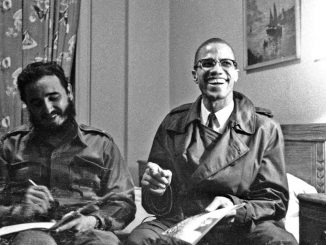
A meeting in Harlem: Malcolm X, Fidel Castro, and the struggle for Palestine

Fidel malcolm
Fidel Castro and Malcolm X met at the Hotel Theresa in Harlem.

Lee en español aquí

In September 1960, in the heart of Black America, Harlem’s Hotel Theresa became the stage for one of the world’s most monumental encounters.

When Malcolm X and Fidel Castro met there 65 years ago, Harlem itself was transformed into a crossroads of revolutionary fervor. The rendezvous would leave an indelible mark not only on New York City but on the entire world, becoming a watershed moment that helped shape the conscience of generations of freedom fighters and sped the rhythm for the struggle for liberation in the United States and across the globe.

The meeting between Fidel and Malcolm X at the Hotel Theresa was not a mere photo-op; it was a potent symbol of an era of revolution and national liberation struggles crystallized in an embrace between two young revolutionaries facing the wrath of the US empire and sending a powerful statement against US hegemony and racial oppression.

This event, born out of circumstance and defiance, continues to hold profound relevance today, particularly in the context of global debates on self-determination and the ongoing struggle for Palestinian liberation. Like the Cuban Revolution in 1960, which embodied the dreams and aspirations of oppressed people worldwide, the Palestinian cause and the people of Gaza today serve as a compass for those seeking to change the world. The unyielding spirit of resistance in Gaza has become a powerful symbol for a new generation of activists fighting for liberation everywhere.

US hostility and the Harlem welcome

Fidel’s visit to New York for the 15th session of the UN General Assembly was met with hostility from the US establishment. When he and the Cuban delegation were initially booked at the downtown Shelburne Hotel, the management demanded a hefty USD 20,000 cash deposit for “damages” and the US State Department restricted their movements. This was a clear political attack, part of the broader US campaign to isolate the young Cuban Revolution as the CIA’s sabotage and terror attacks on the island began to pick up steam.

It was in this moment of diplomatic tension that a group of Black leaders, including Malcolm X, stepped in. They extended an invitation for Fidel and the Cuban delegation to move to the Hotel Theresa, a beacon of African American cultural and political life in Harlem. Fidel accepted, turning a diplomatic insult into a powerful political statement against the Eisenhower Administration’s attempt to silence him. By moving to Harlem, Fidel would create a headache for Washington by intentionally highlighting the hypocrisy of a nation that claimed to be a champion of democracy and freedom abroad while its Black citizens faced systemic segregation and oppression at home.

The atmosphere in Harlem was electric. Thousands of people, defying the rain, gathered outside the Hotel Theresa to cheer the revolutionary leader, a testament to the popular support for Cuba’s struggle against US imperialism among African Americans. As Malcolm X himself later wrote in his autobiography, Fidel “achieved a psychological coup over the US State Department when it confined him to Manhattan, never dreaming that he’d stay uptown in Harlem and make such an impression among the Negroes.”

Rosemari Mealy, in her work “Fidel & Malcolm X: Memories of a Meeting”, emphasizes the profound significance of this move. She notes that the meeting symbolized “the respect that both men expressed towards each other” and their shared struggle for self-determination and national liberation. To the thousands who gathered outside the hotel, “the idea began to build that Castro would come here to stay because he had found out, as most Negroes found out, the nasty ways the underdog was treated downtown.” Fidel was seen as a revolutionary who had “told White America to go to hell,” as a contemporary Black newspaper put it. This powerful sentiment resonated deeply within the community.

Anti-imperialist meeting in the heart of Harlem

The Hotel Theresa meeting was a crucial moment in the history of internationalism and anti-imperialist solidarity. It demonstrated a clear understanding that the struggle against racial oppression and for human rights in the US was inextricably linked to the struggle against colonialism and imperialism abroad. This is a central theme explored by scholars like Rosemari Mealy in her work, which compiles firsthand accounts and reflections, highlighting how the meeting symbolized an era of decolonization and human rights struggles among Black and Third World peoples globally. It was a powerful rejection of the Cold War narrative that sought to frame these movements as isolated and illegitimate.

The meeting exposed the hypocrisy of US claims of being a beacon of freedom while its own Black citizens faced systemic segregation and violence, not just in the US South under Jim Crow, but even in the urban centers of the US North. Fidel’s decision to move to Harlem and his subsequent meetings with world leaders like Jawaharlal Nehru of India and Gamal Abdel Nasser of Egypt from his “new headquarters” transformed him from a hemispheric figure into a global one. As Simon Hall writes in “Ten Days in Harlem”, Fidel’s actions highlighted that “the stain of segregation was alive and well in the urban north,” and placed the politics of anti-imperialism and racial equality at the center of the Cold War. The image of the Hotel Theresa, a Black-owned establishment, serving as a hub for global leaders challenging US power, was a tangible manifestation of the rise of the Third World project of sovereignty and independence in the making.

On September 24, the atmosphere in Fidel’s room at the Hotel Theresa was electric, a small room buzzing with the energy of a young revolution. It was cramped with Cuban guerrillas, youth who had descended from the Sierra Maestra mountains less than two years earlier. At 34, Fidel himself was a whirlwind of motion; his famous beard and olive-green fatigues radiated a restless energy. The room, cluttered with drafts of his upcoming UN speech and scattered news cables, served as a makeshift headquarters. Across from him sat Malcolm X, 35, who, in a sharp suit and with an equally commanding presence, embodied the increasingly militant Black liberation movement within the United States. The encounter was a profound, if brief, exchange between two men who recognized the mirror of their struggles in one another, a shared fight for what Fidel would later call, two days later, in his historic four-hour-long UN speech, “the full human dignity” of all oppressed people. Only a few Black journalists were permitted inside, where Fidel, speaking in English, expressed his admiration for the resilience of African Americans. “I admire this,” he said. “Your people live here and are faced with this propaganda all the time, and yet, they understand. This is very interesting.” Malcolm X’s reply was succinct and powerful: “There are twenty million of us, and we always understand.” As he left the hotel, facing a throng of hostile journalists asking about his sympathies for the Cubans, Malcolm X defiantly replied “Please don’t tell us who should be our friends, and who should be our enemies”.

Though Fidel and Malcolm X would never again meet in person, their lives became intertwined through a shared commitment to internationalism. Just a few years after their historic encounter, Malcolm X would travel to Gaza, where he met with the newly formed Palestinian Liberation Organization (PLO) and wrote his powerful essay “Zionist Logic,” describing Zionism as “a new form of colonialism.” This solidarity mirrored that of the Cuban Revolution; earlier Cuban delegations, including Raúl Castro and Che Guevara, had also visited Gaza, and Cuba would become one of the first countries to recognize both the PLO and the Palestinian state.

From Harlem to Palestine

The echoes of the 1960 meeting resonate powerfully with the upcoming 80th high-level segment of the UN General Assembly. The core principles that defined the encounter between Fidel and Malcolm X, self-determination, anti-imperialism, and the full dignity of oppressed peoples, are being intensely contested today. This is most evident in the ongoing genocide in Palestine, where for nearly two years, Israel, with the unwavering support of the United States, has sought to eradicate the Palestinian people in Gaza through a brutal campaign of endless war, siege, and man-made famine.

Today the struggle of the Palestinians mirrors the oppressive blockade and genocidal siege Cuba has endured for decades. While Cuba’s fight against the US blockade and sanctions has been a protracted war of attrition, marked by a calculated erasure from the news cycle, the Palestinian experience has been one of constant, visceral carnage. US and Western media consistently delegitimize the realities of both peoples, yet they differ in their immediate, brutal visibility. The solidarity Malcolm X showed Cuba, seeing in Fidel a kindred spirit in the fight against a powerful US empire, is the same spirit that animates pro-Palestinian movements today. Just as Fidel and Malcolm X recognized their shared cause, a new generation of activists around the world is increasingly linking the Palestinian struggle to their own anti-colonial, anti-racists, and liberation movements. Across continents, the Palestinian flag and the keffiyeh have become inseparable from the fight for self-determination. Youth in their millions around the world today challenge the domination of US hegemony and re-center the debate on the fundamental human right of all oppressed peoples to live free from imperialism through the lens of the Palestinian struggle.

The dynamics of the 1960 meeting are mirrored in the current debates at the UN. The US government continues to use its power to stifle opposition and punish those who challenge its foreign policy agenda, particularly concerning Palestine. The unprecedented decision on August 29, 2025, by Secretary of State Marco Rubio to deny visas to the entire Palestinian delegation is a stark example of this. In a statement, Rubio made it clear that the US will use its visa authority to advance its political agenda, stating, “It is in our national security interests to hold the PLO and PA accountable for not complying with their commitments, and for undermining the prospects for peace.”

This act of diplomatic isolation, much like the treatment Fidel received in 1960, is designed to delegitimize the Palestinian cause and prevent it from continuing to gain traction on the world stage. Despite the contradictions raised by the Palestinian Authority’s role as the only representative of the Palestinian people at the UN, it’s important to recognize that it’s an attempt to silence a people whose very existence is under siege. However, the more burning issue is that the international community’s response to the genocide taking place in Gaza must move beyond simple expressions of sympathy. While several European countries and US allies are poised to recognize Palestinian statehood formally, this gesture alone will not be enough to end the genocide and the ongoing man-made famine. The UN must move beyond symbolic recognition and take concrete action. At a minimum, this must include sanctions against Israel and a concerted effort to end the blockade of Gaza. Furthermore, based on international law and accusations of war crimes and crimes against humanity, the presence of Netanyahu or any Israeli representatives at the UN General Assembly should be rejected. How can the UN credibly host individuals who have been found responsible for designing and executing mass atrocities?

The struggle for Palestine today, akin to the struggle for Cuba against the blockade, is a fight for self-determination. The lessons of the Fidel-Malcolm X meeting are clear: solidarity across movements is a powerful weapon against imperialism. Sixty-five years later, we are still drawing inspiration from that brief yet monumental meeting in Harlem, learning that solidarity is not a mere gesture but a vital tool in the fight for liberation.

Manolo De Los Santos is Executive Director of The People’s Forum and a researcher at Tricontinental: Institute for Social Research. His writing appears regularly in Monthly Review, Peoples Dispatch, CounterPunch, La Jornada, and other progressive media. He coedited, most recently, Viviremos: Venezuela vs. Hybrid War (LeftWord, 2020), Comrade of the Revolution: Selected Speeches of Fidel Castro (LeftWord, 2021), and Our Own Path to Socialism: Selected Speeches of Hugo Chávez (LeftWord, 2023).

Strugglelalucha256


From Sally-Tom to Charlotte Fosgate: populism and the fight for trans lives, then and now

In May, the Struggle for Socialism Party Los Angeles branch discussed the new book, “Against Fascism: Reclaiming Populism’s Legacy for Today’s Class Struggle,” compiled by Louisiana socialist Gregory Williams. 

Following is the closing presentation for the series of classes, given by trans activist Melinda Butterfield on May 31.

BUY BOOK NOW  |  FREE PDF

Since this is the eve of Pride Month, I thought it would be good to start with a little about the convergence of queer lives with the 19th-century Populist movement in the South. We know there were queer people involved in the Farmers’ Alliance and the People’s Party, because we have always existed, and today’s queer communities have strong roots throughout the South. 

No doubt some of those who joined the movement were closeted, some were stealth, and some were accepted for who they were, as part of their community. But because there was no queer movement as we understand it today, it can be difficult to find direct information on these intersections. We have to suss them out.

This week I’ve been reading a new book by activist and scholar Eli Erlick, “Before Gender: Lost Stories from Trans History, 1850-1950.” In this book, I learned about Sally-Tom and Mollie Wilson, trans women of color who lived in the South during the height of the Populist movement and the People’s Party. I’m going to share a little bit of their stories:

Sally-Tom was a Black woman who lived the first 26 years of her life in slavery. She took the new opportunities opened up by Emancipation to start living more fully and openly as her true feminine self. In 1869, when she came before the Freedmen’s Bureau on an unrelated matter, she was presented with the opportunity to choose her gender for the official records, and she chose to be legally recognized as a woman. According to Erlick, Sally-Tom was probably the first trans person in U.S. history to have her gender officially recognized.

Sally lived in several Georgia towns over the next four decades, working as a cook and household help, as many Black women did. “Sally refused to discuss her life with reporters, so we do not have a single word of her self-narrative,” Erlick writes. “Those who knew her described her to papers at length, however. With a high and crackly voice, Sally reportedly hid behind her straw hat and left events before conflict arose. 

“Her decision to avoid media made sense from the perspective of self-preservation; she likely did not want to draw attention to herself during such a violent era of increasing lynchings and attacks on the Black population.” She died on March 4, 1908, in Waycross, Georgia, at around the age of 69. According to a death notice in the local paper, none of her friends and neighbors knew she was trans.

Mollie Wilson was a Two-Spirit trans woman who was Choctaw and Black, born around 1865 in what was then the Choctaw Territory, which included parts of Mississippi, Alabama and Louisiana. Originally, she spoke only her Indigenous language. At the age of 19, she barely escaped a lynching, killing several of her would-be murderers in the process. She fled from home and took the opportunity of her escape from these traumatic events to embrace her womanhood.

Erlick writes: “Eventually, she moved to Kansas City, Missouri. She reportedly had a large group of friends, mostly Black residents of the city. Mollie always wore a dark dress and fascinator, and with a tall and thin frame, passed with ease. Her transition allowed her to blossom into a social butterfly without fear of lynch mobs.” She married a man and later lived with a woman.

As Jim Crow’s noose tightened, Mollie was arrested twice on police claims that she was a sex worker. Shortly after one of these arrests, she died of tuberculosis in 1901.

These long-hidden lives show how trans and queer people found ways to live as their true selves during the same era that the Populist struggles were pushing back against reaction.

Trump attacks trans health care

But let’s move to the here and now. Trump’s “big beautiful” budget bill recently passed in the House and is currently before the Senate. It attacks housing, Social Security and public health care to transfer funds to the war machine, ICE, and the 1%. Some 20% of Medicaid recipients are to be cut – nearly 14 million people. 

A rider attached to the House bill would eliminate all Medicaid and Affordable Care Act coverage for trans health care, both for youth and adults. At least 275,000 trans people currently depend on Medicaid. The likely knock-on effect would be to allow private insurance companies to dump gender-affirming care, affecting many more. 

In addition to Sally-Tom and Mollie Wilson, this week I have been thinking about Charlotte Fosgate. Charlotte was a 17-year-old trans girl who lived in Oregon. She disappeared May 1 and jumped from a bridge in Portland the next night. Her death was confirmed last week. 

Charlotte’s final social media posts, made from the bridge where she leapt to her death, became a lightning rod for bigots posting hateful memes and messages.

Charlotte represents all the trans youth and adults who are being forced out of public life and losing their hopes for the future because of health care bans, bathroom bans, sports bans, doxxing and violence.

Populism is supposed to represent the interests of those who have been left out, who are marginalized. What kind of “populism” is it that doesn’t include someone like Charlotte Fosgate and other queer youth who are completely stripped of their right to exist, to be themselves, to even dream of a better future?

What the media and politicians term “populism” now is something utterly different. Where populism in the 19th Century represented the desire of people at the margins – small farmers, formerly enslaved people, agricultural workers and all those left behind by the growth of capitalism – to work together to better their futures, now it usually means appealing to the most backward, atomized, anti-social elements that have completely swallowed the small-capitalist, white supremacist mentality. 

What they now call “populism” appeals mostly to the social base of fascism – the shock troops of the billionaire class.

Nazis co-opted socialist terms

It’s not the first time this has happened. The classical fascist movements and regimes in Europe in the first half of the 20th Century adopted some of the anti-establishment and even anti-capitalist rhetoric of their enemies, the communists and socialists, to attract people to their cause. Hitler even called his organization “National Socialists.” 

But they redirected the righteous anger at capitalism toward Jews, queers, people of color, and the left – much as we see ultra-corrupt capitalists like Donald Trump and Elon Musk railing against the “elites” and “Washington insider corruption” as stand-ins for marginalized communities, migrants, and the working class as a whole.

Like the followers of the Strasser brothers, who formed the “left” wing of the Germany Nazi movement, today we have formations like the so-called American Communist Party (ACP) and the Center for Political Innovation (CPI) that use leftist terminology and symbolism to draw disaffected people and those lacking class consciousness into the orbit of the fascist movement. 

While claiming to be socialists or communists, they adopt the exact same racist, misogynist, anti-trans and anti-queer arguments and bigotry as their MAGA inspirations do.

Where is the united movement from the grassroots that will give a voice to people like Charlotte Fosgate or to Sam Nordquist, a Black trans man who was tortured to death in upstate New York earlier this year? 

Where is the movement that will give a voice to the children whose parents are ripped away by masked ICE Gestapo at immigration hearings across the country? Or the migrants from Southeast Asia who were kidnapped and sent by the Trump regime to South Sudan? 

What about Mahmoud Khalil, who is being held thousands of miles from his wife and newborn child in a Louisiana prison? Or the queer youth who are being thrown away by their families or pushed into state-mandated conversion therapy torture?

Building united movement is our task

This united movement of the dispossessed, of the workers and oppressed, is not going to come from the Democratic Party or the established nonprofits that cling to the broken system. Fighting back in the courts and with other “official” methods, while important, is not going to save us or build the movement we need.

It’s up to us. We have to build this movement, this unity. We have to refuse to be siloed. We have to reach out and find ways to collaborate, even when there is not 100% mutual understanding yet. Working together against our common enemies, in our common interests, is the way to build that understanding.

Queer rights are under attack everywhere, including California. Gruesome Gavin Newsom just this week began the process of excluding trans students from athletic competitions, after months of pandering to the worst anti-trans bigots on his podcast. Trans youth have been under attack in schools throughout Southern California for the past few years. And last month, queer activists had to confront a fascist march in the streets of West Hollywood.

That brings us back to LGBTQIA+ Pride Month. This year especially, it’s important for people from all sectors of the working class, all communities, and all organizations of the real left to come out in support of trans rights, trans lives, and all queer people. This is the time to take good sentiments about being an ally and turn them into contacts, joint work, and real efforts to build a united movement. 

In Los Angeles, the Harriet Tubman Center, Struggle for Socialism Party, Trans Rescue Action, and others will be mobilizing for Pride events and queer resistance actions. If you’re not in LA, talk to us, and we can put you in touch with others doing the work in your area.

Let me close with this thought from the conclusion of Vince Copeland’s “Southern Populism and Black Labor,” a classic Marxist work included in the book we’re studying today: “[The Populists’] failure was not due nearly so much to the failure of their ideas, as to the failure to maintain their social position – to hold on to the material base of independent small and especially farming business, from which these ideas originated.

“The new class, the working class, does not yet have the ideas that correspond to its class position. But its class position is innately superior to that of the old Populists from the point of view of having the base to mount a serious and successful struggle. When the new ‘people-ism’ of the workers is born, it will soon grow powerful enough to really lead the people and rule in the name of practically the whole people – something the Populists could not have done, even if they had won.”

Strugglelalucha256


10 years of injustice: Anti-fascist leader recounts Odessa massacre

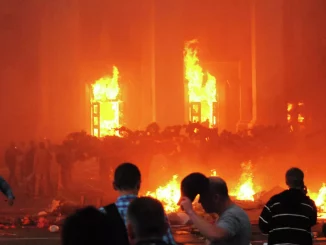
May 2 marks the 10th anniversary of one of the biggest crimes of 21st century fascism – the massacre of nearly 50 activists at the House of Trade Unions in Odessa, Ukraine. Despite extensive video and photographic evidence, the Ukrainian government has never prosecuted any of those responsible. This attack on the anti-fascist resistance paved the way for today’s U.S. proxy war against Russia and the Donbass republics.

The following interview with massacre survivor Alexey Albu was conducted by Struggle-La Lucha co-editor Melinda Butterfield in Simferopol, Crimea, in September 2014, and was originally published in October of that year.

Odessa Regional Council Deputy Alexey Albu, a member of the Ukrainian Marxist organization Borotba (Struggle), was a leader of the city’s Anti-Maidan movement against the U.S.-backed coup of February 2014. Albu survived the May 2, 2014, massacre, when at least 48 people were killed by neo-Nazi gangs at the House of Trade Unions. Albu and his family were forced to flee to Crimea, where he continues his work as co-founder of the Committee for the Liberation of Odessa and leads an independent investigation of May 2. I spoke with Albu about his experiences.

Melinda Butterfield: How did you become active in the anti-fascist movement?

Alexey Albu: I first joined Komsomol, the youth organization of the Communist Party of Ukraine (KPU). Later, I became a member of the KPU and organized its youth wing. I also took part in several local elections in Odessa. So I was always involved in political life as a communist.

The leaders of the KPU were afraid of openly demonstrating anti-fascist views. They didn’t want to take responsibility for an open confrontation with the neo-Nazis or the actions of young people who were strongly against fascism. They took an opportunistic position.

In 2011, I accompanied friends who were members of Borotba to a couple of anti-fascist rallies. When the KPU leaders learned of my attendance at these protests, they planned to expel me.

I left the KPU and became a member of Borotba. I didn’t plan to take people with me. Nevertheless, several comrades left the KPU and joined Borotba. One of them was Vlad Wojciechowski, who is now a political prisoner. Another was Andrey Brazhevsky, who was killed by the Nazis on May 2.

Borotba’s role in Odessa

MB: What kind of work did Borotba carry out in Odessa?

AA: I was an elected deputy of the regional council, so I had the opportunity to speak for Borotba in the local government. We also had the opportunity to create an organizational headquarters in Odessa. Many people came to our organization. Odessa residents got to know us and our symbols, and a lot of journalists covered our activities.

We organized solidarity actions with Ukrainian sailors in England and supported the struggle of dockworkers in the Odessa region. We organized anti-fascist meetings and demonstrations. We held a lot of protest rallies against the local government. We also helped organize immigration and education centers.

All of our protests were directed against the government of President Victor Yanukovych. But when the Euromaidan movement started, we understood that the people who wanted to use it to get power were even worse. Bourgeois democratic law was preferable to direct rule of Nazis and oligarchs. We were against them from the very beginning.

[Euromaidan was the pro-imperialist movement which took its name from Maidan, the central square of Kiev, the Ukrainian capital, where it held protests in late 2013 and early 2014. The backbone of this movement, which received extensive funding and political support from the U.S. government, were neo-Nazi gangs and political parties. Euromaidan culminated in the overthrow of President Victor Yanukovych in February. – MB]

When Euromaidan activists tried to occupy the Odessa Regional State Administration, our comrades protected the building. During the defense of the RSA, I became good friends with Regional Council Deputy Vyacheslav Markin, who was later killed at the House of Trade Unions.

Markin and I were the only deputies who openly said we were against the Nazis, the Euromaidan, the junta and all the crimes this movement brought to Ukraine.

Protest encampment

MB: How did the Anti-Maidan movement and the protest encampment develop?

AA: After Yanukovych was overthrown in February, the Anti-Maidan movement grew and became quite broad. It was based among common people who were not connected with any party. It was organized from below, from the people. The coordinators of this movement included members of many organizations, including Borotba. Borotba was not the most powerful organization; it was just one of those that influenced the Odessa Anti-Maidan.

The biggest parties of Ukraine, the Communist Party and the Party of Regions, didn’t participate in Anti-Maidan, although many of their members did.

The tent camp at Kulikovo Field [similar to the 2011 Occupy Wall Street encampments or the current student Gaza Solidarity Encampments in the U.S.] was the creation of all the groups that took part in the Anti-Maidan movement. For example, one group set up the area where people held speakouts. Others brought tents and supplies.

MB: How did you use your position as a regional deputy to help the movement?

AA: There was a lot of publicity when I introduced a draft law in the Regional State Administration, with help from Deputy Markin, calling for autonomy for the Odessa Region within Ukraine. This made Borotba very popular in Odessa. But unfortunately, most of the delegates didn’t vote for the law.

By ignoring this draft law, the regional deputies forced people to protest. On March 3, they came to the RSA building and started clashing with police. I tried to bring the people into the building to give them the opportunity to speak with the deputies. I was injured trying to get people inside.

Afterward, I had problems with the Security Service of Ukraine [SBU, political police whose role is similar to the FBI in the U.S.]. They searched my apartment and tried to interrogate me. The growing repression had a great impact in Odessa society. By the end of April, the Anti-Maidan protests had become smaller. Fewer people came to Kulikovo.

People were also disappointed because they came to Kulikovo every day, or every weekend, and saw that the leaders of the organizations couldn’t agree with each other. Instead, one by one, these groups started to make deals with the government.

The local government wanted to remove the camp, using the annual May 9 Victory Day parade as an excuse. Some organizations agreed to remove their tents, but others decided to stay.

Target: Odessa

MB: Why do you think the Kiev junta and the fascists targeted Odessa on May 2?

AA: First of all, I should explain that the Odessa region is very important for the Ukrainian economy. [The administrative subdivision of] Odessa has seven seaports and 70% of the country’s imports come through there.

Supporters of the junta in the local government wanted to stop the Anti-Maidan movement. They brought in neo-Nazis from Kiev in the middle of the night. They organized checkpoints inside the city, with 10 or 15 people at each checkpoint. They operated in around-the-clock shifts. They were fed by the government, and they earned money.

On April 29-30, Andriy Parubiy, head of the Defense and National Security Council, even presented the people at the checkpoints with bulletproof vests.

On one hand, they wanted the people from Kiev to radicalize the local Euromaidan movement, to ensure that they would enforce the new government’s orders. On the other hand, they wanted to remove the activists from Kulikovo Field, to make sure there would be no organized opposition.

I don’t think the government necessarily planned to kill people and cause so many casualties. But they organized everything and set the events in motion.

MB: Before the massacre on May 2, you planned to run for mayor of Odessa.

AA: What happened was that we held a strong anti-fascist demonstration on May Day, which worried the local government. That day, a lot of people from the Odessa Anti-Maidan movement agreed to back my campaign for mayor as the candidate of Kulikovo Field.

The following day, May 2, the tragedy began.

Deputy Markin was my campaign manager. He was killed by the Nazis. Afterward, anyone who tried to agitate for the candidate of Kulikovo Field was attacked by the fascists. So I decided to stop the campaign. I couldn’t take part in such elections.

Anyway, I was soon forced to leave Odessa. The local government spread lies, saying that I was responsible for the deaths at the House of Trade Unions. They claimed I took people into the building and subsequently the building burned, so I was guilty. They planned to arrest me.

Actually, I was one of the last people to enter the building. Never mind the fascists who threw Molotov cocktails, shot people and beat to death those who leapt from the burning building!

Kiev suppresses evidence

MB: Along with other Odessa political exiles, you have been conducting an independent investigation of the May 2 tragedy. Can you describe your work?

AA: The main problem for us is that a lot of information was lost the day after the tragedy. Many people went there. The House of Trade Unions was cleaned out before facts and evidence could be gathered.

Also, all the material recorded by the police and Security Service of Ukraine was never published and is classified top secret. So we have to look for information from open sources or solicit people who witnessed the massacre to share information. And of course many have been coerced by the new regime to remain silent or change their stories.

Our committee is sure that there were more than 48 victims on May 2. For one thing, the mother of an activist told us that when she went to the morgue to identify her child, the police showed her more than 60 bodies.

Officials of the government, the Security Service and the police do not provide any information, not even to the official investigation committee set up by the Ukrainian parliament. The leaders of the ultranationalist Ukrainian militia do not comment or make any statements. They are trying to avoid all questions about this tragedy.

But under the law they have to answer all the questions and turn over all the evidence and facts they have to the investigation committee.

MB: Do you have any parting message for workers and youth in the U.S.?

AA: The government in Kiev is doing everything in order to hide the real causes of this terrible tragedy and the real culprits of the massacre. We declare that we will pursue the investigation anyhow, and everyone guilty will answer for it and will be punished.

We are grateful to all the comrades who support the struggle of the Ukrainian people against the oligarchy and the Nazis. We are grateful to everyone who is helping us, and we call for solidarity because only together, by joint efforts, can we defeat the world capitalist system.

¡No pasarán!

Svetlana Licht and Marina Nova provided translation assistance.

Strugglelalucha256


UAW workers at Daimler Truck win big wage gains: Organize the South!

Blinking at the last minute on April 26, Daimler Truck agreed to union demands for big pay raises. The 7,300 United Auto Workers members won an immediate 10% wage increase.

Pay will go up by at least 25% over the proposed four-year contract. UAW President Sean Fain announced that employees will for the first time receive cost of living increases.

The lowest-paid UAW members making school buses at Daimler’s Thomas Built Bus won increases of over $8 an hour. Their wages will match the pay of the workers in the truck plants.

Equal pay for equal work was won. The hated pay tiers — where two workers doing the same job get different pay because of when they were hired — will be abolished. 

Daimler — headquartered in Stuttgart, Germany — is the world’s biggest commercial vehicle manufacturer. It made $4.3 billion in profits last year from exploiting 100,000 workers in the United States, Germany, Mexico, South Africa, Brazil, India, Indonesia, Türkiye and other countries.

Corporate profits are stolen wages. Daimler’s wage theft amounted to an average of $43,000 in profit taken from every one of its employees.

The huge corporation saw how UAW’s successful strikes last year against General Motors, Ford and Stellantis (Chrysler and Jeep) brought the Big Three automakers to their knees. The week before, workers at Volkswagen’s Chattanooga, Tennessee, plant voted three to one to join the UAW. 

What made the Daimler and Volkswagen victories all the more important is that they happened in the U.S. South.

Daimler has truck factories in Cleveland, Gastonia and Mount Holly, North Carolina, and Gaffney, South Carolina. The Thomas Built Buses plant is in Mount Holly. (There’s also a Daimler Freightliner truck plant in Portland, Oregon.) 

Using the Klan to bust unions

The UAW breakthroughs in the Carolinas and Tennessee are historic because unions have been overwhelmingly kept out of southern states.

Just one out of 37 workers in North Carolina have union protection. That’s 2.7% of the workforce.

Next door in South Carolina, only 2.6% of workers belong to unions. 

This union busting is a legacy of slavery and the bloody overthrow of the Reconstruction governments in the South following the U.S. Civil War. The Ku Klux Klan was used to break union drives like at the old Bibb textile mills in Macon, Georgia, in the 1940s.

Wall Street banksters were the puppet masters of these lynch regimes which they viewed as reservoirs of cheap labor. Behind the fascist Alabama Gov. George Wallace was U.S. Steel, whose mills dominated the state’s economy in the 1960s.

At least U.S. Steel hired Black workers, although usually in the worst jobs. Ford and General Motors refused to employ Black workers on their Atlanta area assembly lines until the early 1960s. They did so only after Black workers in Detroit threatened walkouts.

The biggest southern industry was textiles, centered in the Carolinas. Yankee textile outfits fled south to escape union drives in the North. By 1960, 89% of U.S. textile production was in the South. 

Wages in southern mills were up to 40% below the northern average. Key to keeping this industry non-union was keeping out Black workers.

No other manufacturing industry in the United States was so segregated for so long. In the southeastern textile belt, millions of Black workers lived near mills where they couldn’t get a job. 

Hiring Black workers in southern textile mills is one of the great triumphs of the civil rights movement. However, hundreds of these plants, including the Bibb Mills, have since shut down.

When Ezell Blair Jr., Franklin McCain, Joseph McNeill and David Richmond began their sit-in at a Woolworth’s lunch counter in Greensboro, North Carolina, on Feb. 1, 1960, just 3.3% of textile workers were Black. 

Eighteen years later, in 1978, African Americans “held a quarter of all production jobs in the Southern textile industry.” (“Hiring the Black Worker, The Racial Integration of the Southern Textile Industry, 1960-1980,” by Timothy J. Minchin)

Avenging Ella May Wiggins

Some whites did break with Jim Crow. The most notable example was the Gastonia, North Carolina strike — led by the Communist Party — in 1929. Today Gastonia is home to one of the UAW-organized Daimler truck plants.

Despite a fantastically intense campaign of race-baiting, hundreds of white workers remained loyal to the National Textile Workers Union. The NTW called for equality between Black and white workers. 

The strike was drowned in blood. Among its martyrs was 29-year-old union leader Ella May Wiggins. She was shot to death in broad daylight on Sept. 14, 1929.

Typical of the poverty suffered by white textile workers was that four of Wiggins’ children died of whooping cough. (“The Lean Years: A History of the American Worker 1920-1933,” by Irving Bernstein)

Textile workers were seething. They exploded in 1934. One hundred seventy thousand workers went on strike in the South. 

Bosses and their state governments mobilized 23,000 sheriff deputies, National Guard soldiers and private gunmen to break the strike.

After receiving $20,000 from mill owners, Georgia Governor Eugene Talmadge declared martial law. A concentration camp for arrested strikers was set up at Fort McPherson near Atlanta. 

Thirteen strikers were killed in the South. Another two died in the North. Seven workers were murdered at the Chiquola Mill in Honea Path, South Carolina, alone. (“Testing the New Deal: The General Textile Strike of 1934 in the American South,” by Janet Irons)

President Franklin Roosevelt and Labor Secretary Frances Perkins did nothing about these bloody massacres. Don’t count on Joe Biden to help union organizing drives either. Genocide Joe is busy helping to kill children in Gaza.

The capitalist deep state also allowed the Klan and Nazis to murder five Communist Workers Party members in Greensboro, North Carolina, on Nov. 3, 1979. 

Cesar Cauce, Mile Nathan, Bill Sampson, Sandi Smith and Jim Waller were murdered in front of TV cameras. The leader of these fascist killers, Edward Dawson, was on the payroll of the Bureau of Alcohol, Tobacco and Firearms of the United States Treasury Department.

None of the assassins spent a day in jail. Like the Honea Path atrocity in 1934, the Greensboro Massacre was approved by the wealthy and powerful.

The UAW victories at Daimler and Volkswagen are helping to avenge Ella May Wiggins and the Greensboro martyrs. Organize the South!

Strugglelalucha256


Behind Southern governors’ anti-union agenda

Southern politicians who sold their souls to the corporations and banks are a bit rattled right now, and who can blame them? Volkswagen workers won big in Chattanooga, Tennessee, when 73% of plant workers voted to join the United Auto Workers Union.

This is the first time that autoworkers have successfully unionized via election in the South since the 1940s! What if more of us workers here in the South get an idea? 

Before the vote even happened, six “anti-woke” southern governors put out a joint letter condemning the union. That should tell us how significant the unionization victory is.

Seriously. The Volkswagen vote is a big deal for all workers in the region. When economists compare workers of the same type, with the only difference being whether they’re union members, unionized workers earn 10-15% more in wages according to the U.S. Department of the Treasury. That’s just wages. Unionized workers have better benefits and working conditions, too.

And unlike with “trickle down economics” – the now totally disproven idea that tax breaks for the ultra-wealthy will trickle down to the rest of us – when it comes to the benefits of unions, the high tide really does lift all workers’ boats. The Treasury Department admits that the data is clear on this point. There is a spillover.

For every 1% increase in union membership in the private sector, that results in a 0.3% increase in wages for nonunion workers, and the benefits are greatest for workers without college degrees. 

Workers in states that have extreme anti-union laws (misleadingly called “right to work” or RTW laws) make 3.2% less on average than those doing the same job in states with less restrictions on unions. That is to say, full time workers in RTW states like Louisiana or Mississippi make about $1,670 less per year.

The letter written by the governors has a laughable graphic saying “Republican governors stand with American Auto Workers.” It’s signed by Kay Ivey (Alabama), Brian Kemp (Georgia), Tate Reeves (Mississippi), Henry McMaster (South Carolina), Bill Lee (Tennessee), and Greg Abbott (Texas). Every word of the statement is a lie. We should ask who they’re working for, because it ain’t us.

Roster of shame

The governors’ main claim is that all the jobs are going to leave if the workforce unionizes. But there is no correlation between whether a state has RTW laws, and thus low unionization rates, and employment. When you look at whether prime working-age people (ages 25-54) have a job in RTW vs. non-RTW states, there’s no systematic difference. Fluctuations in employment follow the same capitalist boom-and-bust cycles (expansion followed by recession) across states.

Forbes looked at U.S. Census data for 2023 and ranked the states with highest and lowest poverty levels. Mississippi comes in as the poorest state, with 19.1% living below the federal poverty level. So there’s Tate Reeve’s state. 

(U.S.-occupied Puerto Rico has a poverty rate of 43%, but the island is not a state, so is usually not included on these lists. It’s being plundered by corporations and banks. U.S. out of Puerto Rico, now! Puerto Rico will be free!)

Louisiana has the second-highest poverty level, but our governor – Jeff Landry – didn’t sign the letter; maybe because auto-manufacturing hasn’t taken off here yet. Alabama is the 7th highest, so Kay Ivy gets an “F.” South Carolina comes in at number 10; Henry McMaster is another loser.

So, three out of six of the signees govern states in the top 10 poorest. And since they’re doing absolutely nothing to alleviate poverty, we can rest assured that they do not care about workers, only about making themselves and their big donors rich. There’s no reason to trust them about unions.

Speaking of big donors, a Mississippi Today investigation in late 2023 found that Tate Reeve’s top campaign contributors brought home a whopping $1.4 billion in state contracts and grants, all from agencies Reeves oversees. It pays to play! Or is it pay to play? 

Texas-sized hypocrisy

According to Market Realist, Greg Abbott has a net worth of $14 million. In December 2023, his campaign received $6 million – “the largest single donation in Texas history,” in the campaign’s words – from Pennsylvania billionaire Jeff Yass. 

Yass is thought to have $29 billion. He’s the co-founder and managing director of investment firm Susquehanna International Group.

Why would a Pennsylvania capitalist be funding Texas politics? Because he champions the anti-public school voucher movement, tax cuts for billionaires, and all manner of other things that only benefit the rich. He’s making an investment in Texas. 

The truth is that there is nothing unusual about these shenanigans, and Democratic politicians are no better. The Washington Post said it: “More than half of those who served in the House and Senate were worth more than $1 million; many had net worths that stretched into the tens of millions.”

We should not be surprised where these capitalist politicians’ allegiances lie. Every time they try to stir us up about unions, trans people, immigrants, or some supposed foreign adversary, we should ask: “What’s in it for you?”

Strugglelalucha256


Cuba’s victory at Playa Giron and the U.S.’s moral punishment

April 19, 1961, is marked in the Cuban popular imagination as a day of national pride. Barely 72 hours after the landing of 1500 U.S.-backed mercenaries at Playa Giron (Bay of Pigs) in Matanzas, Cuba demonstrated to the world its willingness and determination to defend with arms the revolutionary process initiated on January 1, 1959. Witnesses of that three-day battle remember the complexity of the combat. Although Cuba was expecting the attack, it was surreal that it was really happening.

The memory of the roar of bullets and tanks hurts. The Zapata Swamp was stained with blood and gunpowder. The consequences of that mercenary incursion are shocking: 118 people lost their lives, many of them peasants and children of the area. Three hundred and sixty people were wounded, and 1,202 mercenaries were captured.

“Do not let our war tanks stop until the mats are soaked in the beach water, because every minute that those mercenaries are on our soil it is a threat to our homeland,” the maximum leader of the Revolution, Fidel Castro, had ordered. And so it was. The forces of the Rebel Army, the National Revolutionary Police, the popular militias, and the peasants residing in the area closed ranks and drove the invaders back to the sea. That feat marked the first military victory against U.S. imperialism in Latin America.

The aggression was organized by the U.S. Central Intelligence Agency (CIA) and had the air and naval support of the Army of that northern power whose government has intended, since then, to reverse the process of social transformations in Cuba. Most of the mercenaries were Cuban emigrants who were recruited and trained by the CIA after the triumph of the Revolution to overthrow the revolutionary government of the island.

In an act of commemoration for the victory’s anniversary in 1965, Fidel affirmed that the victory of the Bay of Pigs “marked the day when the plans drawn up by the brainy generals of the Pentagon, by the luminaries of the Central Intelligence Agency, fell apart.”

This is the best-known story of the invasion. What is less well known is what happened to the mercenaries after the victory. Let’s remember that the attack was doomed to failure before the first shot was fired. President John Fitzgerald Kennedy, from the White House, canceled at the last minute the air strikes that would seek to “neutralize” the Cuban air force, and he did so because the U.S. wanted to camouflage its true role as the driving force behind the invasion. The mercenaries, armed to the teeth and loaded with the coffers of the White House money, were left alone to avoid damaging Washington’s image. But this did not take long to come to light.

The book “Battle for Indemnity” by Verde Olivo Publishing House tells the story of the political process that followed the victory. Authors Acela Caner Román and Eugenio Suárez Pérez explain that imperialism was forced to pay a war indemnity for material damages for the first time in U.S. history. This revealed in no uncertain terms the responsibility of the U.S. government for the invasion, despite its attempts to cover it up. That agreement is considered Cuba’s second victory in the Bay of Pigs.

It has often been said that once the victory at Bay of Pigs was won on April 19, 1961, the mercenaries who invaded the country were exchanged for baby food after a negotiation with the government of President John F. Kennedy. However, this was not exactly what happened. During the trial of the mercenaries, the majority of the participants supported the commander-in-chief’s idea of requesting compensation. Although the people of Cuba demanded the death penalty for the mercenaries, “Fidel, rightly, convinced everyone that the important thing was to get compensation, and he got it,” according to the book.

President Kennedy’s administration never paid 100% of the agreed indemnity, the authors of “Battle for Indemnity” explained and recalled the words of the Commander in Chief concerning the victory: “What we wanted was for them to pay us, not because we needed the money, but because it represented the recognition of the U.S. Government of our revolutionary victory. It was a moral punishment from us to them. It was our second victory.”

Source: Resumen Latinoamercano  – English

Strugglelalucha256


Never forget the Ludlow, Colorado, and Veracruz, Mexico, massacres

Over 20 people were killed by the Colorado National Guard in Ludlow on April 20, 1914, during a coal miners’ strike. Eleven of those murdered were children. They choked to death when the tent above them had been set on fire by soldiers.

The next day, April 21, 1914, the U.S. began a military occupation of Veracruz, Mexico. Hundreds of Mexicans were killed during the invasion.

These two atrocities 110 years ago were committed on behalf of Wall Street banksters who are still running the United States today. Their Pentagon war machine is supplying the bombs and shells that have killed over 14,000 Palestinian children in Gaza.

The coal miners in Colorado were on strike against the Colorado Fuel and Iron Company, which was controlled by the Rockefellers, the world’s first billionaire family and founders of Big Oil.

Nine thousand miners had walked out of the Colorado Fuel and Iron company-owned camps on Sept. 23, 1913. They struck against $1.68-a-day wages.

They revolted against the CF&I company stores, CF&I-controlled schools, and CF&I-censored libraries. Strike leader Louis Tikas, a Greek immigrant, was shot in the back and killed.

The U.S. attack on Veracruz was in response to the Mexican Revolution, which began in 1910. The United States had stolen half of Mexico in the late 1840s to expand slavery.

Thirteen years before the U.S. occupation of Veracruz, Los Angeles oil tycoon Edward Doheny opened his first oil well in Tampico, Mexico. President Woodrow Wilson invaded Mexico to protect the profits of U.S. oil outfits, mining, and railroad companies.

Wilson was a super bigot who segregated government lunchrooms. He had “Birth of a Nation,” a film that glorified the Ku Klux Klan, shown in the White House.

Wilson’s Navy Secretary, Josephus Daniels, helped overthrow Wilmington, North Carolina’s Black elected government in 1898. An estimated 300 Black people were killed.

Every worker needs a rifle

Just as Wilson refused to do anything about lynchings, he did nothing to stop miners and their families from being killed in Colorado. The Ludlow massacre horrified the country.

Victor Berger — the socialist member of Congress from Milwaukee — got up in the House of Representatives and urged every worker to get a rifle. The Cleveland Leader wrote, “The charred bodies of two dozen women and children show that Rockefeller knows how to win!”

Enraged strikers in Colorado attacked mines being operated by strikebreakers. President Wilson sent in U.S. troops to break the strike.

The heroic strike was finally defeated. But, the Colorado Fuel and Iron Company was forced to sign a contract with the United Mine Workers in 1933.

Decades later, New York Gov. Nelson Rockefeller, a grandson of Big Oil founder John D. Rockefeller, had 30 Attica prisoners massacred in 1971.

Poor and working people in Mexico, Palestine, and the United States have the same enemy: the billionaire class whose headquarters is Wall Street.

Always remember the Ludlow, Veracruz, and Attica massacres. Fight like hell for Gaza and all of Palestine.

Strugglelalucha256


Why we should commemorate Nov. 11

Even though Veterans Day is a federal holiday, only 19 percent of workers employed by private business get the day off. Originally called Armistice Day, it marks the end of World War I “at the 11th hour on the 11th day of the 11th month” of 1918.

Twenty million people were killed during this imperialist war, half of whom were civilians. It was waged between colonial powers that had enslaved hundreds of millions in Africa, Asia and the Americas.

Lenin, the leader of the socialist Bolshevik Revolution, called it a “war between the biggest slaveowners for preserving and fortifying slavery.”

The Belgian King Leopold II had killed as many as 15 million Africans in Congo for rubber profits. British capitalists made fortunes from famines in India and occupied a quarter of the planet. Fresh from genocidal wars against Indigenous nations, the U.S. army had killed a million Filipina/os fighting for independence.

Another 50 million people died in the 1918-1919 influenza pandemic that may have started at U.S. Army bases in Kansas.

Around 117,000 U.S. GIs died in the war. Three months after the U.S. entered the conflict, at least 100 Black people were murdered in East St. Louis, Ill., by white racist mobs.

Black soldiers returning from combat were among those killed in the race riots that swept U.S. cities in 1919. But World War I was swell for U.S. big business.

According to Marine Corps Maj. Gen. Smedley Butler in his book “War is a Racket,” “at least 21,000 new millionaires and billionaires were made in the United States during the World War. That many admitted their huge blood gains in their income tax returns. How many other war millionaires falsified their tax returns no one knows.”

This was back in 1918, when the dollar was worth 16 times as much as it is now.

The du Ponts weren’t even mentioned in “The History of Great American Fortunes” by Gustavus Myers, which was published in 1909. The family’s vast profits from selling explosives during World War I catapulted them into the superrich.

Besides their chemical empire, the du Ponts controlled General Motors, which had been the world’s largest corporation, for decades.

Never forget Nat Turner

So why should poor and working people commemorate Nov. 11? Because on Nov. 11, 1831, the liberator Nat Turner was executed.

Turner led a revolt of enslaved Africans in Virginia that terrified all the slave owners. Beginning on Aug. 21, 1831, Black people marched from plantation to plantation in Southampton County fighting for liberation. Black Panther Field Marshal George Jackson was murdered 140 years later on Aug. 21, 1971, in California’s San Quentin prison.

The reaction of slave masters was merciless. They thought they were facing another Haitian Revolution.

Soldiers and sailors were mobilized to crush the rebellion. Militia members were sent from both Virginia and North Carolina.

The Rev. G.W. Powell said there were “thousands of troops searching in every direction,” with many Black people killed. The editor of the Richmond Whig newspaper admitted that “men were tortured to death, burned, maimed and subjected to nameless atrocities.” (“Before the Mayflower, A History of Black America” by Lerone Bennett Jr.)

Nat Turner was captured but never flinched. He was executed in Jerusalem, Va. It’s named after the eternal capital of Palestine, also known as Al-Quds.

The slave masters called Nat Turner a “terrorist.” That’s the same term used today to smear Palestinian freedom fighters.

Hanged for the eight-hour day

Labor leaders George Engel, Adolph Fischer, Albert Parsons and August Spies were hanged in Chicago’s Cook County Jail on Nov. 11, 1887. Twenty-three-year-old Louis Lingg was also slated to be executed, but he was either murdered or committed suicide the day before.

These martyrs died for the eight-hour work day. Most workers in those days worked 10 or 12 hours a day, sometimes even longer.

On May 1, 1886, hundreds of thousands of workers across the U.S. went on strike to demand an eight-hour work day. Capitalists were terrified. Workers marched from factory to factory urging employees to strike.

Chicago was the center of this movement. Chicago police fired on striking workers at the McCormick reaper works — which later became part of International Harvester — on May 3, killing at least two.

The next day, a protest meeting was called at Chicago’s Haymarket Square. Police attacked the crowd, and someone threw a bomb at the cops. Eight policemen died as well as possibly some protesters.

The ruling class went berserk. Police arrested hundreds, but the bomber, who may have been a provocateur, was never found.

Instead, well-known labor leaders were put on trial for their lives because they supposedly incited the bombing. Years later, Illinois Gov. John Peter Altgeld courageously pardoned those who had been jailed.

Four of the five Haymarket Martyrs were immigrants. All were labeled anarchists. Trump wants us to hate immigrants while he calls anti-racist protesters “anarchists.”

As he was about to be hanged, Albert Parsons declared, “The day will come when our silence will be more powerful than the voices you strangle today.”

Lucy Parsons, a Black woman who was Albert Parsons’ partner, continued fighting for the working class until she died in a house fire in 1942. Chicago police said that she was “more dangerous than a thousand rioters.” Lucy Parsons’ books and papers were confiscated by the FBI.

May 1 became the international holiday of the working class. In Mexico, it’s known as the Day of the Chicago Martyrs.

Long live the People’s Republic of Angola!

The People’s Republic of Angola was born on Nov. 11, 1975. Vice President Nelson Rockefeller, along with his employees Secretary of State Henry Kissinger and White House occupant Gerald Ford, sought to kill it. They had the Nazi armies of then-apartheid South Africa invade the African country.

Angola’s independence was historical justice that resonated around the world. Four million Angolans had been kidnapped in a slave trade that lasted four centuries. Brazil’s sugar plantations were fed by Angolan slave pens.

Millions of Brazilians have Angola in their blood. So do some African Americans.

The largest prison in the U.S. is in Angola, La. The sugar plantation which became the core of the prison was named Angola because that’s where the enslaved Africans working there came from.

Today, thousands of slaves work on the Angola prison’s 18,000 acres. The “Angola 3” — Herman Wallace, Robert King Wilkerson and Albert Woodfox — spent decades in solitary confinement on frame-up charges of killing a prison guard before being freed.

Their real crime was forming a chapter of the Black Panther Party. Herman Wallace died of liver cancer a few days after being released.

Five hundred years of Portuguese colonialism in Angola were 500 years of resistance. The founding of the Popular Movement for the Liberation of Angola (MPLA) in 1956 was a decisive step. Forced labor was halted only after 50,000 Angolans were killed during the 1961 revolts.

When South Africa invaded Angola, Cuba came to Africa’s assistance. As the Pan African educator and organizer Elombe Brath said, “When Africa called, Cuba answered.” Two thousand Cuban soldiers died fighting alongside their African comrades.

The initial defeat of South Africa helped inspire the Soweto Uprising on June 16, 1976. The total defeat of the apartheid army at Cuito Cuanavale in 1988 led to Nelson Mandela walking out of prison two years later.

So let us remember Nat Turner and the Haymarket Martyrs while celebrating Angola’s independence. And be prepared to stop any new wars for the rich.

Strugglelalucha256


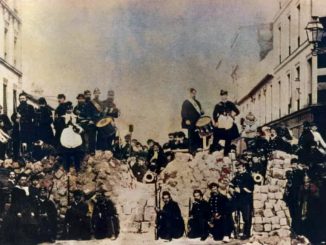
Long live the Paris Commune!

One hundred fifty years ago, poor and working people in Paris took power into their own hands. The Paris Commune was born on March 18, 1871.

Karl Marx ― the founder of scientific socialism, also known as communism ― wrote that the workers in Paris “had stormed heaven.”

The world’s first working-class government lasted just 72 days before being drowned in blood. At least 30,000 of its supporters were killed by counter-revolutionary forces.  

Yet the 1917 Bolshevik Revolution and every socialist revolution that followed were inspired by the workers of Paris. The Bolshevik leader Lenin declared that “we all stand on the shoulders of the Commune.”

One reason revolutionaries raise clenched fists is because captured Communards did so as they were executed by firing squads. The revolutionary anthem “The Internationale” was composed by Eugène Pottier and Pierre De Geyter, who were both supporters of the Commune. The title refers to the First International workers’ party and declares that the international party will unite humanity (“shall be the human race”).

The title of Franz Fanon’s classic work on the African Revolution ― “The Wretched of the Earth” ― comes from the Internationale’s stirring words: “Arise, ye prisoners of starvation! Arise, ye wretched of the earth!”

The road to the Commune

The Commune arose as a result of France being invaded by German armies in 1870. The French leader at the time ― Napoleon III ― thought the Franco-Prussian war would prolong his dictatorship.

The so-called Emperor of the French surrendered his armies and was overthrown instead. Napoleon III was a nephew of the original Napoleon, whose armies conquered much of Europe but were driven out of Haiti.

Napoleon III could have been a model for Trump. Both were lying scoundrels and white supremacists. The French dictator killed tens of thousands of people in Algeria and invaded Vietnam.

Victor Hugo ― who wrote “Les Misérables” ― called the French imposter “Napoleon the little.” Karl Marx wrote “The Eighteenth Brumaire of Louis Bonaparte,” showing how the class struggles in France allowed this faker to seize power. (The “18th Brumaire” refers to the date in the French revolutionary calendar when the original Napoleon seized power in 1799.)

It was the workers of Paris that overthrew King Louis Philippe in the February 1848 revolution. They wanted a social republic with full employment and an end to hunger.

They were betrayed by the capitalists. Thousands of workers were killed when they rose up in June of that year. The wealthy and powerful united in the “party of order” to crush them.

However, the ruling classes were divided, with some wanting a republic while the monarchists supported three different candidates. Louis Bonaparte was able to exploit the divisions to pose as the savior of capitalist society against the poor.

First elected as president, Louis Bonaparte seized power before his term ended in 1852. That’s what Trump wanted to do with his Jan. 6 coup attempt.

The coming to power of Louis Bonaparte, who declared himself Napoleon III, was the last act of the 1848 revolutions that swept through Europe. All were defeated. Karl Marx and his co-worker Frederick Engels fled to Britain.

A long period of reaction set in, like the period following the overthrow of the Soviet Union. Karl Marx dissolved the Communist League.

What turned things around was the U.S. Civil War. While landlords and capitalists supported the Confederacy, every progressive person wanted the slave masters defeated. Thousands immigrated to the United States to join the Union army.

“The Black Jacobins” by C.L.R. James showed how the people of Haiti helped defend the French Revolution against invasion. In the U.S., the Black troops in the Union army and a Black general strike in the Confederacy proved decisive in overthrowing slavery.

Strikes broke out and workers’ organizations were formed across Europe following the North’s victory. Helping to promote these struggles was the First International, which was guided by Karl Marx.

A wonderful, heroic legacy

The German armies overran northern France but couldn’t capture Paris. The people refused to surrender despite being starved.

Following Napoleon III’s downfall, all the Trumps in the French one percent formed a provisional government in Versailles. The former home of “let them eat cake” Marie Antoinette is about 15 miles from Paris.

The Versailles regime’s first act was to try to disarm the workers of Paris who had prevented the city’s capture. Capitalist leader Adolphe Thiers sought to crush the people who wanted a social republic.

To commit this crime, Thiers tried to seize artillery belonging to the worker-dominated National Guard in the city. Working women in the Montmartre neighborhood seized the cannon instead.

The Commune was declared the same day.

“The real women of Paris showed again at the surface,” wrote Marx, “heroic, noble and devoted, like the women of antiquity. Working, thinking, fighting, bleeding Paris ― almost forgetful, in its incubation of a new society, of the cannibals at its gates ― radiant in the enthusiasm of its historic initiative.”

Thiers was a cannibal whose mercenaries slaughtered the Commune’s defenders. In the same decade thousands of Black people were murdered by the Ku Klux Klan during Reconstruction’s bloody overthrow.

While the working people of Paris in 1871 were trying to build a new society, the same year in Los Angeles ― then a village of 5,000 ― a racist mob lynched at least 17 Chinese people. 

In contrast, the military leader of the Commune was the Polish immigrant Jaroslav Dombrowski, who died on the barricades. A thousand Poles fought alongside Parisians.

Most French workers and even many revolutionaries initially supported Napoleon III’s reactionary war. They did so because of the memories of the French Revolution defending itself against the feudal armies of Europe.

But the struggle to build a new society helped defeat national hatreds, often called chauvinism, named after the French soldier Nicolas Chauvin. Another Chauvin is the Minneapolis pig that murdered George Floyd.

French workers repudiated the first Napoleon’s bloody chauvinist record, which included restoring slavery. On May 16, 1871, they tore down the Vendôme column with its statue of Napoleon. 

Meanwhile the German socialist leaders August Bebel and Wilhelm Liebknecht were jailed on treason charges for demanding peace with France. This was internationalism in action.

A record to be proud of

The Commune accomplished so much in its too-short existence.

The existing state power was smashed. No more killer cops!

Elected officials had salaries not exceeding that of a skilled worker and could be immediately recalled by voters.

Closed workplaces were reopened as cooperatives. Nightwork in bakeries was abolished. Education was declared a right.

In its pioneering attempt to create a new society, the Commune made mistakes. It didn’t take over the state bank.

Women weren’t allowed to vote. That didn’t stop women from being the Commune’s staunchest defenders. As Marx wrote, “The women of Paris joyfully gave up their lives on the barricades and on the place of execution.” 

A Women’s Union was formed. Louise Michel fought on the barricades and was exiled to New Caledonia, which is still a French colony.

Forty-six years after the Commune, women textile workers in St. Petersburg, Russia, went on strike on International Women’s Day and overthrew a tyrant called the tsar.

The Paris Commune lasted 72 days within the shrinking limits of a single city. The Soviet Commune defeated Hitler and lasted 73 years over one-sixth of the earth. 

Our class still has China, Cuba, People’s Korea, Laos and Vietnam. The peoples of Bolivia, Nicaragua, Venezuela and Zimbabwe will not surrender to U.S. and European banksters.

Palestine and Yemen will be free. Iran will defend itself against the Pentagon.

Long live the Commune!

Strugglelalucha256


Malcolm X: A human rights activist moving towards socialism

If not for the COVID-19 pandemic, as we mark Malcolm X’s 95th birthday on May 19, 2020, hundreds and thousands of people would be marching and rallying in the streets, shouting “Justice for Ahmaud Arbery and Breonna Taylor!” as we did in 2006 for Sean Bell; in 2009 for Oscar Grant; in 2012 for Trayvon Martin, Jordan Davis, Ramarley Graham and Alan Blueford ;in 2013 for Mariam Carey; in 2014 for Tamir Rice, Michael Brown, Dontre Hamilton and Laquan McDonald; in 2015 for Freddie Gray and Donald Dontay Ivy; in 2016 for Alfred Olango; in 2018 for Aleah Jenkins; in 2019 for Dennis Carolino and on and on. 

We would have signs listing our demands: Justice For Breonna Taylor and Ahmaud Arbery, Stop police brutality, Community control of the police and Jail killer cops. 

Similar demands were made by Malcolm X in 1957, when he intervened at a police station in New York. Johnson X Hinton, a member of the Nation of Islam, had been brutally beaten and arrested by two cops. Word of the brutality spread quickly across Harlem. Furious residents flocked to the police station demanding justice. 

Malcolm X mobilized the self-defense unit of the NOI, the Fruit of Islam, who positioned themselves to maintain order. Malcolm was shocked by Johnson X’s injuries and demanded that he receive immediate medical attention. An ambulance arrived and a crowd of over 2,000 followed it to the hospital on foot. 

Once he was satisfied that Hinton was being cared for, Malcolm stepped out of the hospital and with a wave of his hand, the crowd dispersed. Witnessing his control of the crowd, a police inspector commented, “No man should have that kind of power.” What he really meant was, “No Black man should have that kind of power.” 

Johnson X survived, but had to have multiple brain surgeries and live with a metal plate in his head. He filed suit against the New York Police Department. An all-white jury awarded him $70,000, the largest police brutality settlement in New York City at that time. 

Roots in the struggle

Malcolm Little was born on May 19, 1925, in Omaha, Neb. In an interview, Malcolm’s sister Ella Collins said, “When he was born we expected great things of Malcolm. I don’t know if this influenced him, the fact that his family put him in a certain category.” 

His mother, Louise Norton Little, from the Caribbean country of Grenada, and his father, Earl Little, were outspoken supporters of Black nationalist Marcus Garvey. The family had eight children.

Earl Little’s civil rights activism prompted death threats from a white supremacist organization called the Black Legion, forcing the family to relocate twice before Malcolm’s fourth birthday. By age 13, Malcolm had seen his house burned down, been exposed to the violent death of his father by racists and seen the slow breakdown of his mother.

After spending years in foster homes, he went to live with his sister Ella Collins in Boston.                                                                                                                                                                

Asked by a teacher in the eighth grade what he wanted to be, Malcolm’s reply was “a lawyer.” This teacher had not studied the history of Black people, or he might have strongly encouraged Malcolm’s ambition to become a lawyer. 

As a teenager, Malcolm searched and examined the trends among his peers, which included the zoot suit and burning the scalp to approximate the appearance of a white man’s hair. 

In January 1946, Malcolm was arrested in Boston, charged with larceny, breaking and entering, and possession of firearms. That February, he began his prison sentence in Charlestown Prison. He started reading in the prison library.

Ella Collins said this about Malcolm’s time in prison: “From a realistic point of view, I think all of the illusions that he may have adopted in his youth, from his environment, I think he lost it in prison. I think he really saw life for real. One of the most valuable assets that Malcolm did acquire in life, was courage.”

In 1947, his conversion to the Nation of Islam began with the teachings of Elijah Muhammad.  Malcolm was paroled in 1952 and received his “X” name from the NOI.

Malcolm X stood up for Black people when they were being beaten in the streets, publicly humiliated and killed. He understood that people living on the streets and in prisons had contributions to make. Like Mumia Abu-Jamal, he spoke for the jobless, the homeless and the voiceless.

Black unity                                              

From 1953 to 1964, Malcolm X ascended as an NOI minister and successfully started new temples across the country. In early 1964, Malcolm X announced his split with the Nation of Islam. 

At a news conference in March 1964, Malcolm spoke on Black unity: “Whites can help us, but they can’t join us. There can be no Black-white unity until there is first some Black unity. There can be no workers’ solidarity until there is first some racial solidarity. We cannot think of uniting with others, until after we have first united among ourselves. We cannot think of being acceptable to others until we have first proven acceptable to ourselves.”

Malcolm X left the U.S. on his first extended trip abroad in April 1964. He visited Egypt, Lebanon, Saudi Arabia, Nigeria, Ghana, Morocco and Algeria. He made the pilgrimage to Mecca that every Muslim seeks to complete, which entitled him to use the name El Hajj Malik El Shabazz.

He consolidated his relations with representatives of orthodox Islam, met with students, journalists, members of parliaments, ambassadors and government leaders, and never stopped talking about the race problem in the U.S. He encountered people of all races, and many fighters against all kinds of oppression. He spoke to whites as well as Blacks.

In one of Malcolm’s letters from abroad — written in Ghana, which he called the fountainhead of Pan-Africanism — he said, “It is time for all African-Americans to become an integral part of the world’s Pan-Africanists, and even though we might remain in America physically while fighting for the benefits the Constitution guarantees us, we must ‘return’ to Africa philosophically and culturally and develop a working unity in the framework of Pan-Africanism.”

After his return to the U.S., on May 29, 1964, Malcolm spoke at a socialist forum in New York: “They say travel broadens your scope and recently I’ve had an opportunity to do a lot of it, in the Middle East and Africa. While I was traveling I noticed that in most of the countries that have recently emerged into independence, they have turned away from the so-called capitalistic system in the direction of socialism. So out of curiosity I can’t resist the temptation to do a little investigating wherever that particular philosophy happens to be in existence or an attempt is being made to bring it into existence.    

“All of the countries that are emerging today from under the shackles of colonialism are turning to socialism. I don’t think it is an accident.”

Fighting imperialism

On June 28, 1964, Malcolm announced the formation of the Organization of Afro-American Unity (OAAU), a nonreligious organization designed to fight all the negative political, economic and social conditions that exist in our neighborhoods.

Later in 1964, Malcolm traveled to the Middle East and Africa for five months. He attended the second meeting of the African Unity Summit conference in Cairo in July. He was the only North American allowed to attend and submitted a paper on the plight of the 20 million African Americans in the U.S. 

Malcolm had lengthy conversations with Julius Nyerere of Tanzania, Jomo Kenyatta of Kenya, Milton Obote of Uganda, Kwame Nkrumah of Ghana, Sekou Toure of Guinea, Gamal Abdel Nasser of Egypt and Ahmed Ben Bella of Algeria, all of whom offered him official positions in their governments.

He was one of the first African leaders to meet with the newly created Palestine Liberation Organization and was a pioneer of the Black-Palestinian solidarity that continued with the Black Panther Party and the Black Lives Matter movement.

Earlier, in 1960, he famously met Fidel Castro of Cuba at Harlem’s Hotel Theresa. 

Malcolm X spoke in Alabama on Feb. 3 and Feb. 4, 1965, before traveling to Britain and France from Feb. 6 to Feb. 13. He was detained in France and put on a plane back to London. He returned to the U.S. on Feb. 14 to find his home had been firebombed. But after making sure his family was safe, he went to speak in Detroit. 

There he said: “Colonialism or imperialism, as the slave system of the West is called, is not something that is just confined to England or France or the United States. The interests in this country are in cahoots with the interests in France and the interests in Britain. It’s one huge complex or combine, and it creates what’s known not as the American power structure or the French power structure but an international power structure. 

“The newly awakened people all over the world pose a problem for what is known as Western interests, which is imperialism, colonialism, racism and all these other negative -isms or vulturistic -isms,” Malcolm said.

He was assassinated just a week later, on Feb. 21, 1965.

A life of transformations

Malcolm never claimed to be socialist. But his life was full of transformations. 

When he announced the formation of the Organization of Afro-American Unity, Malcolm stated that it had the same aim and objective as the Organization of African Unity (OAU), “to fight whoever gets in our way, to bring about the complete independence of people of African descent here in the Western Hemisphere and first here in the U.S., and bring out the freedom of these people by any means necessary.”

Malcolm, who referred to himself as a human rights activist, was on the path to socialism. By reading or listening to his speeches, especially his last speeches after his trips abroad, we see that Malcolm was in search of the truth and solutions to the issues making life so miserable for Black people in this country and around the world. 

Malcolm made it clear that the system that he was attacking was one based on greed, exploitation of one race by another and one class by another, and that it is our duty not just to analyze it but to change it.

Strugglelalucha256
https://www.struggle-la-lucha.org/history/