At San Diego Pride: ‘If you support trans rights, support ending genocide in Gaza’
written by Struggle – La Lucha
July 23, 2025
SLL photos
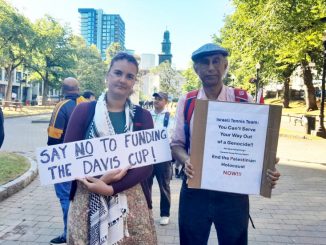
San Diego, July 19 – A contingent from the Harriet Tubman Center for Social Justice in Los Angeles joined members of the San Diego Struggle for Socialism Party to participate in San Diego’s 2025 Pride March. The group highlighted the Palestinian struggle and demanded an end to ICE raids. The Harriet Tubman Center for Social Justice is also part of L.A.’s Community Self Defense Coalition, which has been in the streets protecting community members from ICE.
The Harriet Tubman Center’s John Parker spoke with Nico, a local trans community member, about trans solidarity with Palestine.
Nico: “I’m a San Diego native born and raised. I grew up in the ‘gayborhood,’ and in regards to the work that you guys are doing, I just want to say first and foremost, thank you so much for the work that you guys are doing. It’s important. “And second of all, as someone who is politically minded and active, the amount of times that I have heard Zionists specifically use my trans identity and try to weaponize that as a means to divide me against what I believe is a fight for human rights.
“And if you support trans rights, then you have to support ending the genocide in Gaza. There’s no way that you can explain it away. There’s no dividing that. It’s very, very simple. It’s an all or nothing thing. This is a zero sum game. Are you for human rights or are you not for human rights?”
Cuba: ‘The beauty of this difficult hour lies in knowing that we are part of an undefeatable people’
written by Struggle – La Lucha
July 23, 2025
Speech delivered by Miguel Mario Díaz-Canel Bermúdez, First Secretary of the Central Committee of the Communist Party of Cuba and President of the Republic, at the closing of the Fifth Ordinary Period of Sessions of the National Assembly of People’s Power in its 10th Legislature, at the Convention Palace, on July 18, 2025, “Year 67 of the Revolution”
(Shorthand Versions-Presidency of the Republic)
Dear Army General Raúl Castro Ruz, leader of the Cuban Revolution;
Dear comrade Esteban Lazo Hernández, President of the National Assembly of People’s Power;
Dear deputies;
Compatriots:
This has been an authentic Assembly of the people, as the young deputy Danhiz expressed here. It has been so because its debates were the debates of today’s Cuban society on the enormous challenges ahead of us, but also because they once again revealed the impressive willingness of this people to fight when everything becomes more difficult.
Neither pessimism, nor defeatism, nor discouragement. What we found here were sober presentations, criticisms based on commitment and, above all, concrete proposals and demands to change what must be changed without delay.
The wisdom and enthusiasm that has characterized practically all the interventions of these days do not surprise me, it is what I have seen in the tours through the provinces. Just where the situation is hardest, after long hours of blackout, you always find the extra of Cubans.
It is not the first time nor will it be the last time that the Cuban Revolution faces its “most difficult moment”, although it will always seem to us that nothing can be worse than what we face at the instant we face it.
I will cite a few episodes in the history of Cuba: the Zanjón Pact after ten years of a bloody war that ended with the death or exile of its leaders; the fall in combat of José Martí and Antonio Maceo; the Yankee intervention that robbed us even of the right to enter the heroic city and to attend the signing of the Treaty of Paris because there two empires negotiated our freedom; the neocolonial republic with its appendix, and the Yankee military base where human dignity is tortured and violated.
Then comes the Machado times with its pomp and misery, and Julio Antonio Mella assassinated, and the Revolution that went to the dogs, and Antonio Guiteras massacred in El Morrillo for his profoundly anti-imperialist action. And the corruption of the authentic ones, and Batista’s coup d’état, and the murders of “our children” denounced by the Cuban mothers, and the repressed students and the massacre of the assailants of the Moncada, the Presidential Palace, the Goicuría.
With all this inheritance of heroism and frustrations of the revolutionary struggles, the Centennial Generation entered history, with its setback marking the victory in the attack to Moncada. They already had a program, an ideal and a willingness to carry it to the ultimate consequences. And so they did.
When we review all the periods of the 66 years of the Revolution in power, what we find, in addition to victories, are third world challenges, enemy obstacles and also our own mistakes and lessons learned, all fruits of the never abandoned eagerness to conquer and sustain social justice as a supreme aspiration, in a completely adverse world context, since the Soviet Union and the socialist camp ceased to exist.
If, in spite of all that, the Cuban Revolution is standing and fighting for the possible prosperity, it is because of its authentic and genuine character. We are not an accident of history. We are the logical consequence of a history of resistance and rebellion against abuse and injustice that has very deep reasons to believe in its own strength.
That is why the national dignity is offended by those who play at comparing times to praise “how well Cuba was before 1959”, posting photos of the palaces and the elegance of its ladies and gentlemen, but hiding those of the eviction, the machete plan, the misery, the children swollen with parasites who worked when they should have gone to school, the prostitutes, and the Italian-American mafias sharing the spoils of the hotels and cabarets for whites only in a mestizo country.
Because the Revolution that finally took power in 1959 was started by a small group of revolutionaries, but it was made by a whole people. And the people who made it have defended it and defend it today even with their teeth, let there be no doubt about it! (Applause).
Otherwise, it will never be possible to explain its existence in this uncertain decade of the 21st century, where dissidence from the single way of thinking, imposed by predatory capitalism, is paid for with smart bombs, the destruction of entire nations or with asphyxiating economic blockades, like the one that this small country of courageous people has been enduring for more than 60 years.
It is deeply insulting to human dignity that those who use the Internet in campaigns to denigrate the Cuban people do not react with equal indignation in the face of the scandalous crimes of those who blockade the country; They avoid calling by name the Israeli genocide in Gaza and Lebanon, and do not protest, do not rebel, do not have the courage to point the finger at those guilty of so much xenophobia, so much war, so many weapons and so much injustice, competing in news prominence with the rampage of billionaire pedophiles and the deportation or imprisonment, without proven crimes, of tens of thousands of migrant workers and their families.
What we learned from the Cuban Revolution is that ideals are not changed because circumstances change; that the trench is not abandoned when the enemy siege tightens. We learned that only by having clear convictions as principles is it possible to sustain and win battles. And we also learned that we can fight our way out of the siege! (Applause).
Fellow Members:
I am not going to expand on the topics already addressed. The gravity of the times demands more actions than words, although we will always have the duty to say them and above all to honor them before the people who elected us. The guide is in the concept of Revolution that Fidel bequeathed us: “Never lie or violate ethical principles”.
These working sessions leave us with an important lesson. This is the Assembly of the Cuban people and everything that is discussed and approved in it has to connect with the feelings, needs and demands of the Cuban people. But let us not forget, as we rethink these days, the revolutionary ethics, that which Fidel taught us; let respect and not hatred prevail in us after learning, we cannot for any reason resemble our enemies.
On the other hand, it would not be realistic or honest to commit ourselves to fulfill the solution of all those needs and demands, always growing, where the main obstacle to achieve it is external. What we can and have the duty to commit is our energy, our effort, our tireless search for new ways and actions towards the satisfaction of those demands.
As the main obstacle is not within reach, all solutions depend entirely on the ability to foresee, to anticipate events and to face them with intelligence, effort and innovation. But, first of all, with the indispensable participation of our heroic people.
The recently launched Soberanía information and services platform and the proposal of several deputies to reach a consensus and make transparent the measures of the Government Program to correct distortions are strengths of the digital transformation, which should speed up processes that are still running too slow for the seriousness of the urgencies.
The Cuban economy operates under many risks for any decision, largely derived from the fierce enemy persecution. We cannot add more with our own inadequacies.
We maintain the conviction reiterated by Army General Raúl Castro Ruz that it is possible to move forward and overcome the current situation through our own efforts and results; but to achieve this, more discipline, organization, awareness and perseverance are required.
I believe that the reports of the Prime Minister and the Ministers of Economy and Planning and of Finance and Prices have been sufficiently commented on and received observations and proposals that should be taken into account.
An encouraging example is the fiscal results analyzed in this Assembly. I will not dwell on the details, but I do think it is good to remember that we will close the year 2023 with a 35% increase in the fiscal deficit. Many will remember the alarm that this caused and the fatalistic prediction of those who calculated up to a decade to recover that indicator. A year and a half later, the encouraging news is that we were able to achieve a significant reduction. In fact, during the first four months of this year we had surplus results and up to this moment the current account closes without deficit, which had not been achieved for more than ten years.
This has been an authentic Assembly of the people. Photo: José Manuel Correa
How was this possible? The main formula: discipline and exigency in the fight against tax evasion, in the collection of taxes and fines. The work is not perfect yet, this is an area in which a lot of awareness and control work is needed, until we gain in tax culture.
This result, very important for the economy, has a transcendental social impact: it will allow us to redistribute that income to the most vulnerable sectors, such as our retirees. This is what has enabled us to bring their pensions to a level that, while not sufficient, does put them in a better condition.
The main currency in fiscal policy is and will continue to be to attend to those, in society, who suffer most severely from the difficult situation of the country under the noose of the asphyxiation plan contained in Mr. Trump’s Presidential Memorandum.
With the conviction that “Yes we can”, we have to turn to other vital areas for development, such as achieving an increase in foreign currency income, in the midst of a very hostile scenario in which the United States Government is reinforcing its siege to prevent the entry of a single cent into the country every day.
We cannot remain impassive, much less feel defeated. We must focus on all our export capacities, which inevitably start from an increase in production in all possible areas, to do so in sufficient quantity and quality, which will then allow us to impose ourselves against the siege and global competition.
It is up to us, and only us, to be sufficiently efficient, even in the difficult circumstances of acting with our hands tied by the blockade that some try to avoid. It is a challenging challenge, but not an impossible one.
Here, I would like to return to what we find in every tour we make week after week through the country’s municipalities: how some, in the same circumstances of shortages, can overcome difficulties and demonstrate results.
An undeniable answer to this question, which we constantly ask ourselves, lies in the potential of leadership and the value of successful collectives.
The import mentality that has corroded us for years, in addition to generating dependence, whose negative effects are felt more in times of crisis, curbs internal capacity and potential and facilitates the actions of persecution against Cuba.
We cannot say that we will renounce imports, they will always be necessary at some level; but it is urgent to change the matrix and work on the basis of consuming more of what we produce internally than what is imported.
These productive processes, which we urgently need to dynamize, we cannot expect them to be only from large structures or companies.
As a way of contributing to municipal development, we must bet on boosting local production systems. Let us defend once and for all that the municipalities finally occupy the leading role they should have in national development.
Dear deputies:
We are facing a world in which an attempt is being made by the main military and economic power to impose a hegemonic and neoliberal approach.
During this semester we have consolidated foreign relations, which are being strengthened in the midst of constant pressures from sectors of extreme anti-Cuban hatred to promote economic and political isolation, which they will never achieve.
Cuba continues to be that benchmark of dignity and national sovereignty that many governments and peoples of the world look up to with admiration.
We have reached a higher level in strategic relations with China, Vietnam, Russia and other friendly countries that participate in a growing and mutually beneficial way in economic and social development plans.
Our support for the Bolivarian Revolution, the Sandinista Revolution and the ever-sister nation and people of Mexico is ongoing.
We have continued the respectful dialogue and cooperative relations with the member countries of the European Union, on the broad basis and legal framework offered by the Political Dialogue and Cooperation Agreement between Cuba and that bloc of countries.
Cuba will maintain its solidarity and cooperation with the sister nations of Africa and Latin America and the Caribbean that continue to denounce the blockade and the arbitrary certifications, in spite of the different pressures to which they are subjected.
In the important events we have participated in this year, such as CELAC, the summits of the Eurasian Economic Union and the BRICS, the understanding, sensitivity and willingness to insert and support Cuba in these international mechanisms have been ratified.
We observe in the reactions of the people many favorable expectations about the strengthening of these exchanges and their results. Although it takes time to consolidate the incorporation into these mechanisms, they mean new and hopeful opportunities.
For this we also have to work together, at all levels, with a high sense of belonging, responsibility and without that persistent bureaucracy that we still encounter and not infrequently hinders and frustrates important projects.
Any strategy to move forward must take into account that the new U.S. doctrine, which seeks to impose peace by force, is a latent threat to true peace at the global level, which poses, in the particular case of Cuba, a very dangerous scenario.
No one is safe when the most powerful empire in history breaks all the rules of international relations to impose its hegemonic will against countries it intends to subjugate, even, as we have seen, its own traditional allies.
In our case, the attempt to subjugate us, much older than the Revolution, has intensified in recent years, and very recently the current Republican administration has taken it upon itself to declare it, formally and publicly, in a Presidential Memorandum on National Security.
The main measures contemplated in this Memorandum have actually been applied since Donald Trump’s first term in office and are aimed at closing all access to the financing that is essential for the normal performance of the economy.
This brutal siege, in combination with the unacceptable inclusion of Cuba on the list of alleged sponsors of terrorism, reinforces the blockade policy to unprecedented levels and causes a multiplied impact of the coercive measures on the economy and, by extension, on the standard of living of the Cuban population. We cannot hide or ignore this effect, much less its destructive purpose.
The combination of the limited availability of foreign currency income, as we have already mentioned, the high dependence on imports and the transversal effects caused by the instability of the national electro-energy system cause a significant paralysis or slowdown of economic activity which imposes a deficit in the supply of goods and services to the population, and a contraction of exports.
Consequently, the capacity to import foodstuffs for the basic food basket and the fuels necessary for the generation of electricity and the functioning of the economy is limited. The scarce availability of medicines, the decrease in transportation services, solid waste collection and water supply, among others, make up the harsh panorama that our people face every day.
To overcome this situation, we have been forced to accept the partial dollarization of the economy, which undoubtedly, in some way, favors those who possess certain capital resources or receive remittances, which translates into an undesired widening of the gaps that mark social inequality.
In this context, we must increase the effectiveness of the redistributive social function of the State with public and fiscal policies that, without restricting solutions, prevent the concentration of wealth in the hands of a few, thus increasing inequality and poverty. And to pay the greatest attention to inflation which, although maintaining a slight deceleration, is still very high, limiting the purchasing power of workers’ salaries and the lower income of pensioners and retirees.
It is urgent to reorder the relations between the state sector and the private sector to correct distortions, bad practices and negative tendencies that deviate from the principles of socialist construction. Strengthen business ethics to avoid bribery, favoritism and corruption.
It is precisely in this scenario that we are working to enforce and support the Government Program to eliminate distortions and re-drive the economy, whose progress, results and projections were presented by comrade Marrero.
It is essential to make it known, from its foundations to its actions, so that it can be truly supported with popular participation and control.
The eminent scientist and member of our Council of State, Yury Valdés Balbín, very graphically exposed here the importance of the people’s participation in the control and in all the processes that have an impact on their welfare, always from a perspective free of formalisms, which really connects with the interests of those who participate.
It is necessary to articulate and promote in municipal and community spaces participatory forms to meet the needs of citizens. And municipal management must be based on avoiding and preventing problems in the community, leaving behind tolerance and justifications, and designing a true and effective popular control, exercising it on the fulfillment of approved public policies and their effective implementation.
Another decisive front of national sovereignty is the battle in the digital ecosystem. This is demonstrated by the constant discrediting operations against the country; the networks of influencers, media and algorithms that amplify negative narratives; digital weapons such as bots and fake accounts that saturate that space with distorted narratives. It is also confirmed by the use of emotional techniques that seek to erode the credibility of leaders, institutions and public media.
There we also have to be able to defend the truth with ethics, decency, ingenuity, optimism, confidence and energy; go on the ideological offensive; seek international alliances that allow us to break the media encirclement; promote sovereign technological solutions and, increasingly, build an articulated cyberspace of emancipation.
Ladies and gentlemen:
In the Session that concludes today, four laws were approved, all with a gender focus, which will strengthen the institutional order of the country, with a determining role in the economic and social sphere of the nation.
The Law of the Cuban Sports System establishes and regulates the areas, objectives, principles, components, organization and its operation, favoring its integral development in the midst of the current challenges.
The Law of the General Regime of Contraventions and Administrative Sanctions provides modifications that bring its content into greater harmony with the constitutional postulates and with the legislative provisions adopted lately, related to public administration to guarantee compliance and respect for legality.
The Civil Registry Law makes it possible to set up a single civil registry for the whole nation that contributes to achieve a more agile and efficient processing of the population’s affairs, incorporating the use of new information and communication technologies.
They are all important norms, but one, in my opinion, stands out among them all and reveals in all its beauty the importance of what we do as legislators: I am referring to the Code of Children, Adolescents and Youth. By approving it, we legislate on the most sacred rights in our society, according to the future that is already walking with us.
The Code of Children, Adolescents and Youth is a source of pride for Cuba, as was and still is the Code of Families. Photo: José Manuel Correa
The Code is a guide and a tool. Everyone who has to do with the formation of Cuban children, adolescents and youth must imbibe the spirit and the letter of the norm so that the future they symbolize finds its life project in the nation. And that this project is saved from the terrible plagues of this era, such as drugs and violence.
This Code is a source of pride for Cuba, as was and still is the Code of Families, in the midst of an increasingly hostile and aggressive world. It is also a tribute to Vilma, who dedicated her life to Cuban children, adolescents and young people, and opened the way for us with her always humanist, feminist and, above all, revolutionary vision (Applause).
Nothing of what we dream and do would make sense without our greatest treasure: the new generations. Or to put it in more personal words: our children and grandchildren. Their happiness and the better possible world we want to bequeath to them is what the Code seeks to promote. Thanks to those who made it possible in such a short time (Applause).
On the other hand, the approved constitutional reform constitutes a legitimate and fair fact, responds to the current realities of the country and is faithful to our history. In such a way that the Constitution favors the possibility of a wider selection of comrades with conditions to be elected as President of the Republic. Finally, we defend the future of the nation with the approval of this constitutional reform (Applause).
Compatriots:
Today, when only hours away from a new commemoration of that key moment in history that was July 26, 1953, it is worth remembering what Fidel said at the Fourth Party Congress in 1991, the year that would end with the disappearance of the USSR and the socialist camp.
Faced with the challenging uncertainty that this scenario posed for Cuba, the Commander-in-Chief responded as follows: “To those who say that our struggle would have no perspective in the current situation and in the face of the catastrophe that has occurred, we must respond categorically: The only thing that would never have any perspective is if the homeland, the Revolution and socialism were lost. It is as if we had been told that we had no perspective after the Moncada attack…”.
His legendary optimism is summed up in that phrase and in the ways out that he always saw, not outside but within the people, with his tremendous intelligence potential, which is one of the great resources at hand. Aware of the absolute validity of those ideas, I reiterate today what Fidel told us then: “There are possibilities, that is the important thing, there are possibilities, but the possibilities are for the peoples who fight, the firm peoples, the tenacious peoples, the peoples who fight; the possibilities exist for a people like ours” (Applause).
That is the Cuban people who, represented by you, have illuminated the days to come and have done so with just criticisms and hopeful proposals, from the magnificent sessions of this Assembly that has left us with lessons, lessons learned, heartbreaks, but above all an extraordinary inspiration to undertake today’s decisive combat: to prepare ourselves to leap over the obstacles of the economic war that the greatest empire in history is waging against us with its infamous Memorandum and its plan to suffocate our sacred independence and sovereignty.
On July 26th in Ciego de Avila, whose industrious people we congratulate, we shall celebrate the certainty that Yes we can! History says so and the present certifies it! (Applause).
On behalf of the Party and the Government, I extend my congratulations and deepest gratitude to all the people of Cuba (Applause). For their resistance to so many difficulties. For their inexhaustible creativity. For never giving up when everything is lacking, sometimes even the indispensable communication that we are obliged to give them.
In less than a month we will be celebrating the beginning of Fidel’s centennial year, which will take place in August 2026. The best tribute to the political-military genius, the educator, the scientist, the leader of just causes in Cuba and the world, is the work of the Cuban people! (Applause).
Thank you, Cuba! The beauty of this difficult hour lies in knowing that we are part of an undefeatable people.
Surrender has never been an alternative. Independence or death, yes! Homeland or death, yes! Socialism or death, yes! Surrender, never! (Applause).
This was certified with his powerful voice by Commander Juan Almeida under a hail of bullets in Alegria de Pio:
Nobody surrenders here…!
Fatherland or Death!
We will win!
(Ovation)
Annual 1967 Newark Rebellion Commemoration March and Rally
written by Struggle – La Lucha
July 23, 2025
Dear Friends:
Please attend the People’s Organization for Progress (POP) annual 1967 Newark Rebellion Commemoration March and Rally in observance of the 58th Anniversary of the uprising.
It will take place Saturday, July 12, 2025, 12:00 NOON, beginning at the Rebellion Monument. The monument is located in Rebellion Park on Springfield Avenue between Hayes Street and Irvine Turner Boulevard, Newark, NJ.
We will march from there to the 1st Police Precinct (old) currently the City of Newark Office of Violence Prevention and Trauma Recovery & Museum, 10 17th Avenue which is now and back. The precinct is where the 1967 Newark Rebellion started.
Please make every effort to attend this march. This is a very important event. Arrive early if possible. This will help us to start on time.
It is free and open to the public. All are invited. If you have any questions, please call (973) 801-0001. Masks and social distance protocols are encouraged. Thank you.
Long Live The Spirit of The 1967 Newark Rebellion!!!
Power to the people!!!
Lawrence Hamm
Chairman
People’s Organization For Progress
Love is the Law book launch – in Cuba, July 29
written by Struggle – La Lucha
July 23, 2025
Struggle ★ La Lucha honored to announce a launch IN CUBA of our most recent book LOVE IS THE LAW: Cuba’s Queer Rights Revolution.
Join us for an historic dialogue between LGTBQ+ activists from Cuba, the U.S., and more.
Tuesday, July 29
2:30 pm
ICAP Friendship House
Havana, Cuba
This meeting will be recorded and shared.
######
Struggle ★ La Lucha tiene el honor de anunciar el lanzamiento EN CUBA de nuestro más reciente libro EL AMOR ES LA LEY: La revolución de los derechos queer en Cuba.
Únase a nosotros para un diálogo histórico entre activistas LGBTQ+ de Cuba, Estados Unidos y más.
Martes 29 Julio
14:30
Casa de la Amistad
La Habana, Cuba
Esta reunión será grabada y compartida.
Struggle ★ La Lucha PDF – June 30, 2025
written by Struggle – La Lucha
July 23, 2025
Get PDF here
Mobilize to Stop U.S. War
No Kings: 200,000+ Los Angelenos protested Trump and ICE
Community shuts down ICE contractor in St. Rose, La., after hearing blitz
No to a $3 transit fare!
Capitalist crisis and the attack on trans people
‘From Iran to Palestine, stop U.S. war crimes!’
Activists rally in New Orleans
NYC says: Stop bombing Iran! End the genocide in Gaza!
Hands off Iran!’ echoes off New York skyscrapers
War on Iran made in the U.S., Israel is a U.S. proxy
Iran was supposed to fold — instead, it’s exposing U.S. & Israeli military limits
One Big Boom?
U.S. Pentagon bombs; China trades
Jewish member of Iran’s parliament says country has right to self-defense
Intersections & crossroads, from L.A. to Baltimore, the struggle for self-determination
Baltimore activists say ‘stop war on Iran’ & ‘Stonewall means fight back’
The populist smokescreen: How both parties serve monopoly capital
Iran resists
From the rejection of anti-immigrant policies to the rejection of the Escensia Project
Del rechazo a políticas antiinmigrante, al rechazo del Proyecto Esencia
Energía y huracanes
Baltimore says: No war on Iran
written by Struggle – La Lucha
July 23, 2025
Baltimore says NO WAR ON IRAN! Money for people’s needs, not the U.S. war machine!
Justice for BJ Abdullah means reparations and shut down the food deserts! No more money for war, genocide, and racist police terror!
Noise demonstration & rally
Monday June 23, 2025
7 pm @ N. Howard & MLK Blvd
Baltimore MD 21201
Labor leader faces prison after standing up to ICE
They blame immigrants while corporations steal billions – sound familiar?
Trump–Musk feud unleashes billions in losses, reveals decay
U.S. demands Asia prepare for war on China
Los Angeles: A Night of Witness and Art
Populism and the fight for trans lives, then and now
Inside the Bay Area’s Gay Liberation Front with Bob McCubbin
Bob McCubbin on LGBTQ+ liberation and Marxist organizing
Leslie Feinberg, Minnie Bruce Pratt, & the radical legacy of LGBTQ+ communists
Reimagining family and love in a post-capitalist world
How the press framed Venezuela’s elections
Baltimore bookstore hosts launch of book on Cuba’s LGBTQ+ rights revolution
Librería de Baltimore acoge el lanzamiento de un libro sobre la revolución de los derechos LGBTQ+ en Cuba
NATO-backed Ukraine escalates war on labor unions
Solidarity in the face of attacks against immigrants
Solidaridad frente arremetida contra inmigrantes
Baltimore bookstore hosts launch of book on Cuba’s LGBTQ+ rights revolution
written by Struggle – La Lucha
July 23, 2025
Baltimore, June 7 – Urban Reads bookstore hosted a launch event for the book, “Love is the Law: Cuba’s Queer Rights Revolution,” published by Struggle-La Lucha. This book documents the mass-democratic development of Cuba’s new Families Code, a comprehensive legal framework expanding the rights of women, children, LGBTQ+ people, seniors, those with disabilities, and ultimately all Cubans. Urban Reads is a Black-owned bookstore targeted in recent months by neo-Nazis. They continue to stand firm. Solidarity with Urban Reads! Following is the presentation given by the book’s editor, Gregory E. Williams. BUY BOOK NOW | FREE PDF
Stonewall means fight back!
Thanks for having me here, and happy Pride Month! This is a special Pride Month because of the conditions of this period. The fascist movement is attacking queer and trans people’s struggles, and the struggles of the working class and all the oppressed in many countries. In the U.S., fascists aligned with Donald Trump have the reins of the government. Now is really the time to fight back. They’re trying to cut off working-class and oppressed people from their histories of struggle. By attacking Pride, they’re trying to cut us off from the radical legacy of Stonewall and ACT UP. They don’t just attack it for cultural reasons, because “people are tired of seeing it,” as if the optics were what’s most important. It’s not about Pride merchandise in stores. They’re attacking the struggle itself. They’re attacking the very idea of struggle, in hopes that we will lie down to be oppressed and exploited. So, in this context, I’m here to talk about the LGBTQ+ struggle in Cuba. We can learn a lot from Cuba. This talk builds on an interview I did with a longtime gay communist activist, Bob McCubbin, whose analysis is part of the bedrock of what I’m going to say. I was interviewing him, and he wanted to interview me about this book. We have his book available today, “The Social Evolution of Humanity: Marx and Engels Were Right!” Please pick up a copy.
Significance of Families Code
So, this collection that we’ve published through Struggle-La Lucha is called “Love is the Law: Cuba’s Queer Rights Revolution.” “Love is the law,” or “el amor es ley,” is one of the main slogans used in Cuba to promote the new Families Code, which is the focus of this book. The Code is a comprehensive overhaul of the legal system, expanding the rights of women, LGBTQ+ people, children, elders, disabled people, and ultimately all Cubans. It’s about much more than same-sex marriage.
The book also includes the full text of Leslie Feinberg’s “Rainbow Solidarity in Defense of Cuba.” Feinberg was a U.S.-born transgender communist – a secular Jewish activist committed to the Palestinian liberation struggle. (Leslie used she / zie pronouns.) Zie had done a lot of analysis of what was happening in Cuba up through 2009 when “Rainbow Solidarity” was published. It forms the backdrop to the passage of the new Code. I’ll recap that history.
There’s a lot of disinformation about Cuba. The imperialists promoted the idea that Cuba was homophobic without giving any context. (Of course, at the time Cuba had its revolution, queer and trans people were routinely arrested in the U.S., subjected to shock therapy, etc. That’s why Stonewall happened in the first place.) But anyway, Leslie analyzed the history of colonialism in Cuba. It was a very repressive society. Spain had colonized Cuba. The Cuban people fought three wars of independence during the 1800s. The U.S. imperialists became dominant after that, taking control of former Spanish colonies in Puerto Rico and the Philippines. They kept Cuba under neocolonial conditions, exploiting laborers and stealing natural resources for Wall Street. In the 1950s, the country was controlled by a U.S.-backed dictator named Fulgencio Batista.
And Havana was basically being run by the mob for foreign tourists. There was a lot of what nowadays they call sex tourism, where these wealthy businessmen come in. There were prostitution rings that catered to people of any sexuality. And so a lot of the gay, lesbian, and trans life in that time was distorted by that. Many were forced into prostitution. They lived on the outskirts of society. When the revolutionaries came to power in Cuba in 1959, they had to deal with this legacy.
Colonial Cuba had a slave system just like in the U.S. People of African descent were enslaved. The revolutionaries had to deal with this legacy, too.
They had to figure out how to integrate queer and trans people into the new revolutionary society. And revolutionaries are affected by the same prejudices as anybody else. They’re human beings. Everybody is affected by their historical context. It’s a learning process. They had to develop an understanding over time as they worked to build a better society. Women led the way
And really, it was the women’s movement in Cuba that blazed the trail. In the early period of the revolution, the Federation of Cuban Women was doing a lot of work on the ground just in terms of literacy campaigns, teaching people – agricultural laborers – how to read, and other incredible things. The revolution allowed women to take on a bigger role in society and advance their own rights.
And the women’s organizations spearheaded the creation of the first Family Code in 1975. This was an advanced new legal framework that expanded the rights of women and children, providing equal pay and many other things that have not been achieved yet in the capitalist United States.
By the 1980s, the AIDS epidemic had come about, and it affected Cuba. They took a proactive stance in stopping the spread of the epidemic in their country. They provided care to people who contracted HIV and AIDS and supported them. Nobody had to worry about losing their job, being homeless and dying on the street. No, that’s not an issue in Cuba. They provided health care and housing to all, and that remains the case today as well.
Under the horrible conditions of the U.S. blockade, they had to do all these things with very few resources, but they were able to care for people with HIV and AIDS at a time when the U.S. government, under Reagan, was barely acknowledging the crisis. People had to throw their bodies on the ground in legislatures and churches, with the activist group ACT UP, and so on, demanding some bit of dignity. But in Cuba, they were taking care of people.
Cenesex launched
They developed an organization called Cenesex in the late 1980s, the National Center for Sex Education. It’s under the Ministry of Health. And to this day, this remains the main hub in Cuba advancing the rights of queer and trans people. Think about it. Cuba’s government of the people proactively advances queer and trans rights. The government doesn’t just respond after the fact of a long struggle as in the U.S.
For example, Cenesex spearheaded the development of a law providing state funding for gender-affirming surgery. It passed in 2008.
Cuba has a popular democracy
And then in 2018, Cuba started a big process to write a new constitution. It’s remarkable how this was done.
We have to understand that because of their socialist system, Cuba has institutions of mass democracy that we do not have in the U.S. They have Committees for the Defense of the Revolution throughout the neighborhoods, and local councils made up of regular workers from those communities.
They don’t have millionaire legislators like we do, making money through investments (bribes) from the corporations they’re supposed to be regulating, including the military industry. The representatives in Cuba’s Congress come from the working class. They come from the communities they serve and continue to live in their communities
Contrast Cuba’s approach to reform with Trump’s “big beautiful bill.” While Cubans carry out mass-democratic processes to reform their system, in the U.S., officials – who generally can’t be elected without big money – work in the dead of night to cram anti-people measures into legislation, including anti-trans legislation. All to enrich the few and take from the majority.
(By the way, 75% of this budget is for the military, ICE, and the repressive state generally. This is a big giveaway to the rich war profiteers.)
Cuba has all these democratic mechanisms that we don’t have. Developing the 2019 Constitution involved people throughout the society, a mass consultative process. To create this constitution, they had meetings in the unions, women’s organizations, youth organizations, in the universities, and more.
This constitution advances women’s and LGBT+ rights. Imagine if we had the opportunity to write a new constitution instead of having our rights decided by how unelected Supreme Court judges choose to interpret a document written by slave owners in the 1700s.
Discrimination outlawed in constitution
Article 42 of Cuba’s 2019 Constitution says:
“All people are equal before the law, receive the same protection and treatment from the authorities, and enjoy the same rights, liberties, and opportunities, without any discrimination for reasons of sex, gender, sexual orientation, gender identity, age, ethnic origin, skin color, religious belief, disability, national or territorial origin, or any other personal condition or circumstance that implies a distinction injurious to human dignity. All people have the right to enjoy the same public spaces and service facilities. Likewise, they receive equal salary for equal work, with no discrimination whatsoever. The violation of this principle is proscribed and is sanctioned by law.”
So, they made many advances with the Constitution, but there was still resistance because of the colonial legacy of homophobia, etc. A lot of it came from the churches, but not all the churches. Many churches in Cuba support LGBTQ+ rights. But particularly the churches that are receiving funding and other influence from the U.S. and right-wing forces in Miami. These churches organized campaigns against any kind of progress for LGBTQ+ people.
So, there was resistance. But over the next couple of years, revolutionaries campaigned to have a referendum for a new Families Code, to update the legal framework to reflect the ways that Cuban society has changed since the 1970s. They had to go back to the drawing board with another mass consultative process. They went through about 60 drafts of this new Families Code. Between February and April 2022, they held more than 79,000 meetings, with over 6.5 million participants, making more than 397,000 proposals.
They held meetings in the neighborhoods, and people would raise issues, arguing them out. The population had a lot of input into creating this new code. And it passed with 66.85% of the votes in favor. The majority of the population voted to expand rights. That’s not an automatic process. That was a long process of mass democracy. This Code recognizes all kinds of families, including those led by grandparents or step-parents. Or, say a lesbian couple and a gay male couple decide to start a family together, and they have children together. They are supported.
The Code specifies that all rights acquired with the 1975 Family Code are maintained. Rights aren’t taken away; they are expanded. Relations of affection and progressive autonomy The Code recognizes relations of affection as the basis of the family, not just blood ties. This is a guiding principle, hence “love is the law.” Another guiding principle is “progressive autonomy.” That is to say, the autonomy and dignity of the individual are paramount – whether children, disabled people, or the elderly. Children and youth are recognized as having increasing, age-appropriate autonomy over their lives and bodies.
“Family defense” offices are established. In the case of custody or domestic violence situations, for example, children and youth can go to these offices and get aid from social workers, lawyers, and psychologists. They are creating mechanisms to give these young people an age-appropriate say in how family life is handled. The focus is no longer on parental control, but on parental responsibility.
Contrast this with the U.S. fascist movement’s focus on parents being able to control exactly which ideas their children are exposed to in school. They’re trying to limit children and youth from accessing information they need to understand their gender and sexuality. This is part of the push to dismantle public education and replace it with private schools and homeschooling. Socialism allows people to flower
In Cuba, people aren’t vulnerable in the same way that we are in the U.S. For example, here, if your family is broken up because of domestic violence, you risk being homeless. Cuba has problems, many because of the U.S. blockade, but the people don’t have that kind of problem. Everybody has a right to housing. Nobody loses their health care because they leave a situation of domestic violence.
I asked a Cuban friend of our 2023 U.S. Friends Against Homophobia and Transphobia delegation whether she had paid maternity leave after her baby was born. She said, “Yes, one year. And nowadays, it is extended to 15 months.” This extension of benefits was enacted with Decree-Law 84 in 2024.
Therefore, we must consider how all these aspects of socialist society support people so that they can truly flower.
That delegation to Cuba in May 2023 – organized by Women in Struggle-Mujeres en Lucha – focused on learning about the New Families Code. We met with Cuban trans and queer organizers at Cenesex headquarters. We met with delegates from the neighborhood assemblies. We went to the National Assembly of People’s Power and met with a deputy of the assembly. That’s like their version of the U.S. Congress. But they’re not millionaire career politicians. Even the highest-level representatives come from the communities and continue to work as plumbers, teachers, doctors, and so on. Solidarity is the key
The blockade is not just economic. It’s political and also cultural. It’s a blockade of knowledge. Those of us struggling in the U.S. and other imperialist countries are being deprived of knowing about what’s possible with revolution, all while our rights are being reversed.
But the Cuban people are absolutely in solidarity with us. As much as we’re in solidarity with them, they’re in solidarity with us. They care about our struggle in the U.S., in the belly of the beast. They want to see us secure our rights. They want a future where we can develop together.
There’s a lot in this book. Everybody in our delegation wrote testimonies. We also have statements from Cuban people. Cenesex director Mariela Castro’s talk, which you heard earlier, is included.
A Cuban transmasculine activist named Verde gave a talk for us, which is included. His organization is doing incredible organizing. He describes the difficulties trans people face in being able to access hormones because of the blockade, made much worse when Trump put Cuba on the State Sponsors of Terrorism list in 2017.
Let me say something about the State Sponsors of Terrorism designation. Biden took Cuba off the list at the very end of his term, even though he could have done it earlier. Trump put it right back on.
But what audacity! The U.S. is literally committing genocide in Palestine right now, burning children alive in refugee camps. Cuba exports doctors and nurses. The U.S. bombs and sanctions. The monsters in Washington are the world’s number one terrorists. Take Cuba off the list!
Finally, I just want to emphasize again that this book is continuing a tradition, continuing the work that was done by comrades like Leslie Feinberg and Bob McCubbin. I hope this book will help bridge the generational gap, making the history of struggle more accessible. There is a continuity of struggle. We must push back against those attempting to erase history. I hope it brings hope to people in the U.S. and elsewhere. There is an alternative to capitalist oppression. With socialist revolution, people can continually advance instead of always being on the defensive, fighting each new attack from the ruling class. So, I say: Stonewall means fight back!