Lula livre! Struggle wins freedom of former Brazilian president

Lula greeted by supporters outside the Metal Workers Union in São Bernardo do Campo, Brazil, on Nov. 9.

After 580 days, one of the most famous political prisoners on the planet, former Brazilian President Luis Inácio Lula Da Silva, was finally released on Nov. 8. But his struggle for justice and freedom continues. 

In a controversial ruling decided by one vote, Brazil’s Supreme Federal Tribunal (STF) voted to deny the imprisonment of defendants who are found guilty until all appeals are exhausted. This was the case with Lula, who was sentenced to prison after being found guilty of corruption and money laundering. Six out of 11 ministers — as Brazilian Supreme Court judges are called — voted to uphold what is written in the constitution. 

Although it is stipulated in the Brazilian Constitution that no person who is accused of a crime, if found guilty, shall be imprisoned until all appeals are exhausted, the former president, union head and leader for the Workers Party (PT) was sent to jail by a first stance judge (a lower court with no jury trial). It is important to point out that this law does not apply to repeat offenders and to crimes deemed to be violent.

The weaponization of the law in Brazil, or “lawfare” as it is commonly known there, is a mechanism that has been used often in the last decade. With the help of corrupt judges and the use of false accusations, or accusations of activities that are commonly done by many politicians and members of society in general, and thus not considered a crime, the ruling class targets politicians that do not acquiesce to its demands. By the same token, it acquits or refuses to indict those who are on their side, even when there is a lot of material evidence of wrongdoings and crimes.

Such was the case of a helicopter that was caught carrying 500 kilos of cocaine in 2013. It belonged to a federal senator who was never indicted or investigated. The pilot of the helicopter is now a member of Congress. More politicians and plutocrats are linked to this case, but not a single one has been indicted.

‘Lawfare’ against Workers Party leaders

Before Lula, the most famous victim of this tactic was Dilma Roussef, another former president from the PT who was ousted in a judicial-parliamentary coup in 2014. Lawfare has grown substantially since Roussef’s ousting. Her impeachment was only possible with the help of some of the STF ministers. 

The successful coup against Dilma made the Brazilian oligarchs even more powerful — for now they had the means to manipulate the laws to finally defeat the PT and put its leaders in jail. Lula was the main prize! 

On trumped-up charges, with no evidence of wrongdoing, Federal Judge Sergio Moro sentenced Lula to 9 years, 6 months, in prison in first stance. After appealing on second stance (higher court), the former president had his sentence increased to 12 years, 11 months, by a judge who plagiarized other judges, including Moro, to write her opinion. 

Lula was immediately called to serve his sentence. After two days of resistance inside the headquarters of the Metalworkers Union in the city of São Bernardo Do Campo, he was sent to a federal prison in the mostly white and reactionary state of Parana, where Judge Moro was based. All this was timed so that Lula would be unable to run in the 2018 presidential election or support any candidate. 

Lula was denied interviews, visits and any type of public comment until it was safe enough to guarantee the victory of the candidate supported by the Brazilian elites. The 2018 election was won by ultrarightist Jair Bolsonaro, and his victory opened the doors to the full implementation of neoliberal policies and the privatization of what is left of nationalized industry. Judge Moro was nominated as minister of justice as payback for his help in Bolsonaro’s election.

Meanwhile, people throughout Brazil and around the world continued to protest loudly for the former president’s freedom with the “Lula Livre” campaign.

Oligarchs’ infighting creates opening

After thinking that they could easily control Bolsonaro, some sectors of the oligarchy and some STF ministers are now being attacked by their own Frankenstein monster. 

The largest media conglomerate in Brazil, Globo Organizations, and the largest newspaper, Folha De São Paulo, are in a battle with Bolsonaro. Threatened with no renewal of their licenses and by the alliance formed between Bolsonaro and other media conglomerate owners, they need something else to keep their creature busy with, and the best option is Lula. 

Lula will divert Bolsonaro’s attention and, at least, divide the attention of his supporters, who angrily demand the shutdown of the Supreme Court, these media outlets, and the return of the military dictatorship, among other reactionary measures. 

The “Bolsominions,” as Bolsonaro’s followers are called by the resistance, are in their vast majority white petty-bourgeois people who still have not accepted that dark-skinned and poor people be treated with dignity and have access to the same areas that they have. 

They see in Lula and the PT the reason why they no longer have the right to call Black people slurs or pay almost nothing to their maids. They hate them for putting dark-skinned people in universities instead of prisons, and for being forced to treat LGBTQ2S people with the respect that they deserve. 

As an Internet commentator said, ”How do we expect people who refuse to accept the law that abolished slavery to understand the Federal Constitution?”

The road ahead for Lula is long. He will still have to face trial on other trumped-up accusations, but for now he can speak and his voice is being heard clearly by the part of the Brazilian population that refuses to allow that neofascists, racists, homophobes, sexists, bigots and religious zealots take control of their country.

The writer is an Afro-Brazilian activist based in Los Angeles.

Strugglelalucha256


Syria, Yemen, Palestine: Trump talks peace, escalates war

Donald Trump tweeted some rare truth last month about the horrible cost of Washington’s “endless wars” in Southwest Asia (“the Middle East”): “Millions dead, $8 trillion spent, entire countries devastated.”

Then he lied big time: He said he would “bring the troops home.”

The Trump regime is not abandoning Washington’s long war to corner the world’s energy markets for U.S. monopolies. It is not ending the bloody war against Syria. The prize is too great, the profits too big.

The White House has made a tactical shift in an effort to pull Turkey back into the U.S./NATO orbit. This has become an issue in the factional struggle raging in Washington between the Trump regime and its rivals.

The shift follows the victories of Syria and its allies in eight years of war over invading mercenary forces armed and paid by the U.S., Britain, France, Saudi Arabia, the United Arab Emirates, Qatar, Turkey and Israel.

Trump lies, children die …

While the Liar-in-Chief tweeted, the Pentagon poured more troops into Syria and the region. 

Days after several hundred U.S. troops were transferred out of northern Syria, a U.S. armored brigade invaded eastern Syria and seized the country’s oilfields. Private U.S. military contractors–mercenaries–have also been seen in the area.

“We are leaving soldiers to secure the oil,” Trump said at an Oct. 27 press conference. He was speaking of Syria’s estimated 2.5-billion-barrel oil reserves.

“We’re going to secure the oil,” he went on. “And we may have to fight for the oil. It’s okay. Maybe somebody else wants the oil, in which case they have a hell of a fight. 

“But there’s massive amounts of oil. … What I intend to do, perhaps, is make a deal with Exxon Mobil or one of our great companies to go in there and do it properly.”

On Oct. 28, Defense Secretary Mark Esper threatened to use “overwhelming force” to keep Syria from using its own oil fields. Esper is a former lobbyist for Raytheon, a leading Pentagon contractor with big interests in Saudi Arabia.

On Nov. 1, a U.S. B52 strategic bomber took off from Britain and circled a Russian base in Syria.

On Nov. 6, at a White House meeting, Trump and Pentagon officials agreed to “expand the U.S. military mission in Syria.”

… in Syria

Meanwhile, U.S.-armed and -trained terrorist militias that had been driven from Syria returned under the protection of invading NATO Turkish troops. They have attacked villages, murdered civilians and soldiers, planted bombs and mines, and destroyed schools, a hospital and a power station.

Trump encouraged the invasion, inviting Turkey’s Prime Minister Recep Tayyip Erdoğan to the White House on Nov. 13. Turkey launched its offensive on Oct. 9. On Oct. 10, the U.S. vetoed a United Nations Security Council resolution condemning Turkey’s invasion. 

On Oct. 17, Vice President Mike Pence, Secretary of State Mike Pompeo and National Security Adviser Robert O’Brien traveled to Ankara to meet Erdoğan. A war between Turkey and Syria, which could draw in Iran, would be a dream scenario for the fracking interests that dominate the Trump White House.

The Syrian city of Idlib is still occupied by an alliance of Saudi, UAE and Turkey-funded bandit armies from outside Syria. The largest is Jabhat Al Nusra, the Syrian branch of al-Qaida, which now calls itself Hayat Tahrir Al Shams (HTS).

Nusra-HTS is armed with U.S.-made TOW antitank missiles supplied by Turkey with U.S. permission. HTS is on the U.S. “terror list,” but the White House approved a big shipment of missiles to the group in May. On Oct. 22, the White House gave $4.5 million to the White Helmets, the HTS “civil defense” arm.

On Nov. 12, speaking at the Paris Peace Forum, Russian Foreign Minister Sergey Lavrov accused the U.S. of continued support to Nusra-HTS and of blocking Syria’s efforts to rebuild.

On Nov. 1, HTS launched a new offensive in northern Latakia, which was repelled by the Syrian Arab Army. On Nov. 6 and Nov. 8, the group shelled the city of Aleppo, injuring civilians.

As the fighting raged in Syria, the Pentagon deployed 1,800 more troops, two fighter jet squadrons, a THAAD missile battery and four B1B strategic bombers to Saudi Arabia.

The troops landed as Saudi ARAMCO, the world’s biggest oil company, prepared to launch what Bloomberg.com calls the “world’s biggest public offering.” The $100 billion stock sale is being underwritten by JPMorganChase and other major U.S. banks. Exxon, Chevron, BP and Shell market ARAMCO’s production.

There are now 3,000 U.S. troops in the Saudi kingdom and 70,000 in the region. Fourteen thousand U.S. troops have been sent to Southwest Asia since May.

… in Yemen

In April, Trump vetoed a Senate bill restricting U.S. involvement in Saudi genocide in Yemen. One hundred thousand Yemenis have been killed since 2015, when the U.S.-armed Saudi Kingdom began bombing their country.

Many more, mostly children, have died from famine and disease inflicted by the U.S.-Saudi blockade and deliberate destruction of Yemen’s agriculture. UNICEF reports that 360,000 children under age 5 suffer from acute malnutrition. All of the country’s hospitals are now closed due to lack of fuel.

At a Sept. 16 press conference with Prince Salman Al Khalifa of Bahrain, Trump bragged that the House of Saud had spent $400 billion on U.S. arms in recent years. “Saudi Arabia pays cash,” he said. On Nov. 6, CNN reported new U.S. armored vehicles being unloaded in Yemen’s Saudi-occupied port of Aden.

Saudi troops keep Bahrain’s brutal Prince Salman on his throne. He is also a big U.S. arms client. General Dynamics keeps the F16 fighter in production under a Bahraini contract. Bahrain is home base for the U.S. Fifth Fleet.

… and in Palestine

The figures on U.S. troop strength in West Asia don’t include the 1.5-million-strong Israeli occupation army in Palestine, armed and paid for by the U.S.

On Nov. 12-14, U.S.-made Israeli planes flown by U.S.-trained Israeli pilots again rained U.S.-made missiles on the nearly 2 million Palestinians imprisoned in the Gaza Strip. Thirty-five Palestinians, six of them children, died in the latest U.S.-Israeli attacks.

In Deir Al Balah, eight members of the Al Sawarka family were murdered when U.S.-Israeli planes targeted their house. Twelve more are in critical condition. Fifteen schools were hit by U.S.-Israeli missiles.

The latest attack began when Israel assassinated Palestinian Islamic Jihad (PIJ) military commander Badar Abu Ata and his spouse. Israel forces struck when they knew Abu Ata would be home, on his daughter’s birthday. The same night, an Israeli strike in Damascus, Syria, missed PIJ commander Akram Al Ajouri but murdered one of his sons.

One million Palestinian children live in the giant open-air prison called the Gaza Strip, where 97 percent of the water is poisoned with sewage and salt, 52 percent of adults cannot find work, hospitals are without medicine and there is electricity for only a couple hours a day.

Israeli snipers shot 94 children in the last two weeks of October. Israeli troops shoot Gaza fishers for working their own waters. Meanwhile, U.S. energy companies plunder gas off the shores of occupied Palestine.

In September, Trump proposed a mutual defense pact between the U.S. and the racist Israeli settler state. Last year, he signed the U.S.-Israel Security Assistance Act, which codifies $38 billion of U.S. military aid into law. In March, he signed a proclamation recognizing Israel’s “sovereignty” over Syria’s Golan Heights. Israeli Prime Minister Benjamin Netanyahu called Trump “Israel’s best friend ever.”

Strugglelalucha256


Bolivians bravely fight back against coup: ‘We are going to resist until the last’

It has been five days since the violent, racist coup d’état forced the resignation of President Evo Morales and Vice-president Álvaro García Linera. Since then, the people of Bolivia and the world have remained firm in their resistance against the coup and in defense of Morales and the process of change in the country. Across Bolivia, people are facing heavy repression from the Armed Forces, the Police and fascist groups but still they remain determined both on the streets and within institutional spaces to reject and fight back against the coup.

Resistance

The city El Alto, which neighbors the capital La Paz and whose inhabitants are mostly Indigenous and working class, has been the center of the mobilizations in support of Morales. Protesters have been marching from El Alto to the capital daily to demand the resignation of the opposition senator Jeanine Áñez, who proclaimed herself ‘interim president’ on November 12.

Protesters have also erected road blockades surrounding the capital in order to stop the flow of supplies into the city and several hundreds have begun a protest-camp outside Plaza Murillo where the major government buildings are located, including Congress and the Presidential Palace.

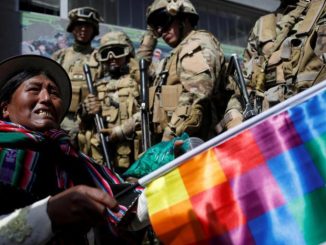
Thousands are mobilizing against the coup in Bolivia and the Indigenous symbol the Wiphala has become the symbol of the resistance against the racist, white, conservative sectors behind the coup. Photo: AFP

The Executive Committee of the United Trade Union Confederation of Bolivia (CSUTCB), the Trade Union Confederation of Intercultural Communities of Bolivia, the Peasant Workers Federation ‘Ponchos Rojos’, the Six Federations of the Tropic of Cochabamba, among others, have manifested their complete support to Morales and his process of change. They have said that these demonstrations would not stop until Morales could resume his position as President of the Plurinational State in Bolivia.

A member of the organization Tupac Katari told journalist Marco Teruggi on the streets of La Paz that their resistance against the coup supporters and the right-wing is historic. “Today is November 15, one day like today [in 1781] they killed our great leader Tupac Katari because he was strong, because he fought for the peasant class, because he fought for the Aymaras, Quechuas, and Guaranís [Indigenous nations in Bolivia] and those in the countryside in general,” he explained, “And what did they do? To teach a lesson to all of the peasant class, they dismembered him using four horses because he did not give up and swear allegiance to the Spanish crown. So they tied him to four horses to stretch him but he was so strong that they had to use the machete to dismember our great leader.”

For this protester and many others, their resistance is about carrying on the legacy of anti-colonial resistance of Katari and many other Indigenous leaders, “I am from the land of Tupac Katari, I am from the Aroma province and I will not surrender. We are going to resist until the last consequences because we have already taken down a right-wing leader, who is also a coup supporter, a dictator, Gonzalo Sánchez de Lozada that was an assassin and now the North American empire has him there as the golden boy. Now they have brought their student Jeanine Añez, as well as Luis [Fernando] Camacho…but they will pay because they can silence the people for a moment but the people have memory and we will not surrender, we are not willing to surrender, we will struggle, and even if we have to die, we will die.”

Indigenous women have been at the forefront of the protests against the coup in Bolivia. Photo: Redfish

Repression

The coup supporting Police Force and Armed Forces have unleashed brutal repression against those in the streets against the coup. They are attacking the multitudinous mobilizations with tear gas, firing at close range with firearms, beating up protesters, and have also been arresting people suspected of pertaining to the Movement Towards Socialism (MAS) and carrying out violent house raids.

They are the same forces that turned a blind eye to the right-wing groups committing violent acts against members of the MAS and sustaining road blockades and strikes in the days following the general elections and leading up to the coup. Now the US-trained repressive apparatus in Bolivia has been fully activated to stop the Bolivian people from demanding that their votes in the elections be respected, that the illegitimate Jeanine Añez step down, and that the right-wing cease acts of violence and racism.

According to a report compiled by the Latin American Center for Strategic Analysis (CLAE), the International Committee of Youth for Peace in Latin America, and Generation Evo, the escalation of violence after the civic-military coup has already cost 12 deaths and more than 530 have been injured. The report was released prior to the massacre committed in Sacaba, Cochabamba wherein Armed Forces and the Police fired tear gas and live bullets at protesters and killed at least 5 and injured hundreds.

Ruddy Uria, the Director of Communications of the National Police said on November 13: “We are going to organize groups in all of the cities where the greatest level of violence exists, we will go to the focus points that have been identified and retake the city. I ask the citizens to collaborate with us, and to the people who do not know that democracy has returned to our country, that they abstain from committing excesses, we will proceed to arrests, we will catch all of the heads that are creating chaos in our country.”

Bolivia’s Guaidó

On November 12, right-wing Senator Jeanine Áñez declared herself ‘interim president’ of Bolivia in a session of Congress that did not meet quorum. She was later decorated with the tri-color presidential sash by members of the Armed Forces and accompanied by far-right opposition leader Fernando Camacho as she celebrated her proclamation with a bible in her hand. Her self-proclamation has been widely condemned as illegitimate due to the lack of quorum, but that has not stopped Añez from adopting measures and electing a new cabinet.

In addition to the mass rejection of Añez for illegitimately seizing power, she is also a representation of the regressive, racist, conservative sectors in Bolivia. Her declaration that “the bible has returned to the palace” perfectly synthesizes the motivating ideological factors behind this coup. The white conservative minority in Bolivia could not tolerate an Indigenous, coca farmer as President who is pro-people, and pro-working class, who made Bolivia a secular state and does not abide by the diktats of US imperialism.

Following her self-declaration, a series of racist tweets written by Añez in 2013 were uncovered which have since been deleted. “I dream of a Bolivia free of Indigenous satanic rituals, the city is not for the Indians, they should go back to the high plains or to Chaco,” she wrote.

Self-proclaimed ‘interim president’ Jeanine Añez, with a bible in hand.

Añez’ declaration has been recognized by the United States, Colombia, Brazil, the UK, Guatemala, and Russia.

Meanwhile Añez declared that she recognized the other self-proclaimed ‘interim president’ on the continent, Juan Guaidó of Venezuela, and cut diplomatic relations with the constitutional government of President Nicolás Maduro and ordered all Venezuelan diplomatic staff to leave the country.

Cuban doctors in Bolivia have also been targeted by government officials. On November 13, four members of the Cuban Medical Brigade in El Alto were arrested and accused of financing and instigating anti-coup protests.

Institutional Fight

In the hours before and after Morales and García Linera’s resignation, a series of ministers and legislators resigned from their posts due to a campaign of threats and violence. To give one example, Victor Borda, the president of the Chamber of Deputies from MAS, was forced to resign on November 10 after right-wing mobs burned his house and kidnapped his brother, he declared “I renounce from the Chamber of Deputies…hopefully at least it can preserve the physical integrity of my brother that has been taken hostage.”

The threats and intimidation to state functionaries was a key element of the coup plan as it opened up space for the right-wing to intervene and seize power. However, MAS legislators have been regrouping and fighting back in the legislative realm as they have a majority in both the Chamber of Deputies and the Senate.

On Thursday, after attempts by the security forces to violently block the entrance of MAS legislators to the Plurinational Assembly, composed of the Chamber of Deputies and Senate, MAS was able to wage an institutional counter attack. In sessions with quorum, Sergio Choque of MAS was elected as the new president of the Chamber of Deputies and Mónica Eva Copa was elected as the new president of the Senate.

Choque announced that he plans to push forward legislation so that the Armed Forces are taken off the streets and vowed to work to pacify the country. Choque declared that him and his party do not recognize the self-proclaimed ‘interim president’ Añez as she violated several constitutional norms.

International

Social movements, trade unions, political parties and leaders across the world have maintained strong in their rejection of the coup carried out against Morales and the brutal attacks carried out by the Armed Forces and the Police against the Bolivian people who are resisting the coup.

An extraordinary meeting of the platform Bolivarian Alliance for the Peoples of Our America-People’s Trade Treaty (ALBATCP) was held in Managua, Nicaragua on Thursday November 14 in order to address the pressing situation in Bolivia.

In a declaration released following the meeting they declared, “We categorically condemn the coup d’état carried out against the Government of brother Evo Morales Ayma, President of the Plurinational State of Bolivia, the persecution and disproportionate violence to which his Ministers and other government functionaries are submitted to, as well as leaders and their families.”

They also saluted Mexico for granting political asylum to Morales and García Linera as well as other progressive leaders for standing against the coup. They denounced the declarations of the government of Donald Trump, “which show both his support to the coup d’état in Bolivia as well as the threat to the legitimate, sovereign, and free governments of the brother republics of Nicaragua and Bolivarian Venezuela.”

Source: Peoples Dispatch

Strugglelalucha256


Massive Anti-Coup Protests Explode Across Bolivia

Chanting “resign now” to Bolivia’s interim, self-declared president Jeanine Añez, protesters across the Latin American country on Friday made their displeasure with the overthrow of the government by right-wing Christian extremists last Sunday known.

Thousands of demonstrators marched through the cities of La Paz and El Alto. Friday’s protests follow days of unrest as the Bolivian people rejected Sunday’s coup, which forced democratically-elected President Evo Morales to resign and flee the country.

An Indigenous woman, in comment to RT Thursday, asked if the coup leaders thought the people of Bolivia were ignorant of what was happening in the country.

Friday’s demonstrations were a show of force by the Bolivian people against the coup government. Video and photographs from the country showed long stretching lines of people waving the Indigenous wiphala flag and calling for Añez to step down.

“Evo Morales has been a good man,” a supporter identified as Sonia told Democracy Now! Thursday. “He worked for the people. He didn’t rob from us like these thieves who want to shake up the state and kill us like dogs, as if we’re not humans.”

Strugglelalucha256


At least five killed by army in massacre in Cochabamba, Bolivia

Protests against the civic-military coup have been growing in strength across the country and security forces have responded with brutal repression

Bolivian security forces killed as many as five protesters on November 15 near the Huayllani bridge in Sacaba, Cochabamba and gravely injured hundreds. The Indigenous and peasant protesters, who hail from six coca-farmer federations, were attempting to march from the small city of Sacaba to the department’s capital, Cochabamba when they were met with a military and police cordon. As the peaceful march attempted to advance, soldiers and police officers fired at the protesters with tear gas canisters and live bullets.

Their intention was to march to the city of Cochabamba and to reach the country’s capital, La Paz, on Sunday to join the thousands of Bolivians mobilizing against the civic-military coup carried out against President Evo Morales and Vice-president Alvaro García Linera.

On November 12, right-wing senator Jeanine Añez declared herself “interim president” of Bolivia in a session without quorum, which would theoretically render the declaration illegitimate. Shortly after she was decorated with the tri-color sash by military officials, thrust up a massive bible and proclaimed “the bible has returned to the palace!” She was accompanied by right-wing leader Fernando Camacho who was one of the driving leaders of the pro-coup mobilizations.

A protester in Sacaba stated “We want freedom, until this “self-proclaimed” resigns, we will continue marching with road blockades, we will not stop. For 14 years in the Tropic of Cochabamba we have lived in peace, there has not been this type of conflicts, massares, robberies. This is a peaceful march.”

Organizations in Bolivia have denounced the complete media blackout on the violent repression of anti-coup protests. Apart from the five deaths and hundreds of injured today in Sacaba, reports indicate that as many as 6 have been killed in the past week as well as hundreds of injured. Many supporters of Morales’ Movement Towards Socialism have also been arrested, threatened, and intimidated by security forces and right wing thugs. Four Cuban doctors, members of the Cuban medical brigade were also arrested and accused of inciting the anti-coup protests.

Source: Peoples Dispatch

Strugglelalucha256


Bolivia: El Alto stands up against the coup

On this occasion they were peasants with red ponchos, men and women with hats, coming from afar, from the highlands. Then they joined those from the city of Alto, those who could get there, others were held back as they tried to reach the center. La Paz has become the scene of daily mass mobilizations, town councils, repressions, a raging river against a coup d’état.

This time the day ended without tear gas or motorcycles. The police and military maintained their usual encirclement of Plaza Murillo, center of national political power, where the seat of government, the legislative branch and the vice-presidency are located, among other institutions.

Thursday’s central events took place in those blocks. The Senate elected a new president: Eva Copa, a native of the city of El Alto, as well as the president of the Chamber of Deputies elected the night before, Sergio Choque. With the swearing in of both new presidencies, belonging to the party of the Movement Toward Socialism (MAS), which holds two-thirds of the seats, the direction of the legislative power was redefined.

Simultaneously, the self-proclaimed president Jeanine Añez appointed five more ministers to her cabinet. Two of them, appointed yesterday, had statements alerting them to the policies to be pursued by the government appointed outside the Constitution in an attempt to build an institutional image.

The first was the Minister of the Transitional Government, Arturo Murillo, who announced that he will undertake a “hunt” against three former officials of the overthrown government: Raúl García Linera, Juan Ramón Quintana, Hugo Moldiz, all wanted for “sedition”.

The second was Communication Minister Roxana Lizarraga, who threatened “journalists or pseudo-journalists”, both national and international, who engage in “sedition”.

The few announcements made by the transitory government, where high commanders of the Bolivian Armed Forces and the Bolivian National Police were also elected, have been a double threat within a general framework of news of repression, deaths, injuries, confrontations, military deployed in the streets and highways.

The coup strategy faces an inevitable contradiction. The coup d’état denies being a coup d’état, seeking to build an institutionality outside the law to sustain this narrative, but in the acts of self-proclamation and announcements of hunting of leaders and journalists it reveals its anti-democratic character.

That has been made clear to those who mobilize day after day and have among their main demands the resignation of Añez, whom they accuse of being a coup plotter and a racist. For these reasons, together with the demand for Evo’s return – which is not homogeneous in the mobilizations – they have set in motion an uprising in different parts of the country in a process of confluence towards La Paz.

It is expected that between Friday and Saturday those who mobilize from rural areas of the interior of the country will arrive, including the coca growers of the Tropic, who this Thursday protested in the city of Cochabamba.

Therefore, the situation is uncertain for the coup d’état. On the one hand, it is facing a growing national mobilization process increasingly marked by racial cleavages: those who mobilize recognize the self-proclaimed Añez, Fernando Camacho and Carlos Mesa, leaders opposed to Indigenous nations, due to their ancient and recent history and the trampling of the Whipala flag.

On the other hand, those who lead the coup must fulfil the announced pledge: the holding of presidential elections within ninety days. There are four central steps in the process: the overthrow, the formation of a new transitional government, the call for elections, and the holding of elections.

The process is currently at the moment of the establishment of the government, and is facing difficulties: it must appoint new authorities of the Supreme Electoral Tribunal, something that must proceed through the legislative branch, where the MAS has presidencies and majorities. Will it seek an agreement with those who are persecuted or will it advance against the legislative branch, further evidencing its coup character? Will the MAS accept an agreement with the objective of achieving an electoral channel?

The mobilizations are expected to increase in the next few days with the arrival of people from different departments of the country and the massive presence of El Alto, where the dead are guarded this Thursday night. There is speculation of more than ten dead in the country, and more than two hundred arrested, a provisional and approximate figure within which the rule of law has been broken and journalists who do not comply with the coup order are being persecuted.

Source: Internationalist 360°

Strugglelalucha256


Bolivia: El Alto’s history of resistance

The Counter-Coup from El Alto Forced Jeanine Áñez’s Self-proclamation

During the colonial era, Cerro Rico de Potosí in Bolivia was the focus of Europe’s looting of gigantic quantities of silver ore. At the beginning of this century, specifically in Cochabamba, the transnational water privatization plan was woven, with the authorship of the Bretton Woods institutions and the faithful accompaniment of then-president Hugo Banzer.

Following this line, the Bolivian State, under the presidency of Evo Morales, found itself immersed in a series of global corporate pressures and aggressions. From an attempt to Balkanize Bolivian territory in 2008, to the recent cycle of armed violence that, with police and military support, consummated the coup d’état.

However, in the face of every offensive by the elites, the Bolivian people have responded with gigantic street demonstrations. And perhaps the social and class conflict that developed in Bolivian territory in 2003: the “Gas War” will serve as a sufficient example.
https://i1.wp.com/misionverdad.com/sites/default/files/styles/mv2_820/public/gas1.jpgThe Alteños were protagonists in the “Gas War,” a social and political conflict that was significant for the contemporary history of Bolivia.

The Times

The plan of privatization and sale of gas to the United States undertaken by the government of Gonzalo Sánchez de Lozada (of which Carlos Mesa was the vice-president), met with the strongest resistance in the municipality of El Alto, where the Dantesque “October Massacre” would take place.

Both in the era of privatizations and in the current events, El Alto has been a bastion of struggle and resistance in the anti-democratic, commotion and fascist onslaught scenarios.

El Alto: “October is not forgotten”

In the contemporary history of Bolivia, El Alto has been characterized by a powerful organization among its inhabitants.

When the potable water services transnational “Suez”, in alliance with the company Aguas del Illimani, refused to make investments to expand the service in El Alto, the service rates increased considerably. As a result, the people of El Alto joined an indefinite strike that forced the government of Carlos Mesa to conclude the contract with the transnational.

The strike had great economic repercussions, so much so that the French water company withdrew from Bolivia. It pressured the Bolivian state to obtain soft loans in order to expand its concessions and thus its profits.

Part of the arguments of the people of Alteño in the face of this situation was that these credits should go to a national public company and not to a transnational company that centralized profits.

Likewise, in the full growth of energy demand with the use of oil and gas, Bolivia was not lagging behind in corporate plans for the management of these energy sources.

In 2003, after several decades of exploitation of its strategic resources, the Bolivians in El Alto joined together to stop the unjust management of these resources, holding multiple demonstrations to demand that gas be directed towards national development.

Gonzalo Sánchez de Lozada, popularly known as “Goni”, ordered the Armed Forces to combat the protests. By October 13 of that year, the intense repression had claimed the lives of more than 60 Alteños, leaving more than 500 wounded.
https://i1.wp.com/misionverdad.com/sites/default/files/styles/mv2_820/public/represion_0.jpgThe Armed Forces repressed the Alteños during the “Gas War” using tanks and other heavy weapons.

It should be noted that during this political crisis, on the international front, the Organization of American States (OAS) gave its support to “Goni”, completely ignoring the human rights violations of his government. In El Alto, protests in defense of natural resources continued, and popular organizations established a scheme of self-defense groups, blockades, and permanent mobilization.

Days after these events, specifically on October 17, “Goni” resigned and fled the country with the help of the United States. This is how the people of El Alto demonstrated their strong organization and forcefulness against the imposition of corporate measures. It is the epicenter of a series of historical demands of the Bolivian people.

Currently, in the face of the coup offensive, El Alto has done the same.

Since the beginning of the change of regime, El Alto has demonstrated against the actions of Luis Fernando Camacho and in support of Evo, configuring a situation of counter-coup that has been forcefully reprimanded by the military and police.

On November 5, at the International Airport, the Alteños forced Camacho’s return to Santa Cruz, blocking his intention to approach the Palacio Quemado to bring a letter of resignation to Evo.

In synchrony with these events, the anti-coup mobilizations were strengthened by the initiative of the Federation of Neighborhood Councils of El Alto (FEJUVE), which gave Camacho 48 hours to leave his spaces, showing a rejection of the destabilization and violence perpetrated by fascist armed groups.
https://i0.wp.com/misionverdad.com/sites/default/files/styles/mv2_820/public/partidarios_del_ex_presidente_de_bolivia_evo_morales_se_manifiestan_hoy_martes_en_la_paz_bolivia_portando_la_whipala_una_bandera_que_representa_a_los_indigenas_del_pais._efe_martin_alipaz.jpgThe population of El Alto came out in support of President Evo Morales and against the self-proclamation of Áñez

The police, who turned their backs on President Morales, continued to carry out riots and reprimands against the supporters of MAS. Faced with this, FEJUVE assured that they would build a Civil Union Police to protect citizens from the waves of violence directed by the security agencies.

As for the Bolivian Armed Forces, which give the final blow to Evo, they initiate a wave of repression of the population that goes out into the streets to denounce and reject the coup d’état and violence. The thousands of peasants of El Alto, armed with sticks and carrying the Wiphala, shouted the slogan “now yes, civil war”.

The anti-coup protests have persisted to date, despite the attacks of the security forces against the indigenous people, and with the planes of the Armed Forces flying over the municipality, replicating the modus operandi of “Goni” in the middle of the “Gas War”.

Demonstrations of El Alto against the self-juramentation of Áñez

With an empty Plurinational Legislative Assembly, without quorum, the opposition senator, Jeanine Áñez, proclaimed herself President of Bolivia and made symbolic use of the Bible in the process of breaking the constitutional order.
https://i2.wp.com/misionverdad.com/sites/default/files/styles/mv2_820x460/public/media/photos/anez_0.jpgWith the Bible in hand and violating the Constitution from end to end, Senator Jeanine Áñez proclaimed herself president.

In addition, neighborhood leaders from the city of El Alto and the other provinces announced mobilizations to the city of La Paz. On Wednesday, Áñez named a new military high command who was sworn in in front of an altar of crosses, in the middle of the repression of the protests in La Paz.

At the same time, the MAS bench tried to enter the Assembly, but the police prevented the passage, making barriers, using force and even using chemical agents. Even the president of the Senate, Adriana Salvatierra, of the MAS party, was blocked from access to prevent Jeanine Áñez’s self-proclamation from losing its effect.

The conscious destruction of the line of presidential succession that led to the self-proclamation of Áñez is explained by the counter-coup in El Alto, a situation that has been repressed to sustain the coup and undermine the mobilization that, as in 2003, threatens the crystallization of a new offensive by the elites.

Source: Internationalist 360°

Strugglelalucha256


Bolivia: ‘Welcome to the Dictatorship!’

“Welcome to the dictatorship,” said one woman as she ran from tear gas, motorcycles, pickup trucks with arrested youth, and military tanks. The scene was in the center of the city of La Paz, in the afternoon, after the president of the Senate, Adriana Salvatierra, had been detained and the self-proclaimed president Jeanine Añez had appointed a new military leadership.

Events are happening at dizzying speed in Bolivia. The bloc carrying out the coup d’état has taken a series of steps to carry them forward. Añez’s self-proclamation, gospel in hand and with the tricolor band placed by the Bolivian Armed Force was one of them. On Wednesday, the next one took place, that of fictifying the government, that means putting oneself in a position to give orders. These steps are paradoxical: while they are trying to prove that there is a new government adhering to the laws, the unconstitutional way in which they do so testifies to the dimension of state slaughter. Not only for analysts, parties and diplomats, but for a segment of the population that regards self-proclamation as impossible to justify democratically.

That was reflected in the uprising in the city of El Alto that began on Monday, which this Wednesday began as a massive assembly and then descended in a unified manner to La Paz. The number of people mobilized is growing, and their radicalism is consolidating. The situation in this key territory of Bolivian history and political dynamics reflects the tensions and unity. On the one hand, the mobilizations are characterized by two indisputable points of unity: the defense of the Whipala that was trampled by the coup plotters – “it is the revolution of the Whipalas,” said an Aymara leader – as well as the fact that Añez, who made declarations against the indigenous peoples, must leave an illegal presidency.

On the other hand, there is a debate: the return of Evo Morales. One group is chanting it, asking for it and struggling to make it a reality, while another affirms that they do not belong to the Movement Towards Socialism (MAS) – “we are not masists,” they say-, but they are clear that they must confront the coup d’état that does not distinguish between masists or no masists, and equally persecutes, represses and murders. This situation seems to be in an upward spiral where police violence reinforces the uprising. There have already been two deaths in El Alto -possibly three- and the prolonged crackdown lasting hours this Wednesday exacerbates the already clear separation: El Alto, the Whipala, the indigenous nations, against the coup d’état led by those who despise and humiliate them.

The direction of the coup attempts to build messages in response to this, such as placing Whipalas on top of military tanks, or broadcasting videos of Fernando Camacho – the main civilian and business face of the coup – and Añez where they claim to be united and respect diversity and lawhipala. The messages do not produce the expected effect and the conformation of a process of resistance-advance. It is not only in El Alto, but also in rural areas, with local mobilizations, in highways, cities, and other areas that converge toward the city of La Paz, where the Ponchos Rojos arrived on Wednesday. Will there be a siege of La Paz? It is one of the main fears that we face at this time. Fear is precisely what drives many who support the coup, celebrate it, and organize themselves in their middle class and wealthy neighborhoods to defend themselves from what they see as the invasion of El Alto by the Indigenous people. Fear and revenge are two of the forces that are driving the coup. The overthrow of Morales had several objectives, among which was to return to the configuration of the country lost to the ruling classes: a Bolivia governed by them and for them.

They are advancing in that objective, and on Wednesday night eleven ministers of the new cabinet were appointed after the crackdowns and the news of the dead. According to several newspapers, there were two: one in Montero and another in Yapacaní, in the department of Santa Cruz. News of repression, persecution, arrests, gunfire against demonstrators are multiplying in social networks, but speed, censorship, the rupture of the rule of law and the lack of government open a field of impunity that appears to have no limits. Who commanded the Bolivian Armed Forces until tonight? Who commands the right-wing armed groups that have lists of masists to be assassinated? The process of consolidation of the coup is advancing in its steps and has international backing.

In addition to the U.S. government and the secretary of the Organization of American States, Luis Almagro, the Colombian government also joined, and the high representative of the European Union’s foreign policy, Federica Mogherini, supported Añez’s appointment as interim president. The next step of the coup will be to advance the legislative power, where the MAS has the majority in both chambers. While that takes place, the resistance process will grow, spurred by demands, indignations and forces, uncertain about its direction and strategy for confronting the coup.

Source: Internationalist 360°

Strugglelalucha256


In the midst of violent repression, Bolivian demonstrators reject the coup

Repression increases in Bolivia against Evo Morales’ supporters

La Paz, Nov. 13 (Prensa Latina) Bolivian police today violently prevented Senator Adriana Salvatierra from entering Parliament as evidence of increased repression against Evo Morales’ supporters.

The official asked the colonel in charge of the supposed security of the facility to allow them access to begin their work and restore the constitutional order of the South American country.

Through the social network Twitter, a video began to circulate showing the confrontation between the police and Salvatierra who was willing to hold the parliamentary session in order to assume the presidency of the plurinational State.

Those mobilized in the Bolivian capital in repudiation of the self-proclamation of the vice-president of the Senate, Jeanine Añez, as interim president of the country condemned the presence of snipers in the streets, and assert that the right wants the extermination of the native communities.

They also denounced the dropping of tear gas bombs against members of the Movement Towards Socialism (MAS) near the Legislative Assembly.

In this regard, the indigenous representatives notified that a large military contingent was headed towards the province of Chapare to repress the mobilizations denouncing the coup d’état against the constitutional president of Bolivia.
Residents of that community, one of the 16 provinces of the department of Cochabamba, requested help through Twitter after the cold-blooded murders of the indigenous people by members of the armed forces.

They also condemned the silence of the national press and explained that helicopters shoot indiscriminately at the population of the area.

In an interview with the Telesur, President Morales pointed out that ‘it seems it is now a crime to be indigenous. I ask the state security forces not to stain themselves with the blood of the people’.

From Mexico, the MAS leader emphasized the need to resolve the nation’s political differences through peaceful dialogue.

“I urge the police not to threaten the peoples’ lives; weapons are not to intimidate the people. To the mobilized, take care of your lives, do not take risks”.

Police and demonstrators clash in the center of La Paz, Bolivia

La Paz, Nov. 13 (Prensa Latina) Police and demonstrators who do not recognize the self-proclaimed president Jeanine Áñez clashed this afternoon in the center of the capital, according to witnesses.

Television media also show uniformed officers repressing protesters with tear gas and antiriot tactics to quell the peaceful protest of residents of El Alto, who are calling for Añez’s resignation.

At the beginning of the day hundreds of people, many members of the Movement Towards Socialism (MAS), ‘ponchos rojo’ from the city of El Alto and ordinary citizens, advanced towards Plaza Murillo, located in front of the Parliament, and where later on, in the presidential palace Quemados, the new military leadership of the nation was sworn in.

The directive body of the military was composed of Major General Carlos Orellana Centellas, as Commander of the Armed Forces of the country, instead of William Kaliman, who served when the civil-military coup against Evo Morales took place.

The new military leadership also includes Major General Pablo Arturo Guerra Camacho, Chief of Staff; Brigadier General Iván Patricio Inchauste, Commander of the Army; General Ciro Orlando Álvarez Guzmán, Air Force; and Rear Admiral Moisés Orlando Mejía Heredia, of the Bolivian Navy.

The ceremony was presided over by Áñez while in the surrounding area groups of people tried to advance on the seat of Parliament.

According to the latest reports released by the Ombudsman’s Office, since October 20, the day of the elections, clashes resulted in eight deaths, 508 injuries and 460 arrests following different incidents.

Among the victims is Herbert Antela, commander of the special operations unit of the La Paz Police, after an accident last Sunday on a city highway when he was trying to control protests.

In the city of Cochabamba, where clashes are taking place today, three people were reported killed.

jha/lb

Source Prensa Latina/Internationalist 360°

Strugglelalucha256


Day 2 of the civic-military coup in Bolivia

Bolivian people have taken to the streets to resist the civic-military coup d’état carried out against President Evo Morales and Vice-President Alvaro García Linera which culminated in their forced resignation on Sunday November 10. Due to serious threats to their physical integrity and safety and the escalation of violence and intimidation, Morales and García Linera were forced to leave the country on Monday November 11. They travelled to Mexico, which offered them political asylum on Sunday, and has been an important political counterweight to the open approval of the coup by right-wing governments.

The majority Indigenous city of El Alto, next to the capital La Paz, has been the central force of the resistance to the coup where members of Indigenous organizations, social movements, trade unions, and community organizations have manifested their complete support to President Evo Morales and the process of change. They have also rejected the racist violence perpetuated by the right-wing opposition. Since Monday, inhabitants of El Alto as well as people from other regions have marched on Bolivia’s political capital La Paz in order to despute the territory currently occupied by pro-coup right-wing groups and security forces.

Anti-coup protesters have given right-wing leaders such as Fernando Camacho a 48-hour deadline to leave the capital La Paz. The Executive Committee of the United Trade Union Confederation of Bolivia (CSUTCB), declared their complete rejection of the coup and announced that in their mobilization to the capital their aim is to drive the violent right-wing out of the city. They wrote in a document “The CSUTCB instructs the nine departmental federations and the 26 regionals, to close in La Paz, and give a 48-hour ultimatum to Fernando Camacho so that he retreats along with his violent hired people of the Youth Union of Santa Cruz, if he does not, they will be responsible for all of the actions that occur.”

The Trade Union Confederation of Intercultural Communities of Bolivia has also called on the people to engage in a permanent mobilization against the violence and the coup perpetrated against the president.

The Bolivia security forces, who backed the coup, have been brutally repressing the protests in support of Evo. Organizations have denounced that security forces have fired live bullets on protesters and have shot at protesters from helicopters. This violence has already cost several lives, the official numbers are not available yet but some estimate at least 3 deaths, and many people have been gravely injured.

Meanwhile, the violence against protesters and their brave resistance to the military coup has been silenced by mainstream media within Bolivia and the region.

The desecration of the Indigenous symbol, the Wiphala, one of the official symbols of the Plurinational State of Bolivia, has also been a central driving factor in the indignation of the people. Following the coup, several videos circulated of national security officials cutting the Wiphala flag out of their uniforms, and on November 10, right-wing opposition forces removed this flag from the government palace and burned it on the street. These acts of racist, colonial violence were symbolic of the nature of the coup. Shortly after Morales announced his resignation from Cochabamba, opposition leader Camacho entered the seat of government with a bible in hand and declared that “God has returned to the palace”.

Asylum in Mexico

On November 12, Morales confirmed that him and his family and Alvaro García Linera had arrived safely in Mexico where they were offered political asylum amid the coup.

The Foreign Minister of Mexico, Marcelo Ebrard, announced on November 10 that their government had decided to grant Morales “political asylum for humanitarian reasons,” given the risk to his life and freedom in the country, following the civic-military coup d’état perpetrated against his democratically elected government on November 10.

Through his twitter account, Morales informed that he was “leaving for Mexico”. He thanked the Mexican government for protecting him and vowed to come back to his country “stronger and more energetic.”

“Sisters and brothers, I am leaving for Mexico, grateful to the generosity of the government of this brother nation that gave us asylum to protect our lives. It hurts me to leave the country for political reasons, but I will always keep an eye [on what happens in the country],” tweeted Morales.

Bolivia’s Guaidó 

On Tuesday November 12, in a session of Congress that met without quorum, right-wing legislator Jeanina Áñez declared herself “interim president” of Bolivia. The move is in a complete violation of the Bolivian constitution, legislative rules and Bolivia’s democracy. It is a clear repetition of the action of Venezuela’s Juan Guaidó, who was also accompanied by the violent right-wing opposition guarimba groups but has been unsuccessful in successfully ousting Nicolás Maduro.

The world is with Evo

Social movements, politicians, political parties and academics from across the globe, have continued in their condemnation of the civic-military coup carried out against Morales’ government. This includes Venezuelan President Nicolas Maduro, Cuban President Miguel Diaz-Canel, Mexican President Andrés Manuel López Obrador (AMLO), Argentine President Elect Alberto Fernandez, Former Brazilian President Lula de Silva, Former Ecuadorian President Rafael Correa, UK’s labour party leader Jeremy Corbyn, the governments of Nicaragua, Syria and Uruguay, the Communist Party of India (Marxist), leftist academic Noam Chomsky, Marxist intellectual and director of the Tricontinental Institute for Social Research Vijay Prashad, Roger Waters, and dozens more.

US legislators Bernie Sanders, Alexandria Ocasio-Cortez and Ilhan Omar also condemned the coup and expressed their solidarity with the Bolivian people in their struggle for the defense of their sovereignty, their democracy and their right to live in peace.

Mexican President AMLO, in addition to expressing his condemnation of the coup, announced that he would request an urgent meeting of the Organization of American States (OAS) for its silence before the coup that took place in Bolivia against the constitutional government of Evo Morales.

On November 11, massive protests in solidarity with the Bolivian people and against the unconstitutional interruption of Morales’ mandate were carried out in Argentina, Cuba, Brazil, Venezuela and Panama.

Source: Peoples Dispatch

Strugglelalucha256
https://www.struggle-la-lucha.org/around-the-world/page/67/