Turkey: Hunger striking lawyers defy Erdoğan’s repression

Aytaç Ünsal and Ebru Timtik

Aug. 10 — The lives of political prisoners and people’s lawyers Ebru Timtik and Aytaç Ünsal hang in the balance as the regime of President Recep Tayyip Erdoğan of Turkey, a member of the U.S.-dominated NATO military alliance, continues its brutal repression against the left.

Today, Timtik of the Progressive Lawyers Association (ÇHD) is on day 221 of a “hunger strike to the death,” and Ünsal of the People’s Law Office (HHB) is on day 190, to demand a fair trial for themselves and the right of attorneys to do their job without being labelled “terrorists.”

The death fast is a political tactic with a long history in Turkey, developed as a last-ditch effort to bring injustice to light in a country ruled by a succession of far-right military dictatorships and now by Erdogan’s U.S.-backed, nominally civilian government, which many Turkish leftists characterize as fascist.

Some 17 lawyers of ÇHD and HHB have been arbitrarily arrested and jailed for representing mineworkers, teachers, political activists and others singled out for repression by the Turkish state, including well-known cases like that of 15-year-old Berkin Elvan, who was killed during the 2014 Gezi Park protests after being hit in the head with a tear gas canister fired by police.

On July 30, an official report of the İstanbul Forensic Medicine Institution called for Timtik and Ünsal’s immediate release, stating that there was no basis to keep them imprisoned in their present condition. But the courts immediately overruled the medical professionals’ assessment. Legal appeals have so far been unsuccessful.

Instead of releasing the political prisoners, they were kidnapped the next day to a hospital for force-feeding. This is internationally recognized as a form of torture that often results in permanent disability or death, and the Turkish state has used it against other hunger strikers. 

According to the People’s Law Office, Timtik and Ünsal “are at the stage where not even days or hours count, but minutes. From Turkey and all over the globe, many colleagues and people stand in solidarity with them and see their demands as their own. People support these demands and call on the authorities to end the injustices and oppression towards them. Courts of the fascist ruling party ignored these calls with their open intention to murder them.”

People have rallied daily outside the Istanbul hospital where the two lawyers are being held under armed guard as they continue to fight against “medical intervention” — force-feeding. 

Actions are also organized around the world to bring attention to Timtik and Ünsal’s heroic struggle and the plight of thousands of political prisoners of the Turkish regime, including outside the seat of the European Union in Brussels, Belgium.

Protest outside Istanbul hospital where Timtik and Ünsal are held captive. Photos: People’s Law Office

Attack on Grup Yorum

Already this year, three political prisoners have perished following hunger strikes and attempts at forced medical intervention: Mustafa Koçak, Helin Bölek and Ibrahim Gökçek. The latter two were members of the leftist band Grup Yorum, whose musical message of resistance so frightens the Turkish ruling class that it has outright banned their concerts and continues to persecute the musicians.

On Aug. 9, Grup Yorum attempted to hold a long-planned concert in Istanbul in defiance of the government ban. The concert was meant to uphold the legacy of the bandmates who are still imprisoned, those who died on hunger strike and the struggle of the people’s attorneys. 

As people began to gather for the concert, police arrested concertgoers, blocked journalists and forced passersby to delete photos from their phones. The crowd resisted, chanting and raising banners demanding the right of Grup Yorum to be heard. Although the concert was not able to go forward, the organizers have vowed to continue their efforts and not be silenced.

A few days earlier, on Aug. 5, cops arrested six Grup Yorum members who were rehearsing for the planned concert and raided the group’s İdil Cultural Center for the 13th time in three years.

The blood of the attorneys and Group Yorum musicians is on the hands of Erdoğan. It is also on the hands of U.S. President Donald Trump and the leaders of the imperialist powers, who allow the regime in Turkey to run rampant against the working class and peasants, leftist and Kurdish movements at home, while carrying out genocidal wars on NATO’s behalf against neighboring Syria and in faraway Libya.

It is urgent for leftist and workers’ movements in the U.S. to join the international campaign to save Turkey’s hunger strikers and support their demands.

For updates, follow People’s Law Office on Facebook and Free Grup Yorum on Twitter.

Strugglelalucha256


U.S. crimes against humanity at home and abroad

This month marks the second year since former president of Bolivia, Evo Morales, announced to the world a campaign promoted by a group of Latin American writers and academics to declare August 9 as International Day of U.S. Crimes against Humanity. Appropriately, the day is to remember the second nuclear bomb dropped in 1945 on Nagasaki Japan that came just three days after the first nuclear bomb was dropped on Hiroshima. 

Imagine how depraved and cold-blooded the then-Democratic president, Harry Truman, could be to find that he had incinerated 150,000 people on one day and turned right around and did it again in Nagasaki, instantly killing 65,000 more human beings. U.S. historical accounts love to turn truth on its head by saying how many lives those nuclear bombs saved when Japan was already defeated before the bombs were dropped after 67 Japanese cities had been leveled to the ground by relentless U.S. aerial fire bombings.

The people of Hiroshima and Nagasaki were sacrificed as an exclamation point on a proclamation to the world announcing the arrival of the U.S. as the world’s new preeminent superpower. It also served as an example that the U.S. would commit any murderous crime of any proportion to maintain that imperial position of dominance, and they have demonstrated that to be true time and time again. 

Even now, in decline, the U.S. has never apologized for this unnecessary crime because that could convey a sign of weakness and a step back from a policy of nuclear blackmail held over the nations of the world. Obama had the chance to do that in the final year of his presidency when he had nothing to lose in a 2016 visit to Hiroshima. Instead of apologizing to the people of Japan or easing tensions in the world, Obama, in eloquent fluffy double talk, said, “Mere words cannot give voice to such suffering. But we have a shared responsibility to look directly into the eye of history and ask what we must do differently to curb such suffering again.”

The responsibility for the majority of suffering in the world was then and continues to be on an imperialist policy and its inherent neoliberal engine that violently throttles the ability of countries to develop in a way that would bring health and prosperity for the benefit of their majorities. In the end, it is an unsustainable system that only benefits a sliver of privileged society.

The U.S. crimes against humanity did not begin or end with the dropping of the nuclear bombs on Japan. As militant civil rights leader Jamil Abdullah Al-Amin (formerly H. Rap Brown) pointed out years ago, “Violence is as American as cherry pie.” Since its inception, the U.S. has been ingrained with a motor force of violent oppression against everyone and every country that stood in its way of its expansion for control of resources and its entitlement to limitless accumulation of vast wealth for a few. 

The original thirteen colonies that rebelled against England were not motivated solely by being taxed without representation but more for the restrictions that King George had placed on the unbridled greed of the white settlers to expand and steal the lands of the Indigenous nations and communities and to establish a system of slavery which was the main source of capitalist accumulation, especially for the southern colonies. 

At the time of the revolution, close to 20 percent of the population consisted of Black slaves. Slavery actually ran contrary to British common law so the only way the emerging class of landowners in the colonies could flourish was to secede from the British Empire. In doing so, it established a pivotal component of the original DNA of the United States; structural racism as a means to justify any level of discrimination and oppression with a deeply embedded belief in the inferiority of any race not white and Christian. 

The cries of Black Lives Matter in the streets today of all the major cities and towns of the U.S. are a resounding echo of resistance that comes from the plantations and the slave ships that came from Africa.

The genocide of Indigenous people in the U.S. was its initial crime wave against humanity as it expanded westward destined by God to exercise their Manifest Destiny. The early history of this country is littered with hundreds of massacres of the original caretakers of the land from the Atlantic to the Pacific. And that crime continues to this day with Native Americans suffering from the highest infection rates of COVID-19 in the country as a direct result of government neglect and broken treaties that keeps the reservations in grinding poverty, including in many areas where there is not even running water.

On July 21, Congress passed a $740 billion military appropriations bill, the biggest ever and $2 billion more than last year. The U.S. spends more on national defense than the next 11 largest militaries combined.  A well-intended but feeble attempt by sections of the Democratic Party to cut 10 percent of the budget to go to health and human services failed because ultimately funding the 800 U.S. military installations that occupy territory in more than 70 countries around the world takes precedence over something so basic and human as subsidized food programs. Meanwhile, approximately 20 percent of the families in this country are struggling to obtain nutritious food every day, just as one example of the growing social and health needs.

Wars and occupations are expensive and that money goes right down the drain. It does not recycle through the economy. Rather, it is equipment and operations meant to destroy and terrorize and the only part of it that is reused is the militarization of police forces in the U.S., who are geared out in advanced equipment for the wars at home not even normally seen in theaters of war abroad.

When Obama took over from Bush Junior, he vowed to end the war in Afghanistan and instead left office with the unique distinction of having had a war going every day of his eight years in office. He launched airstrikes or military raids in at least seven countries: Afghanistan, Iraq, Syria, Libya, Yemen, Somalia and Pakistan. 

And Trump came in and did not miss a beat and has carried the war of death, destruction and destabilization of Afghanistan into its twentieth year. The Pentagon knows that the days of outright winning a war are over and relies now on hybrid wars that are perhaps even more criminal. It is now wars attrition, with proxy and contract armies, aerial bombardment, sabotage of infrastructure that turns into endless wars that’s intent is to make sure that a country is imbalanced, exhausted and does not become independent or develop and use its resources for the benefit of its own people.

This, of course, is not the only type of criminal warfare in the Empire’s arsenal. Economic sanctions are just as much a crime against humanity as military attacks. No one should ever forget the ten years of the U.S.-orchestrated United Nations sanctions against Iraq in the 1990’s that were responsible for the deaths of 500,000 Iraqi children.  Primarily through executive order, Trump has put some sort of sanctions on around one-third of the countries of the world ranging in severity starting with the 60-year-old unilateral blockade of Cuba for the crime of insisting on its sovereignty just 90 miles away, to the sanctioning of medicines and food to Venezuela causing the deaths of 40,000 people, the outright stealing of billions of dollars of their assets out of banks and organizing coup plots against the democratically elected president, Nicolás Maduro.

Now the chickens have come to roost with Trump sending shadowy military units of federal agents into cities like Portland, Seattle and other cities like it was a military invasion of some poor country, barging in uninvited not to bring order and peace but to brutalize, escalate and provoke people in the streets, people who, for months now, have been demanding real justice and equality. 

The combination of the failure of the Trump administration to confront the pandemic with any sort of will or a national science-based plan, the existing economic crisis with its glaring separation of wealth and the endless murdering of people of color as normal police policy has exposed the system like never before. The growing consciousness of a majority of the U.S. population that now seem to be getting that there has to be fundamental change will be the catalyst for real change to happen. It will not come from a government that does not reflect their interests, but only through a unity of struggle will we be pointed in a direction that will push U.S. crimes against humanity, at home and abroad, to become a thing of the past.

Alicia Jrapko and Bill Hackwell are members of the U.S. chapter of the Network in Defense of Humanity.

Source: Resumen

Strugglelalucha256


EE.UU: Crímenes contra la Humanidad en casa y en el extranjero

8 de Agosto, 2020

Desde el año 2017 se lleva a cabo una campaña mundial promovida por un grupo de escritores y académicos latinoamericanos para declarar el 9 de agosto como Día Internacional de los Crímenes de Estados Unidos contra la Humanidad. Apropiadamente el día es para recordar la segunda bomba nuclear lanzada en 1945 sobre Nagasaki Japón que llegó justo 3 días después de que la primera bomba nuclear fuera lanzada sobre Hiroshima. Imaginen lo depravado y frío que podría ser el entonces presidente demócrata Truman al conocer que había incinerado a 150.000 personas en un día y lo hizo de nuevo en Nagasaki matando instantáneamente a 65.000 seres humanos más. El relato de la historia oficial de los Estados Unidos suele ocultar la verdad diciendo cuántas vidas salvaron esas bombas nucleares. Se omite que Japón ya estaba derrotado antes de que se lanzaran las bombas atómicas debido al bombardeo incesante que padecieron 67 ciudades japonesas, arrasadas por los implacables ataques aéreos estadounidenses.

Las sociedades de Hiroshima y Nagasaki fueron sacrificados como un signo de exclamación, como una proclamación al mundo anunciando la llegada de los EE.UU. como nueva superpotencia preeminente del mundo. También sirvió como advertencia de que EE.UU. estaba dispuesto a cometer cualquier acto homicida a gran escala proporción para mantener esa posición imperial de dominio. La historia del siglo XX y de la actual centuria certifica esta postura, una y otra vez.

Incluso ahora, mientras comienza su decadencia y declive, los Estados Unidos nunca se han disculpado por ese crimen innecesario, que podría interpretarse como una señal de debilidad y un paso atrás en la política de chantaje nuclear que se aplica a las naciones del mundo. Obama tuvo la oportunidad de hacerlo en el último año de su presidencia cuando no tenía nada que perder, en una visita a Hiroshima en 2016. En lugar de pedir disculpas al pueblo de Japón o de aliviar las tensiones en el mundo, Obama, en un elocuente y esponjoso doble discurso, dijo: “Las meras palabras no pueden dar voz a tal sufrimiento. Pero tenemos la responsabilidad compartida de mirar directamente al ojo de la historia y preguntarnos qué debemos hacer de forma diferente para frenar de nuevo ese sufrimiento”.

La responsabilidad de la mayoría de los sufrimientos en el mundo fue entonces y sigue siendo, una política imperialista y su inherente modelo neoliberal que estrangula violentamente la capacidad de los países para desarrollarse de manera que lleven salud y prosperidad a sus mayorías, La responsabilidad, en definitiva, es de un sistema insostenible que sólo beneficia a una parte de la sociedad privilegiada.

Los crímenes de los Estados Unidos contra la humanidad no comenzaron ni terminaron con el lanzamiento de las bombas nucleares sobre Japón. Como el líder militante de los derechos civiles Jamil Abdullah Al-Amin (antes H. Rap Brown) señaló hace años, “La violencia es tan americana como el pastel de cereza”.

 Desde su creación, los EE.UU. ha utilizado como lenguaje de sus relaciones exteriores variadas formas de opresión violenta contra todos y cada uno de los países que se interpusieron en su camino de expansión para el control de los recursos y su pretendido derecho a la acumulación ilimitada de vasta riqueza para unos pocos. Las trece colonias originales que se rebelaron contra Inglaterra no estaban motivadas únicamente por el hecho de que se les cobraran impuestos sin representación, sino más bien por las restricciones que el Rey Jorge había impuesto a la codicia desenfrenada de los colonos blancos por expandir y robar las tierras de las naciones y comunidades indígenas y por establecer un sistema de esclavitud que era la principal fuente de acumulación capitalista, especialmente para las colonias del sur. En el momento de la revolución, cerca del 20% de la población consistía en esclavos negros. La esclavitud era en realidad contraria al derecho consuetudinario británico, por lo que la única manera de que la clase emergente de terratenientes en las colonias pudiera prosperar era separarse del Imperio Británico. Al hacerlo, estableció un componente fundamental del ADN original de los Estados Unidos: el racismo estructural como medio para justificar cualquier nivel de discriminación y opresión con una creencia profundamente arraigada en la inferioridad de cualquier raza que no fuera blanca y cristiana. Los gritos de Black Lives Matter en las calles hoy en día de todas las grandes ciudades y pueblos de los EE.UU. son un eco resonante de la resistencia que proviene de las plantaciones y los barcos de esclavos que vinieron de África.

El genocidio de los pueblos indígenas en los EE.UU. fue su primera ola de crímenes contra la humanidad al expandirse hacia el oeste. La historia temprana de este país está plagada de cientos de masacres de los pueblos originarios desde el Atlántico hasta el Pacífico. Y ese crimen continúa hasta el día de hoy con los nativos americanos sufriendo las tasas más altas de infección de Covid-19 en el país como resultado directo de la negligencia del gobierno y de los tratados rotos que mantienen a las reservaciones en una pobreza extrema, incluso en muchas áreas donde ni siquiera hay agua corriente.

El 21 de julio pasado el Congreso aprobó un proyecto de ley de asignaciones militares de 740 mil millones de dólares, el más grande de la historia y 2 mil millones más que el año pasado. Los Estados Unidos gastan más en defensa nacional que los siguientes 11 ejércitos más grandes combinados. Un bien intencionado pero débil intento de secciones del Partido Demócrata de recortar el 10% del presupuesto para usarlos en la salud y los servicios humanos fracasó porque en última instancia la financiación de las 800 instalaciones militares de EE.UU. que ocupan territorio en más de 70 países de todo el mundo tiene prioridad sobre algo como los programas de alimentos subvencionados. Mientras tanto, aproximadamente el 20% de las familias de este país están luchando por obtener alimentos nutritivos todos los días, como un ejemplo de las crecientes necesidades sociales y de salud.

Las guerras y las ocupaciones son caras y ese dinero se va por el desagüe. No se recicla a través de la economía, sino que se trata de equipo y operaciones destinadas a destruir y aterrorizar y la única parte que se reutiliza es la militarización de las fuerzas policiales en los EE.UU., que están preparadas con equipo avanzado para las guerras en el país, que ni siquiera se ven normalmente en los teatros de guerra en el extranjero.

Cuando Obama tomó el relevo de Bush hijo, prometió poner fin a la guerra en Afganistán y en su lugar dejó su cargo con la distinción única de haber tenido una guerra todos los días de sus 8 años en el cargo. Lanzó ataques aéreos o incursiones militares en al menos siete países: Afganistán, Irak, Siria, Libia, Yemen, Somalia y Pakistán. Donald Trump entró y tampoco perdió el ritmo, llevando la guerra de muerte, destrucción y desestabilización de Afganistán a su vigésimo año. El Pentágono sabe que los días en que se ganaba una guerra directamente se han acabado, así que la nueva guerra híbrida que –es quizás aún más criminal– es una de desgaste con ejércitos por encargo o por contrato, bombardeos aéreos, y sabotajes a la infraestructura. Todo ello se convierte en guerras interminables cuya intención es asegurarse de que un país está desequilibrado, agotado y no se independiza o desarrolla y utiliza sus recursos en beneficio de su propio pueblo

Este, por supuesto, no es el único tipo de guerra criminal en el arsenal del Imperio. Las sanciones económicas son un crimen contra la humanidad tanto como los ataques militares. Nadie debería olvidar los 10 años de sanciones de la ONU orquestadas por EE.UU. contra Irak en los años 90 y que fueron responsables de la muerte de 500.000 niños iraquíes. Principalmente a través de órdenes ejecutivas, Trump ha impuesto algún tipo de sanciones a un tercio de los países del mundo. Sanciones que van desde el bloqueo unilateral a Cuba, que tiene 60 años, por el hecho de insistir en su soberanía a sólo 90 millas de distancia, hasta la sanción de medicinas y alimentos a Venezuela, causando la muerte de 40.000 personas, mientras organizaba planes de golpe de Estado contra el presidente democráticamente elegido, Nicolás Maduro.

Ahora, estos reflujos bélicos e inhumanos, regresan como una marea negra a los Estados Unidos, con Trump enviando entre sombras unidades militares de agentes federales a Portland, Seattle y otras ciudades, como si fuera una invasión militar de algún país pobre, irrumpiendo sin invitación, no para traer orden y paz sino para reprimir brutalmente, escalar violencia y provocar a la gente en las calles que durante meses ha estado exigiendo justicia e igualdad reales.

La combinación del fracaso de la Administración Trump para enfrentar la pandemia con cualquier tipo de voluntad o un plan nacional basado en la ciencia, la crisis económica existente con su flagrante separación de clases y el interminable asesinato de personas de color como política policial normal, ha expuesto al sistema como nunca antes. La creciente conciencia de la mayoría de la población de los EE.UU. que ahora parece darse cuenta que tiene que haber un cambio fundamental, será el catalizador para que un cambio real suceda. No vendrá de un gobierno que no refleje sus intereses, sino que sólo a través de una lucha coordinada y unida socialmente. Solo de esta forma la nación se orientará en una dirección que permitirá a EE.UU. dejar en el pasado su tradición de crímenes contra la humanidad. Tanto en la sociedad norteamericana como en su política exterior

Alicia Jrapko y Bill Hackwell son miembros de la Red en Defensa de la Humanidad, Capitulo EEUU

Fuente correodelalba.org

Strugglelalucha256


Beirut explosion: Lebanese Communist Party requests a prompt investigation

August 5 — A massive explosion rocked Lebanon’s capital city, Beirut, on Tuesday, killing dozens of people, injuring thousands and blowing out windows in buildings across the city. According to reports, the was felt in the neighboring island of Cyprus, around 240 kilometers away.
In a statement, the Lebanese Communist Party (LCP) expresses its condolences to the families of the victims and requests a prompt investigation to reveal the responsibilities.
The statement reads:

The Lebanese Communist Party expresses its deepest condolences to the families of the victims who martyred today in the Beirut in the harbor explosion, and wishes fast recovery for all the wounded. In this regard, we call upon the Lebanese people generally and the communists in particular to show solidarity with those who suffered from the explosion, provide support, and open the houses for those who need it.

We also call for blood donations in the clinics of the Red Cross, hospitals, social and aid institutions and where it is needed, and to be ready to engage in all tasks of voluntary work and social assistance that is required from all of us, taking into consideration safety procedures and wearing masks.

The Lebanese Communist Party declares Wednesday August 5th 2020 as a day of humanitarian solidarity with the harmed people and social solidarity with the compatriots, and puts all its available resources to face the consequences of the disaster that happened.

The party requests a prompt and transparent investigation to reveal the truth of what happened and to determine the people responsible for this national catastrophe.

Political Bureau of the Lebanese Communist Party.

August 4th, 2020.
lcparty.org

Source: In Defense of Communism

Strugglelalucha256


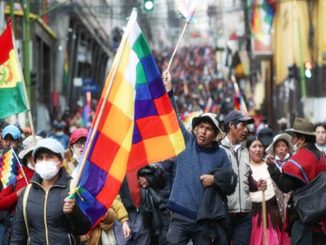
Bolivia: Roadblocks against the dictatorship setting up around the country

The indefinite general strike with roadblocks called by the Central Obrera Boliviana (COB) and the Unity Pact, which brings together the country’s social movements, is massing on the roads from La Paz to Cochabamba to Santa Cruz, demanding that the general elections scheduled for September 6 be held and not postponed until October 18, as determined by the Supreme Electoral Tribunal (TSE).

Starting on August 3, the blockades immediately began to be felt on the road that connects the city of El Alto with the interior of the country, in the High Valley and the Tropic of Cochabamba, in San Julián of the department of Santa Cruz, as well as in rural sectors of the department of Oruro and Chuquisaca, according to the Bolivian Police report.

The general strike and roadblocks were decided upon at a town hall meeting held in the city of El Alto, La Paz, on July 28 where social organizations from the nine departments of the country gathered for a massive protest march. The social movements reject the postponement of the election until Oct. 18 as announced by TSE president Salvador Romero, arguing the risk of the highest peak of the coronavirus pandemic (COVID-19) in August and the first week of September.

The national elections were supposed to be held on May 3, but because of the spread of COVID-19, they were postponed to August 2. However, due to the consensus of the main party fronts included in the presidential elections, they were postponed to September 6; however, the TSE then decided to delay them to October 18.

Faced with this panorama, the peasant and intercultural sectors, neighborhood councils and unions affiliated with the COB decided to take their opposition to the streets in view of the risk of the constant extension of the mandate of the transitional president Jeanine Áñez, whom they blame for the disaster caused to the economy and the health of the Bolivian people, that has been exacerbated since March because of her complete neglect and incapability of implementing an efficient health plan to confront and contain the coronavirus pandemic.

The southern zone of Cochabamba, District 8, began with the blockades on Petrolera Avenue. Likewise, there are marches and town halls in Barrio Millini, Tupiyan crossing, north of Quillacollo in defense of democracy and freedom that are in support of the national road blockade and the COB’s indefinite general strike.

It is expected that in the next few hours the blockades will spread and be installed on the road to Chile, Peru, and with greater intensity in the departments of Cochabamba, La Paz, Beni, Oruro, Pando, Santa Cruz, Chuquisaca, Potosi and Tarija.

After receiving the instruction at the national level from the organizations Tupac Katari and Bartolina Sisa, leaders of the communities installed a roadblock at the site demanding that the elections scheduled for September 6 are respected.

Source: Resumen

Strugglelalucha256


‘We will coup whoever we want’: Elon Musk and the overthrow of democracy in Bolivia

What role did billionaire Elon Musk and his thirst for lithium play in the coup in Bolivia?

On July 24, 2020, Tesla’s Elon Musk wrote on Twitter that a second US “government stimulus package is not in the best interests of the people.” Someone responded to Musk soon after, “You know what wasn’t in the best interest of people? The US government organizing a coup against Evo Morales in Bolivia so you could obtain the lithium there.” Musk then wrote: “We will coup whoever we want! Deal with it.”

Musk refers here to the coup against President Evo Morales Ayma, who was removed illegally from his office in November 2019. Morales had just won an election for a term that was to have begun in January 2020. Even if there was a challenge against that election, Morales’ term should rightfully have continued through November and December of 2019. Instead, the Bolivian military, at the behest of Bolivia’s far right and the United States government, threatened Morales; Morales went into exile in Mexico and is now in Argentina.

At that time, the “evidence” of fraud was offered by the far right and by a “preliminary report” by the Organization of American States; only after Morales was removed from office was there grudging acknowledgment by the liberal media that there was in fact no evidence of fraud. It was too late for Bolivia, which has been condemned to a dangerous government that has suspended democracy in the country.

Lithium Coup

Over his 14 years in office, Morales fought to use the wealth of Bolivia for the Bolivian people, who saw—after centuries of oppression—remarkable advances in their basic needs. Literacy rates rose and hunger rates dropped. The use of Bolivia’s wealth to advance the interests of the people rather than North American multinational corporations was an abomination to the US embassy in La Paz, which had egged on the worst elements of the military and the far right to overthrow the government. This is just what happened in November 2019.

Musk’s admission, however intemperate, is at least honest. His company Tesla has long wanted access at a low price to the large lithium deposits in Bolivia; lithium is a key ingredient for batteries. Earlier this year, Musk and his company revealed that they wanted to build a Tesla factory in Brazil, which would be supplied by lithium from Bolivia; when we wrote about that we called our report “Elon Musk Is Acting Like a Neo-Conquistador for South America’s Lithium.” Everything we wrote there is condensed in his new tweet: the arrogance toward the political life of other countries, and the greed toward resources that people like Musk think are their entitlement.

Musk went on to delete his tweet. He then said, “we get our lithium from Australia”; this will not settle the issue, since eyebrows are being raised in Australia regarding the environmental damage from lithium mining.

Suspension of Democracy

After Morales was removed, an insignificant far-right politician named Jeanine Áñez set aside the constitutional process and seized power. She showed the character of her politics when she signed a presidential decree on November 15, 2019, that gave the military the right to do whatever it wanted; even her allies found this to be too far and repealed it on November 28.

Arrests and intimidation of activists from the Movement for Socialism (MAS)—the party of Morales—began in November 2019 and still continue. On July 7, 2020, seven US senators published a statement that said, “We are increasingly concerned by the growing number of human rights violations and curtailments of civil liberties by the interim government of Bolivia.” “Without a change in course by the interim government,” the senators wrote, “we fear that basic civil rights in Bolivia will be further eroded and the legitimacy of the crucial upcoming elections will be put at risk.”

There’s no need to worry about that, since the government of Áñez seems unwilling to hold an election. By all polls, Áñez looks likely to be defeated in the general elections. A recent poll by El Centro Estratégico Latinoamericano de Geopolítica (CELAG) says that Áñez will get a mere 13.3 percent, far behind the Movement for Socialism’s Luis Arce (41.9 percent) and the center right’s Carlos Mesa (26.8 percent). The election was supposed to have taken place in May, but it was rescheduled for September 6; it has now been postponed once more, this time to October 18. Bolivia would not have had an elected government for an entire year.

Luis Arce of MAS recently told Oliver Vargas, “We face persecution, we face surveillance… we are facing a very difficult campaign.” But, he said, “we are sure that we will win these elections.” If elections are permitted.

The CELAG study shows that 9 out of 10 Bolivians have seen their incomes decline due to the coronavirus recession. Because of this—and of the attack by this government on the MAS—65.2 percent of Bolivians have a negative appraisal of Áñez. It is important to note that due to the positive policies of Morales’ MAS, there is widespread support for a socialist orientation; 64.1 percent of Bolivians support taxes against the rich, and Bolivians in general support the resource socialism of the MAS and Morales.

CoronaShock and Bolivia

The government of Áñez has been utterly incompetent regarding the coronavirus. The number of confirmed cases of COVID-19 in this country of 11 million people is 66,456; since testing is low, the number is likely much higher.

Musk returns to our story. Earlier this year, on March 31, Bolivia’s Foreign Minister Karen Longaric wrote an obsequious letter to Musk asking him about the “offer of cooperation posted by you regarding ventilators ready to be dispatched to countries where they are needed the most.” Longaric said, “If it is not possible to send it to Bolivia, we can arrange its receipt in Miami, FL. and transport them from there as quickly as possible.” No such ventilators came.

Instead, the government bought ventilators from a Spanish supplier for $27,000 for each of the 170 devices; Bolivian producers had said they could supply ventilators for $1,000 per unit. The health minister in the Áñez government—Marcelo Navajas—was arrested for this scandal.

Morales

Evo Morales read Musk’s tweet about the coup in Bolivia and responded: “Elon Musk, the owner of the largest electric car company, says about the coup in Bolivia: ‘We will coup whoever we want.’ Another proof that the coup was about Bolivian lithium; at the cost of two massacres. We will always defend our resources!”

The reference to the massacres is important. In November, from Mexico City, Morales watched as the government of Áñez let loose the dogs of war against the people of Bolivia from Cochabamba to El Alto. “They are killing my brothers and sisters,” Morales said at a press conference. “This is the kind of thing the old military dictatorships used to do.” It is the toxic character of the government of Áñez, backed fully by the US government and Elon Musk.

Protests across Bolivia began on July 27 for the restoration of democracy.

Vijay Prashad is an Indian historian, editor and journalist. He is a writing fellow and chief correspondent at Globetrotter, a project of the Independent Media Institute. He is the chief editor of LeftWord Books and the director of Tricontinental: Institute for Social Research. He has written more than 20 books, including The Darker Nations and The Poorer Nations. His latest book is Washington Bullets, with an introduction by Evo Morales Ayma.

Alejandro Bejarano is a Bolivian musician, documentarian, and social media manager. In 2016, he received the Medal of Honor for Cultural Merit of the Plurinational Legislative Assembly of Bolivia.

This article was produced by Globetrotter, a project of the Independent Media Institute. Source: Peoples Dispatch

Strugglelalucha256


Bolivians reject postponement of elections with massive mobilizations

Organizations and trade unions from diverse sectors in Bolivia joined the call to mobilize today, on July 28, against the postponement of the general elections in Bolivia. The call for nationwide mobilizations was given by the Central Obrera Boliviana (COB), Bolivia’s trade union center, and the Pact of Unity, a national alliance of grassroots organizations in Bolivia.

On July 23, the Supreme Electoral Court (TSE), which is under the direct control of the coup-installed government, postponed the elections scheduled for September 6 to October 18, citing the COVID-19 pandemic. The following day, the COB and the Pact of Unity released a video announcing their rejection of the coup regime’s decision to further suspend the elections and called on citizens and workers to mobilize to demand the restoration of democracy and compliance with the decision to hold elections on September 6.

Indigenous, peasant, rural and women organizations have organized massive demonstrations in the capital city La Paz as well as in El Alto, Potosi, Santa Cruz, Cochabamba, among others cities, under the banner of “For Democracy, Health and Life”. The organizations have also urged to abide by public health protocol and wear face masks, gloves and carry hand sanitizer.

The Coordinator of the Six Federations of the Tropic of Cochabamba and the Special Federation of Intercultural Communities and Agricultural Producers of San Julian also rejected the suspension of elections and demanded compliance with the electoral schedule. They warned that if the decision to delay elections is not reversed, they will carry out indefinite mobilizations across the country.

The United Federation of Rural Workers announced that they will embark on a general strike and maintain roadblocks in all 20 provinces of the La Paz department for an indefinite period of time.

The organizations criticized the TSE for its complicity in the attempts by the country’s right-wing leaders to delay the democratic elections. They denounced that the TSE does not have the authority to repeal Law 1304, which set the date of the elections for September 6. They also denounced that the postponement is a way to extend the de-facto president Jeanine Áñez’s time in office. The social and union leaders also condemned the political persecution against MAS members.

Former president Evo Morales, his party, the Movement Towards Socialism (MAS), and the MAS presidential candidate, Luis Arce, among other leaders, denounced the suspension of elections as a coup against democracy and reminded that any change in the date must be approved by the country’s parliament.

“The announcement of the Supreme Electoral Court is an abuse and an arbitrariness. It violates laws 1266, 1297 and 1304 that establish that the TSE may set the election date no later than September 6, 2020. This unilateral and arbitrary decision, surpassing the Plurinational Legislative Assembly exposes the members to eventual responsibility,” said the MAS in a statement.

Former president Morales in a tweet on July 27 said that “an administrative resolution of the Supreme Electoral Court cannot be above the law or above the Political Constitution of the State, especially if it talks about postponing general elections, suspended twice with the approval of the Legislative Assembly.”

In another tweet, Morales denounced that “the Supreme Electoral Court and the de-facto government agree in trying to undermine the value of the Legislative Assembly. The resolution to postpone the elections is intended to close the Assembly, a State entity born of the people’s vote. No to the coup.”

Earlier last week, on July 24, Morales also alerted that the right-wing political parties were trying to seize power in municipality and departmental governments. “The right-wing involved in the coup aims to extend itself, outlaw MAS, and assault the state. They are now planning coups in departmental and municipal governments, among them the department of Pando,” tweeted Morales.

Bolivia’s de-facto government led by far-right Jeanine Áñez, which seized power following the civic-military coup against Morales in November 2019, has postponed the general elections three times since March this year. Social movements have condemned Áñez for holding on to power in pursuit of her imperialist and neoliberal policies.

Source: Peoples Dispatch / Internationalist 360°

Strugglelalucha256


Fidel Agcaoili, lifelong fighter for liberation

Fidel Agcaoili, chief negotiator of the Peace Panel of the National Democratic Front of the Philippines, has passed on in Utrecht, the Netherlands.

In a statement emailed to the media, the NDFP announced that he died on July 23 at 12:45 p.m. in Utrecht.

“According to the doctor, the cause of his death was pulmonary arterial rupture which caused massive internal bleeding. It was not COVID-19 related,” the NDFP’s International Information Office said in a statement.

Agcaoili, 75, assumed the chairmanship of the NDFP Peace Panel in 2016.

He was the longest-detained political prisoner during the Marcos dictatorship and later served as the founding secretary general of SELDA, an organization of political detainees.

Agcaoili also served as secretary general of the Partido ng Bayan, a national democratic political party that fielded candidates to both senatorial and congressional seats during the administration of then president Corazon Aquino.

Source: Bulatlat


Following is a statement from the Socialist Unity Party:

The Socialist Unity Party and Struggle for Socialism/La Lucha por el Socialismo send our deepest and warmest condolences to the family and friends of Fidel Agcaoili and to all his comrades in the National Democratic Front of the Philippines. We are deeply saddened to learn of the untimely passing of a beloved revolutionary hero, a lifelong fighter for liberation who braved the single longest political imprisonment under Ferdinand Marcos’s martial law, who founded the organization SELDA for ex-political detainees, and served as Secretary-General of Partido ng Bayan and as Chair of the NDFP Negotiating Panel.

Comrade Fidel embodied all the best values of a great revolutionary — selfless, humble, comradely, warm, and completely and singularly devoted to the masses. He was a true hero who devoted his life to serving the people. He is well-remembered in his life’s work: the steadfast and enduring revolutionary movement of the people of the Philippines. It is an honor to have known and worked with him in the international solidarity movement. He will live forever in our hearts and in the people’s struggle.

On this sad occasion, the Socialist Unity Party and Struggle/La Lucha remain steadfast in our revolutionary solidarity with the Communist Party of the Philippines, the National Democratic Front, the New People’s Army, and the People’s Democratic Revolution. Your struggle and victory will be his monument.


In Honor Of Ka Fidel Agcaoili. A Great Filipino Patriot And Communist Fighter

By Jose Maria Sison

International League of Peoples’ Struggle Chairperson Emeritus

Chief Political Consultant, National Democratic Front of the Philippines

July 24, 2020

As Founding Chairman of the Communist Party of the Philippines (CPP) and Chief Political Consultant of the National Democratic Front of the Philippines (NDFP) and on behalf of my family, I express the deepest grief over the unexpected demise of Ka Fidel Agcaoili and convey sincerest condolences to his widow and children, all his comrades, relatives and friends.

Ka Fidel has been my close comrade since the early 1960s, when he joined the Student Cultural Association of the University of the Philippines, the Kabataang Makabayan and the Communist Party of the Philippines. We advanced together in our development ideologically, politically and organizationally in pursuit of the people’s democratic revolution in the context of the world proletarian revolution.

Ka Fidel deserves to be honored as a great Filipino patriot and outstanding communist fighter even only on the basis of what is publicly known about him. He has accomplished far more than this in the service of the Filipino people and their revolutionary movement within the context of the epochal struggle of the proletariat against the bourgeoisie, a struggle of the oppressed and exploited for a fundamentally new and better world than one dominated by imperialism and all kinds of reaction.

He became a revolutionary without ever boasting or feeling sorry that he had sacrificed so much for the people and the revolution.. He came from an upper-class family and could have easily attained an endless series of high positions in the ruling system. But he chose to side with the people, especially the toiling masses of workers and peasants, in their just revolutionary struggle for national and social liberation.

He was outraged by the unjust semicolonial and semifeudal system and was determined to contribute what he could to develop the revolutionary movement for overthrowing it and establishing a people’s democratic state under the leadership of the proletariat. He was never afraid of the tremendous odds and the risks to life, limb and liberty. He did not expect any kind of material reward for all his work and sacrifices.

When he was sent out by his parents to study in the U.S. and keep him away from social activism in the UP, he joined the mass protests in California and soon he was back in the Philippines on time for the preparations and establishment of the Kabataang Makabayan in 1964.

Even while he was a high executive of his family’s insurance company, he helped organize studies and produce publications and performed the lowly tasks that had to be undertaken in the underground in support of the mass movement and in the establishment and development of the CPP. He also carried out important missions that required a high level of knowledge and negotiating skills in dealing with domestic allies and with fraternal parties abroad. He put facilities and connections available to someone of his class origin in the service of the people and the revolution.

Anywhere the Communist Party of the Philippines had its headquarters, be it in Central Luzon or Northern Luzon, he attended the meetings of leading organs in order to participate in deliberations and make reports on matters he was responsible for and made recommendations on what policies and courses of action to take. He shared with his comrades all the discomfort and risks of travelling to and staying in rural huts and forest camps.

It was sometime in 1972 that it became untenable for Ka Fidel to work aboveground and he had to go underground. He and his wife with their two young children were on the manhunt list of the enemy. They had to face a far higher level of discomfort and risks than ever before. In 1974, he and his wife Chit were arrested, together with their two small children Eric and Joseph. He was subjected to severe physical and mental torture by the minions of the Marcos fascist dictatorship.

He became the political prisoner with the longest duration of detention (more than 10 years) during the Marcos fascist regime and earned the deep respect of many other political prisoners in the common struggle against the autocratic regime. He over served the penalty for the political offense of rebellion. And he was never tempted to take advantage of the fact that his father was a classmate and friend of Marcos at the UP College of Law to ask for much earlier release from prison.

He was released from prison as a result of his dropping the appeal of his unlawful conviction for rebellion and asserting that he had even overserved the sentence. He proved to be a steadfast proletarian revolutionary fighter with an unyielding moral stamina and complete dedication to the revolutionary cause of the people.

He helped to establish and became Chairperson of Samahan ng Ex-detainees Laban sa Detensyon at Aresto (SELDA) to work hard for the release of all political prisoners. He also helped organize Families of Victims of Involuntary Disappearance (FIND) in 1985 and became its Executive Director.

After the overthrow of Marcos in 1986, Ka Fidel and I worked together in laying the ground for peace negotiations upon the request of the Aquino regime through Executive Secretary Joker Arroyo. But later on Aquino would scale down the projected peace negotiations to ceasefire negotiations as prelude to setting the agenda for peace negotiations.

Ka Fidel and I were in the Preparatory Committee which established the Partido ng Bayan (PngB) on August 30, 1986. In November 1986, the first PngB Chairman Ka Rolando Olalia and his driver Ka Leonor Alay-ay were kidnapped and murdered by ultrareactionary elements of the Armed Forces of the Philippines under Oplan God Save the Queen.

Ka Fidel had the high sense of duty and courage to take the place of Ka Lando as PngB Chairman and further organize the Partido ng Bayan for the 1987 senatorial elections. He was also uncowed by the related assassination of BAYAN Secretary General Lean Alejandro and the coup and murder plans of the Enrile-RAM faction of the AFP.

Conditions became untenable for Ka Fidel to stay in Manila when he was targeted for arrest and the Aquino and Enrile-RAM factions were competing to attack the patriotic and democratic political forces. Thus, he accepted employment in a Spanish nongovernmental organization, Instituto de Estudios Políticos para América Latina y Africa (IEPALA), in 1988.

Subsequently, he joined exploratory talks for the GRP-NDFP peace negotiations since 1989 when President Cory Aquino sent Rep. Jose Yap to The Netherlands. He became the Vice Chairperson of the NDFP Negotiating Panel when the GRP and NDFP adopted The Hague Joint Declaration as the framework for the GRP-NDFP peace negotiations.

He played a key role in the GRP-NDFP peace negotiations and in the drafting and finalization of major agreements, especially the GRP-NDFP Comprehensive Agreement on Respect for Human Rights and International Humanitarian Law, the first item in the substantive agenda of the negotiations signed by the GRP and NDFP Negotiating Panels in 1998, with him as Chairperson of the Reciprocal Working Committee of the NDFP and then Justice Secretary Silvestre Bello as Chairperson of the RWC of the GRP. He co-chaired the GRP-NDFP JMC (Joint Monitoring Committee) upon its formation in 2004.

In connection with the GRP-NDFP peace negotiations, Ka Fidel like Ka Luis Jalandoni, then Chairperson of the NDFP Negotiating Panel, had the privilege of going to the Philippines to consult with Philippine presidents, from Estrada to Duterte. It was Ka Fidel who met Duterte as often as six times in 2016 and 2017. Ka Louie turned over the position of Chairperson of the NDFP Negotiating Panel to Ka Fidel in 2017.

Since he became a member of the Central Committee of the CPP in 1970, Ka Fidel successfully carried out missions of the highest importance in representation of the highest organs of either the CPP or the NDFP in relations of practical cooperation with major political forces in the Philippines and with fraternal parties and revolutionary movements abroad.

Ka Fidel had the good fortune to become well-informed about the Second National Congress of the CPP and to see with his own eyes the high level of achievement that the revolutionary movement had reached nationwide when he traveled to the Philippines in 2016 and 2017 and visited a number of major guerrilla fronts in connection with the GRP-NDFP peace negotiations. He saw the vibrant strength of the CPP, the NPA, the revolutionary mass organizations and the people’s democratic government in meetings and in activities among the people.

Ka Fidel easily endeared himself to comrades and allies because he was really modest and had an infectious sense of humor even if at certain times he looked stern. He explained complex issues patiently and persuasively to comrades and friends and dished out an alternation of serious talk and a certain amount of jokes and light banter. He firmly held on to revolutionary principles and explained complex issues patiently and persuasively to comrades and friends. He gave his opinions frankly. And he welcomed objections, corrections and additions to his explanations.

He never flaunted his high level of knowledge. He was an avid reader and observer of national and global events and freely shared his views with others. His amiable characteristics will be sorely missed by many comrades and friends who knew him at close quarters and loved him.

There are more achievements of Ka Fidel that other comrades and allies in various sectors of the national democratic movement as well as in the armed revolutionary movement can narrate in memorial meetings in his honor. I yield to their direct knowledge and more detailed narratives. May all the testimonies be put together and his biography be written in order to inspire this generation and further generations of Filipinos to follow his patriotic and revolutionary example.

The revolutionary spirit, ideas and deeds of Ka Fidel are now flowing in the growing body and blood of the the people’s struggle for national and social liberation and for a socialist future. All the efforts and sacrifices that he has made in his lifetime will live after him in the hearts and minds and collective will and actions of the people in the people’s democratic revolution and in the subsequent socialist revolution.

Revolutionaries never die, they continue to live through their revolutionary successors. Let us turn our grief to revolutionary courage. Let us celebrate the revolutionary achievements of Ka Fidel, honor him for these and emulate his example in serving the people and the revolution.

Long live the memory of Ka Fidel Agcaoili!

Celebrate his spirit, ideas and deeds as a Filipino patriot and communist fighter!

Long live the Filipino people and the Philippine revolution!

Strugglelalucha256


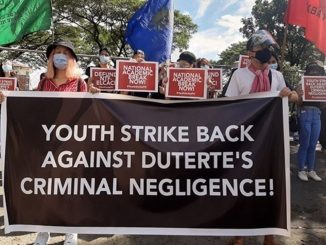
Philippine communists: Fight against Duterte’s terrorism entails greater sacrifice, courage and wisdom

July 18 — Today, the Filipino people enter a new stage of resistance against President Rodrigo Duterte’s tyrannical regime as his draconian terror law goes into effect. As it is set to use the new law to silence all criticism and opposition, all democratic forces are compelled to raise their level of courage and commitment to defend their democratic rights and fight state terrorism.

By signing the anti-democratic law of state terror, Duterte has shown the extent to which he is determined and desperate to defend and extend his reign of corruption, treachery and oppression.

Over the past years, he has unleashed the worst forms of state terrorism in carrying out a campaign of mass murder and destruction. Tens of thousands have been killed and terrorized in the bloody path towards establishing his authoritarian regime. With the terror law in the hands of the tyrannical monster, tens of thousands more are bound to be victims of his greed and brutality.

Mortally afraid of losing his power and facing judgement for all his crimes, Duterte seeks to perpetuate himself in Malacañang up to 2022 and beyond, even if confronted with widespread clamor for his resignation or removal. Expect the worst of state terrorism in the coming months as Duterte seeks to consolidate his power and secure the 2022 elections by eliminating all those who will dare to stand up to his tyrannical power.

The continuing fight against the tyrant Duterte and his reign of state terror will entail even greater sacrifice, courage and wisdom on the part of the Filipino people. With Duterte’s terror law, they will have to face greater threats of getting surveilled, wiretapped, arrested, imprisoned, subjected to various forms of torture or being killed. History shows us that the struggle against tyranny and dictatorship, oppression and exploitation is never an easy task. To bask in freedom and democracy, the people must endure the pain of arduous struggle.

Duterte is a rabid monster. But he is no match for the even greater power of the Filipino people. In the face of a fascist dictatorship, the broad masses of the people are called upon to muster their strength in great numbers by getting organized and marching as one. They must also learn when to conceal and when to declare their plans, when to flank and when to strike. They must fight wisely as they confront a fascist beast.

Duterte is a dying monster. He has devastated the economy and the people’s lives, and has made them ever vulnerable to disease and death as a result of his incompetence and failures. Determined and united, the Filipino people will attain certain victory in the fight against the Duterte regime.

Source: Philippine Revolution Web Central

Strugglelalucha256


Global protests erupt in response to Philippines ‘terror law’

On July 3, Philippines President Rodrigo Duterte signed into law what he calls the “Anti-Terrorism Act,” now the Anti-Terrorism Law. Despite international criticism from human-rights watchdogs, legal professionals and grassroots organizations, the Anti-Terrorism Law will go into effect on July 18. 

The Anti-Terrorism Law creates a Duterte-appointed council that subsumes the powers of the Philippines courts to designate who or what can be considered a “terrorist” or “terrorism.” It also allows for people suspected of “terrorism” to be wiretapped and surveilled for 90 days, arrested without a warrant and imprisoned for 24 days. Punishments for those convicted include life imprisonment without parole. 

Duterte and his government mouthpieces claim that the bill is necessary to stamp down “terrorism” influenced by the Islamic State. But the facts don’t lie: Duterte has utilized the full force of the Philippines National Police and Armed Forces of the Philippines, under the guise of his “War on Drugs,” to gun down anyone he deems a dissenter. 

To date, extrajudicial killings have claimed over 30,000 lives, an overwhelming number of them farmworkers, Indigenous people, unionists, legal professionals — the list goes on. This Anti-Terrorism Law is simply Duterte’s way to make legal his fascist reign of terror.

But the broad masses of the Philippines and their allies around the world will not be cowed. 

Wednesday, July 8 was declared a Global Day of Protest against the Anti-Terror Law. In the U.S., demonstrators hit the streets in New York; Baltimore; Washington, D.C.; Boston; Chicago; Portland, Ore.; Austin, Houston and Dallas, Texas; San Diego; Los Angeles; and San Francisco.

Baltimore’s demonstration on July 8 was the very first street action called by Malaya Movement Baltimore. Speakers from Malaya Movement Baltimore, the Maryland Committee for Human Rights in the Philippines, the Baltimore Teachers Union, the Peoples Power Assembly, Youth Against War and Racism and the Socialist Unity Party broadly condemned Philippines President Duterte and his reign of terror and declared unwavering solidarity with the Filipino people. 

On behalf of the Peoples Power Assembly, Andre Powell said, after reminding the crowd of martial law in the Philippines under Ferdinand Marcos, “History in the Philippines is repeating itself over and over again, and it could not do so without the money poured into it that the U.S. Congress passes and designates to go to the Philippines dictators.” 

Alec Summerfield, representing the Socialist Unity Party, made clear that no one is fooled by Duterte’s latest move: “This is not an anti-terror law, as we all know. This is an anti-worker law, anti-farmer law, anti-union law, anti-student law and anti-legal worker law. … This is just another way for the U.S. to assert its agenda through its puppet fascist dictatorship in the Philippines.”

Even before the official passage of the law, the Duterte government in the Philippines has already cracked down on dissent. On June 26, the day the Anti-Terror bill passed through the Philippines House of Representatives, 20 activists of the LGBTQ organization Bahaghari were arrested for their protest in Metro Manila. They were released four days later. 

Philippines solidarity organizations like the International Committee for Human Rights in the Philippines and the Malaya Movement have reached out to U.S. congressional representatives, asking them to condemn the passage of the Anti-Terrorism Law. Illinois Rep. Jan Schakowsky spearheaded a letter of condemnation alongside California Rep. Judy Chu, which was signed by over 50 other congressional representatives and sent to Jose Manuel Romualdez, the Philippines ambassador to the U.S. 

In response, ironically, Duterte supporters have called on the U.S. to “stop meddling” in Philippines affairs.

Strugglelalucha256
https://www.struggle-la-lucha.org/around-the-world/page/62/