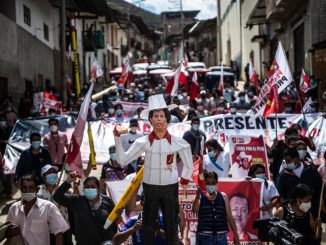
Ecuador elections: state of emergency in the aorta of Latin America

Illustration: Ezequiel Garcia

Sunday will define who will be the new president of Ecuador and polls predict a close runoff. The candidates in dispute are oil and water: on one side the country’s biggest banker, representing the elites and the neoliberal creed; on the other a leftist economist, heir to former president Rafael Correa, currently in exile. Will the indigenous movement tip the balance? Is there any guarantee of a fraud-free election? One thing is certain: the outcome will have a major impact on regional geopolitics.

State of emergency in Ecuador: the news was confirmed minutes after I finished interviewing Andres Arauz. The candidate is confident and thoughtful. He is greeted and hugged in the street, pictures are taken with him. Each day of campaigning means touring one or more provinces and, at the same time, defusing threats. The presidential ballot of April 11 is very close. It is the moment of desperate, dangerous maneuvers, something that, it was known, was going to happen. I bid him farewell. Night falls in Quito and little can be seen, there is no fog but clouds, mountains, volcanoes, the almost three thousand meters of the city.

For the second time the government of Lenin Moreno decrees a state of emergency. The previous one occurred in October 2019, when the indigenous and popular uprising took place to confront the adjustment decided by the International Monetary Fund (IMF). Quito was then a battlefield, columns arrived from Cotopaxi, Amazon, neighborhoods of the capital, confronted with a response with gunfire, police, military, eleven dead, loss of eyes, and a negotiation at the last minute agreement that the government did not respect.

A lot of crisis and political persecution has happened since then. The country is worse, the pandemic devastated Guayaquil in 2020 with corpses in the houses, streets, morgues, hospitals. Three health ministers have succeeded each other in the last month, and hardly any vaccines have arrived. Moreno, meanwhile, seeks to culminate the conflagration with a wave of privatizations that will reach the main target: the Central Bank of Ecuador (BCE).

The state of exception, under the argument of the pandemic, has two objectives: to privatize behind the scenes and to build an even more unfavorable scenario for Arauz in the elections. It prohibits “the realization of all events of massive affluence and congregation” in the eight provinces where it is in force -they are the principal areas of the country, which means that the campaign in the streets is limited, where Arauz has strength and the valuation of his closeness with the people is great.

The decree is also a threat for election day in the event that some event occurs before which mobilization is necessary. In 2017, for example, Lasso, facing Moreno, was proclaimed winner in advance and falsely by the hegemonic media apparatus. There was then an institutionality in which confidence could be placed. Correism was a government and a movement with structure, now it is a persecuted force.

Dreams of banishment

Moreno’s political time has expired. He fulfilled his objectives: he carried forward the agenda of financial capital, of the US State Department, and persecuted those who brought him to the presidency. He earned his place in history as the one who executed one of the deepest betrayals within a political movement. Now he is looking, like others before him, for a place to spend the rest of his years, most likely outside the country.

The process of dismantling Correaism was carried out in stages. The first target was Rafael Correa, who moved to Belgium with his family after leaving the presidential palace of Carondelet. As in Brazil, Bolivia or Argentina, the first target was the leadership of the process, on whom a combination of media, judicial and political attacks were unloaded until the objective was achieved: to prevent his return to Ecuador and his electoral participation.

The persecution continued on the second and third lines, with charges of corruption or the crime of rebellion. The result was jail for Moreno’s vice president, Jorge Glas, exile for Correa’s former foreign minister, Ricardo Patiño, a permanent threat of sentence for the current prefect of Pichincha, Paola Pabón, who wears an electronic anklet to be located at all times.

Simultaneously, and often invisibly, there was a multiplication of cases for those who were part of government teams during the Correa years. Young people, for example, who had joined the government attracted by the possibilities of a state that was open to all. These actions impacted a large part of a generation that had its first political experience in the Citizen Revolution.

The persecution also reached the Alianza País party, which was left in the hands of Moreno and those who accompanied him in the betrayal were numerous. The strategy was not only to dismantle Correism, but also to prevent its electoral participation. That is why when Arauz achieved the presidential registration in the National Electoral Council (CNE), there was already, in that act, a victory.

The operations were designed by those who knew the process from the inside, which added impact and blocked any reaction. The weaknesses of the citizen revolution did the rest, two of them in particular: the absence of a strong party, and the scarce popular organization (both in the territories and in the world of work). The capacity for pressure in the streets was weak, sporadic, and without the possibility of alliance with the only movement with structure and capacity for mobilization: the indigenous movement.

Lenín Moreno’s political time expired. He fulfilled his objectives: he carried forward the agenda of financial capital, of the U.S. State Department, and persecuted those who brought him to the presidency. He earned his place in history as the one who executed one of the deepest betrayals within a political movement.

The return of the indigenous movement to the center of the political stage occurred in October 2019. The uprising was centrally led by the Confederation of Indigenous Nationalities of Ecuador (Conaie), the main national organization, which maintained roadblocks and an encampment in Quito for more than a week. The action had great social legitimacy, which was translated into banging pots and pans, provision of food, lodging, medical care for the wounded.

Two leaders had high visibility during those days: Jaime Vargas, president of Conaie, and Leonidas Iza, who emerged as a leader because he was at the head of the main column, with about 50,000 people, coming from Cotopaxi. The former has now seven judicial processes against him, the latter eight, and several regional leaders have precautionary measures. Criminalization also hit those who, within the indigenous movement, confronted the government.

The uprising meant the definitive rupture with Moreno after an initial stage of agreements, which were manifested, for example, in the appointment of a Conaie leader as Minister of Environment. Those days also revealed the distance between Conaie and the Citizen Revolution, the depth of the rift and the apparent impossibility of a rapprochement between the parties.

The disagreements between Conaie and Correism were over various issues, such as indigenous justice, organization in the territories where the communities are located, the so-called millennium schools, and water management. And there were conflicts regarding mining and oil exploitation, demands that did not receive the necessary answers, according to leaders such as Iza, who is also an authority of the Panzaleo people.

We talk about it near his home, in the community of San Ignacio de Toacaso in the Canton Latacunga. Everything there is green, the rain and the Andes. The land where he was born belonged to a landowner and was recovered in a process of struggle where his parents were involved. Iza comes from an indigenous, leftist background, and explains the map of the movement, composed of a peasant sector -to which he belongs-, traders, transporters, financiers, and the respective influences in the politics of alliances and interests.

The disagreement with Correism is explained by other factors. The citizen revolution did not consider the Conaie an essential alliance, due to a majority political conception that denied an important place to the construction of popular organization. That is why, after the exit of the government, there were no places of withdrawal and rearticulation to confront Moreno’s betrayal.

There is another element: the path of the Conaie, particularly a sector permeated by the entry of national and international NGOs, linked to U.S. foreign policy, and their progressive influence on the leadership. At the same time, there are those who confront this current within the movement. The translation of this debate today is the dispute within the Conaie and its electoral instrument Pachakutik, between leftist sectors -internationally close to Evo Morales- and those who maintain alliances with the right wing and adopt the anti-correista discourse to justify the rapprochement with Lasso. Yaku Perez, who was designated candidate without respecting the internal mechanisms of the movement, third in the first presidential round, is one of the main figures of this second tendency.

This dispute had a first resolution before the April 11 ballot with the Conaie’s call for an “ideological null vote”. That agreement was modified in the final days of the campaign when Pérez’s vice-presidential candidate called to vote for Lasso, Iza announced that he would never vote for the candidate of the right, and Vargas made an unexpected turn: the public support to Arauz, in an event held in the Amazon. “Andres achieved what I could not,” Correa tweeted after the agreement reached. The Conaie later ratified the call for a null vote. How much impact will this agreement have in terms of votes? And what will be its implications in a possible Arauz government? These are some of the questions still without clear answers.

The last days

The polls favor Arauz, with a difference of almost four points and there is more than 30% of the electorate that would vote null or blank. The final days of the campaign occupy a central place within this framework: they may be decisive to obtain the necessary majority, particularly because of the almost one third of voters in dispute. The warning signs of threats are even greater for the Arauz campaign.

This was never a level playing field election. The Ecuadorian institutions were transformed into a device against Correism, such as the Prosecutor’s Office for the legal persecution, and the National Electoral Council which hindered Arauz’s candidacy from the very first hour. It is a context reminiscent of the Bolivian election in 2020 where last minute operations could take place during the campaign, the night of the election, the days after, until the inauguration. The difference in Ecuador is that the government was democratically elected.

This set of threats occurs while, at the same time, a dirty campaign with known elements is taking place. One of them is the use of Venezuela as an accusatory method to instill fear in a country where Venezuelan immigrants are numerous. The maneuver went as far as hiring migrants for ten or twenty dollars a day to carry signs at traffic lights such as: “For voting for socialism I am here begging for alms”.

The stakes of the election are high. Nationally, a victory for Lasso would be the deepening of neoliberalism under the direction of the banks, now without intermediaries: the government in the hands of those who see the country as their hacienda. In political terms, it would mean the attempt of definitive banishment of the citizen revolution, four more years of selective persecutions, of impossibility for those who are outside to return to Ecuador, with cases brought under the most profound lawfare, perhaps the deepest in the continent.

The international dimension is also central. An example has been the dirty campaign from Argentina via Clarín, with false news about Arauz. And from Colombia, through the magazine Semana and the Attorney General’s Office, on a larger scale: the accusation, fabricated without evidence, against the candidate of the citizen revolution allegedly receiving financing from the Colombian National Liberation Army.

This is, in turn, the first election that will take place in South America under the administration of Joe Biden in the United States. His positioning with respect to other agendas, such as Bolivia or Venezuela, has so far maintained more continuity than rupture with respect to Donald Trump’s foreign policy. How much of a threat does an Arauz victory represent, and what is needed to prevent it? Perhaps the answer should not be sought so much at the top in the White House, as in those intermediate zones of the deep state that deploys its agencies in the continent.

Ecuador emerges on the continental map with the possibility of a new progressive government. It would be, should it happen, the fourth victory in three years: the Mexican Andrés Manuel López Obrador in 2018, the Argentine Alberto Fernández in 2019, and the Bolivian Luis Arce in 2020. Arauz has placed special emphasis on the need to rebuild the instruments of Latin American integration that were dismantled by right-wing governments in a policy aligned to Washington’s strategy. And on the near horizon there are several presidential elections in the continent, in particular, Brazil in 2022, with the new possibility of a Lula da Silva candidacy.

The final days, before the vote, are passing without any electoral climate in the streets, with a great deal of campaigning in social networks, and under state of emergency. Ecuador is facing a defining moment in which Latin America can see itself as in a great mirror.

Source: Revista Crisis, translation Internationalist 360 / Resumen

Strugglelalucha256


Why Ukraine’s borders are back at the center of geopolitics

On March 11, Ukraine’s Foreign Minister Dmytro Kuleba wrote on Twitter that his government has “approved the Strategy for Deoccupation & Reintegration of Crimea.” What he referred to is a new strategy driven by Ukraine’s President Volodymyr Zelensky to retake Crimea — including the Black Sea port of Sevastopol. Ukraine’s National Security and Defense Council passed Decree no. 117/2021 on March 24 that laid out the government’s decision to contest Russia’s control over Crimea. 

On Twitter, President Zelensky used the hashtag #CrimeaIsUkraine to send a clear signal that he is prepared to escalate conflict with Russia over Crimea. The Ukrainian government set up a Crimean Platform Initiative to coordinate strategy alongside the United States and the North Atlantic Treaty Organization (NATO) to pressure Russia over both Crimea and the conflict in the Donbass region of eastern Ukraine.

Zelensky, an actor, was thrust into politics when he played the role of Ukraine’s president in a television show called “Servant of the People.” Fiction became reality when his television show became a political party, which ran on a decidedly vague platform to bring decency back to politics. He won the presidency in 2019 with 73 percent of the vote. 

There was a general sense that Zelensky’s blank slate, and advocacy for Russian actors in Ukraine, would translate into a peace process for eastern Ukraine and with Russia. Instead, Zelensky — egged on by his NATO allies — has become far more aggressive against Russia than his predecessor Petro Poroshenko.

In March 2014, after Russian troops entered Crimea, the population voted to join Russia; eight days later, the United Nations General Assembly passed a resolution asking Russian troops to withdraw. The stalemate set up by the vote in Crimea and the UN resolution persists.

NATO’s march eastward

Current tensions should not masquerade as ancient animosities. This is the case with the relationship between Ukraine and Russia. For seven decades, both countries were part of the USSR, and for over a decade after 1991, relations between the two countries remained cordial. 

On February 9, 1990, U.S. Secretary of State James Baker told the last leader of the USSR Mikhail Gorbachev that NATO would not move “one inch to the east” from the Oder-Neisse line that divides Germany from Poland. “NATO expansion is unacceptable,” Gorbachev told Baker. Baker agreed: “Not an inch of NATO’s present military jurisdiction will spread in an eastern direction.” In a letter to the German chancellor Helmut Kohl the next day, Baker recounted this conversation, emphasizing the “extension of the zone of NATO would be unacceptable.” “By implication,” Baker wrote, “NATO in its current zone might be acceptable.”

The Western powers broke their commitment immediately. In 1999, the Czech Republic, Hungary and Poland joined NATO, while in 2004, the alliance drew in Bulgaria, Estonia, Latvia, Lithuania, Romania, Slovakia and Slovenia. A line of states that comprise Ukraine, Belarus and Moldova — all of which border Russia — remain outside NATO. 

In 2002, the NATO-Ukraine Action Plan opened up a framework for Ukraine’s possible entry into NATO. This process has raised serious questions not only about the eastward expansion of NATO, but also — more significantly — about the deeper cultural relationship that Ukraine has had with Russia to its east and with Europe to its west; in what direction should Ukraine orient itself? (A fifth of the Ukrainian population is Russian-speaking, with the largest numbers in Ukraine’s urban areas and in the Donbass region.)

NATO has aggressively courted Ukraine and Belarus, with NATO’s various plans deeply focused on putting pressure on Russia. The most recent “NATO 2020” report highlights its strategic focus around Russia, which is seen as “destabilizing” and “provocative.” In the interest of putting pressure on Russia at its border with Ukraine, the NATO-Ukraine Commission met throughout 2020 to advance the NATO-Ukraine Distinctive Partnership (set up in 1997). 

In June 2020, NATO recognized Ukraine as an Enhanced Opportunities Partner, the closest form to full NATO membership. Ukraine’s armed forces, now substantially trained with NATO, joined NATO forces for three major military exercises last year (Saber Junction, Sea Breeze and Combined Resolve).

At a meeting of NATO foreign ministers on March 24, NATO Secretary General Jens Stoltenberg said, “Russia has increased its pattern of repressive behavior at home and aggressive behavior abroad.” To this end, NATO’s approach to Russia will be, Stoltenberg said, “deterrence and defense,” with an “openness to dialogue.” Dialogue seems to have been downgraded between the Western alliance and Russia, with a green light to Ukraine to make provocative statements and actions.

Europe’s need for Russian gas

Beneath the tension lies Europe’s appetite for energy. As a result of U.S. actions over the past two decades, Europe lost three major sources of energy: Iran, Libya and Russia. Because Ukraine has become a hotspot, Russian energy investors — mainly the state energy firm Gazprom — moved to build a pipeline under the Baltic Sea to connect Russian oil fields with Germany. The two pipeline projects (Nord Stream and Nord Stream 2) began in 2011-2012, before the outbreak of hostilities in eastern Ukraine and before Russia formally took Crimea (both in 2014).

Germany welcomed the pipelines, since these would resume gas delivery to Europe on a regular basis. U.S. President Joe Biden’s administration has sharpened the attack on Nord Stream 2; Biden’s Secretary of State Antony Blinken warned “that any entity involved in the Nord Stream 2 pipeline risks U.S. sanctions and should immediately abandon work on the pipeline.” Poland’s anti-monopoly regulator — UOKiK — has fined Polish subcontractors to the tune of about $7.6 billion for participation in the project. German Chancellor Angela Merkel’s close ally Peter Beyer, who is Germany’s coordinator for transatlantic affairs, called for a suspension of the pipeline.

Nord Stream 2’s Andrei Minin said that his project’s fleet have been targets of “regular provocations on the part of foreign civilian as well as military vessels.” This could only refer to the military exercises that NATO and its allies — including Ukraine — have conducted in the Baltic Sea; Minin directly pointed to Polish aircraft flying low over the project in Danish waters.

Nord Stream 2 is 95 percent complete and is projected to be ready to go by September 2021. Failure of the U.S. to properly return to the Iran deal and the continued crisis in Libya make Nord Stream 2 fundamental to Europe’s energy planning. But Nord Stream 2 is trapped in the attempt by NATO to isolate Russia.

Ukraine’s minority problem

No country is truly culturally homogenous. Ukraine has substantial populations with cultural roots in neighboring states. This applies mainly to the Russian-speaking population, which has close ties to Russia both culturally and politically. One in five Ukrainians speaks Russian, while about one in 10 Ukrainians identify with a range of cultural worlds that emerge from Belarus to Gagauz (a Turkish community from Budjak).

NATO’s pressure against Russia exacerbated and joined with extreme Ukrainian nationalists—including fascists such as the Azov Battalion—to drive an anti-Russian cultural and political movement in the country. Former Ukrainian President Petro Poroshenko, who benefited from Western backing, put forward a language law in 2017 that hampers the teaching of the minority languages in the country’s schools. The target for the law was to de-Russianize the population, but it had an impact on the country’s smaller minorities. For that reason, Bulgaria, Greece, Hungary and Romania filed complaints with the Council of Europe.

Hungary’s Foreign Minister Péter Szijjártó said on Facebook in late 2020 that his government would “stand up for Transcarpathian Hungarians in every international forum.” Ukraine, he said, “not a member of NATO, has launched an attack against a minority group originating from a NATO member country.” The contradictions of Ukraine-NATO’s anti-Russian agenda run afoul of other NATO members for reasons that were not calibrated carefully.

Firing across the Ukraine-Russia border has stepped up, egged on by Biden’s full-throated support of Zelensky’s newly found anti-Russian ambitions. A senior United Nations official at the Department of Political and Peacekeeping Affairs tells me that they want military forces to withdraw from the border. All the main platforms for negotiation — the Normandy Format and the Arria Formula meetings at the U.N. — are in a stalemate. “We need cool heads to prevail,” said the U.N. official. “Anything other than that could lead to a catastrophic war.”

This article was produced by Globetrotter

Vijay Prashad is an Indian historian, editor and journalist. He is a writing fellow and chief correspondent at Globetrotter. He is the chief editor of LeftWord Books and the director of Tricontinental: Institute for Social Research. He is a senior non-resident fellow at Chongyang Institute for Financial Studies, Renmin University of China. He has written more than 20 books, including The Darker Nations and The Poorer Nations. His latest book is Washington Bullets, with an introduction by Evo Morales Ayma.

Strugglelalucha256


Global proposal against the economic blockade

At least twenty countries are formally victims of U.S. “sanctions”. Since 1992, in the United Nations General Assembly, all countries except the U.S. and Israel have voted against the unilateral coercive measures imposed by the United States on Cuba. Despite the evident majority, the U.S. has ignored them. Good wishes, denunciations and calls to lift the blockades have not been enough to prevent these genocidal actions against entire peoples.

To put an end to these interference practices, we must make amends for two serious mistakes we made as humanity in 1944 and 1971. To do so, it is first necessary to know how “sanctions” work. Let’s look at an example.

When food company “X” from, for example, Mexico wants to trade with company “Y” from Venezuela (a sanctioned country), the U.S. government, through the Office of Foreign Assets Control (OFAC) sends a little message and says: “if you sell food to Venezuela, we will freeze all the bank accounts you have in the world financial system. Therefore, if Venezuelan company “Y” pays you for the food, you will not be able to dispose of that money, nor the money already in your accounts. Don’t even bother to transfer it to another bank account because we will block it as well. Oh, and if you put it in the name of another person or company, we will block that one too.”

The U.S. government can block financial resources because it is the owner of the purse strings of all financial transactions made in dollars in the world. Through the Swift (global payment clearing system) the U.S. has the power to decide what financial transactions are made, when and under what conditions. With that power it instills fear, threatens, blackmails, “sanctions” and blockade.

Removing this power from the U.S. is the strategy to be followed to combat criminal blockades, which involves suspending the Bretton Woods Agreement (1944) and the petro-dollar (1971).

In 1944, in the midst of World War II, 44 countries met in Bretton Woods to decide on the new commercial, monetary and financial order that still prevails today. At that time, when Europe was destroyed and ruined by the war, the United States imposed itself, taking advantage of its status as not only the country that produced 50% of the world total with a surplus trade balance, but above all as the world’s largest lender.

They decided that the U.S. dollar would be, the world’s reference currency. In other words, the U.S. was granted the exclusivity and therefore the power that all the world’s currencies should be referenced to the dollar, which in turn was backed by gold. That was the first big mistake. Incidentally, the IMF was created, which granted the largest share, 31.1%, to the U.S. and with it the greatest voting power and control in that organization.

Then, in 1971, mankind committed the second great mistake by silently allowing the United States to unilaterally disassociate itself from gold as the standard for fixing the price of its currency. Nixon announced to the world that from that moment on, the price of the dollar, to which all the world’s currencies would continue to be pegged, would depend on confidence in the U.S. economy. This announcement was accompanied, not by chance, by the creation of the petro-dollar. From that moment on, all the oil bought in the world had to be traded in dollars, and since there was no country that did not buy hydrocarbons, all of them would need the U.S. currency, which would be available in sufficient quantities because it could be issued without the restriction of the amount of gold in the vaults of the U.S. Federal Reserve.

They flooded the planet with dollars and, in order to be able to trade them, they created the SWIFT payment clearing system, also unilaterally granting themselves the monopoly of the world financial market. It was a masterful move on the part of the country of the North.

Today, 80 years after Bretton Woods and half a century after the petro-dollar, the world has turned upside down.

The U.S. has gone from being the world’s largest lender in 1944 to the most indebted country on the planet; it literally owes the whole world, its debt amounts to US$ 25 trillion. The situation worsens for those in the North when their international reserves do not even cover 2% of their foreign debt. In contrast, China tops the list with the largest international reserves, which also covers 153% of its foreign debt. Not to mention that the U.S. has had a negative trade balance for half a century, importing more than exporting. The Chinese have been in surplus for 5 decades. U.S. production no longer represents 50% of the world total, it dropped to 24% while China went from 1% to 16%.

Proposal against the economic blockade

In this context, what should be submitted for debate and decision in the United Nations National Assembly is not only whether countries are for or against the “sanctions” and blockades imposed by the United States. The debate should focus on the democratic construction of a new trade, monetary and financial system.

The questions to be taken to the UN Assembly for consultation should be:

Are you in favor of the U.S. dollar not being the only world reference currency? Are you in favor of there being many world reference currencies and not granting exclusivity, and therefore economic power, to a single country? Are you in favor of countries being able to buy oil and its derivatives in any currency and not exclusively in dollars? Are you in favor of all currencies being considered international reserve assets and not only the dollar, the euro, the pound sterling, the yen or the yuan? Do you agree that countries should be free to trade their goods in any currency? Do you agree that there should be several, many, payment clearing systems in the world and not only SWIFT, including the exchange of goods itself? Do you agree that, within the framework of regional integrations, currencies should be created for exchange in that region that can also be used for transactions with other regions or countries? Do you agree that decisions in the IMF should be democratized and, therefore, that each country should have the right to vote, eliminating the quotas that apply there?

The coalition of countries against the blockade that has recently been formed by Venezuela, China, Russia, Iran, Cuba, among others, should, besides continuing to add nations, besides denouncing the criminal “sanctions” of the U.S., and besides calling for compliance with the UN Charter, include in the agenda of the United Nations Assembly the creation of a new commercial, monetary and financial system that would allow us to move towards a pluripolar, multicentric, truly democratic world in which the sovereignty and self-determination of the peoples would be respected. Thus, in passing, and in the face of the imminent decline of the most genocidal empire that history has ever known, they would give it a little push to finish its fall.

Source: Ultimas Noticias, translation Resumen Latinoamericano – English

Strugglelalucha256


Justice for Vladik! No U.S.-Ukraine war on Donbass and Russia

Stop provocations ⬝ Stop drone strikes on civilians ⬝ Stop killing children!

The right-wing government of Ukraine, supported by the U.S., has been at war with the people of the independent Donetsk and Lugansk republics in the Donbass region of eastern Europe for 7 years. More than 14,000 people have been killed, according to the United Nations. The people of Donetsk and Lugansk live under a blockade by Ukraine and its Western allies. Workers in Ukraine suffer repression, joblessness and price hikes while their government sells off the country to Wall Street.

On April 3, a Ukrainian military drone strike killed 5-year-old Vladik Shikhov and wounded his 66-year-old grandmother in Aleksandrovskoye, Donetsk. On April 4, another Ukrainian drone strike wounded a civilian in Nikolaevka, Lugansk. On March 22, a 71-year-old pensioner was killed by sniper fire near the capital of Donetsk. Many members of the anti-fascist People’s Militia have also been killed while defending residents.

Since January, Ukraine has been building up its military forces on the front line of the conflict. It uses prohibited weapons, targets civilians, schools and homes in violation of international law and regional ceasefire agreements. Battalions of troops affiliated with neo-Nazi groups have been sent to the region, replacing regular Ukrainian Army troops. But the Ukrainian and U.S. governments and mainstream media blame Donetsk and Lugansk for taking steps to defend themselves, and threaten Russia for pledging to protect the people there if Ukraine invades.

The Biden administration, as the Trump administration did before it, wants to stop the Nord Stream 2 pipeline project that would allow Germany and other Western European countries to purchase Russian gas. Children, elders and other civilians in Donetsk and Lugansk are considered expendable targets by Kiev and Washington as they try to provoke a crisis to give them an excuse to further NATO military expansion and punish Russia.

In recent days, the U.S. and NATO have been warning of a Russian military buildup near the Ukrainian border, but never mention that one of the largest U.S. Army-led military exercises in decades has begun and will run until June: Defender Europe 2021, with 28,000 troops from 27 countries operating in a dozen countries from the Balkans to the Black Sea. This is where the real danger of war is coming from.

We say no! People in the U.S. don’t want war with Russia to protect the profits of Big Oil and U.S. banks. We don’t want the U.S. proxy regime in Ukraine to kill our sisters and brothers in Donetsk and Lugansk. We don’t want U.S. troops to be sent to fight and die in another needless conflict. We need an end to racist police brutality and anti-Asian violence. We need money for jobs, housing, healthcare and schools, not war.

End U.S. aid to the Kiev regime! End all U.S. wars and sanctions! Shut down NATO and bring the troops home! 

Initiated by Solidarity with Novorossiya & Antifascist in Ukraine

Endorsers (list in formation):

Individuals: Jose Maria Sison, Chairperson Emeritus of the International League of Peoples’ Struggle*; Phil Wilayto, Coordinator, Odessa Solidarity Campaign; Berta Joubert-Ceci, Coordinator, International Tribunal on U.S. Crimes against Puerto Rico; William Camacaro, Alberto Lovera Bolivarian Circle; Sharon Black, Peoples Power Assembly; John Parker, Harriet Tubman Center for Social Justice, Los Angeles; Joe Lombardo, National Co-Chair, United National Antiwar Coalition (UNAC)*; Professor Vijay Singh, editor, Revolutionary Democracy journal, New Delhi (India); Bridget Dunne, Solidarity with the Anti-Fascist Resistance in Ukraine (UK); Theo Russell, International Ukraine Anti-Fascist Solidarity (UK); Andy Brooks, General Secretary, New Communist Party of Britain; Gedrius Grabauskas, Chairperson, Lithuanian Socialist Front; Donatas Shultsas, Chairperson, Lithuanian Union on Human Rights; Heinrich Bücker, Coop-Anti-War-Café Berlin; Panagiotis Papadomanolakis, Editor, GuernicaEu (Greece); Gerry Downing, Socialist Fight (UK)

Organizations: Anti-Imperialist Front; Socialist Unity Party (U.S.); Struggle-La Lucha newspaper; Borotba (Ukraine-Donbass); Communist Party of the Donetsk People’s Republic; Union of Political Emigrants and Political Prisoners of Ukraine; Women In Struggle-Mujeres En Lucha; Samidoun Palestinian Prisoner Solidarity Network; Workers Voice Socialist Movement (U.S.); International Action Center; No Pasarán Hamburg (Germany); Anti-NATO Group Berlin-Brandenburg (Germany); “Frente Unido América Coordinamento Ucraina Antifascista (Italy); Latina” Berlin (Germany); Communist Revolution Action – KED (Greece); Liaison Committee for the Fourth International (LCFI); Frente Comunista dos Trabalhadores (Brazil); Tendencia Militante Bolchevique (Argentina); Socialist Workers League (U.S.); Trotskyist Faction/Consistent Democrats (UK); Socialist Solidarity Party of Bangladesh; Molotov Club; Panhellenic Antiwar Κinematic Coordination – PAKC (Greece); Red Banner Anti-Imperialist Collective (U.S.)

*For I.D. only

To endorse or for more info, contact:
solidarityukraineantifa [at] gmail [dot] com

In New York City, an emergency protest is planned for Saturday, April 10, 2:30 p.m., at the U.S. Armed Forces Recruiting Station in Times Square, W. 43rd Street and 7th Avenue, Manhattan. Visit the event page on Facebook.

Strugglelalucha256


Ukraine, U.S. drum up war threats against Donbass and Russia

“The USA has the unique condition of being a flagrant violator of human rights within its own borders and in practically every region of the world. No other nation has such a systematic record. Its massive control of media and communications hides this truth from its own people.”

I thought of this tweet from Carlos F. de Cassio, the Cuban Foreign Ministry’s director for U.S. affairs, while reading the latest corporate news reports about the conflict between Ukraine and the independent Donetsk and Lugansk People’s Republics in the Donbass region of eastern Europe.

A series of alarmist articles appeared in late March and early April warning of an escalation in the seven-year war in the region and a buildup of Russian military forces in Crimea and near the border with Ukraine. Fanning the flames of these reports are recent statements by Biden administration officials. 

“U.S. Secretary of State Antony Blinken, in a phone call with Ukrainian Foreign Minister Dmytro Kuleba on Wednesday, affirmed Washington’s support for Ukraine’s territorial integrity ‘in the face of Russia’s ongoing aggression,’ the State Department said in a statement,” Reuters reported March 31. 

Meanwhile, the New York Times reported March 30 that U.S. European Command (EUCOM) had changed Ukraine’s status on an internal watch list from “possible crisis” to “potential imminent crisis.”

Completely missing from these reports, however, is the fact that Ukraine has been building up its troops and military hardware on the “line of contact,” the front line of the conflict, since mid-January. 

At the same time, Ukrainian military forces have stepped up unprovoked attacks on frontline settlements in Donetsk and Lugansk, killing and injuring residents and targeting homes, schools and other civilian targets.

Ukraine attacks civilians, violates ceasefire

The city of Gorlovka in the Donetsk People’s Republic (DPR) was one of several that came under increased fire from Ukrainian forces starting in February. 

On Feb. 20 “the mayor of Gorlovka denounced the increase in Ukrainian shelling on the outskirts of the city. According to the population of the area, the bombardments, with the use of heavy artillery, had started in the early morning and lasted throughout the night. At least one DPR soldier was killed in the shelling, after which, as a precaution, shelters in the city were reopened,” reported Slavyangrad.es.

Then on the night of Feb. 21-22, a big attack on Gorlovka resulted in the deaths of several troops of the Donetsk People’s Militia. 

Another settlement under frequent attack in February was Staromikhaylovka, where teacher Nadezhda Vasilievna’s house was destroyed by Ukrainian shelling on Feb. 17. Fortunately, she had gone out for coal and wasn’t home when the bomb hit.

It was only after weeks of these escalating attacks that the Donetsk People’s Militia was authorized to respond with defensive fire on March 3.

On March 4 Ukrainian forces launched a missile attack on Donetsk, capital of the DPR. The Donetsk People’s Republic Foreign Ministry said that “the strike at Donetsk with multiple rocket launchers on Thursday morning was terror against the civilian population.” It was the first time Ukraine had used these prohibited weapons since 2018, it said. 

“Earlier, the Joint Center for Control and Coordination reported that Kiev forces used a Grad-P rocket system to fire at the northern suburbs of Donetsk on Thursday morning. The strike was delivered from Ukrainian forces positions in the Opytnoye village area,” reported the Donetsk News Agency.

The Donetsk Foreign Ministry repeatedly appealed for the Organization for Security and Cooperation in Europe (OSCE) to send monitors to investigate the increased attacks, and for Ukraine’s patrons in the U.S. and European Union to rein in Kiev’s provocations. 

Pensioner killed

A 71-year-old pensioner was killed March 22 after Ukrainian troops opened fire on Alexandrovka, a suburb of the Donetsk capital. Emergency personnel were unable to provide medical aid or even remove the person’s body for some time while the shooting continued.

The DPR People’s Militia reported: “Punishers of the Ukrainian 28th Brigade, deployed to Maryinka, opened sniper fire on Alexandrovka in an attempt to provoke retaliatory fire, following the command of their commander Maxim Marchenko.”

On the night of March 26, in the frontline settlement of Zolote-5 in the Lugansk People’s Republic, a school and residential buildings were damaged after shelling by the Ukrainian military. During an earlier shelling, in the daytime on March 11, children had to be evacuated from the school.

“Residents of Zolote say that the shelling has become more frequent. There is no truce for Ukrainian militants. They use various weapons, including large-caliber ones,” Komsomolskaya Pravda reported.

These and numerous other acts are violations, not only of the current ceasefire agreement negotiated by the OSCE last July, but also of the 2015 Minsk Agreement between Ukraine, Russia, France and Germany, which bars Ukraine from deploying and using heavy weaponry in the region. 

DPR Foreign Minister Natalia Nikonorova said: “Donbass has repeatedly seen that it makes no difference to Ukrainian armed formations who their targets are: soldiers, pensioners, women or children. While Ukraine reports at international venues the successful observation of tighter ceasefire control measures, civilians continue to get killed.”

Trump, Biden and Ukrainian fascists

On March 1, “The Pentagon announced a $125 million military aid package for Ukraine, the first of its kind under the Biden administration,” wrote Defense News. “The U.S. State Department has [also] cleared a potential sale to Ukraine of 16 Mark VI patrol boats and other gear worth $600 million.”

While these amounts are small potatoes by Pentagon standards, they sent a clear message of encouragement to Kiev. (It was Donald Trump who first authorized direct weapons sales to Ukraine. The Obama administration preferred to arm Ukraine through third parties in NATO, including Poland and Turkey, and the Persian/Arabian Gulf monarchies. These are still the country’s main sources for offensive weaponry.)

On March 15, Ukrainian media quoted sources in the military that they were at “readiness level one” awaiting orders for a military offensive against Donbass.

The Russian government restated its commitment to defend the Donbass in the event of a full-scale Ukrainian assault. This was the context for Biden’s subsequent provocative declaration calling Russian President Vladimir Putin a “killer” during an ABC interview March 17.

As Struggle-La Lucha has reported, President Joe Biden has a longtime relationship with the right-wing regime in Kiev. 

After the U.S.-backed coup of February 2014, Biden — then vice president — became the official in charge of overseeing the new regime to ensure the interests of U.S. big business and NATO military goals. This included austerity measures, repression, privatization and the war in Donbass. 

U.S. imperialism has had a longstanding plan to dismantle the neighboring Russian Federation since the early 1990s, which includes the expansion of NATO military power to Russia’s border.

A key component of the U.S. takeover of Ukraine was the use of ultra-right nationalist and neo-Nazi groups. These groups provided the shock troops for the 2014 coup, took violent measures against opposition groups in Ukraine, and were unleashed as “volunteer battalions” against Donetsk and Lugansk after their people voted overwhelmingly for independence. The fascist gangs were then integrated into the Ukrainian army and police. 

Today Ukrainian President Vladimir Zelensky is relying on these same forces to increase pressure on the Donbass republics and Russia. For example, journalist Dmitry Rodionov noted that large numbers of troops affiliated with the fascist group Right Sector are being transferred to the region near Gorlovka. 

“According to sources, the militants were spotted in Konstantinovka and Dzerzhinsk. The Rightists do not hide their presence, openly wear their symbols, intimidating the local population. The militants are occupying houses, driving out the owners from them. At the same time, the local authorities are not doing anything — no one wants to challenge them,” Rodionov explained.

The Ukrainian neo-Nazis regard the Russian-speaking residents of the Donbass region as sub-humans who should be “cleansed.” They have the same opinion of other national minorities and any ethnic Ukrainians with leftist and anti-fascist views. 

Besides the war in Donbass, which has claimed 14,000 lives according to the U.N., the clearest expression of their intentions was the massacre of 48 anti-fascists and labor activists in the Ukrainian city of Odessa on May 2, 2014.

Fascists rallied for Trump at the Capitol in Washington, D.C., on Jan. 6. But in Ukraine fascists were emboldened by Biden’s taking office. Ironically, Ukrainian nazis also helped to train some of the Trump-supporting white supremacists who took part in the deadly 2017 Charlottesville “Unite the Right” rally that ended in the death of anti-racist activist Heather Heyer.

This is why it’s important for workers in the United States to understand that both capitalist parties represent the interests of imperialism and its exploitation of people abroad and at home. Today Democratic Party leaders may posture as opponents of fascist and white supremacist groups in the U.S. But they are only too willing to make use of them abroad when it suits the interests of Wall Street.

Workers in the U.S., like those fighting for a union in Bessemer, Ala., have more in common with the workers in Donbass threatened by bombs and blockade and workers in Ukraine fighting austerity than they do with the occupants of the White House, whatever their differences of geography, language and culture. 

And we have a responsibility to demand: No war in Donbass! U.S. out of Ukraine!

Strugglelalucha256


Haiti demands freedom

Haitian people and their supporters demonstrated around the world against the U.S.-imposed regime of Jovenel Moïse. Thousands marched in Haiti on March 28 against ex-president Moïse, who is still clinging to power despite his term having run out.

Moïse’s police thugs beat and kill Haitian people demanding freedom. But the real power is in the U.S. Embassy.  

Demonstrations were held on March 29 to commemorate the passing of Haiti’s current constitution in 1987. The constitution marked the end of the Papa Doc and Baby Doc Duvalier terrorist dictatorships.

People demonstrated in Atlanta, Boston, Miami, Washington, D.C., and other cities. An important demonstration was held in the Dominican Republic, Haiti’s neighbor.

A rally was held across from the U.S. Mission to the United Nations in New York City. Speakers denounced the U.S. and the U.N. for their occupation of Haiti. Deadly outbreaks of cholera, as well as killings and rapes, were the result.

A special disgust was reserved for Bill Clinton and Hillary Clinton, whose family-controlled foundation siphoned off millions of dollars that were supposed to be used to rebuild Haiti following the 2010 earthquake.

Among the organizations that built the impressive action at the U.N. were the Committee to Mobilize Against Dictatorship in Haiti (KOMOKODA); Haitian Women for Haitian Refugees; Family Action Network Movement (FANM); Community Movement Builders; Organization of Human Rights and Democracy; Flanbwayan Haiti Literacy Project; Brigade Dessalines; Solidaridad Dominicana con Haití; and Socialist Action.

The world capitalist class can’t forgive Haiti for having the only successful slave revolution in history. Every slave master from Texas to Maryland had nightmares of another Haiti starting on their plantation. It was the Haitian people who gave ships and other aid to the Liberator Simón Bolívar.

That’s why people around the world love Haiti, which deserves reparations, not a U.S.-imposed dictatorship.

Strugglelalucha256


Despite U.S. dirty tricks, Bolivia is finding a way to stay independent

Sentiments in Bolivia for and against the coup d’etat of November 2019 are predictably along class lines. Those from more affluent sections felt that the socialist policies of the government of President Evo Morales (which was in power from 2006 to 2019) were eating into their authority. But these sections could not oust Morales at the ballot box because his policies of redistribution were wildly popular among the mass of the population. Morales won three elections, each of them with a decisive mandate: winning 53.74 percent in 2005, 64.08 percent in 2009, and 61.36 percent in 2014.

Pressure to prevent Morales from running in the election in 2019 mounted early, but it failed. The opposition — with the full backing of the U.S. government — tried to undermine the October 2019 election by painting it as fraudulent. With no real evidence, the military — with a green light from Washington, D.C. — moved against Morales, sending him into exile.

Coup Regime

Morales was replaced by a minor extreme right lawmaker, Jeanine Áñez, who became the interim president. Harsh repression against Morales’ party, the Movement for Socialism (MAS), followed, and Morales was forced to leave Bolivia. Almost immediately, then U.S. President Donald Trump said that the coup “preserves democracy.” As the violence of the coup unfolded, U.S. Secretary of State Mike Pompeo described it as “Bolivia’s political transition to democracy”; Pompeo’s statement was made on November 21, 2019.

Two days before Pompeo’s statement, troops under the authority of Áñez conducted two documented massacres of MAS supporters at Senkata and Sacaba (near El Alto). The day after the killings, and the day before Pompeo’s statement, the New York Times reported on the killings in Senkata. None of this mattered to Áñez, whose Defense Minister Luis Fernando López denied the murders (“not one bullet was fired,” he said), or to Pompeo. This kind of coup was business as usual for Washington, D.C. (I recount the story of this coup in Washington Bullets, my book about the CIA, coups and assassinations.)

But the Bolivian people were not going to allow their democratic rights to be stolen. They began to organize against the Áñez regime, which tried to postpone elections over and over again. Eventually, a month before the October 2020 elections were held, Áñez herself dropped out for her embarrassingly low poll numbers, and the MAS — led by Luis Arce and David Choquehuanca — prevailed with 55.10 percent of the vote. Morales returned to the country triumphantly, and President Arce revived the MAS agenda to advance the interests of the Bolivian people.

No Impunity for Coups

No coup can go by without some framework to reestablish faith in institutions and to prevent the feeling of impunity among the coup makers. Therefore, after a legal process, on March 13, the Bolivian authorities arrested a dozen people, most of them political leaders of the coup, and released arrest warrants for military officers who exceeded their constitutional authority. The most high-profile arrest was of Áñez, who tweeted, “The political persecution has begun.” A warrant was made for General Williams Kaliman who nudged Morales to resign. It is telling that two of the men who were to be arrested — Defense Minister Luis Fernando López and Interior Minister Arturo Murillo — have taken refuge in the United States. Yerko Núñez Negrette, another minister, who came out shouting about a “hunt for former ministers,” has vanished.

Not long after the arrest, the new U.S. Secretary of State, Antony Blinken, released a statement warning of the “anti-democratic behavior” of the Bolivian government. It is important to pause here: Blinken, U.S. President Joe Biden’s secretary of state, is not critical of the coup of November 2019 but of the arrest of the coup makers in March 2021. Trump said that the coup “preserves democracy,” and now Blinken says that the legal process against the coup makers is “anti-democratic.” The word “democracy” has lost its meaning when uttered by U.S. government officials.

Group of Friends

For the most part, the Biden administration continues the broad U.S. policy to seek paramountcy over the countries of the world. The U.S. government’s unilateral and illegal sanctions against more than 30 countries come alongside the promotion of regime change policies against countries such as Venezuela and Iran. Blinken’s statement about Bolivia indicates the continuities between the Trump and Biden administration.

No wonder that 17 countries — including Bolivia — formed a new group in 2019 to address the way in which some countries — such as the United States — have undermined the United Nations Charter. The Group of Friends in Defense of the Charter of the United Nations first met on the margins of the Non-Aligned Movement (NAM) meeting held in Caracas, Venezuela, in July 2019. This was before the coup in Bolivia. The pandemic disrupted the process of building the group, which resurfaced in March 2021 at the United Nations. “Strengthening multilateralism is essential,” said Venezuela’s Foreign Minister Jorge Arreaza. The members of the group include China and Russia, both permanent members of the UN Security Council, which gives heft to the process.

Mohammad Marandi, who teaches at the University of Tehran, told me that this group is an antidote to the “major problems that currently exist with the UN, such as the undemocratic nature of the organization that severely handicaps the Global South.” The U.S. and its allies, he said, are “increasingly ignoring the current global order and the UN Charter.”

Carlos Ron, Venezuela’s vice minister of foreign affairs for North America, told me that the group “is a decisive move in support of multilateralism and international law at the moment when humanity faces the most serious challenges in recorded history.” These challenges include climate change and increased inequality. From the standpoint of Venezuela and Bolivia, this group, Carlos Ron said, “is a mechanism to defend peoples against the threats of hybrid warfare,” which include sanctions and coups. “Diplomacy, cooperation and solidarity,” Carlos Ron told me, “are the only keys to move forward.”

Bolivia has decided to act against the coup makers. The U.S. government is now using that action to delegitimize the government of President Arce. Platforms such as this group might turn out to be essential as a conduit for Bolivia to tell its story and not be suffocated by Washington’s information war, a vital part of the regime change strategy.

This article was produced by Globetrotter. Vijay Prashad is an Indian historian, editor and journalist. He is a writing fellow and chief correspondent at Globetrotter. He is the chief editor of LeftWord Books and the director of Tricontinental: Institute for Social Research. He is a senior non-resident fellow at Chongyang Institute for Financial Studies, Renmin University of China. He has written more than 20 books, including The Darker Nations and The Poorer Nations. His latest book is Washington Bullets, with an introduction by Evo Morales Ayma.

Strugglelalucha256


Protest marks 18th anniversary of U.S. invasion of Iraq

Chants of “No more bombing, no more sanctions, no more regime change, no more war!” rang out in New York’s Times Square March 21, on the 18th anniversary of the U.S. invasion of Iraq. The protest, which marched to Herald Square, was called by Americans of Pakistani Heritage (AOPH). 

Imam Dr. Sakhawat Hussain Sandralvi and Imam Shamsi Ali addressed the rally, which was emceed by Ali Mirza of AOPH. Two young speakers, Serene Ali Mirza, 8, and Jahanay Abidi, 10, spoke of the suffering of children in Iraq, Syria and Yemen and called for an end to war and sanctions. 

Other participating organizations included Jaafari Youth of New York, the Jaafria Association, Muslims for Peace, New York Peace Action, Samidoun Palestinian Prisoner Solidarity Network, Struggle-La Lucha and United National Antiwar Coalition.

Strugglelalucha256


Remembrance of the 1976 military coup in Argentina

March 24, 2021, marks the 45th anniversary of the bloody military coup in Argentina that killed tens of thousands, particularly young people. The coup was a response to people rising up demanding a better world, nothing different from what we are witnessing today. Right before and after the coup I lost some of my best and closest friends. I was studying journalism at the time in the School of Information Science, in Cordoba. They were the years with change in the air, full of effervescence, optimism, joy, and what felt like a real possibility that the dreams my generation was sharing could materialize into reality. It was this growing movement that posed a threat to the power establishment and they responded with a deadly military coup and in a very short time, everything changed to a period of terror. I still remember to this day those moments of sadness and pain.

People were taken in the middle of the night and were never heard from again. Cars with no license plates would drive slowly around and stop people in the street or in buses, snatching them away into torture and disappearance. It suddenly became a time of generalized fear where nobody felt safe.

In Cordoba, there was a big catholic church in the downtown area right next to a police station where people were tortured before being taken to concentration camps. We always wondered how the catholic authorities were capable of remaining silent with such atrocities taking place right under their noses.

At the Journalism school, I was part of a student group with 4 other people, made up of two sisters, Maria Ester and Mabel, Jose Alberto who was also Maria Ester boyfriend, and another woman who was afraid and left the group. We became an inseparable group of friends, who shared a common political view but also we had a good time in the process playing guitars, singing songs, going camping, etc. We were far from imagining what was about to come.

On May 11, 1976, Mabel and Jose Alberto were kidnaped in the middle of the night by a police gang and gone forever without a trace. Along with them were 30,000 people.

Then came the exile for many of us, the loss of family connection and cultural norms, the uprooting, and the guilt I felt for what I was leaving behind.

Time went by but what happened was never erased. My three children carry in their middle names the memory of the closest; Mabel, Jose Alberto, and Emma, who was not from the same school but affiliated with a revolutionary organization.

I was one of the lucky ones who managed to stay alive to tell the story. What happened during the military dictatorship was nothing more than a barbaric crime against humanity, and changed our lives forever, but the memory of these young people and their example is always with me. To them, I dedicated my life and all the struggles I have been a part of from the moment I left my homeland.

Living in the United States I joined different struggles for peace and justice. I learned that no matter where one lives the important thing is to be active and engaged in the process of change to feel helpful and useful.

In the early nineties, I had the good fortune of traveling to Cuba on a Pastors for Peace Caravan to challenge the inhumane US blockade of Cuba. The visionary leader of the group, Rev. Lucius Walker, became an extraordinary example to me of how one could be involved in something worth fighting for with commitment and determination while never losing your love and belief in humanity. That initial trip helped me visualize what solidarity was about and revolutionary Cuba was clearly something to stand up for.

Then came the struggle for the return of Elian Gonzalez to Cuba, a young boy who was rescued at sea after his mother and others died trying to get to the US in a raft. I saw for the first time Fidel and the entire Cuban people in action demanding the return of Elian. He did return, and it was without a doubt because of the determination of Cuba and the people of the US who agreed that Elian should not be a political pawn but rather be home with his father.

From 2001 to 2014 I was involved in the struggle to free the Cuban Five political prisoners in the US. These were five unarmed agents of the Cuban government who infiltrated and monitored dangerous anti-Cuba organizations to protect the island against terrorist attacks. Despite being told over and over that they would never be free I became involved as an organizer in the struggle for their freedom that happened on December 17, 2014 thanks to the leadership of Fidel, the strength of the Cuban people, and a worldwide movement that relentlessly demonstrated in front of the White House and every US consulate and embassy around the world demanding their freedom.

From that initial experience of fleeing my homeland I was set on a path and today in particular I remember all those who gave their lives during that bloody coup. They will accompany me forever and I am indebted to them and their memory because I now know that nothing is gained without struggle and that includes loss.

Today along with all the people who are having to flee their homeland, because of oppression, poverty, and terror we declare together Never Again, We Will Never Forget and We Will Never Go Backwards! We Continue Forward in Their Honor!

Source: Resumen

Strugglelalucha256


Erdoğan starts a political earthquake in Turkey

Significant developments are underway in Turkey. Most ominously, the government of President Recep Tayyip Erdoğan of the Justice and Development Party (AKP) has moved toward the banning of one of the country’s main opposition parties, the Peoples’ Democratic Party (HDP).

Erdoğan says that the HDP is not a legitimate political party, but merely the offshoot of the outlawed Kurdish Workers’ Party (PKK). Bekir Şahin, the chief public prosecutor of the Supreme Court of Appeals, echoed this view, arguing that the HDP “was acting together with the PKK terrorist organization and affiliated organizations.” But in 2019, as an example of its independence, the HDP broke with PKK leader Abdullah Öcalan on the Istanbul municipal elections.

One of the co-leaders of the HDP — Selahattin Demirtaş — has been in prison since November 2016. He is charged with instructing pro-PKK groups toward the 2014 protests over the ISIS invasion of Kobanî in Syria; protests across Turkey led to the death of 53 people. Demirtaş, who remains in prison, has not been tried or convicted despite a ruling by the European Court of Human Rights for his release. His party is now in danger of being banned.

Nowruz fires

Each year in March, Kurds across the Middle East celebrate the Nowruz or New Year festival. This year, across Turkey, Kurdish communities burned their Nowruz fires and celebrated the new year. Everywhere the mood was similar: people felt angry that the health of the Kurdish leader Öcalan — imprisoned in solitary confinement since 1999 — has deteriorated and that the Turkish state is attempting to ban the HDP. In Diyarbakir, HDP co-leader Mithat Sancar said with defiance, “As long as the Nowruz fire is burning, nobody can make us kneel.”

What is happening to the HDP now is a recurrent feature of Turkish politics since the republic was established in 1923. Kurds, who make up almost 20 percent of the Turkish population, have struggled to get their political voice heard in the country. The PKK (formed in 1978) went into an armed struggle in 1984, thereby ceding the political space to other Kurdish forces. Over the past several decades, Kurdish political groups and the Turkish left have worked together in a range of alliances to widen democracy in the country; each of these attempts has been shut down. In 1990, the political left and the Kurds came together to form the People’s Labor Party (HEP), which was then banned in 1993. Out of HEP came the Freedom and Democracy Party (ÖZDEP), which only lasted four months. Then came the Democracy Party (DEP, 1993-1994), the People’s Democracy Party (HADEP, 1994-2003), and the Democratic People’s Party (DEHAP, 1997-2005).

The streams of the Turkish left and the Kurdish emancipatory currents came together in 2012 to form the HDP. Unlike its predecessors, the HDP aspired to be, and acted like, a truly inclusive rather than purely ethnically based political movement. Initially, the HDP and the government worked together to grant Kurds social and political rights in exchange for the transition to a presidential system. The process stalled (or was perhaps sabotaged). Erdoğan has supported the negotiations, then denounced them.

Everything came to a head in 2016, after Demirtaş was accused of praising Öcalan in a March 2016 Nowruz address. Not long after that, in May 2016, the parliament voted to strip HDP members of immunity, and in November of that year, the police arrested nine HDP leaders, including Demirtaş and the other party co-chair Figen Yüksekdağ. Two years later, the Turkish state arrested Yüksekdağ’s successor as party leader, Serpil Kemalbay, in February 2018, and by March 2018, 11,000 HDP members were reported to have been arrested. The current attempt to ban the HDP is part of this long-standing attempt of the Turkish state to delegitimize both Kurdish political forces and the political opposition.

A bed inside parliament

On March 17, the Turkish parliament stripped HDP lawmaker Ömer Faruk Gergerlioğlu, a medical doctor, of immunity from prosecution and revoked his parliamentary status; this revocation is the first step toward imprisonment. The immediate reason was that Gergerlioğlu had shared content on Twitter in 2016 that the government said was tantamount to support for terrorism (it was actually a news story, which remains accessible on the news site T24, about how the PKK in northern Iraq had called for a peace process). In 2018, for the 2016 tweet, Gergerlioğlu was convicted, which he appealed. He recently publicized violations of human rights in Turkey, which could send him to prison for two to six years.

Gergerlioğlu refused to buckle. He said that he had been elected by the people of Kocaeli, east of Istanbul, and he would be guided only by their will. Gergerlioğlu moved into the HDP offices inside parliament, where he slept until Sunday, March 21, when the police entered the building and arrested him on his way to the morning prayers.

The extreme right-wing leader Devlet Bahçeli of the fascist Nationalist Action Party (MHP), whose parliamentary support is essential to keep Erdoğan in power, tweeted that when Gergerlioğlu slept in parliament, he left “a black stain on democracy.” Bahçeli called Gergerlioğlu a “dirty person” and urged his removal both from the parliament and from high office.

Erosion of democracy

Erdoğan faces an economy in tatters, a foreign policy in shambles, and a splintering AKP. The alliance between the AKP and the MHP seeks to maintain power by breaking up the parliamentary opposition.

Frustration with the economy in Turkey led Erdoğan to fire central bank governor Naci Ağbal, the third person in this post to be removed in two years. Turkey’s economy continues to show modest growth, but its currency—the lira—has been struck by inflationary pressure. Ağbal and his predecessors had kept interest rates high to control inflation; this is something that his successor — Şahap Kavcıoğlu — said he would reverse. Kavcıoğlu is a close ally of Erdoğan, whose theory that high interest rates are the cause of inflation has long raised eyebrows. Following Kavcıoğlu’s appointment, the Turkish lira lost 15 percent of its value when the Asian markets first opened, eventually stabilizing around a loss of 9.5 percent. Without parliamentary scrutiny, the central bank will become more of an appendage of the presidency.

Finally, in the midst of all this chaos, Erdoğan withdrew his country from the Istanbul Convention, a 2011 Council of Europe treaty for the prevention of violence against women. Many speculate that it has to do with pressure from traditionalist and extreme right groups that are the base of his support.

Anger, dismay and confusion reign among those in Turkey who see Erdoğan’s actions as the slow destruction of Turkey’s modest democratic gains. If the HDP is banned and its parliamentarians are deprived from holding on to their seats, the only way the plans of the government alliance can be stopped will be an extremely improbable act of defiance on the part of the official opposition. Only if the Republican People’s Party (CHP) and the Good Party (IP), the official opposition along with the HDP, walk out of the parliament, the three of them holding a combined total of 226 seats in the 600-seat parliament, will there be a deep embarrassment to Erdoğan.

This article was produced by Globetrotter.

Vijay Prashad is an Indian historian, editor and journalist. He is a writing fellow and chief correspondent at Globetrotter. He is the chief editor of LeftWord Books and the director of Tricontinental: Institute for Social Research. He is a senior non-resident fellow at Chongyang Institute for Financial Studies, Renmin University of China. He has written more than 20 books, including The Darker Nations and The Poorer Nations. His latest book is Washington Bullets, with an introduction by Evo Morales Ayma.

E. Ahmet Tonak is an economist who works at Tricontinental: Institute for Social Research. He is the co-editor or author of several books, including Marxism and Classes, From Right to the City to the Uprising, and Turkey in Transition.

Strugglelalucha256
https://www.struggle-la-lucha.org/around-the-world/page/57/