
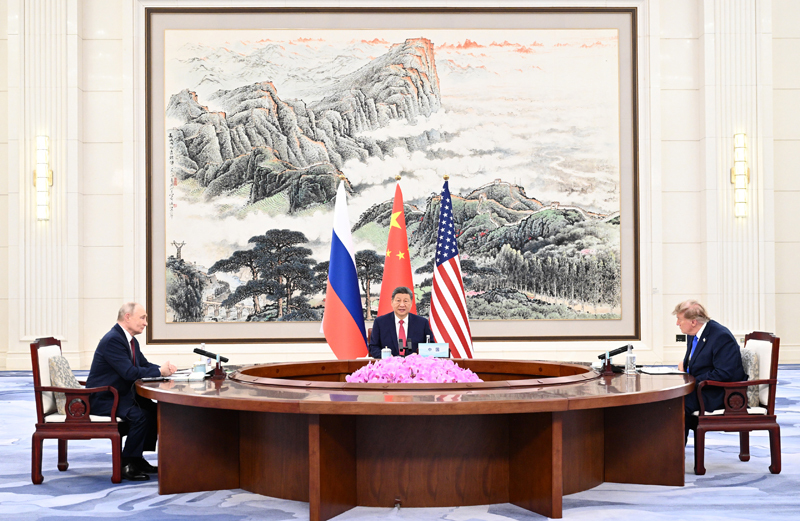
On Nov. 19, Chinese President Xi Jinping sat down with Russian President Vladimir Putin and United States President Donald Trump in Shenzhen, China, during the Asia-Pacific Economic Cooperation summit. It was the first meeting of its kind in history. China hosted it, and Xi chaired it.
The four-point declaration addressed United Nations reform, energy supplies, the immunity of government officials from the jurisdiction of the International Criminal Court and the danger of nuclear war. All three governments agreed that a nuclear war cannot be won and must never be fought. Yet on Feb. 5, Trump let New START, the last treaty limiting the strategic nuclear arsenals of the United States and Russia, expire. Putin had offered to abide by the treaty’s limits for another year. Trump let the offer go unanswered.
The significance of the meeting goes far beyond the declaration. What brought the president of the United States to that table? He came losing his war on Iran and short of oil. But what has changed in the world that compelled the government of the most heavily armed capitalist country in history to sit down and negotiate with China and Russia?
The answer begins with generations of struggle by workers and oppressed peoples against imperialism.
From revolution to Shenzhen
In World War II, the Soviet Union broke the back of Nazi Germany at a cost of some 27 million Soviet lives.
United States imperialism came out of the war stronger than any capitalist power had ever been. Its vaults held about two-thirds of the world’s gold, and it made the dollar, backed by that gold, the center of world trade and finance. Yet at the very moment it reached the height of its power, the revolutionary struggle was advancing across the world.
In 1949, the Chinese people overthrew the landlords, capitalists and agents of foreign imperialism who had ruled their country. The United States refused to recognize the new People’s Republic, imposed an economic blockade and sent its warships into the Taiwan Strait.
The Soviet victory over fascism, the revolutionary overturns in Eastern Europe and the Chinese Revolution were interconnected developments. Together they fundamentally altered the international relationship of forces. They narrowed the territory in which the capitalist class could extract surplus value and exploit the oppressed peoples.
The United States fought a war in Korea and another in Vietnam. Both wars were aimed at containing the Chinese Revolution and checking revolutionary socialist development.
In October 1950, as United States troops drove toward the Yalu River on China’s border, the Chinese People’s Volunteers crossed into Korea to fight alongside the Korean People’s Army. Together they drove the Pentagon’s forces back to the middle of the peninsula, where the war had begun. The armistice signed on July 27, 1953, ended the Pentagon’s attempt to conquer all of Korea.
It was an early demonstration of that change. A revolution barely a year old had helped the Korean people stop the most powerful imperialist army in the world.
The socialist revolutions and the victories of national liberation gave tremendous impetus to the struggles sweeping Africa, Asia and Latin America. The colonial empires that had divided much of the world among themselves began to break apart.
In 1972, President Richard Nixon went to China. The Vietnamese people were dealing devastating blows to the Pentagon’s war machine. The policy of isolating China had failed.
The United States ruling class subsequently sought to draw China back into the capitalist system through trade, foreign investment and the development of capitalist relations within China itself.
When the capitalist counterrevolution destroyed the Soviet Union in 1991, Wall Street celebrated. The socialist state that had defeated fascism was gone. Its support for the national liberation struggles ended, and the territory open to capitalist exploitation widened enormously. The ruling class expected that China would eventually follow the same course. United States corporations poured billions of dollars into China, pursuing profits from the labor of Chinese workers.
But the Communist Party of China remained in power. The publicly owned banks, energy industries, transportation networks and other decisive sectors of the economy remained the foundation for national economic planning.
China built the world’s largest manufacturing economy. It developed high-speed rail, renewable energy, electric vehicles, telecommunications and artificial intelligence on a vast scale.
Shenzhen, home to Huawei and BYD, is one of the centers of that development.
The factories, railways and power grids built by hundreds of millions of Chinese workers have broken the hold United States imperialism once had over the world’s industry, technology and trade.
Africa fights for its independence
The African peoples won political independence through decades of struggle. The imperialist powers fought to take it back. The CIA and the Belgian government were behind the 1961 murder of Patrice Lumumba, the first prime minister of independent Congo. The imperialists instigated civil wars to sabotage economic development, and they set up and supported local ruling classes that answered to the imperialist powers.
Through it all, the banks and monopolies of the former colonial powers retained control over much of Africa’s mineral wealth, trade and financial resources.
In the 1970s, Chinese, Tanzanian and Zambian workers built a railroad connecting Zambia’s copper-producing region to the Tanzanian port of Dar es Salaam. The railroad freed landlocked Zambia from its dependence on transportation routes controlled by the white supremacist regimes of southern Africa.
The imperialist powers had refused to finance the railroad. Revolutionary China helped build it at a time when China itself was still a poor country.
In 1988, Angolan, Cuban and Namibian fighters dealt a historic blow to the apartheid army at Cuito Cuanavale in Angola. Their victory helped open the road to Namibian independence and the overthrow of apartheid in South Africa.
The struggle against imperialist domination continues. The West African countries of Burkina Faso, Mali and Niger have expelled French troops and formed the Alliance of Sahel States. In September 2024, the Pentagon was forced to complete its military withdrawal from Niger.
China’s economic development has opened new possibilities for Africa to break its dependence. On May 1, 2026, China extended its zero-tariff policy to all 53 African countries with which it maintains diplomatic relations, opening its enormous domestic market more widely to African producers. The first shipment admitted under the policy, 24 tons of South African apples, cleared customs in Shenzhen in the first minutes of May 1, as the policy took effect.
The wars the Pentagon could not win
Trump arrived in Shenzhen nearly nine months after launching the war against Iran on Feb. 28.
The Pentagon’s enormous arsenal has failed to force Iran into submission. Iran closed the Strait of Hormuz, the route that carried about a fifth of the world’s oil before the war. Its resistance has exposed the limits of United States military power.
Energy supplies were among the principal subjects of the Shenzhen declaration. Trump came looking for help with an oil shortage his own war had caused, from countries the United States has spent years threatening with sanctions and economic warfare.
The campaign to isolate Russia has also failed. In Shenzhen, Trump called Putin a friend and asked Xi to help end the war in Ukraine. Russia has expanded its economic relations with China and other countries despite the sanctions imposed by the United States and the European imperialist powers.
Russia today is a capitalist country, following the destruction of the Soviet Union. It is struggling to maintain its sovereignty without the protection of the Soviet Union’s former allies in Eastern Europe, now all in NATO. China remains a socialist state. Their cooperation against imperialist pressure has strengthened the ability of both countries to resist United States demands. Together, their strategic position also helps protect Iran.
Meanwhile, the Pentagon continues its preparations for war against China, expanding its military bases and alliances across the Pacific.
The technology blockade continues as well. Yet China’s drive to develop its own semiconductor industry has increasingly undermined the ability of the United States to use its technology monopolies as weapons against the Chinese economy. In May, Nvidia chief executive Jensen Huang said his company had “largely conceded” China’s market for artificial intelligence chips to Huawei.
Imperialism cannot surrender its interests
The banks, oil companies, mining corporations, technology monopolies and military corporations of the United States have investments and loans in every corner of the world. The dollar system, the international lending institutions, economic sanctions and the Pentagon’s worldwide network of military bases protect them. United States imperialism must maintain that global domination even as its relative economic strength declines. The more its economic position weakens, the more it depends on the Pentagon and the military corporations to hold on to what it has. That contradiction has grown sharper with every decade.
The labor of hundreds of millions of workers throughout the world produces the surplus value the imperialist monopolies take as profit. Their grip on the oil of West Asia and the minerals of Africa lets them claim a still larger share of the wealth those workers produce.
The growth of socialist China’s economy, the expansion of trade outside the dollar system and the resistance of oppressed countries challenge the ability of United States finance capital to dictate the terms under which much of the world develops.
The capitalist class will continue to fight to preserve that power. Venezuela shows how far it will go.
Venezuela holds the largest proven oil reserves in the world. When the Bolivarian government took majority control of its oil fields in 2007, ExxonMobil and ConocoPhillips refused the new terms and left the country. The United States government answered with years of sanctions and coup attempts. On Jan. 3, United States forces kidnapped Venezuelan President Nicolás Maduro and First Combatant Cilia Flores.
The interests of the oil monopolies reach from the Strait of Hormuz to the Caribbean.
Peace and the class struggle
According to China’s Xinhua news agency, Xi told the Shenzhen meeting that major countries should respect one another’s sovereignty, territorial integrity and chosen social systems, cooperate for mutual benefit and settle their differences through dialogue.
China needs peace to continue building socialism. Every year free from war allows China to devote more of its productive resources to the development of its economy and the improvement of the lives of its people.
Through BRICS and the Belt and Road Initiative, countries in Africa, Asia and Latin America can get loans, build railways and ports, and trade without accepting the draconian conditions set by Wall Street, the International Monetary Fund and the World Bank.
The struggle between capitalism and socialism goes on at the negotiating table, in trade and in what each system can build.
There is no lasting peace while the class that makes war remains in power.
The power that brought them to the table
Behind the meeting in Shenzhen stands the Chinese Revolution. Behind it stand the Korean people’s defeat of the Pentagon’s attempt to conquer all of Korea, the Vietnamese people’s victory over United States imperialism, the Cuban Revolution, the African liberation struggles, the Palestinian liberation struggle and the resistance of the Iranian people.
From the defeat of colonialism in Africa to the expulsion of foreign troops from the Sahel, from the development of socialist China’s industrial economy to the resistance of Cuba against the United States blockade, generations of workers and oppressed peoples have fought to break the grip of imperialism. In the imperialist countries, workers and students are answering with their own fight.
These struggles have brought about the changes that forced the United States government to negotiate in Shenzhen.
For the working class in the United States, these developments open new possibilities. Every blow against the international power of the banks and monopolies weakens the same capitalist class that exploits workers here. The working class inside the United States, organized and in motion against the war makers, can itself help change the international relationship of forces.
The forces that brought the United States government to the negotiating table in Shenzhen have the power, through their organized struggle, to put an end to imperialism itself.
Join the Struggle-La Lucha Telegram channel