
The Pentagon has decided that the farm towns of southeast Iowa and northeast Missouri can live with a cloud of lead. What matters to it is keeping the ammunition plant running while it races to replace the munitions it burned through in the war on Iran.
At 9 a.m. Central Time on Nov. 25, the United States Army blew up nearly five tons of deteriorating lead azide, an explosive used in detonators, inside two bunkers at the Iowa Army Ammunition Plant in Middletown, near Burlington on the Mississippi River. The Army’s own maps showed the lead dust drifting southwest as far as 100 miles into northern Missouri. Enough lead could settle on floors and windowsills to exceed the Environmental Protection Agency’s limits for lead dust in homes.
Federal officials urged residents within five miles southwest of the plant to evacuate. Pregnant women, children under 6 and people with chronic illnesses anywhere in the path were told to get out. Those farther away were told to shut their windows and stay indoors for one to two days. Nearly 100,000 people and some 350 farms lie in the path of the lead dust.
There is no safe level of lead exposure. Lead damages the brain, nervous system, kidneys and heart. It passes from mother to child in the womb and through breast milk. Lead does not break down. What falls on the bare, harvested fields stays in the soil.
The Army told farmers to get their cattle, sheep and goats under cover and watch for miscarriages, blindness, seizures and sudden death. Moving an entire herd indoors is “literally not possible,” one cattle rancher said.
“Everybody knows that the acceptable level of lead is zero,” Krys Plate, a mother of two, told the New York Times. “I feel like we’re guinea pigs.”
Acting Army Secretary Adam Telle told reporters on Nov. 24 that the public should not panic. “We are very calm about this,” he said.
Twenty years of warning
The Pentagon says it discovered on March 11 that the lead azide had crystallized and could explode from friction, shock or cold. The Pentagon’s own records show it knew the stockpile was decaying more than 20 years ago.
In a 2014 press release, the Army said it began developing substitutes for lead azide in 2004 because of “concerns over a 40-year-old stockpile of lead azide deteriorating” at the Iowa plant.
In 2009, the Pentagon moved the nation’s entire stockpile to Middletown. Some of it was already more than 60 years old and decaying, according to Robert Cekada, director of the federal Bureau of Alcohol, Tobacco, Firearms and Explosives.
In September 2025, six months before the Pentagon says it discovered the danger, the Army sought bids for “Lead Azide Neutralization at Iowa Army Ammunition Plant.”
The stockpile required regular maintenance. The lead azide is kept wet, under water mixed with ethanol so the water won’t freeze. Because ethanol evaporates, the drums were supposed to be checked every month and topped up every September.
The private company that runs the plant is responsible for those inspections. By this spring, crystals coated the outside of 58 of the 68 drums. The drums could no longer be opened, and the September 2026 top-up was not carried out, according to a sworn court declaration by Col. Aaron Teller, who commands the unit carrying out the blast.
The Army has released no inspection records.
It waited until October to tell Middletown of its plans. Communities as far as 100 miles away first learned of the danger when the Army issued an advisory on Nov. 15.
Government-owned, run for profit
American Ordnance LLC has run the plant since 1998. It is now a unit of Day & Zimmermann, a family-owned Philadelphia company that ranks among the largest private companies in the United States and the world’s top 100 arms makers.
The government owns the land, the bunkers and the factory buildings. American Ordnance runs them for profit. It competes with General Dynamics for orders under a five-year Army contract for 155 mm shells worth nearly $1 billion. The company’s profits depend on the plant turning out shells.
While the lead azide rotted, the Pentagon was expanding ammunition production at Middletown. On July 15, four months after the Pentagon says it discovered the danger, the Army broke ground on its Future Artillery Complex, designed to load 36,000 artillery shells a month.
MSM North America, a unit of the Czech arms conglomerate CSG, got the $635 million contract without competition. Republican Gov. Kim Reynolds attended. Cannons were fired in celebration. The drums stayed in the bunkers.
The Iowa plant is the Army’s main source of 155 mm artillery shells. Most were going to Ukraine, the New York Times reported in 2023. Fired across Ukraine’s farmland, the shells leave heavy metals and explosive residues poisoning the soil.
The plant also makes tank shells used by Israel. In January 2024, fragments of an M830A1 120 mm tank shell were found in the burned-out ambulance of Palestine Red Crescent paramedics Yusuf Zeino and Ahmed al-Madhoun. Israeli tank fire killed the two paramedics as they tried to reach 6-year-old Hind Rajab in Gaza City. The shell’s serial number traced back to Middletown, The Nation reported.
Today’s munitions no longer use lead azide. But the Pentagon kept the stockpile for a wartime “quick draw,” Cekada said.
Now the stockpile stands in the way of ammunition production. The Army’s own Environmental Assessment judged every disposal option by whether it would allow the plant to resume production “as quickly as possible.”
Pushing back
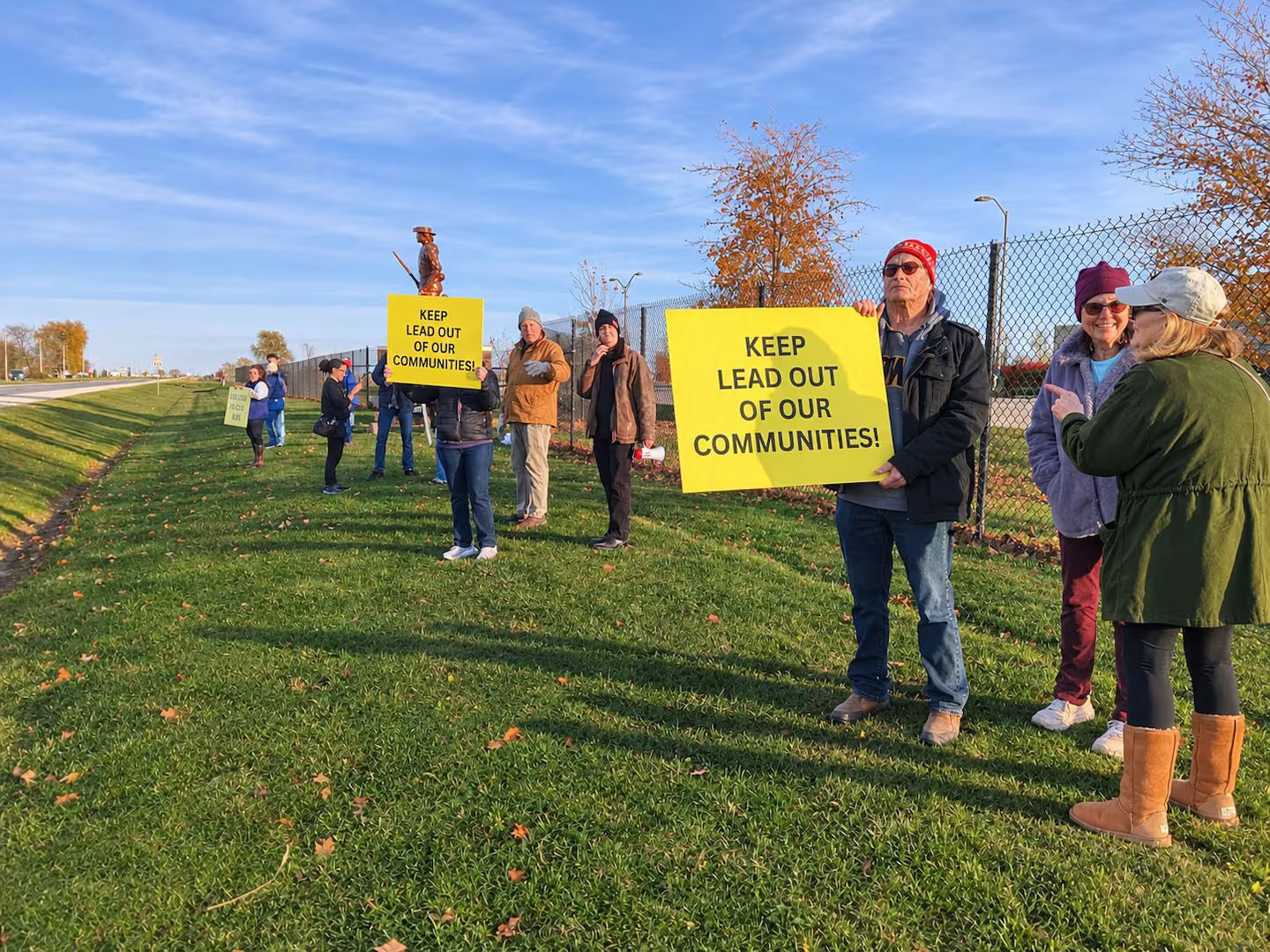
The people downwind did not wait. On Nov. 18, residents rallied outside the Armed Forces Reserve Center in Middletown. They demanded that the Pentagon halt the blast and give the communities in its path time to examine the dangers and alternatives.
EPA workers spoke out against their own agency’s decision. American Federation of Government Employees Local 704 represents about 1,000 EPA workers in six Midwestern states. The union’s president, Nicole Cantello, demanded that the blast be delayed “until more protective alternatives can be fully evaluated.”
On Nov. 19, the Pentagon put off the next day’s blast after what the Associated Press described as “an outpouring of public concern.”
Late that night, the Iowa Environmental Council and the Iowa chapter of the Sierra Club won a court order putting the EPA permit on hold.
The blast was postponed three times in one week.
Everyone signs off
As the pressure mounted, Trump tried to dump responsibility for the blast on Iowa’s Democratic governor-elect, Rob Sand, who doesn’t take office until January. Trump threatened to hold Sand responsible for “any and all death or destruction.”
Trump blamed the Obama administration for the storage. But every administration since 2004, Republican and Democratic, has let the stockpile rot.
On Nov. 23, the Eighth Circuit Court of Appeals lifted its hold on the EPA permit. Sand handed the decision back to the White House. Reynolds, who had celebrated the plant’s expansion in July, called the blast a “federal operation.”
Last year, the EPA weakened the standard for cleaning up lead-contaminated soil in people’s yards.
The Pentagon kept a decaying stockpile for decades because it might need it for a war. It blew up the stockpile because the plant has to keep turning out artillery shells.
The residents and EPA workers who fought to stop the blast are up against an arms industry that treats the poisoning of people and farmland, from Iowa to Ukraine, as a cost of doing business.
The next round starts when the dust settles.
Join the Struggle-La Lucha Telegram channel