
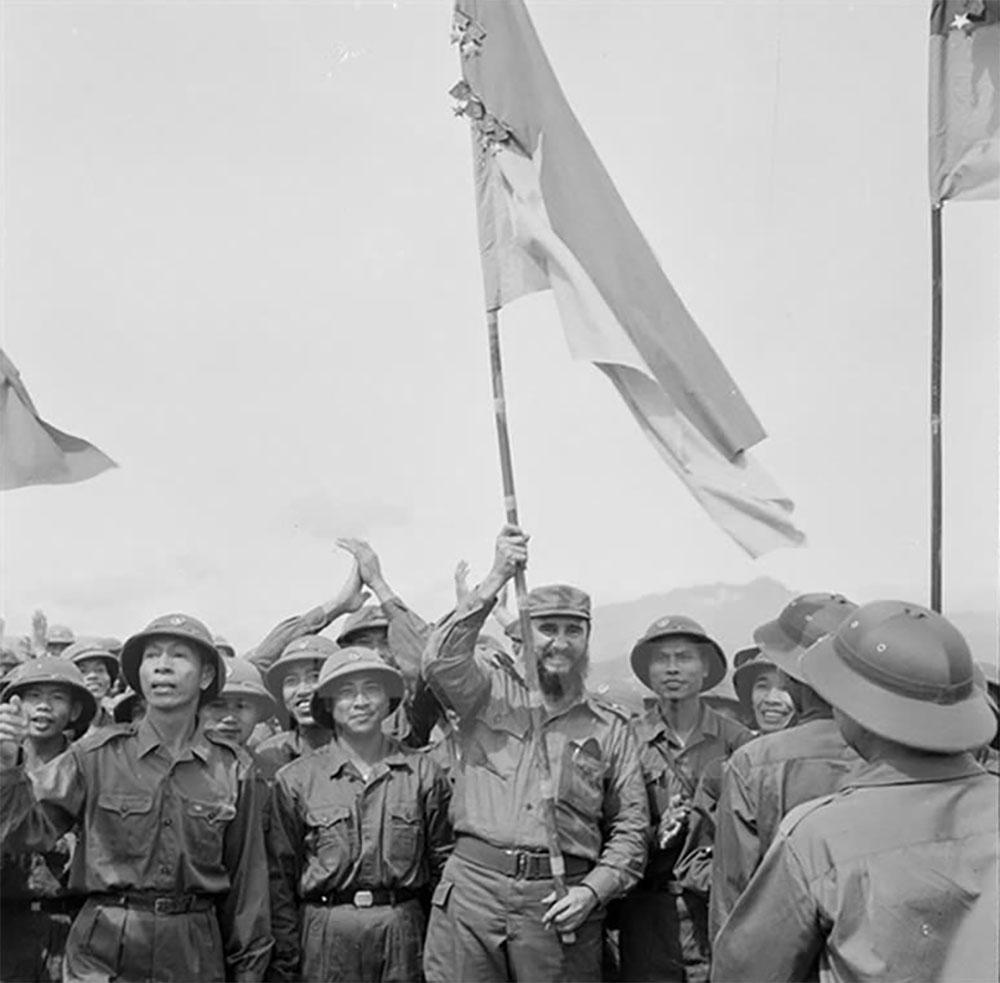
Fidel Castro Ruz, the historic leader of the Cuban Revolution, died 10 years ago on Nov. 25, 2016. This year marks the centennial of his birth. To commemorate his passing, a large meeting was held at the Cuban Mission to the United Nations in New York City on Nov. 19.
The Cuban ambassador to the United Nations, Ernesto Soberón Guzmán, said that to speak of Fidel Castro is to speak of the transformation of Cuba. The ambassador mentioned Cuba’s historic campaign to wipe out illiteracy, which became a model to other countries.
Soberón also spoke of Cuba’s commitment to national liberation struggles. As the late Elombe Brath said, “When Africa called, Cuba answered.” More than 2,000 Cuban internationalists died alongside their African comrades in defeating the Nazi armies of apartheid South Africa.
Ambassador Soberón said that behind every Olympic medal earned by Cuban athletes are sports programs with hundreds of thousands of people.
He said young people in Cuba have the opportunity to study without worrying about tuition. While the United States has the most military bases around the world, socialist Cuba sends the most doctors.
“Small nations can undertake great events,” declared Ambassador Ernesto Soberón. Viva Fidel!
A film was shown featuring the late Harry Belafonte, who described the “blatant racism” in pre-revolutionary Cuba, when it was a United States sugar colony. Belafonte also mentioned Cuba’s role in helping to overthrow apartheid. Nelson Mandela was quoted: “The Cuban people hold a special place in the hearts of the people of Africa.”
Along with the speakers, there were cultural performances with poetry and music.
Vietnam, Namibia and Nicaragua salute Fidel
The Socialist Republic of Vietnam’s Ambassador to the United Nations, Đỗ Hùng Việt, said it was a great honor to speak. He said there’s a long friendship between Cuba and Vietnam. Cuba was the first country in the Western Hemisphere to establish diplomatic relations with Vietnam in 1960.
The Vietnamese ambassador quoted Fidel: “For Vietnam Cuba is willing to shed its own blood.” Fidel visited the liberated areas of South Vietnam in 1973.
Pictures were shown of Fidel Castro greeting Vietnamese Gen. Võ Nguyên Giáp, who defeated the French colonialists at Điện Biên Phủ. The Vietnam – Cuba Friendship Hospital was built with Cuban assistance.
Ambassador Việt also said he had a special reason to thank Cuba because his mother was educated in Cuba.
Namibia’s ambassador to the United Nations, Penda Naanda, said that Fidel Castro has a special place in the hearts of his people. “We never forget Cuito Cuanavale,” referring to the 1987-88 battle in southern Angola in which the apartheid army was decisively defeated. “We’ll never forget when Cuba stood with us,” he said.
He spoke of the Cuban doctors and teachers who have helped Namibia. He denounced the cruel blockade of Cuba.
“History remembers who defended the oppressed,” declared Ambassador Penda Naanda.
Nicaragua’s ambassador to the United Nations, Jaime Hermida Castillo, declared that Fidel Castro lives on in every struggle of the people. He said that Fidel was an “incorrigible optimist.”
He pointed out that the Cuban and Nicaraguan revolutions were just 20 years apart. “To defend Cuba is to defend the dignity of the people,” he said.
Solidarity from the U.S. movement
Long-time activist and organizer Rosemari Mealy, J.D., Ph.D., described her personal interactions with Fidel, who was “bearded and defiant always.” Dr. Mealy is the author of “Fidel & Malcolm X: Memories of a Meeting,” which describes their historic get-together in Harlem’s Hotel Theresa in 1960.
As a member of the Venceremos Brigade’s leadership, she interviewed Fidel Castro. The brigade has brought thousands of people from the United States to visit Cuba and help socialist construction.
Rosemari Mealy recalled a meeting in Cuba about U.S. political prisoners, including Mumia Abu-Jamal and Shaka Sankofa. Mumia Abu-Jamal has spent more than 44 years in prison, while Shaka Sankofa was executed in Texas by then-Gov. George W. Bush in 2000.
Ike Nahem of the New York-New Jersey Cuba Sí Coalition spoke about growing up in the 1960s and hearing all the lies the corporate media told about Cuba. Nahem said that when he asked his father about it, his father told him not to believe their fibs and slander.
There was more musical entertainment, and a movie was shown about Cuba’s Agrarian Law that took over the sugar plantations owned by United States capitalists and distributed land to peasants.
Fidel Castro will always be remembered. Hands off Cuba!
Join the Struggle-La Lucha Telegram channel