
More than three years have passed since October 7, and Gaza is still standing.
It is hard to write that sentence without stopping at the word standing.
How does a city stand when its neighborhoods have been leveled? How does a people bury their children, then search for water and bread? How does the human spirit remain upright after so much death?
Perhaps there is another word for it.
Perhaps it is Gaza.
More than three years of killing, bombing, hunger, siege, displacement, fear, and genocide. A war machine armed and paid for by the United States tried to erase not only homes, but the meaning of home; not only schools, but childhood; not only hospitals, but the human right to find a hand reaching for yours when you are bleeding.
Entire neighborhoods became rubble. Behind every stone lies a story: a mother waiting for her son, a child hiding a toy, a father standing before the ruins of the home he spent his life building.
These are not simply “casualties of war.” These are human lives crushed.
And this is not simply “displacement.” It is repeated uprooting, relentless pressure to drive people from their land, and ethnic cleansing meant to strip them of home, place, and memory.
Yet Gaza did something the machinery of war could not explain:
It refused to become death.
This is not the story of people untouched by fear, hunger, or despair. It is the story of people who knew all of them and still rose each morning because a child needed water.
The mother arranging a corner inside a tent so her children can feel they still have a place. The father carrying flour as though it were his family’s future. The doctor working while the hospital itself is bleeding. The teacher giving children back their letters beneath a roof of cloth.
And the child who sits on the rubble and opens a book.
What image could be more heroic than a child opening a book in a place meant to become a graveyard?
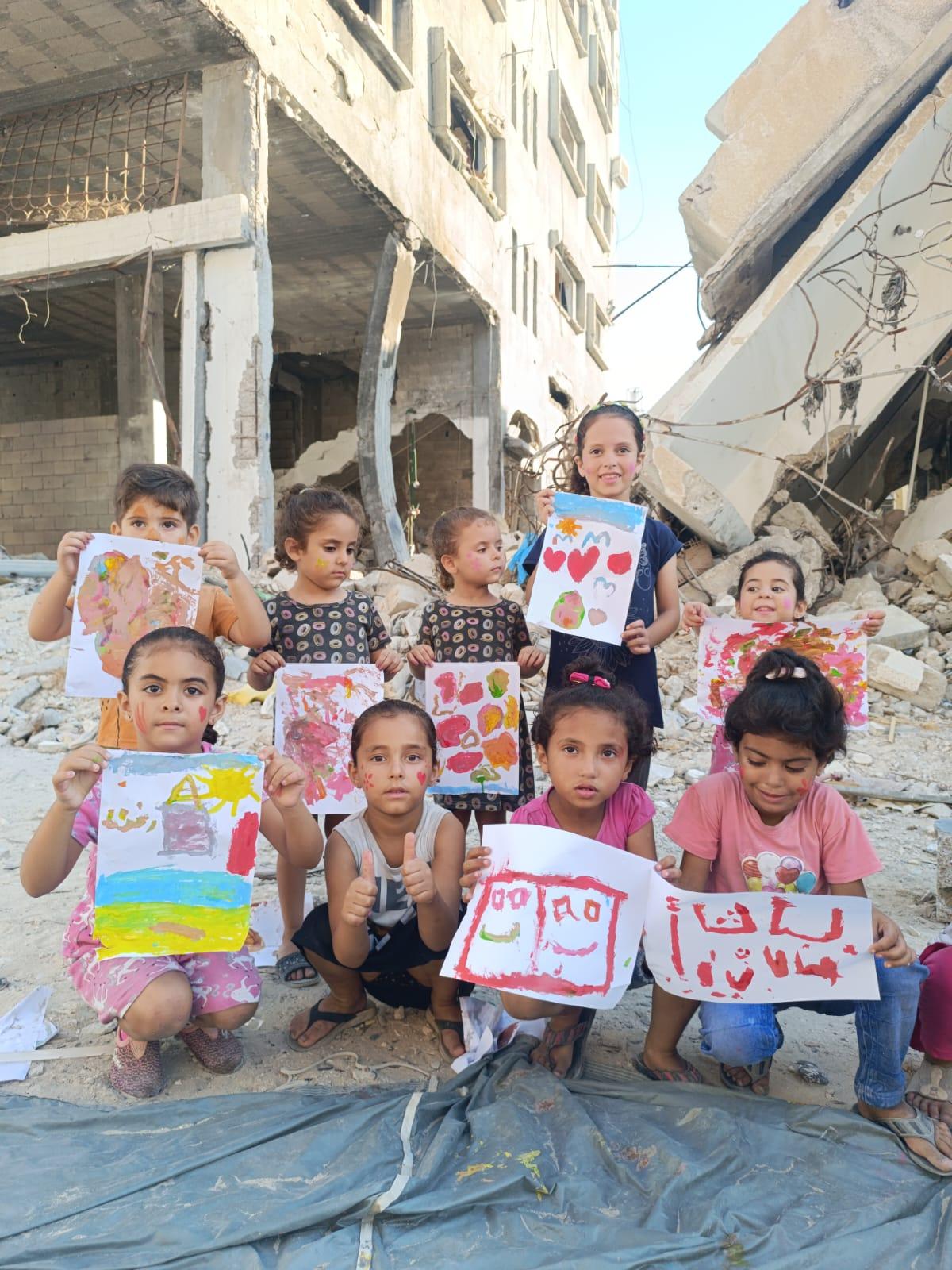
Perhaps no children in our time have endured what Gaza’s children have endured. They learned the sounds of warplanes before the names of birds, displacement before geography, and sometimes the names of the dead before multiplication tables.
And still, they draw: houses, the sea, trees, the sun, schools.
As though the child of Gaza were saying: You can destroy my house, but you cannot destroy the house inside my imagination.
That is Gaza’s secret: preserving an image of life in the heart of death.
From beneath the rubble, Gaza still gives birth to knowledge, art, and brilliance. The university is destroyed, and the student searches for a connection. The school is shattered, and part of a tent becomes a classroom. The studio disappears, and a stone from the rubble becomes a canvas. The paint runs out, and charcoal becomes color.
This is where destruction failed in its deepest purpose.
Because destroying a city is easier than destroying the human will.
You can demolish a library, but not the knowledge it planted. Destroy a home, but not the road leading back to it in memory. Try to kill a people, but you cannot erase their name from history while their children still speak it.
That is why Gaza became larger than a place.
Gaza became a meaning: dignity when bowing would be easier, generosity when the hungry share what little remains, heroism not in dying but in insisting on living, and steadfastness as a woman carrying her child beneath the bombs.
And resistance in its broadest human meaning: resistance to the erasure of a people.
Gaza was meant to terrify others. Instead, it inspired them. It was meant to become a forgotten place at the edge of the world.
Instead, it became the heart of the world.
From Gaza came the spark that flashed on October 7, and its glow spread far beyond the Strip. The region caught fire. Assumptions that had seemed permanent began to shake. Palestine returned to streets and universities, churches and mosques, public squares—and to the conscience of millions.
An entire generation discovered Palestine anew.
That is why the world is still living through the Gaza moment.
Gaza did not create everything now changing in the world. But it became a spark when history itself seemed dry and waiting to ignite. It accelerated forces already gathering, shook what had seemed immovable, and exposed the weakness of an old world that believed military power, money, and control of the narrative could impose reality forever.
The new world has not yet been born. The old world has not yet died. But something has broken.
Gaza was that crack in the old wall.
But before history and politics, Gaza has a human claim on all of us that cannot be erased.
The images of its children must never become ordinary. Their hunger must never become another headline. Human beings must never stare at genocide so long that they become accustomed to it.
Standing with Gaza is not a celebration of death. It is a commitment to life—the refusal to accept the killing of children, the destruction of cities, starvation, and forced removal as normal.
Supporting Gaza is not a partisan position or a seasonal slogan.
For Palestinians, standing with Gaza is a matter of honor. For Arabs and Muslims, it is a duty. For every free human being, it is a human responsibility.
It means saying: Your tears are not a statistic. Your life deserves to be lived. You are not alone.
People do not have to share the same religion, identity, or politics. It is enough to believe that a child is a child, a home is a home, and no one loses the right to live simply for being born in Gaza.
More than three years later, Gaza remains an open wound, a memory, a moral question, and a historical spark that has not gone out.
They wanted Gaza to be the end of a story.
Instead, it became the beginning of a new chapter.
History will say that a people endured genocide, killing, starvation, and uprooting—and still loved, learned, painted, and dreamed of the home they would rebuild.
It will say that children came out from beneath the rubble carrying their books, that a people carried their cities in memory when their stones fell, and that a small place on the Mediterranean carried the pain of an entire people—and its hope.
This is Gaza.
Wounded, but refusing to surrender its soul.
Destroyed, but teaching the world that destruction does not mean the end.
Surrounded by death, but still pulling life from between its fingers.
And this may be the greatest epic Gaza has written:
Death says to Gaza: You are finished.
And Gaza rises like the phoenix from beneath the rubble, brushes the dust from the face of its child, looks toward the Mediterranean, and says:
Not yet.
The story is not over.
Palestine is not over.
The march toward freedom that Gaza reignited is not over.
Perhaps it has only begun again.
So do not leave Gaza alone. To abandon Gaza today is to abandon Palestine, our dignity, our honor, and the humanity within us.
Michel Shehadeh is a Palestinian American writer and activist. He immigrated to the U.S. in 1975 and was a defendant in the landmark “Los Angeles Eight” case, a 20-year deportation battle that ended in a major civil rights victory. A former director of the American-Arab Anti-Discrimination Committee (ADC) and the Arab Film Festival, his latest book is “Freedom on Trial: The war against Palestine and the fight for justice in America a memoir of the L.A. Eight and civil rights, and the battle against being branded as ‘Terrorists’.”
Join the Struggle-La Lucha Telegram channel