
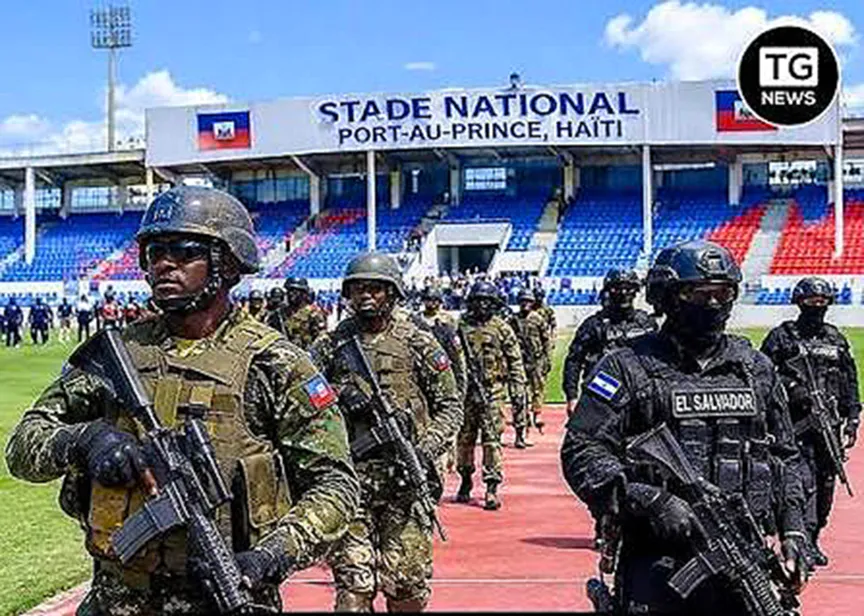
On Thursday, November 12, some twenty armored vehicles from the Salvadoran army entered the Sylvio Cator Stadium in downtown Port-au-Prince, and the Haitian National Police reported that it had regained control of the stadium and its surroundings, which had been occupied by gangs for years. The stadium will serve as a base for the troops that Nayib Bukele began deploying on October 22, according to local media. Six days after that first flight, the Salvadoran Foreign Ministry confirmed more than 2,000 soldiers on Haitian soil.
The UN-backed multinational force, upon completing its first year of deployment, had about 1,500 troops out of the 5,550 authorized by the Security Council, and the Kenya-led mission that preceded it never exceeded 991 police officers out of the 2,500 planned. Most Salvadorans operate outside that force, as confirmed by the UN, which treats the deployment as a bilateral matter between the two countries. To date, no document has been published establishing their mandate, the duration of their deployment, or the rules under which they may open fire.
With more troops than the UN and no known agreement, the Salvadoran contingent raises a question that extends beyond Haiti. At stake is who can authorize a foreign army to wage war in a country that hasn’t held an election in ten years, and to whom that army will be accountable if it makes a mistake. The answer matters throughout the region, because Bukele’s security model—which is already being replicated in prisons across much of Latin America—is facing its first test outside its home country in Haiti.
The authorization
As of October 18, El Salvador had about 100 military personnel in Haiti—almost all of them aviation technicians involved in medical evacuations—under an agreement that the ambassadors of the two countries signed before the OAS in October 2024.
On September 29, the Salvadoran Legislative Assembly passed a transitional law extending that deployment by one year and included a clause stipulating that the country retains jurisdiction over its military personnel and may not hand them over to international courts or third-party states without complying with the treaties it has ratified.
Four of those technicians went missing on October 18, when a gang ambushed their vehicle in Santo, northeast of the capital. The first commandos landed on the 22nd, and on the 27th—with some 1,300 soldiers already on the ground—Bukele called Donald Trump to ask for support for the escalation. Trump replied that he should do whatever he had to do. Haitian Prime Minister Alix Didier Fils-Aimé was attending a wedding in Mexico, and upon his return on the 28th, he issued a statement referring to cooperation “within the framework of the GSF.” According to sources cited by the U.S. press, his government approved a bilateral agreement that day, the text of which is unknown. On the same day, the Provisional Electoral Council set the first round of elections—which had been postponed twice this year—for July 18, 2027.
In Port-au-Prince, the Secretary of State for Communication, Lucien Jura, denied the existence of any agreement and asserted that all foreign troops are operating under the auspices of the GSF—a claim refuted by a source close to that force, who specified that only between 200 and 300 Salvadorans are under its command. In Madrid, during the Ibero-American Summit on November 5, Salvadoran Vice President Félix Ulloa denied that this constituted an occupation. “It is a bilateral agreement with the Haitian authorities,” he said. In San Salvador, Rodolfo Cardenal, director of the Monsignor Romero Center at the Central American University (UCA), called these troops “Bukele’s occupation force.” Amnesty International called on both governments to publish the agreement and the rules of engagement.
Consent without the ballot box
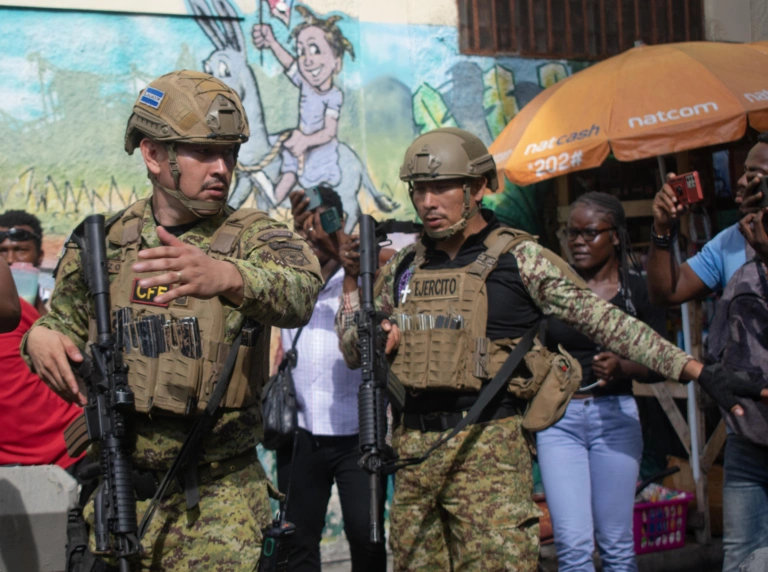
International law permits a state to send troops to another if invited to do so, and the International Court of Justice recognized this in 1986 in the case of Nicaragua v. the United States. The doctrine imposes conditions on such an invitation: it must come from the government recognized as legitimate, be explicit, and be received before the troops cross the border. In Haiti, the first soldiers landed on October 22, and the agreement—if it exists—was approved six days later, signed by a government that did not emerge from any election and without a parliament that could ratify it.
For Haitian security and defense expert Emmanuel Paul, this gap makes the deployment “a flagrant violation of Haiti’s sovereignty”, because such an agreement would have to pass through a parliament that does not exist and be signed by an executive branch that has been without a president since the assassination of Jovenel Moïse in July 2021. The Haitian weekly Haïti Liberté went further, arguing that consent was impossible to obtain from a prime minister who governs by decree.
Fils-Aimé, who has been in charge of the executive branch since the Presidential Transition Council was dissolved on February 7, defended the operation on November 3 with a Salvadoran colonel at his side. He said that Haiti retains command of all foreign forces and that the Salvadorans “are here to support us”. When asked to whom these troops are accountable, he did not specify and replied that the only ones acting outside international law are the gangs.
Under the Salvadoran law passed in September, if a soldier commits an abuse in Croix-des-Bouquets, only a court in El Salvador can try him. The UN cannot monitor him either, because Salvadorans operating outside the GSF are exempt from the human rights due diligence policy that the organization applies to that force. The judicial system that would have the final say appeared on October 26 before the Inter-American Commission on Human Rights in Panama, where the organization Cristosal documented 454 deaths of people in the custody of the Salvadoran state since 2022, including 33 women, three girls, and one boy.
Haiti last held an election on November 20, 2016; since then, Moïse was assassinated, the last ten senators left their seats in January 2023, and a designated prime minister is governing. For the first round of voting in July, 759,257 voters are registered, in a country with about 6.5 million people of voting age.
From the inside
In Haiti, many people welcomed the Salvadorans with applause, and in Port-au-Prince, crowds chanted Bukele’s name. Pierre Espérance, director of the National Network for the Defense of Human Rights (RNDDH), praised the speed of the deployment and said he hoped it would curb gang-related violence—with one condition. “Not everyone living in gang-controlled areas is a gang member,” he warned. Activist Monique Clesca acknowledges that Bukele has spoken with Haitians more than their own leaders have, and reminds him that Haiti is not his backyard.
Jocelyne Noël, national director of the Episcopal Commission for Justice and Peace (CE-JILAP), criticizes Haitian authorities for failing to assume their responsibilities. “The population has been abandoned in the face of everything that is happening,” she said in a recent interview. On the Cul-de-Sac plain, where the 400 Mawozo and Chen Mechan gangs hold sway, security operations killed at least 21 people in Croix-des-Bouquets alone between October 18 and November 2, according to the conflict monitoring group ACLED, in a district that had recorded 98 deaths in armed clashes so far this year.
Doctors Without Borders treated about 30 people with gunshot and blast wounds in the eight days following the ambush, nearly a third of whom were women and children—a number that, under normal circumstances, its hospitals would receive in a month. The drones of the Haitian task force, operated with support from Vectus Global—the company owned by Erik Prince, founder of Blackwater—were already responsible for more than 1,200 deaths in a year, according to Human Rights Watch. Diego Da Rin, an analyst with the International Crisis Group, warns that El Salvador’s pursuit of quick, symbolic victories “poses enormous risks to civilians” and could push rival gangs to form alliances, as has happened before.
The OAS, 1965
Latin America has already seen regional armies deployed with Washington’s backing in a Caribbean country. In May 1965, after more than 40,000 U.S. soldiers landed in the Dominican Republic to quell the constitutionalist uprising demanding the return of Juan Bosch, the OAS approved the creation of an Inter-American Peace Force by a vote of 14. El Salvador and Haiti voted in favor. Mexico, Uruguay, Chile, and Peru voted against it, and Venezuela abstained.
Brazil, then under the Castelo Branco dictatorship, sent 1,130 soldiers; Honduras contributed 250; Stroessner’s Paraguay, 184; and Somoza’s Nicaragua, 160; El Salvador sent three General Staff officers. In 2004, Brazil assumed military command of MINUSTAH in Haiti, a UN mission that left behind a cholera epidemic—introduced by Nepalese blue helmets—that killed more than 10,000 people. In 1965 there was an OAS resolution, and in 2004 a Security Council resolution. The Salvadoran operation has neither.
In the 1980s, the United States formed and trained elite army battalions that today patrol Port-au-Prince, including the Atlacatl, which the UN Truth Commission in 1993 blamed for the El Mozote massacre, committed in December 1981. Pablo Parada, a former FMLN commander, recalls that Salvadoran gangs fled en masse without putting up a fight when martial law was declared in 2022, and that Haitian gangs—which, according to the UN, possess up to 500,000 illegal weapons—are a different matter. “Our army is not prepared for urban combat,” he said.
Allies and silences
Luis Abinader, president of the Dominican Republic, said on November 10 that his government is collaborating with Bukele by providing logistics and intelligence and asked the GSF to coordinate with Salvadoran troops.
Colombia helped transport the troops, and the U.S. Southern Command provided C-130 aircraft. OAS Secretary General Albert Ramdin expressed solidarity with El Salvador and called for more decisive measures against the gangs.
No statement regarding the deployment has been issued by CARICOM or CELAC. The current CARICOM chair, Saint Lucia’s Prime Minister Phillip J. Pierre, defended the UN force on October 22, arguing that Haiti is bleeding to death, and in September, OAS member states called for strengthened coordination between Haiti, the UN, and CARICOM. Both blocs have so far preferred to discuss Haiti through these multilateral channels rather than comment on an operation that Port-au-Prince and San Salvador present as bilateral. Within civil society, the ALBA Movimientos network rejected the operation as a violation of Haitian sovereignty.
Secretary of State Marco Rubio stated that his government is not actively participating in the operation. On November 4, however, the U.S. chargé d’affaires in Port-au-Prince called for a halt to Salvadoran actions, and the following day the embassy in San Salvador sent a formal protest mentioning shots fired by Salvadoran weapons at the diplomatic mission in Haiti. Bukele accused the diplomat of lying and told someone close to him that he had already consulted with Trump.
Romain Le Cour Grandmaison, of the Global Initiative Against Transnational Organized Crime, describes a division of labor in which Bukele provides the soldiers, Prince provides the drones, and both act on Trump’s behalf without the United States being officially involved in the operation. He fears that Haiti will become a testing ground for this model, which would have a legal framework available under the Shield of the Americas, signed by Washington and 14 governments in the region, including El Salvador, Colombia, and the Dominican Republic. In August, U.S. Southern Command assembled an operational force with these partners that its commander, General Francis Donovan, called “the enforcement arm” of the command. Haiti is not among the members.
A survey by InSight Crime identified 16 prison projects in 10 countries inspired by El Salvador’s Center for the Confinement of Terrorism (Cecot). In October, Costa Rica inaugurated a mega-prison for 5,100 inmates, the cornerstone of which Bukele himself laid in January; in Peru, Keiko Fujimori pledged five such prisons; and in Colombia, Abelardo de la Espriella pledged ten.
February in San Salvador
In March 2024, Bukele wrote that he could resolve the crisis in Haiti if the Security Council authorized it, the Haitian government requested it, and someone covered the costs. Two and a half years later, he arrived without the first of those conditions being met. Cardenal believes that Bukele wants to demonstrate that his leadership has Latin American reach, and Salvadoran anthropologist Juan José Martínez d’Aubuisson, who researches gangs in the region, adds that he chose a country where no one can verify whether the dead he reports were gang leaders.
In February 2027, the president will seek a third consecutive term, after the Assembly—controlled by his party—approved indefinite reelection and moved up the elections originally scheduled for 2029. Communications strategist Roberto Dubon sees Haiti as the setting for an election campaign that portrays Bukele as a superhero and as a testing ground for implementing his policies outside the country. For security consultant Luis Enrique Amaya, the president needs this success given the country’s sluggish economic growth. Bukele claims that El Salvador pays 90% of the mission’s costs, though he did not disclose the total amount, and economist Carlos Acevedo suspects that Washington covers a significant portion of the logistics in a country where extreme poverty rose from 4.5% to 7.67% of households between 2019 and 2025.
On Monday the 16th, Fils-Aimé will travel to San Salvador to attend an international conference on democracy and discuss the future of the troops. Tiziano Breda, an analyst at ACLED, predicts that Bukele will seek quick, high-impact moves before pulling back. The GSF’s mandate expires on March 31, and the UN political mission is up for renewal in January. No public document yet states how long the more than 2,000 soldiers will remain or to whom they will be accountable if something goes wrong.
Source: Resumen Latinoamericano – Buenos Aires
Join the Struggle-La Lucha Telegram channel