
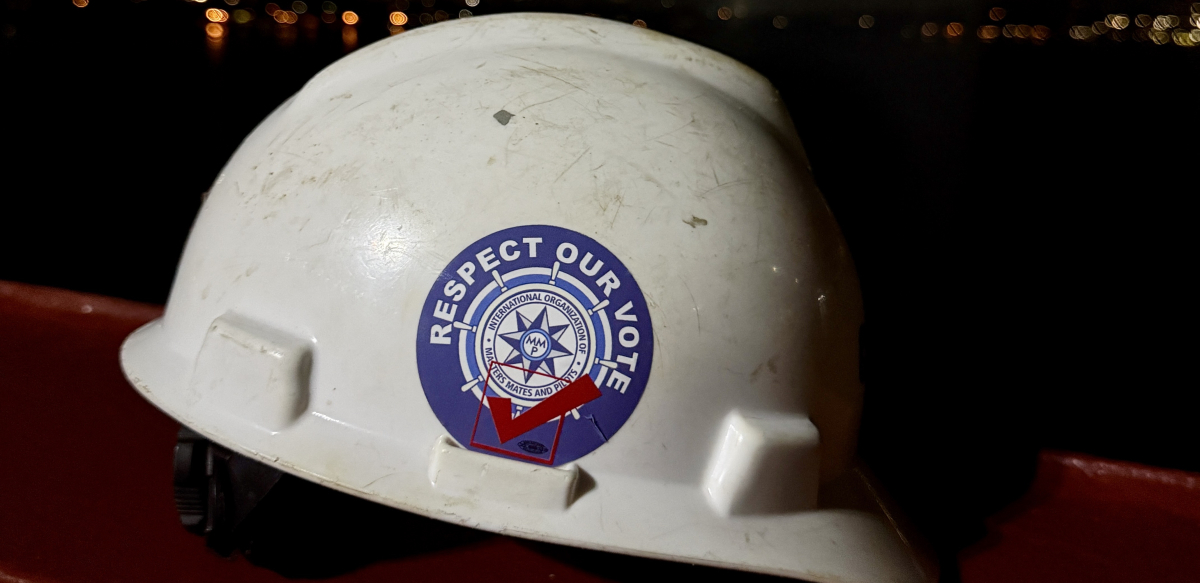
The mates who navigate the oil tankers that fuel the United States Navy voted for a union more than two years ago. They still have no contract. Their employer collects Pentagon charter fees and federal subsidies, ignores a federal order to bargain, and is now asking a court to throw that order out.
The employer is Saltchuk, a privately owned Seattle shipping conglomerate. Its two tanker companies have gone to federal court to overturn the labor board orders requiring them to bargain with the mates’ union.
The mates are the licensed workers who stand the navigation watches and run the loading and discharge of the cargo: chief mates, second mates and third mates, more than 125 workers on 17 tankers. They live aboard for months at a time. Alaska Tanker Company’s ships carry crude oil from Alaska to West Coast refineries, about 1.3 million barrels on each ship. Overseas Shipholding Group’s tankers carry crude, gasoline and jet fuel.
The mates at Alaska Tanker voted first. When their ballots were counted in January 2024, four out of five had chosen a union, and the International Organization of Masters, Mates & Pilots had an outright majority. The larger Overseas Shipholding fleet voted in October 2024. About two out of three chose a union there, and Masters, Mates & Pilots again took the majority. Six months before that vote, chief executive Samuel Norton wrote to the mates that it was up to them to decide whether they wanted a union, and which one. Once they had decided, both companies refused to bargain.
Saltchuk’s supervisor claim
The companies’ excuse is that chief mates are supervisors, and the law bars supervisors from a union with the workers under them. The claim does not fit the job. A chief mate is the senior mate on the ship, a licensed worker who stands watches and runs the cargo work under the captain’s command. Chief mates do not hire or fire anyone, and carrying out the captain’s orders and the company’s procedures is not supervising as the law defines it. The National Labor Relations Board heard the evidence and found the companies had not proved their claim. According to the union, the same companies once recognized another union in units that included chief mates, and objected only after Masters, Mates & Pilots won.
The supervisor rule comes from the Taft-Hartley Act of 1947, the law Congress passed to roll back the great strike wave that followed World War II. It strips union rights from any worker an employer can get classified as a supervisor. Shipowners have used it against the unions of licensed mariners ever since.
The mates won their elections. Saltchuk’s companies challenged the results, lost before the board’s regional directors, and appealed to the full board. Then the Trump administration did the companies’ work for them. In January 2025, Trump fired board member Gwynne Wilcox, leaving the board without enough members to rule on anything. The mates’ cases sat frozen for more than a year.
When the board could act again, in March 2026, it ruled unanimously for the mates. The companies still refused to bargain. The board ordered Alaska Tanker to the table in May 2026 and Overseas Shipholding in August. Along the way the companies argued that the labor board itself is unconstitutional, the same claim Elon Musk’s SpaceX and Amazon have made in their own fights against unions.
The companies have taken the orders to the federal appeals court in Atlanta, where their brief, reported Nov. 3, 2026, asks the judges to throw the orders out. Without even asking the court to suspend the orders while it decides, they simply do not obey them, and the law imposes no penalty for that. The labor law is written to allow it. An employer that loses a union election has no direct appeal, so it refuses to bargain, waits for the labor board to rule against it, and takes that ruling to federal court, which can take as long as it likes.
The Navy’s tanker
One of these ships is the Overseas Mykonos. Since 2023 it has been on charter to the United States Navy’s Military Sealift Command, fitted out to refuel Navy ships at sea. A Heritage Foundation review of the merchant fleet identifies the Mykonos as the tanker dispatched to refuel the aircraft carrier USS Abraham Lincoln. The mates on its bridge are civilian merchant mariners on a private company’s payroll, and their labor fuels the fleet.
On Aug. 17, 2026, Iran’s Nournews agency reported that Iran’s armed forces are examining the commercial shipping companies that supply United States forces in the war on Iran. A military official named Overseas Shipholding Group among six companies and the Overseas Mykonos among 14 vessels. Hauling fuel and ammunition for a military at war, the official said, cannot be passed off as ordinary commerce.
That puts the mates in the war. Masters, Mates & Pilots President Don Josberger says they “have waited more than two years while navigating active conflict zones.”
Seafarers with a union contract have some say in the matter. On March 5, 2026, days after the United States launched the war on Feb. 28, the international seafarers’ unions and the shipowners they bargain with declared the Strait of Hormuz, the narrow passage out of the Persian Gulf, and the waters around it a war zone. The designation has been renewed since. On ships under that agreement, a seafarer draws a bonus equal to basic pay for each day in the zone, compensation for death and disability doubles, and anyone can refuse to sail in and be sent home at the company’s expense with two months’ basic pay. About two dozen seafarers have been killed in those waters since the war began. The Saltchuk mates won their elections and still have no contract, and no enforceable say over where they are sent or on what terms.
The Pentagon pays Saltchuk for the Mykonos charter. Separately, the federal Tanker Security Program pays a yearly stipend to keep other privately owned tankers on call for the Pentagon. The Mykonos left that program when it went on the Navy charter in 2023. Other Overseas Shipholding tankers are in it, and the stipend now runs to more than $8 million a year for each ship. Saltchuk has money to spend. It bought Overseas Shipholding in July 2024 in a deal valued at $950 million. In April 2026 it bought Great Lakes Dredge & Dock, the country’s largest dredging company, in a deal valued at $1.5 billion.
The same federal government that charters the ship and pays the stipend has issued two orders to bargain. The checks arrive. The orders go unenforced. The labor board has no power to enforce its own orders and must ask the appeals court to do it. The Navy and the Maritime Administration, which pay Saltchuk, have kept paying without a word of objection.
Organizing without a contract
While the case sits in court, the mates keep organizing aboard the ships. The job exposes them to benzene from the cargo, and cleaning out the cargo tanks is high-risk work. Port turnarounds are rushed. Management has changed the relief schedules and kept mates at sea past the end of their tours without consulting them.
Management tried in September 2025 to move the mates onto cheaper health coverage with higher premiums and co-pays. The mates protested, and Masters, Mates & Pilots told the companies they had to bargain over any change. The companies gave up the attempt inside two weeks, and coverage and premiums stayed where they were.
The mates have made other gains without a contract. The companies now reimburse training costs. Travel conditions have improved, and tour lengths and duties are written down in a handbook.
Alex Gilmore, a third mate at Alaska Tanker, told Labor Notes that after seven years sailing some of the largest ships under the United States flag, he has seen conditions stand still while the energy companies book record profits. The mates are committed to the safety of the ships, the environment and each other, he said, and “we need a contract to ensure our concerns are addressed.”
Their campaign, Mates United, has a petition to Saltchuk chair Mark Tabbutt and Norton and is lining up support from other unions.
Every arm of the federal government has had a hand in this fight. Congress wrote the supervisor rule and Trump froze the labor board. The appeals court holds the case while the Pentagon and the Maritime Administration keep paying the company. The one force that has made Saltchuk retreat so far is the mates themselves, who stopped a health care cut in two weeks with no contract at all. They move the fuel the Navy cannot sail without.
Join the Struggle-La Lucha Telegram channel