
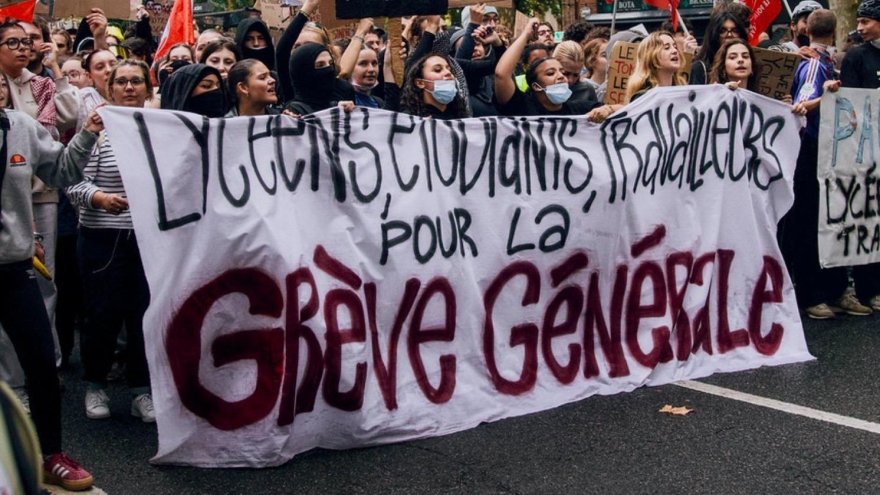
When French workers walked out on Nov. 5, trains slowed, schools emptied, and refineries and power plants cut production until France had to import electricity. For a day, France’s workers held the country in their hands.
On Nov. 9, Prime Minister Sébastien Lecornu offered union leaders a wage conference, and most agreed to wait before striking again. Politicians point to the 2027 election. In their assemblies, workers and students are deciding for themselves.
When work stops, France stops
All eight national union federations called the strike against 54 billion euros in cuts, demanding higher wages, pensions and public services. Management reported half to four-fifths of railway workers struck. More than half of secondary school staff walked out, along with half the workers at three oil refineries.
The CGT counted 1.6 million marchers. “We need to realize how powerful we are,” Antonia Barot, 27, said in Paris.
The strike grew out of a revolt in the schools. In late September, high school students in Seine-Saint-Denis, a working-class area north of Paris with many African and Arab families, began blockading their crumbling schools. African, Arab and Muslim youth from working-class suburbs have led the revolt ever since. The government and the far right have tried to turn it into a fight over immigrants and Islam. The youth answered by bringing the country into the streets on their demands.
By Nov. 5, students counted about 1,000 high schools blocked or closed and roughly half the universities blockaded. Teachers, rail workers and hospital staff joined them. The students lit the fuse, but workers could stop the trains, refineries and power plants. “I’m also fighting for my parents, for gas prices, for the cost of living — period,” said Lou, a student marching in Sens.
Modest demands, dangerous method
Workers and students demand higher wages, a price freeze, school funding, freedom for jailed protesters and repeal of Parcoursup, which sorts graduates into too few university places.
The bankers holding France’s debt demand 54 billion euros in cuts, and Lecornu’s budget carries out their demands. The United States war on Iran has more than doubled European gas prices, with Europe already tied to United States gas monopolies. The bosses demand cuts; workers demand raises and press their demands by stopping production.
Every great strike carries a revolution in embryo. A strike that stops a country raises the question of who should run it.
The police and the conference table
The government mobilized 70,000 police and gendarmes on Nov. 5 and made 448 arrests, more than 12,000 since the school blockades began. Police grenades have blown off teenagers’ hands.
The ruling class also counts on union leaders to bring workers back to work. That is what Lecornu’s conference is for.
In May 1968, some 10 million workers struck, many occupying factories. At the Labor Ministry, government, employers and union leaders agreed to raise the minimum wage by a third and other wages by a tenth. Renault workers at Billancourt booed down the agreement, but union leaders brought the workers back over the following weeks. Rising prices soon swallowed the raises.
This time the government reportedly offered to advance January’s minimum-wage increase by one month, worth about 20 euros ($22). Marine Le Pen said even a symbolic raise meant “we’re heading back to the USSR.” The bosses could not give real concessions if they wanted to.
The ballot box detour
In 1968, President Charles de Gaulle called snap elections and moved tanks toward Paris. With workers back at work, his party won a landslide. The ballot handed back what the strike had won.
On Nov. 7, Jean-Luc Mélenchon of France Unbowed gathered supporters to launch his 2027 presidential program. His party has backed students against police. But winning government office does not give workers control of the banks and factories. Elected in 1981 with Communist Party support, the Socialist government turned to austerity within two years under bankers’ pressure.
If workers are sent home, shopkeepers, small farmers and professionals may turn toward Le Pen. Workers who keep fighting can win them instead. The election road says: win a majority in 2027, then act. The action committees of May 1968 said the opposite: act first, and the struggle will win the majority. Today that means keeping the strike going now.
A lull, not a defeat
The Nov. 7 marches were smaller, but struggles do not rise in straight lines. In 1848 and the Paris Commune of 1871, workers fought to the end. In 1936 and 1968, leaders called off strikes before the battles were fought out. Workers kept their organizations; the fight was interrupted.
The embryo of workers’ power
In Toulouse, an assembly of more than 800 people prepared rolling strikes at Airbus, in sanitation and on transit. In Montpellier, workers and students defended the Clémenceau high school blockade; police who had broken it up each morning pulled back when workers arrived.
These assemblies are workers’ power in embryo. Linked by elected delegates from workplaces, schools, farms and neighborhoods, they could decide when to strike, how to spread the fight and what to accept. They could stand against the bankers’ parliament as a center of working-class power.
Teachers and researchers strike again Nov. 10. One-day general strikes are called in Spain, Italy, Belgium and Greece later this month.
On Nov. 5, French workers showed they can stop the country. Lecornu offers them a few euros to return to work, and the 2027 election offers a ballot. The assemblies offer the power to decide how the struggle continues — and what it must win.
Join the Struggle-La Lucha Telegram channel