
Working people in the United States have opposed the wars of the United States ruling class — the genocide in Gaza and the wars on Iran, Venezuela and Cuba — and Trump’s ICE terror at home. In Minneapolis, they organized block by block and forced Trump’s agents to retreat. Nurses, meatpackers and small towns took on the bosses and the tech monopolies. Against the wars, they have marched and protested but have not yet built a fight that can stop them.
One way to hit back
The Nov. 3 midterm elections were a mass vote against Trump, his wars and his terror campaign against immigrant workers. Trump, the wars and ICE were not on the ballot. But tens of millions of working people saw the vote as a way to stop Trump’s course. With no workers’ party on the ballot, the two-party system left them only the Democrats. That party will now work to bring the anger back under control.
Exit polls showed six in 10 voters opposed the war on Iran. Most voters opposed the ICE gestapo. Two in three said the economic system serves the rich. Texas and Georgia had been held up for years as proof that the working class in the South belonged to the right. Texas elected Gina Hinojosa, its first Latine woman governor. Georgia elected Keisha Lance Bottoms, the first Black woman governor in the country’s history. New Mexico elected Deb Haaland, the first Native woman governor.
The election measured the outrage. The outrage itself has been building up outside the ballot box.
The working class under attack
The working class in the United States faces an offensive by the bosses, driven by the decline of United States imperialism and the billionaires’ competition for profits and power. The wars on Iran, Venezuela, Cuba and Gaza are fronts of a global class war to hold on to world domination, including control of oil and the energy supply of the world. At home, the same ruling class is driving down wages and living standards. Gasoline, diesel, food and rent have soared since the war began, while the oil companies and arms makers have raked in record profits.
The bosses have remade the working class that faces this offensive. They closed the auto plants and steel mills, moved production abroad and used new technology to wipe out millions of better-paid union jobs. The work that remains is in hospitals, warehouses, meatpacking plants, restaurants, schools and delivery vans, at lower pay and with no security. Women are nearly half of this working class. Millions of immigrant workers from Mexico, Central America, the Caribbean, Africa and Asia do much of its hardest work. The employers have fought to keep these workplaces nonunion.
The sharpest blows have fallen on the most oppressed sections of the class: immigrant workers, Black and Latine workers, women and LGBTQ+ people. Those same sections have been at the front of the resistance.
Young workers are hit from every side. They are the low-wage workers of the delivery apps, coffee shops and fast-food counters. Rent eats up their pay, leaving little for groceries. They carry school debt into jobs with no future, if they can find a job at all. They are the ones the Pentagon recruits to fight its wars. And they are fighting back. Young people filled the campus encampments against the genocide in Gaza, organized Starbucks and Amazon and walked out of high schools against ICE. In the military, young soldiers are the ones seeking a way out rather than fight in Iran. On the picket lines and in the streets, some are beginning to look for a socialist answer.
Minneapolis: the neighborhoods organize
ICE has become an army at home. Congress handed it more money than all other federal police agencies get in a year combined. It doubled its agents in 2025. Troops were sent into Los Angeles, Washington, D.C., and Memphis, and an army base in Texas was turned into a detention camp. More people died in ICE custody in the year to September than in any year on record. Close to a million people have been deported since Trump took office, four in five of them with no criminal record, and most of the rest convicted of minor offenses such as traffic violations.
The turning point came in January in Minneapolis. The Trump administration sent more than 3,000 heavily armed federal agents into Minnesota, where about 150 had worked before, to raid immigrant communities. On Jan. 7, an ICE agent shot and killed Renée Good, a 37-year-old mother. Trump threatened to invoke the Insurrection Act, and the Pentagon put some 1,500 active-duty soldiers on orders to prepare to deploy. Administration officials told reporters that some in the White House would welcome violence from protesters as a pretext for sending in troops.
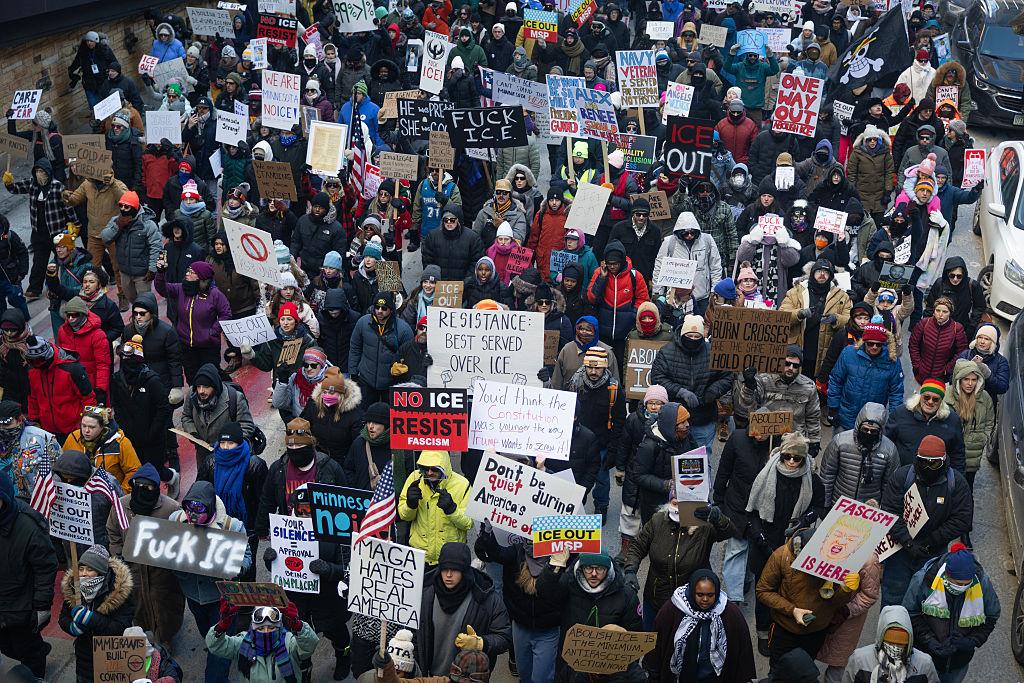
The people of Minneapolis answered with organization. The city had organized before, in the 2020 rebellion against the police murder of George Floyd. Immigrant rights groups trained some 30,000 people to observe and document ICE raids. Block by block, neighbors formed rapid-response networks linked by encrypted chats. When ICE vehicles appeared, whistles sounded and residents arrived within minutes to warn families, film the agents and track the people seized. Others escorted children to school, brought food to families afraid to leave home and stood guard outside immigrant-owned shops.
The unions joined the fight. Labor law in the United States exposes unions to heavy penalties if they call a strike over political demands, so the Minneapolis Regional Labor Federation and the area labor councils called Jan. 23 a “Day of Truth and Freedom” — no work, no school, no shopping. Immigrant organizations, teachers, service workers and congregations built it together. Roughly 1,000 businesses closed, and tens of thousands marched downtown in subzero cold. It was the closest thing to a general strike the state had seen since the Minneapolis Teamsters’ general strike of 1934.
The administration answered with more killing. On Jan. 24, the day after the work stoppage, federal agents shot and killed Alex Pretti, an intensive care nurse, on a street in south Minneapolis. The neighborhoods did not retreat.
The administration was forced to retreat. Trump’s standing on immigration, until then his strongest issue, collapsed in the polls within weeks.
The rapid-response networks spread to Chicago, Los Angeles, Las Vegas, Memphis and towns across the South. They are the most important new form of mass organization in the United States in many years. They bring together immigrant workers, unionists, students, religious congregations and neighbors who had never been active before, and they meet the repressive forces of the capitalist government directly, in the street, every day.
The government has hit back. Fifteen Minnesota activists face federal charges, and their lawyers say undercover agents worked inside organizing groups to entice members into breaking the law. In Texas, defendants in the Prairieland detention center case were handed sentences totaling some 450 years. Trump has declared “antifa” a terrorist organization. No such organization exists. The designation is a weapon against anyone who resists.

Against the wars
On Jan. 3, United States forces kidnapped Venezuelan President Nicolás Maduro and First Combatant Cilia Flores. When Maduro was brought before a federal judge in Lower Manhattan on Jan. 5, protesters gathered outside with signs reading “Hands off Venezuela’s oil” and “US out of the Caribbean.” Protests also broke out in Washington, D.C., and other cities. Since then, on the 3rd of every month, protesters have rallied outside the Metropolitan Detention Center, the federal jail in Brooklyn, New York, where Maduro and Flores are held, to demand that they be freed. Protesters also rally at every one of their court appearances. The most recent monthly rally was on Nov. 3, Election Day.
The Pentagon then tightened the blockade of Cuba, seizing Cuba-bound fuel shipments to cut off the island’s electricity. In March, a convoy of some 600 people from 36 countries, including a large delegation from the United States, defied the blockade to bring medicine, solar panels, bicycles and school supplies to Cuba. On Aug. 3, more than 900 delegates from 63 countries, including from the United States, braved threats to open an international colloquium in Havana marking the 100th anniversary of the birth of Fidel Castro, the leader of the Cuban Revolution.
Protests against the United States war on Iran began on Feb. 28, the day the Pentagon launched it. Iranian, Arab and Palestinian communities and antiwar coalitions marched in New York, Washington, San Francisco, Seattle, Philadelphia and dozens of other cities. Within two weeks, the war on Iran was the least popular foreign war in modern United States history.
For more than three years, people across the country have marched against the United States–Israeli genocide in Gaza. The United States supplies and pays for the weapons. The genocide began under a Democratic administration and continued under a Republican one. That movement joined the protests against the war on Iran, a country that stands with Palestine.
In the months that followed, opposition to the wars and opposition to ICE marched together, on the same banners.
The war on Iran has reached the ranks of the military. Groups that counsel soldiers reported a tenfold increase in service members seeking discharge as conscientious objectors after the war on Iran began. On April 20, dozens of veterans, some of them disabled, were arrested at the Capitol demanding an end to the war.
On Oct. 30, dockworkers at 113 ports in 22 countries struck or demonstrated under the slogan “Dockworkers don’t work for war.” In the United States, ILWU Local 10, the longshore workers of Oakland and San Francisco, supported the action. These workers have a long record of refusing to handle cargo for the wars and regimes of United States imperialism, from Chile in 1978 to South Africa and Israel. Their support on Oct. 30 linked workers in the United States to workers in the Mediterranean, Asia and Latin America against the same war.
These are the beginnings. A movement against the wars is stirring and building. Opposition to the war on Iran is now the view of the majority, but it has not become organized mass action that can stop the wars. The marches have come in waves and then receded. The dockworkers’ international action lasted one day. No union in the United States has carried out a sustained strike against the wars, and the arms plants, bases and ports that build, stock and distribute the weapons run every day. Against ICE, working people in Minneapolis organized block by block and forced the federal government to retreat. Against the wars, nothing on that level has been built yet.
The wars have another side. Iran still holds the Strait of Hormuz, and Cuba has not bowed to the blockade. Their resistance is why the Pentagon has not won. They are allies of workers here, who face the same enemy.
Here, the wars run through the hands of workers: the longshore workers who move military cargo, the rail and warehouse workers who carry it, the machinists who build the missiles and the young soldiers sent to fire them. On Oct. 30, dockworkers in other countries showed that the workers who handle war cargo can act against it, and the longshore workers of Oakland and San Francisco stood with them. The rise in soldiers seeking discharge shows the war on Iran meeting resistance inside the Pentagon’s own ranks. In Minneapolis, unions called a political work stoppage once the neighborhoods were organized behind them. Opposition to the wars becomes a fight when that kind of organization reaches the ports, the plants and the bases.
Workers on strike
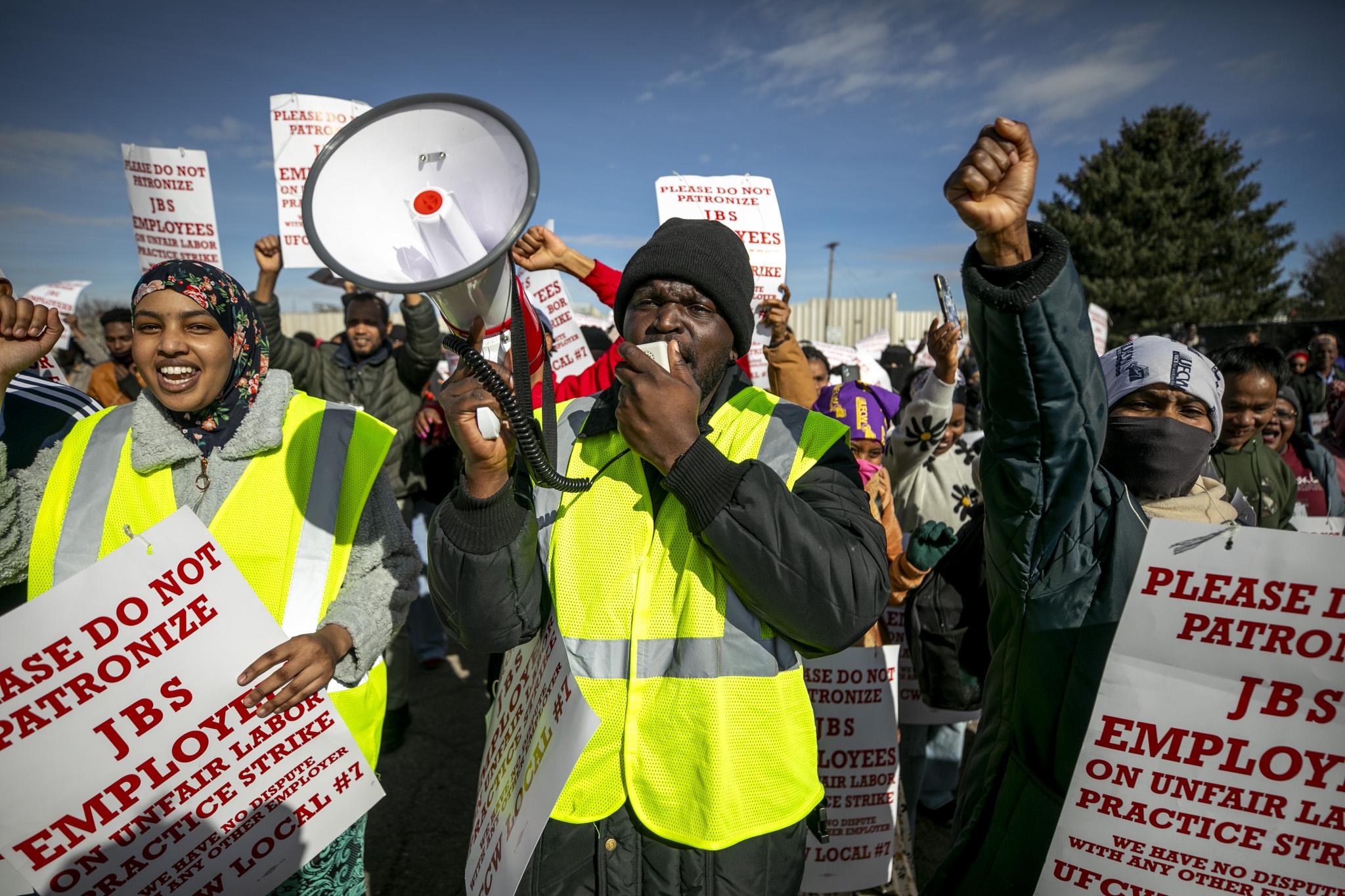
The year opened with a wave of strikes. Some 15,000 nurses, most of them women, struck three New York City hospital systems. More than 31,000 Kaiser Permanente nurses and health care workers walked out in California. In Greeley, Colorado, 3,800 meatpacking workers at the JBS beef plant, most of them immigrants and refugees, carried out the first strike at a major United States beef slaughterhouse since the 1980s, in the middle of the ICE terror. Teachers, school workers and university workers in California authorized strikes over wages that no longer cover rent.
On May 1, unions, immigrant worker centers and community groups called for “no work, no school, no shopping” under the slogan “Workers over billionaires.” Organizers reported more than 5,000 actions. Participation was uneven, and it fell short of a general strike. But many unions, including both national teachers’ unions, endorsed a call for a national political work stoppage on May Day, something workers in the United States had not seen in generations. The marches in many cities were made up overwhelmingly of working people, with Black and Latine workers in the lead.
Small towns against the tech monopolies
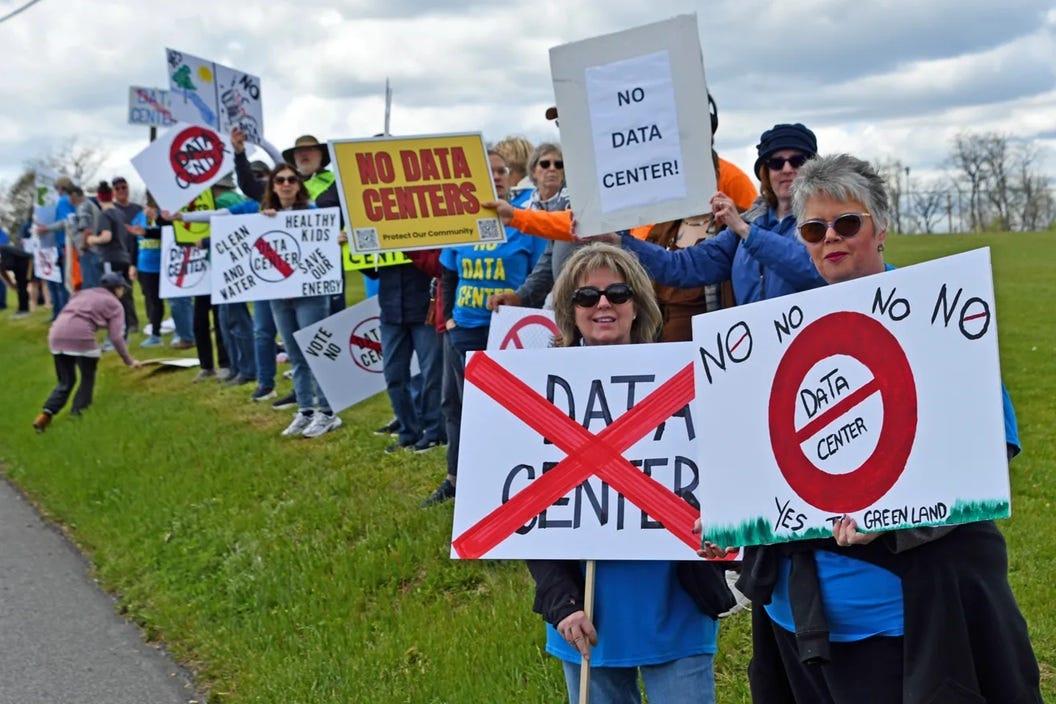
One of the broadest fights of the year has been led by small farmers, retirees and working families in small towns and rural counties, many of them in areas that vote Republican. Their target is the giant data centers that Google, Amazon, Microsoft, Meta and other tech monopolies are racing to build. These projects drive up electricity bills, use enormous amounts of water, pave over farmland and foul the air with exhaust from the gas turbines and diesel generators that power them. They are handed tax breaks and government money. The same monopolies use the technology inside the data centers to cut jobs and speed up work in warehouses, offices and call centers. The towns are fighting them over land, power, water and pollution. Workers are fighting them on the job.
Citizens’ petitions put most of the data center measures on the November ballots. Voters decided 47 data center measures this year and sided with limits on the monopolies in all but one, in the small town of Harwood, North Dakota. Across the country, residents also launched dozens of recall campaigns against local officials who approved the projects, and community opposition halted or canceled more than 50 projects in 2026.
Many of the people in these towns voted for Trump in 2024. Up against the monopolies, their class interests came out from under their party labels.
The same monopolies are spending without limit on politics. In California, Silicon Valley billionaires spent hundreds of millions of dollars and outspent supporters 250 to 1 to defeat a tax on billionaires’ wealth. Where the billionaires could buy the outcome, they did. Where working people were organized, as in the data center fights, the money lost.
Where the class stands
Class consciousness in the United States does not develop evenly. It develops in leaps, through struggle, as workers learn from their own experience who their enemy is. The past year has been such a leap. Workers are drawing the connections between the wars, the ICE raids, the cost of living and the billionaires on their own. Signs at the marches and picket lines united them. A Gallup poll released in September found that 43% of people in the United States view socialism positively, the highest share since Gallup began asking in 2010, while views of big business and capitalism have fallen.
The leap came from below. The most oppressed sections of the class moved first, and their resistance pulled in wider layers of workers, including many who had voted for Trump in 2024. That is the meaning of the rapid-response networks, the Greeley strike and the data center fights.
The level of organization is still far behind the level of people’s anger. Nine in 10 workers don’t belong to a union. In Minneapolis, the neighborhood networks, immigrant organizations and unions acted together, but that unity was local and built for one fight. Across the country, the neighborhood networks, community fights and antiwar groups have no lasting ties to each other or to the unions.
Most union leaderships keep struggles within the limits of their contracts and of labor laws such as the Taft-Hartley Act that ban solidarity strikes and expose political strikes to heavy penalties. They also tie their members to the Democratic Party, and Teamsters president Sean O’Brien has tied his union’s leadership to Trump. Minneapolis showed both sides of this. The unions joined a political work stoppage, a step far beyond ordinary contract demands, because their members and the neighborhoods around them were already in motion. The leaderships called it a “day of truth” so it could not be called a strike. Workers who have walked off the job once for a political demand can do it again, whatever their leaders choose to call it.
The past year has also opened a contradiction. In struggle, the working class has begun to act on its own. The rapid-response networks, the strikes, the longshore workers’ solidarity and the small-town fights were built by workers themselves, with no help from either capitalist party. At the ballot box, the same workers had nowhere to go but the Democrats. A worker who voted Democratic to hit at Trump did not vote for the Democratic leadership’s program. In several cities and districts, millions of voters went further and elected social democrats: the new mayors of Los Angeles and Washington, D.C., and five new members of Congress who campaigned against the genocide in Gaza and refused corporate money. But the votes went to a party tied to the same banks, oil companies and arms makers as the Republicans.
That contradiction will not stand still. The new Democratic Congress will not end the wars, abolish ICE or take on the billionaires who fund both parties. As workers run into those limits, more of them will look for ways to act for themselves in politics, as they have begun to do in the streets and on the job.
What comes next
The rulers of the United States are already preparing to contain what the vote expressed. On Election Night, White House chief of staff Susie Wiles told senior staff that the administration will not take its “foot off the gas.” The next morning, Homeland Security Secretary Markwayne Mullin posted, “Deportations will continue.”
The administration has prepared to rule without Congress. Since April, deputy chief of staff Stephen Miller and budget director Russell Vought have drawn up steps Trump can take on his own on immigration, tariffs and federal spending, Reuters reported on Nov. 1. They include stricter visa rules for international students and foreign workers.
Congress has done nothing to stop him. Trump launched the war on Iran without a vote of Congress. Every president since Harry Truman has made war without a declaration from Congress, from Korea and Vietnam to Iraq and Libya. Trump has also declared one “national emergency” after another to give himself powers Congress never gave him, from tariffs to sending troops to the border. Congress can vote to end those emergencies, but Trump can veto that vote, and the new Congress is far short of the two-thirds needed to override him.
The wars go on. ICE goes on.
The gains that matter for the working class are the ones that were made outside the ballot box. Tens of thousands of people in the neighborhoods learned to organize against federal agents. Unions in Minneapolis learned to call a political work stoppage. Longshore workers stood with dockworkers in 22 countries who protested the handling of war cargo. Small towns stopped the tech monopolies. Immigrant workers, Black workers, women and LGBTQ+ people, Native Peoples and young workers were at the center of every one of these fights.
Shared class interests will not join these struggles together on their own. That takes political leadership rooted in them and independent of both capitalist parties. It takes a revolutionary organization that can carry the lessons of Minneapolis to the ports, the plants and the small towns. With it, the working class can fight as a class against the wars, against ICE and against the bosses who profit from both.
The vote of Nov. 3 was one way working people hit back. The rejection of Trump’s agenda was made in the streets of Minneapolis, on the picket lines, on the docks and in the town halls, where a working class under attack began to organize against ICE, the wars and the billionaires. How far it goes depends on what it builds there.
Join the Struggle-La Lucha Telegram channel