
Over the past year, Google has put its artificial intelligence to work for the Pentagon, first on a platform open to every Pentagon employee and now on the classified networks where the United States military plans missions and picks targets. The engineers who build that technology are quitting, forming a union and talking openly about a strike. Google also binds DeepMind workers with contract clauses that they say prohibit them from criticizing the company for the rest of their lives.
Sofia Liguori, a research engineer at Google DeepMind, the company’s AI laboratory in London, resigned the week of Oct. 19 over Google’s growing work for the Pentagon and Israel’s military. She told the BBC on Oct. 21 that her employment contract forbids her to speak against the company: “In principle I’m not allowed to criticize Google for the duration of my life.” She spoke anyway.
Andreas Kirsch, an AI researcher at DeepMind, resigned in late September. He told the BBC that Google has no power to control or veto how the Pentagon uses its AI and can barely see where it is being deployed. Other DeepMind workers, current and former, told the BBC that staff are afraid to speak out because they fear retaliation.
What Kirsch described is in the contract Google signed with the Pentagon on April 28, 2026. The Pentagon can use Google’s Gemini AI system for “any lawful government purpose,” including on classified networks used to plan missions and select weapons targets. Google also agreed to help change the system’s safety settings at the government’s request. The contract says Gemini should not be used for domestic mass surveillance or autonomous targeting without human oversight. But the Pentagon keeps the power to decide how it uses the system. The agreement states that it “does not confer any right to control or veto lawful Government operational decision-making.”
The Pentagon sets the terms. OpenAI, Amazon, Microsoft, Oracle, Nvidia and Elon Musk’s SpaceX signed similar contracts this year. The one AI company that refused to drop its bar on fully autonomous weapons and domestic mass surveillance, Anthropic, was branded a “supply-chain risk” by the Pentagon earlier in the year.
Gemini’s rollout across the Pentagon began on Dec. 9, 2025, when Secretary of War Pete Hegseth launched GenAI.mil, a Pentagon platform built on Google’s Gemini and opened to more than 3 million military and civilian personnel. “The future of American warfare is here, and it’s spelled AI,” Hegseth said.
What Google’s workers won in 2018
Google’s workers have stopped this before. In 2018, more than 4,000 of them signed a letter against Project Maven, a Pentagon program to use AI to pick targets out of drone footage. About a dozen quit. Google let the contract lapse and published a set of “AI principles” pledging it would never build AI for weapons, or for surveillance that violates international norms.
That pledge was a concession won by workers. On Feb. 4, 2025, two weeks after Google CEO Sundar Pichai stood among the tech billionaires at Donald Trump’s inauguration, Google deleted it. The rewritten principles, co-authored by DeepMind chief Demis Hassabis, promise only “appropriate human oversight” and respect for international law and human rights. Those are the words Google’s spokespeople recite today.
Project Maven did not die when Google dropped it. Palantir, the military contractor co-founded by billionaire Peter Thiel, took it over and built it into the Maven Smart System, which helped the Pentagon select targets in its 2026 war on Iran.
On Feb. 28, 2026, the first day of that war, United States Tomahawk missiles struck the Shajareh Tayyebeh girls’ elementary school in Minab, in southern Iran, killing 168 people, most of them schoolgirls. An unreleased Pentagon review, reported by Bloomberg, found that Central Command leaned on Maven, which had flagged the school as a military site from outdated data. Hegseth had cut Central Command’s civilian-harm team from 10 people to one. No one on that team reviewed the target before launch.
The Pentagon wants it fast. “Speed defines victory in the AI era,” Pentagon Under Secretary Emil Michael said this year. Sarah Shoker, who once headed OpenAI’s geopolitics team, told the BBC that when AI hands an operator hundreds of targets on a short clock, real human review is close to impossible. That is what “human oversight” meant at Minab.
Liguori warns against treating Minab as an accident. If the only objection is that AI selected the wrong target, she told The Intercept, the argument concedes that an AI targeting machine that never erred would be acceptable. She opposes AI targeting itself, because it lets the people in the kill chain each say someone else decided.
Tested on Gaza
Google was already supplying AI and cloud technology to Israel’s military through Project Nimbus. Google and Amazon signed the $1.2 billion Nimbus contract in 2021, and it covers Israel’s government as well as its military. In 2024, Google insisted Nimbus had nothing to do with classified, weapons or intelligence work. In 2026, Google agreed to supply AI for classified Pentagon operations, including networks used for weapons targeting. Israel serves as the Pentagon’s forward base in West Asia, and Gaza became the proving ground. Liguori told The Intercept she saw the new Pentagon contract as making the AI-powered slaughter tested in Gaza the standard for war.
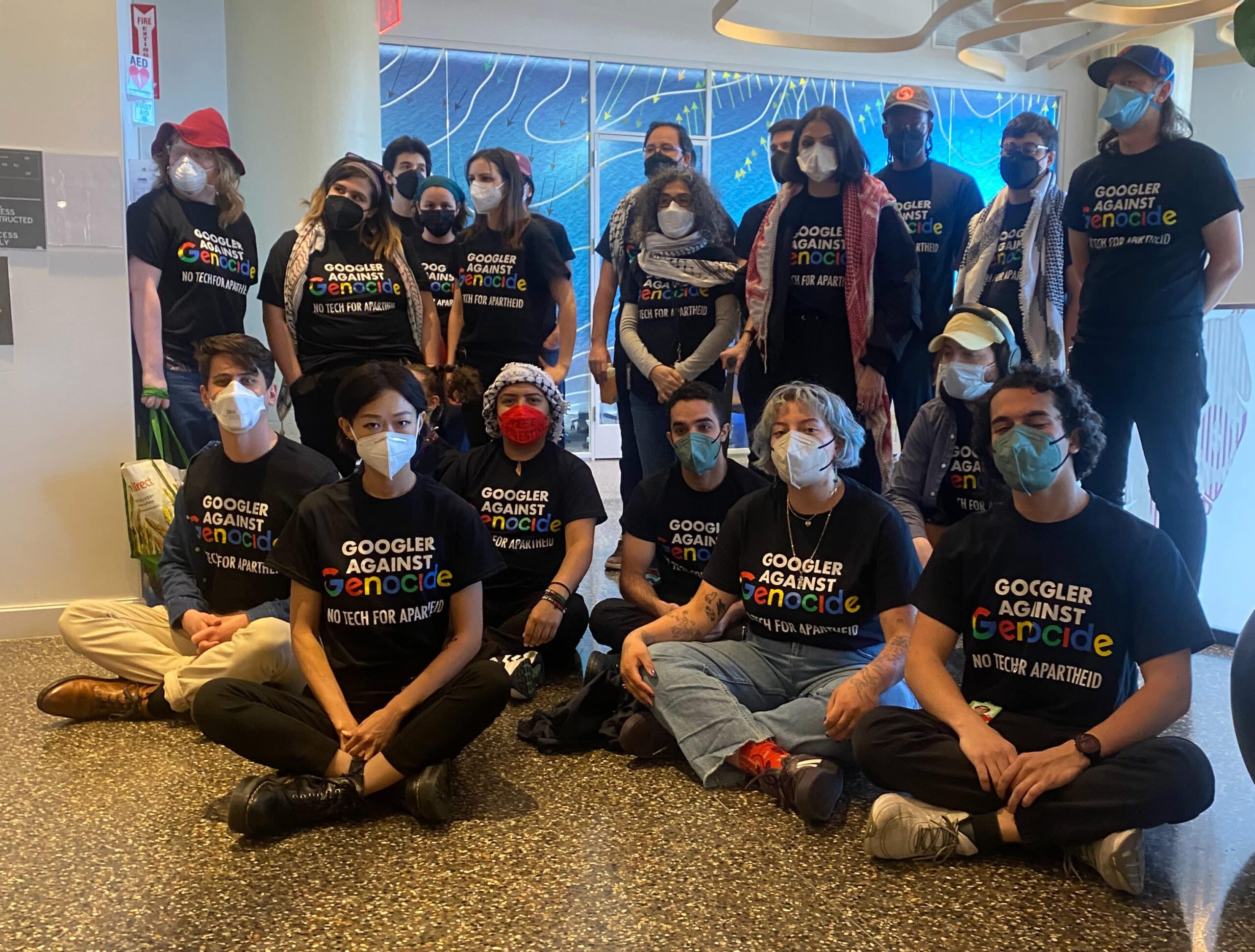
Google workers who resisted Nimbus learned what the company’s “dedicated channels” for concerns look like. On April 16, 2024, members of No Tech for Apartheid sat in at Google offices in New York and Sunnyvale, California. Google called the police, nine workers were arrested, and the company fired more than 50 people, including bystanders who never joined the sit-ins.
Inside DeepMind, the method is quieter. Liguori said her posts on internal channels were deleted for using the word genocide. “I was told that genocide is an intrinsically violent word,” she said. Managers and human resources told her that her tone was too aggressive and directed her to file tickets, which drew automated replies and no answers from leadership.
A Google spokesperson told the BBC the company has “dedicated channels” for employees to raise concerns and strict policies against retaliation. A current DeepMind worker who would not give a name for fear of retaliation told the BBC what management is counting on: the workers with a conscience can leave, and a pipeline of young hires will fill their seats.
The workers organize
The workers are not going quietly. In April 2026, about 600 Google employees signed a petition urging the company to refuse classified military work. Alex Turner, a DeepMind safety researcher, gathered more than 250 signatures opposing the Pentagon deal. He also wrote a 25-page proposal for binding contract limits and sent it to Hassabis. It went to the policy staff, and nothing came back until the deal was signed. Turner quit in June.
DeepMind’s British workers then voted to unionize. Ninety-eight percent of Communication Workers Union members at DeepMind backed the drive, and on May 5, 2026, the workers demanded that Google recognize the CWU and Unite the Union as their representatives. The union campaign includes protests, and workers have discussed research strikes that would halt work on improvements to Gemini. In February 2026, Liguori and her co-workers rallied outside the London office under banners reading “No AI in the kill chain” and “No Gemini for Genocide.”
Liguori says petitions have not been enough. She told The Intercept the workers should have struck, and that only a workforce ready to strike can stop these contracts.
Google’s workers build Gemini. Google’s owners sell it. The Pentagon decides whom it is aimed at. The engineers who write the code get no vote on any of it, and DeepMind workers say their contracts forbid them to say so in public, ever.
In 2018, Google’s workers forced the company out of AI targeting. Everything Google has done since, from the deleted pledge to the Nimbus firings and the plan to replace those who quit, is aimed at making sure that never happens again. The DeepMind union and the growing demand for a strike carry forward the collective resistance that forced Google to abandon Project Maven in 2018.
Join the Struggle-La Lucha Telegram channel