
For years the Pentagon has been building Japan into a military base and arms supplier for its war drive against China: Japanese troops, Japanese factories and Japanese islands within sight of Taiwan. The war on Iran has drained the Pentagon’s missile stocks, and its own advisers admit that rebuilding them will take years. Now the Pentagon is pushing to accelerate the buildup in Japan. The people of Okinawa, forced to live on the launch pad, are fighting back.
On Oct. 19, the Pentagon and Japan’s Self-Defense Forces opened Keen Sword 27, one of the largest war games the two militaries have staged together. About 45,000 Japanese troops and 12,000 United States troops are drilling through Oct. 29. Australia, Canada, France, Germany, the Netherlands, New Zealand and the Philippines sent forces; South Korea and Britain sent observers. European imperialist powers have sent their militaries halfway around the world to rehearse war on China.
The drills center on islands southwest of Japan’s main islands, toward Taiwan. On Yonaguni, just 68 miles east of Taiwan, United States Marines set up NMESIS anti-ship missile launchers with a range of about 115 miles. Japan brought its new Type-25 missile to the same island, with a range of about 620 miles — far enough to reach mainland China. The United States Army placed a HIMARS rocket launcher on Ishigaki, a larger island about 80 miles east.
Gen. Hiroaki Uchikura, head of Japan’s Joint Staff, denied the drills target any country. The drills target China.
The United States Army is also moving its Typhon launcher and more HIMARS to Kadena Air Base on Okinawa, Japan’s Defense Ministry announced. Typhon can fire Tomahawk cruise missiles about 1,000 miles, from Okinawa deep into China. The ministry calls the move “storage” and gave no end date. On Sept. 28, Kadena Mayor Hiroshi Toyama demanded that the plan be withdrawn, warning that storage could turn into permanent deployment.
The United States Army’s Pacific commander, Gen. Ronald Clark, told Britain’s Financial Times he had never in his career seen it pour so many resources and so much firepower into the Pacific. He wants to display more of the Pentagon’s most advanced weapons to “show the adversary some things that they should be concerned about.”
Chinese military analyst Song Zhongping told China’s Global Times that United States missiles on Yonaguni raise the danger of a miscalculation and could force China to hold its own drills in the area.
The arms industry can’t keep up
In August, the Council on Foreign Relations, where Wall Street and the Pentagon hammer out foreign policy, published a report titled “Out of Ammo.” Banker David Rockefeller long chaired the council, and it launched Henry Kissinger’s career. The report says the war on Iran has “severely depleted” the Pentagon’s stocks of air-defense interceptors and precision-guided munitions, and that the Pentagon’s most expensive weapons cannot be replaced within two years.
Every interceptor fired at an Iranian missile since Operation Epic Fury began on Feb. 28 is one the Pentagon no longer has for the Pacific. Nearly eight months into the war, Iran is still fighting, while the Pentagon’s advisers urge the United States military to learn from how Iran has fought it.
The report explains why the shortages cannot be fixed quickly. Advanced missiles, interceptors and warships take years to build. The giant arms makers rely on subcontractors for critical parts, many of them made in a single factory. Some take so long to make that the report recommends stockpiling them. And the arms makers will not expand production unless Congress guarantees their orders years in advance.
But money and guaranteed orders cannot create new factories, machine tools, materials or skilled workers overnight. The Pentagon’s expanding military commitments are running into the limits of the private industry on which it depends.
The report calls for cheaper drones and sensors built in huge numbers on commercial assembly lines, faster contracts and looser purchasing rules. Its authors want a two-year crash program to prepare for war over Taiwan, a province of China that the Pentagon treats as its own protectorate, because they assume such a war could come within two years.
Japan as arsenal and launch pad
Japan’s buildup began long before the war on Iran. It installed military radar on Yonaguni in 2016. In December 2022, the government of then-Prime Minister Fumio Kishida adopted a plan to double military spending and buy hundreds of Tomahawk missiles from the United States. Prime Minister Sanae Takaichi said in November 2025, before the war on Iran began, that Japan could go to war against China over Taiwan.
The shortages exposed by the war on Iran have increased the Pentagon’s dependence on Japanese factories, territory and troops. Japanese companies can produce weapons. Japanese islands and troops give the Pentagon launch sites close to China and forces to fight beside its own, and that is what Keen Sword is rehearsing.
On April 18, Japan signed contracts to build three frigates for Australia’s navy, its first postwar contracts to build warships for another country. On April 21, the Takaichi government approved a sweeping relaxation of restrictions on exporting weapons, opening the way for more sales of lethal arms abroad. Northrop Grumman and Japanese industry are splitting the work evenly on a new interceptor designed to shoot down hypersonic missiles. On Sept. 2, Mitsubishi Heavy Industries and NEC agreed to cooperate on military drones and the systems that direct them, the kind of weapons the Council on Foreign Relations report calls for.
Japan’s first Tomahawk-armed destroyer returned from the United States at the end of August. Long-range missiles are now on Kyushu, Japan’s southernmost main island, and Japan’s military budget is the largest ever.
After defeating Japan in World War II, the United States imposed a constitution, written by its occupation officials, that renounced war and barred Japan from keeping an army. Within a few years it reversed course. When the Pentagon went to war in Korea in 1950, the occupation ordered Japan to build a new armed force, the start of today’s Self-Defense Forces. It also freed jailed wartime leaders, among them Nobusuke Kishi, who had overseen munitions production for Japan’s war. He was never tried, and in 1957 he became prime minister.
Ever since, the United States has pushed Japan to rearm, and Japan’s ruling party has been eager to go further. Later governments restricted arms exports and pledged not to possess, produce or allow nuclear weapons into the country. The export restrictions are now gutted. The Liberal Democratic Party, which Kishi helped found, has long wanted to rewrite the constitution. Takaichi has pushed to review the ban on bringing in nuclear weapons, which stands in the way of United States nuclear-armed ships. At the Hiroshima memorial on Aug. 6, she would not commit to keeping that pledge.
Mitsubishi Heavy Industries, Japan’s biggest arms maker, built warships and warplanes for Japan’s last imperialist war. The same section of Japanese big business that profited from that war stands to gain military contracts at home, weapons exports and a share of the Pentagon’s orders. But the interests go beyond arms-company profits. The Pentagon leads the alliance and sets its war aims; Japan’s ruling class follows willingly because it wants military power of its own behind Japanese capital in Asia. The Takaichi government is advancing those interests.
Okinawa fights back
Japan is an occupied country. It holds more United States troops than any other country in the world, and most of them are on Okinawa. Expanding the bases for war on China deepens the conditions Okinawans have resisted for generations: seized land, crimes by United States troops and the danger of being dragged into a wider war.
On Oct. 3, Anna Yagi, 39, was found dead in a hotel in Naha, Okinawa’s capital. She died of asphyxiation from pressure on her neck. Early on Oct. 4, police arrested Lance Cpl. Devin Jacob Ballard, 20, a United States Marine stationed at the Futenma air station, on suspicion of robbing and murdering her. He denies the charges.
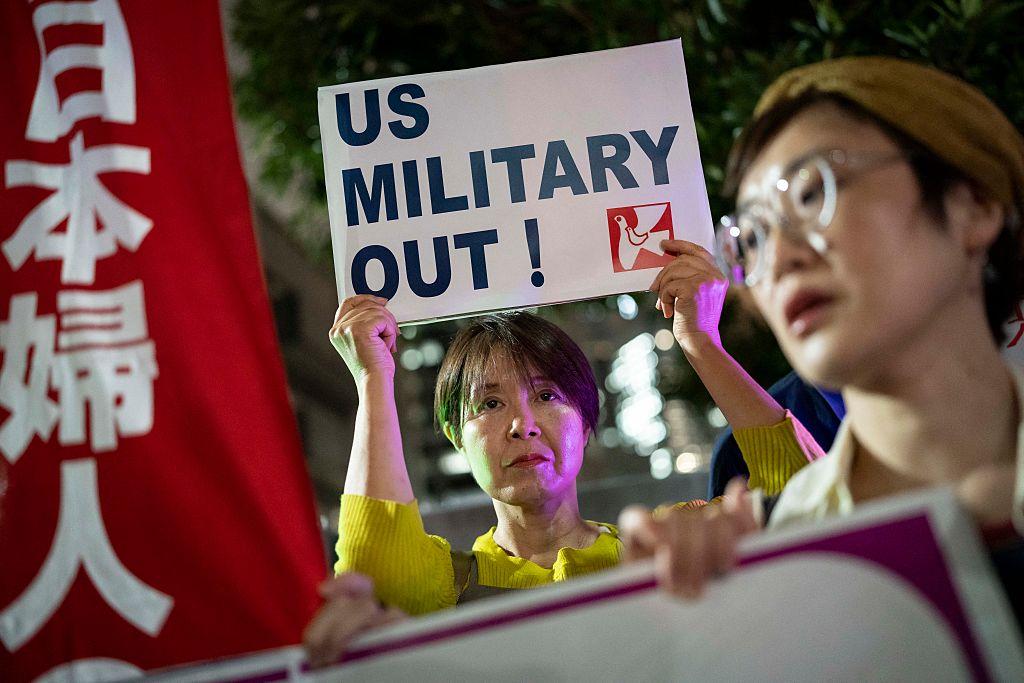
People rallied on Oct. 4 outside the prefectural government building in Naha. The Okinawa women’s group Femibridge said anger had boiled over and demanded answers. On Oct. 8, protesters gathered outside the Foreign Ministry in Tokyo with signs denouncing crimes by United States troops.
Even Okinawa Gov. Genta Koja, a conservative elected in September with backing from Takaichi’s Liberal Democratic Party, said decades of promised discipline had failed and called for a review of the Status of Forces Agreement governing United States troops in Japan. Former upper house member Keiko Itokazu said: “As long as there are US military bases in Okinawa, such incidents will occur.”
The Pentagon ruled Okinawa directly from 1945 until 1972, seizing land at gunpoint and bulldozing farms for bases. Today Okinawa, a sliver of Japan’s land, holds more than two-thirds of the land in Japan set aside for the exclusive use of United States bases. Arrests of United States troops, base civilians and their families for crimes on Okinawa hit a 20-year high in 2024.
Okinawans have never accepted United States occupation. In 1995, after two United States Marines and a sailor raped a 12-year-old girl, the United States military refused to hand the three men over to Japanese police until they were charged. Mass demonstrations forced the Pentagon to promise to consider earlier handovers in murder and rape cases, though it kept the final say. In 2016, after a former Marine working on a base raped and murdered a 20-year-old woman, tens of thousands marched again.
The protests against crimes by United States troops, the fight against the bases and the opposition to new missiles arise from the same military domination. Local officials say opposition forced Japan’s Defense Ministry to scale back this year’s Keen Sword from what was first planned. Kadena and neighboring towns are also fighting the Typhon deployment. The Pentagon needs land, ports, roads, airfields and cooperation from local governments to carry out its preparations. The less its own arms industry can supply, the more the Pentagon relies on Japanese territory for its war plans, and the more that resistance stands in its way. The war drive against China has to go through the people of Okinawa.
Join the Struggle-La Lucha Telegram channel