
The United States war on Iran and the Saudi war on Yemen are one war. Both are fought to keep the oil wealth of West Asia flowing to Wall Street, the oil companies and the weapons makers. Iran broke free of that system in 1979. The United States ruling class has been trying to drag it back ever since.
The Pentagon attacked Iran on Feb. 28. Iran answered by taking control of the Strait of Hormuz, the narrow passage out of the Persian Gulf, and nearly eight months later it still holds it. Far less oil gets through than before the war.
Saudi Arabia and the United Arab Emirates now pump much of their oil out by pipeline around the strait. The Gulf monarchies trapped behind it have no way around. The International Monetary Fund expects Kuwait’s economy to shrink by a sixth this year and Qatar’s by nearly as much. Saudi Arabia is borrowing to pay its bills and has frozen spending, even as it pays for a war on Yemen that has brought missiles down on its own capital.
Trump is threatening new bombing even as messages pass between the two governments. Iran’s terms are plain: lift the Pentagon’s naval blockade, give back the Iranian money frozen abroad, guarantee there will be no new attack and stop the fighting on every front in the region, including Gaza, Lebanon and Yemen. Iran has offered to reopen the strait within a week if the United States lifts its blockade. Trump’s demands change from week to week. Iran’s have not.
The corporate media explain the war as the personal politics of two men. Some say Trump started it to bury the Epstein files, the government records on his old friend Jeffrey Epstein, the child rapist and convicted sex offender. Others say Benjamin Netanyahu dragged Trump into it to save his own job. If this war were about Trump’s personal interests, he would have ended it by now. Ending it would be popular, even among many Trump voters. The war goes on because the United States ruling class needs it.
Where the oil money goes
Saudi Arabia, the United Arab Emirates and the other monarchies of the Arabian Peninsula pour trillions of dollars into the United States. When Trump toured the Gulf in May 2025, he came home claiming $4 trillion in investment pledges. Saudi Arabia signed on for the biggest arms deal the United States has ever made.
The wealth comes from oil sold in dollars and from the labor of millions of workers, most of them migrants from South Asia and Africa. The monarchies send it back to the United States in three ways: they buy weapons made in the United States, they invest on Wall Street and they lend to the United States government.
The weapons money goes straight to Lockheed Martin, Boeing and Raytheon. It keeps their production lines running and their profits high. The investment money goes to Wall Street. The big banks and funds manage it and take their cut. The loans go to the United States government, and that money helps pay for its wars. The monarchies collect interest on what they lend. But the Treasury Department can lock that money up whenever it chooses. In 2022 the United States and its allies froze the money Russia kept in Western banks.
Britain drew the borders of these monarchies. The United States keeps them on their thrones with Pentagon bases, weapons and intelligence. Their wealth flows back to build up the power that protects them.
Iran under the shah handed over its oil wealth the same way. In 1953 the CIA and British intelligence overthrew Iran’s elected prime minister, Mohammad Mossadegh, who had taken Iran’s oil out of British hands. The coup handed the shah full power. He poured Iran’s oil money into Wall Street banks and became the Pentagon’s biggest foreign arms customer.
The Iranian people ended that, and the oil workers struck the decisive blow. In the fall of 1978 they walked off the job and cut Iran’s oil exports to almost nothing, shutting off the shah’s money and the profits of the British and United States oil companies that had run Iran’s oil since the coup. Mass strikes and marches brought down the monarchy in February 1979. Iran took back its oil and kept the wealth at home. For 47 years the United States ruling class has tried to force it to hand that wealth over again: through sanctions, through the 1980s war it helped Iraq wage against Iran, and now through direct war.
Control of oil is one purpose of this war. The larger purpose is the whole flow of wealth out of the region. Iran is fighting to keep the independence it won in 1979. The United States is fighting to break it: to overthrow Iran’s government, destroy its ability to resist and bring it back under the control of the United States. Netanyahu said on Oct. 20 that he and Trump are “committed to completing the elimination of the Iranian regime.”
Every country that breaks free weakens the whole system of plunder that United States capitalism and its military-industrial complex depend on. An Iran that survives this war shows every other country in the region that the United States can be defied. That is why the United States ruling class cannot let it stand.
The same war in Yemen
Saudi Arabia is the richest of the Gulf monarchies and the biggest buyer of weapons from the United States in the world. With Hormuz in Iran’s hands, the kingdom ships its oil out the back door: a pipeline across the desert to the Red Sea. Attacks have already disrupted that pipeline. And the Red Sea’s southern exit, the narrow Bab al-Mandab strait, runs along Yemen’s coast. A Yemen that refuses to bow to the Saudi monarchy threatens the throne and its oil route at the same time.
Yemen is the poorest country in West Asia. In September 2014 Ansar Allah, the movement the corporate media call the Houthis, took the capital, Sanaa, and drove out the Saudi-backed president. Starting in March 2015, Saudi Arabia bombed Yemen for seven years to put him back, with warplanes from the United States and Pentagon help picking targets. With the backing of the United States, the United Nations Security Council recognized the ousted president as Yemen’s government. Tens of thousands died in the bombing. Counting the hunger and disease caused by the Saudi blockade, the United Nations put the death toll in the hundreds of thousands by the end of 2021.
A truce in April 2022 stopped most of the bombing, but the blockade stayed. That same month the Saudi monarchy replaced its president with a council of its own choosing, based in Aden, the port city in the south. The United Nations recognizes that council, so the corporate media call it Yemen’s government. It governs almost nothing and has no support among Yemenis. The government of Yemen is Ansar Allah. It holds the capital, Sanaa, and most of northwestern Yemen, where most of Yemen’s people live. Sweden’s Uppsala University, whose war records researchers around the world rely on, counts Ansar Allah as Yemen’s government because it holds the capital.
Ansar Allah answered the Saudi blockade with a blockade of its own, stopping Saudi oil tankers at the Bab al-Mandab. In September Ansar Allah forces took new ground. On Oct. 5 Saudi Arabia’s mercenary forces in Yemen struck back, with Saudi warplanes overhead. Ansar Allah counts more than 1,500 Saudi air and missile strikes on Yemen since the fighting flared.
Then Ansar Allah hit the kingdom itself. It has hit the main airport in Riyadh, the Saudi capital, 20 times since the start of October, by the Saudi coalition’s own count. The Oct. 10 strike alone killed at least 13 people and wounded more than 300. On Oct. 13 it hit the headquarters of Saudi Aramco, the state oil company. On Oct. 15 its missiles hit the presidential palace in Aden, the seat of the Saudi-picked council. On Oct. 19 its missiles struck a camp in southern Yemen where new Saudi-paid recruits were training, killing at least 73 and wounding more than 200, with 14 still missing.
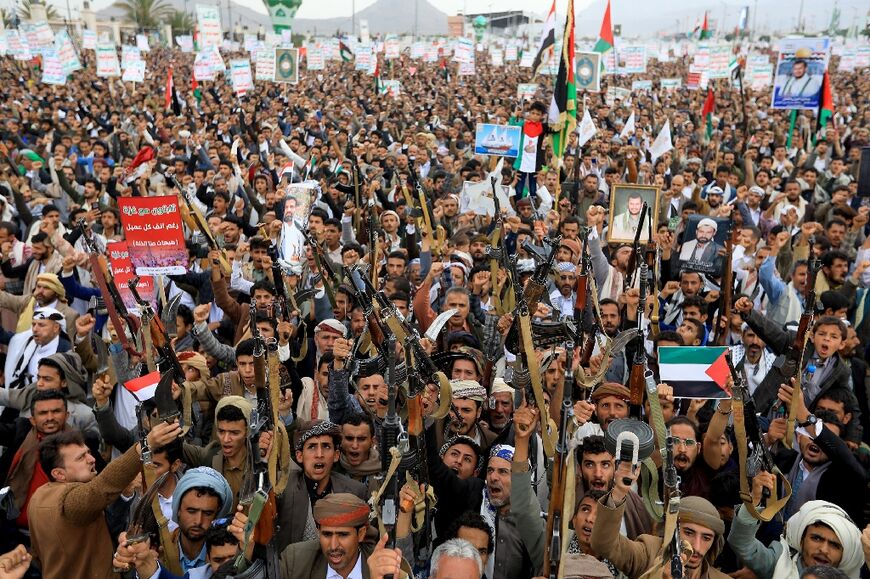
This is a movement that survived years of bombing and a blockade that starved its people. Under siege it organized. It brought hundreds of thousands of Yemenis into the streets of Sanaa week after week, rallying for Palestine and against the war on their own country. It built missiles and drones that reach the Saudi capital and the heart of the Saudi oil industry. Yemen has a people organized to fight for their own country, and that has changed the balance of the war.
The Saudi monarchy has one of the biggest military budgets in the world. Its warplanes, missiles and targeting intelligence come from the United States and Britain. Still, it could not beat Ansar Allah. For all its wealth, it has never raised ground forces that can win. So it hires them. Saudi money has recruited Sudanese fighters, some of them children, for the front lines in Yemen. It also pays Yemenis to join militias that fight Ansar Allah, like the new recruits killed at the training camp on Oct. 19. Oil money can buy weapons. It cannot buy soldiers with a reason to fight. So the monarchy goes looking for more armies.
Crown Prince Mohammed bin Salman, who runs the kingdom, asked Trump on Sept. 11 to send troops. Trump said no. The Saudis asked again. Central Command, the military headquarters that runs the Pentagon’s wars in the region, opposed it.
The same government bombing Iran will not send troops to save the Saudi monarchy in Yemen. Its military is tied down in a war on Iran it still has not won. And it has fought Ansar Allah before. In 2025 the Pentagon bombed Yemen for seven weeks, lost warplanes and drones, and in May agreed to a ceasefire with Ansar Allah still standing. That is the trap the United States is in. It cannot hold West Asia without war, and every new war builds the resistance, kills more of its own soldiers and stretches its military thinner. So the Pentagon sends the Saudi monarchy weapons and intelligence, and lets soldiers from other countries do the fighting and dying.
The forward base
Israel is the United States empire’s forward base in West Asia. The United States pays for it with $3.8 billion in military aid a year. Its job is to attack any force in the region that refuses to submit to the United States. When the Pentagon holds back, Israel attacks. Israeli warplanes joined the Pentagon’s attack on Iran. Israel has bombed Yemen’s ports and leveled much of southern Lebanon.
The Palestinians are Israel’s first target. They are also the first to resist. Every October, during the olive harvest, settlers attack Palestinian farmers in their groves. The United Nations counted more than 1,600 settler attacks causing injuries or damage in the West Bank between January and August.
On Oct. 16, masked settlers attacked Palestinians harvesting olives in villages outside Ramallah and set groves and cars on fire. Palestinian volunteers put out the flames. The settlers also beat Heidi Levine, a Jewish photojournalist filming for the Washington Post. Netanyahu’s office called the attack “alleged.” The next day, settlers beat a visiting French mayor with iron bars in the village of Taybeh.
The settlers beat a journalist from the United States and a French mayor in the open because they know Israel’s government, and the United States behind it, will protect them. The Palestinians face these attacks every day. They keep harvesting their olives anyway, because that is how they hold on to their land.
Borrowed armies
The Trump administration has told the Gulf monarchies to find others to fight for them. At a security conference in Qatar, Trump’s envoy Tom Barrack told the Gulf governments that “America as the guarantor to the world, for the last 80 years, it is no longer there,” and urged them to defend themselves through “regional partnerships.” Then he added: “We’re not leaving.” The United States wants to keep the region’s wealth without sending its own soldiers to die for it.
Pakistani troops have guarded the Saudi kingdom since the 1980s. On Aug. 7 Saudi Arabia, Turkey and Pakistan signed a defense pact in Mecca that treats an attack on one as an attack on all, as NATO does. Commentators called it an “Islamic NATO.” Many in the region hoped it would be a check on Israel, which had bombed Qatar in September 2025. Trump welcomed the Mecca pact as a “big, bold, important first step.” In early October the three governments met in Riyadh and agreed to rush forces to Saudi Arabia against Ansar Allah. The “Islamic NATO” sent no forces to defend Gaza. Now it is mobilizing to defend the Saudi throne against Yemen, a Muslim country that closed the Red Sea to Israeli shipping in support of Gaza.
Under its earlier pact with the kingdom, Pakistan sent a fighter squadron, 8,000 troops and an air defense system to Saudi Arabia in May. Turkey has provided air defense systems, intelligence, drone operators and logistics. On Oct. 20 Britain, the old colonial power in the Gulf, announced it would send Royal Air Force Typhoon fighters to patrol Saudi skies, along with military advisers.
Now Egypt is being drawn in. On Oct. 17 President Abdel Fattah el-Sisi asked parliament to authorize military action to defend Saudi Arabia. The next day Egypt’s National Defense Council, which Sisi chairs, approved sending troops on what it calls a defensive mission. Parliament has twice put off the vote, most recently pushing it to Oct. 26. The deployment needs a two-thirds majority.
Gulf money has paid Sisi’s bills since the 2013 coup that brought him to power. Egypt sits on Gaza’s southern border and helps enforce the blockade that is starving its people. It has done nothing to defend Gaza. It is ready to send its army to defend an oil monarchy.
Ansar Allah warned Cairo against it, recalling Egypt’s war in Yemen in the 1960s. Then Egypt sent some 70,000 troops to defend the new Yemeni republic against royalists armed by Saudi Arabia, and lost an estimated 26,000. This time Sisi would send Egyptian soldiers to fight on the Saudi side.
The Pakistani government guarding the Saudi throne is jailing and shooting its opponents at home. Supporters of jailed former Prime Minister Imran Khan set out Oct. 4 on a march toward the capital, Islamabad, demanding his release and that Pakistan send no troops to fight in Yemen. Khan himself opposed sending Pakistani troops into the Saudi war on Yemen when it began in 2015. Ahead of the march, police rounded up scores of workers from Khan’s party, women among them, along with lawmakers and party leaders. Some families could not find out where their relatives were being held. On Oct. 13 police opened fire to break up another protest in Bara, a town in Pakistan’s northwest. Khan’s party says officers fired directly into the crowd.
The war spreads
Iran broke free of the United States in 1979. Yemen’s Ansar Allah refuses to bow to the Saudi monarchy today. Every attempt to force them back brings more resistance, and every new round of resistance forces the United States to widen its war. It sends the weapons and the intelligence. The Saudi monarchy buys the soldiers. Egypt and Pakistan, whose governments live on Gulf money and on aid and loans the United States controls, are being drawn in to defend a throne their own people have no reason to die for. This way the United States empire gets armies the Pentagon never has to command.
But every time the war widens, it reaches new countries and new people. In Pakistan, marchers are demanding no troops for Yemen. In Egypt, people are being asked to fight for an oil monarchy while Gaza starves on their border. Millions of workers from Pakistan and Egypt already labor in the Gulf, producing the wealth their governments now want to send soldiers to defend. The more the United States empire leans on others to fight its war, the more people it drags in, and the more people it turns against it. In 1978, Iran’s oil workers shut off the oil and brought down a throne propped up by the United States.
Join the Struggle-La Lucha Telegram channel