
Within an hour of ICE shooting a man on West 225th Street, the people of Marble Hill were in the street. Marble Hill is a working-class, largely Dominican neighborhood at the northern tip of Manhattan. The Harlem River separates it from the rest of the borough, while its streets connect directly to the Bronx. A subway stop, shopping center and several high schools are packed into a few blocks.
Protesters came off the 1 train, out of the apartment buildings and the shops, and marched on the hospital where the wounded man was held under federal guard. Their demand was the one rising from every neighborhood ICE has attacked this year: Abolish ICE.
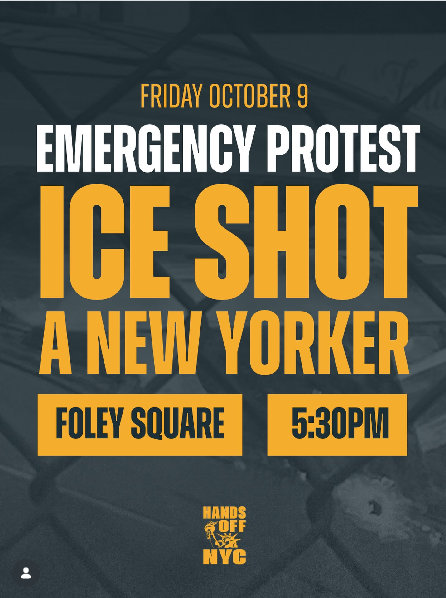
Another protest is planned for 5:30 p.m. on Friday, Oct. 9, in Foley Square in lower Manhattan, called by Hands Off NYC.
Seven shots rang out just after 4 p.m. on Thursday, Oct. 8, on one of the most crowded blocks in the neighborhood, between the Target store and the elevated train, at the hour the high schools let out. Parents were walking children home. Students filled the sidewalks. Iris Rosa, who lives nearby, hid in a store with others until the firing stopped. When she came out she saw a man on the ground, bleeding, pinned down by agents, and a small child in the car being held by the agents who had just shot into it.
The man was Oscar Belgal, 28, a Dominican immigrant. His 5-year-old son was in the back seat. Viely Herrera saw Belgal’s SUV crash into a concrete barrier after the shots and saw him climb out holding his neck and shouting in Spanish. The boy was crying, Herrera said, and the agents would not let a woman take him from the scene. Pedro Almaraz, who works at a restaurant on the block, heard the shots and saw people screaming as masked men in vests stood over the man on the ground.
Emily DeTar Birt, a Unitarian minister who has lived in Marble Hill for 10 years, put it plainly: “There are a number of high schools here, a charter school and at least three day cares. This is happening in broad daylight in front of our kids.”
The agents wore masks instead of uniforms. More than one was disguised as a construction worker in a yellow high-visibility vest. By using workers’ clothing as a disguise, ICE puts real construction workers in danger. Anyone wearing those vests could now be mistaken for an ICE agent.
One of the agents wearing a construction vest carried a military assault rifle and drew his weapon on Belgal. Rosa watched him take off the vest afterward and stash it in a vehicle. “There was no reasonable way to identify them as ICE agents,” Mayor Zohran Mamdani said that night.
Agents kept Belgal on the asphalt as he bled. New York police officers were the ones who finally took him from the agents, put him in a police car and drove him to NewYork-Presbyterian Allen Hospital a few blocks away. Later that night, ICE took the wounded Belgal from the hospital in an unmarked vehicle and drove him to detention. Mamdani said he spent about two hours on the phone with President Donald Trump and Homeland Security Secretary Markwayne Mullin, demanding that ICE leave the city and that Belgal be released. He got neither, and ICE drove Belgal away while the mayor was still talking.
The neighborhood moves
Bystanders at the scene said to each other, “This is Minneapolis all over again.” Hand-lettered signs appeared: “Jail all killer ICE agents.” “Leave our neighbors alone.” At an emergency press conference called by Hands Off NYC and the New York Immigration Coalition, every speaker demanded the same thing.
“ICE, get out of our neighborhood,” Bronx Borough President Vanessa Gibson told the crowd. “I’m angry that we have to be here. We are a working-class community. We don’t deserve this type of treatment from the White House. There are more of us than there are of them. I want this to be a moment that we turn into a movement.”
Darializa Avila Chevalier, the Democratic nominee for Congress in the district that includes Marble Hill, told Democracy Now the next morning what the crowd was demanding. “This is an agency that should have never existed to begin with. And what we saw yesterday was a prime example of why it is a terror to our communities, why it should not exist. It undermines public safety. It makes our communities feel terrorized by their own government. And we need to make sure that such an agency never comes to pass and never exists again.”
At the rally she pointed at the people around her. Trump runs his assault on immigrant communities “to make us feel powerless,” she said. “But I want us to look around and look at how many people came out for this community. That is how powerful this community is. He messed with the wrong city.”
Public Advocate Jumaane Williams told the crowd, “It is our time to stand up. Those of us who have more privilege, we must take more risk to protect those who don’t.”
While the rally went on, federal agents went door to door in the surrounding apartment buildings. Homeland Security Investigations agents went door to door in the surrounding buildings, Chevalier said, “asking neighbors for, quote-unquote, ‘evidence,’ asking them about their video cameras.” She and state Sen. Gustavo Rivera followed behind them, telling residents they did not have to open the door or speak to any agent without a warrant. “They will pretend to be NYPD police,” she said. “They are not. You do not have to open the door to them.” Residents do not have to open their doors to police without a warrant, either.
At the hospital
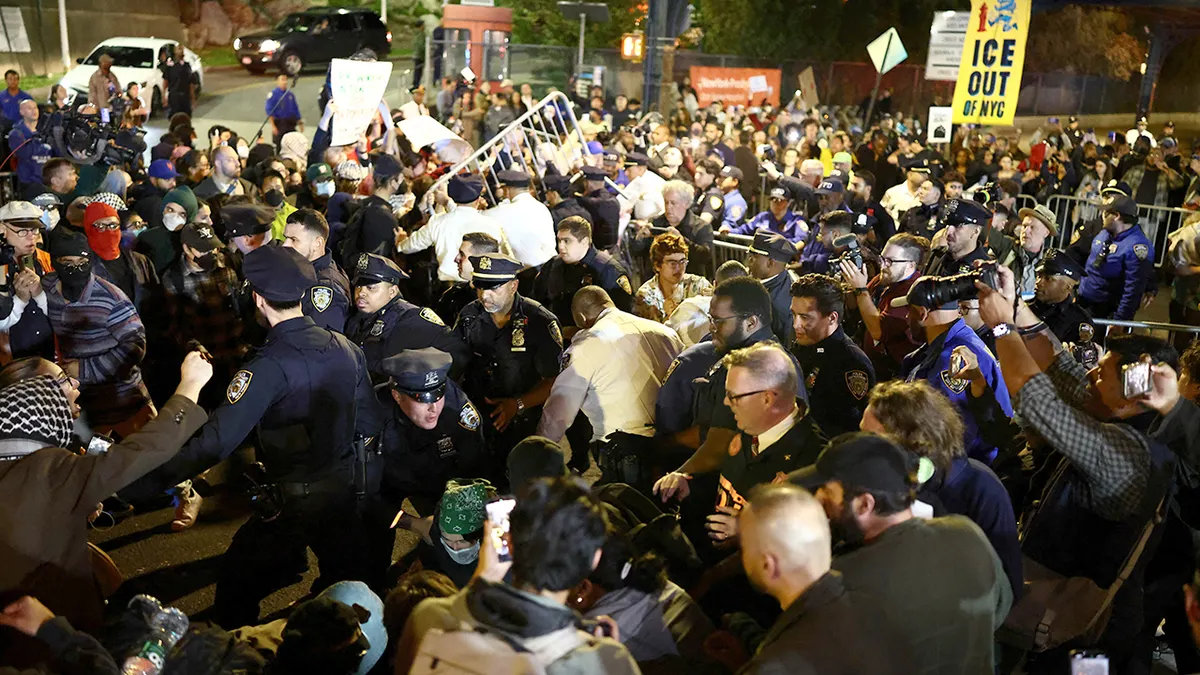
Then the march went to Allen Hospital, where ICE was holding Belgal. Hundreds of people filled Broadway. Drums pounded. Passing cars honked. The chants were “ICE off our streets now!” and “We want justice!” The crowd’s purpose, Chevalier said, was “to make sure that ICE wasn’t leaving with our neighbor.”
The New York Police Department made sure it did. Officers threw up barricades and pressed them into the crowd. Chevalier, trying to get the police to pull the barricades back, was shoved to the ground with others. Four people were arrested and charged with obstructing governmental administration and resisting arrest. “This is why we also must demand that we get rid of and disband the SRG,” Chevalier said of the NYPD’s Strategic Response Group, the unit that polices protests. “This type of response should have never happened for folks who were just simply trying to protect their neighbor.” Chevalier watched an unmarked car with police lights drive south through the crowd, “ramming into people before speeding away.” Police shoved protesters out of its path.
City Council Member Carmen De La Rosa, who represents Marble Hill, Inwood and Washington Heights, said the department’s claim that it does not collaborate with ICE did not survive the night. “I personally witnessed the NYPD escalating aggressively towards our community, barricading the community in, pressing barricades against our neighbors,” she said. “I also witnessed NYPD helping the ICE vehicles whisk away our neighbors and come in and out of the hospital.”
Outside the hospital, Murad Awawdeh of the New York Immigration Coalition described why people had come out: “The pain that you’re witnessing is people who are witnessing their neighbors, their family members, their friends being ripped away.” Donna Lieberman of the New York Civil Liberties Union said New Yorkers had come out “because ICE is a rogue, unaccountable, violent, and racist plague on our communities,” and ended: “We demand ICE get out of New York.”
The smear
Instead the department did what it always does: It called Belgal a ‘criminal illegal alien,’ pointed to an old conviction and blamed New York City for releasing him after past arrests. DHS rules generally prohibit agents from firing at a moving vehicle solely because its driver poses a threat with the vehicle. Police Commissioner Jessica Tisch read out his arrest record at her own press conference. New York law seals the records of arrests that end without a conviction, and the NYPD has already been taken to court for handing such records to the press.
Jumaane Williams had warned the crowd hours earlier that officials would use Belgal’s arrest record against him. “There was no reason for her to read out this person’s past contact with police,” Chevalier said. “There was no justification for anything that transpired that afternoon. There is no occasion under which this is OK. There is no excuse for allowing ICE to come into our city to shoot seven bullets into cars where there are children.”
DHS also claimed its officers “immediately rendered aid.” That is a lie, and everyone on the block saw it: the agents held Belgal down on the asphalt as he bled, and it was city police who got him to the hospital. DHS lied the same way about Renee Good and Alex Pretti in Minneapolis, and it lied again here.
WIRED identified one of the armed agents at the scene, who wore a construction vest and carried a rifle, as Brenden Cuni. Federal judges have found arrests he led unlawful three times this year. One found he signed an arrest warrant swearing database searches had confirmed a Bronx man was undocumented when the searches had found nothing. In another case, a judge found that doorbell video ‘largely contradicts’ Cuni’s sworn account. A lawsuit says he tripped a 21-year-old Bronx man, breaking a tooth, then shocked him with a Taser about six times while he lay handcuffed, and called him a “maldito Mexicano.” ICE kept him on the street, leading arrest teams, with a rifle. “These cowboys, who think they can just be above the law, are shooting into our streets, not asking who is around,” Chevalier said.
Why now
The neighborhood saw this coming. De La Rosa said ICE agents had been gathering for weeks in the Target parking lot a quarter mile from the shooting, private property whose owner had promised local officials he would bar them and did not. Residents had protested the agents in the lot. ICE teams had been seen massing in Van Cortlandt Park and Inwood Hill Park. “This is the result of that escalating presence,” De La Rosa said.
The Trump administration has stepped up ICE operations nationwide ahead of the Nov. 3 midterm elections. Since Sept. 27, DHS has been running what it calls a “public safety surge” against sanctuary cities and states, including New York. On Oct. 6, two days before the shooting, ICE leaders ordered agents nationwide to make 1,000 more arrests a day, reviving the White House quota of 3,000 arrests a day, CNN reported. ICE arrests in New York had already jumped by more than two-thirds between May and July. On the day of the shooting, Trump called on “the people of Minnesota” to “fight back” against Somali immigrants.
In Austin on Sept. 20, an ICE officer shot Wilber Rafael Garcés Pérez, a Venezuelan DoorDash driver. ICE took him from the hospital within hours, with the bullet still lodged near his spine. The shooting left him paralyzed on his left side, his lawyer and mother say. ICE still holds him in a detention center, where he has been given painkillers and little else. In July, ICE agents killed Lorenzo Salgado Araujo in Houston and Johan Sebastián Durán Guerrero in Biddeford, Maine. Durán Guerrero was not even the man they were looking for. All three men were behind the wheel, as were Belgal and Renee Good, the Minneapolis woman an ICE agent shot dead in her car in January.
After the July killings, Mullin paused ICE traffic stops. Trump overruled him within days, calling traffic stops one of ICE’s “most important and effective Crime Fighting tools.” In ICE detention centers, people are dying at the highest rate in more than a decade, Human Rights Watch reports.
Congress gave ICE $75 billion through 2029, including $45 billion to expand detention. That government money flows to private jail companies and contractors. Contracts that pay according to the number of people detained give these companies a financial interest in keeping the camps full. The Government Accountability Office found that ICE spent more than $1 billion buying 11 warehouses for detention camps this year and now plans to sell seven of them, after spending more than $20 million it cannot recover. ICE spreads terror through working-class communities while private detention companies and contractors profit from mass arrests.
Workers who live in fear of ICE raids are more vulnerable to low wages and harder to organize. The repression targets migrant workers first, but extends to Black and Latine communities, women, LGBTQ people and anyone who takes to the streets to resist it.
Minneapolis, then New York
Gibson said there are more of us than there are of them. Minneapolis proved it. Months of mass resistance in the streets forced a withdrawal of federal immigration forces from Minneapolis. In Marble Hill on Oct. 8, the mayor’s two hours on the phone with the White House got Belgal nothing; while he was still talking, ICE drove him away. What stopped ICE in Minneapolis, and what filled Broadway outside Allen Hospital, was people.
A 5-year-old boy watched his father shot on a block he walks every day, in front of hundreds of other children heading home from school. The neighborhood that saw it has given its answer, in a chant that carried over the barricades: ICE off our streets, now. Not reformed, not retrained, not re-dressed in uniforms. Off our streets. Abolish ICE.
Join the Struggle-La Lucha Telegram channel