
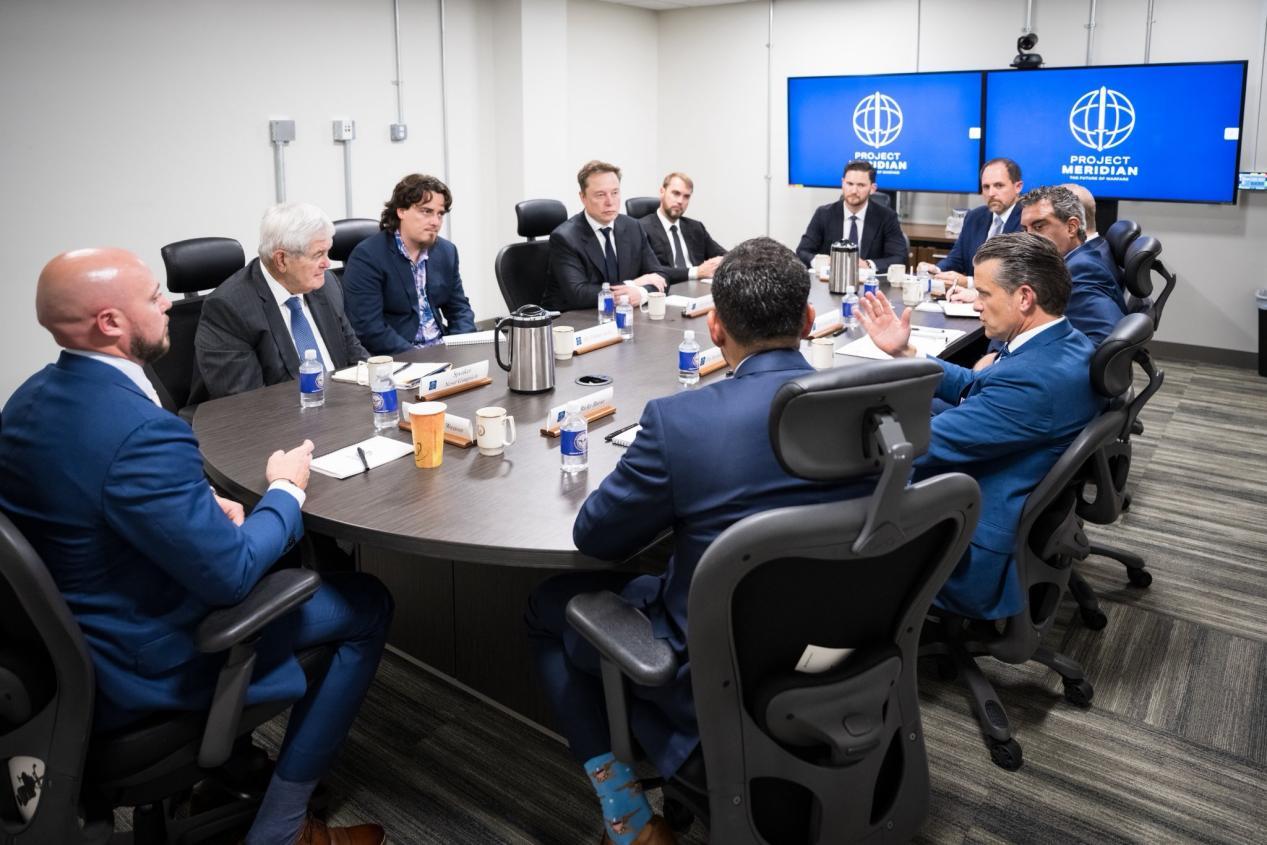
Elon Musk’s SpaceX and Palmer Luckey’s Anduril do billions of dollars of business with the Pentagon. Now, the Pentagon has given the two billionaires the job of telling it what to buy.
On Sept. 30, Secretary of War Pete Hegseth stood before a screened audience of junior troops at Marine Corps Base Quantico in Virginia and named Musk, Luckey and former House Speaker Newt Gingrich to lead Project Meridian. In 120 days, the three are to identify the “domains that we must conquer, and capabilities we must master” and find the weapons and systems the military will need, “without any creative limitations or restrictions.”
They met with Hegseth in a secure classified facility a short walk from the stage as soon as the speech ended. Emil Michael, a former Uber executive who is now the Pentagon’s chief technology officer, will oversee the project. A separate memo ordered the Joint Staff and every branch of the military to tie their own work on future warfare to it.
Who is picking the weapons
The Pentagon’s operations in space increasingly depend on Musk’s SpaceX. Its rockets launch military satellites. Its Starshield division is building hundreds of spy satellites for the National Reconnaissance Office, giving the military the ability to find targets almost anywhere on Earth. In May, the Space Force gave SpaceX the job of building the backbone of a new military satellite network. It called the award competitive but could not say whether any other company had bid. Pentagon documents released in August acknowledged that, for some military aircraft, there is no near-term alternative to Starshield.
SpaceX’s reach goes far beyond the military. Starlink, its satellite internet service, accounts for about two of every three working satellites orbiting Earth. One private monopoly controls a satellite network on that scale just as the Pentagon is making satellites essential to its communications, surveillance, targeting and missile tracking. The Pentagon has built a dependence on SpaceX that it cannot quickly replace.
Luckey founded Anduril Industries in 2017 to sell autonomous weapons. In March, two weeks into the war on Iran, the Army signed a 10-year contract with Anduril worth up to $20 billion, aimed largely at shooting down drones. Anduril is building a giant weapons plant, Arsenal-1, in Ohio.
Drones, satellites, autonomous weapons, artificial intelligence: the fields Project Meridian is assigned to study are the fields where SpaceX and Anduril make their money. Their satellites, networks and battlefield software have become part of the military’s own infrastructure, and the war budget is the market through which the companies grow. The Pentagon and this layer of capital are building the same war machine together.
Gingrich supplies a political case for this military buildup. For more than a decade he has warned that an attack on the electrical grid could shut down much of the country. One threat he repeatedly raised is an electromagnetic pulse, produced by a nuclear explosion high above the Earth that could damage electrical systems across a wide area. He also backed the creation of the Space Force in 2018.
Those ideas now overlap with programs the Pentagon is expanding. Hegseth’s new “Fortress America” plan calls for every major military base to generate its own power so it can keep operating if the civilian grid is knocked out by cyberattack, sabotage or another attack. At the same time, the Space Force has become one of SpaceX’s biggest military customers. Gingrich is not selling the weapons or satellites. He helps make the political case for buying and building them.
From DOGE to the war command
Musk spent nearly $300 million to help elect Trump and other Republicans in 2024. Then he took a government appointment and ran the DOGE drive that pushed some 260,000 federal workers out of their jobs.
He left the government at the end of May 2025. Days later, he and Trump fell out over Trump’s budget bill, which ended tax credits for the electric cars Tesla sells. Trump threatened to cancel SpaceX’s government contracts. Nothing came of it. The Pentagon depends on SpaceX to launch its satellites and run its military satellite networks, and SpaceX’s military business has only expanded since. The rockets kept launching, the spy satellites kept going up and the Pentagon kept paying.
Elon Musk has moved through two parts of the government in two years. In 2025 he helped slash the federal workforce. In 2026 he is helping plan the Pentagon’s future wars. In both jobs, decisions were pushed into parts of the government that can act without a separate vote in Congress. Congress did not stop them; it kept voting the money that allowed them to be carried out. Musk has this access because the government serves the class he belongs to, and because the Pentagon depends on what he owns.
Trump’s 2027 budget asks over $1.5 trillion for the military, nearly half again what was spent in 2026. Even that figure hides much of what the war machine costs. Nuclear weapons are paid for through the Energy Department and the Coast Guard through Homeland Security, and more is scattered across other agencies. Counted in full, the real total is far higher. The money is pouring into the industries where the biggest fortunes are already gathered: weapons, aerospace and artificial intelligence.
The capitalist government has always served monopoly capital, and the monopolists have often run the Pentagon themselves. Charles Wilson left the presidency of General Motors to become secretary of defense in 1953. Robert McNamara came from the presidency of Ford in 1961 and ran the war on Vietnam. Project Meridian is the same rule in the open, but with something new. Wilson and McNamara came from the auto monopolies that built the tanks, trucks and bombers of World War II.
Musk and Luckey made their fortunes in satellites, drones and artificial intelligence, the industries now moving to the center of the war buildup. The Pentagon depends on SpaceX to launch satellites and run military networks it says cannot quickly be replaced. Musk now has a hand in deciding what the Pentagon will buy next. Luckey does too. Their rise was already underway, but the Pentagon’s defeat in Iran has accelerated it as military planners search for new weapons and technologies they think can solve the problems the war exposed.
The guaranteed buyer
The war buildup comes as artificial intelligence has become one of the biggest sources of investment in the United States economy. By bank estimates, spending on data centers, chips and the power to run them accounted for a quarter to a third of economic growth over the past year. The five biggest tech companies plan to spend more than $700 billion on it this year. Each is racing to build more computing power and capture a larger share of the market.
That expansion is running ahead of the market it depends on. The companies are building data centers and buying chips today on the expectation that future sales will make those investments profitable. If the sales fall short, computing power that looked urgently needed during the boom becomes excess capacity that cannot earn the expected profit.
As the AI companies build more capacity than the civilian market may be able to use profitably, the Pentagon offers another market. It signs long contracts, buys on emergency timetables and does not have to wait for civilian customers to appear. That can guarantee sales and profits for particular companies. But Pentagon spending creates no new value. The government borrows to finance the war, while the weapons it buys are used up in war rather than becoming new means of production.
The war budget cannot save the boom. The war is fought on borrowed money. The federal government is borrowing heavily to finance the war while the AI monopolies borrow enormous sums to build data centers, buy chips and secure the power to run them. Together they add to the demand for money capital. When that demand grows faster than the supply, interest rates rise. Higher rates make the debts accumulated during the boom harder to carry and tighten the credit that allowed the overbuilding to go so far in the first place.
The buildup did not begin with the AI boom and will not end with it. The drive to war on China comes from imperialism itself. The AI boom has its own immediate economic drive. Competition pushes each capital to invest in a technology that promises to cut labor costs, seize markets from rivals and yield exceptional profits. But the war buildup and the AI boom are now reinforcing each other.
United States capital also uses military force as a weapon in the struggle for markets, resources and trade routes. The ban on selling the most advanced chips to China and the warships off its coast serve the same aim. The overbuilding in AI adds pressure and speed. A layer of capital with hundreds of billions of dollars sunk into machines has a growing stake in the war budget as a guaranteed market, and its owners now sit where that budget is written.
War without limits
Hegseth said Project Meridian “is not about developing new strategies or new policies.” The basic aims and targets are already set. The ruling class has named its enemies; Project Meridian will help decide what weapons will be used against them. Choosing the weapons helps determine how those wars will be fought and who profits from fighting them. On Project Meridian, the choosers are the owners of the war industries.
The Pentagon says the project will look at fighting everywhere from underground to the space around the moon. Hegseth’s memo lists artificial intelligence, autonomous systems, directed energy, robotics and biotechnology. The stated goal is “absolute technological dominance on the next-generation battlefield.” The Congressional Research Service has documented plans for space-based directed-energy weapons in the same Space Development Agency program that Starshield belongs to.
Project Meridian has a twin. A new Autonomous Warfare Command, or AUTOWARCOM, will pair commercial developers directly with combat units under a program called Project Agincourt. The corporations design the future weapons at the top and field the current ones alongside the troops.
The wrong answer
The Pentagon opened the war on Iran on Feb. 28 expecting to overthrow the government in weeks. Seven months later, it has failed to topple the government or force a surrender, and it is the Pentagon that is losing. Iranian strikes wrecked the Navy’s logistics hub in Bahrain. Commanders have put in writing that the military cannot keep up the war without stripping forces from the rest of the world.
Hegseth gave his answer at Quantico: the military needs masses of cheap drones that “flip the cost exchange.” Washington Post columnist David Ignatius, who welcomed the new command, agrees that failing to foresee drone warfare is a big reason the war has gone badly.
That is the war managers’ answer, and it is the wrong one. Iran has held out through seven months of bombing and blockade because a country of 90 million people is defending itself against imperialist aggression. Its drones and missiles are the weapons of that defense. The Pentagon can buy cheaper drones of its own. It cannot buy a people’s determination to defend their country. The same thing defeated the Pentagon in Vietnam, where it held every technical advantage.
Hegseth turns the war into an engineering problem, and an engineering problem has a seller. Anduril was selling the answer before Hegseth gave it. The $20 billion Army contract came two weeks into the war. Six months later, Hegseth gave Luckey a hand in deciding what the Pentagon buys next. The profit came first, and the control followed. The war itself drives the Pentagon to produce more, field new weapons faster and buy on emergency timetables. Private ownership turns each of those war needs into profit and expansion for companies like Anduril.
The missile-defense systems the war has drained come from the old giants of the arms industry. Lockheed Martin and RTX, formerly Raytheon, build the Patriot and THAAD systems and the Navy’s Standard Missile interceptors. The war has used up about two-thirds of the Patriots the Pentagon had before Feb. 28, and stocks will take years to rebuild. The defeat has not cost these companies. The Army has signed Lockheed to produce Patriots through 2032 in a deal worth tens of billions of dollars. But the old giants cannot produce their way out of the war, and their failure has widened the opening for a newer section of war capital. Anduril, SpaceX and their partners sell themselves as the answer the old giants could not deliver, and Project Meridian puts them in the room where the coming decade’s buying is decided. The defeat pays both sections. They compete over who gets the contracts, technologies and profits from the wars to come, while both depend on the war machine expanding.
On Oct. 2, Vice President JD Vance chaired a secret meeting at Camp David with Hegseth, Joint Chiefs Chairman Gen. Dan Caine, Secretary of State Marco Rubio and others on the next stage of the war. Trump says Iran either “signs the deal, or it won’t exist any longer.” He is losing the war, and he is weighing a return to major combat.
The bigger war
The war managers are studying Iran with a bigger war in mind. Interceptors used up in West Asia have already left the Pentagon short for the Pacific, and its planners read every failure in West Asia as a warning about war on China. The biggest target of the buildup is China, and the Pentagon says so in its own planning. Its 2026 budget named “deterring Chinese aggression in the Indo-Pacific” as a top priority. Biden’s Pentagon called China its “pacing challenge” and built its budgets around it. The aggression runs the other way, with United States bases, warships and missiles ringing China’s coast. Project Meridian, AUTOWARCOM and the space buildout are the newest part of a buildup against China that has run through administrations of both capitalist parties.
Starshield’s spy satellites are built to find targets anywhere on Earth, and the space weapons on the drawing board are not meant for Iran. The same “Fortress America” plan calls for bringing rare earths, semiconductors and specialty metals into the United States. Most of the world’s rare earths are processed in China. The Pentagon is preparing its supply lines for war on China and has handed Musk and Luckey the job of planning the weapons.
The United States government targets China because China’s development lies outside imperialist control. Its banks, its land and its main industries are not owned by Wall Street or any other imperialist center. China has lifted hundreds of millions of people out of poverty and built industry and infrastructure at a pace no capitalist country has matched, and it trades and lends across the Global South on terms the imperialist banks do not set. The policy toward China is containment, a form of warfare against a country imperialism cannot own. Project Meridian is planning a wider front of the same global class war. If the Pentagon cannot buy its way past a country of 90 million defending itself, it will not buy its way past a country of 1.4 billion.
Project Meridian’s report is due at the end of January 2027. The Pentagon is losing the war on Iran to a people defending their country, and nothing Musk and Luckey recommend can change that. The answer from the top is to give the owners of the war industries the job of naming the next battlefields: underground, out to the moon, across the Pacific to China. Their capital grows by widening the war, and the war widens to keep it growing. What stands against that drive is what has stood against it in Iran: people who will not be conquered.
Join the Struggle-La Lucha Telegram channel