
Since he stood at the United Nations on Sept. 22, President Donald Trump has threatened again and again to annihilate Iran. The Pentagon is moving the warships and troops that would give him the means to launch a much larger attack after the Nov. 3 election.
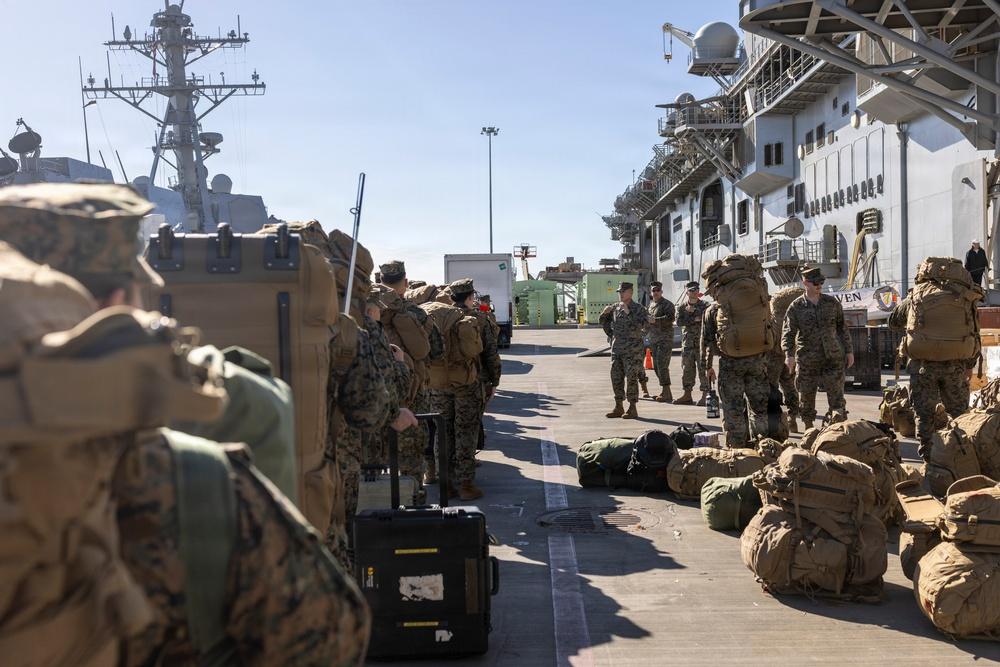
On Sept. 27, the aircraft carrier USS Theodore Roosevelt and its strike group quietly left San Diego for West Asia. On Sept. 28, the USS Makin Island Amphibious Ready Group followed, carrying Marines of the 13th Marine Expeditionary Unit. Together, the two groups would bring 9,000 to 10,000 troops to West Asia, where more than 50,000 United States military personnel are already deployed.
A United States official told The Associated Press the new forces could arrive as early as the end of October. Trump has told aides he expects to resume bombing Iran after the election, The Wall Street Journal reported Sept. 25.
The Roosevelt would join the USS George H.W. Bush, in the region since April, and the USS George Washington. United States officials say that could put three carrier strike groups in West Asia at once, although Stars and Stripes reported that the Roosevelt is expected to relieve the George Washington.
On Oct. 2, Trump’s top war managers met for hours at Camp David to plan the next steps in the war on Iran, three United States officials told Axios. Vice President JD Vance chaired the meeting. Secretary of State Marco Rubio, Secretary of War Pete Hegseth, CIA Director John Ratcliffe, White House envoy Steve Witkoff and Gen. Dan Caine, chairman of the Joint Chiefs of Staff, attended. The White House did not announce it.
The last such meeting took place in June 2025, days before the United States and Israel attacked Iran. “Things were decided or at least deeply discussed,” one of the officials said.
That afternoon, asked about his next move on Iran, Trump told reporters, “If I told you, you would have a major story.”
‘Annihilate the Islamic Republic’
At the United Nations General Assembly on Sept. 22, Trump told the world’s governments he had “a big decision to make.” He asked aloud whether to make a deal with Iran “or do I annihilate the Islamic Republic and do it quickly.” He asked whether to drive Iran “into hell with no chance of survival.”
On Sept. 30, asked how he could make a deal with Iran’s government, Trump said: “Maybe you blow them up. We have to make that decision: We blow them up or make a deal.”
On Oct. 1, leaving the White House for a campaign stop in Texas, he said Iran would “either sign a very fair deal or they won’t exist any longer.”
That evening in Denton, Texas, he said Iran’s government would “do something very proper and smart, or they won’t be around very long.”
The same day, Time magazine published an interview in which Trump said, “By annihilating Iran, we’ve created peace in the world,” and, “With Iran, I don’t think you could ever have peace.” Asked whether he would order new strikes after the midterm elections, he said it was “possible.” “We have a lot of weapons,” he added. Reminded of his threat at the United Nations to annihilate Iran, he replied: “Yeah, I would do that. It’s possible.”
Iran is a country of 90 million people. United States bombing killed at least 3,527 people there in the first six months of the war, according to Iran’s Health Ministry.
Each threat comes wrapped in the claim that Iran must never obtain a nuclear weapon. Iran’s nuclear program is a civilian development program, used to produce electricity and nuclear technology for medicine, agriculture and industry. Iran has consistently maintained that it has never sought nuclear weapons. United States intelligence agencies have reported since 2007 that Iran was not building one, including during both Trump administrations. On Oct. 1, the Wall Street Journal’s editors urged the administration to finish “the nuclear program or the regime itself.”
That demand makes the war aim plain. The United States government has been trying to force Iran to surrender its independence, accept the blockade and sanctions, and submit to United States domination in West Asia.
Iranian President Masoud Pezeshkian answered on Oct. 1 that the United States government should “get the idea of bringing us to our knees” out of its head.
The offer Trump dismissed
During the General Assembly, Iranian Foreign Minister Abbas Araghchi sent a seven-day plan through Qatari mediators. Iran would reopen the Strait of Hormuz by the seventh day and return to talks. In return, the United States would lift its naval blockade of Iran’s ports, waive oil sanctions, release about $12 billion in frozen Iranian money and end the fighting on all fronts, including Lebanon.
Trump rejected it on Sept. 26.
“They want to make a deal where they open the strait immediately because they’re losing so badly,” he said. He told Time the offer was “not good enough.” More oil and gas has been getting through the strait in recent weeks, but shipping remains disrupted, costly and far from secure.
Iran has offered to restore normal passage through the strait in exchange for ending the blockade, sanctions and fighting. Trump is demanding an agreement in which Iran reopens the strait while the blockade and sanctions intended to strangle it remain in place.
In March, Trump said the war would last four to six weeks. It is now in its eighth month, and the government he set out to overthrow still stands.
The administration has failed to achieve the aims for which it began the war. Bombing has not overthrown the Iranian government. The blockade and sanctions have not forced surrender or broken the country.
That is the contradiction now driving the escalation: the United States government cannot obtain submission by the means used so far, but it is unwilling to abandon the objective.
Mohsen Rezaei, secretary of Iran’s Supreme National Security Council, said on Sept. 29 that Trump is “trapped in a quagmire where he can neither negotiate nor fight.”
The “very fair deal” Trump demands is Iran’s surrender.
Iran under siege
The United States Navy has turned back 125 commercial ships from Iran’s ports, according to the United States military. On Sept. 26, Trump called the blockade “a wall of steel.”
The Treasury Department’s Operation Economic Outcast, launched Aug. 24, aims to cut Iran off from the world economy. Treasury Secretary Scott Bessent has said its purpose is to “sever every economic lifeline” of Iran’s government.
On Sept. 23, Treasury’s threat to sanction any company or airport that refuels or services Iranian airliners took effect. Within a week, international flights at Tehran’s main airport fell by more than two-fifths.
On Oct. 1, Treasury sanctioned Iran’s automobile and railway industries. The targets include Iran Khodro and SAIPA, which make more than nine of every 10 cars sold in Iran; the state-owned Islamic Republic of Iran Railway Company, which carries passengers and freight; and two other major rail companies. Treasury also sanctioned foreign companies supplying Iran’s auto plants, from Indonesia to Turkey to the United Arab Emirates.
Treasury called these industries “some of the last significant elements” of Iran’s industrial base.
Car plants, passenger trains and airliners are how people earn a living, get to work and move food and goods. The blockade, industrial sanctions and bombing are different weapons in the same war, aimed at making ordinary life so difficult that the country is forced to submit.
Bessent told Fox News on Sept. 27 that Iran would have “nothing” left to trade “probably within the next two weeks.” On Aug. 31, he had predicted collapse “within weeks or months.” In March, Trump called the war a “short-term excursion.”
The earlier deadlines have passed. Iran has not collapsed.
In recent weeks, the Pentagon sent two more Patriot missile-defense batteries to West Asia, Axios reported on Oct. 2: one to guard a Saudi oil facility and the other a Qatari gas facility.
In early August, when Trump was weighing a massive attack that included Iran’s energy infrastructure, the Saudi and Qatari monarchies lobbied him against it. They feared that Iran would strike their oil and gas installations in return. United States officials told Axios that this was a major reason Trump held off.
A renewed assault needs Saudi airspace. United States officials say the Saudi monarchy will not open it unless its oil fields are protected.
The Patriots are the price of the airspace.
This is the material relationship behind the military alliance. The Gulf monarchies sit on immense oil and gas wealth. These regimes, propped up by the United States, depend on its weapons and military protection. The Pentagon, in turn, depends on their territory, bases and airspace to wage war throughout the region.
The Pentagon has fired off so much of its arsenal that its own inspector general reported on Sept. 14 that the war had caused “strategic inventory shortfalls.” Trump dismissed the report as “mostly fake news.”
The batteries guarding the oil and gas installations come from the same depleted stock needed to protect United States bases. The Pentagon pulled them from other military commands, Axios reported.
The strain is not confined to weapons. On Oct. 2, the G7 agreed to release 100 million barrels of diesel and crude oil from emergency reserves as the war on Iran continued to squeeze global fuel supplies.
The war is already forcing choices about where scarce weapons will go. The oil installations were given priority.
Iran prepares its answer
Senior Iranian officials told Reuters on Oct. 1 that Iran is preparing a broader and more forceful response if the United States resumes large-scale attacks. Commanders are reviewing plans to extend targets beyond United States bases to countries that support United States military operations, and possibly to locations outside West Asia.
Allied forces in Lebanon, Yemen and Iraq have been told to prepare.
Hamidreza Azizi of the International Crisis Group told Reuters that Iran appears determined “not to respond symbolically to a symbolic move.”
On Sept. 29, Revolutionary Guard spokesperson Gen. Hossein Mohebbi read a letter addressed to the people of the United States. The war will end, it said, when the United States government admits defeat and withdraws its forces from the region.
Mohebbi told The Associated Press that the United States government uses Iran’s nuclear program as a pretext to plunder Iran’s wealth and make it a colony again.
Whatever the next military move, the war has already demonstrated something the administration did not expect. A country subjected to bombing, blockade and economic siege has continued to resist rather than accept the terms imposed on it, and that resistance is why deadlines for Iran’s collapse keep being replaced by new deadlines.
Still greater force
In his Denton speech, Trump said Iran is “ready to fold up” and that the United States will win the war “right after the election.”
Yet the White House is preparing still greater force: another carrier group, thousands more troops, reinforced defenses for the Gulf oil monarchies and repeated threats that Iran “won’t exist any longer.”
The buildup is no sign that United States imperialism has found a way to win the war it expected to finish in four to six weeks. The bombing and siege have failed to force Iran to its knees, while the United States ruling class remains unwilling to accept an independent Iran that it cannot control.
The outcome is not Trump’s to choose. The Roosevelt is sailing toward West Asia, but seven months of bombing, blockade and siege have not brought Iran to its knees.
Join the Struggle-La Lucha Telegram channel