
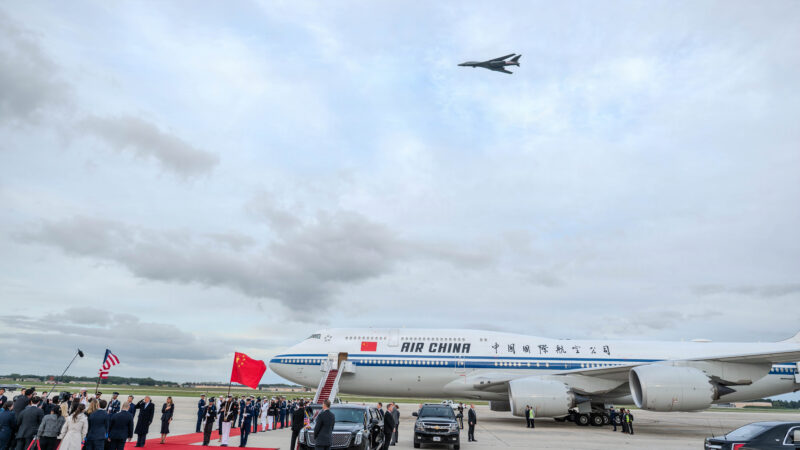
The United States government gave Xi Jinping a 21-gun salute at Joint Base Andrews on Sept. 23 and sent two B-1B bombers and a dozen fighters over his head as the national anthem ended. At the White House ceremony the next day, it did it again, this time with a B-2 stealth bomber and four F-22s directly over the South Lawn.
That is the whole summit in one picture.
Xi’s Sept. 23-25 visit was the first state visit by a Chinese president in 11 years. The ceremony welcomed him. The warplanes showed what stood behind the welcome. The ruling class in the United States wants the profits it gets from China while the United States government continues its military, economic and technological drive to contain China.
The imperialist press and politicians looked past the bombers and asked which leader had won. The New York Times called the trip a propaganda boost for Xi. Semafor’s Andy Browne quoted Rush Doshi, a top China official on Biden’s National Security Council, saying the “tectonic plates have shifted” and that Beijing believes it has “basically tamed the United States.” Twenty-one Democratic senators, including Chuck Schumer, accused Donald Trump of failing to confront China. Schumer said Trump greeted Xi “sort of as a supplicant.” Bloomberg said the two leaders were buying time “with neither able to afford a fight.”
Containment continued through the state dinner
Ten days before Xi arrived, Air Force Secretary Troy Meink told an Air and Space Forces Association conference that the Pentagon “now has on-orbit space control weapons.” It was the first public acknowledgment that the United States has put weapons in orbit. The Wall Street Journal editorial board noted that the timing “may be no accident” with Xi’s visit approaching.
On Sept. 22, the day before Xi landed, Trump stood at the United Nations and threatened to “annihilate” Iran.
China buys most of Iran’s oil exports. Treasury Secretary Scott Bessent had already moved to isolate every country that trades with Iran. He called it the greatest coordinated economic isolation in history and told those countries: “You are either with us or against us.”
The United States launched the war on Iran on Feb. 28. One purpose of the war is control over oil — who sells it, who buys it and on what terms. China is directly affected by that pressure.
In April 2026, the Treasury Department cut Hengli Petrochemical, China’s second-largest independent refinery, off from the United States financial system for buying Iranian oil. Banks and companies elsewhere that continue doing business with Hengli now risk being cut off as well.
United States forces have also seized three tankers carrying oil to China on the high seas, two loaded with Venezuelan oil and one with Iranian: the Centuries east of Barbados in December 2025, the Aquila II in the Indian Ocean in February 2026 and the Majestic X, bound for the port of Zhoushan, in April 2026.
The pressure goes beyond oil.
In April 2025, Trump raised tariffs on most Chinese goods to 145%, a tax that more than doubled their price at the United States border. When he took office three months earlier, the tariff on most of those goods had been about 20%. Smartphones, computers and some other electronics were exempted.
China answered in April 2025 by putting exports of seven rare-earth elements under government license. Automakers and other manufacturers in the United States depend on those materials. Their pressure helped force the Trump administration to retreat. In May 2025, it cut the tariff from 145% to 30% to get the licenses flowing. China had won the first round of the fight over rare earths.
In October 2025, China announced a second, broader set of rules on top of the April licenses. It included a ban on rare-earth exports for military use, sales to weapons manufacturers in the United States among them.
Rare earths go into F-35 fighters, Virginia- and Columbia-class submarines, Tomahawk missiles, Reaper drones, radar systems and guided bombs. They are part of the physical foundation of the Pentagon’s war machine.
China had its hand on that supply line. That hand is a government hand. China’s rare-earth mining and processing were consolidated into state-owned groups, and exports move only under government licenses.
Within three weeks, Trump agreed to a trade truce. The United States cut tariffs again and shelved a Commerce Department rule extending sanctions to the subsidiaries of sanctioned Chinese companies, while China suspended the October rules, the military ban included, for a year. The April licensing system stayed in force, and under it exports to the United States military and its contractors remain barred.
This was not a change of heart in the White House. China had imposed a material limit on what the United States government could do.
The truce covered tariffs and rare earths. It did not touch the military pressure on China, beginning with Taiwan.
A $14 billion package of weapons for Taiwan, mostly Patriot and NASAMS missiles, cleared congressional review in January 2026 and remains on hold. After meeting Xi in Beijing in May 2026, Trump told Fox News: “I’m holding that in abeyance and it depends on China. It’s a very good negotiating chip for us, frankly.”
The weapons have not disappeared. They are being held in reserve.
Nor did the truce touch the military buildup around China by the United States. The Army has stationed Typhon missile batteries, able to reach the Chinese mainland, in the Philippines and Japan. The Pentagon has expanded its use of bases in the Philippines, and Japan is rearming with backing from the United States.
Now set that record beside what came out of the summit.
A new United States-China Board of Trade recommended lower tariffs on about $30 billion in goods each way. No tariff has changed yet. The United States would lower duties on Chinese toys, small appliances, holiday decorations and children’s car seats. China would lower duties on seafood, wood, cosmetics and some farm goods from the United States.
The White House says China will buy coal from the United States in 2027 and 2028. Two pandas will go to the Atlanta zoo. There was talk of an artificial-intelligence hotline.
On rare earths, the White House fact sheet says only that the two sides “continue to work” on the issue. Nothing on chips. Nothing on Taiwan.
Xi’s formula for the relationship, at the White House on Sept. 24, was the one the two governments adopted in Beijing in May. He described it as a relationship of “strategic stability” between China and the United States. The two countries, he said, “stand to gain from cooperation and will both lose in confrontation.” The B-2 had passed over the South Lawn minutes earlier.
The contradiction inside monopoly capital in the United States
The Sept. 24 state dinner explained the summit better than the communiques did.
The heads of the largest technology and finance monopolies were there: Jensen Huang of Nvidia, Tim Cook of Apple, Elon Musk of Tesla and SpaceX, Sam Altman of OpenAI, Satya Nadella of Microsoft, Sundar Pichai of Google, Jeff Bezos of Amazon, Larry Fink of BlackRock and Jamie Dimon of JPMorgan Chase.
At the same tables sat Jim Taiclet of Lockheed Martin and Kelly Ortberg of Boeing, two of the biggest corporations in the war industry.
The technology and finance monopolies need the Chinese market and Chinese manufacturing.
Apple builds there. Tesla’s biggest factory is in Shanghai. Nvidia wants to sell its AI chips there. Before restrictions imposed by the United States cut off most of that business, China accounted for between a fifth and a quarter of Nvidia’s data-center revenue. Nvidia now expects almost no sales of those chips in China.
But many of the same monopolies are tied directly to the Pentagon and the military buildup.
Musk’s SpaceX launches military satellites and is a major Pentagon contractor. Microsoft, Google, Amazon and Oracle operate Pentagon cloud computing under a $9 billion contract.
Artificial intelligence is where the two sides of the table meet. The chip bans exist to keep China behind in AI. The corporations whose chiefs sat at the dinner — Nvidia, Microsoft, Google, Amazon and OpenAI — sell that same AI to the Pentagon, and the artificial-intelligence hotline the two governments discussed is a hotline between the two sides of an arms race.
The contradiction therefore does not run between one section of capital that wants peace and another that wants war. It runs through monopoly capital in the United States itself.
The corporations want the Chinese market, Chinese production and Chinese profits. At the same time, United States imperialism is trying to stop China from developing independently and to preserve United States domination in Asia.
Trump’s task at the summit was to manage both needs at once.
He held out the possibility of renewed chip sales to corporations that want access to China. At the same time, he kept the $14 billion Taiwan weapons package in reserve.
Nothing about this began with Trump.
Barack Obama launched the Pivot to Asia in 2011. It was primarily a military operation, moving 60% of the Navy’s fleet to the Pacific, but it was also accompanied by restrictions on advanced technology.
During Trump’s first term, the United States barred its corporations from selling chips and other technology to Chinese companies including Huawei and ZTE.
Joe Biden went further. His administration banned sales of advanced chips and chipmaking machinery to China and expanded military and technology alliances directed against it, including AUKUS with Britain and Australia and the military arrangement among the United States, Japan and South Korea.
In 2024, Biden imposed a 100% tariff on Chinese electric cars. During his final week in office, his Commerce Department issued a rule barring the sale of Chinese cars in the United States
Trump continued the same course after returning to office. In April 2025, his administration cut off the chip Nvidia had designed specifically for China. Since February 2026, the United States has allowed through small amounts of an older Nvidia chip, each one inspected in the United States and taxed 25%.
What actually holds imperialism back
China has won real ground, above all the rare-earth victory of 2025. That victory came from China’s own planned industry.
Multipolarity is the word Chinese diplomacy uses for the world it wants to see. At the Shanghai Cooperation Organization summit in Bishkek on Sept. 1, Xi called for “an equal and orderly multipolar world” with “equal rights, equal opportunities and equal rules for all countries, regardless of their size, strength and wealth.” BRICS communiques repeat the idea. So do many writers on the left in the United States and Europe, along with capitalist governments looking for more room to maneuver under pressure from the United States.
To supporters of multipolarity, China’s ability to force a retreat by the United States can look like evidence that a new balance among powers is restraining United States imperialism. But that reverses what happened. China did not force the retreat because the United States accepted equal rules or because a balance among governments held it in check. It forced the retreat because China’s planned industry gave it control over materials that industry in the United States and the Pentagon need.
The giant banks and industrial monopolies compete for markets, investment outlets, raw materials and profits. The governments they dominate use tariffs, financial sanctions, blockades and military force to defend those interests.
As the economic power of the United States declines relative to other parts of the world, that pressure does not disappear. The capitalist ruling class fights harder to defend what it holds.
The form can change. The underlying class drive remains.
The world before 1914 was also divided among several major powers. So was the world before 1939. Those poles were imperialist powers — Britain, France, Germany, Japan and the United States — driven by their own finance capital to compete for markets, colonies, places to invest capital and spheres of control.
A balance among powers did not prevent war. Nor did international rules.
Supporters of multipolarity will say that is not what they mean. The multipolar world Xi calls for is one in which no country is imperialist and all follow equal rules. But imperialism does not end because other countries ask it to follow equal rules.
The imperialist governments signed the Hague Conventions in 1899 and 1907. In 1928, they signed the Kellogg-Briand Pact renouncing war. Neither prevented another world war.
Imperialism has been restrained only when it has been held back by the resistance of the socialist countries, national liberation movements and the working class inside the imperialist countries.
That is the distinction between an agreement won through struggle and a theory that agreements can abolish the struggle itself.
Peaceful coexistence and class struggle
The same distinction applies to peaceful coexistence.
A workers’ state surrounded by capitalist powers needs periods of peace. It may need trade, diplomatic relations, arms agreements and temporary compromises.
The first Soviet government did all of these things.
The Bolsheviks did not confuse such agreements with the end of the struggle between the two social systems. A period of peace could give the workers’ state time to build, recover and prepare. It did not change the character of imperialism.
That distinction became blurred later. In the 1970s, Soviet leaders called the policy détente. Détente itself was not the problem. A workers’ state can negotiate arms limits, trade and less dangerous relations with an imperialist power.
The danger begins when a necessary tactical agreement is turned into a permanent theory of relations with imperialism — when concessions required by the balance of forces are presented as though the underlying conflict has disappeared.
Nixon went to Beijing and Moscow in 1972 while the United States was still waging war against Vietnam.
The possibility of détente did not make the Vietnamese struggle unnecessary. Nor could the interests of the Vietnamese liberation movement be subordinated to agreements among governments.
A workers’ state may have to make concessions. It should recognize them as concessions and continue supporting the struggles of workers and oppressed peoples.
Under Mikhail Gorbachev, the retreat became a rout. His “new thinking” declared that “universal human values” stood above the class struggle. Peaceful coexistence stopped being a tactic in the fight between two social systems and became the goal itself — an end to the fight. That was surrender dressed up as a theory.
This ideological retreat accompanied the advance of social forces inside the Soviet Union moving toward capitalist restoration. In 1991, those forces took control and destroyed the workers’ state.
The lesson is not that socialist countries should refuse negotiations. It is that negotiations cannot replace the class struggle.
The ruling class in the United States has only ever accepted peaceful coexistence on one set of terms: a truce in which the socialist countries set aside the struggle and United States imperialism does not. Its “peaceful competition” with the socialist countries has always meant blockade, boycott and economic strangulation, and each such phase has prepared the next military one.
The chip bans, tariffs, tanker seizures and orbital weapons are forms of that pressure today.
Even at its most peaceful, coexistence changes the form of the conflict. It does not remove its class basis. The Pentagon has never forgotten that. The bombers over the South Lawn were the reminder.
China and the pressure of coexistence
China is a workers’ state defending itself against imperialist encirclement. It is not an imperialist country. It has no colonies and no troops fighting abroad. Its one overseas military base is in Djibouti.
China is not a capitalist country, although capitalist relations exist within it.
The government owns the key sectors of industry, technology and banking. It retains the ability to plan major parts of the economy. The Communist Party controls the military and the political system.
But the market reforms introduced beginning in the late 1970s also created a large private sector, widened income differences and pushed profit-driven practices deeper into the economy. They fostered a privileged social layer whose outlook leans toward capitalism.
Under Xi, the government has taken measures to check some of these tendencies. They have not disappeared.
Capitalist restoration would mean a capitalist class taking control of the government and overturning the social foundations created by the revolution, as happened in the Soviet Union in 1991. That has not happened in China.
This contradiction inside China also shapes the pressure surrounding its foreign policy.
A workers’ state surrounded by imperialism has a real need for peace and trade. It needs time to develop its productive forces and defend itself. China’s policy of peaceful coexistence grows in part from that necessity.
The private sector and that privileged layer have their own interest in stable commercial relations and a secure place in the world market on whatever terms the imperialist powers allow. China’s diplomacy of peaceful coexistence and multipolarity reflects both pressures. Beijing does not promote multipolarity as a socialist project, but as a national strategy inside a capitalist world system. Agreements that reduce immediate conflict serve both.
An “equal and orderly multipolar world” assumes that the imperialist powers can be fitted into a stable system of equal rules and mutual benefit. But monopoly capitalism continues to produce the drive for markets, profits, resources and military advantage.
No diplomatic formula abolishes that drive.
States are not classes
That is why multipolarity works against socialism. It describes relations among governments, not social systems. It says nothing about who owns the banks, who controls production, who takes the profits or which class holds political power.
Those are the questions that determine whether a country is socialist or capitalist and whether its expansion is imperialist. A multipolar world is still a capitalist world, and still an imperialist one.
Multipolarity tells workers and oppressed peoples to look for protection to a balance among governments, most of them capitalist, instead of to their own struggle and their solidarity with each other.
The “Three Worlds” theory of the 1970s, which lumped the United States and the Soviet Union together as “superpowers,” made the same mistake. It turned the world struggle into a rivalry among governments and made cooperation with United States imperialism look normal.
What the summit settled
Trump posted Sept. 25 that “tremendous things will be happening.” What the United States government actually brought to the summit was strategic bombers over both ceremonies, weapons in orbit, tankers seized at sea, war against one of China’s main oil suppliers and $14 billion in weapons for Taiwan held in reserve.
Trump and Xi are scheduled to meet again at the APEC summit in China in November and at the G20 in the United States in December. The trade truce, and with it China’s suspension of the October 2025 rare-earth rules, may be extended again when it runs out on Jan. 10. Extensions can move deadlines.
They cannot remove the contradiction that produced those deadlines.
The ruling class in the United States still wants the profits it gets from China while the United States government prepares for the possibility of war against China. For now the ruling class is doing both, and the bombers show which way it leans.
Join the Struggle-La Lucha Telegram channel