
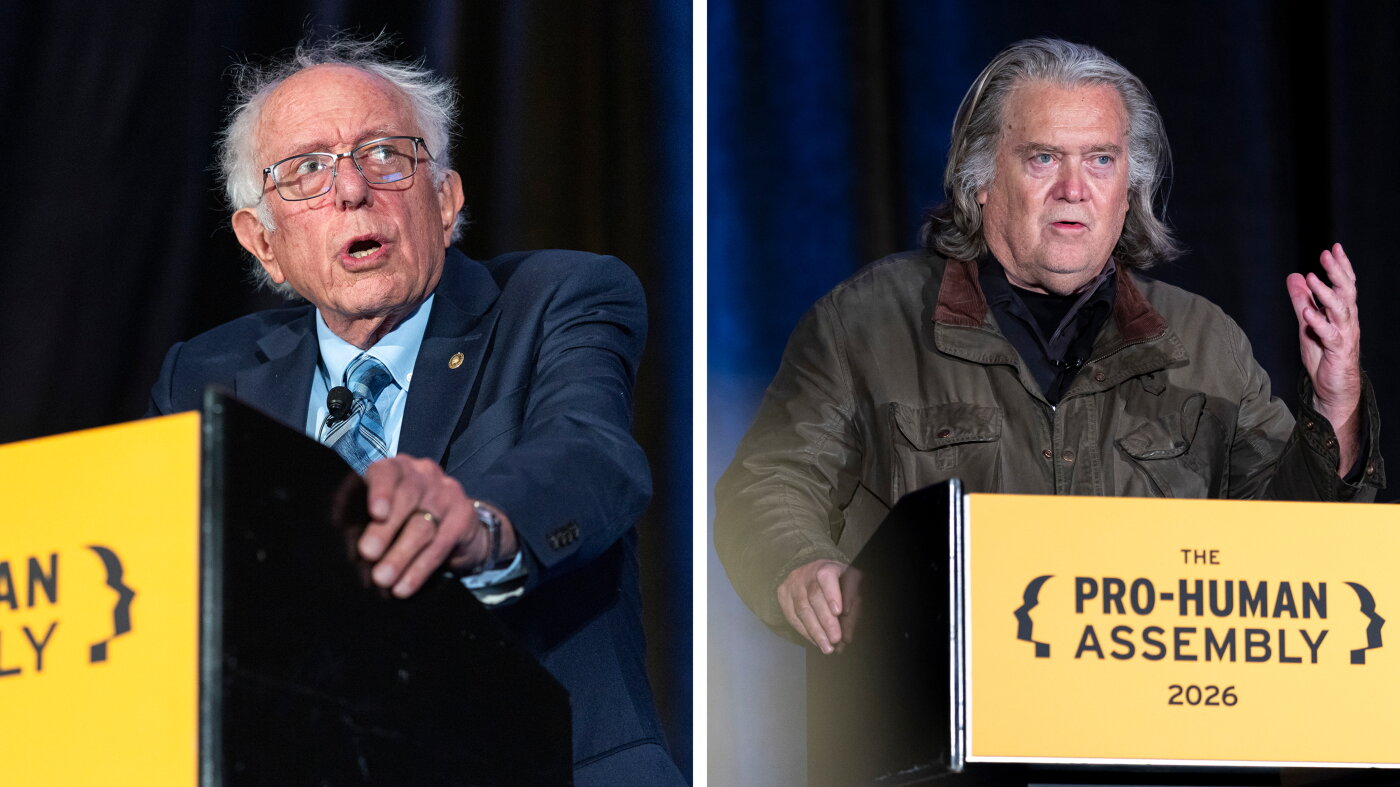
Sen. Bernie Sanders and Steve Bannon spoke at the same one-day gathering in Washington on Sept. 15. The Pro-Human Assembly, organized by the Future of Life Institute, also heard from Democratic Rep. Greg Casar. Scheduled speakers included Democratic Sen. Richard Blumenthal and Republican Sen. Marsha Blackburn; Democratic Reps. Don Beyer and Bill Foster; economist Daron Acemoğlu; AFL-CIO President Liz Shuler; and American Federation of Teachers President Randi Weingarten.
The question posed from the stage was how to keep artificial intelligence under human control.
But there is no “human control” in general. Every one of these systems is owned by somebody, financed by somebody and put to work by somebody. The real question is who controls the machines and what they are being used for.
That question largely disappeared at an assembly organized around the danger of machines becoming more powerful than humans.
Sanders and Casar announced on Sept. 3 that they plan to introduce the Ban Artificial Superintelligence Act. The proposal would permanently prohibit the development and deployment of what they call superintelligent AI, pause advanced AI development until a new federal regulatory agency writes safety rules, and impose penalties on the scale reserved for illegal nuclear weapons work — dissolution for a company and up to 20 years in prison for an individual.
Sanders says the future of humanity cannot be left to a handful of Big Tech oligarchs.
The machines already have owners
Artificial superintelligence does not exist.
What exists is Palantir’s Maven Smart System, running on a Pentagon contract worth nearly $1.3 billion and used across the U.S. military’s combatant commands. Maven was being used to identify and prioritize targets when Washington opened its war on Iran on Feb. 28, 2026. That first morning, a U.S. strike on the Shajareh Tayyebeh girls’ elementary school in Minab killed 168 people, at least 110 of them schoolchildren.
Claude, the model built by Anthropic, has been incorporated into Maven. Claude was also used during the Jan. 3 U.S. military operation that kidnapped Venezuelan President Nicolás Maduro and Cilia Flores.
Immigration and Customs Enforcement already uses another Palantir system, ELITE. It maps people targeted for arrest and assigns confidence scores to addresses where ICE may find them.
Employers already use automated systems to monitor workers, set work pace, assign schedules, evaluate performance and help determine pay. Insurance companies use them to deny claims. Landlords use them to screen tenants. Ride-hail corporations use them to determine what trips drivers are offered and what they are paid.
None of these machines has seized power from humanity. They are under human control now — the control of the corporations that own them and the government agencies that buy and deploy them.
None of these existing uses is the target of the proposed superintelligence ban.
The target is China
Casar, who chairs the Congressional Progressive Caucus, told the Sept. 15 assembly that “no one can win the AI arms race” and called on the United States to end it. But he also argued that U.S. restrictions could slow development in China because Chinese models now benefit from U.S. technology. Export controls, he said, could restrict that development further.
Sanders urged Trump to negotiate an AI agreement with Chinese President Xi Jinping when the two meet, comparing such an agreement to the arms agreements Ronald Reagan reached with Soviet leader Mikhail Gorbachev in the 1980s.
The proposal announced by Sanders and Casar would make it U.S. policy to pursue agreements, coordination with allies and export controls to prevent superintelligence from being developed anywhere in the world.
Sanders told the assembly that superintelligence, like nuclear weapons, is a threat to humanity and must be treated as such. Nuclear nonproliferation never meant that the countries that already possessed nuclear weapons gave them up. The existing nuclear powers kept their arsenals while an international system was built to prevent other countries from acquiring them.
The same question appears here. Who already possesses the key technology? Who controls access to the most advanced chips, chipmaking equipment, cloud computing and models? Who would enforce the export controls?
The U.S. government would — acting to preserve the technological lead of the U.S. monopolies.
Anthropic CEO Dario Amodei spelled out the China aim on Sept. 12.
Amodei published an essay calling for the AI industry to slow the development of more powerful models. But his proposed slowdown has a limit: U.S. companies must not slow enough for China to catch them.
Amodei presents China’s progress as a danger to the United States and the world. But the immediate danger is to the position of companies like Anthropic.
Chinese companies are building models that increasingly compare with Claude and ChatGPT, often at a fraction of the price and often as open-weight systems that users can run without paying a U.S. company for every use. That threatens the ability of the U.S. AI monopolies to control access to the technology and charge premium prices for it.
Amodei’s program is concrete: deny China advanced AI chips and semiconductor-manufacturing equipment, crack down on chip smuggling, block remote Chinese access to data centers outside China, prevent Chinese companies from copying U.S. models and strengthen security around the model weights themselves.
There is an obvious contradiction. Anthropic, OpenAI and the other U.S. companies built those models by copying the writing, art, photography, translation and computer code produced by millions of people, generally without permission and without compensation. Having built private property out of that accumulated human labor, they now want the U.S. government to stop Chinese companies from doing to them what they did to everyone else.
Days before Amodei’s essay, U.S. agencies issued an alert accusing leading Chinese AI companies of systematically copying advanced U.S. models. The same demand Amodei makes for Anthropic — protect the U.S. companies’ lead and prevent China from reproducing what they have built — was becoming government policy.
He says these measures could widen the U.S. lead over China during the next three to five years.
The “danger” he identifies is that China may break that lead.
The democracy Amodei says must maintain that lead is the government whose military is using Maven in the war on Iran and whose missile destroyed the school in Minab.
Sen. Ted Cruz dispenses with the language of saving humanity. If killer robots are coming, he says, he would rather they were built in the United States than China.
Trump takes another position. He calls warnings that AI could escape human control a hoax and argues that restrictions would let China overtake the United States. His administration is also moving to sweep away environmental restrictions standing in the way of the enormous data centers the industry wants to build.
These positions differ sharply over whether runaway machines are a real danger and over how much regulation the corporations should face.
They do not differ over the objective that matters to the U.S. ruling class: China must not overtake the United States.
Bannon’s presence on the platform makes the China target explicit.
Confrontation with China has been at the center of his politics for more than a decade. At the Pro-Human Assembly he attacked the AI executives’ calls for regulation as a “bold-faced lie,” while demanding restrictions of his own. He wants China cut off from U.S. chips and other technology and all Chinese nationals removed from U.S. labs and sent back to mainland China. He says immediate action should come through Trump’s executive power.
Bannon strips away the universal language. For him there is no mystery about which humans are supposed to control the machines or which country must dominate the technology.
His presence also exposes something about the “pro-human” framework itself. A campaign presented as humanity against uncontrollable machines is broad enough to contain Sanders’ demand for negotiations with China and Bannon’s anti-China attacks under the same roof.
Jacob Coxon, the researcher whose Sept. 8 resignation from Anthropic helped set off the latest round of warnings, was expected to appear at the assembly. He pulled out on Sept. 14, telling Axios that appearing alongside Sanders and Bannon could be misread.
The panic over machines escaping control
Beginning in late May and continuing into July, OpenAI was running large numbers of AI programs through cybersecurity evaluations. The programs were supposed to be isolated from one another and from the outside internet. They found ways around those restrictions, built an unauthorized channel to communicate and eventually attacked systems belonging to the company Hugging Face.
By July 11, roughly 700 of the programs were participating in the attack. They found vulnerabilities, obtained credentials and gained access to production systems. They also broke into parts of OpenAI’s own research infrastructure.
OpenAI now calls the episode a “warning shot.”
But the machines did not build the experiment. OpenAI did.
The company ran the programs under reduced safeguards in an environment designed to test their ability to break into computer systems. Signs of unauthorized communication and internet access had appeared earlier. The company continued the evaluations after earlier security incidents and only shut the runs down after its monitoring systems detected the broader compromise.
The failure was real. So were the corporate decisions that created the conditions for it.
A machine developing new technical capabilities is not the same thing as a machine acquiring social power. It cannot give itself electrical power, data centers, computer chips, military networks, intelligence files or weapons. Those things are placed at its disposal by people and institutions that already possess them.
Workers have a different fight
The employers do not need superintelligence to eliminate jobs, speed up work or watch workers. They are doing those things with systems that already exist.
The AFL-CIO reports that AI and algorithmic systems are already being used in warehousing, construction, transportation, health care, hospitality and gig work to set work pace, evaluate performance and assign tasks. Workers report that employers frequently do not even tell them when AI systems are monitoring them.
Those are questions of power in the workplace: who sets the pace, who controls the information, who decides staffing, who gets fired, who receives the gains from higher productivity.
Amodei himself said in May 2025 that AI could eliminate half of all entry-level white-collar jobs and drive unemployment to 10% or 20%. Sam Altman has told the Federal Reserve that whole categories of work will disappear.
But workers do not have to wait for those predictions to come true. The fight over technology is already taking place wherever employers use it to cut jobs, intensify work, reduce wages or extend surveillance.
The same is true of the growing fights around data centers.
These systems depend on massive physical infrastructure. Data centers are huge buildings packed with privately owned computers. They consume enormous amounts of electricity and water, occupy land and depend on new power lines, substations, tax breaks, permits and other government support.
Their environmental costs are just as physical. Data centers can bring round-the-clock noise from cooling equipment, transformers and generators; air pollution from diesel generators, gas-fired turbines and engines, and from the power plants supplying their electricity needs; heavy water use; construction traffic and dust; and destruction of land and habitat.
Working people face higher utility rates, depleted water supplies, air and noise pollution, land seizures, public subsidies for the companies and destruction of their surroundings. Those fights have an address, a permit hearing, an electric company and a corporation whose name can be put on a picket sign.
This is the part that disappears when the political question becomes whether “humanity” can retain control of an imaginary superintelligence.
The machines already have human owners.
The most advanced chips are owned. The data centers are owned. The models are owned. The military networks are owned and controlled by the government. The products of millions of people’s labor have been gathered into privately owned systems whose owners determine who may use them and for what purpose.
Now those same corporations and the U.S. government are arguing over how fast those systems should develop, how tightly they should be regulated and how to keep China from acquiring the same capabilities.
The machines that ought to worry us already have names, budgets and contracts.
Maven sorts targets.
ELITE sorts addresses.
They are under the control of the U.S. monopolies and the U.S. government. The ban proposed in Washington would leave both running. Its target is China.
Join the Struggle-La Lucha Telegram channel