
The far-right Alternative für Deutschland took 43.8% of the vote in Saxony-Anhalt on Sept. 6, winning 39 of the 83 seats in the state parliament and falling three short of an outright majority. The Christian Democratic Union, the party of Chancellor Friedrich Merz, fell to 17.2%, its worst result in the state.
German and U.S. media described the result as a shock. It was not. The AfD took 37.1% in the state at the 2025 federal election, and polling for Germany’s public broadcaster ARD had it near 40% a year before this one.
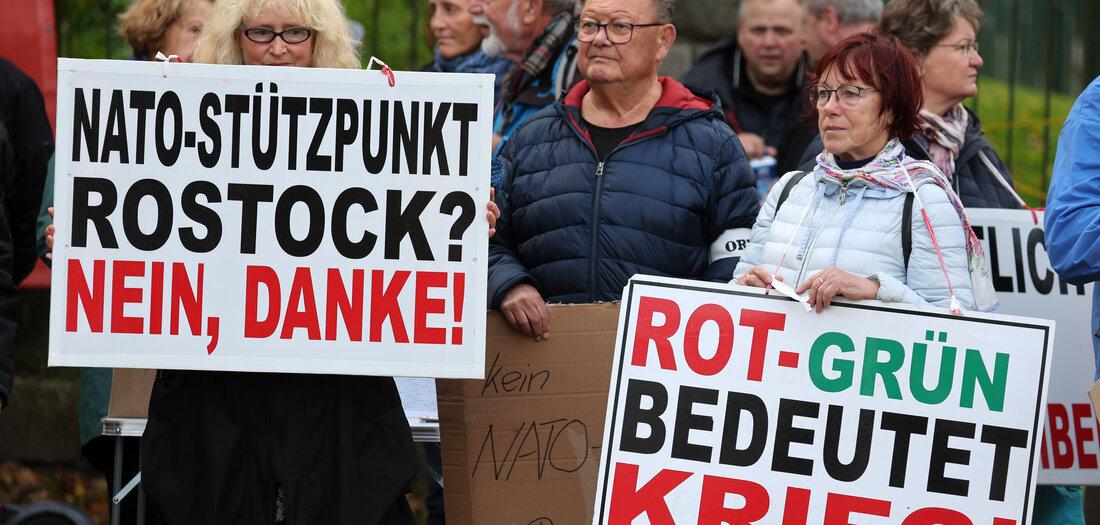
The German ruling class is losing its ability to hold large sections of the working class behind the war in Ukraine and the arms buildup that goes with it. The AfD is capturing much of that opposition.
Coalition governments are the rule in Germany. Since May 2025, Merz’s Christian Democrats (CDU) have governed nationally with the Social Democratic Party (SPD), historically tied to the trade unions. Together they are carrying out the arms buildup, cuts and industrial restructuring.
Die Linke, the Left Party, sits to their left. The Sahra Wagenknecht Alliance (BSW) split from it in 2024, opposing the war while moving right on migration. The Greens back the war in Ukraine and the arms buildup as strongly as the governing parties.
The CDU, SPD, Greens and Die Linke maintain what Germans call the Brandmauer, the firewall against governing with the AfD.
But when Die Linke offers to help keep the Christian Democrats in office, it leaves the AfD appearing to be the only party workers can vote for against rearmament and cuts.
Behind the vote
Turnout reached 77.8%, up from 60.3% in 2021. The AfD gained roughly 170,000 votes from people who had stayed home five years earlier. Three of every five manual workers voted AfD. Close to two-thirds of voters described their financial situation as bad.
Saxony-Anhalt is a state of about 2 million people in what was East Germany. It has some of Germany’s lowest wages, and its population has fallen sharply since the 1980s. Chemical plants in the towns of Leuna and Bitterfeld face high energy costs. Auto-parts suppliers have been hit by cutbacks at Volkswagen and BMW. Intel abandoned a planned semiconductor plant in Magdeburg, the state capital.
Washington set the terms. Trump demanded that NATO members spend 5% of their economic output on the military, more than double the existing target. Berlin agreed to it, and the alliance adopted it at its June 2025 summit.
Most of the orders go to German firms, and Rheinmetall and Thyssenkrupp are booking record revenues. But the decisive systems come from the U.S. Germany is buying 50 F-35 fighters from Lockheed Martin, aircraft it cannot maintain without U.S. contractors. Their assigned mission is to deliver the roughly 20 U.S. nuclear bombs stored at Büchel air base.
German big business has its own stake in the military buildup. Its civilian industry is losing profitability, and arms production is where the government guarantees the orders. Restructuring plants and workforces toward it requires increasing the exploitation of the working class through longer hours, later retirement and cuts to unemployment benefits and health coverage.
What the AfD offers
The AfD promises to reverse the decline. It says Germany can end the war policy, restore relations with Moscow, obtain cheap Russian energy again and bring industrial prosperity back.
That promise has tremendous appeal where factories are closing or cutting production and workers remember when a wage could support a family.
But the AfD leaves capitalist ownership untouched. It was founded in 2013 by an economics professor and a group of businessmen, including a former president of the Federation of German Industries. Its program favors deregulation and tax cuts for the rich while directing anger toward migrants, refugees, women and LGBTQ+ people.
Real anger begins with a factory closure, an unaffordable heating bill or a shrinking pension. The AfD redirects that anger away from the capitalist class and toward the more oppressed sections of the working class.
Its appeal to working-class memory of East Germany works the same way.
Ulrich Siegmund, the AfD’s candidate for minister-president, made the Simson moped his campaign emblem. Built in the German Democratic Republic, Simson mopeds were cheap, easy to maintain and enormously popular in East Germany. The AfD turned them into a campaign fixture, and Siegmund led thousands of riders through Quedlinburg on a blue Schwalbe on Aug. 23 and rode one to the polls on Sept. 6.
The AfD offers the memory with the socialism removed. Those were gains of a workers’ state, a society built by the working class in its own interest.
The Simson company was founded in 1856 by a German Jewish family. The Nazis expropriated it, and Minna Simson fled to New York in 1936. The German Democratic Republic ran the factory after the war and built the mopeds there.
Minna Simson’s grandson, Dennis Baum, traveled from the United States in July to protest the AfD’s party conference in Thuringia, held a century after the Nazis held one in the same region. He asked the party to keep the name out of politics. Siegmund told the Quedlinburg rally that someone living across the ocean had no standing to judge how Germans live. The crowd cheered.
The AfD also erases another part of the GDR it claims to remember: its international ties and the foreign workers who came to its factories.
The GDR brought Vietnamese, Mozambican and Angolan workers into its factories and established a school at Staßfurt for Mozambican children. Siegmund himself was born in October 1990 and has no GDR of his own to remember.
The Leipzig drone
The Merz government has justified Germany’s military buildup by campaigning on the threat of Russian attack. On Aug. 4, a drone carrying explosives struck a Ukrainian Antonov cargo aircraft at Leipzig/Halle airport, a major freight hub and transit point for military cargo going to Ukraine. The explosives failed to detonate.
Nothing publicly disclosed about the drone identified it as Russian. The device used commercially available communications equipment obtainable in Germany, including a 5G router and two SIM cards, not equipment imported from Russia. Russia called the incident a staged provocation.
On Sept. 1, five days before the election, Interior Minister Alexander Dobrindt declared Russia responsible. Berlin offered no public proof that Moscow ordered the operation. Its evidence was its own assertion, which it said rested on police investigations and intelligence findings it would not make public. The government summoned the Russian ambassador and closed Russian institutions, while NATO backed the accusation.
The timing was useful. Opposition to arms deliveries and the break with Russia had become a major election issue.
Die Linke had already abandoned much of that ground. In May, party co-chair Ines Schwerdtner said the party could help sustain a Christian Democratic minority government to keep the AfD from power, while opposing social cuts.
Die Linke finished fifth with 8.6%, its worst result in Saxony-Anhalt. The Wagenknecht alliance, campaigning against the war policy, won 5.3%.
But the Wagenknecht alliance has since agreed to talks with the AfD in Saxony-Anhalt on energy and “peace policy.” Opposition to the war alone does not create working-class politics.
In the ports
Independent working-class politics has to be built outside these parliamentary arrangements, in the workplaces and unions. Dock workers at Hamburg, Bremerhaven, Bremen, Wilhelmshaven, Emden and Brake struck for higher wages. German port workers have also joined international actions against war. In February, workers in Hamburg and Bremen joined a coordinated action by dock workers across Europe and the Mediterranean against arms shipments to Israel, the militarization of the ports and Europe’s military buildup. Dock workers elsewhere blocked ships and military cargo bound for Israel. Hamburg workers and trade unionists have also organized against NATO war exercises that use the port to rehearse moving troops and weapons eastward.
At Rostock, the former GDR’s main Baltic port, anti-war organizers brought the February international dockworkers’ action against war and port militarization directly to port workers, where it drew support and signatures.
A few hundred dock workers can stop a port. Rail workers can stop trains. The AfD won 573,000 votes with 3,500 members in the state. It cannot stop anything.
Germany has a written plan for war with Russia. It runs more than 1,000 pages. Under it, Germany is the staging ground, the country NATO troops, weapons and supplies move through on the way east.
That takes more than the army. It takes roads, rails, ports, hospitals and police, and carrying out the plan requires all 16 state governments to coordinate those civilian systems with the military. Each one holds the full plan. Defense Minister Boris Pistorius is now considering taking it away from Saxony-Anhalt if the AfD forms a government there, or cutting out the parts Berlin does not want that government to see.
Mecklenburg-Vorpommern and Berlin vote Sept. 20. Whatever government forms in Saxony-Anhalt, Germany’s militarization and industrial restructuring will continue.
The AfD cannot restore the world it promises. Its answer is anti-immigrant racism, attacks on women and LGBTQ+ people, and German nationalism. Whether workers’ anger keeps moving to the far right will be settled in the workplaces — by whether that anger is organized against the war, the cuts and the capitalist program behind them, or channeled into an anti-worker agenda.
Join the Struggle-La Lucha Telegram channel