
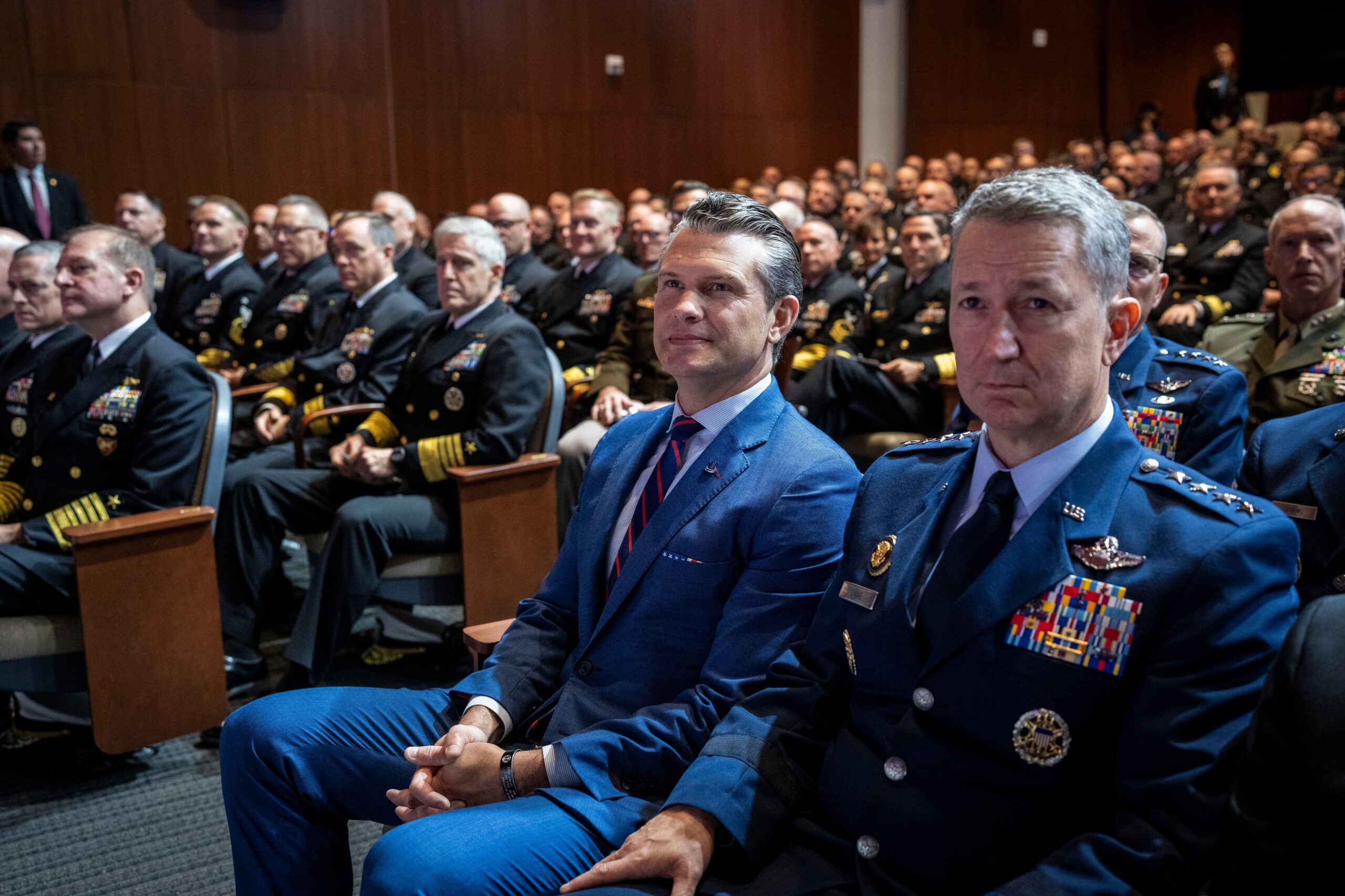
Donald Trump is remaking the U.S. military command.
Secretary of War Pete Hegseth has blocked the promotions of seven U.S. Army officers selected for major general. Two are Black. Two are women. The New York Times reported the removals Sept. 1.
They join more than 80 generals and admirals whom Hegseth has fired or blocked from promotion — about 10% of the military’s highest-ranking officers, according to a New York Times analysis. More than half of those affected have been Black or women.
The same analysis found that of 201 officers nominated for senior military posts in 2026, eight were women — less than half the average rate of the previous decade and the lowest share in at least 25 years.
Hegseth is carrying out the purge, but he is not its political leader. Trump is.
Trump renamed the Department of Defense the Department of War in 2025. The name matches what it does.
Hegseth did not come out of the Pentagon’s senior command. He served as an officer in the Army National Guard, including deployments to Iraq and Afghanistan, but his national political career was made on television. For nearly a decade, he was a Fox News personality and one of Trump’s loudest defenders. Trump put him over generals and admirals with decades of command experience.
That is what makes Hegseth useful. He did not arrive at the Pentagon representing an established section of the military command. He arrived as Trump’s political appointee, charged with imposing Trump’s program on it.
Trump is remaking the military command during a war that has lasted far longer than the White House said it would, while pushing military spending toward levels not seen since World War II. An enormous concentration of economic and political power drives both developments.
The billionaires and the war economy
The richest 1% own nearly a third of the country’s wealth. In a single year, their wealth grew by more than the bottom half of the country owns altogether.
The concentration is still accelerating. Corporate profits hit a record this year. The share of national income going to profits is the highest since the 1940s, and workers are receiving the smallest share of what they produce since records began.
The richest 0.1% own about as much of the country’s wealth as they did in 1929, before the Wall Street crash and Great Depression. Unemployed councils, sit-down strikes and the industrial unions built in the 1930s drove that concentration down. Union contracts raised wages, and over the decades that followed millions of working-class families got houses, pensions and money in the bank, which most had never had before.
None of that was ownership of industry. The mines, mills, railroads and banks stayed in the same hands, and what workers had won could be taken back. Starting in the late 1970s the employers took it back — closing plants, breaking strikes, forcing concession contracts on the unions. Wealth and power have been concentrating ever since.
The capitalist class does not ordinarily have to run the government directly. It can rule through presidents, members of Congress, cabinet officials and the permanent government apparatus that administers the capitalist state. That arrangement is worth more to them than direct rule — elections hide the class character of the government behind the appearance of democratic choice, and ownership is never on the ballot. But that distance can narrow sharply in a period of crisis.
Trump is himself a billionaire. Elon Musk, the world’s richest capitalist, spent nearly $300 million backing Trump and other Republican candidates in the 2024 election. After Trump took office, Musk moved directly into the executive apparatus as a special government employee, leading the DOGE drive that pushed some 260,000 federal workers out through layoffs, buyouts and early retirement. One of the largest private fortunes in history had helped put a president in office, then entered the government that president headed.
At the highest levels, concentrated capital and the governing apparatus are increasingly interlocked. The Trump administration has driven the AI buildout forward. It has moved to speed permits for giant data centers and the power plants and transmission lines they require, offered federal loans, grants and tax incentives, and opened federal land to AI infrastructure.
Capitalists are pouring hundreds of billions of dollars into machinery that allows them to produce more with fewer workers. At the same time, high tech is being drawn deeper into the war machine.
The buildout is going forward against widespread opposition. Electricity bills have climbed as utilities build the generating plants and transmission lines data centers demand, then spread the cost across everyone else’s bill. Dozens of counties and towns have imposed moratoriums on new data center construction, and New York imposed a statewide moratorium on large data center permits in July 2026.
Trump’s AI plan calls for new high-security data centers for the Pentagon and intelligence agencies. In June, he ordered the national security agencies to accelerate their use of commercial AI systems and build the computing facilities needed to run them.
Musk’s own SpaceX shows how close the connection has become. The Space Force is the part of the U.S. armed forces that operates military satellites, missile-warning systems, military communications and other operations in space. In 2025, it awarded Musk’s SpaceX $5.9 billion in national-security launch contracts running through 2029.
Trump’s 2027 budget requests just over $1.5 trillion for the Department of War, nearly 50% more than was spent in 2026. The Congressional Budget Office estimates that his proposals would push military spending far higher for a decade.
Missiles are fired and must be replaced. Ships, aircraft and drones are ordered. Satellites, computers and surveillance systems are bought. Data centers and power plants are built. The war on Iran is consuming weapons faster and putting new demands on production. Government money is being concentrated in the industries where the biggest pools of capital are already gathering — weapons, aerospace and artificial intelligence.
The AI buildout is concentrating even more capital in corporations that can spend hundreds of billions on machinery while employing relatively few workers. Seven companies — Alphabet, Amazon, Apple, Meta, Microsoft, Nvidia and Tesla — took in two-thirds more profit over the past year than the year before.
Trump himself embodies the fusion of concentrated wealth and state power. He was already a billionaire when he first took office in 2017, and his fortune fell during that term. It has roughly doubled since he returned to the White House in January 2025, on cryptocurrency and his media company. A capitalist with vast private financial interests occupies the presidency itself while using that office to make money for his family’s businesses.
And he is surrounded by others from the same class. Their companies are tied increasingly closely to government contracts, AI infrastructure and the expanding military apparatus.
At the top, the concentration of wealth and the concentration of government power are fusing. The capitalist class that owns the corporations, banks and great financial fortunes dominates the government that protects that ownership. As that ownership concentrates in fewer hands, more power moves into the presidency, the Pentagon, intelligence agencies and police. These are the parts of the government that act by command. They can move without a vote in Congress and without public debate.
Trump did not create these conditions. The concentration of wealth, decades of attacks on working-class organization and the enormous expansion of the war machine were already underway. Joe Biden armed and funded the war on Gaza, raised the military budget every year, and opened the federal drive to build out AI that Trump has since accelerated. Trump’s rise belongs to that development.
Trump summons the generals
On Sept. 30, 2025, hundreds of generals and admirals commanding U.S. forces around the world were suddenly ordered to Marine Corps Base Quantico in Virginia. Trump addressed them personally.
He spoke of an “enemy from within.” He defended sending troops into U.S. cities and named cities his administration wanted to target. He said cities could be used as “training grounds” for the armed forces.
Trump even joked that officers who did not like what they were hearing could leave the room. Walking out, he said, would cost them their rank and their future.
Hegseth spoke before Trump. He denounced what he called “woke” policies, announced new directives and told officers who rejected the program that they should resign.
Trump was not merely demanding obedience to particular military orders. He was putting the senior command on notice that careers would increasingly depend on toadying to Trump.
Trump had already installed his own officer at the top of the uniformed command. On Feb. 21, 2025, Trump fired Gen. Charles Q. Brown Jr. as chairman of the Joint Chiefs of Staff and named Air Force Lt. Gen. Dan Caine to replace him. Brown was the second Black officer to hold the post. Caine was retired. He had never held four-star rank, never commanded a combatant command and never served as a service chief — the qualifications set in law for the job. Trump signed a waiver. Caine is the first officer called back from retirement to become chairman and the first chairman who had not been a four-star general or admiral.
Caine has shown what Trump got for the promotion. Trump opened the war on Iran without congressional authorization on Feb. 28, 2026, and Caine helped direct the operation. U.S. Tomahawk missiles struck southern Iran in the opening hours of the assault. One of them destroyed the Shajareh Tayyebeh elementary school in Minab about an hour in, and the school was hit more than once. Iranian state media reported 168 killed, most of them children. Bombing an elementary school full of children is a war crime. Four days into the war, with the school already in ruins, Caine stood beside Hegseth as they boasted of the destruction and laid out the campaign’s next stages.
Defeat in Iran
Washington opened the war expecting to overthrow Iran’s government in weeks. Trump called on Iranians to “take over” their government and demanded unconditional surrender. Hegseth suggested the operation might take as little as two weeks.
Six months later, the U.S. had suffered a historic defeat at the hands of Iran. Washington had failed to overthrow the government or force its surrender. Iran was still fighting, while U.S. weapons stocks were being depleted, forces were being pulled from other commands, and senior military leaders were warning that the war could not be sustained at its present level without weakening the military elsewhere.
The Trump administration’s answer has been to extend deployments into 2027 while tightening control over the command that must carry them out. Hegseth is cutting the number of general and admiral positions. He is removing officers already holding senior commands. He is reaching into promotion lists to determine who will rise into the highest commands years from now.
The promotion list as a weapon
Military officers are selected for promotion by boards of senior officers, and the names move upward as lists, so holding up a list stops everyone on it. An Army list of 34 officers selected for promotion to brigadier general was held up from October 2025 to February 2026 because Hegseth objected to four or five names.
One was Col. Dave Butler, who had served as senior spokesperson for retired Gen. Mark Milley. Milley had become one of Trump’s principal enemies inside the old military leadership after opposing Trump’s push to use troops against Black Lives Matter protesters in 2020 and publicly rejecting the idea that the armed forces owed personal loyalty to a president. Trump later accused him of treason. On Hegseth’s second full day at the Pentagon in January 2025, he revoked Milley’s security clearance, pulled his security detail and ordered a review that could strip him of a star in retirement.
The Washington Post reported that Butler’s connection to Milley appeared to be a factor in Hegseth’s opposition to his promotion. Army Secretary Dan Driscoll resisted Hegseth’s pressure to remove Butler for months, according to Fox News, before Hegseth ordered it done in February. Butler volunteered to take his name off the promotion list if that would allow the others to move forward.
Hegseth intervened in other lists. In March, two Black officers and two women were removed from an Army one-star list. A Navy board selected 31 captains for promotion to rear admiral. Hegseth blocked nine. All three women chosen by the board were removed, along with two Black men. The list published May 22 held 22 men and no women.
Then came the latest Army list: seven officers selected for two-star rank blocked at once. Days earlier, four more officers had been pulled from a separate one-star list over their professional ties to generals Hegseth had already removed.
Control who advances and you determine the kind of officer that reaches the top.
Former Air Force Secretary Frank Kendall says that pressure is already being felt below the top command. He wrote Sept. 1 that lower-level officers he has spoken with are “privately appalled” but afraid to challenge what they are seeing. The next day he told CNN that some serving officers were questioning whether to remain in the military because speaking up can mark an officer as someone who is “not with the program” and damage a career.
War and the crisis of command
The officers and officials being removed are not opponents of U.S. imperialism. The Army chief of staff, the commander of Army Europe and Africa, the Army secretary — all were part of the same war machine.
But generals can agree on U.S. military power and still clash over strategy, weapons, preparedness, targets, deployments and whether an order from the White House can accomplish what it claims.
The Washington Post reported Aug. 30 that four commanders formally objected to Hegseth’s order to keep forces committed to the war. Their objections appeared in the Aug. 14 edition of the classified Secretary of War Orders Book.
Adm. Daryl Caudle, the chief of naval operations, and the commanders of U.S. forces in Europe, the Pacific and Latin America entered “non-concurs” — a formal record that they disagreed with the order but would carry it out. Army and Air Force leaders concurred but warned that the order carried significant risk.
Caudle told Hegseth that barely a quarter of the destroyer fleet was ready to deploy and that the Navy could not sustain its contribution without a firm end date.
None objected to the war itself. The four put in writing that the U.S. military was having difficulty sustaining one major war without pulling forces and equipment from other commands.
General Caine drew that boundary publicly. Speaking to National Defense University graduates June 11, he said whether the military can carry out an operation is a military question, and whether it should “lands at the policy level, and we don’t do that in our business.”
Hegseth extended the deployments anyway, some of them into 2027. Some 50,000 U.S. troops and 19 warships remain committed to the region. The war is eating through missiles, maintenance time and training funds. Air-defense deployments have been stretched from nine months to 12. Some units sent to West Asia before the war began Feb. 28 have already been deployed for more than a year.
Gen. Randy George, the Army chief of staff, was fired in April. Gen. Chris Donahue, commander of U.S. Army Europe and Africa, was forced into retirement earlier this summer after only 18 months in the post. No reason was given for either removal, and neither was publicly tied to the objections over Iran.
Army Secretary Dan Driscoll, who had resisted Hegseth’s pressure to pull Butler from the promotion list, resigned Aug. 31. The Atlantic reported that before leaving, he complained directly to Trump that Hegseth had removed some of the Army’s most experienced commanders and was shrinking the pool available for future senior commands. When senior Army officials objected to what Hegseth was doing, they went over his head to Trump.
Trump’s answer is to reduce the room in which those conflicts can be expressed. In August, government investigators put roughly 50 members of the Joint Staff through polygraph tests, asking whether they had given classified information to reporters and, specifically, whether they had disclosed how far U.S. munitions stocks had fallen. A retired Navy judge advocate general told the New York Times he had never seen polygraphs used that broadly or at that level of seniority. The Army meanwhile is operating without a Senate-confirmed secretary or chief of staff. The chief’s post has been vacant for more than five months, longer than at any time since 1972.
Promotion boards still meet. The Senate still confirms nominees. Military commanders can still file objections. But Trump is putting greater pressure on all of them.
Gen. Christopher LaNeve left command of the Eighth Army in South Korea to become Hegseth’s senior military adviser and became acting Army chief of staff when George was removed. Hegseth now wants him permanently in the Army’s top uniformed post.
The issue is not simply which general gets which job. It is the increasing subordination of the military command to the presidency and to Trump’s personal political authority.
The force Trump wants
The reshaping of the officer corps also has a racist and sexist pattern.
The Pentagon recruits where the choices are narrowest — up to $65,000 toward student loans and bonuses reaching $50,000, offered to young people whom U.S. capitalism has already loaded with debt, and citizenship held out to noncitizens whose families live under threat of deportation.
As of December 2024, more than one in five active-duty Army soldiers were Black. Across the armed forces, a 2022 Carnegie Endowment study found that Black officers made up about 9% of active-duty officers but only 6.5% of generals.
The disparity already existed. Trump’s Pentagon is making it wider.
Asked in Congress about his intervention in promotion boards, Hegseth complained of years of “gender and demographic engineering.”
He calls for a “High-T Department of War.” In July, Hegseth announced annual testosterone-deficiency screening for troops 30 and older, saying they needed the “right testosterone levels” and the “biological foundation required to sustain the fight.”
That politics becomes even more explicit in the Trump administration’s purge of transgender service members. Hegseth barred new transgender recruits and halted transition-related medical care. After a period for voluntary departure, the Pentagon directed commanders to begin identifying service members for involuntary separation.
In April 2025, Hegseth declared that there would be “no more gender confusion, no more pronouns” in the military and said transgender people were “no longer allowed” in the Department of War.
A Black general does not represent Black enlisted soldiers, nor does a woman general represent women in the ranks. The officer corps commands the same military and serves the same ruling class.
A military whose ranks are Black, Latine, LGBTQ+ and drawn from every section of the working class is being reshaped from above around a racist, sexist and anti-LGBTQ+ conception of who belongs in uniform, and around greater political loyalty to the president.
The danger does not end with Iran. Trump has already told military commanders that U.S. cities can be “training grounds” and spoken of an “enemy from within.” The purges since Quantico give those words greater meaning.
The ranks
Hegseth can fire generals, block promotions and decide who wears the stars. Over the officer corps, he holds a career. He does not hold the same thing over the ranks, and he cannot promote or retire away the resistance coming up from below.
The USS Abraham Lincoln left San Diego on Nov. 21, 2025, for a routine Pacific deployment. It stopped at Guam on Dec. 11 and 12 and made a shorter stop at Oman on July 7. Between them, its crew of 5,000 sailors and Marines spent 208 consecutive days at sea — the longest uninterrupted stretch for a U.S. aircraft carrier in the modern era. Two hundred days of the deployment were spent in a combat zone. The carrier did not make a full port call until it reached Laem Chabang, Thailand, on Sept. 2, after 286 days at sea.
Iranian strikes on the Navy’s Bahrain logistics hub wiped out the carrier’s supply line. The Navy’s top admiral has said publicly that U.S. personnel will not be returning to Bahrain soon. With the hub gone, the fleet has had to be sustained from Diego Garcia, thousands of miles away.
Sailors and families reported shortages of food and basic supplies, contaminated water, failed plumbing and lost mail.
On Aug. 6, about 200 family members confronted Acting Navy Secretary Hung Cao and other senior officials in San Diego. Another session was held online that evening. The families leaked recordings of the meetings. What the Navy wanted handled inside the chain of command became a public fight over the conditions of Trump’s war.
Asked about the length of the deployment, Trump said it was “not nearly long enough.”
On July 4 in Philadelphia, at least a dozen serving members of the Army, Navy, Air Force and Marines marched in a Service Members’ Anti-War Contingent organized by the Center on Conscience and War. Several more had signed up and were denied leave by their units. According to the center, it was the largest gathering of serving military personnel at an antiwar protest since the war on Vietnam.
Antiwar veterans have put up billboards outside U.S. bases reminding those inside that they have the right and the duty to refuse illegal orders.
Trump can tighten his control over the military command. He cannot remove the class contradictions underneath it.
The longer the war continues, and the more tightly power is concentrated above, the sharper those contradictions become.
Join the Struggle-La Lucha Telegram channel