
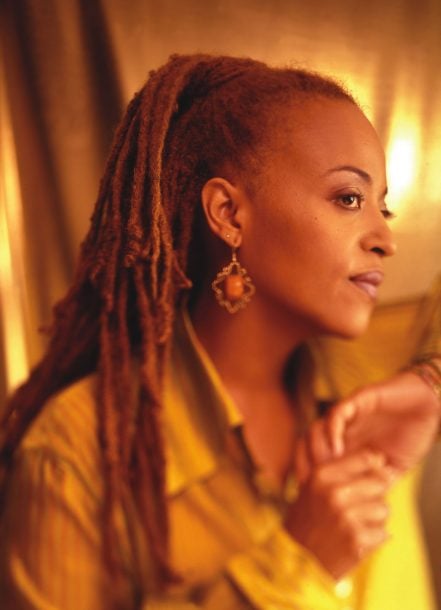
Jazz musician Cassandra Wilson died at her home in Jackson, Mississippi, on Sept. 1. She was 70.
She was born in Jackson on Dec. 4, 1955, 10 weeks after an all-white jury 115 miles north in Sumner, Mississippi, acquitted the men who lynched 14-year-old Emmett Till. That is the ground she came up on, and she never pretended otherwise.
When she was 7, Medgar Evers was shot in his own driveway a few minutes from her house. When she was 14, Mississippi Highway Patrol officers and Jackson police fired hundreds of rounds into Alexander Hall at Jackson State College on May 15, 1970, killing Phillip Lafayette Gibbs, 21, and James Earl Green, 17. Eleven days earlier, the National Guard had shot students at Kent State, and that killing was national news for months. The Jackson State killings were dropped. No one was charged. Wilson took her degree in mass communications from that same campus in 1981.
Her father, Herman Fowlkes Jr., was a working musician in a segregated music market. Born near Chicago in 1918, he played trumpet in a U.S. Army band, came to Jackson in 1948 and became one of the first Mississippi musicians to play electric bass, starting in 1952. He recorded with Sonny Boy Williamson II. He also taught, because a Black musician in Jackson could not live on the bandstand alone. Her mother, Mary Fowlkes, taught elementary school. Both were educators because the color line had left teaching as one of the few professions open to them.
The music the cotton system produced
Wilson moved to New York in 1982 and spent the decade there, first with the M-Base collective around Steve Coleman, Geri Allen, Greg Osby and Graham Haynes — a group of Black musicians building their own framework rather than waiting for the industry to hand them one. Wilson was also a guitarist, composer and arranger, and helped shape the sound of her own records. Then in 1993 she released “Blue Light ‘Til Dawn” on Blue Note and went straight back to the Delta. Her father died while she was making it.
She recorded songs by Robert Johnson, Son House and Muddy Waters. She put Hank Williams, Joni Mitchell and the Monkees alongside them. As a schoolgirl in Jackson, Wilson had been teased for carrying a Monkees record because Black children supposedly were not supposed to listen to that music. Years later, some in the jazz world objected when she recorded “Last Train to Clarksville” because a jazz singer supposedly was not supposed to sing the Monkees.
Wilson rejected those boundaries. “Blue Light ’Til Dawn,” she later explained, brought blues and jazz together with Appalachian music and rock because that was what she had grown up hearing. “We are at the crossroads of the South,” she said.
In 2001 she took her band to Clarksdale, Mississippi, set up in a converted railroad depot in the middle of the Delta and cut “Belly of the Sun.” The blues was not a heritage exhibit to her. It was the sound produced by a specific system of exploitation — plantation labor, debt peonage, the lash of the crop lien — and by the people who survived it.
Miles Davis was another of Wilson’s major influences. She opened for him at the JVC Jazz Festival in Chicago in 1989. A decade later she released “Traveling Miles,” developed from a series of concerts she had performed in Davis’ honor at Lincoln Center. She did with his music what she did with everything else she touched: rearranged it, changed its setting and made it her own.
“Strange Fruit”
Wilson’s last album, “Coming Forth by Day,” came out on April 7, 2015, Billie Holiday’s 100th birthday. Three days later she headlined the Apollo Theater with it.
The record opens the Holiday songbook, and at its center is “Strange Fruit.” That song was written in 1937 by Abel Meeropol, a Bronx high school teacher and trade union activist who was a member of the Communist Party, publishing under the name Lewis Allan. He wrote it after seeing a photograph of a lynching. It first appeared in a teachers union magazine, then in the Marxist journal New Masses. His wife, Anne Meeropol, a public school teacher and union organizer, sang it at Teachers Union events before Holiday ever heard it. Columbia refused to record it. Holiday cut it for Commodore in 1939.
After Ethel and Julius Rosenberg were executed in 1953, their sons, Michael and Robert, were shuffled among friends until Abel and Anne Meeropol took them in. The Meeropols formally adopted them in 1957.
That is the lineage Wilson had been carrying since 1995, when she opened “New Moon Daughter” with the song. She came back to it in 2015, while cops were killing Black people in the streets from Ferguson to Staten Island and the Black Lives Matter movement was rising against it. She sang an anti-lynching song written by a communist schoolteacher, and she sang it as a woman from Jackson, Mississippi, who had grown up about half a mile from where Medgar Evers was assassinated.
What she was given
Time magazine called her the best singer in the United States in 2001. She won Grammys in 1997 for “New Moon Daughter” and in 2009 for “Loverly.” She sang on Wynton Marsalis’ “Blood on the Fields,” the oratorio on chattel slavery that took the Pulitzer Prize in 1997. The National Endowment for the Arts made her a Jazz Master in 2022. There is a marker with her name on it on the Mississippi Blues Trail.
The honors came late and changed nothing in Jackson.
Mississippi remains the poorest state in the country. Jackson, its capital, is more than 80% Black and governed by Black elected officials. Its 2022 water-system collapse came after years in which the white-dominated state government refused to provide the money needed for repairs and blocked efforts by the city to raise its own. Then-Mayor Chokwe Antar Lumumba called the treatment “racist” and “paternalistic.” In 2023 the Legislature moved again against Black political control in Jackson, creating a court inside the city with judges and prosecutors appointed by white state officials instead of elected by Jackson voters, and expanding Capitol Police authority over the city.
Cassandra Wilson never treated Mississippi as scenery or the blues as something safely finished in the past. She carried Jackson and the Delta into everything she sang — their beauty, their violence, their history and the music Black people made from all of it. She took that music around the world, and she kept bringing it home.
Join the Struggle-La Lucha Telegram channel