
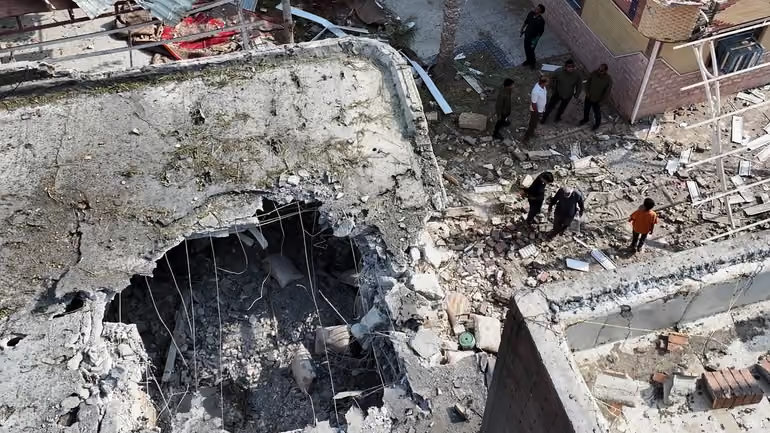
On Sept. 1, 2026, a U.S. missile hit a house in Kuhestak, a small coastal town in Iran’s Hormozgan province, where a family was holding a wedding. Iranian state media reports that at least five people were killed in the U.S. attacks there and at least 68 were wounded.
The same night, eight explosions were reported along Qeshm Island’s southern coast. Iranian state television said a fishmeal plant in Suza was hit. U.S. strikes also hit a fishing pier and a Ports and Maritime Organization tower at Sirik. A projectile struck outside the runway area at Jiroft’s civilian airport. Power outages were reported in Hormozgan.
U.S. Central Command said its targets were air defense sites, radar systems, maritime assets and facilities, mine-laying capabilities and communications sites.
Put the two lists next to each other. A fishmeal plant becomes a maritime facility. A fishing pier becomes a maritime asset. A harbor tower becomes a communications site. The wedding disappears from the list altogether.
Who was in those buildings
Kuhestak, Suza and Sirik are fishing towns on the Strait of Hormuz. The fishmeal plant grinds the catch into feed and fertilizer. The pier is where the boats tie up. The people killed and wounded in Kuhestak were a family and their guests celebrating a wedding.
These are among the civilian sites struck on the 186th day of a war Washington has been unable to win.
Six months of war have not broken Iran. Iranian missiles and drones have damaged or destroyed radar, communications and air-defense equipment at U.S. bases across the region. An Iranian attack destroyed much of the U.S. Navy base in Bahrain and forced the Navy to shift its main logistics hub to Diego Garcia in the Indian Ocean. Iran says it has now downed its 50th Reaper drone.
The U.S. military remains capable of enormous destruction, but it has not forced Iran to surrender. So the destruction spreads outward — to ports, power systems, fishing towns and wedding parties.
Twenty-four years of the same method
The U.S. war command can call Kuhestak a mistake. It has used that explanation before.
On July 1, 2002, U.S. aircraft attacked a wedding in Kakarak, Afghanistan. An Afghan government investigation found 48 people killed and roughly 117 wounded, most of them women and children.
On May 19, 2004, U.S. aircraft and ground forces attacked a wedding gathering at Mukaradeeb in Iraq. Iraqi officials and hospital staff counted 42 dead, including 11 women and 14 children. The U.S. military denied bombing a wedding and called the site a military target.
On Dec. 12, 2013, a U.S. drone struck a wedding convoy near Rada’a, Yemen. Human Rights Watch documented 12 men killed and at least 15 wounded, including the bride. U.S. and Yemeni officials initially described those killed as militants.
The U.S.-armed Saudi coalition carried the same method into its war on Yemen. In 2015, airstrikes hit a wedding at al-Wahga, killing 131 people, at least 80 of them women. In 2018, another coalition strike hit a wedding at Bani Qayis, killing at least 22 people, including eight children, and wounding 54.
Four countries. Twenty-four years. The weapons change and the explanations change. The result does not.
The double tap at Karaj
On April 2, 2026 — Sizdah Bedar, when Iranian families spend the day outdoors — U.S. missiles struck the unfinished B1 bridge at Karaj. Eight people were killed and more than 95 wounded. According to Fars News Agency, first responders arrived to help the victims.
The rescue workers ran toward the wounded. Another U.S. strike followed.
A rural wedding in West Asia can mean a large gathering, a convoy of vehicles and celebratory gunfire. Through the machinery of U.S. warfare, ordinary parts of life can become signs on a targeting screen. The targeting system has already decided how many civilian lives can be sacrificed to military objectives — as the U.S. double strike on rescuers at the Karaj bridge in April showed again.
A first strike can be called a mistake. The second one required someone to watch the rescue and fire again.
The war on the people of Iran
Trump has dismissed renewed negotiations, ordered a “tanker for tanker” policy of striking Iranian commercial shipping, and threatened Iran’s main crude export terminal at Kharg Island.
Each decision pushes the war deeper into the civilian economy — ships, ports, plants and the electrical system.
Washington began the war believing overwhelming U.S. firepower would force Iran to submit. That has not happened. Iran has continued to fight. U.S. bases have been damaged. Naval operations have been pushed farther from the battlefield.
The answer from Washington is to widen the destruction.
The contradictions of the war are also reaching into the U.S. military. Sailors and Marines have spent months at sea under exhausting conditions and shortages aboard U.S. warships. Some military personnel are beginning to question what they are being ordered to do, while antiwar veterans are reaching out to active-duty troops.
This is not yet an organized movement within the military against the war. But every unsuccessful imperialist war can sharpen the class conflict between the ruling class that orders it and the workers in uniform sent to fight it.
The generals can change deployments, move ships and planes, and order another round of bombing. None of that solves Washington’s basic problem: the Iranian people have not surrendered.
Join the Struggle-La Lucha Telegram channel