
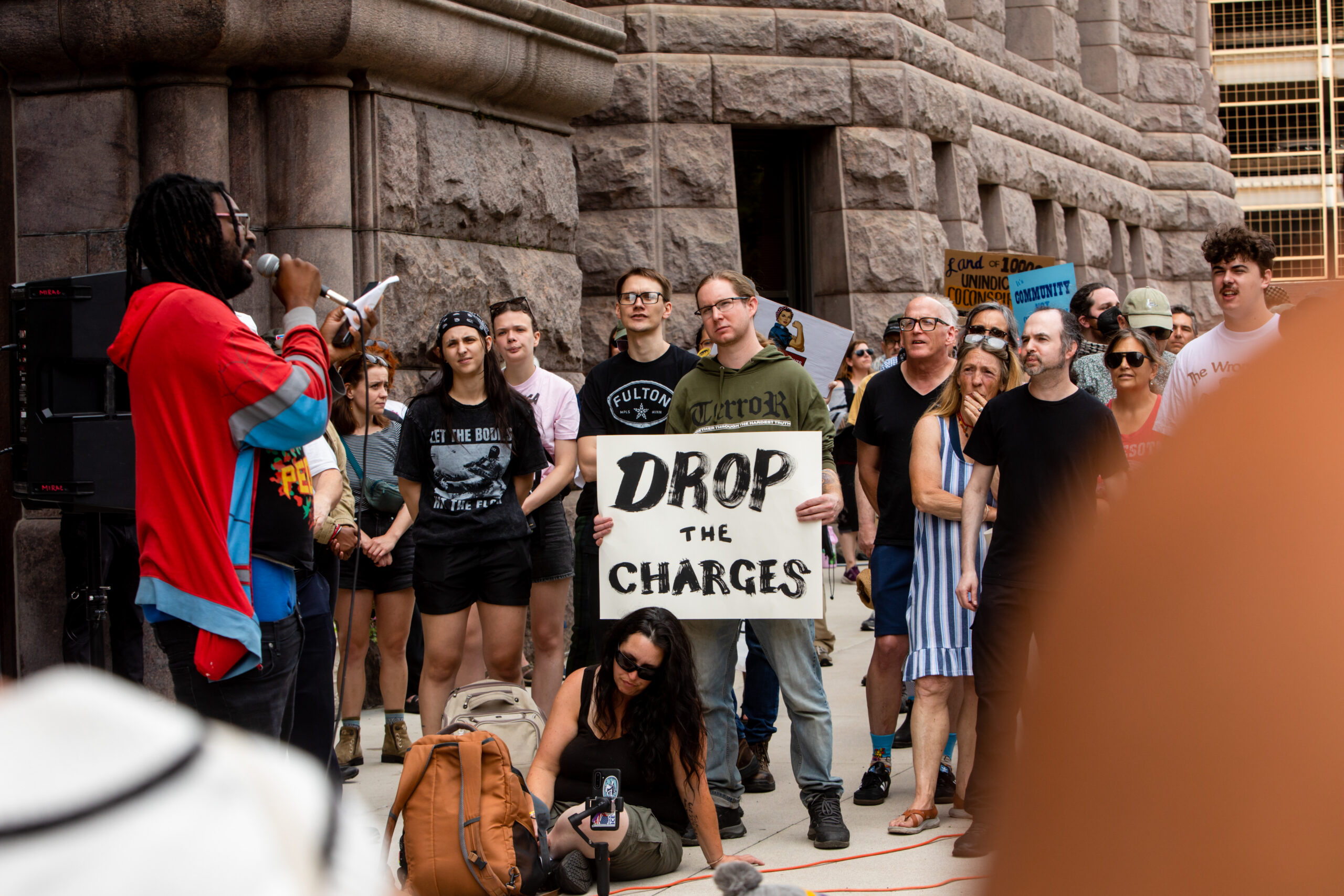
A federal judge in Minneapolis heard arguments Aug. 27 on whether prosecutors must turn over more records from the government’s surveillance of the Minnesota 15, labor unions and community organizations opposing ICE.
The 15 defendants, charged in June with conspiring to impede or injure a federal officer, have all pleaded not guilty. Their lawyers are seeking undercover reports, communications and other records they say could show that the prosecution was politically motivated.
Defense attorney Kevin Riach, representing Isaac Sant, asked U.S. Magistrate Judge David Schultz to order prosecutors to disclose downloads from undercover agents’ phones and laptops, reports on surveillance of unions and nonprofit groups, and communications between prosecutors in Minneapolis and officials in Washington.
Riach says the records are needed to determine whether the government selectively prosecuted people who opposed the deportation campaign. He has told the court that the prosecution is meant to chill dissent.
The government is fighting the request. Schultz has not yet ruled.
The records already made public show how far the government went.
Undercover Department of Homeland Security officers attended a Jan. 11 planning meeting. By Jan. 14, prosecutors acknowledge in their own court filing, they had entered an encrypted Signal chat and were reading plans for the Jan. 23 general strike against ICE as organizers discussed them.
The undercover officers tried to push organizers toward criminal actions. Federal investigators examined years of financial records from several national unions and community organizations, monitored churches and political groups, and put 18 organizations on a chart DHS called “The Conspiracy.”
None of those organizations has been charged with a crime.
This is preparation by the capitalist state against movements that can interfere with deportations and war — and with an anti-union drive to intensify exploitation and extract greater profits from workers.
Workers stop work — DHS infiltrates
ICE’s Operation Metro Surge sent roughly 3,000 federal officers into the Twin Cities. Federal agents shot and killed two U.S. citizens during the operation: Renée Good on Jan. 7 and Alex Pretti, an AFGE member and VA intensive care nurse, on Jan. 24.
Workers organized resistance.
Unions distributed food to members threatened by ICE who could not safely leave their homes. Rapid-response networks tracked immigration agents. Trade unionists met at the United Labor Center in Minneapolis.
They called the Jan. 23 “No Work, No School, No Shopping” general strike. Tens of thousands of people filled the streets of Minneapolis in subzero cold. Around 700 businesses closed and labor was withheld across the state.
A week later, on Jan. 30, organizers took the call national. Payday Report counted solidarity actions in more than 300 cities.
DHS was already inside the organizing.
Undercover officers attended a Jan. 11 planning meeting. By Jan. 14, according to government records, they had entered an encrypted Signal chat and were reading the organizers’ plans for Jan. 23 as they were being discussed.
Agents posed as protesters at meetings in churches, schools, libraries, restaurants, parks and union halls. They recorded meetings and collected license plate numbers. At one church meeting, an agent built files on attendees containing names, addresses and information about their families and jobs.
DHS put the Minnesota AFL-CIO, Democratic Socialists of America and even a Minneapolis bicycle repair collective on its “Conspiracy” chart. Prosecutors showed the chart to a grand jury.
The Trump administration pardoned or commuted the sentences of people convicted over the Jan. 6, 2021, Capitol attack while prosecuting Minnesotans who protested immigration enforcement.
The prosecutor who convened the grand jury in the Minnesota 15 case, Brian W. Lynch, was himself at the Capitol on Jan. 6, photographed on the grounds in a Trump 2020 hat and a star-spangled mask. Lynch is now co-director of Joint Task Force Vanguard, the unit created in March to carry out National Security Presidential Memorandum 7.
Lynch is the prosecutor who showed the “Conspiracy” chart to the grand jury. Justice Department metadata lists him as the author of the government’s brief opposing Riach’s motion — the brief that boasts that undercover agents were inside the organizers’ Signal chat by Jan. 14.
Agents also worked to create the conduct they claimed to be investigating. At a Jan. 31 Sunrise Movement training where participants discussed peaceful sit-ins and de-escalation, an undercover officer offered to build items for more “direct-action” protests and said going to jail did not bother him.
Riach says undercover agents were at times “working to entice people into discussing or committing crimes.”
In response to mass protests in Minnesota and across the country, border czar Tom Homan announced the end of Operation Metro Surge on Feb. 12. Agents left over the following weeks, with several hundred staying on — still more than triple the number in the state before the surge. The spying continued for months.
Union finances searched
Homeland Security investigators used administrative summonses — issued by the agency itself, with no judge involved — to obtain wire-transfer records going back to 2023 from the Service Employees International Union’s main account at U.S. Bank in Minneapolis. They took the records of Communications Workers of America donations and political action committee spending from 2023 through 2026. The search reached transactions involving the International Federation of Professional and Technical Engineers in Canada. They also obtained PayPal and Venmo records for Voices for Racial Justice, a Minneapolis organization founded in 1993, on the stated grounds that its website carried “ICE OUT” material and linked to rapid-response networks.
The summonses described the investigation as one into domestic terrorist financing under National Security Presidential Memorandum 7.
None of these organizations has been charged with a crime.
What investigators found in SEIU accounts was union business: annuity payments, strike payments, dues and pension expenses.
The surveillance was not confined to the deportation fight. HSI reports document agents monitoring a “Stop the War on Iran!” demonstration organized by Minnesota 50501, Veterans for Peace and the Sunrise Movement. Opposition to the war was treated as part of the same conspiracy as opposition to ICE.
The Aug. 27 hearing brought this surveillance campaign back into court. Supporters filled the courtroom and remained outside on the plaza.
Afterward, Sant said federal agents had been “spying on us from day one.”
“If it wasn’t us on trial, it was going to be one of you,” he said.
From Minneapolis to Washington’s international campaign
The attack in Minnesota is part of a much broader political program.
On July 16, Secretary of State Marco Rubio brought representatives of 66 governments to Washington for a meeting called the “Ministerial on the Resurgence of Political Terrorism.”
Rubio claimed Cuba had built an intelligence and ideological network that created the far left in the U.S. and throughout the Western Hemisphere. He also claimed Iranian networks were connected to left-wing militant movements worldwide. He presented no evidence.
Rubio specifically named National Security Presidential Memorandum 7, issued Sept. 25, 2025, as the strategy Washington is using against these supposed networks inside the U.S.
The State Department followed Rubio’s ministerial four days later with a report titled “Cuba: The Capital of 21st Century Communism.” It portrays revolutionary Cuba as the center of decades of ideological subversion and names U.S. left organizations. It treats Black Lives Matter and pro-Palestine campus organizing as part of the same supposed foreign-influence network.
Washington has attacked Cuba for more than six decades because the Cuban Revolution broke the rule of U.S. capital. It targets Iran because Iran has resisted U.S. domination in West Asia.
Now solidarity with those struggles is being used as evidence against movements inside the U.S.
Trump’s Sept. 25 memorandum ordered the Justice Department, Joint Terrorism Task Forces, Treasury Department and IRS to investigate and financially disrupt organizations accused of political violence. A later directive ordered federal agencies to map the full network of people supposedly involved.
There is no federal law allowing Washington to designate U.S. political organizations as terrorist groups. The government instead takes movements and organizations abroad that resist U.S. domination, designates them as Foreign Terrorist Organizations, and then uses the sweeping and politically manufactured charge of “material support” to criminalize people in the U.S. accused of assisting or supporting them.
The administration is trying to extend that same machinery to domestic political opposition: call domestic opposition part of a violent network, then claim that network is tied to Cuba, Iran or organizations designated as foreign terrorists.
Washington’s campaign against “political terrorism” is aimed at breaking real ties of solidarity before they grow stronger — between workers fighting deportations, movements opposing U.S. wars, and people standing with Cuba, Palestine, Iran and other targets of imperialism.
But Minneapolis showed why the government is worried. On Jan. 23, workers stopped work, shut businesses and disrupted normal life across a major metropolitan area.
That is the power Washington is preparing against: workers acting together, across workplaces and in their neighborhoods, and linking their own struggles to resistance against U.S. imperialism abroad.
Join the Struggle-La Lucha Telegram channel