
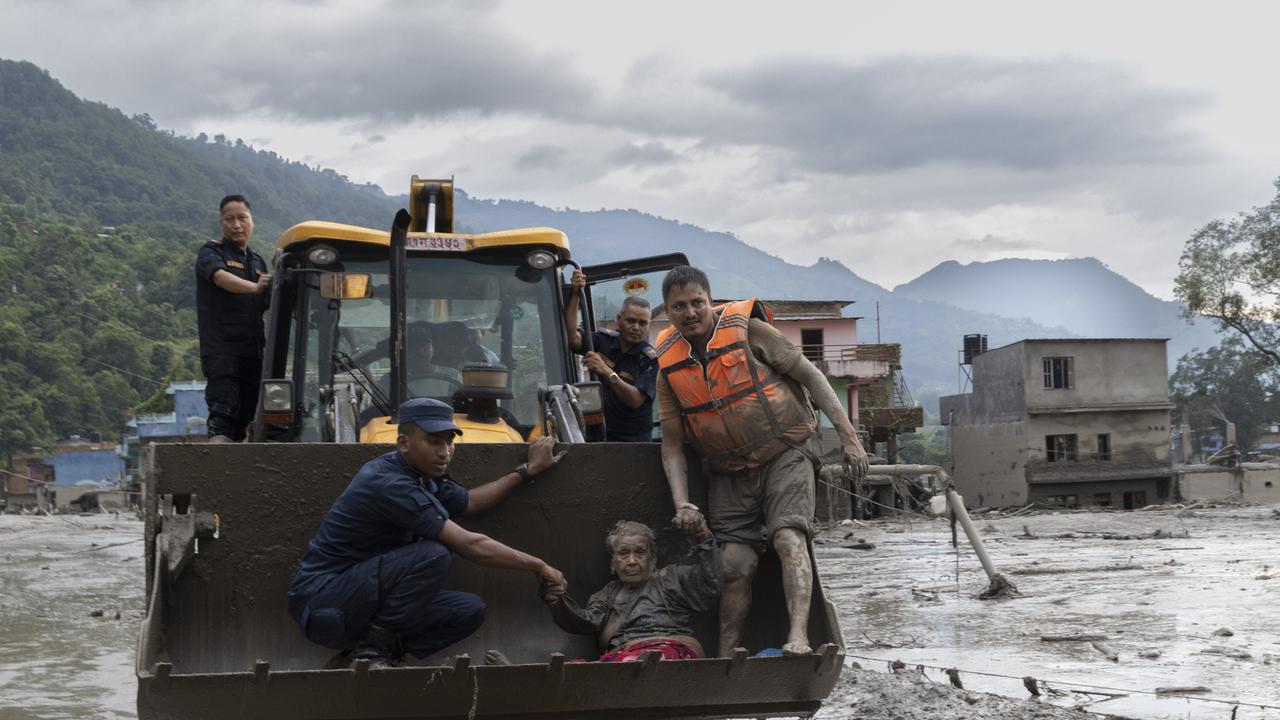
At about 9 a.m. on Aug. 26, a mass of ice and rock broke loose from the north face of Langtang Lirung, about 17,000 feet above sea level on the Nepal-China border. Hydrologists described the flow as liquid concrete. It covered its first 14 miles at an average speed of 120 miles per hour.
The flood tore through Timure, Syapru Besi and Betrawati along the Bhote Koshi and Trishuli rivers and wiped out the Gyirong Port crossing, Nepal’s main overland trade route with China. The impact was so powerful that it registered as a magnitude 5.2 seismic event.
By midday Aug. 28, 547 people had been confirmed dead in Nepal and five in the Tibet Autonomous Region of China. Nepali officials that morning roughly doubled their count of the missing to 1,900, after some 900 people were reported missing from hydropower projects alone. Chinese state media reported another 558 missing in Gyirong County, though it is not clear whether the two counts overlap at the border.
The International Federation of Red Cross and Red Crescent Societies estimated that 93,000 people in Nepal need support. Nepal’s disaster authority said more than 3,700 people had been rescued. The United Nations said more than 30,000 Nepali security personnel had been deployed.
Who was in the valley
The flood struck at the beginning of a working day.
At the Rasuwa customs yard, registered porters from nearby villages load and unload trucks moving between Nepal and China. They are organized through a Porters’ Union and receive work in rotation.
Hydropower workers were scattered through the valley as well. Thirteen projects were reported damaged across Rasuwa and Nuwakot, and by Aug. 28 some 900 hydropower workers were listed as missing — the single largest group among the missing.
At the Upper Trishuli-1 project, 76 workers were out of contact. At Rasuwagadhi, 51 were unaccounted for. At Langtang Khola, 60 people were trapped inside a tunnel.
Eighty-five Nepali security personnel were also reported missing, along with customs officers, immigration workers and bank employees.
Travelers were in the valley too. The Rasuwagadhi crossing is the overland gateway to Tibet, and many of those swept away were pilgrims returning from Mount Kailash, a peak held sacred by Hindus, Buddhists, Jains and followers of the Bon tradition. The Nepal Tourism Board listed 127 Nepali travelers unaccounted for, along with more than 500 foreign nationals from 32 countries. Of the 558 people reported missing in Gyirong County, 260 were foreign nationals.
The Nepal Electricity Authority estimated that about 430 megawatts of generating capacity had been damaged, more than 12% of the country’s generating capacity. Around 19 bridges and 25 miles of road were destroyed, along with four hydrological monitoring stations.
The same valley flooded last year
This was the second major glacier disaster to strike the same corridor in 14 months.
On July 8, 2025, a glacial lake in Tibet burst about 22 miles upstream from Rasuwagadhi. The flood destroyed the Miteri Bridge linking Nepal and China, wrecked the dry port and knocked out more than 200 megawatts of hydropower. Officials counted 11 dead and 18 missing in Nepal, with another 11 swept away in China.
The toll in 2025 could have been far worse. Rasuwa officials received a warning through border security about an hour before the flood entered Nepal. The district chief later estimated that without that warning, around 200 people might have died.
Fourteen months later, the customs yard, border post, hydropower camps and workers’ housing were still in the same valley. So were the porters.
The scientific warnings had meanwhile become stronger.
In March 2026, the International Centre for Integrated Mountain Development reported that glacier loss across the Hindu Kush Himalaya had doubled since 2000. The region’s glaciers lost about 12% of their area and 9% of their ice between 1990 and 2020.
Scientists studying the Aug. 26 collapse point especially to thawing permafrost — frozen soil and rock that has helped hold the mountainsides together for thousands of years. As it thaws, slopes become increasingly unstable.
A U.N.-backed survey in 2020 identified 47 potentially dangerous glacial lakes across the region. The July 2025 Rasuwagadhi flood came from a rapidly growing glacial lake that was not on that list. The Aug. 26 disaster was different: bedrock beneath part of the glacier on Langtang Lirung gave way, sending ice and rock into the valley and producing the debris flow and flood.
Nepal’s warning system monitors glacial lakes and river levels. It could not provide an hour’s warning for a rock-and-ice avalanche moving at 120 miles per hour.
The heat behind the collapse
Four days before the mountain came down, another climate record was broken.
On Aug. 22, the average sea-surface temperature across much of the global ocean reached 70 degrees Fahrenheit (21.1 degrees Celsius), the highest reading since records began in 1979, according to the European Union’s Copernicus Climate Change Service.
The timing was especially striking. Global ocean temperatures normally peak in March and April. This record came in late August, when they are normally falling.
The American Meteorological Society’s annual State of the Climate report found that carbon dioxide, methane and nitrous oxide all reached record concentrations in 2025. Ocean heat content and global sea level also set records.
Land glaciers lost ice for the 38th consecutive year. About 41% of all glacier loss since 1976 has occurred during the last decade.
That is the heat working on the glaciers and permafrost beneath Langtang Lirung.
The Copernicus service attributes the August record to decades of warming with a strengthening El Niño loaded on top. The U.S. National Oceanic and Atmospheric Administration now puts the chance of a very strong El Niño developing over the fall and winter of 2026 at better than 90%. El Niño years run hotter worldwide — the two hottest on record, 2023 and 2024, both had one — and that heat goes into the same mountains.
The countries that caused the crisis
Nepal produces roughly one-tenth of 1% of global greenhouse gas emissions.
The rich capitalist countries that produced most of the carbon destabilizing Nepal’s mountains have promised compensation to oppressed nations suffering the consequences.
Very little has arrived.
The Fund for Responding to Loss and Damage has received pledges of about $822 million since 2023. As of July 2026, only about 55% had been transferred, and not one project had been approved.
Climate loss and damage in oppressed nations, meanwhile, is expected to cost hundreds of billions of dollars every year by 2030.
After hundreds were killed on Aug. 26, Washington offered Nepal $500,000 and one disaster-response adviser. Britain pledged £5 million. The U.N. released $2 million. India sent 50 tons of supplies.
Capitalism is producing the disaster
The U.S. government withdrew from the Paris climate agreement in January. In February, Environmental Protection Agency Administrator Lee Zeldin revoked the legal basis for federal regulation of greenhouse gases.
The administration also cut research and weather-monitoring programs that help measure the climate changes producing disasters like this one.
But the climate crisis cannot be reduced to bad policy in Washington. The profits of the giant energy corporations depend on extracting and selling oil, gas and coal. The imperialist powers compete for markets, resources and military advantage while carbon continues accumulating in the atmosphere.
The porters of Rasuwa enter those calculations only as labor power.
Capitalism is not merely failing to stop the climate crisis. The drive for profit that governs capitalist production is producing it.
Built where investment is profitable
Nepal is a dependent capitalist economy, relying heavily on remittances from workers abroad, tourism and the sale of hydroelectric power. Its power stations, roads and workers’ camps are built in narrow mountain valleys because that is where investment is profitable and where export earnings can be generated to make payments on foreign debt.
The July 2025 flood showed the danger. The infrastructure was rebuilt there anyway.
What has actually saved lives has often been much simpler.
What has saved lives
In July 2025, one hour of warning passed through border security before the flood reached Nepal. Officials estimate that it may have reduced a potential death toll of around 200 to 11.
After that flood, Nepali and Chinese officials established a cross-border system to exchange warnings about glacial lakes and floods. This week, Chinese authorities warned Rasuwa officials when a new barrier lake formed above Gyirong Port.
The workers of Rasuwa did not burn the carbon that is melting the Himalayas. They carried the freight, built the power stations, worked in the tunnels and loaded the trucks.
The class whose corporations accumulated fortunes from fossil fuels offers condolences, a few million dollars and another round of investment under the same capitalist rules.
The answer will come from the working class organizing its own power across borders.
Join the Struggle-La Lucha Telegram channel