
On Aug. 27, the New York Times announced the death of Bosnian Serb Gen. Ratko Mladić with a headline calling him the murderous “Butcher of Bosnia.” It told readers that Mladić had been convicted in the killing of “some 8,000 Muslims at Srebrenica,” which it called Europe’s deadliest massacre since World War II.
The Times does more than repeat the NATO version of Srebrenica. It defames Mladić by turning him into a cartoon villain whose supposed role in the war was simply to slaughter Muslims. That figure never existed. The caricature is a propaganda construction that removes the civil war, the armies fighting on all sides, the U.S. and NATO role in provoking the conflict and the years of warfare that preceded Srebrenica.
Mladić was the military commander of the Bosnian Serb army in a civil war. The Times replaces that history with a morality tale: criminal Serbs, helpless Muslim victims and NATO coming to their rescue. That was precisely the story Washington needed to justify deeper military intervention and the destruction of Yugoslavia.
As the war unfolded, the International Action Center in New York documented a very different history. Washington and the other Western powers weakened Yugoslavia’s economy, used loans and economic aid to pit the republics against one another, and inflamed old national divisions that the socialist federation had overcome through shared government and equal national rights.
The IAC collected much of that record in two books: NATO in the Balkans: Voices of Opposition, published in 1998, and Hidden Agenda: U.S./NATO Takeover of Yugoslavia, published in 2002.
Yugoslavia came out of the fight against fascism
The history did not begin with Mladić or with the civil wars of the 1990s.
Yugoslavia’s socialist federation grew out of the Communist-led Partisan struggle against Nazi occupation during World War II. The Partisans united the different nationalities of Yugoslavia and became the largest resistance movement in Europe, more than a million strong. That struggle laid the basis for the socialist federation established after the war.
British writer Basil Davidson saw that struggle firsthand. As an officer of Britain’s Special Operations Executive, he parachuted into Bosnia in 1943 and fought alongside the Partisans. In the book Partisan Picture, Davidson described not only their military campaigns but the village networks, political organizing and multinational unity that allowed Tito’s movement to grow into a mass force against Nazi occupation and its collaborators. For Davidson, that multinational character was not incidental to the struggle; it was one of the reasons the Partisans could defeat both the occupiers and the nationalist forces that collaborated with the Nazis.
From 1945 to 1991, Yugoslavia existed as a multinational federation of six republics. Large industry was socially owned, national rights were guaranteed and the republics shared a rotating presidency. Industry and infrastructure were developed, while medical care and education were free and the right to a job was established.
Marxist writer and organizer Sam Marcy wrote that it was impossible to understand Yugoslavia’s breakup by accepting the claim that ancient national hatreds had simply broken through after decades of communist suppression.
“The establishment of the socialist federation of Yugoslavia was a historic victory,” he wrote. It had united peoples who had previously been subjected to rival imperialist powers and created a state capable of resisting outside domination.
That multinational unity was one of the foundations of socialist Yugoslavia. The Partisan movement had brought Serbs, Croats, Muslims, Slovenes, Macedonians, Montenegrins and other peoples together against fascist occupation, and the socialist federation gave that unity a political and economic basis for more than four decades.
To break Yugoslavia apart, the imperialist powers had to break that unity. Washington and the other Western powers intensified economic and political pressures that sharpened national antagonisms and backed forces seeking to separate the republics from one another. Right-wing and fascist nationalist organizations that had survived in exile in the U.S., Germany, Austria and elsewhere were revived and became channels for money and arms. U.S.-imposed austerity and economic disruption intensified national antagonisms on all sides, while outside powers renewed their support for right-wing and fascist organizations.
Yugoslavia’s breakup was not the spontaneous return of “ancient ethnic hatreds.” Western economic pressure and political intervention sharpened national antagonisms and backed separatist and right-wing nationalist forces.
Washington helped break up the country
Yugoslavia had internal economic and political contradictions, but the Western powers deliberately deepened the national divisions and backed the forces that pulled the federation apart.
Germany and Austria backed the secession of Slovenia and Croatia. Washington used economic pressure against the federation and backed forces seeking to break it apart. By 1992, the socialist federation had collapsed into civil war.
Meanwhile, U.S. military involvement steadily grew.
European newspapers reported CIA training of the Bosnian army, U.S. provision of satellite intelligence, weapons shipments, construction of airstrips and training of Bosnian and Croatian forces.
NATO’s military intervention was accompanied by a campaign to portray the Serbs as the new Nazis of Europe — a grotesque reversal of Yugoslavia’s World War II history. Under Nazi occupation, Serbs were themselves targeted for mass murder, along with Jews and Roma. The fascist Ustashe regime in Croatia carried out systematic slaughter of Serbs, Jews and Roma. Yet in 1992, television images from Trnopolje were broadcast around the world as evidence of Serbian “concentration camps.” German journalist Thomas Deichmann later investigated the footage and challenged the way the famous barbed-wire images had been presented.
By the time Srebrenica fell in July 1995, that propaganda image had been repeated for three years to justify escalating U.S./NATO intervention.
That propaganda did more than prepare public opinion for NATO intervention. It divided the anti-war movement. During the Vietnam War, a mass movement had learned to reject Washington’s claims and oppose U.S. aggression against the Vietnamese people. The movement against apartheid likewise identified with the struggle of the oppressed majority in South Africa. But over Yugoslavia, Washington and the corporate media succeeded in getting important sections of the left and anti-war movement to accept the picture of Serbs as fascist aggressors and NATO intervention as protection for their victims.
The method outside Yugoslavia mirrored the method used inside it. The imperialist powers sharpened national divisions among Yugoslavia’s peoples. At the same time, they used those same divisions and atrocity stories to fracture opposition to the war abroad. Once the argument focused on the Serbs rather than on U.S./NATO intervention, a united anti-war movement became much harder to build. That political division helped isolate Yugoslavia and clear the road for the NATO attack.
What was Krajina?
Washington had been preparing the Croatian military. In September 1994, the Pentagon contracted Military Professional Resources Inc. (MPRI), a company of former U.S. military officers, to train the Croatian army. In November, the U.S. and Croatia signed a military agreement, followed by the establishment of a U.S. intelligence operations center on the Adriatic island of Brac.
The invasion of Krajina was preceded by CIA and Defense Intelligence Agency analysis of the region. A Croatian officer later said MPRI advisers had taught the large-scale military tactics the Croatian army needed for Operation Storm. Croatian sources also reported that the U.S. supplied satellite intelligence.
British reporting described the rearming and training of Croatian forces as part of a “classic CIA operation.”
In August 1995, the Croatian army launched Operation Storm against the Serbian population of the Krajina region. For some, it stirred memories of the Nazis targeting the Serbs.
Some 200,000 refugees fled the Croatian offensive. Unlike Srebrenica, there were no demands in Washington for sanctions or NATO attacks on Croatia. Secretary of State Warren Christopher instead said the offensive was “to our advantage.”
What was Srebrenica?
The description of Srebrenica as an unarmed civilian “safe area” was false.
A May 30, 1995, report by U.N. Secretary-General Boutros Boutros-Ghali said that Bosnian government troops had incorporated several U.N.-declared safe areas into their military campaign. The government maintained “a substantial number of troops in Srebrenica,” which the report described as a violation of the demilitarization agreement.
In her dissent from Mladić’s appeal judgment, presiding Judge Prisca Matimba Nyambe noted that even the prosecution had acknowledged that the Bosnian Serb attack on the Bosnian army around Srebrenica had a legitimate military objective.
Srebrenica was part of the Bosnia war’s military front. Washington had helped build up the Bosnian government army with arms, training, military advisers and intelligence, and U.S. officers were involved in directing operations against the Bosnian Serb Army. Bosnian government troops operated from the Srebrenica enclave in violation of its demilitarized status. The fighting in July 1995 came out of that continuing war.
The Times obituary presents Srebrenica as a simple story: Mladić’s forces entered a civilian refuge and murdered some 8,000 Muslims.
The figure of 8,000 was not originally a count of bodies found at Srebrenica. It came from Red Cross tracing requests for people missing after the enclave fell. Thousands of men had left Srebrenica in an armed column of the Bosnian army and civilians that fought its way toward Tuzla, suffering heavy casualties from fighting and mines.
That military context disappears when Srebrenica is presented simply as the massacre of an unarmed civilian population.
One of the tribunal’s own appellate judges rejected the Srebrenica case against Mladić. Judge Nyambe wrote that illegal killings outside combat were reprehensible but “not tied to Mr. Mladić.” She found that the Trial Chamber had failed to distinguish adequately between executions and deaths in combat and concluded that it had erred in convicting Mladić on the Srebrenica charges, including genocide.
NATO bombs
Srebrenica was followed in August 1995 by an explosion at a Sarajevo marketplace that killed 43 civilians and wounded 75.
Washington immediately blamed Bosnian Serb forces. The explosion became the justification for a massive NATO bombing campaign.
Military specialists disputed the accusation. New York Times correspondent David Binder reported that several military sources questioned whether the mortar could have come from Serbian positions. One Canadian specialist said evidence indicated that the shell had not come from a mortar tube.
NATO proceeded with more than 3,515 sorties, dropping 1,026 bombs on 338 targets.
The bombing, economic blockade and military pressure forced the Bosnian Serb leadership and the Yugoslav government into U.S.-brokered negotiations at Dayton, Ohio, where they accepted Washington’s terms for ending the war. The agreement stopped the fighting, but it also opened the way for tens of thousands of NATO troops to occupy Bosnia under U.S. command.
Dayton put NATO in charge
The settlement finally signed at Dayton in November 1995 closely resembled proposals Washington had previously opposed. The essential difference was that the earlier agreements would not have put Bosnia under a U.S.-led NATO military force. Dayton did.
The political and economic provisions went much further. An appointed High Representative received sweeping authority over civilian government. The International Monetary Fund was given control over the Bosnian Central Bank, while Western financial institutions directed the restructuring and sale of socially owned assets.
The result was colonial-style reconstruction. Yugoslavia’s foreign debt was divided among the successor republics, which were then subjected separately to IMF programs, plant closings, bank failures and cuts. Bosnia’s reconstruction was subordinated to debt payments and Western corporate interests.
The country had been broken apart politically. NATO occupied it militarily. Western banks and financial agencies took control of its economic reconstruction.
The war Washington and NATO sold as humanitarian intervention ended in military occupation and a colonial administration.
The Hague tribunal completed the story
The International Criminal Tribunal for the former Yugoslavia gave this political narrative the authority of a court.
The “Hague tribunal” was an ad hoc court created by the U.N. Security Council in 1993, while the Bosnia civil war was still underway. It was not a permanent international court standing above the conflict. Washington drove its creation, financed and staffed it, and supplied it with information. NATO governments provided much of its funding, while NATO military power gave its indictments force.
Madeleine Albright, then the U.S. ambassador to the United Nations, was a driving force behind establishing the tribunal. David Scheffer, the U.S. official dealing with the court, acknowledged that it was “supported, financed, staffed and provided information” primarily by the United States. NATO spokesperson Jamie Shea was even more explicit: “NATO countries are those that have provided the finances to set up the Tribunal, we are among the majority financiers.”
The tribunal therefore did not stand outside the NATO intervention as a neutral judge. It functioned as its legal arm: the same powers intervening in Yugoslavia helped create and finance the court, supplied its information and used its indictments against the political and military leaders they were fighting.
Almost 60 of the first 76 people publicly indicted by the tribunal were Serbs. Figures such as Radovan Karadzic and Ratko Mladić had already been pronounced guilty in the media before they came before any court.
The tribunal was set up to prosecute people from the former Yugoslavia; it was not empowered to put the broader conduct of the NATO powers on trial. The same armies bombing and occupying Yugoslavia supplied support to the institution judging their opponents.
The tribunal’s own appellate record also exposed serious problems with Mladić’s trial. In her dissent, Appeals Chamber presiding Judge Prisca Matimba Nyambe found that the Trial Chamber had violated the principle of equality of arms by refusing to hear two defense witnesses and that prosecution disclosure failures impaired Mladić’s ability to prepare his defense. She concluded that the accumulated errors undermined the findings supporting his convictions and would have ordered a retrial on every count except hostage-taking.
Bosnia opened the way to the 1999 war
Dayton did not end Washington’s intervention in Yugoslavia. It established a bridgehead for the next stage.
U.S. bases followed the Bosnia operation. NATO expanded deeper into Eastern Europe. Washington and Germany backed the Kosovo “Liberation Army,” and by 1998 NATO had prepared detailed plans for another attack on Yugoslavia.
The timing made the 1997 film Wag the Dog impossible to ignore. The movie imagined a White House manufacturing a fake war against Albania to divert attention from a presidential sex scandal. Then came the Monica Lewinsky scandal, Clinton’s impeachment and, in 1999, a real U.S.-led war in the Balkans. “Wag the dog” quickly became part of the political vocabulary surrounding the bombing.
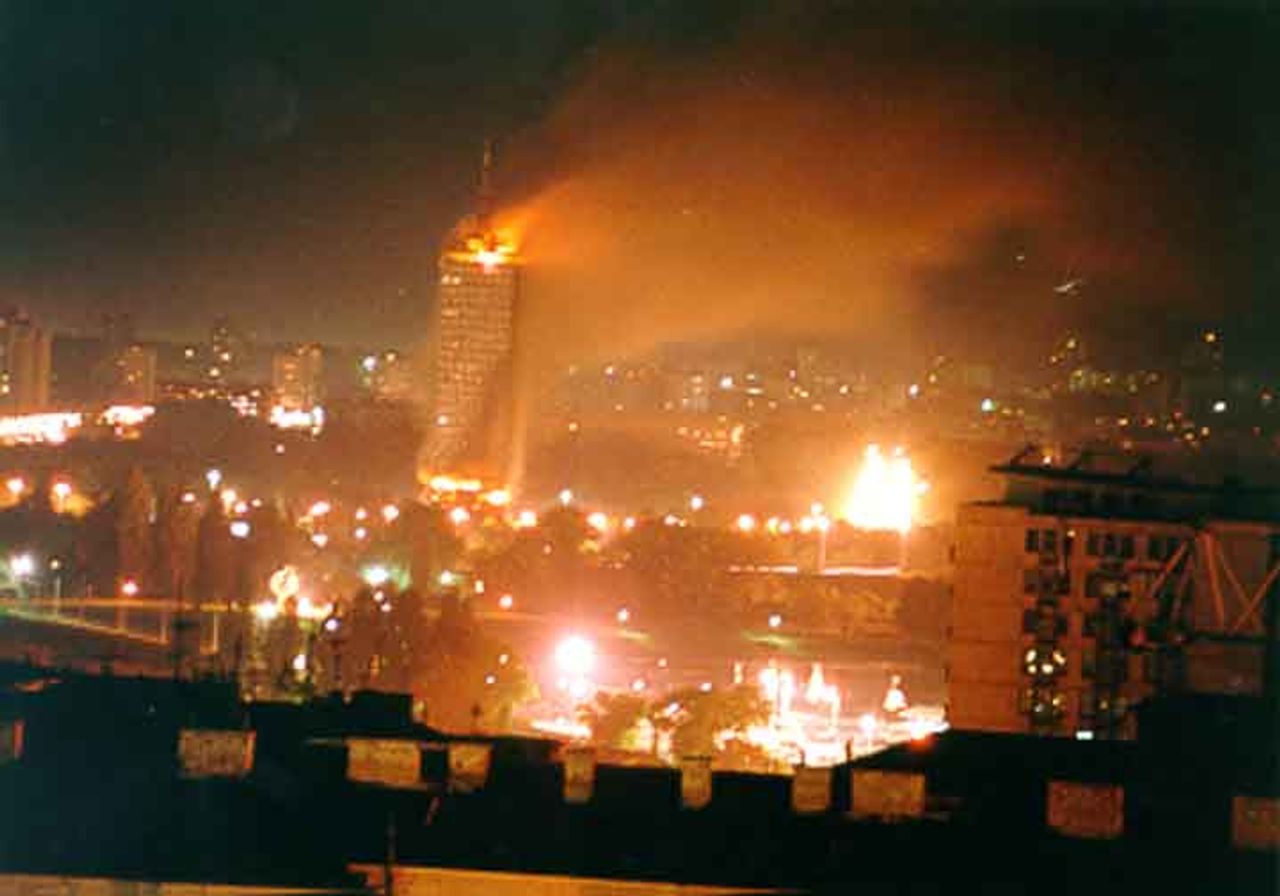
On March 24, 1999, NATO began bombing what remained of Yugoslavia.
For 78 days, U.S. and NATO aircraft attacked factories, bridges, electrical systems, television facilities, hospitals and other infrastructure. When Yugoslavia finally accepted NATO’s terms, Washington had achieved what years of sanctions, destabilization and civil war had prepared.
The NATO occupation spread through the Balkans.
NATO leaders claimed that they had gone to war to stop massacres. The result was the overthrow of the government in the region that had resisted U.S. rule and a network of NATO military bases in Croatia, Bosnia, Hungary, Macedonia, Albania and Kosovo.
The history behind the obituary
Ratko Mladić was vilified in the history written by the powers that destroyed Yugoslavia.
His death gives the New York Times another occasion to repeat NATO’s deceptive version of Srebrenica and of the destruction of Yugoslavia.
The Times’s portrayal is not a description of what happened in Bosnia. It is a propaganda construction. Mladić was a military commander in a civil war in which armies fought for territory and opposing forces suffered thousands of casualties. By reducing him to a symbol of Serbian savagery, the Times makes the war appear to have been the slaughter of Muslims by one uniquely criminal Serbian army — precisely the story Washington needed to justify NATO intervention.
Missing is the socialist federation born from the Partisan victory over fascism and built on the unity of Yugoslavia’s many nationalities. Missing is how Washington and the other Western powers sharpened national divisions, backed the breakup of the federation and then intervened militarily in the wars that followed. Missing are the CIA operations, the arming and training of selected forces, the destruction of Serbian Krajina, the NATO bombing campaigns and the colonial controls imposed through Dayton.
And missing is what came afterward: the 1999 NATO war and the network of U.S. and NATO bases spread across a country that had once stood outside their control.
The New York Times’s portrayal of Mladić preserves the political story used to sell the destruction of Yugoslavia: Serbs as aggressors, Muslims as helpless victims and NATO as their rescuer. The historical record does not fit that story.
The same method of division is being used today, though in different forms.
In Venezuela, the division has centered increasingly on Acting President Delcy Rodríguez. In the immediate aftermath of the U.S. kidnapping of Nicolás Maduro and Cilia Flores, some voices suggested that Rodríguez had been complicit. Few accepted that claim. The broader attack has been that she has not resisted strongly enough as Washington moved to seize control of Venezuelan oil and finances. The result is to turn the anti-war movement away from the central issue of U.S. aggression and takeover into a narrow argument over whether to support the Venezuelan government.
That resembles the method used against Yugoslavia. Slobodan Milosevic and Ratko Mladić were turned into personal embodiments of the crisis, so that the question became whether they were worthy of defense rather than whether the U.S. and NATO had the right to break up and bomb Yugoslavia.
In Iran, the method is more direct: the government and its leaders are portrayed as monsters whose destruction can be presented as liberation.
The form changes, but the purpose is the same: shift attention from U.S. aggression to the character of the targeted government, divide the anti-war movement over whether its leaders deserve support, and make united resistance to intervention harder to build.
That was one of the lessons of Yugoslavia. U.S. propaganda exploited national divisions inside the country and political divisions inside the anti-war movement abroad. Both helped clear the way for the U.S./NATO assault.
The destruction of Yugoslavia became a model for later U.S. wars sold in the name of human rights.
Mladić’s death should not be used to revive the propaganda that made NATO’s war appear humanitarian. The Times’s caricature depends on everything its obituary leaves out. The history it buries is the U.S./NATO destruction and takeover of Yugoslavia.
Join the Struggle-La Lucha Telegram channel