
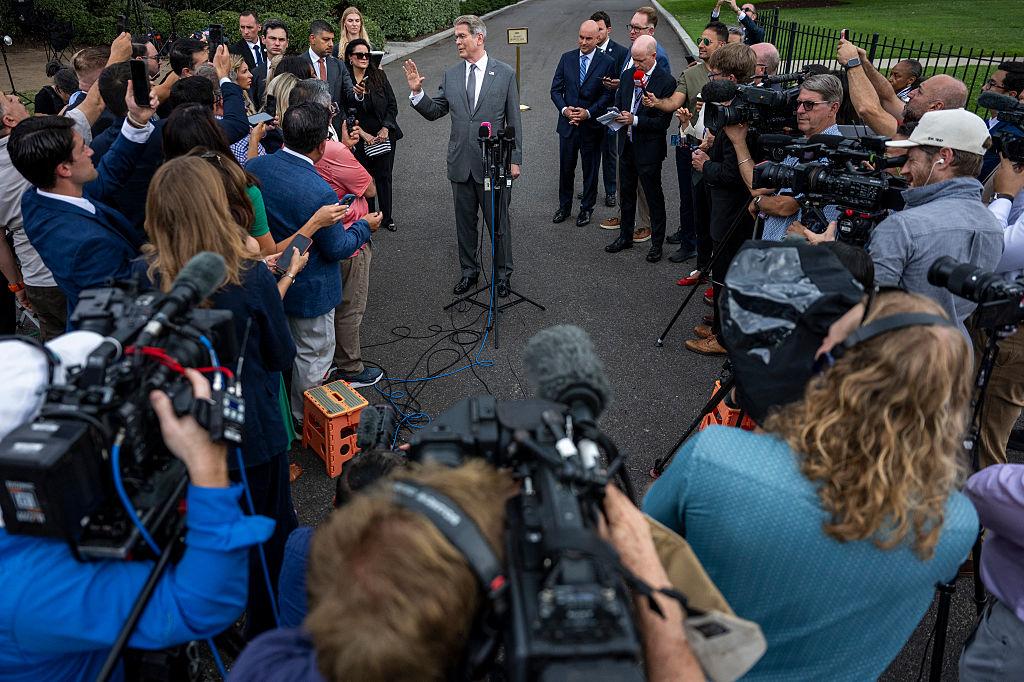
The U.S. Treasury has told the world to choose sides in Washington’s war on Iran. In an Aug. 20 CNBC interview, Treasury Secretary Scott Bessent promised “the greatest coordinated economic isolation in the history of the world” and delivered the ultimatum in plain words: “We’re going to our allies and saying, you are either with us or against us.”
Any government, bank or shipping company that keeps “doing business with Iran, transferring money, buying their oil, or doing seaborne ship transfers,” Bessent said, would face the “full might and force” of the U.S. government.
This is a threat to extend the war into a worldwide economic blockade — to cut Iran off from its oil buyers, banks and shipping and force other countries to help carry it out. Washington has used the same kind of economic warfare for more than six decades trying to strangle Cuba.
But one word in Bessent’s boast gives away the problem: “coordinated.” Washington does not yet have the coalition it claims will carry out this “economic isolation.”
The contrast with Russia in 2022 is sharp. For years, Moscow had warned against NATO’s expansion toward Russia’s borders and especially against bringing Ukraine into the military alliance. By early 2022, Washington and its European allies were already preparing a coordinated economic attack if the crisis turned into war. When Russia launched the Special Military Operation on Feb. 24 in response to the growing NATO threat and in support of Donbass, the sanctions were ready. The U.S. and its allies immediately moved against Russia’s largest banks and financial system.
Nothing like that exists today. Bessent is not announcing an agreement among Washington and its allies. He is announcing that the U.S. still has to go out and get one — “going to our allies” to demand that they enforce an economic blockade they never signed onto.
In March, those same allies refused to send warships to join the U.S. effort to force open the Strait of Hormuz.
The UAE has imposed a broad trade and financial embargo on Iran, but that still does not solve Washington’s central problem. On Aug. 19, the United Arab Emirates announced it was halting all trade and financial transactions with Iran — but it had run this play once already. Days after the war began, the UAE suspended direct cargo shipping with Iran in early March, then quietly resumed it through Dubai’s Jebel Ali Port in late June. The August halt came only after Abu Dhabi said Iranian missiles were fired toward it on Aug. 18. But Iran’s oil sales run overwhelmingly through China, which buys more than 80% of its shipped oil.
Bessent insisted the markets were misreading him, saying they were “misinterpreting what this economic pressure means.” But oil prices rose after his threats and held near $94 a barrel on Aug. 21, the highest since July 24.
“We’ve got a spike in oil prices today that I don’t really understand,” Bessent told reporters outside the White House.
The reaction is not mysterious. If Washington knocks more Iranian oil off the market while shipping through the Strait of Hormuz remains disrupted, less oil is available and prices are pushed upward. Prices would fall if economic pressure forced Iran to retreat and brought the war to an end. So far, the market is moving in the opposite direction.
The wall in Beijing
The biggest obstacle to Bessent’s plan is China, which buys more than 80% of Iran’s shipped oil. Much of it goes to independent refineries through trading companies and tanker networks developed over years of U.S. sanctions.
U.S. sanctions reach far beyond U.S. borders because so much world trade still depends on the dollar and banks tied to the U.S. financial system. Washington can threaten a bank or corporation anywhere in the world with loss of access to dollar payments, U.S. banks and the U.S. market if it does business with Iran.
China has spent years building parts of its Iranian oil trade to reduce that pressure. Independent refiners with relatively little business in the U.S. buy crude through layers of intermediaries and tanker networks designed to withstand sanctions. Washington has already sanctioned Chinese refineries for buying Iranian oil. Beijing answered in May by ordering that U.S. sanctions against five of them not be enforced in China.
Iranian oil kept reaching Chinese refineries.
Washington can threaten larger Chinese corporations and banks, but the stakes rise sharply when it moves from small independent refineries to the major banks of the world’s second-largest economy. Trying to cut those banks out of dollar finance could bring retaliation and disrupt trade and banking far beyond Iran. U.S. corporations themselves are deeply tied to business with China.
That is the contradiction Bessent cannot threaten away. Measures powerful enough to seriously damage China could also impose heavy costs on the U.S. and the world capitalist economy.
China has already rejected unilateral U.S. sanctions and says its trade with Iran is its own affair. Beijing could buy oil elsewhere, but that misses the point. Washington is demanding that China accept the U.S. Treasury’s right to decide whom Chinese companies may trade with — and Beijing is refusing.
Sanctions can still hurt
None of this means the blockade or sanctions are harmless. The existing U.S. naval blockade is already cutting Iranian oil shipments.
China’s imports of Iranian oil fell to about 534,000 barrels a day so far in August, down from about 1.4 million barrels a day on average in 2025, according to the tanker-tracking firm Kpler. China is by far Iran’s largest buyer, so that collapse cuts directly into Tehran’s export income — fewer resources for imports and production, and greater pressure on prices and living standards.
Washington tried the same approach during Trump’s first “maximum pressure” campaign. Iranian oil exports were driven sharply downward, and the sanctions inflicted real economic damage. But they did not force Iran to surrender.
Iran and its trading partners adapted. New tanker networks appeared, payments moved through channels harder for Washington to control, and Chinese independent refineries became major buyers. The Treasury could sanction another tanker, trading company or refinery, but the trade found new routes.
That history matters because Bessent is promising a much bigger version of a policy that already inflicted heavy damage on Iran without forcing it to surrender.
The dollar and the U.S. banking system still give Washington enormous power to hurt countries that resist it. But after decades of sanctions, countries targeted by the U.S. have built new trade routes, payment systems and financial ties while becoming more self-reliant and strengthening their economic sovereignty. That makes it harder for the Treasury Department to cut them off.
China is still buying Iranian oil. U.S. allies refused to send warships to force open the Strait. Yet Bessent promises “the greatest coordinated economic isolation in the history of the world” while Washington is still trying to recruit the countries that would have to carry it out.
The U.S. can still make Iran suffer. What it has not shown is that it can force China and the rest of the world to help make Iran surrender.
Join the Struggle-La Lucha Telegram channel