
Iranian missile and drone strikes heavily damaged the U.S. Navy base in Bahrain that supplied the USS Abraham Lincoln, and the carrier’s crew ran short of food and basic supplies as a result. The Trump administration kept that cause from the public.
MS NOW senior national security reporter David Rohde reported Aug. 18 that Department of War boss Pete Hegseth had hidden the extent of the destruction from the public.
The Navy eventually shifted supply operations to Diego Garcia in the Indian Ocean — roughly 2,200 miles from the Gulf of Oman — but at that distance the Lincoln kept running short.
The Lincoln has now been relieved by the USS George Washington and is heading home after nearly nine months of deployment. The George Washington, normally based in Japan, arrived in the Arabian Sea on Aug. 19.
But the story of what happened to the Lincoln begins on Feb. 28, the first day of the U.S. assault on Iran.
Iran immediately struck U.S. bases throughout West Asia. Among the targets was Naval Support Activity Bahrain in Manama, headquarters of the Navy’s Fifth Fleet and a logistics center that U.S. naval operations had depended on for decades.
The scale of the damage was kept largely out of public view.
The Washington Post reported May 6 that Iranian strikes had damaged or destroyed at least 228 structures or pieces of equipment at 15 U.S. military sites. The targets included barracks, hangars, fuel depots, aircraft, radar installations, communications equipment and air-defense systems. The newspaper found that the destruction was far greater than the U.S. government had publicly acknowledged.
Bahrain was hit especially hard.
A Wall Street Journal investigation June 26 found that repeated Iranian missile and drone attacks from late February through June extensively damaged Naval Support Activity Bahrain. The command headquarters, more than a dozen other buildings and two satellite communications terminals were hit. Most U.S. personnel were evacuated.
A U.S. official told the Washington Post that damage at the base was “extensive” and that the Fifth Fleet headquarters was being relocated to MacDill Air Force Base in Tampa, Florida. The official said personnel were unlikely to return to the Bahrain base anytime soon.
Rohde reported that the destruction knocked out the Navy’s main logistics hub supporting the Lincoln. Instead of acknowledging what had happened, Hegseth kept the extent of the damage from the public while the Navy tried to sustain the carrier from Diego Garcia.
Diego Garcia, home to a U.S.-British military base south of the Maldives, lies thousands of miles from the waters where the Lincoln was launching bombing missions against Iran and supporting the U.S. blockade.
The disrupted supply line was one more sign that the bases the U.S. military bombs Iran from were themselves within Iran’s reach. Iran had brought the war back onto the sprawling network of bases Washington depends on to wage war throughout West Asia.
Sailors and families push back
The consequences were passed directly to the rank-and-file sailors aboard the Lincoln.
The carrier’s approximately 5,000 sailors and Marines endured a record stretch of more than 200 days between port calls while carrying out thousands of sorties in the war. Families and sailors reported shortages of fresh food and basic supplies, contaminated water, broken toilets and other plumbing problems, lost mail and severe exhaustion.
Reports also emerged of sailors attempting to jump overboard and of worsening mental health aboard the ship. Hegseth dismissed reports about conditions as “completely misrepresented.”
On Aug. 6, about 200 family members confronted Acting Navy Secretary Hung Cao and other senior Navy officials at a meeting in San Diego. Another meeting was held online that evening. Families demanded answers about food, water, working conditions, mental health, safety and when their relatives would finally come home.
Recordings of the meetings were leaked to MS NOW. Sailors and their relatives also spoke to military and civilian news outlets. What Navy leaders had been able to contain within the ship was suddenly in public view.
The complaints went beyond discomfort. Young enlisted sailors on a nuclear-powered aircraft carrier were working exhausting shifts in a war zone, under continuing threat of Iranian missile and drone attack, after months with little relief from the ship.
Families described deteriorating morale and fears that the extended deployment was breaking people down. They forced the issue into the national media and Congress.
Trump responded with contempt. When questioned about the extraordinary length of the Lincoln’s deployment, he said it was “not nearly long enough.” Hegseth rejected the reports of poor conditions.
The protests continued.
Organized refusal aboard the Lincoln has yet to surface. But rank-and-file discontent has become open resistance to the way the Navy leadership has handled the deployment and tried to control information about it. Sailors are talking. Their families have organized, confronted senior Navy officials and made sure those confrontations reached the public.
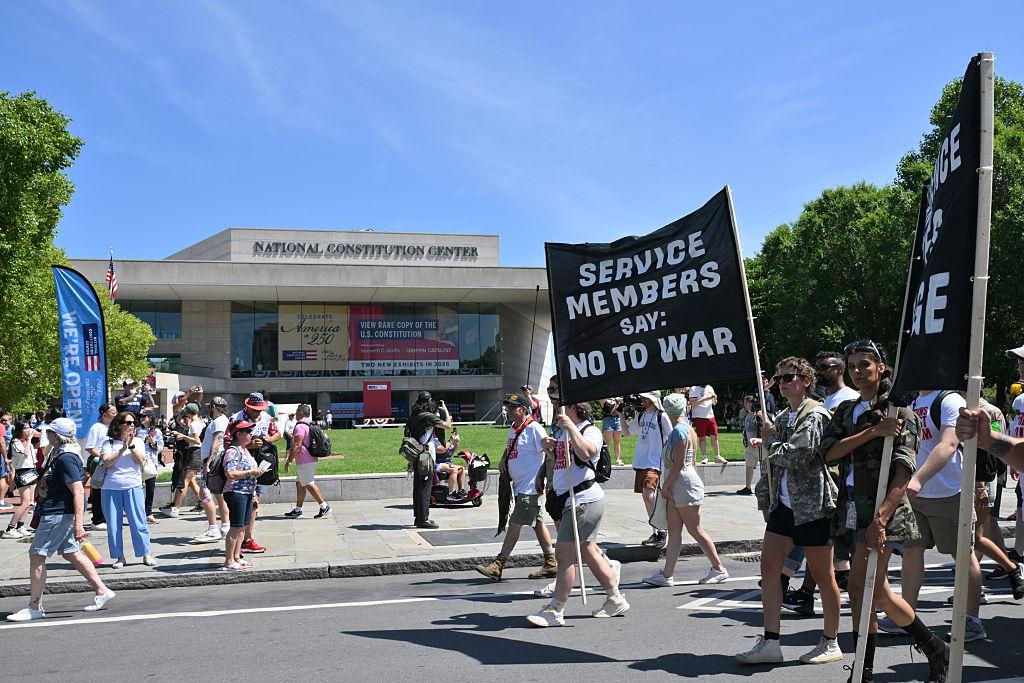
The resistance reaches beyond the Lincoln. On July 4, at least a dozen currently serving members of the Army, Navy, Air Force and Marines — officers as well as enlisted — marched in a Service Members’ Anti-War Contingent in Philadelphia organized by the Center on Conscience and War. Several more had signed up to march but were denied leave by their units. According to the center, it was the largest gathering of serving military personnel at an antiwar protest since the Vietnam War.
The significance goes beyond the Lincoln. Military discipline depends in part on isolating rank-and-file personnel from the people at home and keeping grievances within the chain of command. On the Lincoln, that barrier began to break down. Sailors and their families turned what Navy leaders wanted treated as an internal problem into a public fight over the conditions of the war itself.
The Navy finally sent the USS George Washington from the Pacific to relieve the Lincoln. That decision left the western Pacific temporarily without a U.S. aircraft carrier and showed how the Iran war is straining military forces far beyond West Asia.
Replacing one carrier with another only moves the underlying problem.
Washington entered the war assuming that its network of military bases, aircraft carriers and advanced weapons would allow it to pound Iran while maintaining overwhelming military superiority throughout the region.
Iran’s counterstrikes showed that the base system on which that power depends could itself be attacked.
The Department of War could minimize the damage in its briefings and keep photographs of wrecked bases out of public view. It could not hide the consequences forever.
They eventually appeared thousands of miles at sea — in an aircraft carrier that could no longer rely on its normal supply base, in exhausted sailors and angry families who began speaking out, and in another carrier pulled out of the Pacific to take its place.
The sailors who kept the Lincoln running for nine months are working-class youth, most of them 26 or younger, sent to enforce a blockade and bomb a country that never attacked them. Iran’s missiles hit the bases. The war’s cost hit the crew. When their families stood up to the acting Navy secretary in San Diego and leaked what he told them, they gave the war managers something new to fear: the people ordered to fight this war starting to fight back.
Join the Struggle-La Lucha Telegram channel