
Fidel Castro sleeps, overcome by exhaustion, while several young people surround him with the joyful curiosity of those who discover that even a hero closes his eyes. In other photographs, he eats with farmers, rides a horse at a cooperative, enjoys an ice cream, feeds an elephant in New York, or improvises, with a pair of spoons, Alicia Alonso’s dance. In these scenes, there is no machete charge nor a guerrilla column advancing up the mountain. There is something politically more difficult to fabricate: familiarity. The leader steps down from the podium for a moment and enters everyday life. The camera brings him closer without diminishing his historical stature.
If we close our eyes, we can trace the journey of a man through still images of Fidel. Memory does not function like a video camera that records continuously. When we experience something, the brain retains fragments: places, faces, emotions, sounds, movements, and certain particularly significant moments — and the Cuban Revolution forged its public image at the very moment the world was beginning to think in images. Fidel was born on Aug. 13, 1926, just as sound cinema was preparing to supplant silent film. Three decades later, he would lead a rebellion that coincided with the birth of international television and major illustrated magazines.
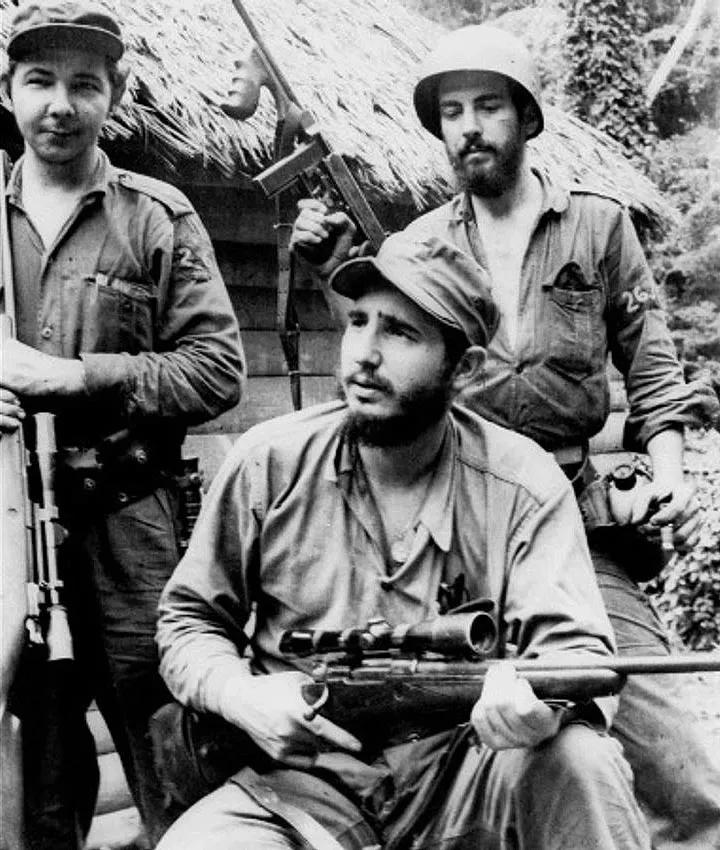
The American historian Nancy Stout called the Cuban Revolution “the perfect revolution” for that new visual era. It was epic, poetic, and aesthetically provocative. Its narrative unfolded in episodes: the Moncada, prison, exile, the landing, the Sierra Maestra, the final offensive, and the entry into Havana. There was danger, defeat, comebacks, young protagonists, and an outcome that seemed improbable until it actually happened. On Jan. 8, 1959, when Fidel arrived in the capital, the story already had the structure of a suspenseful narrative, and photography was there to provide it with visible continuity against the backdrop of a city nestled by the sea, in one of the world’s most beautiful bays.
The Cuban Revolution is a beautiful revolution — and even more so now, when it is being relentlessly attacked. Not because photography embellished it, nor because a frame could fabricate history, but because it has lived through — and continues to live through — a real-life epic that, from the very beginning, found those who knew how to translate it into images. Korda, Raúl Corrales, Osvaldo and Roberto Salas, Liborio Noval, Perfecto Romero, Ernesto Fernández, and other great photographers recognized in that political transformation an extraordinary visual subject: bearded young men arriving from the mountains, crowds in the streets, literacy teachers, peasants, workers, militiamen; a country that seemed to throw itself wholeheartedly into its own narrative.
The epic became an image because it was already present in the events themselves. It did not invent the energy of leadership: Fidel among the people, touring fields and factories, conversing with students, workers, or foreign visitors. Its creators mastered a modern visual grammar. Some had worked in journalism, advertising, or commercial studios and knew how much a silhouette, a close-up, a low-angle shot, or the contrast of black and white can convey. Alberto Korda, for example, came from a background in advertising photography before documenting the revolution. That expertise did not replace the event itself: it gave it visible form.
But the image was merely the frame; what sustained the revolution was something else. Fidel led a “beautiful” revolution because at its core lay an ideal of justice that recognized itself as the heir to a long Cuban tradition. In Ese sol del mundo moral, Cintio Vitier described that continuity as “a concrete spiritual process: that of the progressive conception of justice, and the struggles for its realization, in Cuban history.” The key was not the isolated beauty of a photograph, but the ethical aspiration that the photograph manages to reveal.
That is why images of Fidel possess a depth that goes beyond the political portrait. The beard, the olive-green uniform, his height, his gesturing hands, and his ease in mingling with a variety of interlocutors created an immediately recognizable presence, but its symbolic power depended on its relationship to the historical moment. Without the expectation of change, without popular mobilization, without the promise of social justice, those frames would have been nothing more than portraits.
The Cuban people were never mere background in those photographs, but their true center. That centrality also explains the persistence of a revolution subjected for decades to hostility from Washington and forced to defend, under increasingly harsh circumstances, the sovereignty it had won. The beauty of that history does not lie in having remained intact — for no living revolution can do so — but in having preserved, amid contradictions, sieges, and wear and tear, the determination to place justice on the horizon of what is possible.
On Aug. 13, 2026, Fidel turns 100, and his beautiful and just revolution celebrates with him.
Source: La Jornada. Translation: Resumen Latinoamericano — English.
Join the Struggle-La Lucha Telegram channel