
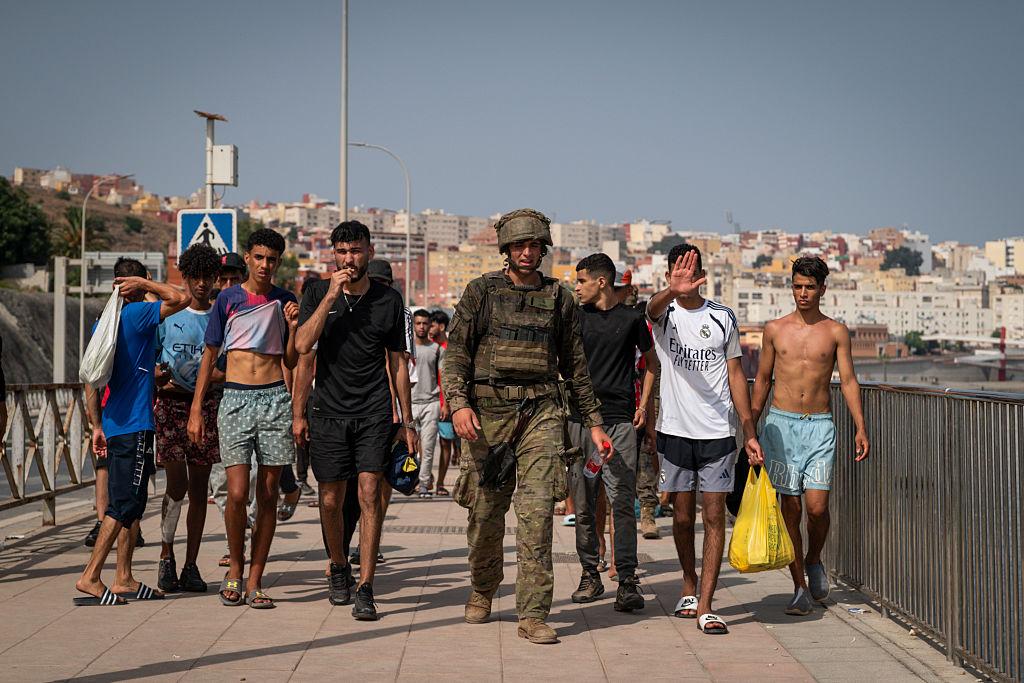
On July 30 and 31, tens of thousands of Moroccan workers crossed into the Spanish-held enclave of Ceuta. At least 72 drowned or were crushed on the way. The toll kept rising as bodies washed ashore. Within two days, most had returned to Morocco. Many went back voluntarily; Spanish soldiers escorted others to the border.
They were poor, out of work and mostly young. Many told reporters they had come looking for a job. Ajoub el-Arrot, 24, put it plainly to the New York Times: everyone came because there is no work in Morocco.
The ruling-class press on both sides of the Atlantic reached for one word: invasion. Donald Trump, whose approval has sunk into the low 30s ahead of the November midterms, told Republicans to make the crossings a “talking point.” The U.S. State Department joined the fascist-style racist campaign. It recast a desperate movement of unemployed Moroccan workers as “mass illegal migration” and blamed Spain for it.
Sánchez had already angered the right with Spain’s more open immigration policy. In April 2026, his government allowed more than one million undocumented migrants already living in Spain to apply for legal residency. The Ceuta crossings became a weapon in Trump and the European far right’s campaign against that policy.
Nigel Farage took up the cry for Reform in Britain. Italian Prime Minister Giorgia Meloni suspended passport-free travel with Spain under the Schengen system for a month and demanded that Spain be expelled from the system altogether. Poland and Finland backed her. Alice Weidel’s far-right Alternative for Germany party, known as AfD, and Spain’s far-right Vox party joined the attack. German Chancellor Friedrich Merz demanded that Morocco take back the migrants “immediately.” Denmark’s Mette Frederiksen, a Social Democrat, urged other governments to consider suspending Schengen as well, carrying the campaign into the social-democratic center. Twenty-two of the European Union’s 27 member states signed a letter to European Commission President Ursula von der Leyen demanding an emergency meeting of interior ministers, set for Aug. 4.
The letter framed the crossings as “hybrid threats” — the security-state term for treating unemployed workers as a military attack. The threat was manufactured.
Their letter called the crossings a “hybrid threat” — security-state language that turns unemployed workers into a military attack. Ceuta and Melilla are outside the Schengen zone. Suspending Schengen rules could not stop anyone crossing from Morocco into the enclaves. It only restored border checks between Spain and the rest of Europe, turning the crossings into a pretext to isolate Spain.
Not an invasion — a movement of workers turned back
Set the word “invasion” against the facts and it collapses. These were unarmed, unemployed workers, not an army. The troops Spain rushed to Ceuta were ordered to back up the Civil Guard with logistics and surveillance, while the police handled the crowds. Within two days most of the roughly 60,000 who had crossed were back in Morocco, more than 48,000 in the first 48 hours. Most turned back on their own. They did so because Ceuta gave them nothing to stay for: no work, no food, no shelter. The reception center overflowed, the shelters for unaccompanied children ran at 16 times capacity, and people slept in parks and on sidewalks. Spain moved the returns fast — the Interior Ministry clocked departures at 150 a minute — and soldiers escorted some to the border. For the sea arrivals the Supreme Court had just ruled could not be summarily pushed back, there were no hearings.
What the cameras recorded was a wave of poor workers answering messages that promised an open route into Ceuta and access to jobs, only to find the promise empty and turn back.
The tinder was unemployment: young Moroccans with no work and no future at home. The spark was a campaign of false messages that twisted a Spanish Supreme Court ruling. The court had only ruled that people reaching Ceuta or Melilla by sea could not be immediately pushed back under the special procedures used at the border fences. Those spreading the messages turned that limited ruling into a promise that anyone who reached the enclaves by sea could stay in Spain and find work. That was false. They could still be returned through the ordinary legal process.
Those behind the campaign deliberately flooded social media with disinformation, turning the court’s limited ruling into a false promise that anyone who reached Ceuta by sea could stay in Spain and find work. Videos and messages spread across Instagram, TikTok and other networks saying the border was open and that anyone who reached Ceuta by sea would be safe from deportation and able to look for work. One 16-year-old told Reuters that he and his cousin saw the videos and set out for Ceuta, a 12-hour drive away.
A Moroccan human-rights activist said the departures had been promoted. He said the message that the border was open came first, followed by claims about the court ruling. That sequence, repeated rapidly across several platforms and followed by the movement of tens of thousands of people, was a sign of coordination, not a rumor spreading by accident. Many in Spain and Morocco believe the disinformation campaign was part of the wider attack on Spain.
The false messages explain why the workers came. What turned the movement into a crossing of tens of thousands was the Moroccan government pulling its forces back from the border. A crowd that size could not have reached the fence in a day otherwise. The withdrawal confirmed that the disinformation campaign and the opening of the border were coordinated parts of the same attack on Spain.
Spanish Prime Minister Pedro Sánchez blamed smugglers and a misreading of the court ruling rather than name the Moroccan government or the forces behind the coordinated attack. Doing so openly would threaten a relationship Madrid wants to preserve. Yet his own defense minister described Morocco’s actions as blackmail.
Morocco had used the border this way before. In 2021, after Spain admitted Brahim Ghali, leader of the Polisario Front, for medical treatment, the Moroccan government loosened its border controls and about 8,000 people crossed into Ceuta. The Polisario Front leads the struggle for an independent Western Sahara.
Why Spain is in the crosshairs
Washington put Spain in its crosshairs after the Sánchez government broke with it over Iran, Palestine and NATO military spending. Spain refused to let the jointly operated Rota and Morón bases be used for the U.S. war on Iran. It recognized the state of Palestine in 2024, called the slaughter in Gaza a genocide and opposed military cooperation with Israel. That same year, Spain turned away a U.S.-flagged ship carrying weapons for Israel at Algeciras. The cargo was rerouted through Morocco, which also let an Israeli warship refuel at Tangier.
On July 20, days before the Ceuta crossings, Sánchez flew to Algiers and signed a deal for more Algerian gas. Algeria has overtaken the U.S. as Spain’s biggest gas supplier, sharply cutting U.S. energy sales. The visit defied Morocco and undercut Washington’s energy interests while it wages war in West Asia partly to control the flow of gas and oil.
Spain has refused to fall in line on military spending as well. It is the one NATO member that would not accept the 5% military-spending target Washington drove through the alliance, holding at about 2%. At the NATO summit in Ankara on July 7 and 8, Trump called Spain a “terrible partner,” told the alliance to “cut off all trade” with it, and called Spaniards “hopeless, bad people.”
Spain is not one of the dominant imperialist powers. It is a capitalist state tied to the imperialist camp and subordinate above all to Washington.
Sánchez heads that state, but his government has broken with Washington on key questions. Its course cuts across the U.S. war drive in West Asia and weakens the NATO unity Washington works to enforce.
Washington and its allies move against Spain
As the images spread, Israeli officials moved against Spain. Israel’s U.N. ambassador, Danny Danon, taunted Spain over its “colonial enclaves in Africa.” Spain still holds Ceuta and Melilla, remnants of the centuries-old Iberian conquest of North Africa. National Security Minister Itamar Ben-Gvir mocked Prime Minister Pedro Sánchez and told Spain to take in Palestinians expelled from Gaza.
Their attacks raised open questions about Israel’s role in the crisis. Actor Javier Bardem shared posts with millions of followers saying that, while it was unclear who had “engineered” the crisis, Israel and the Western far right stood to gain by using it to attack Spain over its support for Palestine. Antonio Maíllo of Izquierda Unida and Spanish Transport Minister Óscar Puente, both part of Sánchez’s governing coalition, also pointed to Israel.
Israel acts, but it never acts alone. Behind it stands Washington. Morocco is a neocolony, ruled by a monarchy tied to U.S. and European capital and dependent on Washington. The U.S. uses Israel and Morocco in different ways to pressure governments that resist it.
Washington has the power, the motive and the record of using human misery to pressure governments that resist it.
The border opening was not the whole attack. The campaign that followed was open and coordinated. The U.S. State Department blamed Spain within hours. Trump turned the deaths into a campaign issue. Israeli officials attacked Spain over Gaza. Far-right parties across Europe used the images to stir hatred against Muslim and migrant workers.
They all moved in the same direction because they serve the same system. Washington stood at the center, using Israel and the European far right to force the Sánchez government back into line.
The monarchy serves imperialism
Morocco carried out its part of the attack, but the monarchy did not direct the larger operation. Morocco is a neocolonial country ruled by a reactionary monarchy tied to U.S. and European imperialism. Under King Mohammed VI, the monarchy has moved closer to Washington and away from its older dependence on France and Spain. He marked 27 years on the throne on July 30, the day the border opened.
In 2020, the monarchy normalized relations with Israel in defiance of the Moroccan people’s overwhelming support for Palestine. In return, Washington recognized Morocco’s annexation of occupied Western Sahara. Since then, the monarchy has expanded its military, intelligence and drone ties with Israel, even as Israel devastated Gaza.
At home, Morocco serves as an assembly platform for European capital. Workers build cars and airliners for export, while the technology, ownership and profits remain in foreign hands. Unemployment, illiteracy and rural poverty drive young people toward the sea.
The monarchy has no trouble sending police to crush protests. But at Ceuta, it pulled its forces back when that served Washington. It turned its own workers into a weapon against Spain. Seventy-two or more are dead. Morocco’s own interior ministry counted just 11, against Spain’s 72 — the monarchy playing down the cost of what it had set in motion. One man who made the crossing put it plainly to the Financial Times: the government had opened the border to let the workers through. “We were exploited,” he said.
The colonial enclaves are real — and so is the cynicism
Behind the talk of decolonization lies a strategic prize. Ceuta and Melilla sit on the African side of the Strait of Gibraltar, only eight miles wide at its narrowest point. Much of the shipping between the Atlantic and the Mediterranean passes through it. Control of the African shore means leverage over one of the world’s key sea lanes.
In late April, a U.S. House Appropriations Committee report broke with decades of Washington policy. It described Ceuta and Melilla as Moroccan territory under Morocco’s claim. For the first time, Washington took sides on the enclaves — and backed Morocco.
Danon and the Moroccan monarchy are right about one thing: Ceuta and Melilla are colonial possessions on African soil. Spain has held Ceuta since 1580. The anti-colonial movement does not defend either enclave.
But Danon is not fighting colonialism. Israel occupies Palestinian land and works closely with the same Moroccan monarchy that claims Ceuta. Washington backs that claim against Spain while it still holds Puerto Rico and Guam as colonies and occupies the naval base at Guantánamo on Cuban soil against Cuba’s demand that it leave.
Israel and Washington use Ceuta and Melilla to attack Spain for naming the genocide in Gaza. The enclaves are colonial relics. But the powers now raising the issue have no concern for African or Arab workers. Their aim is to force the Spanish government back into line.
Their record at the U.N. exposes the fraud. On March 25, 2026, the General Assembly declared the transatlantic slave trade the gravest crime against humanity and called for reparations. Only the U.S., Israel and Argentina voted no. Spain and the rest of the European Union abstained. The whole imperialist camp evaded the crime. But the U.S. and Israel — now making the loudest use of Ceuta’s colonial status — were two of only three governments on earth that voted no.
Join the Struggle-La Lucha Telegram channel